
STORM WATER DRAINAGE
Storm water Runoff
• Water falls as rain,
snow, or ice. Most
seeps into ground.
• If ground is saturated,
frozen, or has paved
surfaces, water flows &
is called stormwater
runoff.
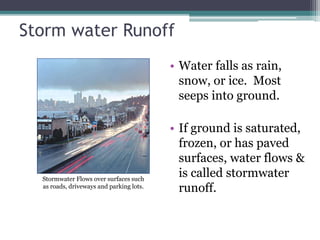
Stormwater Flows over surfaces such
as roads, driveways and parking lots.
Where does Stormwater Go?
• Stormwater flows to
storm drains along
streets.
• It may carry soil, pet
waste, oil, pesticides,
& other pollutants
with it.
• This polluted runoff
goes to streams &
lakes untreated.
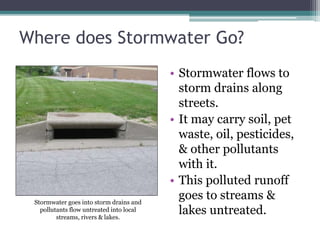
Stormwater goes into storm drains and
pollutants flow untreated into local
streams, rivers & lakes.
Storm Water Inlets
• These are the openings through which the surface
runoff and storm water is admitted and conveyed to
the storm water sewer or combined sewer.
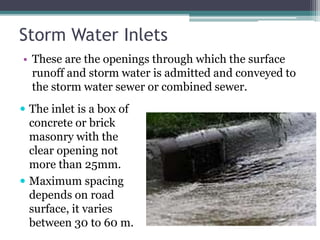
 The inlet is a box of
concrete or brick
masonry with the
clear opening not
more than 25mm.
 Maximum spacing
depends on road
surface, it varies
between 30 to 60 m.
Storm Water Inlets
• Storm water inlets may
be categorised into 3
types:
▫ Curb inlets
▫ Gutter inlets
▫ Composite inlets
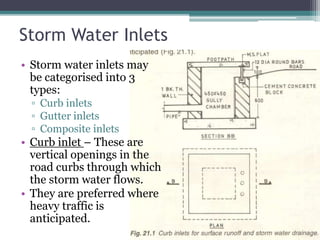
• Curb inlet – These are
vertical openings in the
road curbs through which
the storm water flows.
• They are preferred where
heavy traffic is
anticipated.
Storm Water Inlets
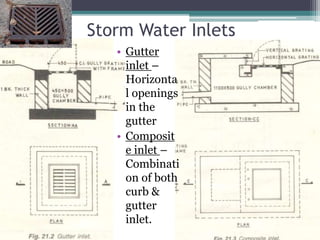
• Gutter
inlet –
Horizonta
l openings
in the
gutter
• Composit
e inlet –
Combinati
on of both
curb &
gutter
inlet.
Surface Drains
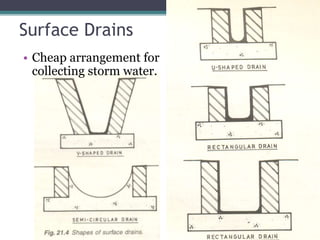
• Cheap arrangement for
collecting storm water.
Regulators
• These are used for preventing overloading of
sewers, pumping stations, treatment plants and
other disposal arrangements.
• Normally used in case of combined sewers and
divert excess storm water to natural stream or
river.
• There are three types of regulators:
▫ Leaping weir
▫ Overflow weir
▫ Siphon spillway
Regulators
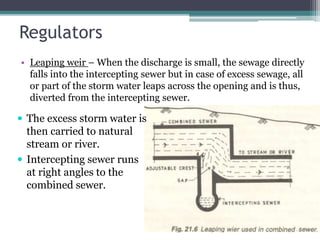
• Leaping weir – When the discharge is small, the sewage directly
falls into the intercepting sewer but in case of excess sewage, all
or part of the storm water leaps across the opening and is thus,
diverted from the intercepting sewer.
 The excess storm water is
then carried to natural
stream or river.
 Intercepting sewer runs
at right angles to the
combined sewer.
Regulators
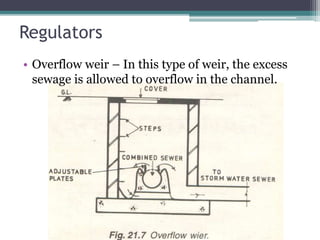
• Overflow weir – In this type of weir, the excess
sewage is allowed to overflow in the channel.
Regulators
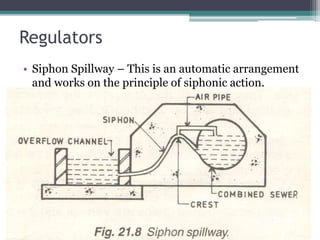
• Siphon Spillway – This is an automatic arrangement
and works on the principle of siphonic action.
Inverted Siphon
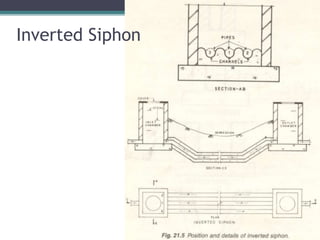
• An inverted siphon is a sewer section which is
constructed below the adjacent sewer sections and
which runs full under gravity with pressure greater
than atmosphere.
• The purpose is to carry the sewer under the
obstruction and regain as much as elevation is
possible after the obstruction is passed.
• As the siphons are depressed below the hydraulic
grade line, self-cleansing velocity is ensured by
providing one pipe for minimum dry weather flow*
and subsequent pipes for the balance flow when the
flow exceeds the minimum.
*DWF = Sanitary Sewage = Sewage from houses, business places, institutions, etc.
Inverted Siphon
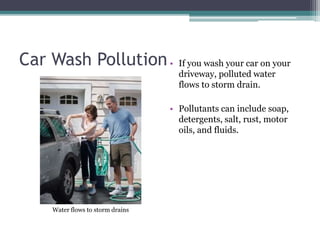
Car Wash Pollution• If you wash your car on your
driveway, polluted water
flows to storm drain.
• Pollutants can include soap,
detergents, salt, rust, motor
oils, and fluids.
Water flows to storm drains
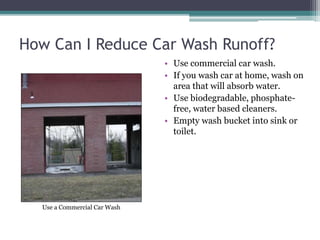
How Can I Reduce Car Wash Runoff?
• Use commercial car wash.
• If you wash car at home, wash on
area that will absorb water.
• Use biodegradable, phosphate-
free, water based cleaners.
• Empty wash bucket into sink or
toilet.
Use a Commercial Car Wash
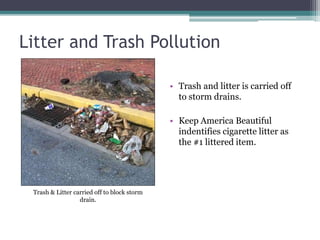
Litter and Trash Pollution
• Trash and litter is carried off
to storm drains.
• Keep America Beautiful
indentifies cigarette litter as
the #1 littered item.
Trash & Litter carried off to block storm
drain.
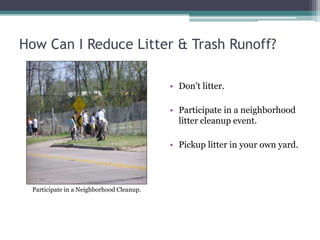
How Can I Reduce Litter & Trash Runoff?
• Don’t litter.
• Participate in a neighborhood
litter cleanup event.
• Pickup litter in your own yard.
Participate in a Neighborhood Cleanup.
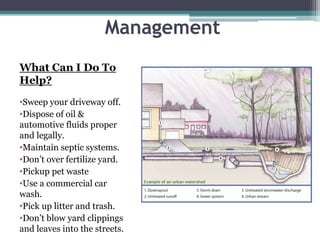
Stormwater Runoff
Management
What Can I Do To
Help?
•Sweep your driveway off.
•Dispose of oil &
automotive fluids proper
and legally.
•Maintain septic systems.
•Don’t over fertilize yard.
•Pickup pet waste
•Use a commercial car
wash.
•Pick up litter and trash.
•Don’t blow yard clippings
and leaves into the streets.
Help Keep our Waterways Cleaner
Wyandotte County Lake

Storm water drainage

  • 1.
  • 2.
    Storm water Runoff •Water falls as rain, snow, or ice. Most seeps into ground. • If ground is saturated, frozen, or has paved surfaces, water flows & is called stormwater runoff. Stormwater Flows over surfaces such as roads, driveways and parking lots.
  • 3.
    Where does StormwaterGo? • Stormwater flows to storm drains along streets. • It may carry soil, pet waste, oil, pesticides, & other pollutants with it. • This polluted runoff goes to streams & lakes untreated. Stormwater goes into storm drains and pollutants flow untreated into local streams, rivers & lakes.
  • 4.
    Storm Water Inlets •These are the openings through which the surface runoff and storm water is admitted and conveyed to the storm water sewer or combined sewer.  The inlet is a box of concrete or brick masonry with the clear opening not more than 25mm.  Maximum spacing depends on road surface, it varies between 30 to 60 m.
  • 5.
    Storm Water Inlets •Storm water inlets may be categorised into 3 types: ▫ Curb inlets ▫ Gutter inlets ▫ Composite inlets • Curb inlet – These are vertical openings in the road curbs through which the storm water flows. • They are preferred where heavy traffic is anticipated.
  • 6.
    Storm Water Inlets •Gutter inlet – Horizonta l openings in the gutter • Composit e inlet – Combinati on of both curb & gutter inlet.
  • 7.
    Surface Drains • Cheaparrangement for collecting storm water.
  • 8.
    Regulators • These areused for preventing overloading of sewers, pumping stations, treatment plants and other disposal arrangements. • Normally used in case of combined sewers and divert excess storm water to natural stream or river. • There are three types of regulators: ▫ Leaping weir ▫ Overflow weir ▫ Siphon spillway
  • 9.
    Regulators • Leaping weir– When the discharge is small, the sewage directly falls into the intercepting sewer but in case of excess sewage, all or part of the storm water leaps across the opening and is thus, diverted from the intercepting sewer.  The excess storm water is then carried to natural stream or river.  Intercepting sewer runs at right angles to the combined sewer.
  • 10.
    Regulators • Overflow weir– In this type of weir, the excess sewage is allowed to overflow in the channel.
  • 11.
    Regulators • Siphon Spillway– This is an automatic arrangement and works on the principle of siphonic action.
  • 12.
    Inverted Siphon • Aninverted siphon is a sewer section which is constructed below the adjacent sewer sections and which runs full under gravity with pressure greater than atmosphere. • The purpose is to carry the sewer under the obstruction and regain as much as elevation is possible after the obstruction is passed. • As the siphons are depressed below the hydraulic grade line, self-cleansing velocity is ensured by providing one pipe for minimum dry weather flow* and subsequent pipes for the balance flow when the flow exceeds the minimum. *DWF = Sanitary Sewage = Sewage from houses, business places, institutions, etc.
  • 13.
  • 14.
    Car Wash Pollution•If you wash your car on your driveway, polluted water flows to storm drain. • Pollutants can include soap, detergents, salt, rust, motor oils, and fluids. Water flows to storm drains
  • 15.
    How Can IReduce Car Wash Runoff? • Use commercial car wash. • If you wash car at home, wash on area that will absorb water. • Use biodegradable, phosphate- free, water based cleaners. • Empty wash bucket into sink or toilet. Use a Commercial Car Wash
  • 16.
    Litter and TrashPollution • Trash and litter is carried off to storm drains. • Keep America Beautiful indentifies cigarette litter as the #1 littered item. Trash & Litter carried off to block storm drain.
  • 17.
    How Can IReduce Litter & Trash Runoff? • Don’t litter. • Participate in a neighborhood litter cleanup event. • Pickup litter in your own yard. Participate in a Neighborhood Cleanup.
  • 18.
    Stormwater Runoff Management What CanI Do To Help? •Sweep your driveway off. •Dispose of oil & automotive fluids proper and legally. •Maintain septic systems. •Don’t over fertilize yard. •Pickup pet waste •Use a commercial car wash. •Pick up litter and trash. •Don’t blow yard clippings and leaves into the streets.
  • 19.
    Help Keep ourWaterways Cleaner Wyandotte County Lake