Massimo Bianchini, Politecnico di Milano
Venanzio Arquilla, Politecnico di Milano
Stefano Maffei, Politecnico di Milano
Alessandro Carelli, Politecnico di Milano
FabLand.
‘Making’ (digital/
analog) distributed
urban production
ecosystems
Fab10, Barcelona, 2-8 July 2014
Could distributed
microproduction be a tool for
territorial development?
STRUCTURE OF THE PRESENTATION
1.  Theoretical premise
2.  3 ongoing case studies
3.  Conclusions and further
developments
THEORETICAL PREMISE
Microproduction is everywhere1
+
Every territory has its own capital2
1 Bianchini, M., Maffei, S. (2013). ‘Microproduction everywhere. Social, local, open and connected
manufacturing’. Social Frontiers NESTA Conference, London, UK, 4th-5th November.
2Villari, B. (2012) Design per il territorio. Un approccio community centred. Francoangeli, Milano.
THEORETICAL PREMISE
Microproduction
is everywhere
{
1.  Systemic openness
2.  Widespread
Interactivity
3.  Community enabling
4.  Fractal organization
5.  Social learning
SYSTEMIC OPENESS
img. source: www.wikihouse.cc
•  Open design
•  Open machines
•  Open materials
•  Open hardware
•  Open knowledge
(open innovation)
WIDESPREAD
INTERACTIVITY
img. source: unfold.be/pages/projects/artisan-electroniqu
•  From tinkering to things
•  From bits to atoms
•  From codes to products
•  From frames to things
•  Interactive making
•  Haptic technologies
COMMUNITY
ENABLING
img. source: www.makerfairerome.eu/en/
•  Micro-networks
•  Alliances
•  Associations
FRACTAL
ORGANIZATION
•  Flat Hierarchies
•  Automorphism
•  Cellular-network
•  Granularity
SOCIAL
LEARNING
source: http://artisansasylum.com
•  Tinkering
•  Learning by using
P2P education
•  Tutorials
THEORETICAL PREMISE
“the territorial capital is the combination of
elements (tangible and intangible)
available to a territory, and which may
represent strengths or necessary conditions
for the valorisation of the territory.”
Villari, B. (2012) Design per il territorio. Un approccio community centred. Francoangeli, Milano.
THEORETICAL PREMISE
5 layers of territorial capital
Source: Villari, B. (2012) Design per il territorio. Un approccio community centred. Francoangeli, Milano.
1 Know How and Identity
2 Human resources and activities
3 Phisical resources
4 Governance
5 External relationship
THEORETICAL PREMISE
what does ‘production’ stand for within
the theoretical framework just outlined?
THEORETICAL PREMISE
what does ‘production’ stand for ?
It shifts from production of value…
(for instance goods, services)
THEORETICAL PREMISE
what does ‘production’ stand for ?
to production as a value
(empowering local communities by enabling them to fabricate
what they exactly need, habilitating social learning processes as
well as give value to the territorial capital.)
img. source: http://fablab.waag.org/	
  
CASE STUDIES
{
•  FARB-
MakeFactory
www.makefactory.org/farb
•  Maker Hub
BRNZ
Upcoming link
•  Make in Progress
www.makeinprogress.org
www.makefactory.org
CASE STUDIES
FARB - MakeFactory
{
•  The relationship
between design and
new production
technologies;
•  The relationship
between design and
new networks of
production.
Make Factory is a research lab which investigates the relationship
between design, making and new models of productions.
CASE STUDIES
Self-Production
the act of designing, prototyping, producing and selling your own designs
in an autonomous way..
img. source: www.dirkvanderkooij.nl	
  
img. source: www.behance.net/gallery/
7420871/MusicInk-Learn-the-Music-Play	
  
CASE STUDIES
Making@PoliMi – A full-immersion production workshop
6 different design team
CASE STUDIES
Making@PoliMi – A full-immersion production workshop
the WS focussed on the realization phase rather than
the concept-generation one;
CASE STUDIES
Making@PoliMi – A full-immersion production workshop
A temporary makerspace within the Design School
connected to the Laboratory System of the Design
Department.
CASE STUDIES
Makerspace BRNZ
img. source: http://analogicodigitale.it/
CASE STUDIES
Makerspace BRNZ
14,3 km
Politecnico
Di Milano
Makerspace
BRNZ
(Cesano MB)
CASE STUDIES
Make in Progress
25,7 km
Politecnico
Di Milano
Make in
Progress
(Sulbiate MB)
CASE STUDIES
Make in Progress
Call for Ideas	
   First workshop	
  
CASE STUDIES
Make in Progress
CASE STUDIES
Make in Progress – Ideas we received (Subiate has 4000
inhabitants)
•  19/34
Were ideas that people would
have liked to create for fun or
passion (not entrepreneurial
ideas);
•  11/34
Were entrepreneurial ideas ;
•  4/34
Were people that had no ideas
to implement (at the moment)
but would much like to
collaborate with us.
{
CONCLUSIONS
•  FARB-MakeFactory
Combining Making + Design, experimenting self-
production, as well as connecting self-producers with
Design Department resources;
•  Maker Hub BRNZ
Connecting local enterprises with innovators;
•  Make in Progress
Bringing back creativity and entrepreneurship into
Sulbiate district.
Production
as a
value
{
1.  Not only economical value
but also cultural, social and
environmental in relation to
the territorial own capital;
2.  Enabling local communities
and activating learning
processes;
3.  Bring together citizen and
local policymakers to define
new policies related to
specific problems.
CONCLUSIONS
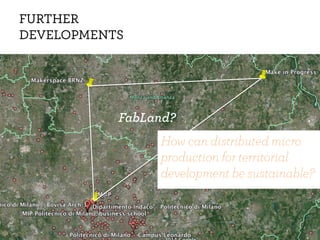
FURTHER
DEVELOPMENTS
FabLand?
How can distributed micro
production for territorial
development be sustainable?
THANKS
Venanzio Arquilla
venanzio.arquilla@polimi.it
Massimo Bianchini
massimo.bianchini@polimi.it
Alessandro Carelli
alessandro.carelli@polimi.it
Stefano Maffei
stefano.maffei@polimi.it
www.makefactory.org

Fab Land - Making digital - analog distributed urban production ecosystem