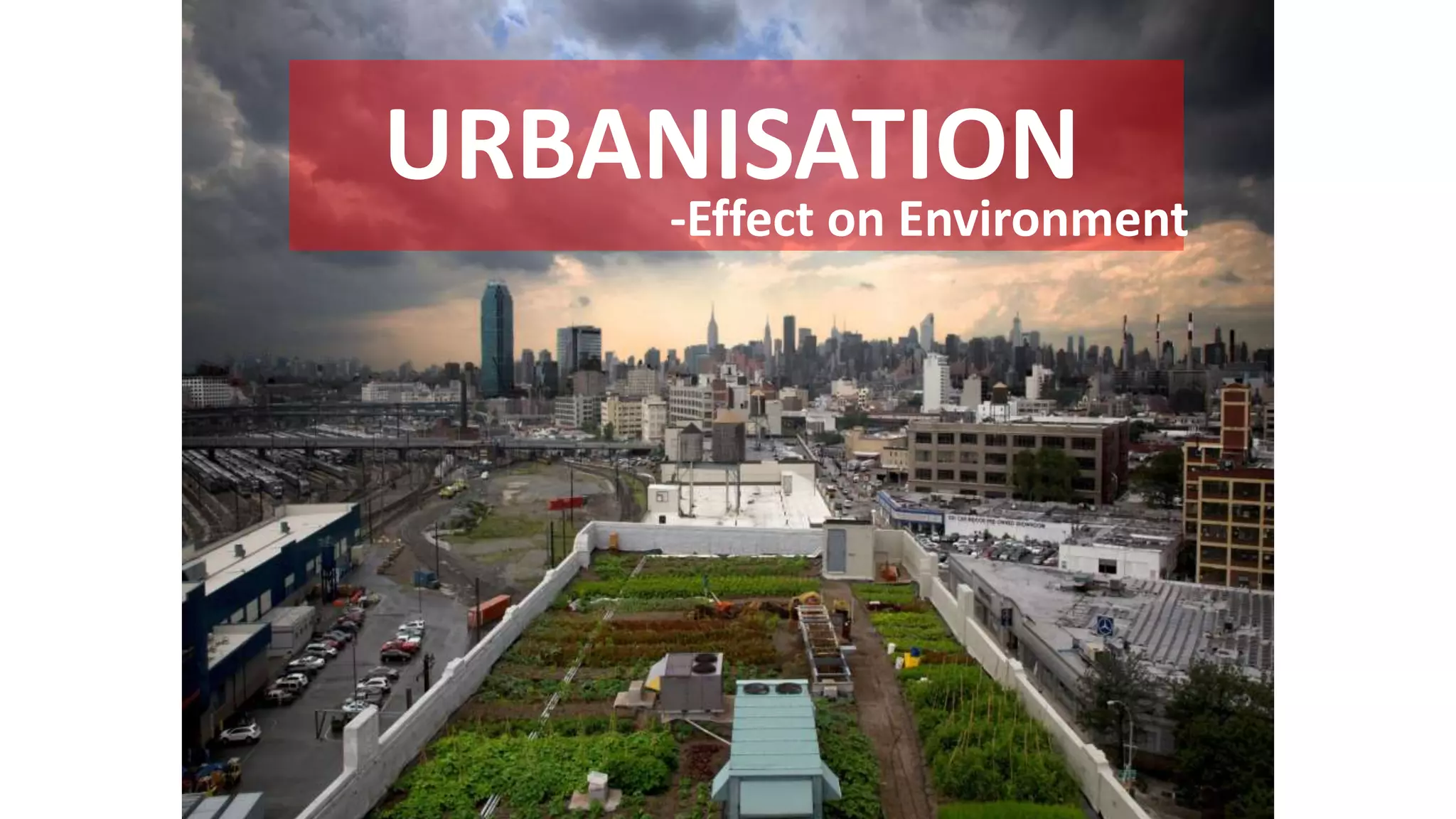
URBANISATION
-Effect on Environment
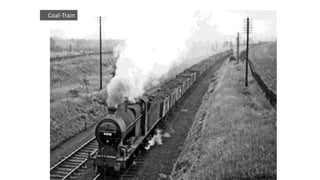
Coal-Train
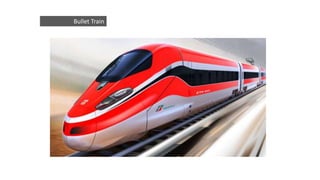
Bullet Train
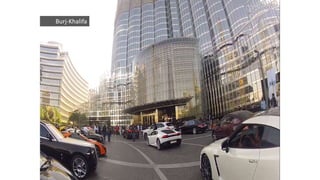
Burj-Khalifa
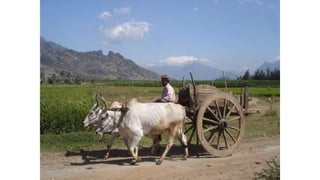
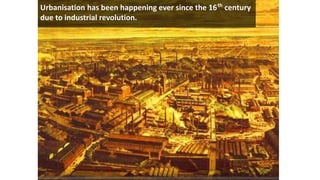
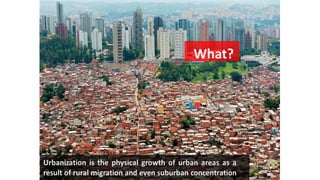
Urbanisation has been happening ever since the 16th
century
due to industrial revolution.
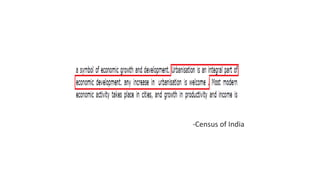
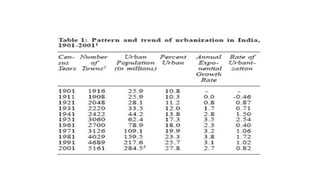
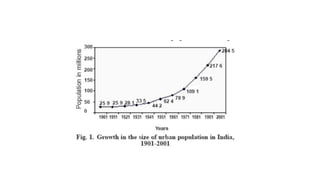
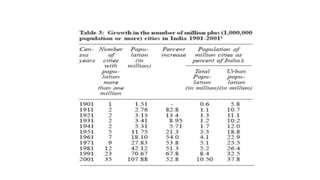
-Census of India
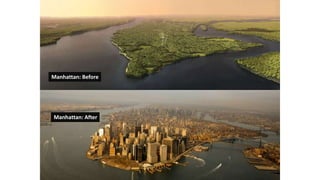
Manhattan: Before
Manhattan: After
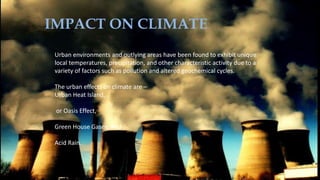
IMPACT ON CLIMATE
Urban environments and outlying areas have been found to exhibit unique
local temperatures, precipitation, and other characteristic activity due to a
variety of factors such as pollution and altered geochemical cycles.
The urban effects on climate are –
Urban Heat Island,
or Oasis Effect,
Green House Gases, And
Acid Rain.
OASIS EFFECT
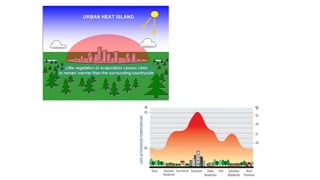
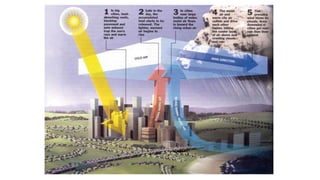
The urban heat island is a phenomenon in which
central regions of urban centres exhibit higher
mean temperatures than surrounding urban
areas.
The reflecting power of a surface, and the
increased surface area of buildings to absorb
solar radiation.
Concrete, cement, and metal surfaces in urban
areas tend to absorb heat energy rather than
reflect it, contributing to higher urban
temperatures.
The heat island effect has corresponding
ecological consequences on resident species.
Cities in desert environments show a different
trend known as the “urban oasis effect”.
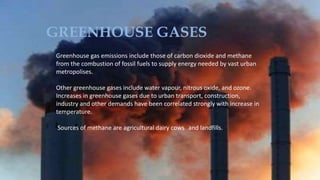
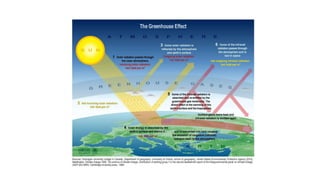
GREENHOUSE GASES
Greenhouse gas emissions include those of carbon dioxide and methane
from the combustion of fossil fuels to supply energy needed by vast urban
metropolises.
Other greenhouse gases include water vapour, nitrous oxide, and ozone.
Increases in greenhouse gases due to urban transport, construction,
industry and other demands have been correlated strongly with increase in
temperature.
Sources of methane are agricultural dairy cows and landfills.
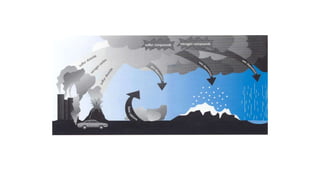
ACID RAIN AND
POLLUTION
Processes related to urban areas result in the emission of numerous
pollutants, which change corresponding nutrient cycles of carbon, sulphur,
nitrogen, and other elements.
Ecosystems in and around the urban centre are especially influenced by
these point sources of pollution.
High sulphur dioxide concentrations resulting from the industrial demands
of urbanization cause rainwater to become more acidic.
Such an effect has been found to have a significant influence on locally
affected populations, especially in aquatic environments.
Wastes from urban centres, especially large urban centres in developed
nations, can drive biogeochemical cycles on a global scale.
Effect of urbanization on lithosphere
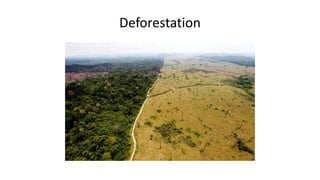
Deforestation
Decrease in agricultural activities
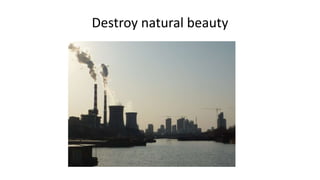
Destroy natural beauty
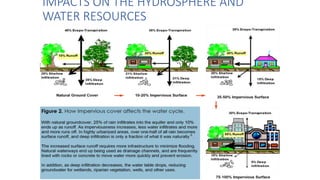
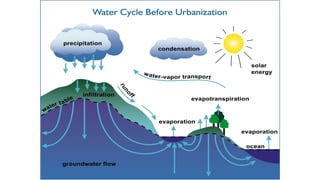
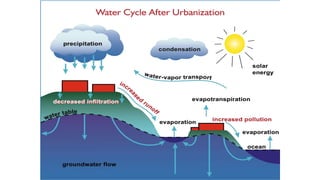
IMPACTS ON THE HYDROSPHERE AND
WATER RESOURCES
1. Flow of Water into
Streams
•Natural vegetation and undisturbed soil
are replaced with concrete, asphalt,
brick, and other impermeable surfaces.
This means that, when it rains, water is
less likely to be absorbed into the
ground and, instead, flows directly into
river channels.
2. Flow of Water through
Streams
•Higher, faster peak flows change
streams channels that have evolved
over centuries under natural conditions.
Flooding can be a major problem as
cities grow and stream channels
attempt to keep up with these changes.
3. Degraded Water
Quality
•The water quality has degraded with
time due to urbanization that ultimately
leads to increased sedimentation there
by also increasing the pollutant in run-
off.
What?
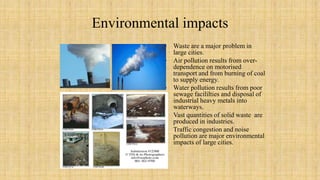
Environmental impacts
• Waste are a major problem in
large cities.
• Air pollution results from over-
dependence on motorised
transport and from burning of coal
to supply energy.
• Water pollution results from poor
sewage facililties and disposal of
industrial heavy metals into
waterways.
• Vast quantities of solid waste are
produced in industries.
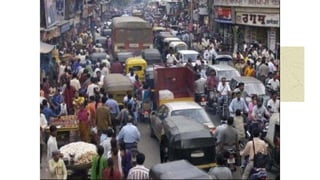
• Traffic congestion and noise
pollution are major environmental
impacts of large cities.
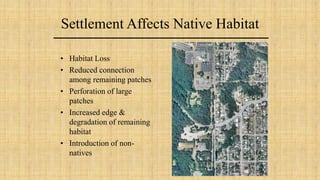
Settlement Affects Native Habitat
• Habitat Loss
• Reduced connection
among remaining patches
• Perforation of large
patches
• Increased edge &
degradation of remaining
habitat
• Introduction of non-
natives
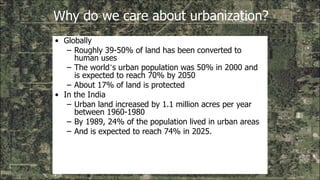
Why do we care about urbanization?
• Globally
– Roughly 39-50% of land has been converted to
human uses
– The world’s urban population was 50% in 2000 and
is expected to reach 70% by 2050
– About 17% of land is protected
• In the India
– Urban land increased by 1.1 million acres per year
between 1960-1980
– By 1989, 24% of the population lived in urban areas
– And is expected to reach 74% in 2025.
Start-up India Event
21/01/16
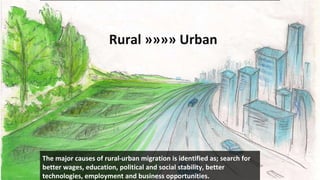
The major causes of rural-urban migration is identified as; search for
better wages, education, political and social stability, better
technologies, employment and business opportunities.
Rural »»»» Urban
21/01/16
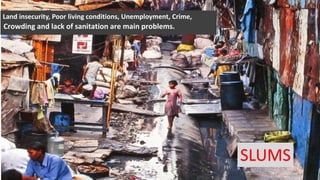
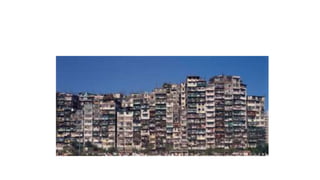
SLUMS
Land insecurity, Poor living conditions, Unemployment, Crime,
Crowding and lack of sanitation are main problems.
21/01/16
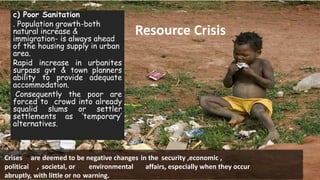
Resource Crisis
Crises are deemed to be negative changes in the security ,economic ,
political , societal, or environmental affairs, especially when they occur
abruptly, with little or no warning.
c) Poor Sanitation
. Population growth-both
natural increase &
immigration- is always ahead
of the housing supply in urban
area.
Rapid increase in urbanites
surpass gvt & town planners
ability to provide adequate
accommodation.
Consequently the poor are
forced to crowd into already
squalid slums or settler
settlements as ‘temporary’
alternatives.
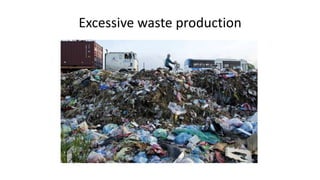
Excessive waste production
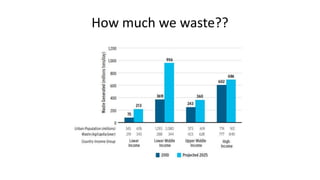
How much we waste??
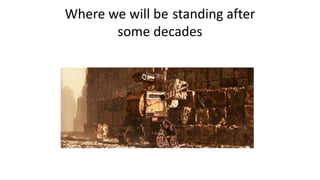
Where we will be standing after
some decades
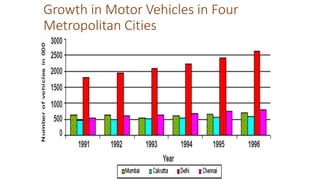
Growth in motor vehicles in India
and in Metropolitan Cities:
• Within 10 years from 1990 to 2000 there has been
almost a three-
fold increase in the number motor vehicles in India.
On an average
10% increase has been found in each year, which is
a serious concern
for air pollution.
Growth in Motor Vehicles in Four
Metropolitan Cities
in India
21/01/16
IMPACTS ON THE BIOSPHERE
1. Modification of Habitats The fertilizers that spread across lawns finds its way
into water channels where it promotes the growth of plants at the expense of
fish. The waste dumped into streams lowers oxygen levels during its decay and
cause the die-off of plants and animals.
2. Destruction of Habitats There is also complete eradication of habitats as an
outcome of urbanization and native species are pushed out of cities.
3. Creation of New Habitats New habitats are also created for some native and
non-native species. Cities also create habitats for some species considered pests,
such as pigeons, sparrows, rats, mice, flies and mosquitoes. Urbanization has,
for example, eliminated many bat colonies in caves, but has provided sites such
as bridges for these species to nest
21/01/16
Conclusion:
21/01/16
One’s own responsibility
There are two primary choices in life: to accept conditions as
they exist, or accept the responsibility for changing them.
21/01/16
Sources:
1. Census of India 2001, Population Projections for India and States 2001, Report of the Technical Group on
Population Projections Constituted by the National Commission on Population.
2. Mohan R.: Urbanisation in India: Patterns and Emerging Policy Issues in The Urban Transformation of the
Developing World. Josef Gugler (Ed.). Oxford University Press, Oxford (1996).
3. MoRTH, 2000. Motor Transport Statistics of India. Transport Research Wing, Ministry of Road Transport
and Highways,Government of India, New Delhi.
4. Sunil Kumar , J.K. Bhattacharyya, A.N. Vaidya, Tapan Chakrabarti, Sukumar Devotta, A.B. Akolkar ,
Assessment of the status of municipal solid waste management in metro cities, state capitals, class I cities,
and class II towns in India: An insight , Waste Management 29 (2009) 883–895.
5. United Nations Environment Programme, 1999 Annual Evaluation Report, Evaluation and Oversight unit,
August 1999.
6. World Resources, A guide to the global environment, The urban environment, 199697
21/01/16

Urbanization

  • 1.
  • 3.
  • 4.
  • 5.
  • 6.
    Urbanisation has beenhappening ever since the 16th century due to industrial revolution.
  • 8.
  • 11.
  • 12.
    IMPACT ON CLIMATE Urbanenvironments and outlying areas have been found to exhibit unique local temperatures, precipitation, and other characteristic activity due to a variety of factors such as pollution and altered geochemical cycles. The urban effects on climate are – Urban Heat Island, or Oasis Effect, Green House Gases, And Acid Rain.
  • 13.
    OASIS EFFECT The urbanheat island is a phenomenon in which central regions of urban centres exhibit higher mean temperatures than surrounding urban areas. The reflecting power of a surface, and the increased surface area of buildings to absorb solar radiation. Concrete, cement, and metal surfaces in urban areas tend to absorb heat energy rather than reflect it, contributing to higher urban temperatures. The heat island effect has corresponding ecological consequences on resident species. Cities in desert environments show a different trend known as the “urban oasis effect”.
  • 15.
    GREENHOUSE GASES Greenhouse gasemissions include those of carbon dioxide and methane from the combustion of fossil fuels to supply energy needed by vast urban metropolises. Other greenhouse gases include water vapour, nitrous oxide, and ozone. Increases in greenhouse gases due to urban transport, construction, industry and other demands have been correlated strongly with increase in temperature. Sources of methane are agricultural dairy cows and landfills.
  • 18.
    ACID RAIN AND POLLUTION Processesrelated to urban areas result in the emission of numerous pollutants, which change corresponding nutrient cycles of carbon, sulphur, nitrogen, and other elements. Ecosystems in and around the urban centre are especially influenced by these point sources of pollution. High sulphur dioxide concentrations resulting from the industrial demands of urbanization cause rainwater to become more acidic. Such an effect has been found to have a significant influence on locally affected populations, especially in aquatic environments. Wastes from urban centres, especially large urban centres in developed nations, can drive biogeochemical cycles on a global scale.
  • 20.
    Effect of urbanizationon lithosphere
  • 21.
  • 22.
  • 23.
  • 24.
    IMPACTS ON THEHYDROSPHERE AND WATER RESOURCES
  • 25.
    1. Flow ofWater into Streams •Natural vegetation and undisturbed soil are replaced with concrete, asphalt, brick, and other impermeable surfaces. This means that, when it rains, water is less likely to be absorbed into the ground and, instead, flows directly into river channels.
  • 26.
    2. Flow ofWater through Streams •Higher, faster peak flows change streams channels that have evolved over centuries under natural conditions. Flooding can be a major problem as cities grow and stream channels attempt to keep up with these changes.
  • 27.
    3. Degraded Water Quality •Thewater quality has degraded with time due to urbanization that ultimately leads to increased sedimentation there by also increasing the pollutant in run- off.
  • 30.
  • 31.
    Environmental impacts • Wasteare a major problem in large cities. • Air pollution results from over- dependence on motorised transport and from burning of coal to supply energy. • Water pollution results from poor sewage facililties and disposal of industrial heavy metals into waterways. • Vast quantities of solid waste are produced in industries. • Traffic congestion and noise pollution are major environmental impacts of large cities.
  • 32.
    Settlement Affects NativeHabitat • Habitat Loss • Reduced connection among remaining patches • Perforation of large patches • Increased edge & degradation of remaining habitat • Introduction of non- natives
  • 33.
    Why do wecare about urbanization? • Globally – Roughly 39-50% of land has been converted to human uses – The world’s urban population was 50% in 2000 and is expected to reach 70% by 2050 – About 17% of land is protected • In the India – Urban land increased by 1.1 million acres per year between 1960-1980 – By 1989, 24% of the population lived in urban areas – And is expected to reach 74% in 2025.
  • 41.
  • 43.
    21/01/16 The major causesof rural-urban migration is identified as; search for better wages, education, political and social stability, better technologies, employment and business opportunities. Rural »»»» Urban
  • 44.
    21/01/16 SLUMS Land insecurity, Poorliving conditions, Unemployment, Crime, Crowding and lack of sanitation are main problems.
  • 45.
    21/01/16 Resource Crisis Crises aredeemed to be negative changes in the security ,economic , political , societal, or environmental affairs, especially when they occur abruptly, with little or no warning. c) Poor Sanitation . Population growth-both natural increase & immigration- is always ahead of the housing supply in urban area. Rapid increase in urbanites surpass gvt & town planners ability to provide adequate accommodation. Consequently the poor are forced to crowd into already squalid slums or settler settlements as ‘temporary’ alternatives.
  • 46.
  • 47.
    How much wewaste??
  • 48.
    Where we willbe standing after some decades
  • 49.
    Growth in motorvehicles in India and in Metropolitan Cities: • Within 10 years from 1990 to 2000 there has been almost a three- fold increase in the number motor vehicles in India. On an average 10% increase has been found in each year, which is a serious concern for air pollution.
  • 51.
    Growth in MotorVehicles in Four Metropolitan Cities in India
  • 52.
  • 53.
    IMPACTS ON THEBIOSPHERE 1. Modification of Habitats The fertilizers that spread across lawns finds its way into water channels where it promotes the growth of plants at the expense of fish. The waste dumped into streams lowers oxygen levels during its decay and cause the die-off of plants and animals. 2. Destruction of Habitats There is also complete eradication of habitats as an outcome of urbanization and native species are pushed out of cities. 3. Creation of New Habitats New habitats are also created for some native and non-native species. Cities also create habitats for some species considered pests, such as pigeons, sparrows, rats, mice, flies and mosquitoes. Urbanization has, for example, eliminated many bat colonies in caves, but has provided sites such as bridges for these species to nest 21/01/16
  • 54.
    Conclusion: 21/01/16 One’s own responsibility Thereare two primary choices in life: to accept conditions as they exist, or accept the responsibility for changing them.
  • 55.
  • 56.
    Sources: 1. Census ofIndia 2001, Population Projections for India and States 2001, Report of the Technical Group on Population Projections Constituted by the National Commission on Population. 2. Mohan R.: Urbanisation in India: Patterns and Emerging Policy Issues in The Urban Transformation of the Developing World. Josef Gugler (Ed.). Oxford University Press, Oxford (1996). 3. MoRTH, 2000. Motor Transport Statistics of India. Transport Research Wing, Ministry of Road Transport and Highways,Government of India, New Delhi. 4. Sunil Kumar , J.K. Bhattacharyya, A.N. Vaidya, Tapan Chakrabarti, Sukumar Devotta, A.B. Akolkar , Assessment of the status of municipal solid waste management in metro cities, state capitals, class I cities, and class II towns in India: An insight , Waste Management 29 (2009) 883–895. 5. United Nations Environment Programme, 1999 Annual Evaluation Report, Evaluation and Oversight unit, August 1999. 6. World Resources, A guide to the global environment, The urban environment, 199697 21/01/16