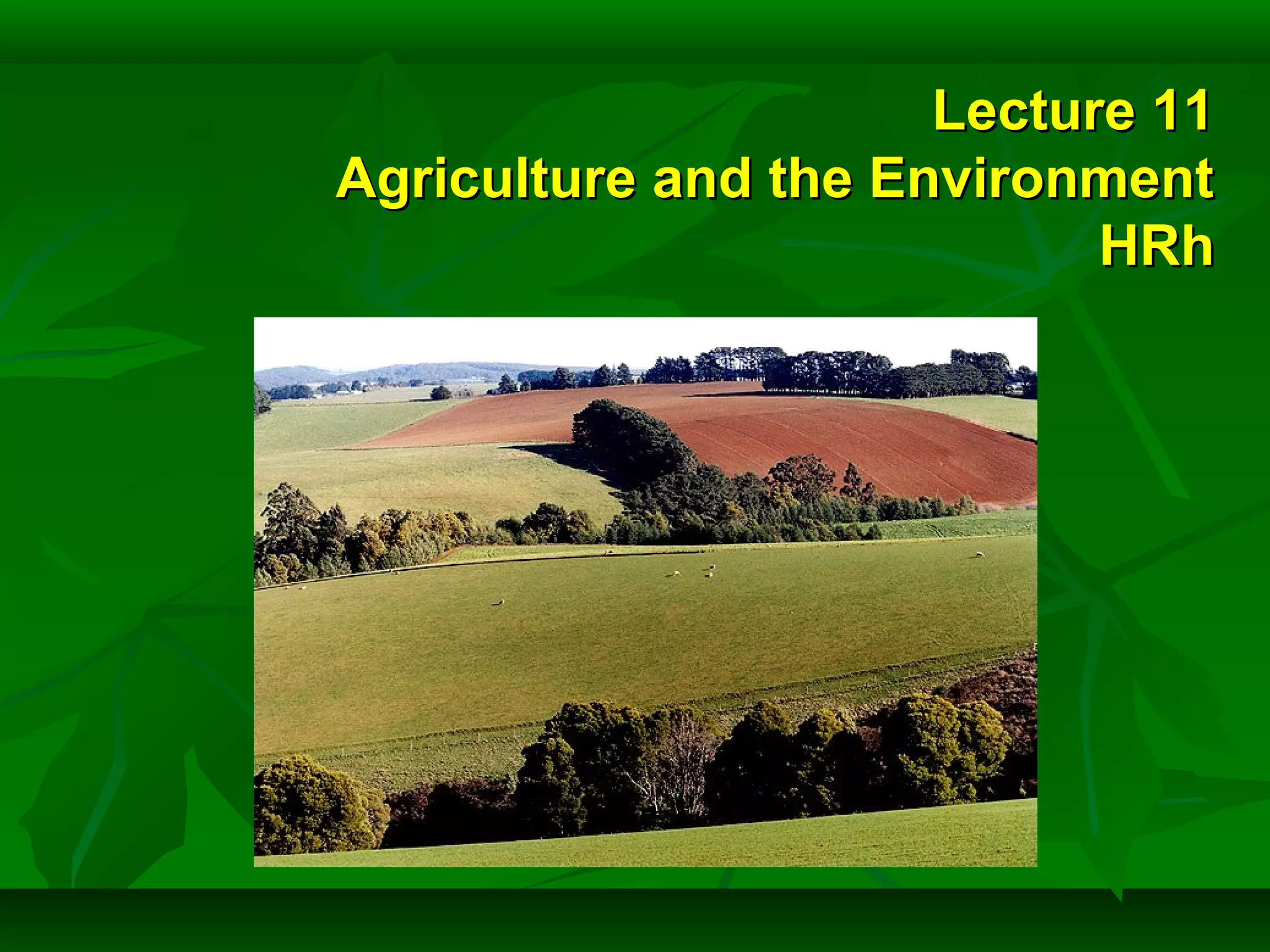
Lecture 11Lecture 11
Agriculture and the EnvironmentAgriculture and the Environment
HRhHRh
Agriculture and the EnvironmentAgriculture and the Environment
 95% of human population’s protein & most of its calories are95% of human population’s protein & most of its calories are
obtained from traditional land-based agriculture of crops andobtained from traditional land-based agriculture of crops and
livestocklivestock
CropsCrops
 World’s food is provided by only 14 crop speciesWorld’s food is provided by only 14 crop species
 Six cropsSix crops provide >80% of the total caloriesprovide >80% of the total calories
Types of CropsTypes of Crops
 Cash cropsCash crops– grown to be sold or traded, e.g. jute– grown to be sold or traded, e.g. jute
 Subsistence cropsSubsistence crops– used directly for food by the farmer or– used directly for food by the farmer or
sold locally, e.g., ricesold locally, e.g., rice
Seasonal crops of BangladeshSeasonal crops of Bangladesh
 Mainly two seasonsMainly two seasons–– Rabi and KharifRabi and Kharif
 Kharif – Kharif 1 & Kharif 2Kharif – Kharif 1 & Kharif 2
 Overlapping occursOverlapping occurs
 Many are grown in all seasonsMany are grown in all seasons
 Crops are dividedCrops are divided into cereals, pulses, fiber crops, oil seeds,into cereals, pulses, fiber crops, oil seeds,
root crops, vegetables, spice crops, fruit cropsroot crops, vegetables, spice crops, fruit crops
 Rice and maize are grown in all seasons whereas wheat isRice and maize are grown in all seasons whereas wheat is
grown in Rabi season (rainfed & irrigated), barley & kaon ingrown in Rabi season (rainfed & irrigated), barley & kaon in
Rabi seasonRabi season
 Lentil, khesari, chickpea, balckgram all pulses grown in RabiLentil, khesari, chickpea, balckgram all pulses grown in Rabi
seasonseason
 Mungbean, another pulse crop grown in both Rabi & KharifMungbean, another pulse crop grown in both Rabi & Kharif
seasonsseasons
SoilSoil
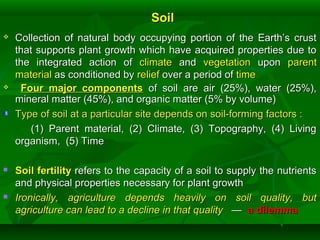
 Collection of natural body occupying portion of the Earth’s crustCollection of natural body occupying portion of the Earth’s crust
that supports plant growth which have acquired properties due tothat supports plant growth which have acquired properties due to
the integrated action ofthe integrated action of climateclimate andand vegetationvegetation uponupon parentparent
materialmaterial as conditioned byas conditioned by reliefrelief over a period ofover a period of timetime
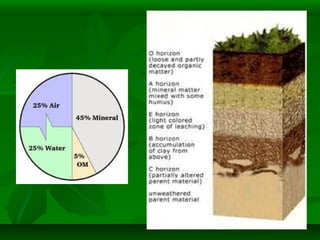
 Four major componentsFour major components of soil are air (25%), water (25%),of soil are air (25%), water (25%),
mineral matter (45%), and organic matter (5% by volume)mineral matter (45%), and organic matter (5% by volume)
Type of soil at a particular site depends on soil-forming factors :Type of soil at a particular site depends on soil-forming factors :
(1) Parent material, (2) Climate, (3) Topography, (4) Living(1) Parent material, (2) Climate, (3) Topography, (4) Living
organism, (5) Timeorganism, (5) Time
 Soil fertilitySoil fertility refers to the capacity of a soil to supply the nutrientsrefers to the capacity of a soil to supply the nutrients
and physical properties necessary for plant growthand physical properties necessary for plant growth
 Ironically, agriculture depends heavily on soil quality, butIronically, agriculture depends heavily on soil quality, but
agriculture can lead to a decline in that qualityagriculture can lead to a decline in that quality —— a dilemmaa dilemma
SoilSoil
 AA high-quality soil hashigh-quality soil has all the nutrient elements, a physical structureall the nutrient elements, a physical structure
conducive to plant growth, and high organic matter contentconducive to plant growth, and high organic matter content
Organic matter includes dead, partially or completely decomposedOrganic matter includes dead, partially or completely decomposed
crop or plant and animal remains, forest litter, leaves, twigs, etccrop or plant and animal remains, forest litter, leaves, twigs, etc
OM is theOM is the store housestore house of nutrients and pof nutrients and providesrovides good structuregood structure
Good structure isGood structure is keykey to soil fertilityto soil fertility
When original vegetation is cleared, soil becomes exposed to moreWhen original vegetation is cleared, soil becomes exposed to more
sunshine and oxidation resultssunshine and oxidation results
RapidRapid oxidationoxidation results decline in OMresults decline in OM
Soil begins toSoil begins to lose fertilitylose fertility
Soils also lose fertility through surface and subsurfaceSoils also lose fertility through surface and subsurface runoff ofrunoff of
dissolved nutrientsdissolved nutrients
Loss of fertility isLoss of fertility is fasterfaster in warmer & wetter climates than it is in colderin warmer & wetter climates than it is in colder
or drier climatesor drier climates
Soil Plowing & ErosionSoil Plowing & Erosion
 PlowingPlowing is the shattering soil uniformly with partial tois the shattering soil uniformly with partial to
complete inversioncomplete inversion
 Plowing opens the soil toPlowing opens the soil to erosionerosion even more than removal ofeven more than removal of
the original vegetationthe original vegetation
 ErosionErosion is the wearing away and transportation of landis the wearing away and transportation of land
surface by running water, wind, ice, or other natural agentssurface by running water, wind, ice, or other natural agents
 Soil loosened by plowing can blow bySoil loosened by plowing can blow by windwind when dry & washwhen dry & wash
away withaway with rain waterrain water
 Plowed lands loose upper layers containing thePlowed lands loose upper layers containing the most fertilemost fertile
organic matterorganic matter
 The less OM present in the soil, theThe less OM present in the soil, the more vulnerablemore vulnerable the soilthe soil
isis toto furtherfurther erosionerosion
 Once erosion starts, the process can easily accelerateOnce erosion starts, the process can easily accelerate
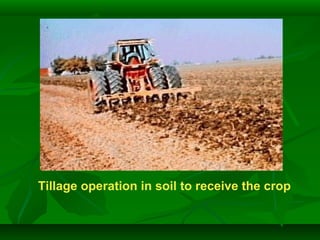
Tillage operation in soil to receive the crop
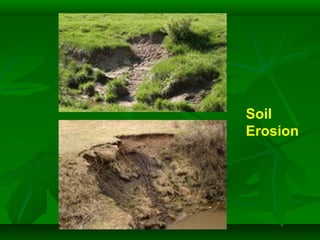
Soil
Erosion
Soil Plowing & ErosionSoil Plowing & Erosion
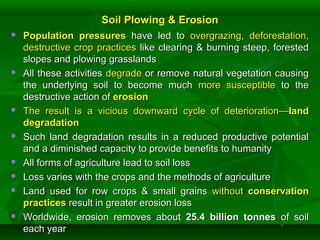
 Population pressuresPopulation pressures have led tohave led to overgrazingovergrazing,, deforestation,deforestation,
destructive crop practicesdestructive crop practices like clearing & burning steep, forestedlike clearing & burning steep, forested
slopes and plowing grasslandsslopes and plowing grasslands
 All these activitiesAll these activities degradedegrade or remove natural vegetation causingor remove natural vegetation causing
the underlying soil to become muchthe underlying soil to become much more susceptiblemore susceptible to theto the
destructive action ofdestructive action of erosionerosion
 The result is a vicious downward cycle of deterioration—The result is a vicious downward cycle of deterioration—landland
degradationdegradation
 Such land degradation results in a reduced productive potentialSuch land degradation results in a reduced productive potential
and a diminished capacity to provide benefits to humanityand a diminished capacity to provide benefits to humanity
 All forms of agriculture lead to soil lossAll forms of agriculture lead to soil loss
 Loss varies with the crops and the methods of agricultureLoss varies with the crops and the methods of agriculture
 Land used for row crops & small grainsLand used for row crops & small grains withoutwithout conservationconservation
practicespractices result in greater erosion lossresult in greater erosion loss
 Worldwide, erosion removes aboutWorldwide, erosion removes about 25.4 billion tonnes25.4 billion tonnes of soilof soil
each yeareach year
Sediment DamageSediment Damage
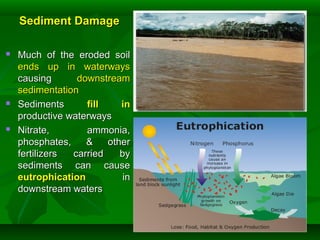
 Much of the eroded soilMuch of the eroded soil
ends up in waterwaysends up in waterways
causingcausing downstreamdownstream
sedimentationsedimentation
 SedimentsSediments fill infill in
productive waterwaysproductive waterways
 Nitrate, ammonia,Nitrate, ammonia,
phosphates, & otherphosphates, & other
fertilizers carried byfertilizers carried by
sediments can causesediments can cause
eutrophicationeutrophication inin
downstream watersdownstream waters
Making Soils Sustainable: Contour PlowingMaking Soils Sustainable: Contour Plowing
 With good management soil is continuously formed at the rate ofWith good management soil is continuously formed at the rate of
1 mm/yr1 mm/yr
 Ideal farming would result in soil loss no greater than theIdeal farming would result in soil loss no greater than the
formation of new soilformation of new soil
 One way to counter soil erosion is toOne way to counter soil erosion is to promote new soil formationpromote new soil formation
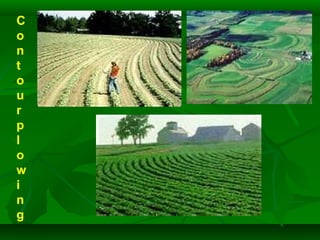
 Another way to counter erosion from plowing isAnother way to counter erosion from plowing is contour plowingcontour plowing
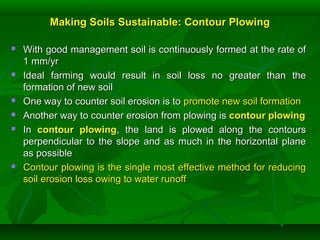
 InIn contour plowingcontour plowing, the land is plowed along the contours, the land is plowed along the contours
perpendicular to the slope and as much in the horizontal planeperpendicular to the slope and as much in the horizontal plane
as possibleas possible
 Contour plowing is the single most effective method for reducingContour plowing is the single most effective method for reducing
soil erosion loss owing to water runoffsoil erosion loss owing to water runoff
C
o
n
t
o
u
r
p
l
o
w
i
n
g
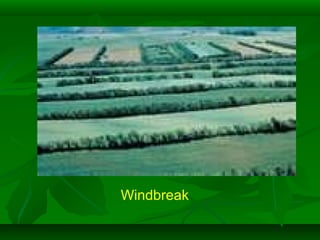
Windbreak
Making Soils Sustainable: Mixed, Strip, Terracing,Making Soils Sustainable: Mixed, Strip, Terracing,
Rotation, No-till agricultureRotation, No-till agriculture
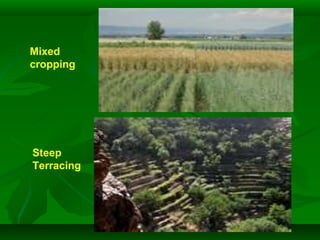
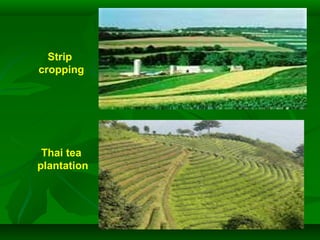
 Other practicesOther practices that can aid in the sustainability of soils includethat can aid in the sustainability of soils include
mixed cropping, strip cropping, terracing, crop rotationmixed cropping, strip cropping, terracing, crop rotation
 An evenAn even more efficient techniquemore efficient technique to slow erosion isto slow erosion is to avoidto avoid
plowingplowing altogetheraltogether
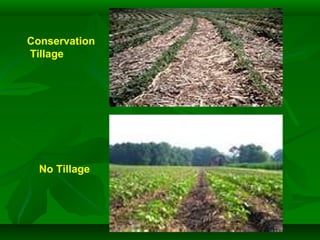
 No –till agriculture or conservation tillageNo –till agriculture or conservation tillage is a recent form ofis a recent form of
combination of farming practices that includescombination of farming practices that includes not plowingnot plowing thethe
land, usingland, using herbicidesherbicides to keep down the weedsto keep down the weeds
 InIn no-tillno-till agriculture the land is leftagriculture the land is left unplowedunplowed most yearsmost years
Mixed
cropping
Steep
Terracing
Strip
cropping
Thai tea
plantation
Conservation
Tillage
No Tillage
Mulch Tillage/Conservation tillageMulch Tillage/Conservation tillage
 In mulch tillageIn mulch tillage plant residues or other materials are left toplant residues or other materials are left to
cover the surface and allowed to decay in placecover the surface and allowed to decay in place
 Besides soil conservation, conservation tillageBesides soil conservation, conservation tillage suppresses &suppresses &
controls the weedscontrols the weeds
 These practices greatlyThese practices greatly
(a)(a) reduce soil & water lossreduce soil & water loss
(b)(b) reduce traffic operations over the fieldreduce traffic operations over the field
(c)(c) reduce the use of fuelreduce the use of fuel
(d)(d) reduce soil compactionreduce soil compaction
(e)(e) increase profitincrease profit
Approach to Sustainable AgricultureApproach to Sustainable Agriculture
 Population pressuresPopulation pressures & the& the availability of arable landavailability of arable land are theare the
most important factors determining sustainability ofmost important factors determining sustainability of
agricultureagriculture
 Maintenance and management of soil fertility is central to theMaintenance and management of soil fertility is central to the
development of sustainable food production systemsdevelopment of sustainable food production systems
 The wisest approach to sustainable agriculture involvesThe wisest approach to sustainable agriculture involves
a combination of different kinds of land use asa combination of different kinds of land use as
 Use best agricultural lands for cropsUse best agricultural lands for crops
 Poorer lands for pastures and rangelandsPoorer lands for pastures and rangelands
 Avoid using best lands for grain production for animal feedAvoid using best lands for grain production for animal feed
End of SlidesEnd of Slides
Thank youThank you

L 11 agriculture & environment

  • 1.
    Lecture 11Lecture 11 Agricultureand the EnvironmentAgriculture and the Environment HRhHRh
  • 2.
    Agriculture and theEnvironmentAgriculture and the Environment  95% of human population’s protein & most of its calories are95% of human population’s protein & most of its calories are obtained from traditional land-based agriculture of crops andobtained from traditional land-based agriculture of crops and livestocklivestock CropsCrops  World’s food is provided by only 14 crop speciesWorld’s food is provided by only 14 crop species  Six cropsSix crops provide >80% of the total caloriesprovide >80% of the total calories Types of CropsTypes of Crops  Cash cropsCash crops– grown to be sold or traded, e.g. jute– grown to be sold or traded, e.g. jute  Subsistence cropsSubsistence crops– used directly for food by the farmer or– used directly for food by the farmer or sold locally, e.g., ricesold locally, e.g., rice
  • 3.
    Seasonal crops ofBangladeshSeasonal crops of Bangladesh  Mainly two seasonsMainly two seasons–– Rabi and KharifRabi and Kharif  Kharif – Kharif 1 & Kharif 2Kharif – Kharif 1 & Kharif 2  Overlapping occursOverlapping occurs  Many are grown in all seasonsMany are grown in all seasons  Crops are dividedCrops are divided into cereals, pulses, fiber crops, oil seeds,into cereals, pulses, fiber crops, oil seeds, root crops, vegetables, spice crops, fruit cropsroot crops, vegetables, spice crops, fruit crops  Rice and maize are grown in all seasons whereas wheat isRice and maize are grown in all seasons whereas wheat is grown in Rabi season (rainfed & irrigated), barley & kaon ingrown in Rabi season (rainfed & irrigated), barley & kaon in Rabi seasonRabi season  Lentil, khesari, chickpea, balckgram all pulses grown in RabiLentil, khesari, chickpea, balckgram all pulses grown in Rabi seasonseason  Mungbean, another pulse crop grown in both Rabi & KharifMungbean, another pulse crop grown in both Rabi & Kharif seasonsseasons
  • 4.
    SoilSoil  Collection ofnatural body occupying portion of the Earth’s crustCollection of natural body occupying portion of the Earth’s crust that supports plant growth which have acquired properties due tothat supports plant growth which have acquired properties due to the integrated action ofthe integrated action of climateclimate andand vegetationvegetation uponupon parentparent materialmaterial as conditioned byas conditioned by reliefrelief over a period ofover a period of timetime  Four major componentsFour major components of soil are air (25%), water (25%),of soil are air (25%), water (25%), mineral matter (45%), and organic matter (5% by volume)mineral matter (45%), and organic matter (5% by volume) Type of soil at a particular site depends on soil-forming factors :Type of soil at a particular site depends on soil-forming factors : (1) Parent material, (2) Climate, (3) Topography, (4) Living(1) Parent material, (2) Climate, (3) Topography, (4) Living organism, (5) Timeorganism, (5) Time  Soil fertilitySoil fertility refers to the capacity of a soil to supply the nutrientsrefers to the capacity of a soil to supply the nutrients and physical properties necessary for plant growthand physical properties necessary for plant growth  Ironically, agriculture depends heavily on soil quality, butIronically, agriculture depends heavily on soil quality, but agriculture can lead to a decline in that qualityagriculture can lead to a decline in that quality —— a dilemmaa dilemma
  • 6.
    SoilSoil  AA high-qualitysoil hashigh-quality soil has all the nutrient elements, a physical structureall the nutrient elements, a physical structure conducive to plant growth, and high organic matter contentconducive to plant growth, and high organic matter content Organic matter includes dead, partially or completely decomposedOrganic matter includes dead, partially or completely decomposed crop or plant and animal remains, forest litter, leaves, twigs, etccrop or plant and animal remains, forest litter, leaves, twigs, etc OM is theOM is the store housestore house of nutrients and pof nutrients and providesrovides good structuregood structure Good structure isGood structure is keykey to soil fertilityto soil fertility When original vegetation is cleared, soil becomes exposed to moreWhen original vegetation is cleared, soil becomes exposed to more sunshine and oxidation resultssunshine and oxidation results RapidRapid oxidationoxidation results decline in OMresults decline in OM Soil begins toSoil begins to lose fertilitylose fertility Soils also lose fertility through surface and subsurfaceSoils also lose fertility through surface and subsurface runoff ofrunoff of dissolved nutrientsdissolved nutrients Loss of fertility isLoss of fertility is fasterfaster in warmer & wetter climates than it is in colderin warmer & wetter climates than it is in colder or drier climatesor drier climates
  • 7.
    Soil Plowing &ErosionSoil Plowing & Erosion  PlowingPlowing is the shattering soil uniformly with partial tois the shattering soil uniformly with partial to complete inversioncomplete inversion  Plowing opens the soil toPlowing opens the soil to erosionerosion even more than removal ofeven more than removal of the original vegetationthe original vegetation  ErosionErosion is the wearing away and transportation of landis the wearing away and transportation of land surface by running water, wind, ice, or other natural agentssurface by running water, wind, ice, or other natural agents  Soil loosened by plowing can blow bySoil loosened by plowing can blow by windwind when dry & washwhen dry & wash away withaway with rain waterrain water  Plowed lands loose upper layers containing thePlowed lands loose upper layers containing the most fertilemost fertile organic matterorganic matter  The less OM present in the soil, theThe less OM present in the soil, the more vulnerablemore vulnerable the soilthe soil isis toto furtherfurther erosionerosion  Once erosion starts, the process can easily accelerateOnce erosion starts, the process can easily accelerate
  • 8.
    Tillage operation insoil to receive the crop
  • 9.
  • 10.
    Soil Plowing &ErosionSoil Plowing & Erosion  Population pressuresPopulation pressures have led tohave led to overgrazingovergrazing,, deforestation,deforestation, destructive crop practicesdestructive crop practices like clearing & burning steep, forestedlike clearing & burning steep, forested slopes and plowing grasslandsslopes and plowing grasslands  All these activitiesAll these activities degradedegrade or remove natural vegetation causingor remove natural vegetation causing the underlying soil to become muchthe underlying soil to become much more susceptiblemore susceptible to theto the destructive action ofdestructive action of erosionerosion  The result is a vicious downward cycle of deterioration—The result is a vicious downward cycle of deterioration—landland degradationdegradation  Such land degradation results in a reduced productive potentialSuch land degradation results in a reduced productive potential and a diminished capacity to provide benefits to humanityand a diminished capacity to provide benefits to humanity  All forms of agriculture lead to soil lossAll forms of agriculture lead to soil loss  Loss varies with the crops and the methods of agricultureLoss varies with the crops and the methods of agriculture  Land used for row crops & small grainsLand used for row crops & small grains withoutwithout conservationconservation practicespractices result in greater erosion lossresult in greater erosion loss  Worldwide, erosion removes aboutWorldwide, erosion removes about 25.4 billion tonnes25.4 billion tonnes of soilof soil each yeareach year
  • 11.
    Sediment DamageSediment Damage Much of the eroded soilMuch of the eroded soil ends up in waterwaysends up in waterways causingcausing downstreamdownstream sedimentationsedimentation  SedimentsSediments fill infill in productive waterwaysproductive waterways  Nitrate, ammonia,Nitrate, ammonia, phosphates, & otherphosphates, & other fertilizers carried byfertilizers carried by sediments can causesediments can cause eutrophicationeutrophication inin downstream watersdownstream waters
  • 12.
    Making Soils Sustainable:Contour PlowingMaking Soils Sustainable: Contour Plowing  With good management soil is continuously formed at the rate ofWith good management soil is continuously formed at the rate of 1 mm/yr1 mm/yr  Ideal farming would result in soil loss no greater than theIdeal farming would result in soil loss no greater than the formation of new soilformation of new soil  One way to counter soil erosion is toOne way to counter soil erosion is to promote new soil formationpromote new soil formation  Another way to counter erosion from plowing isAnother way to counter erosion from plowing is contour plowingcontour plowing  InIn contour plowingcontour plowing, the land is plowed along the contours, the land is plowed along the contours perpendicular to the slope and as much in the horizontal planeperpendicular to the slope and as much in the horizontal plane as possibleas possible  Contour plowing is the single most effective method for reducingContour plowing is the single most effective method for reducing soil erosion loss owing to water runoffsoil erosion loss owing to water runoff
  • 13.
  • 14.
  • 15.
    Making Soils Sustainable:Mixed, Strip, Terracing,Making Soils Sustainable: Mixed, Strip, Terracing, Rotation, No-till agricultureRotation, No-till agriculture  Other practicesOther practices that can aid in the sustainability of soils includethat can aid in the sustainability of soils include mixed cropping, strip cropping, terracing, crop rotationmixed cropping, strip cropping, terracing, crop rotation  An evenAn even more efficient techniquemore efficient technique to slow erosion isto slow erosion is to avoidto avoid plowingplowing altogetheraltogether  No –till agriculture or conservation tillageNo –till agriculture or conservation tillage is a recent form ofis a recent form of combination of farming practices that includescombination of farming practices that includes not plowingnot plowing thethe land, usingland, using herbicidesherbicides to keep down the weedsto keep down the weeds  InIn no-tillno-till agriculture the land is leftagriculture the land is left unplowedunplowed most yearsmost years
  • 16.
  • 17.
  • 18.
  • 19.
    Mulch Tillage/Conservation tillageMulchTillage/Conservation tillage  In mulch tillageIn mulch tillage plant residues or other materials are left toplant residues or other materials are left to cover the surface and allowed to decay in placecover the surface and allowed to decay in place  Besides soil conservation, conservation tillageBesides soil conservation, conservation tillage suppresses &suppresses & controls the weedscontrols the weeds  These practices greatlyThese practices greatly (a)(a) reduce soil & water lossreduce soil & water loss (b)(b) reduce traffic operations over the fieldreduce traffic operations over the field (c)(c) reduce the use of fuelreduce the use of fuel (d)(d) reduce soil compactionreduce soil compaction (e)(e) increase profitincrease profit
  • 20.
    Approach to SustainableAgricultureApproach to Sustainable Agriculture  Population pressuresPopulation pressures & the& the availability of arable landavailability of arable land are theare the most important factors determining sustainability ofmost important factors determining sustainability of agricultureagriculture  Maintenance and management of soil fertility is central to theMaintenance and management of soil fertility is central to the development of sustainable food production systemsdevelopment of sustainable food production systems  The wisest approach to sustainable agriculture involvesThe wisest approach to sustainable agriculture involves a combination of different kinds of land use asa combination of different kinds of land use as  Use best agricultural lands for cropsUse best agricultural lands for crops  Poorer lands for pastures and rangelandsPoorer lands for pastures and rangelands  Avoid using best lands for grain production for animal feedAvoid using best lands for grain production for animal feed
  • 21.
    End of SlidesEndof Slides Thank youThank you