Graduate Report Presentation on
“Storm Water Management”
ME – TCP, Year – I, Semester – I
Under the subject of
INFRASTRUCTURE AND TRANSPORTATION PLANNING
(Subject Code : 3714803)
Prepared by :
VAKHARIA SIDDHI
Enrollment No:
180420748023
Guided by :
Prof. Himanshu J.
Padhya
Prof. Palak S. Shah
SARVAJANIK COLLEGE OF ENGINEERING & TECHNOLOGY, SURAT
FACULTY OF CIVIL ENGINEERING
MASTER OF ENGINEERING (TOWN AND COUNTRY PLANNING)
Affiliated with
GUJARAT TECHNOLOGICAL UNIVERSITY
Prof.(Dr.) Jigar K. Sevalia
Faculty & Head
Faculty of Civil Engineering,
SCET
1
CONTENTS
1. Introduction
2. Importance of Storm water Management
3. Advantages of Storm water management
4. Disadvantages of Storm water Management
5. Effects of Poor Storm water Management
6. Urban Storm water management
7. Storm Water Management Systems
8. Operation and Maintenance
9. Treatment of Storm Water Management
10. Conclusion
11. References
2
Introduction
• Storm water is Rainwater and melted Snow that runs off
Streets, Lawns and other sites. When storm water is absorbed
into the ground, It is filtered and ultimately refills Aquifers Or
Flows Into Streams And Rivers.
• Storm water management means to manage surface runoff. It
can be applied in rural areas , but is essential in urban areas
where run-off cannot infiltrate because the surfaces are
impermeable.
3
Importance of Storm water Management
As opposed to allowing for flooding in cities, smart stormwater management
opens up several opportunities including:
• Channelling it to irrigation systems, where it is needed the most.
• Controlling of erosion and making our natural river systems cleaner.
• Removal of pollutants, since stormwater carries a large amount of urban
trash along.
• Flood control and restoring city life to normalcy.
• Restoring the natural topography of our river systems.
Apart from this, the stormwater system also:
• Makes our homes and land stronger and less prone to water damage
• Lowers property maintenance costs
• Reduces our water dependence, thus lower water bills
• Increases the value of our land
4
Advantages
• Provides proper drainage of surface run-off and avoids damages on
infrastructure such as private properties and streets.
• Provides possibility to recharge groundwater and re-use precipitation water
and surface run-off as irrigation or household water.
• Minimizing health risks.
• Treatment of storm water in a very early stage
• Avoids damages on infrastructure (private properties, streets, etc.); flood
prevention
• Provides effective storm water flood control.
• It can be integrated into the urban landscape and provide green and
recreational areas.
• Revenue generated by a storm water utility can be used as a new, dedicated
source of funds to supplement or replace the community's current storm
water management funding, enabling tax-based funding to be used for other
community needs.
5
Disadvantages
• Expert planning, implementation, operation and maintenance required for a
storm water management.
• It depends on the technique, a lot of operation and labour required.
• There is risk of clogging infiltration system caused by high sedimentation
rates.
• Temporary covering methods, such as plastic sheeting, can become torn or
ripped, exposing the contaminant to precipitation and/or storm water
runoff.
6
Effects of Poor Storm water Management
• Downstream Flooding
• Stream Bank Erosion
• Increased Turbidity From Erosion
• Habitat Destruction
• Combined Sewer Overflows
• Infrastructure Damage
• Contaminated Streams, Rivers, And Coastal Water
Storm water is actually concern for two Main Issues:
• Related to the volume and timing of runoff water (Flood control and Water
supplies)
• Related to polluted contaminants that the water is carrying,
– i.e. Water Pollution.
7
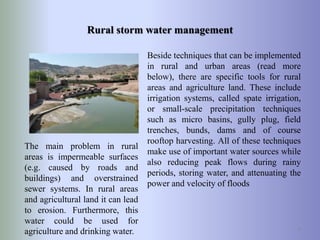
Rural storm water management
Beside techniques that can be implemented
in rural and urban areas (read more
below), there are specific tools for rural
areas and agriculture land. These include
irrigation systems, called spate irrigation,
or small-scale precipitation techniques
such as micro basins, gully plug, field
trenches, bunds, dams and of course
rooftop harvesting. All of these techniques
make use of important water sources while
also reducing peak flows during rainy
periods, storing water, and attenuating the
power and velocity of floods
8
The main problem in rural
areas is impermeable surfaces
(e.g. caused by roads and
buildings) and overstrained
sewer systems. In rural areas
and agricultural land it can lead
to erosion. Furthermore, this
water could be used for
agriculture and drinking water.
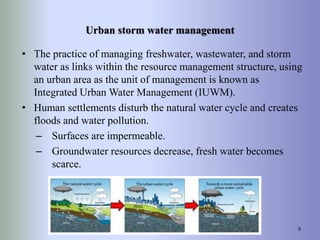
Urban storm water management
• The practice of managing freshwater, wastewater, and storm
water as links within the resource management structure, using
an urban area as the unit of management is known as
Integrated Urban Water Management (IUWM).
• Human settlements disturb the natural water cycle and creates
floods and water pollution.
– Surfaces are impermeable.
– Groundwater resources decrease, fresh water becomes
scarce.
9
Storm Water Management Systems
Storage Type Systems
• Detention Ponds
• Retention Ponds
• Rain Garden & Bioretention
• Onsite Detention (OSD)
• Rainwater Harvesting
• Green Roofs / Rooftop
Gardens
• Constructed Wetlands
Infiltration Type Systems
• Infiltration Trenches
• Grass Filter Stripes
• Grassed Swales
• Pervious Pavements
• Infiltration Basin
10
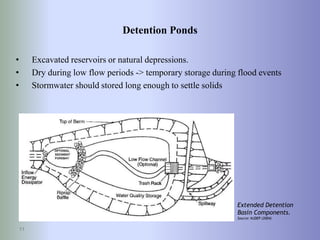
Detention Ponds
• Excavated reservoirs or natural depressions.
• Dry during low flow periods -> temporary storage during flood events
• Stormwater should stored long enough to settle solids
11
Extended Detention
Basin Components.
Source: NJDEP (2004)
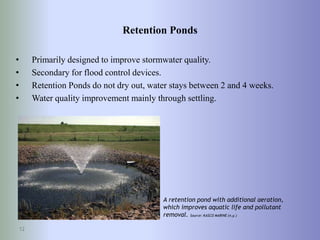
Retention Ponds
• Primarily designed to improve stormwater quality.
• Secondary for flood control devices.
• Retention Ponds do not dry out, water stays between 2 and 4 weeks.
• Water quality improvement mainly through settling.
12
A retention pond with additional aeration,
which improves aquatic life and pollutant
removal. Source: KASCO MARINE (n.y.)
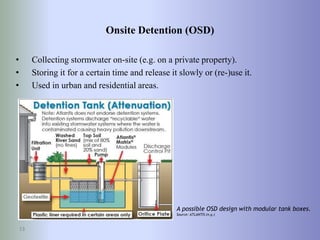
Onsite Detention (OSD)
• Collecting stormwater on-site (e.g. on a private property).
• Storing it for a certain time and release it slowly or (re-)use it.
• Used in urban and residential areas.
13
A possible OSD design with modular tank boxes.
Source: ATLANTIS (n.y.)
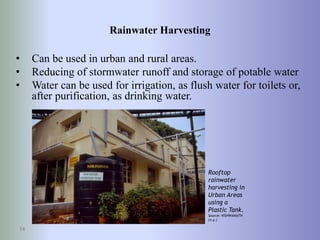
Rainwater Harvesting
• Can be used in urban and rural areas.
• Reducing of stormwater runoff and storage of potable water
• Water can be used for irrigation, as flush water for toilets or,
after purification, as drinking water.
14
Rooftop
rainwater
harvesting in
Urban Areas
using a
Plastic Tank.
Source: VISHWANATH
(n.y.)
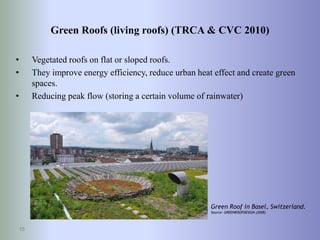
Green Roofs (living roofs) (TRCA & CVC 2010)
• Vegetated roofs on flat or sloped roofs.
• They improve energy efficiency, reduce urban heat effect and create green
spaces.
• Reducing peak flow (storing a certain volume of rainwater)
15
Green Roof in Basel, Switzerland.
Source: GREENROOFDESIGN (2008)
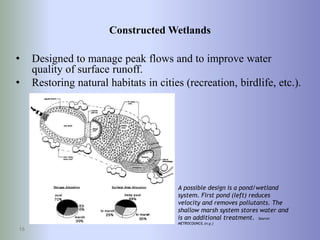
Constructed Wetlands
• Designed to manage peak flows and to improve water
quality of surface runoff.
• Restoring natural habitats in cities (recreation, birdlife, etc.).
16
A possible design is a pond/wetland
system. First pond (left) reduces
velocity and removes pollutants. The
shallow marsh system stores water and
is an additional treatment. Source:
METROCOUNCIL (n.y.)
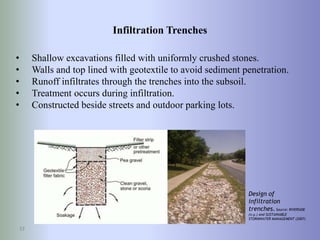
Infiltration Trenches
• Shallow excavations filled with uniformly crushed stones.
• Walls and top lined with geotextile to avoid sediment penetration.
• Runoff infiltrates through the trenches into the subsoil.
• Treatment occurs during infiltration.
• Constructed beside streets and outdoor parking lots.
17
Design of
infiltration
trenches. Source: RIVERSIDE
(n.y.) and SUSTAINABLE
STORMWATER MANAGEMENT (2007)
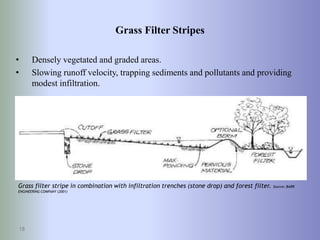
Grass Filter Stripes
• Densely vegetated and graded areas.
• Slowing runoff velocity, trapping sediments and pollutants and providing
modest infiltration.
18
Grass filter stripe in combination with infiltration trenches (stone drop) and forest filter. Source: BARR
ENGINEERING COMPANY (2001)
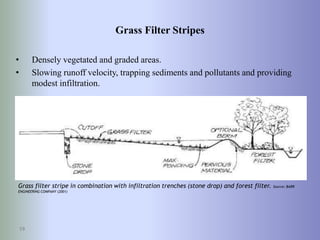
Grass Filter Stripes
• Densely vegetated and graded areas.
• Slowing runoff velocity, trapping sediments and pollutants and providing
modest infiltration.
19
Grass filter stripe in combination with infiltration trenches (stone drop) and forest filter. Source: BARR
ENGINEERING COMPANY (2001)
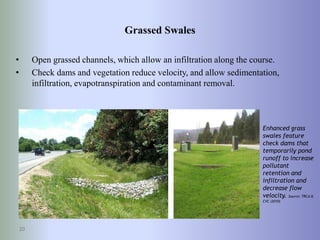
Grassed Swales
• Open grassed channels, which allow an infiltration along the course.
• Check dams and vegetation reduce velocity, and allow sedimentation,
infiltration, evapotranspiration and contaminant removal.
20
Enhanced grass
swales feature
check dams that
temporarily pond
runoff to increase
pollutant
retention and
infiltration and
decrease flow
velocity. Source: TRCA &
CVC (2010)
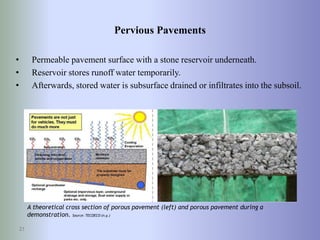
Pervious Pavements
• Permeable pavement surface with a stone reservoir underneath.
• Reservoir stores runoff water temporarily.
• Afterwards, stored water is subsurface drained or infiltrates into the subsoil.
21
A theoretical cross section of porous pavement (left) and porous pavement during a
demonstration. Source: TECOECO (n.y.)
Infiltration Basin (NJDEP 2004)
• Constructed facility with highly permeable soils.
• Water infiltrates into surrounding soil and gets treated.
22
An infiltration
basin. Source: VUSP (n.y.)
23
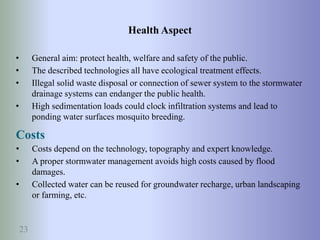
• General aim: protect health, welfare and safety of the public.
• The described technologies all have ecological treatment effects.
• Illegal solid waste disposal or connection of sewer system to the stormwater
drainage systems can endanger the public health.
• High sedimentation loads could clock infiltration systems and lead to
ponding water surfaces mosquito breeding.
Health Aspect
Costs
• Costs depend on the technology, topography and expert knowledge.
• A proper stormwater management avoids high costs caused by flood
damages.
• Collected water can be reused for groundwater recharge, urban landscaping
or farming, etc.
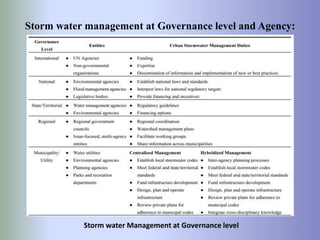
Storm water management at Governance level and Agency:
24
Storm water Management at Governance level
Operation and Maintenance
• All storm water management systems need a
proper O&M service. Regular maintenance extends the life of
storm water systems, improves site drainage, and reduces
pollution entering surface waters and groundwater.
Governmental facilities as well as private property owners are
responsible for O&M.
25
Treatment of Storm Water
• Contaminants in water may include algae, air pollution, bird
excrement, and leaves, sand, and dust. Local wells have dealt
with these problems for decades.
• Installation of filtration and purification equipment can remove
these contaminants at home as well.
• First, take measures to keep foreign matter out of the incoming
rain water, flush devices, gutter screens and other screening
mechanisms keep the rainwater as clean as possible before it
enters the conveyance system.
• Mainly used treatment process are;
 Filtration & Uv treatment
 Chlorination
 Solar Pasteurization 26
Role of Infrastructure
• Green infrastructure
It is functioned as water management that protects, restores, or
mimics the natural water cycle.
• Grey infrastructure
It is man-made designed to move urban storm-water away from
the built environment. Both infrastructure are involved in storm
water management system.
27
Conclusion
• Theoretically, storm water management is necessary in every
settlement, rural or urban, to protect human health, prevent
water pollution, (re-)use precipitation water (on agriculture or
household level) and prevent damages to infrastructure.
• It is essential in urban areas where constructed surfaces change
the hydraulic properties and prevent infiltration. The whole
management has to be adapted to the local conditions (climate,
topography, resources, etc.)
• Therefore, expert knowledge is required.
29
References
• Sustainable Sanitation and Water
Management(https://sswm.info/)
• Ministry of Environment, Forest and Climate change.
(www.envfor.nic.in/)
• Eec environmental (www.eecenvironmental.com )
• Food and Agricultural Organization (www.fao.org/)
• Environmental Protection Agency (www.epa.gov/)
• The International Fund for Agricultural Development.(
www.ifad.org/)
30

Srorm water management

  • 1.
    Graduate Report Presentationon “Storm Water Management” ME – TCP, Year – I, Semester – I Under the subject of INFRASTRUCTURE AND TRANSPORTATION PLANNING (Subject Code : 3714803) Prepared by : VAKHARIA SIDDHI Enrollment No: 180420748023 Guided by : Prof. Himanshu J. Padhya Prof. Palak S. Shah SARVAJANIK COLLEGE OF ENGINEERING & TECHNOLOGY, SURAT FACULTY OF CIVIL ENGINEERING MASTER OF ENGINEERING (TOWN AND COUNTRY PLANNING) Affiliated with GUJARAT TECHNOLOGICAL UNIVERSITY Prof.(Dr.) Jigar K. Sevalia Faculty & Head Faculty of Civil Engineering, SCET 1
  • 2.
    CONTENTS 1. Introduction 2. Importanceof Storm water Management 3. Advantages of Storm water management 4. Disadvantages of Storm water Management 5. Effects of Poor Storm water Management 6. Urban Storm water management 7. Storm Water Management Systems 8. Operation and Maintenance 9. Treatment of Storm Water Management 10. Conclusion 11. References 2
  • 3.
    Introduction • Storm wateris Rainwater and melted Snow that runs off Streets, Lawns and other sites. When storm water is absorbed into the ground, It is filtered and ultimately refills Aquifers Or Flows Into Streams And Rivers. • Storm water management means to manage surface runoff. It can be applied in rural areas , but is essential in urban areas where run-off cannot infiltrate because the surfaces are impermeable. 3
  • 4.
    Importance of Stormwater Management As opposed to allowing for flooding in cities, smart stormwater management opens up several opportunities including: • Channelling it to irrigation systems, where it is needed the most. • Controlling of erosion and making our natural river systems cleaner. • Removal of pollutants, since stormwater carries a large amount of urban trash along. • Flood control and restoring city life to normalcy. • Restoring the natural topography of our river systems. Apart from this, the stormwater system also: • Makes our homes and land stronger and less prone to water damage • Lowers property maintenance costs • Reduces our water dependence, thus lower water bills • Increases the value of our land 4
  • 5.
    Advantages • Provides properdrainage of surface run-off and avoids damages on infrastructure such as private properties and streets. • Provides possibility to recharge groundwater and re-use precipitation water and surface run-off as irrigation or household water. • Minimizing health risks. • Treatment of storm water in a very early stage • Avoids damages on infrastructure (private properties, streets, etc.); flood prevention • Provides effective storm water flood control. • It can be integrated into the urban landscape and provide green and recreational areas. • Revenue generated by a storm water utility can be used as a new, dedicated source of funds to supplement or replace the community's current storm water management funding, enabling tax-based funding to be used for other community needs. 5
  • 6.
    Disadvantages • Expert planning,implementation, operation and maintenance required for a storm water management. • It depends on the technique, a lot of operation and labour required. • There is risk of clogging infiltration system caused by high sedimentation rates. • Temporary covering methods, such as plastic sheeting, can become torn or ripped, exposing the contaminant to precipitation and/or storm water runoff. 6
  • 7.
    Effects of PoorStorm water Management • Downstream Flooding • Stream Bank Erosion • Increased Turbidity From Erosion • Habitat Destruction • Combined Sewer Overflows • Infrastructure Damage • Contaminated Streams, Rivers, And Coastal Water Storm water is actually concern for two Main Issues: • Related to the volume and timing of runoff water (Flood control and Water supplies) • Related to polluted contaminants that the water is carrying, – i.e. Water Pollution. 7
  • 8.
    Rural storm watermanagement Beside techniques that can be implemented in rural and urban areas (read more below), there are specific tools for rural areas and agriculture land. These include irrigation systems, called spate irrigation, or small-scale precipitation techniques such as micro basins, gully plug, field trenches, bunds, dams and of course rooftop harvesting. All of these techniques make use of important water sources while also reducing peak flows during rainy periods, storing water, and attenuating the power and velocity of floods 8 The main problem in rural areas is impermeable surfaces (e.g. caused by roads and buildings) and overstrained sewer systems. In rural areas and agricultural land it can lead to erosion. Furthermore, this water could be used for agriculture and drinking water.
  • 9.
    Urban storm watermanagement • The practice of managing freshwater, wastewater, and storm water as links within the resource management structure, using an urban area as the unit of management is known as Integrated Urban Water Management (IUWM). • Human settlements disturb the natural water cycle and creates floods and water pollution. – Surfaces are impermeable. – Groundwater resources decrease, fresh water becomes scarce. 9
  • 10.
    Storm Water ManagementSystems Storage Type Systems • Detention Ponds • Retention Ponds • Rain Garden & Bioretention • Onsite Detention (OSD) • Rainwater Harvesting • Green Roofs / Rooftop Gardens • Constructed Wetlands Infiltration Type Systems • Infiltration Trenches • Grass Filter Stripes • Grassed Swales • Pervious Pavements • Infiltration Basin 10
  • 11.
    Detention Ponds • Excavatedreservoirs or natural depressions. • Dry during low flow periods -> temporary storage during flood events • Stormwater should stored long enough to settle solids 11 Extended Detention Basin Components. Source: NJDEP (2004)
  • 12.
    Retention Ponds • Primarilydesigned to improve stormwater quality. • Secondary for flood control devices. • Retention Ponds do not dry out, water stays between 2 and 4 weeks. • Water quality improvement mainly through settling. 12 A retention pond with additional aeration, which improves aquatic life and pollutant removal. Source: KASCO MARINE (n.y.)
  • 13.
    Onsite Detention (OSD) •Collecting stormwater on-site (e.g. on a private property). • Storing it for a certain time and release it slowly or (re-)use it. • Used in urban and residential areas. 13 A possible OSD design with modular tank boxes. Source: ATLANTIS (n.y.)
  • 14.
    Rainwater Harvesting • Canbe used in urban and rural areas. • Reducing of stormwater runoff and storage of potable water • Water can be used for irrigation, as flush water for toilets or, after purification, as drinking water. 14 Rooftop rainwater harvesting in Urban Areas using a Plastic Tank. Source: VISHWANATH (n.y.)
  • 15.
    Green Roofs (livingroofs) (TRCA & CVC 2010) • Vegetated roofs on flat or sloped roofs. • They improve energy efficiency, reduce urban heat effect and create green spaces. • Reducing peak flow (storing a certain volume of rainwater) 15 Green Roof in Basel, Switzerland. Source: GREENROOFDESIGN (2008)
  • 16.
    Constructed Wetlands • Designedto manage peak flows and to improve water quality of surface runoff. • Restoring natural habitats in cities (recreation, birdlife, etc.). 16 A possible design is a pond/wetland system. First pond (left) reduces velocity and removes pollutants. The shallow marsh system stores water and is an additional treatment. Source: METROCOUNCIL (n.y.)
  • 17.
    Infiltration Trenches • Shallowexcavations filled with uniformly crushed stones. • Walls and top lined with geotextile to avoid sediment penetration. • Runoff infiltrates through the trenches into the subsoil. • Treatment occurs during infiltration. • Constructed beside streets and outdoor parking lots. 17 Design of infiltration trenches. Source: RIVERSIDE (n.y.) and SUSTAINABLE STORMWATER MANAGEMENT (2007)
  • 18.
    Grass Filter Stripes •Densely vegetated and graded areas. • Slowing runoff velocity, trapping sediments and pollutants and providing modest infiltration. 18 Grass filter stripe in combination with infiltration trenches (stone drop) and forest filter. Source: BARR ENGINEERING COMPANY (2001)
  • 19.
    Grass Filter Stripes •Densely vegetated and graded areas. • Slowing runoff velocity, trapping sediments and pollutants and providing modest infiltration. 19 Grass filter stripe in combination with infiltration trenches (stone drop) and forest filter. Source: BARR ENGINEERING COMPANY (2001)
  • 20.
    Grassed Swales • Opengrassed channels, which allow an infiltration along the course. • Check dams and vegetation reduce velocity, and allow sedimentation, infiltration, evapotranspiration and contaminant removal. 20 Enhanced grass swales feature check dams that temporarily pond runoff to increase pollutant retention and infiltration and decrease flow velocity. Source: TRCA & CVC (2010)
  • 21.
    Pervious Pavements • Permeablepavement surface with a stone reservoir underneath. • Reservoir stores runoff water temporarily. • Afterwards, stored water is subsurface drained or infiltrates into the subsoil. 21 A theoretical cross section of porous pavement (left) and porous pavement during a demonstration. Source: TECOECO (n.y.)
  • 22.
    Infiltration Basin (NJDEP2004) • Constructed facility with highly permeable soils. • Water infiltrates into surrounding soil and gets treated. 22 An infiltration basin. Source: VUSP (n.y.)
  • 23.
    23 • General aim:protect health, welfare and safety of the public. • The described technologies all have ecological treatment effects. • Illegal solid waste disposal or connection of sewer system to the stormwater drainage systems can endanger the public health. • High sedimentation loads could clock infiltration systems and lead to ponding water surfaces mosquito breeding. Health Aspect Costs • Costs depend on the technology, topography and expert knowledge. • A proper stormwater management avoids high costs caused by flood damages. • Collected water can be reused for groundwater recharge, urban landscaping or farming, etc.
  • 24.
    Storm water managementat Governance level and Agency: 24 Storm water Management at Governance level
  • 25.
    Operation and Maintenance •All storm water management systems need a proper O&M service. Regular maintenance extends the life of storm water systems, improves site drainage, and reduces pollution entering surface waters and groundwater. Governmental facilities as well as private property owners are responsible for O&M. 25
  • 26.
    Treatment of StormWater • Contaminants in water may include algae, air pollution, bird excrement, and leaves, sand, and dust. Local wells have dealt with these problems for decades. • Installation of filtration and purification equipment can remove these contaminants at home as well. • First, take measures to keep foreign matter out of the incoming rain water, flush devices, gutter screens and other screening mechanisms keep the rainwater as clean as possible before it enters the conveyance system. • Mainly used treatment process are;  Filtration & Uv treatment  Chlorination  Solar Pasteurization 26
  • 27.
    Role of Infrastructure •Green infrastructure It is functioned as water management that protects, restores, or mimics the natural water cycle. • Grey infrastructure It is man-made designed to move urban storm-water away from the built environment. Both infrastructure are involved in storm water management system. 27
  • 28.
    Conclusion • Theoretically, stormwater management is necessary in every settlement, rural or urban, to protect human health, prevent water pollution, (re-)use precipitation water (on agriculture or household level) and prevent damages to infrastructure. • It is essential in urban areas where constructed surfaces change the hydraulic properties and prevent infiltration. The whole management has to be adapted to the local conditions (climate, topography, resources, etc.) • Therefore, expert knowledge is required. 29
  • 29.
    References • Sustainable Sanitationand Water Management(https://sswm.info/) • Ministry of Environment, Forest and Climate change. (www.envfor.nic.in/) • Eec environmental (www.eecenvironmental.com ) • Food and Agricultural Organization (www.fao.org/) • Environmental Protection Agency (www.epa.gov/) • The International Fund for Agricultural Development.( www.ifad.org/) 30