GEO524 Seminar in Urban analysis and problems Himmet Haybat
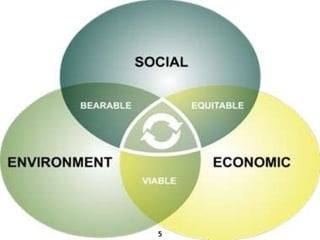
Development   Development  is a process of becoming and a potential state of being. Sustainable Development Development that meets the needs of the present without compromising the ability of future   generations to meet their own needs  . In urban planning, sustainable development represents a reorientation of   traditional goals.
A sustainable city enhances the economic, social, cultural and environmental well-being of current and future generations Sustainable cities, sometimes known as ecological or ‘eco’ cities, are settlements designed to have as little impact on the environment as possible.  These can be pre-existing cities that feature management directed towards reducing the inputs of energy, water and food and reducing the outputs of heat, water and air pollution, or they can be cities designed from scratch with these concerns in mind.
A controlled population for whom adequate, meaningful employment is available Adequate governance set-up which can meet the needs of the populace and ensures civic responsibilities, community participation, a sense of identity, transparency and equity in local institutions Planned housing colonies with adequate infrastructure like schools, parks, drainage system, local Medicare establishments. Efficient basic civic amenities for a reasonably comfortable existence Effective environmental infrastructure to address the issues of untreated sewage and waste polluting rivers, lakes and coastal zones
Empowerment of women and encouraging their participation in the political, social and economic life of a city and adoption of urban policies that take into account women's needs and initiatives An efficient health-care system which would also address issues of nutrition, family planning and sanitation A mechanism in the form of a policy initiative for industrial dispersal to satellite townships where better employment opportunities are created Development of an efficient urban private sector, both formal and non-formal which reduces poverty by generating jobs and helping in economic growth
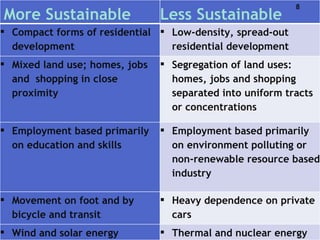
  More Sustainable Less Sustainable Compact forms of residential  d evelopment Low-density, spread-out residential   development Mixed land use; homes, jobs and  shopping in close proximity Segregation of land uses: homes, jobs and shopping separated into uniform tracts or concentrations Employment based primarily on education and skills Employment based primarily on environment polluting or non-renewable resource based industry Movement on foot and by bicycle and transit Heavy dependence on private cars Wind and solar energy Thermal and nuclear energy
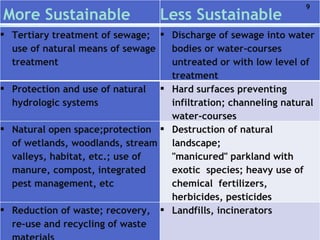
Tertiary treatment of sewage; use of natural means of sewage treatment Discharge of sewage into water bodies or water-courses untreated or with low level of treatment Protection and use of natural hydrologic systems Hard surfaces preventing infiltration; channeling natural water-courses Natural open space;protection of wetlands,   woodlands,   stream valleys, habitat, etc.; use of   manure, compost,   integrated pest   management, etc Destruction of natural landscape;  "manicured" parkland with exotic  species; heavy use of chemical  fertilizers, herbicides, pesticides Reduction of waste; recovery, re-use and recycling of waste materials Landfills, incinerators   More Sustainable Less Sustainable
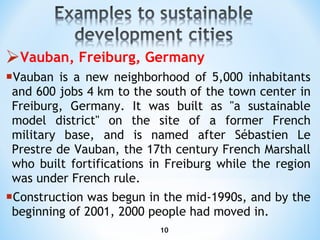
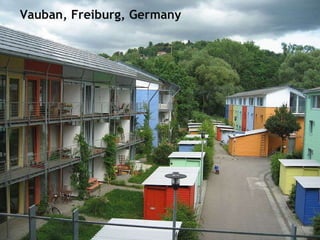
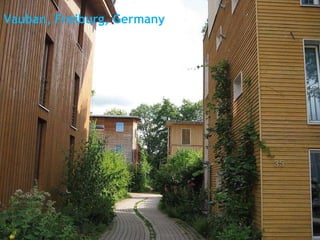
Vauban, Freiburg, Germany Vauban is a new neighborhood   of 5,000 inhabitants and 600 jobs 4 km to the south of the town center in Freiburg, Germany. It was built as "a sustainable model district" on the site of a former French military base, and is named after Sébastien Le Prestre de Vauban, the 17th century French Marshall who built fortifications in Freiburg while the region was under French rule. Construction was begun in the mid-1990s, and by the beginning of 2001, 2000 people had moved in .
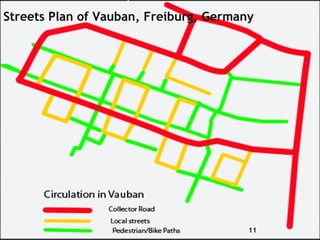
Streets Plan of Vauban, Freiburg, Germany
Vauban, Freiburg, Germany
C algary   is a city in the Province of Alberta, Canada. It is located in the south of the province, in an area of foothills and prairie, approximately 80 km (50 mi) east of the front ranges of the Canadian Rockies. The city is located in the Grassland region of Alberta. In 2006, the City of Calgary had a population of 988,193 making it the third-largest municipality in the country and largest in Alberta .  The entire metropolitan area had a 2006 population of 1,079,310, making it the fifth-largest census metropolitan area (CMA) in Canada. In 2009, Calgary's metropolitan population was estimated at 1,230,248, raising its rank to fourth-largest CMA in Canada. Located 294 kilometers (183 miles) south of Edmonton, Statistics Canada   defines the narrowly populated area between these cities as the "Calgary–Edmonton Corridor."
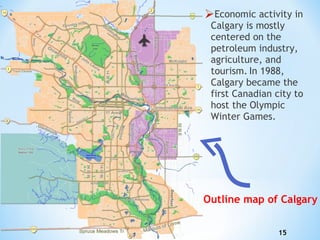
Economic activity in Calgary is mostly centered on the petroleum industry, agriculture, and tourism.   In 1988, Calgary became the first Canadian city to host the Olympic Winter Games. Outline map of Calgary
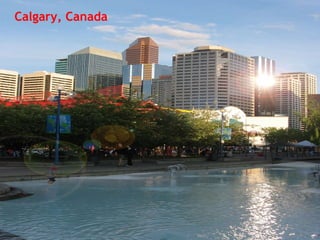
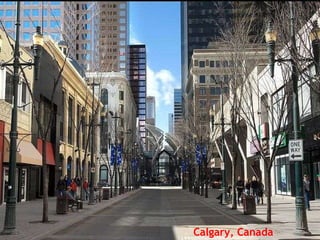
Calgary, Canada
T he city is large in physical area, consisting of an inner city surrounded by communities of various density. Unlike most cities with a sizeable metropolitan area, most of Calgary's suburbs are incorporated into the city proper Calgary maintains a major streets network and a freeway system. Much of the system is on a grid where roads are numbered with avenues running east–west and streets running north–south Roads in predominantly residential areas as well as freeways and expressways do not generally conform to the grid and are usually not numbered as a result
However, it is a developer and city convention in Calgary that non-numbered streets within a new community have the same name prefix as the community itself so that streets can more easily be located within the city Calgary Transit provides public transportation services throughout the city with buses and light rail. Calgary's rail system, known as the C-Train was one of the first such systems in North America
Calgary, Canada
Limits and Regulations Zoning Planning Protection Taxes Tax Breaks Revitalization and New Growth
Limits and Regulations Limit building permits Urban growth Greenbelts around cities Public review of new development Zonning Encourage mixed use Concentrate development along mass transportation routes Promote high-density cluster housing developments Protection Preserve existing open space Buy new open space Buy development rights that prohibit certain types of development on land parcels Taxes Tax land, not buildings Tax land on value of actual use (such as forest and agriculture) instead of highest value as developed land
Planning Ecological land use planning Environmental impact analysis Integrated regional planning State and national planning Tax Breaks For owners agreeing legally to not allow certain types of development For cleaning up and developing abandoned  urban  sites   Revitalization and New Growth Revitalize existing towns and cities Build well-planned new towns and villages within cities
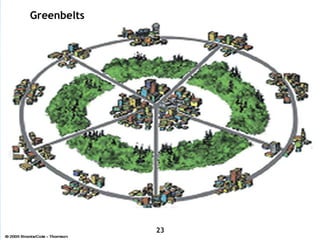
Greenbelts
Individual transit ( Motor  Scooter s) Mass transit Buses Trains Automobiles
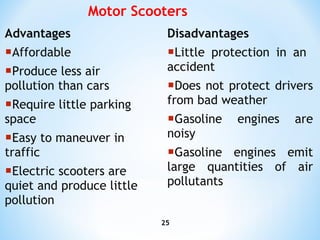
Advantages Affordable Produce less air pollution than cars Require little parking space  Easy to maneuver in traffic Electric scooters are quiet and produce little pollution  Disadvantages Little protection in an  accident Does not protect drivers from bad weather Gasoline engines are noisy Gasoline engines emit large quantities of air pollutants Motor  Scooters
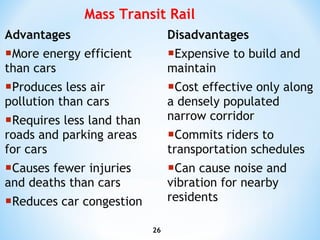
Advantages More energy efficient than cars Produces less air pollution than cars Requires less land than roads and parking areas for cars Causes fewer injuries and deaths than cars Reduces car congestion  Disadvantages Expensive to build and maintain Cost effective only along a densely populated narrow corridor Commits riders to transportation schedules Can cause noise and vibration for nearby residents Mass Transit Rail
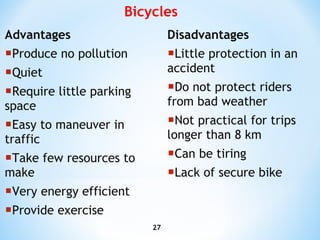
Advantages Produce no pollution Quiet Require little parking space Easy to maneuver in traffic Take few resources to make Very energy efficient Provide exercise Disadvantages Little protection in an accident Do not protect riders from bad weather Not practical for trips longer than 8 km Can be tiring  Lack of secure bike Bicycles
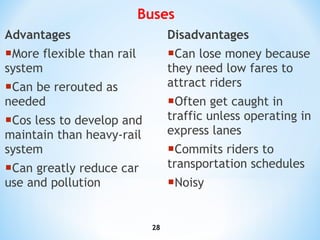
Advantages More flexible than rail system Can be rerouted as needed Cos less to develop and maintain than heavy-rail system Can greatly reduce car use and pollution Disadvantages Can lose money because they need low fares to attract riders Often get caught in traffic unless operating in express lanes Commits riders to transportation schedules Noisy Buses
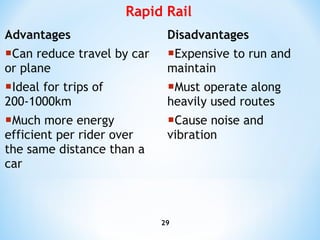
Advantages Can reduce travel by car or plane Ideal for trips of 200-1000km Much more energy efficient per rider over the same distance than a car Disadvantages Expensive to run and maintain Must operate along heavily used routes  Cause noise and vibration Rapid Rail
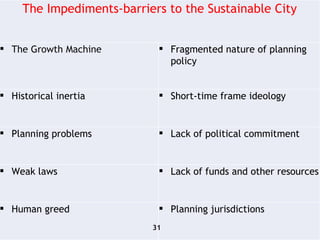
The Impediments-barriers to the Sustainable City The Growth Machine Fragmented nature of planning policy Historical inertia Short-time frame ideology Planning problems Lack of political commitment Weak laws Lack of funds and other resources  Human greed Planning jurisdictions
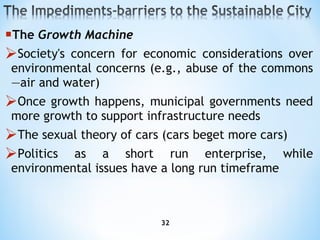
The  Growth Machine S ociety's concern for economic considerations over environmental concerns (e.g., abuse of the commons—air and  water) O nce growth happens, municipal governments need more growth to support infrastructure needs T he sexual theory of cars (cars beget more cars) P olitics as a short run enterprise, while environmental issues have a long run timeframe
T he simplistic desire to develop where it's easiest and cheapest (e.g. flat, well-drained agricultural land). R elative independence of municipalities makes competition fierce for industrial and commercial clients (i.e., in order   to improve the city's tax base) Historical inertia .(e.g., land platting makes cities monotonous and not ecologically-driven)
Planning problems are inherently wicked (e.g. difficult to define, have no rules that determine when they are solved, are   not true or false but good or bad, are unique, basically political in nature and are often derivative of another problem) Weak laws and regulations, and a related lack of enforcement. Human  greed (açgözlülük,hırs) Ambition, Passion
The fragmented nature of planning policy (e.g. zoning decisions made in isolation of transportation and public investment   decisions ) Planning jurisdictions are defined politically rather than ecologically Short-time frame ideology. Instead, think about 500-year planning Lack of political commitment to environmental goals Lack of funds and other resources to implement ecological planning
Air and water pollution; waste management Reduction in vegetation Importation of food, energy, and materials Noise pollution  Climate impacts: urban heat islands Impacts on surrounding rural areas
Compact Urban Form P ermit higher urban densities through zoning (e.g., facilitate vertical rather than horizontal development). S et urban growth boundaries (e.g., growth management): urban land consumption very often occurs on the highest   quality lands (e.g., prime agricultural land). Use Greenbelts (and forbid leap-frog development). M inimize conversion of natural lands to urban uses (therefore, stress infill—except for some earthquake-prone areas). R etrofitting and renovation of older structures G reenbelts that work by refusing to permit leapfrog development
Human scale Gives priority to the pedestrian (i.e., walkability), reduces dependency on the automobile, and   enhances the aesthetic   appreciation of urban life Mixed uses Increases the efficiency of human interactions in space. Transactional intensity (e.g., business, news, life business) is facilitated. Minimizes travel times and commuting times and therefore   reduces the waste of time and non-renewable resources (e.g., petroleum). How? T hrough zoning, integrate commercial, retail, recreational and residential land uses on individual land parcels
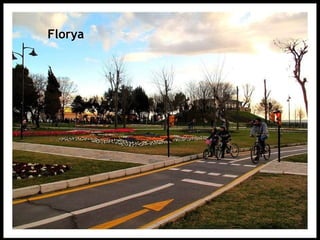
Non-polluting forms of transportation Minimizes impacts on urban air quality. How? Stress walking, biking, public transit, and light rail. Provide pedestrian and cycling networks (even cycling commuter networks). Preservation of open space/green space . How? Provide a system of urban parks, connected systems of green spaces, extensive trees & landscaping. GREEN THE CONCRETE JUNGLE (e.g., Florya is one of the best   examples in Istanbul). Connect  the open space system to water M unicipal land banking, conservation easements, land trusts, public-private partnerships
Florya
Healthy environmental elements (e.g., healthy air, water and land) How? A ggressively rehabilitate degraded landscapes M inimize automobile dependency I solate polluting industries and demand scrubbers on industrial smokestacks U se an integrated approach to waste management (e.g., the 3Rs) (reduce, reuse, recycle) D esign waste disposal sites and take particular care with toxic waste U se a municipal environmental impact assessment system for all new developments
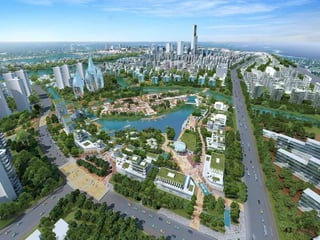
Environmental rehabilitation . Why? Contributes to environmental quality and human health, enhances biomass   productivity of urban areas. How? naturalize, replant, landscape reconstruct water courses that have been buried cap all contaminated sites (e.g., use engineering solutions) clean up the city (i.e., garbage minimization, efficient disposal)
Urban operations (i.e., the way in which communities are operated and managed).  The municipality should set an   example about environmental consciousness and has a considerable impact on how city itself will operate. How? T he 3Rs (reduce, reuse, recycle) Waste reduction Solar and wind projects E nergy conservation measures (e.g. force municipal vehicles to use alternative energy sources) M unicipal procurement policies that target sustainably-produced products
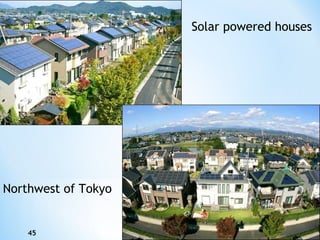
Northwest of Tokyo Solar powered houses
Resource conservation (air, water, soil, energy)   How? P romote water pricing and water conservation methods Promote public transit R equire anti-erosion landscaping and/or appliances on urban stream embankments Minimize consumption of prime agricultural lands, etc. T he 3Rs (reduce, reuse, recycle)
Promotion of an economic base that has minimal environmental impact.  Why? Greater long run feasibility, less expensive   to clean up, and maximizes the health of the environment. How? P romote quaternary economic development (since wealth and educational attainment are related to the demand for a  healthier  environment ) P romote businesses with low energy demands, and produce few or no toxins P romote businesses with closed loop production process for durables in which manufacturers design products for   disassembly and disposal or recovery or reuse
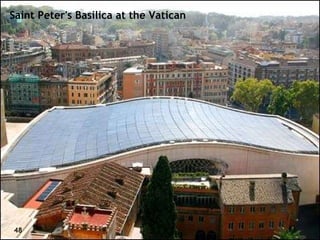
Saint Peter's Basilica at the Vatican
Eco-community development .  How? facilitate urban gardening, aquaculture alternative energy sources like wind, solar and thermal wetlands and aquatic organisms for wastewater treatment define jurisdictions by ecological criteria, not political Sense of place natural heritage conservation heritage conservation of buildings and landscapes (to recognize and value the past) legislate the requirement for a percentage of development costs to be allocated to public art
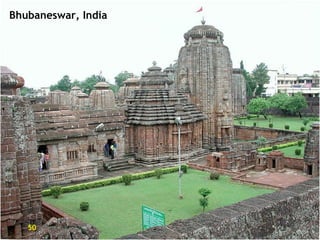
Bhubaneswar, India
Social goals . Why? Urban populations require adequate and affordable housing, health care, safety, cleanliness, freedom   from crime, opportunities for work and personal development. How? B onusing  for  mixed-income   housing P rotect the existing housing stock F acilitation  of  cooperative   housing Diversity (e.g., cultural, lifestyle, land uses, transportation modes, choices, choices, choices).  Why? Diversity makes a city   more interesting and makes it more resilient to external environmental shocks. How? P rotect cultural resources through conservation areas or designations P lan for urban surprises (e.g., use organic design)
Full-cost accounting (i.e., account for the full environmental costs of development in both short and long terms).  Why?   More efficient in the long term. How? D evelopment impact fees (i.e., a progressive development impact fee structure that increases with distance from the   city core to discourage sprawl) Higher  property taxes for industry
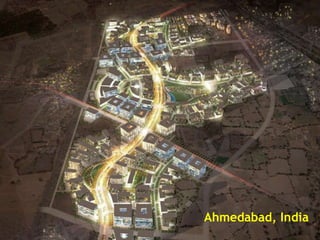
Ahmedabad, India
Sustainable economic development has become the world’s political objective to combat the intensified   environmental problems and especially the non-reversible degradation of the natural environment Sustainable development suggests a framework for the development of economic systems that respect   the limits set by the natural environment In this context, the examination of the pattern of sustainable development in the urban system   becomes now all the more important The intense presence of the humans in the urban system asks  de   facto (fiili, gerçekten yapılan)   for a particular human-oriented interpretation of sustainability
Furthermore , urban  systems   require further specification of the general concept of sustainable development, one that will take into   account the special natural and social features of the urban system In addition ,  the fact that cities accumulate human population, they have to maintain certain   levels of environmental quality, which are related to the healthy survival and reproduction of the human   species

Sustainable cities

  • 1.
    GEO524 Seminar inUrban analysis and problems Himmet Haybat
  • 2.
    Development Development is a process of becoming and a potential state of being. Sustainable Development Development that meets the needs of the present without compromising the ability of future generations to meet their own needs . In urban planning, sustainable development represents a reorientation of traditional goals.
  • 3.
    A sustainable cityenhances the economic, social, cultural and environmental well-being of current and future generations Sustainable cities, sometimes known as ecological or ‘eco’ cities, are settlements designed to have as little impact on the environment as possible. These can be pre-existing cities that feature management directed towards reducing the inputs of energy, water and food and reducing the outputs of heat, water and air pollution, or they can be cities designed from scratch with these concerns in mind.
  • 4.
    A controlled populationfor whom adequate, meaningful employment is available Adequate governance set-up which can meet the needs of the populace and ensures civic responsibilities, community participation, a sense of identity, transparency and equity in local institutions Planned housing colonies with adequate infrastructure like schools, parks, drainage system, local Medicare establishments. Efficient basic civic amenities for a reasonably comfortable existence Effective environmental infrastructure to address the issues of untreated sewage and waste polluting rivers, lakes and coastal zones
  • 6.
    Empowerment of womenand encouraging their participation in the political, social and economic life of a city and adoption of urban policies that take into account women's needs and initiatives An efficient health-care system which would also address issues of nutrition, family planning and sanitation A mechanism in the form of a policy initiative for industrial dispersal to satellite townships where better employment opportunities are created Development of an efficient urban private sector, both formal and non-formal which reduces poverty by generating jobs and helping in economic growth
  • 8.
      More SustainableLess Sustainable Compact forms of residential d evelopment Low-density, spread-out residential development Mixed land use; homes, jobs and shopping in close proximity Segregation of land uses: homes, jobs and shopping separated into uniform tracts or concentrations Employment based primarily on education and skills Employment based primarily on environment polluting or non-renewable resource based industry Movement on foot and by bicycle and transit Heavy dependence on private cars Wind and solar energy Thermal and nuclear energy
  • 9.
    Tertiary treatment ofsewage; use of natural means of sewage treatment Discharge of sewage into water bodies or water-courses untreated or with low level of treatment Protection and use of natural hydrologic systems Hard surfaces preventing infiltration; channeling natural water-courses Natural open space;protection of wetlands, woodlands, stream valleys, habitat, etc.; use of manure, compost, integrated pest management, etc Destruction of natural landscape; "manicured" parkland with exotic species; heavy use of chemical fertilizers, herbicides, pesticides Reduction of waste; recovery, re-use and recycling of waste materials Landfills, incinerators   More Sustainable Less Sustainable
  • 10.
    Vauban, Freiburg, GermanyVauban is a new neighborhood of 5,000 inhabitants and 600 jobs 4 km to the south of the town center in Freiburg, Germany. It was built as "a sustainable model district" on the site of a former French military base, and is named after Sébastien Le Prestre de Vauban, the 17th century French Marshall who built fortifications in Freiburg while the region was under French rule. Construction was begun in the mid-1990s, and by the beginning of 2001, 2000 people had moved in .
  • 11.
    Streets Plan ofVauban, Freiburg, Germany
  • 12.
  • 13.
  • 14.
    C algary is a city in the Province of Alberta, Canada. It is located in the south of the province, in an area of foothills and prairie, approximately 80 km (50 mi) east of the front ranges of the Canadian Rockies. The city is located in the Grassland region of Alberta. In 2006, the City of Calgary had a population of 988,193 making it the third-largest municipality in the country and largest in Alberta . The entire metropolitan area had a 2006 population of 1,079,310, making it the fifth-largest census metropolitan area (CMA) in Canada. In 2009, Calgary's metropolitan population was estimated at 1,230,248, raising its rank to fourth-largest CMA in Canada. Located 294 kilometers (183 miles) south of Edmonton, Statistics Canada defines the narrowly populated area between these cities as the "Calgary–Edmonton Corridor."
  • 15.
    Economic activity inCalgary is mostly centered on the petroleum industry, agriculture, and tourism. In 1988, Calgary became the first Canadian city to host the Olympic Winter Games. Outline map of Calgary
  • 16.
  • 17.
    T he cityis large in physical area, consisting of an inner city surrounded by communities of various density. Unlike most cities with a sizeable metropolitan area, most of Calgary's suburbs are incorporated into the city proper Calgary maintains a major streets network and a freeway system. Much of the system is on a grid where roads are numbered with avenues running east–west and streets running north–south Roads in predominantly residential areas as well as freeways and expressways do not generally conform to the grid and are usually not numbered as a result
  • 18.
    However, it isa developer and city convention in Calgary that non-numbered streets within a new community have the same name prefix as the community itself so that streets can more easily be located within the city Calgary Transit provides public transportation services throughout the city with buses and light rail. Calgary's rail system, known as the C-Train was one of the first such systems in North America
  • 19.
  • 20.
    Limits and RegulationsZoning Planning Protection Taxes Tax Breaks Revitalization and New Growth
  • 21.
    Limits and RegulationsLimit building permits Urban growth Greenbelts around cities Public review of new development Zonning Encourage mixed use Concentrate development along mass transportation routes Promote high-density cluster housing developments Protection Preserve existing open space Buy new open space Buy development rights that prohibit certain types of development on land parcels Taxes Tax land, not buildings Tax land on value of actual use (such as forest and agriculture) instead of highest value as developed land
  • 22.
    Planning Ecological landuse planning Environmental impact analysis Integrated regional planning State and national planning Tax Breaks For owners agreeing legally to not allow certain types of development For cleaning up and developing abandoned urban sites Revitalization and New Growth Revitalize existing towns and cities Build well-planned new towns and villages within cities
  • 23.
  • 24.
    Individual transit (Motor Scooter s) Mass transit Buses Trains Automobiles
  • 25.
    Advantages Affordable Produceless air pollution than cars Require little parking space Easy to maneuver in traffic Electric scooters are quiet and produce little pollution Disadvantages Little protection in an accident Does not protect drivers from bad weather Gasoline engines are noisy Gasoline engines emit large quantities of air pollutants Motor Scooters
  • 26.
    Advantages More energyefficient than cars Produces less air pollution than cars Requires less land than roads and parking areas for cars Causes fewer injuries and deaths than cars Reduces car congestion Disadvantages Expensive to build and maintain Cost effective only along a densely populated narrow corridor Commits riders to transportation schedules Can cause noise and vibration for nearby residents Mass Transit Rail
  • 27.
    Advantages Produce nopollution Quiet Require little parking space Easy to maneuver in traffic Take few resources to make Very energy efficient Provide exercise Disadvantages Little protection in an accident Do not protect riders from bad weather Not practical for trips longer than 8 km Can be tiring Lack of secure bike Bicycles
  • 28.
    Advantages More flexiblethan rail system Can be rerouted as needed Cos less to develop and maintain than heavy-rail system Can greatly reduce car use and pollution Disadvantages Can lose money because they need low fares to attract riders Often get caught in traffic unless operating in express lanes Commits riders to transportation schedules Noisy Buses
  • 29.
    Advantages Can reducetravel by car or plane Ideal for trips of 200-1000km Much more energy efficient per rider over the same distance than a car Disadvantages Expensive to run and maintain Must operate along heavily used routes Cause noise and vibration Rapid Rail
  • 31.
    The Impediments-barriers tothe Sustainable City The Growth Machine Fragmented nature of planning policy Historical inertia Short-time frame ideology Planning problems Lack of political commitment Weak laws Lack of funds and other resources Human greed Planning jurisdictions
  • 32.
    The GrowthMachine S ociety's concern for economic considerations over environmental concerns (e.g., abuse of the commons—air and water) O nce growth happens, municipal governments need more growth to support infrastructure needs T he sexual theory of cars (cars beget more cars) P olitics as a short run enterprise, while environmental issues have a long run timeframe
  • 33.
    T he simplisticdesire to develop where it's easiest and cheapest (e.g. flat, well-drained agricultural land). R elative independence of municipalities makes competition fierce for industrial and commercial clients (i.e., in order to improve the city's tax base) Historical inertia .(e.g., land platting makes cities monotonous and not ecologically-driven)
  • 34.
    Planning problems areinherently wicked (e.g. difficult to define, have no rules that determine when they are solved, are not true or false but good or bad, are unique, basically political in nature and are often derivative of another problem) Weak laws and regulations, and a related lack of enforcement. Human greed (açgözlülük,hırs) Ambition, Passion
  • 35.
    The fragmented natureof planning policy (e.g. zoning decisions made in isolation of transportation and public investment decisions ) Planning jurisdictions are defined politically rather than ecologically Short-time frame ideology. Instead, think about 500-year planning Lack of political commitment to environmental goals Lack of funds and other resources to implement ecological planning
  • 36.
    Air and waterpollution; waste management Reduction in vegetation Importation of food, energy, and materials Noise pollution Climate impacts: urban heat islands Impacts on surrounding rural areas
  • 37.
    Compact Urban FormP ermit higher urban densities through zoning (e.g., facilitate vertical rather than horizontal development). S et urban growth boundaries (e.g., growth management): urban land consumption very often occurs on the highest quality lands (e.g., prime agricultural land). Use Greenbelts (and forbid leap-frog development). M inimize conversion of natural lands to urban uses (therefore, stress infill—except for some earthquake-prone areas). R etrofitting and renovation of older structures G reenbelts that work by refusing to permit leapfrog development
  • 38.
    Human scale Givespriority to the pedestrian (i.e., walkability), reduces dependency on the automobile, and enhances the aesthetic appreciation of urban life Mixed uses Increases the efficiency of human interactions in space. Transactional intensity (e.g., business, news, life business) is facilitated. Minimizes travel times and commuting times and therefore reduces the waste of time and non-renewable resources (e.g., petroleum). How? T hrough zoning, integrate commercial, retail, recreational and residential land uses on individual land parcels
  • 39.
    Non-polluting forms oftransportation Minimizes impacts on urban air quality. How? Stress walking, biking, public transit, and light rail. Provide pedestrian and cycling networks (even cycling commuter networks). Preservation of open space/green space . How? Provide a system of urban parks, connected systems of green spaces, extensive trees & landscaping. GREEN THE CONCRETE JUNGLE (e.g., Florya is one of the best examples in Istanbul). Connect the open space system to water M unicipal land banking, conservation easements, land trusts, public-private partnerships
  • 40.
  • 41.
    Healthy environmental elements(e.g., healthy air, water and land) How? A ggressively rehabilitate degraded landscapes M inimize automobile dependency I solate polluting industries and demand scrubbers on industrial smokestacks U se an integrated approach to waste management (e.g., the 3Rs) (reduce, reuse, recycle) D esign waste disposal sites and take particular care with toxic waste U se a municipal environmental impact assessment system for all new developments
  • 42.
    Environmental rehabilitation .Why? Contributes to environmental quality and human health, enhances biomass productivity of urban areas. How? naturalize, replant, landscape reconstruct water courses that have been buried cap all contaminated sites (e.g., use engineering solutions) clean up the city (i.e., garbage minimization, efficient disposal)
  • 44.
    Urban operations (i.e.,the way in which communities are operated and managed). The municipality should set an example about environmental consciousness and has a considerable impact on how city itself will operate. How? T he 3Rs (reduce, reuse, recycle) Waste reduction Solar and wind projects E nergy conservation measures (e.g. force municipal vehicles to use alternative energy sources) M unicipal procurement policies that target sustainably-produced products
  • 45.
    Northwest of TokyoSolar powered houses
  • 46.
    Resource conservation (air,water, soil, energy) How? P romote water pricing and water conservation methods Promote public transit R equire anti-erosion landscaping and/or appliances on urban stream embankments Minimize consumption of prime agricultural lands, etc. T he 3Rs (reduce, reuse, recycle)
  • 47.
    Promotion of aneconomic base that has minimal environmental impact. Why? Greater long run feasibility, less expensive to clean up, and maximizes the health of the environment. How? P romote quaternary economic development (since wealth and educational attainment are related to the demand for a healthier environment ) P romote businesses with low energy demands, and produce few or no toxins P romote businesses with closed loop production process for durables in which manufacturers design products for disassembly and disposal or recovery or reuse
  • 48.
    Saint Peter's Basilicaat the Vatican
  • 49.
    Eco-community development . How? facilitate urban gardening, aquaculture alternative energy sources like wind, solar and thermal wetlands and aquatic organisms for wastewater treatment define jurisdictions by ecological criteria, not political Sense of place natural heritage conservation heritage conservation of buildings and landscapes (to recognize and value the past) legislate the requirement for a percentage of development costs to be allocated to public art
  • 50.
  • 51.
    Social goals .Why? Urban populations require adequate and affordable housing, health care, safety, cleanliness, freedom from crime, opportunities for work and personal development. How? B onusing for mixed-income housing P rotect the existing housing stock F acilitation of cooperative housing Diversity (e.g., cultural, lifestyle, land uses, transportation modes, choices, choices, choices). Why? Diversity makes a city more interesting and makes it more resilient to external environmental shocks. How? P rotect cultural resources through conservation areas or designations P lan for urban surprises (e.g., use organic design)
  • 53.
    Full-cost accounting (i.e.,account for the full environmental costs of development in both short and long terms). Why? More efficient in the long term. How? D evelopment impact fees (i.e., a progressive development impact fee structure that increases with distance from the city core to discourage sprawl) Higher property taxes for industry
  • 54.
  • 55.
    Sustainable economic developmenthas become the world’s political objective to combat the intensified environmental problems and especially the non-reversible degradation of the natural environment Sustainable development suggests a framework for the development of economic systems that respect the limits set by the natural environment In this context, the examination of the pattern of sustainable development in the urban system becomes now all the more important The intense presence of the humans in the urban system asks de facto (fiili, gerçekten yapılan) for a particular human-oriented interpretation of sustainability
  • 56.
    Furthermore , urban systems require further specification of the general concept of sustainable development, one that will take into account the special natural and social features of the urban system In addition , the fact that cities accumulate human population, they have to maintain certain levels of environmental quality, which are related to the healthy survival and reproduction of the human species