Dance is Architecture
      in Motion.
About the shared vocabulary and concerns of seemingly
                 opposite art forms.
• Wk1: choreographic algorithm
• Wk2: choreographic object
• Wk3: choreographic construction
Dance is architecture in motion.
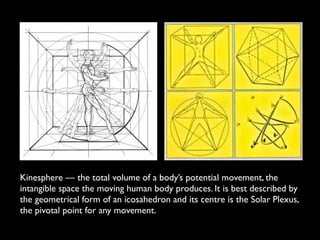
Kinesphere — the total volume of a body’s potential movement, the
intangible space the moving human body produces. It is best described by
the geometrical form of an icosahedron and its centre is the Solar Plexus,
the pivotal point for any movement.
“Movement is, so to speak, living
architecture – living in the sense
of changing emplacements as well
as changing cohesion.
The architecture is created by
human movements and is made up
of pathways tracing shapes in
space.“ (Rudolf Laban, Choreutics)
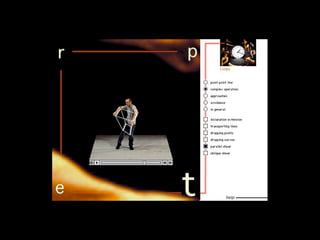
"As an architect I sit in front of my
computer, I click through
the different menus of the CD and
I get overwhelmed by a glaring
similarity to the interface of my
CAAD program." (Britta Callsen 1995)
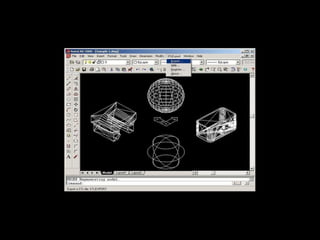
“With the CAAD program I construct a
building with lines, polygons, circles which
are basic geometric figures. I click the
command ‘line’ to define two points and I
draw a line between them.
In order to view it in the right position I
take the line and turn, twist, flip it in the
virtual space. It is the same operation
Forsythe demonstrates on his CD when
he describes the relationship between
parts of the body in motion.” (Britta Callsen)
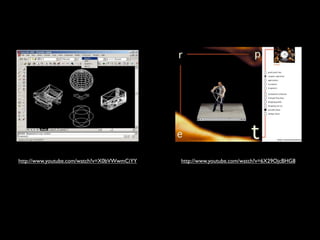
http://www.youtube.com/watch?v=X0bVWwmCiYY   http://www.youtube.com/watch?v=6X29OjcBHG8
“Dance and Architecture have much in common.
Both are concerned with practices of space. For
a dancer the act of choreography as a writing of
place occurs through the unfolding of spatial
dimensions through gesture and embodied
movement. For the architect space is the
medium through which form emerges and
habitation is constructed. For both, the first
space we experience is the space of the
body.” (Carol Brown, choreographer)
http://www.youtube.com/watch?v=RzQazjw-4jI&feature=player_embedded#
“Space lays down the law because it implies a
certain order [...] Space commands bodies,
prescribing or proscribing gestures, routes
and distances to be covered.”
(Henry Lefebvre, The Production of Space)
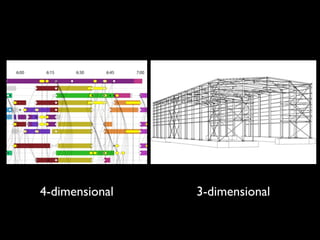
4-dimensional   3-dimensional
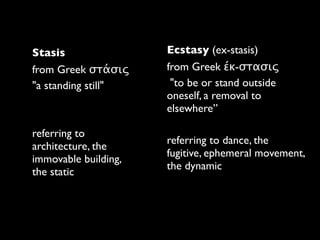
Stasis                Ecstasy (ex-stasis)
from Greek στάσις     from Greek έκ-στασις
"a standing still"     "to be or stand outside
                      oneself, a removal to
                      elsewhere”

referring to
                      referring to dance, the
architecture, the
                      fugitive, ephemeral movement,
immovable building,
                      the dynamic
the static
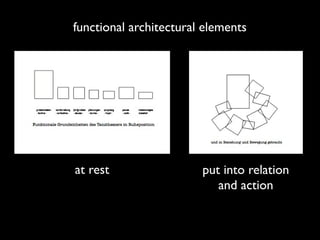
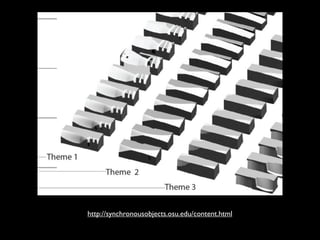
functional architectural elements


at rest                 put into relation
                           and action
http://synchronousobjects.osu.edu/content.html
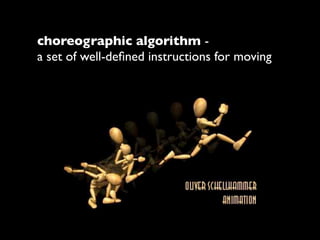
choreographic algorithm -
a set of well-defined instructions for moving
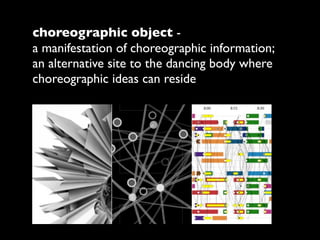
choreographic object -
a manifestation of choreographic information;
an alternative site to the dancing body where
choreographic ideas can reside
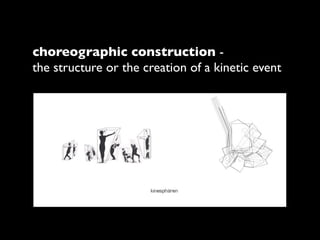
choreographic construction -
the structure or the creation of a kinetic event
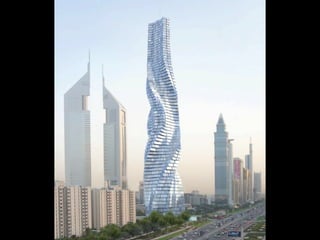
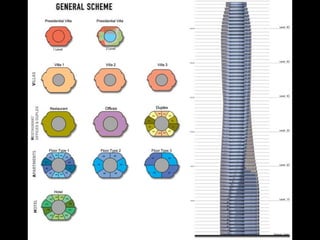
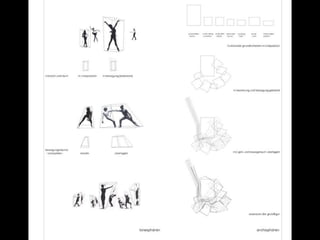
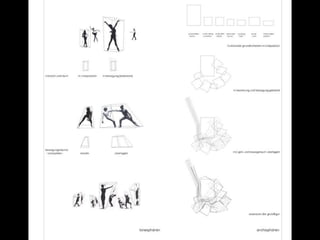
1. Design a 5 min’ choreographic
construction for 5 dancers based
on the architect’s drawings.
2. Form groups of 5 dancers and
choose a choreographic
construction, which none of you
has designed and stage it.
• Any choreographic piece is an
  architectural structure or construction.

• Any dancer is a body of geometric
  forms or architectural elements.

• Both can complement each other.

3 Architecture

  • 1.
    Dance is Architecture in Motion. About the shared vocabulary and concerns of seemingly opposite art forms.
  • 2.
    • Wk1: choreographicalgorithm • Wk2: choreographic object • Wk3: choreographic construction
  • 3.
  • 5.
    Kinesphere — thetotal volume of a body’s potential movement, the intangible space the moving human body produces. It is best described by the geometrical form of an icosahedron and its centre is the Solar Plexus, the pivotal point for any movement.
  • 6.
    “Movement is, soto speak, living architecture – living in the sense of changing emplacements as well as changing cohesion. The architecture is created by human movements and is made up of pathways tracing shapes in space.“ (Rudolf Laban, Choreutics)
  • 8.
    "As an architectI sit in front of my computer, I click through the different menus of the CD and I get overwhelmed by a glaring similarity to the interface of my CAAD program." (Britta Callsen 1995)
  • 10.
    “With the CAADprogram I construct a building with lines, polygons, circles which are basic geometric figures. I click the command ‘line’ to define two points and I draw a line between them. In order to view it in the right position I take the line and turn, twist, flip it in the virtual space. It is the same operation Forsythe demonstrates on his CD when he describes the relationship between parts of the body in motion.” (Britta Callsen)
  • 11.
    http://www.youtube.com/watch?v=X0bVWwmCiYY http://www.youtube.com/watch?v=6X29OjcBHG8
  • 12.
    “Dance and Architecturehave much in common. Both are concerned with practices of space. For a dancer the act of choreography as a writing of place occurs through the unfolding of spatial dimensions through gesture and embodied movement. For the architect space is the medium through which form emerges and habitation is constructed. For both, the first space we experience is the space of the body.” (Carol Brown, choreographer)
  • 13.
  • 17.
    “Space lays downthe law because it implies a certain order [...] Space commands bodies, prescribing or proscribing gestures, routes and distances to be covered.” (Henry Lefebvre, The Production of Space)
  • 18.
    4-dimensional 3-dimensional
  • 19.
    Stasis Ecstasy (ex-stasis) from Greek στάσις from Greek έκ-στασις "a standing still" "to be or stand outside oneself, a removal to elsewhere” referring to referring to dance, the architecture, the fugitive, ephemeral movement, immovable building, the dynamic the static
  • 21.
    functional architectural elements atrest put into relation and action
  • 23.
  • 30.
    choreographic algorithm - aset of well-defined instructions for moving
  • 31.
    choreographic object - amanifestation of choreographic information; an alternative site to the dancing body where choreographic ideas can reside
  • 32.
    choreographic construction - thestructure or the creation of a kinetic event
  • 33.
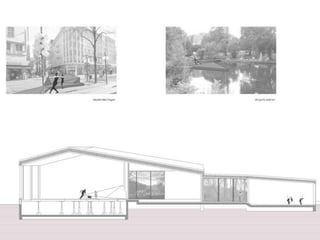
    1. Design a5 min’ choreographic construction for 5 dancers based on the architect’s drawings.
  • 34.
    2. Form groupsof 5 dancers and choose a choreographic construction, which none of you has designed and stage it.
  • 35.
    • Any choreographicpiece is an architectural structure or construction. • Any dancer is a body of geometric forms or architectural elements. • Both can complement each other.