Urbanization
and its
Impact on
Community
By Rohit Yadav
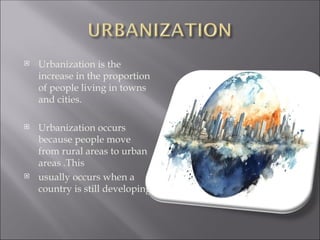
 Urbanization is the
increase in the proportion
of people living in towns
and cities.
 Urbanization occurs
because people move
from rural areas to urban
areas .This
 usually occurs when a
country is still developing.
 Rural to urban migration is happening on a
massive scale due to population pressure and lack
of resources in rural areas.
 People living in rural areas are “PULLED” to the
city. Often they believe that the standard of living
in urban areas will be much better in urban areas.
 For Education, jobs, entertainment, good medical
care, term for trade
 Natural increase caused by a decrease in death
rates while birth rates remain high
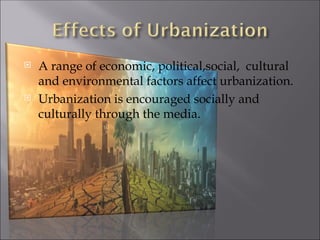
 A range of economic, political,social, cultural
and environmental factors affect urbanization.
 Urbanization is encouraged socially and
culturally through the media.
 As a city grows, the cost of housing and
infrastructure also grows, since there are less
water, land and building material available,and
greater congestion problems.As a city decays in
this way, governments often do not meet the
service needs of residents and urban
development is dominated by private capital.
 Unemployment grows,as do drug abuse,crime
and homelessness.
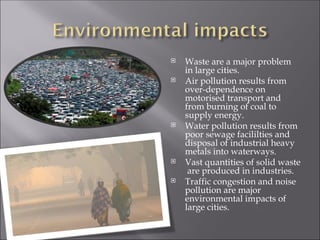
 Waste are a major problem
in large cities.
 Air pollution results from
over-dependence on
motorised transport and
from burning of coal to
supply energy.
 Water pollution results from
poor sewage facililties and
disposal of industrial heavy
metals into waterways.
 Vast quantities of solid waste
are produced in industries.
 Traffic congestion and noise
pollution are major
environmental impacts of
large cities.
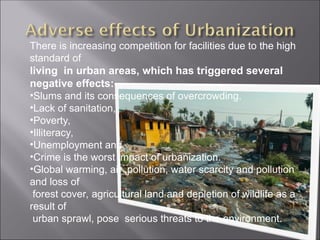
There is increasing competition for facilities due to the high
standard of
living in urban areas, which has triggered several
negative effects:-
•Slums and its consequences of overcrowding.
•Lack of sanitation,
•Poverty,
•Illiteracy,
•Unemployment and
•Crime is the worst impact of urbanization.
•Global warming, air ,pollution, water scarcity and pollution
and loss of
forest cover, agricultural land and depletion of wildlife as a
result of
urban sprawl, pose serious threats to the environment.
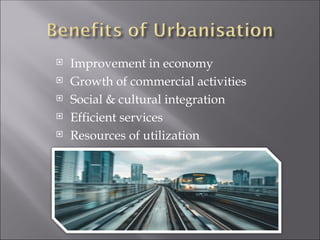
 Improvement in economy
 Growth of commercial activities
 Social & cultural integration
 Efficient services
 Resources of utilization
 The challenge facing the world today is to
Minimize the negative effects and build the
benefits .
Infrastructure needs to be improved.
Opportunities should be created within rural
areas to prevent migration to cities.
Urbanization and its Impact on Community

Urbanization and its Impact on Community

  • 1.
  • 2.
     Urbanization isthe increase in the proportion of people living in towns and cities.  Urbanization occurs because people move from rural areas to urban areas .This  usually occurs when a country is still developing.
  • 3.
     Rural tourban migration is happening on a massive scale due to population pressure and lack of resources in rural areas.  People living in rural areas are “PULLED” to the city. Often they believe that the standard of living in urban areas will be much better in urban areas.  For Education, jobs, entertainment, good medical care, term for trade  Natural increase caused by a decrease in death rates while birth rates remain high
  • 4.
     A rangeof economic, political,social, cultural and environmental factors affect urbanization.  Urbanization is encouraged socially and culturally through the media.
  • 5.
     As acity grows, the cost of housing and infrastructure also grows, since there are less water, land and building material available,and greater congestion problems.As a city decays in this way, governments often do not meet the service needs of residents and urban development is dominated by private capital.  Unemployment grows,as do drug abuse,crime and homelessness.
  • 6.
     Waste area major problem in large cities.  Air pollution results from over-dependence on motorised transport and from burning of coal to supply energy.  Water pollution results from poor sewage facililties and disposal of industrial heavy metals into waterways.  Vast quantities of solid waste are produced in industries.  Traffic congestion and noise pollution are major environmental impacts of large cities.
  • 7.
    There is increasingcompetition for facilities due to the high standard of living in urban areas, which has triggered several negative effects:- •Slums and its consequences of overcrowding. •Lack of sanitation, •Poverty, •Illiteracy, •Unemployment and •Crime is the worst impact of urbanization. •Global warming, air ,pollution, water scarcity and pollution and loss of forest cover, agricultural land and depletion of wildlife as a result of urban sprawl, pose serious threats to the environment.
  • 8.
     Improvement ineconomy  Growth of commercial activities  Social & cultural integration  Efficient services  Resources of utilization
  • 9.
     The challengefacing the world today is to Minimize the negative effects and build the benefits . Infrastructure needs to be improved. Opportunities should be created within rural areas to prevent migration to cities.