
TEKNOLOGI MEMBRAN
Nur Istianah-T.Membrani-2016
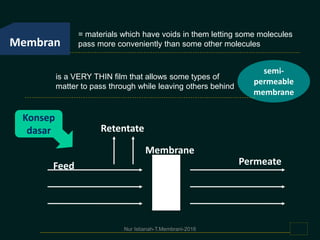
is a VERY THIN film that allows some types of
matter to pass through while leaving others behind
Membran
= materials which have voids in them letting some molecules
pass more conveniently than some other molecules
semi-
permeable
membrane
Retentate
Permeate
Membrane
Feed
Konsep
dasar
Nur Istianah-T.Membrani-2016
Driving force :
3. Voltage difference,
1. Pressure difference
2. Concentration difference
4. Temperature difference,
 RO
 UF
 MF
 Pervaporation
 Dialysis
 Membrane extraction
 Electrodialysis
 Membrane distillation
Nur Istianah-T.Membrani-2016
0.0001 0.001 0.01 0.1 1 10 100mm
hairCrypto-
sporidium
smallest
micro-
organis
m
polio
virus
Suspended solids
Parasites
Bacteria
Org. macro. molecules
Viruses
ColloidsDissolved salts
Sand filtration
Microfiltration
Ultrafiltration
Nanofiltration
Reverse Osmosis
ZW500: 0.04 umZW1000: 0.02 um
TYPES OF PROCESSES
Nur Istianah-T.Membrani-2016
Range of membrane capabilities
for food application
Nur Istianah-T.Membrani-2016
REVERSE OSMOSIS/ hyperfiltration
Nur Istianah-T.Membrani-2016
REVERSE OSMOSIS
• only remove some suspended materials larger
than 1 micron
• the process eliminates the dissolved solids,
bacteria, viruses and other germs contained in
the water
• only water molecules allowed to pass via very big
pressure
• assymmetric type membranes (decrease the
driving pressure of the flux)
• almost all membranes are made polymers,
cellulosic acetate and matic polyamide types
rated at 96%-99+% NaCl rejection
Nur Istianah-T.Membrani-2016
REVERSE OSMOSIS
• Applications in food industries:
– the concentration of whey from cheese
manufacture (the most use)
– concentrate and purify fruit juices (Robe, 1983),
enzymes, fermentation liquors and vegetable oils
– concentrate wheat starch, citric acid, egg white,
milk, coffee, syrups, natural extracts and flavours
– to clarify wine and beer
– to demineralise and purify water from boreholes
or rivers or by desalination of sea water.
Nur Istianah-T.Membrani-2016
REVERSE OSMOSIS
• ‘dealcoholisation’to produce low-alcohol beers,
cider and wines,
• recovery of proteins or other solids from
distillation residues, dilute juices,
• waste water from corn milling or other process
washwaters.
Nur Istianah-T.Membrani-2016
REVERSE OSMOSIS
• future directions:
– municipal and industrial waste treatment
– process water for boilers
– de-watering of feed streams
– processing high temperature feed- streams
Nur Istianah-T.Membrani-2016
MICROFILTRATION
• largest pores
• a sterile filtration with pores 0.1-10.0 microns
• micro-organisms cannot pass through them
• operated at low pressure differences
• used to filter particles.
• may or may not be assymmetric
• lower pressures than RO
Nur Istianah-T.Membrani-2016
• wide array of applications:
– parenterals and sterile water for
pharmaceutical industry
– food & beverages
– chemical industry
– microelectronics industry
– fermentation
– laboratory/analytical uses
MICROFILTRATION
Nur Istianah-T.Membrani-2016
MICROFILTRATION
• applications in the near future:
– biotechnology (concentration of biomass)
– diatomaceous earth displacement
– non-sewage waste treatment (removing
intractable particles in oily fluids)
– paints (separating solvents from pigments)
Nur Istianah-T.Membrani-2016
ULTRAFILTRATION
• to separate a solution; mixture of desirable
and undesirable components
• has smaller pores than microfiltration
membranes
• driving force → pressure differential (2-10 bars
to 25-30 bars)
• used to separate species with pore sizes 10-
1000 Å (103-0.1 microns)
• Can be obtained down to a a molecular weight
cutoff (MWCO) level of 1000 Daltons (Da) and
up to as high as 1 000 000 Da.
• assymmetric; the pores are small
Nur Istianah-T.Membrani-2016
• wide range of applications :
– oil emulsion waste treatment
– treatment of whey in dairy industries
– concentration of biological macromolecules
– electrocoat paint recovery
– concentration of textile sizing
– concentration of heat sensitive proteins for
food additives
– many more …
ULTRAFILTRATION
Nur Istianah-T.Membrani-2016
• wide range of applications in the near future:
– ultraflitration of milk
– bioprocessing (separation and concentration
of biologically active components)
– protein harvesting
– refining of oils
ULTRAFILTRATION
Nur Istianah-T.Membrani-2016
• Application in food processing:
– concentrate milk prior to the manufacture of dairy
products (the most use),
– To concentrate whey to 20% solids or selectively
to remove lactose and salts.
– In cheese manufacture, ultrafiltration has
advantages in producing a higher product yield
and nutritional value, simpler standardisation of
the solids content, lower rennet consumption and
easier processing.
ULTRAFILTRATION
Nur Istianah-T.Membrani-2016
• Application in food processing:
– concentration of sucrose and tomato paste
– treatment of still effluents in the brewing and distilling
industries
– separation and concentration of enzymes, other
proteins or pectin
– removal of protein hazes from honey and syrups
– treatment of process water to remove bacteria and
contaminants (greater than 0.003 m in diameter)
(Mackintosh, 1983)
– pre-treatment for reverse osmosis membranes to
prevent fouling by suspended organic materials and
colloidal materials.
ULTRAFILTRATION
Nur Istianah-T.Membrani-2016
NANOFILTRATION
• less pore sizes than ultrafiltration membranes
• the mass transfer mechanism is diffusion &
separate small molecules from the solution
(assymmetric)
• NF is
• capable of removing ions that contribute
significantly to the osmotic pressure
• Can be operated at lower pressures than RO
• cellulosic acetate and aromatic polyamide type
membranes (salt rejections; 95% for divalent salts
to 40% for monovalent salts)
• can typically operate at higher recoveries;
conserving total water usage due to a lower
concentrate stream flow rate (advantage over
reverse osmosis)
• not effective on small molecular weight organics
(e.g.methanol)
Nur Istianah-T.Membrani-2016
NANOFILTRATION
• typical applications:
– desalination of food, dairy and beverage
products or byproducts
– partial desalination of whey, UF permeate or
retentate as required
– desalination of dyes and optical brighteners
– purification of spent clean-in-place (CIP)
chemicals
– color reduction or manipulation of food products
– concentration of food, dairy and beverage
products or byproducts
– fermentation byproduct concentration
Nur Istianah-T.Membrani-2016
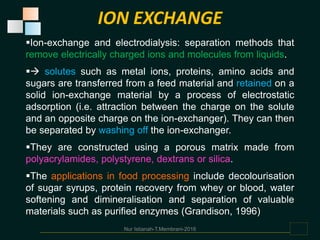
Ion-exchange and electrodialysis: separation methods that
remove electrically charged ions and molecules from liquids.
 solutes such as metal ions, proteins, amino acids and
sugars are transferred from a feed material and retained on a
solid ion-exchange material by a process of electrostatic
adsorption (i.e. attraction between the charge on the solute
and an opposite charge on the ion-exchanger). They can then
be separated by washing off the ion-exchanger.
They are constructed using a porous matrix made from
polyacrylamides, polystyrene, dextrans or silica.
The applications in food processing include decolourisation
of sugar syrups, protein recovery from whey or blood, water
softening and dimineralisation and separation of valuable
materials such as purified enzymes (Grandison, 1996)
Nur Istianah-T.Membrani-2016
ION EXCHANGE
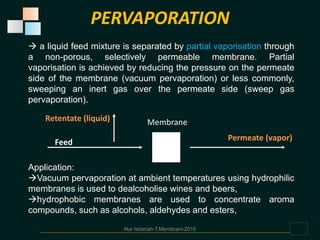
 a liquid feed mixture is separated by partial vaporisation through
a non-porous, selectively permeable membrane. Partial
vaporisation is achieved by reducing the pressure on the permeate
side of the membrane (vacuum pervaporation) or less commonly,
sweeping an inert gas over the permeate side (sweep gas
pervaporation).
Application:
Vacuum pervaporation at ambient temperatures using hydrophilic
membranes is used to dealcoholise wines and beers,
hydrophobic membranes are used to concentrate aroma
compounds, such as alcohols, aldehydes and esters,
Nur Istianah-T.Membrani-2016
PERVAPORATION
Retentate (liquid)
Permeate (vapor)
Membrane
Feed
Material of membrane
preferentially permit water permeation
(e.g. poly (vinyl alcohol) or cellulose acetate)
preferentially permit permeation of organic materials.
e.g. Poly (dimethylsiloxane) or poly (trimethylsilylpropyne)
Nur Istianah-T.Membrani-2016
The important factors in determining the
performance of a membrane
Thickness
Molecular
structure
Chemical
composition
Flat membranes
Spiral wound membranes
Hollow-fiber membranes
Very-small-diameter hollow fibers, the high-pressure feed enters
the shell side at one end and leaves at the other end (closed)
Membrane Configurations
Three basic structures are commonly uses for membranes:
homogeneous, asymmetric, and composite
Constructed from flat sheet membranes separated by spacer
screens, and susceptible to fouling by particulates
Nur Istianah-T.Membrani-2016
20
Flate
Spiral
Hollow
Nur Istianah-T.Membrani-2016
Tabel 1. Aplikasi Teknik Separasi Membran pada
Pengolahan Produk Pangan
No Teknik Proses Tujuan Proses Pustaka
1 Mikrofiltrasi Penghilangan pektin pada sari buah
apel
Zakoer and Mc.
Lelan (1993)
2 Ultrafiltrasi Pemurnian isolat protein kedelai Debra and Cheryan
(1981)
3 Ultrafiltrasi Penyederhanaan proses produksi sari
buah apel
Thomas, et.al.
(1986)
4 Ultrafiltrasi Pemisahan komponen kasein Woychik et.,al
(1992)
5 Ultrafiltrasi Penurunan kandungan bakteri pada
kecap
Tien and Chiang
(1992)
6 Ultrafiltrasi &
reverse osmosis
Pengembangan berbagai produk tepung
protein dari kacang tanah
Lawhon, et., al
(1981)
Nur Istianah-T.Membrani-2016
Advantages :
 Continuous separation
 Low energy requirement
 Meet various separation demands
 reduce the loss of volatiles or changes to
nutritional or eating quality of food
 simple installation with lower labour and
operating costs
Nur Istianah-T.Membrani-2016
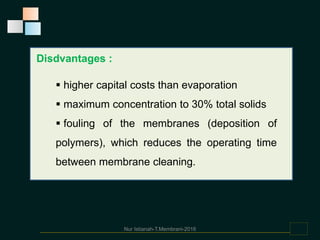
Disdvantages :
 higher capital costs than evaporation
 maximum concentration to 30% total solids
 fouling of the membranes (deposition of
polymers), which reduces the operating time
between membrane cleaning.
Nur Istianah-T.Membrani-2016
Movement of molecules through reverse osmosis
membranes is by diffusion and not by liquid flow. The
molecules dissolve at one face of the membrane, are
transported through it and then removed from the
other face. The flow rate of liquid (the ‘transport rate’
or ‘flux’) is determined by the solubility and diffusivity
of the molecules in the membrane material, and by
the difference between the osmotic pressure of the
liquid and the applied pressure.
Nur Istianah-T.Membrani-2016
Diffusivity
Membrane
thickness
Conceentration and molar
volume of solvent
K (ΔP – Δπ )
Osmotic pressure
applied pressure
Flux (in kg/h.m2)
J =NA
P(Pa) : trans-membrane pressure,
Pf(Pa) : pressure of the feed (inlet),
Pr(Pa) : pressure of the retentate (outlet) (high molecular
weight fraction) and
Pp (Pa) : pressure of the permeate (low molecular weight
fraction)
The pressure difference across the membrane (the trans-
membrane pressure) is found using:
Nur Istianah-T.Membrani-2016
Equations in membrane
................... (1)
Water flux increases with an increase in applied
pressure, increased permeability of the membrane and
lower solute concentration in the feed stream.
Jw(kg/h) = solvent (water) flux,
K(kg / m2.h.Pa) = mass transfer coefficient/permeability const.
A(m2) = area of the membrane,
Δ P(Pa) = applied pressure and
Δπ(Pa) = change in osmotic pressure.
Osmotic pressure is found for dilute solutions using:
π = MRT
Jw = kA (ΔP – Δπ)
Nur Istianah-T.Membrani-2016
................... (2)
................... (3)
M=molarity, T(K), R= 8.314 kPa.m3mol-1K-1
Nur Istianah-T.Membrani-2016
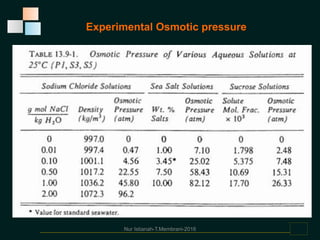
Experimental Osmotic pressure
Larger solutes become concentrated at the membrane
surface. The flux is therefore controlled by the applied
pressure, and the solute concentrations in the bulk of the
liquid and at the membrane surface:
Js= solute flux
c1= concentration of solutes at the membrane
c2= concentration of solutes in the liquid
Nur Istianah-T.Membrani-2016
................... (4)
Js = kA ln (c1 / c2)
Nur Istianah-T.Membrani-2016
Contoh soal
Hitunglah tekanan osmotic larutan yang mengandung
0.10 mmol NaCl/kg H2O pada suhu 25°C dengan
densitas air 997.0 kg/m3.
Penyelesaian:
RT
V
n
MRT
m


m
Vm 
kPa
x
28.494
997/1
)15.298)(314.8(102 4



Nur Istianah-T.Membrani-2016
Contoh soal
Jus buah yang mengandung 9% w/w partikel padat
(solid) telah diberi perlakuan pre-concentration
pada 35°C dengan reverse osmosis untuk
kemudian dilakukan ‘concentration’ pada
evaporator. Jika tekanan operasi RO adalah 4000
kPa dan koefisien transfer massa sebesar 6.3x10⁻³
kg.m-2h-1kPa-1, hitung luasan area membran yang
diperlukan untuk menghilangkan 5 ton permeate
selama 8 jam. (asumsikan mayoritas partikel padat
berbentuk sucrose dan konstanta gas universal (R=
8.314 kPa.m3mol-1K-1)
Nur Istianah-T.Membrani-2016
Penyelesaian:
Molar concentration (M) = concentration (kg/m3) : molecular weight
M = 90/342 = 264 mol m-3 = 0.264 mol/L
Tekanan osmotic (persamaan 3)
π = 0.264 x 8.314 (35+273) = 676 kPa
Flux (kg/jam feed): J = 5000 kg / 8 jam = 625 kg/jam
Persamaan 2:
625 = 6.3x10⁻³. A (4000 – 676)
A = 29.9 m2 = 30 m2
Nur Istianah-T.Membrani-2016
Latihan soal
Hitunglah tekanan osmotic larutan berikut pada suhu
25°C dengan densitas air 997.0 kg/m3.
(a) Larutan 0.5 mmol NaCl/kg H2O
(b) Larutan 1.0 g sucrose/kg H2O
(c) Larutan 1.0 g MgCl2/kg H2O
Nur Istianah-T.Membrani-2016
Latihan soal
Sebuah membran cellulose-acetate dengan area
4x10⁻³ m2 digunakan pada suhu 25°C untuk
menentukan konstanta permeabilitas RO larutan
garam yang mengandung 12 kg NaCl/m3 (ρ=1005.5
kg/m3) dan dihasilkan produk larutan dengan
konsentrasi 0.486 kg NaCl/m3 (ρ=997.3 kg/m3). Flow
rate produk adalah 3.84x10⁻⁸ m3/s dan tekanan
operasi sebesar 56.0 atm. Hitunglah konstanta
permeabilitas RO tersebut!
Densitas air pada 25°C adalah 997 kg/m3
#Bagaimana pengaruh kenaikan suhu sebesar 30 K
pada flow rate produk jika dioperasikan pada tekanan
sama!
THANKS FOR YOUR ATTENTION
The best person is one give something useful always
Nur Istianah-T.Membrani-2016
Hitunglah tekanan osmotic larutan berikut pada suhu
25°C dengan densitas air 997.0 kg/m3.
(a) Larutan 0.5 g mol NaCl/kg H2O
(b) Larutan 1.0 g sucrose/kg H2O
(c) Larutan 1.0 g MgCl2/kg H2O
Jawaban:
(a) = (0.5/58.5)*997*298.15 =

Kp3 membran

  • 1.
  • 2.
    is a VERYTHIN film that allows some types of matter to pass through while leaving others behind Membran = materials which have voids in them letting some molecules pass more conveniently than some other molecules semi- permeable membrane Retentate Permeate Membrane Feed Konsep dasar Nur Istianah-T.Membrani-2016
  • 3.
    Driving force : 3.Voltage difference, 1. Pressure difference 2. Concentration difference 4. Temperature difference,  RO  UF  MF  Pervaporation  Dialysis  Membrane extraction  Electrodialysis  Membrane distillation Nur Istianah-T.Membrani-2016
  • 4.
    0.0001 0.001 0.010.1 1 10 100mm hairCrypto- sporidium smallest micro- organis m polio virus Suspended solids Parasites Bacteria Org. macro. molecules Viruses ColloidsDissolved salts Sand filtration Microfiltration Ultrafiltration Nanofiltration Reverse Osmosis ZW500: 0.04 umZW1000: 0.02 um TYPES OF PROCESSES Nur Istianah-T.Membrani-2016
  • 5.
    Range of membranecapabilities for food application Nur Istianah-T.Membrani-2016
  • 6.
    REVERSE OSMOSIS/ hyperfiltration NurIstianah-T.Membrani-2016
  • 7.
    REVERSE OSMOSIS • onlyremove some suspended materials larger than 1 micron • the process eliminates the dissolved solids, bacteria, viruses and other germs contained in the water • only water molecules allowed to pass via very big pressure • assymmetric type membranes (decrease the driving pressure of the flux) • almost all membranes are made polymers, cellulosic acetate and matic polyamide types rated at 96%-99+% NaCl rejection Nur Istianah-T.Membrani-2016
  • 8.
    REVERSE OSMOSIS • Applicationsin food industries: – the concentration of whey from cheese manufacture (the most use) – concentrate and purify fruit juices (Robe, 1983), enzymes, fermentation liquors and vegetable oils – concentrate wheat starch, citric acid, egg white, milk, coffee, syrups, natural extracts and flavours – to clarify wine and beer – to demineralise and purify water from boreholes or rivers or by desalination of sea water. Nur Istianah-T.Membrani-2016
  • 9.
    REVERSE OSMOSIS • ‘dealcoholisation’toproduce low-alcohol beers, cider and wines, • recovery of proteins or other solids from distillation residues, dilute juices, • waste water from corn milling or other process washwaters. Nur Istianah-T.Membrani-2016
  • 10.
    REVERSE OSMOSIS • futuredirections: – municipal and industrial waste treatment – process water for boilers – de-watering of feed streams – processing high temperature feed- streams Nur Istianah-T.Membrani-2016
  • 11.
    MICROFILTRATION • largest pores •a sterile filtration with pores 0.1-10.0 microns • micro-organisms cannot pass through them • operated at low pressure differences • used to filter particles. • may or may not be assymmetric • lower pressures than RO Nur Istianah-T.Membrani-2016
  • 12.
    • wide arrayof applications: – parenterals and sterile water for pharmaceutical industry – food & beverages – chemical industry – microelectronics industry – fermentation – laboratory/analytical uses MICROFILTRATION Nur Istianah-T.Membrani-2016
  • 13.
  • 14.
    MICROFILTRATION • applications inthe near future: – biotechnology (concentration of biomass) – diatomaceous earth displacement – non-sewage waste treatment (removing intractable particles in oily fluids) – paints (separating solvents from pigments) Nur Istianah-T.Membrani-2016
  • 15.
    ULTRAFILTRATION • to separatea solution; mixture of desirable and undesirable components • has smaller pores than microfiltration membranes • driving force → pressure differential (2-10 bars to 25-30 bars) • used to separate species with pore sizes 10- 1000 Å (103-0.1 microns) • Can be obtained down to a a molecular weight cutoff (MWCO) level of 1000 Daltons (Da) and up to as high as 1 000 000 Da. • assymmetric; the pores are small Nur Istianah-T.Membrani-2016
  • 16.
    • wide rangeof applications : – oil emulsion waste treatment – treatment of whey in dairy industries – concentration of biological macromolecules – electrocoat paint recovery – concentration of textile sizing – concentration of heat sensitive proteins for food additives – many more … ULTRAFILTRATION Nur Istianah-T.Membrani-2016
  • 17.
    • wide rangeof applications in the near future: – ultraflitration of milk – bioprocessing (separation and concentration of biologically active components) – protein harvesting – refining of oils ULTRAFILTRATION Nur Istianah-T.Membrani-2016
  • 18.
    • Application infood processing: – concentrate milk prior to the manufacture of dairy products (the most use), – To concentrate whey to 20% solids or selectively to remove lactose and salts. – In cheese manufacture, ultrafiltration has advantages in producing a higher product yield and nutritional value, simpler standardisation of the solids content, lower rennet consumption and easier processing. ULTRAFILTRATION Nur Istianah-T.Membrani-2016
  • 19.
    • Application infood processing: – concentration of sucrose and tomato paste – treatment of still effluents in the brewing and distilling industries – separation and concentration of enzymes, other proteins or pectin – removal of protein hazes from honey and syrups – treatment of process water to remove bacteria and contaminants (greater than 0.003 m in diameter) (Mackintosh, 1983) – pre-treatment for reverse osmosis membranes to prevent fouling by suspended organic materials and colloidal materials. ULTRAFILTRATION Nur Istianah-T.Membrani-2016
  • 20.
  • 21.
    NANOFILTRATION • less poresizes than ultrafiltration membranes • the mass transfer mechanism is diffusion & separate small molecules from the solution (assymmetric) • NF is • capable of removing ions that contribute significantly to the osmotic pressure • Can be operated at lower pressures than RO • cellulosic acetate and aromatic polyamide type membranes (salt rejections; 95% for divalent salts to 40% for monovalent salts) • can typically operate at higher recoveries; conserving total water usage due to a lower concentrate stream flow rate (advantage over reverse osmosis) • not effective on small molecular weight organics (e.g.methanol) Nur Istianah-T.Membrani-2016
  • 22.
    NANOFILTRATION • typical applications: –desalination of food, dairy and beverage products or byproducts – partial desalination of whey, UF permeate or retentate as required – desalination of dyes and optical brighteners – purification of spent clean-in-place (CIP) chemicals – color reduction or manipulation of food products – concentration of food, dairy and beverage products or byproducts – fermentation byproduct concentration Nur Istianah-T.Membrani-2016
  • 23.
    Ion-exchange and electrodialysis:separation methods that remove electrically charged ions and molecules from liquids.  solutes such as metal ions, proteins, amino acids and sugars are transferred from a feed material and retained on a solid ion-exchange material by a process of electrostatic adsorption (i.e. attraction between the charge on the solute and an opposite charge on the ion-exchanger). They can then be separated by washing off the ion-exchanger. They are constructed using a porous matrix made from polyacrylamides, polystyrene, dextrans or silica. The applications in food processing include decolourisation of sugar syrups, protein recovery from whey or blood, water softening and dimineralisation and separation of valuable materials such as purified enzymes (Grandison, 1996) Nur Istianah-T.Membrani-2016 ION EXCHANGE
  • 24.
     a liquidfeed mixture is separated by partial vaporisation through a non-porous, selectively permeable membrane. Partial vaporisation is achieved by reducing the pressure on the permeate side of the membrane (vacuum pervaporation) or less commonly, sweeping an inert gas over the permeate side (sweep gas pervaporation). Application: Vacuum pervaporation at ambient temperatures using hydrophilic membranes is used to dealcoholise wines and beers, hydrophobic membranes are used to concentrate aroma compounds, such as alcohols, aldehydes and esters, Nur Istianah-T.Membrani-2016 PERVAPORATION Retentate (liquid) Permeate (vapor) Membrane Feed
  • 25.
    Material of membrane preferentiallypermit water permeation (e.g. poly (vinyl alcohol) or cellulose acetate) preferentially permit permeation of organic materials. e.g. Poly (dimethylsiloxane) or poly (trimethylsilylpropyne) Nur Istianah-T.Membrani-2016
  • 26.
  • 27.
    Nur Istianah-T.Membrani-2016 The importantfactors in determining the performance of a membrane Thickness Molecular structure Chemical composition
  • 28.
    Flat membranes Spiral woundmembranes Hollow-fiber membranes Very-small-diameter hollow fibers, the high-pressure feed enters the shell side at one end and leaves at the other end (closed) Membrane Configurations Three basic structures are commonly uses for membranes: homogeneous, asymmetric, and composite Constructed from flat sheet membranes separated by spacer screens, and susceptible to fouling by particulates Nur Istianah-T.Membrani-2016
  • 29.
  • 30.
  • 31.
    Tabel 1. AplikasiTeknik Separasi Membran pada Pengolahan Produk Pangan No Teknik Proses Tujuan Proses Pustaka 1 Mikrofiltrasi Penghilangan pektin pada sari buah apel Zakoer and Mc. Lelan (1993) 2 Ultrafiltrasi Pemurnian isolat protein kedelai Debra and Cheryan (1981) 3 Ultrafiltrasi Penyederhanaan proses produksi sari buah apel Thomas, et.al. (1986) 4 Ultrafiltrasi Pemisahan komponen kasein Woychik et.,al (1992) 5 Ultrafiltrasi Penurunan kandungan bakteri pada kecap Tien and Chiang (1992) 6 Ultrafiltrasi & reverse osmosis Pengembangan berbagai produk tepung protein dari kacang tanah Lawhon, et., al (1981) Nur Istianah-T.Membrani-2016
  • 32.
    Advantages :  Continuousseparation  Low energy requirement  Meet various separation demands  reduce the loss of volatiles or changes to nutritional or eating quality of food  simple installation with lower labour and operating costs Nur Istianah-T.Membrani-2016
  • 33.
    Disdvantages :  highercapital costs than evaporation  maximum concentration to 30% total solids  fouling of the membranes (deposition of polymers), which reduces the operating time between membrane cleaning. Nur Istianah-T.Membrani-2016
  • 34.
    Movement of moleculesthrough reverse osmosis membranes is by diffusion and not by liquid flow. The molecules dissolve at one face of the membrane, are transported through it and then removed from the other face. The flow rate of liquid (the ‘transport rate’ or ‘flux’) is determined by the solubility and diffusivity of the molecules in the membrane material, and by the difference between the osmotic pressure of the liquid and the applied pressure. Nur Istianah-T.Membrani-2016
  • 35.
    Nur Istianah-T.Membrani-2016 Diffusivity Membrane thickness Conceentration andmolar volume of solvent K (ΔP – Δπ ) Osmotic pressure applied pressure Flux (in kg/h.m2) J =NA
  • 36.
    P(Pa) : trans-membranepressure, Pf(Pa) : pressure of the feed (inlet), Pr(Pa) : pressure of the retentate (outlet) (high molecular weight fraction) and Pp (Pa) : pressure of the permeate (low molecular weight fraction) The pressure difference across the membrane (the trans- membrane pressure) is found using: Nur Istianah-T.Membrani-2016 Equations in membrane ................... (1)
  • 37.
    Water flux increaseswith an increase in applied pressure, increased permeability of the membrane and lower solute concentration in the feed stream. Jw(kg/h) = solvent (water) flux, K(kg / m2.h.Pa) = mass transfer coefficient/permeability const. A(m2) = area of the membrane, Δ P(Pa) = applied pressure and Δπ(Pa) = change in osmotic pressure. Osmotic pressure is found for dilute solutions using: π = MRT Jw = kA (ΔP – Δπ) Nur Istianah-T.Membrani-2016 ................... (2) ................... (3) M=molarity, T(K), R= 8.314 kPa.m3mol-1K-1
  • 38.
  • 39.
    Larger solutes becomeconcentrated at the membrane surface. The flux is therefore controlled by the applied pressure, and the solute concentrations in the bulk of the liquid and at the membrane surface: Js= solute flux c1= concentration of solutes at the membrane c2= concentration of solutes in the liquid Nur Istianah-T.Membrani-2016 ................... (4) Js = kA ln (c1 / c2)
  • 40.
    Nur Istianah-T.Membrani-2016 Contoh soal Hitunglahtekanan osmotic larutan yang mengandung 0.10 mmol NaCl/kg H2O pada suhu 25°C dengan densitas air 997.0 kg/m3. Penyelesaian: RT V n MRT m   m Vm  kPa x 28.494 997/1 )15.298)(314.8(102 4   
  • 41.
    Nur Istianah-T.Membrani-2016 Contoh soal Jusbuah yang mengandung 9% w/w partikel padat (solid) telah diberi perlakuan pre-concentration pada 35°C dengan reverse osmosis untuk kemudian dilakukan ‘concentration’ pada evaporator. Jika tekanan operasi RO adalah 4000 kPa dan koefisien transfer massa sebesar 6.3x10⁻³ kg.m-2h-1kPa-1, hitung luasan area membran yang diperlukan untuk menghilangkan 5 ton permeate selama 8 jam. (asumsikan mayoritas partikel padat berbentuk sucrose dan konstanta gas universal (R= 8.314 kPa.m3mol-1K-1)
  • 42.
    Nur Istianah-T.Membrani-2016 Penyelesaian: Molar concentration(M) = concentration (kg/m3) : molecular weight M = 90/342 = 264 mol m-3 = 0.264 mol/L Tekanan osmotic (persamaan 3) π = 0.264 x 8.314 (35+273) = 676 kPa Flux (kg/jam feed): J = 5000 kg / 8 jam = 625 kg/jam Persamaan 2: 625 = 6.3x10⁻³. A (4000 – 676) A = 29.9 m2 = 30 m2
  • 43.
    Nur Istianah-T.Membrani-2016 Latihan soal Hitunglahtekanan osmotic larutan berikut pada suhu 25°C dengan densitas air 997.0 kg/m3. (a) Larutan 0.5 mmol NaCl/kg H2O (b) Larutan 1.0 g sucrose/kg H2O (c) Larutan 1.0 g MgCl2/kg H2O
  • 44.
    Nur Istianah-T.Membrani-2016 Latihan soal Sebuahmembran cellulose-acetate dengan area 4x10⁻³ m2 digunakan pada suhu 25°C untuk menentukan konstanta permeabilitas RO larutan garam yang mengandung 12 kg NaCl/m3 (ρ=1005.5 kg/m3) dan dihasilkan produk larutan dengan konsentrasi 0.486 kg NaCl/m3 (ρ=997.3 kg/m3). Flow rate produk adalah 3.84x10⁻⁸ m3/s dan tekanan operasi sebesar 56.0 atm. Hitunglah konstanta permeabilitas RO tersebut! Densitas air pada 25°C adalah 997 kg/m3 #Bagaimana pengaruh kenaikan suhu sebesar 30 K pada flow rate produk jika dioperasikan pada tekanan sama!
  • 45.
    THANKS FOR YOURATTENTION The best person is one give something useful always Nur Istianah-T.Membrani-2016
  • 46.
  • 47.
    Nur Istianah-T.Membrani-2016 Hitunglah tekananosmotic larutan berikut pada suhu 25°C dengan densitas air 997.0 kg/m3. (a) Larutan 0.5 g mol NaCl/kg H2O (b) Larutan 1.0 g sucrose/kg H2O (c) Larutan 1.0 g MgCl2/kg H2O Jawaban: (a) = (0.5/58.5)*997*298.15 =