Teacher Training and Educational Studies
Sebelas Maret University
M. Masykuri_Physical Chemistry IV
Sep, 2010
01/30/15 1
Dr. M. Masykuri, M.Si.
Chemical Education Study Program
Teacher Training and Educational Studies
Sebelas Maret University (UNS)
Website: http://masykuri.staf.fkip.uns.ac.id,
email: mmasykuri@yahoo.com
Solo, Sep 2010
Kimia Fisika IV
Teacher Training and Educational Studies
Sebelas Maret University
M. Masykuri_Physical Chemistry IV
Sep, 2010
Rate of Reaction
Consider a chemical reaction having the overall
stoichiometry:
aA + bB → cC + dD
The Rate of Reaction is defined as
Experimentally we find that
k = rate coefficient
Ci = Concentration of Reactant “i” or [i]
γi = Order of reaction with respect to reactant “i”
Teacher Training and Educational Studies
Sebelas Maret University
M. Masykuri_Physical Chemistry IV
Sep, 2010
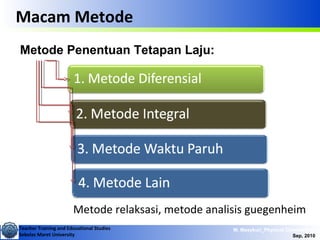
Macam Metode
Metode Penentuan Tetapan Laju:
Metode relaksasi, metode analisis guegenheim
Teacher Training and Educational Studies
Sebelas Maret University
M. Masykuri_Physical Chemistry IV
Sep, 2010
Metode Diferensial
• Data dikumpulkan sebagai laju perubahan
konsentrasi/waktu terhadap konsentrasi reaktan.
• Contoh dasar persamaan bagi reaksi dengan 2 reaktan:
aA + bB → produk
qp
BAk
dt
Ad
r ][][
][
=−=
]ln[]ln[ln
][
lnln BqApk
dt
Ad
r ++=





−=
• Dibuat kurva ln r terhadap ln [A] atau ln [B]
Teacher Training and Educational Studies
Sebelas Maret University
M. Masykuri_Physical Chemistry IV
Sep, 2010
Metode Diferensial
]ln[]ln[ln
][
lnln BqApk
dt
Ad
r ++=





−=
• Kurva ln r terhadap ln [A]
]ln['lnln Apkr +=
Orde reaksi terhadap A = p, diperoleh dari slope = tg α
Tetapan laju k, diperoleh dari intersep grafik
Orde reaksi terhadap A = p, diperoleh dari slope = tg α
Tetapan laju k, diperoleh dari intersep grafik
Slope = tg α
= p
]ln[ln'ln BqkkIntersep +==
Teacher Training and Educational Studies
Sebelas Maret University
M. Masykuri_Physical Chemistry IV
Sep, 2010
Metode Diferensial
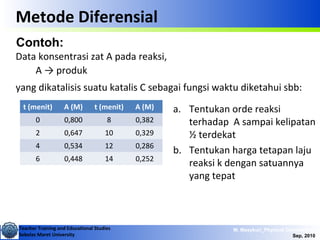
Data konsentrasi zat A pada reaksi,
yang dikatalisis suatu katalis C sebagai fungsi waktu diketahui sbb:
A → produk
Contoh:
t (menit) A (M) t (menit) A (M)
0 0,800 8 0,382
2 0,647 10 0,329
4 0,534 12 0,286
6 0,448 14 0,252
a. Tentukan orde reaksi
terhadap A sampai kelipatan
½ terdekat
b. Tentukan harga tetapan laju
reaksi k dengan satuannya
yang tepat
Teacher Training and Educational Studies
Sebelas Maret University
M. Masykuri_Physical Chemistry IV
Sep, 2010
Metode Integral
• Bersifat trial and error (empiris), yaitu dengan
memasukkan data pada persamaan laju bentuk integral.
• Jika harga k relatif tetap (konstan), maka orde reaksinya
sesuai.
• Penentuan empiris orde reaksi terhadap reaktan:
– Orde nol
– Orde pertama
– Orde kedua tipe I
– Orde kedua tipe II
– Prde ketiga
Teacher Training and Educational Studies
Sebelas Maret University
M. Masykuri_Physical Chemistry IV
Sep, 2010
Metode Integral
• The rate of the reaction is independent of the
concentration of the reacting substance
Zero Order Reactions
A → products
∫∫ −=
−=
=−
dtkAd
k
dt
Ad
k
dt
Ad
A
A
][
][ 0
][
][
][
[A]t - [A]0 = - kt
The reaction half-time t1/2 is the time
required for the concentration to
decrease to one-half of its initial value.
Teacher Training and Educational Studies
Sebelas Maret University
M. Masykuri_Physical Chemistry IV
Sep, 2010
Metode Integral
Zero Order Reactions
Grafik [A] versus t,
Persamaan grafik,
Slope = - k
Intersep = [A]0
Waktu paruh,
Teacher Training and Educational Studies
Sebelas Maret University
M. Masykuri_Physical Chemistry IV
Sep, 2010
Metode Integral
First Order Reactions
The rate of the reaction is proportional to the first power of the
concentration of the reacting substance (order = 1)
A → products
∫∫ −=
−=
=−
dtk
A
Ad
kdt
A
Ad
Ak
dt
Ad
A
A
][
][ 0
][
][
][
][
][
][
Examples:
• decay of radioactive nuclei fluorescence
• decay of electronically excited molecules
• isomerization of cyclobutene to butadiene
• milk turns sour when left out overnight
Teacher Training and Educational Studies
Sebelas Maret University
M. Masykuri_Physical Chemistry IV
Sep, 2010
Metode Integral
First Order Reactions
Grafik ln [A] versus t,
Persamaan grafik,
Buktikan bahwa,
Teacher Training and Educational Studies
Sebelas Maret University
M. Masykuri_Physical Chemistry IV
Sep, 2010
Metode Integral
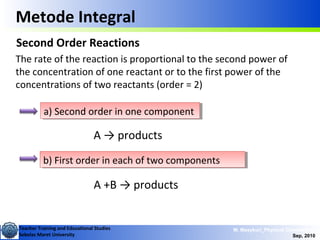
Second Order Reactions
The rate of the reaction is proportional to the second power of
the concentration of one reactant or to the first power of the
concentrations of two reactants (order = 2)
a) Second order in one componenta) Second order in one component
A → products
b) First order in each of two componentsb) First order in each of two components
A +B → products
Teacher Training and Educational Studies
Sebelas Maret University
M. Masykuri_Physical Chemistry IV
Sep, 2010
Metode Integral
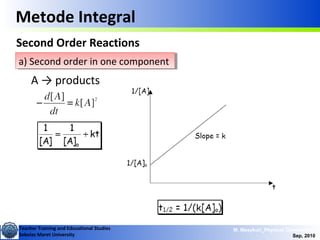
Second Order Reactions
a) Second order in one componenta) Second order in one component
A → products
Teacher Training and Educational Studies
Sebelas Maret University
M. Masykuri_Physical Chemistry IV
Sep, 2010
b) First order in each of two componentsb) First order in each of two components
Metode Integral
Second Order Reactions
A +B → products
Special cases:
i) [A]o = [B]o
ii) [B]o <<[A]o
Teacher Training and Educational Studies
Sebelas Maret University
M. Masykuri_Physical Chemistry IV
Sep, 2010
b) First order in each of two componentsb) First order in each of two components
Metode Integral
Second Order Reactions
Special cases (cont.):
i) [A]o = [B]o ii) [B]o <<[A]o
This is like 2nd order in
one component
Where,
This is called a pseudo
1st order reaction
Teacher Training and Educational Studies
Sebelas Maret University
M. Masykuri_Physical Chemistry IV
Sep, 2010
Metode Integral
Third Order Reactions
Several possible cases. Could be:
(a) three identical chemical molecules interact simultaneously
(unusual)
(a) three identical chemical molecules interact simultaneously
(unusual)
(b) two molecules of one species interact with one of another(b) two molecules of one species interact with one of another
(c) three different chemical species interact with each other(c) three different chemical species interact with each other
Teacher Training and Educational Studies
Sebelas Maret University
M. Masykuri_Physical Chemistry IV
Sep, 2010
Metode Integral
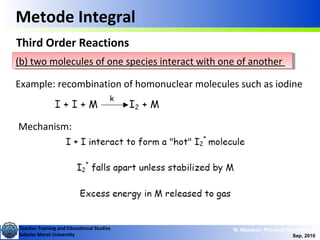
Third Order Reactions
(b) two molecules of one species interact with one of another(b) two molecules of one species interact with one of another
Example: recombination of homonuclear molecules such as iodine
Mechanism:
Teacher Training and Educational Studies
Sebelas Maret University
M. Masykuri_Physical Chemistry IV
Sep, 2010
Metode Integral
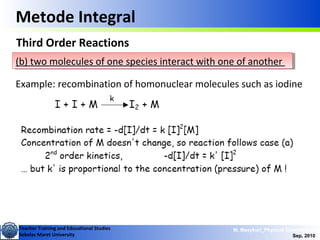
Third Order Reactions
(b) two molecules of one species interact with one of another(b) two molecules of one species interact with one of another
Example: recombination of homonuclear molecules such as iodine
Teacher Training and Educational Studies
Sebelas Maret University
M. Masykuri_Physical Chemistry IV
Sep, 2010
Metode Integral
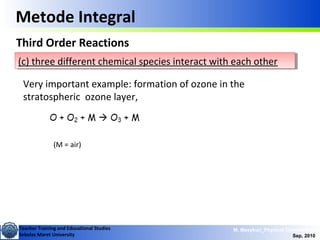
Third Order Reactions
(c) three different chemical species interact with each other(c) three different chemical species interact with each other
Very important example: formation of ozone in the
stratospheric ozone layer,
(M = air)

modul persamaan laju reaksi

  • 1.
    Teacher Training andEducational Studies Sebelas Maret University M. Masykuri_Physical Chemistry IV Sep, 2010 01/30/15 1 Dr. M. Masykuri, M.Si. Chemical Education Study Program Teacher Training and Educational Studies Sebelas Maret University (UNS) Website: http://masykuri.staf.fkip.uns.ac.id, email: mmasykuri@yahoo.com Solo, Sep 2010 Kimia Fisika IV
  • 2.
    Teacher Training andEducational Studies Sebelas Maret University M. Masykuri_Physical Chemistry IV Sep, 2010 Rate of Reaction Consider a chemical reaction having the overall stoichiometry: aA + bB → cC + dD The Rate of Reaction is defined as Experimentally we find that k = rate coefficient Ci = Concentration of Reactant “i” or [i] γi = Order of reaction with respect to reactant “i”
  • 3.
    Teacher Training andEducational Studies Sebelas Maret University M. Masykuri_Physical Chemistry IV Sep, 2010 Macam Metode Metode Penentuan Tetapan Laju: Metode relaksasi, metode analisis guegenheim
  • 4.
    Teacher Training andEducational Studies Sebelas Maret University M. Masykuri_Physical Chemistry IV Sep, 2010 Metode Diferensial • Data dikumpulkan sebagai laju perubahan konsentrasi/waktu terhadap konsentrasi reaktan. • Contoh dasar persamaan bagi reaksi dengan 2 reaktan: aA + bB → produk qp BAk dt Ad r ][][ ][ =−= ]ln[]ln[ln ][ lnln BqApk dt Ad r ++=      −= • Dibuat kurva ln r terhadap ln [A] atau ln [B]
  • 5.
    Teacher Training andEducational Studies Sebelas Maret University M. Masykuri_Physical Chemistry IV Sep, 2010 Metode Diferensial ]ln[]ln[ln ][ lnln BqApk dt Ad r ++=      −= • Kurva ln r terhadap ln [A] ]ln['lnln Apkr += Orde reaksi terhadap A = p, diperoleh dari slope = tg α Tetapan laju k, diperoleh dari intersep grafik Orde reaksi terhadap A = p, diperoleh dari slope = tg α Tetapan laju k, diperoleh dari intersep grafik Slope = tg α = p ]ln[ln'ln BqkkIntersep +==
  • 6.
    Teacher Training andEducational Studies Sebelas Maret University M. Masykuri_Physical Chemistry IV Sep, 2010 Metode Diferensial Data konsentrasi zat A pada reaksi, yang dikatalisis suatu katalis C sebagai fungsi waktu diketahui sbb: A → produk Contoh: t (menit) A (M) t (menit) A (M) 0 0,800 8 0,382 2 0,647 10 0,329 4 0,534 12 0,286 6 0,448 14 0,252 a. Tentukan orde reaksi terhadap A sampai kelipatan ½ terdekat b. Tentukan harga tetapan laju reaksi k dengan satuannya yang tepat
  • 7.
    Teacher Training andEducational Studies Sebelas Maret University M. Masykuri_Physical Chemistry IV Sep, 2010 Metode Integral • Bersifat trial and error (empiris), yaitu dengan memasukkan data pada persamaan laju bentuk integral. • Jika harga k relatif tetap (konstan), maka orde reaksinya sesuai. • Penentuan empiris orde reaksi terhadap reaktan: – Orde nol – Orde pertama – Orde kedua tipe I – Orde kedua tipe II – Prde ketiga
  • 8.
    Teacher Training andEducational Studies Sebelas Maret University M. Masykuri_Physical Chemistry IV Sep, 2010 Metode Integral • The rate of the reaction is independent of the concentration of the reacting substance Zero Order Reactions A → products ∫∫ −= −= =− dtkAd k dt Ad k dt Ad A A ][ ][ 0 ][ ][ ][ [A]t - [A]0 = - kt The reaction half-time t1/2 is the time required for the concentration to decrease to one-half of its initial value.
  • 9.
    Teacher Training andEducational Studies Sebelas Maret University M. Masykuri_Physical Chemistry IV Sep, 2010 Metode Integral Zero Order Reactions Grafik [A] versus t, Persamaan grafik, Slope = - k Intersep = [A]0 Waktu paruh,
  • 10.
    Teacher Training andEducational Studies Sebelas Maret University M. Masykuri_Physical Chemistry IV Sep, 2010 Metode Integral First Order Reactions The rate of the reaction is proportional to the first power of the concentration of the reacting substance (order = 1) A → products ∫∫ −= −= =− dtk A Ad kdt A Ad Ak dt Ad A A ][ ][ 0 ][ ][ ][ ][ ][ ][ Examples: • decay of radioactive nuclei fluorescence • decay of electronically excited molecules • isomerization of cyclobutene to butadiene • milk turns sour when left out overnight
  • 11.
    Teacher Training andEducational Studies Sebelas Maret University M. Masykuri_Physical Chemistry IV Sep, 2010 Metode Integral First Order Reactions Grafik ln [A] versus t, Persamaan grafik, Buktikan bahwa,
  • 12.
    Teacher Training andEducational Studies Sebelas Maret University M. Masykuri_Physical Chemistry IV Sep, 2010 Metode Integral Second Order Reactions The rate of the reaction is proportional to the second power of the concentration of one reactant or to the first power of the concentrations of two reactants (order = 2) a) Second order in one componenta) Second order in one component A → products b) First order in each of two componentsb) First order in each of two components A +B → products
  • 13.
    Teacher Training andEducational Studies Sebelas Maret University M. Masykuri_Physical Chemistry IV Sep, 2010 Metode Integral Second Order Reactions a) Second order in one componenta) Second order in one component A → products
  • 14.
    Teacher Training andEducational Studies Sebelas Maret University M. Masykuri_Physical Chemistry IV Sep, 2010 b) First order in each of two componentsb) First order in each of two components Metode Integral Second Order Reactions A +B → products Special cases: i) [A]o = [B]o ii) [B]o <<[A]o
  • 15.
    Teacher Training andEducational Studies Sebelas Maret University M. Masykuri_Physical Chemistry IV Sep, 2010 b) First order in each of two componentsb) First order in each of two components Metode Integral Second Order Reactions Special cases (cont.): i) [A]o = [B]o ii) [B]o <<[A]o This is like 2nd order in one component Where, This is called a pseudo 1st order reaction
  • 16.
    Teacher Training andEducational Studies Sebelas Maret University M. Masykuri_Physical Chemistry IV Sep, 2010 Metode Integral Third Order Reactions Several possible cases. Could be: (a) three identical chemical molecules interact simultaneously (unusual) (a) three identical chemical molecules interact simultaneously (unusual) (b) two molecules of one species interact with one of another(b) two molecules of one species interact with one of another (c) three different chemical species interact with each other(c) three different chemical species interact with each other
  • 17.
    Teacher Training andEducational Studies Sebelas Maret University M. Masykuri_Physical Chemistry IV Sep, 2010 Metode Integral Third Order Reactions (b) two molecules of one species interact with one of another(b) two molecules of one species interact with one of another Example: recombination of homonuclear molecules such as iodine Mechanism:
  • 18.
    Teacher Training andEducational Studies Sebelas Maret University M. Masykuri_Physical Chemistry IV Sep, 2010 Metode Integral Third Order Reactions (b) two molecules of one species interact with one of another(b) two molecules of one species interact with one of another Example: recombination of homonuclear molecules such as iodine
  • 19.
    Teacher Training andEducational Studies Sebelas Maret University M. Masykuri_Physical Chemistry IV Sep, 2010 Metode Integral Third Order Reactions (c) three different chemical species interact with each other(c) three different chemical species interact with each other Very important example: formation of ozone in the stratospheric ozone layer, (M = air)