#atlassian
Knowledge-Centered Support (KCSSM) 
The knowledge management 
methodology that works! 
JOHN CUSTY • MANAGING CONSULTANT • JPC GROUP • @ITSMNINJA
Agenda 
INTRO TO KCS 
SUPPORT-DEMAND CURVE 
BENEFITS & PRACTICES 
KCS PROBLEM SOLVING MODEL
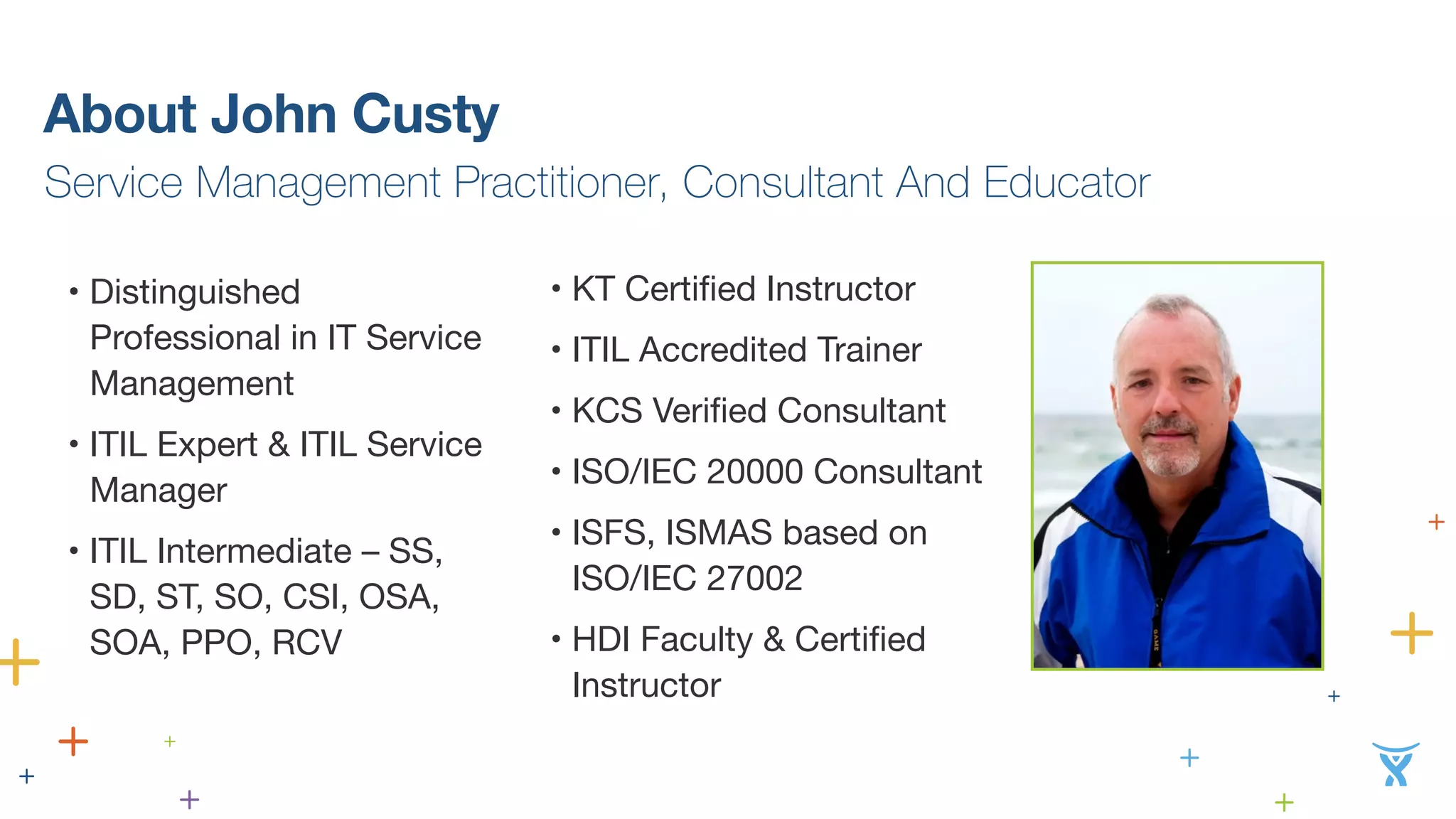
About John Custy 
Service Management Practitioner, Consultant And Educator 
• Distinguished 
Professional in IT Service 
Management 
• ITIL Expert & ITIL Service 
Manager 
• ITIL Intermediate – SS, 
SD, ST, SO, CSI, OSA, 
SOA, PPO, RCV 
• KT Certified Instructor 
• ITIL Accredited Trainer 
• KCS Verified Consultant 
• ISO/IEC 20000 Consultant 
• ISFS, ISMAS based on 
ISO/IEC 27002 
• HDI Faculty & Certified 
Instructor
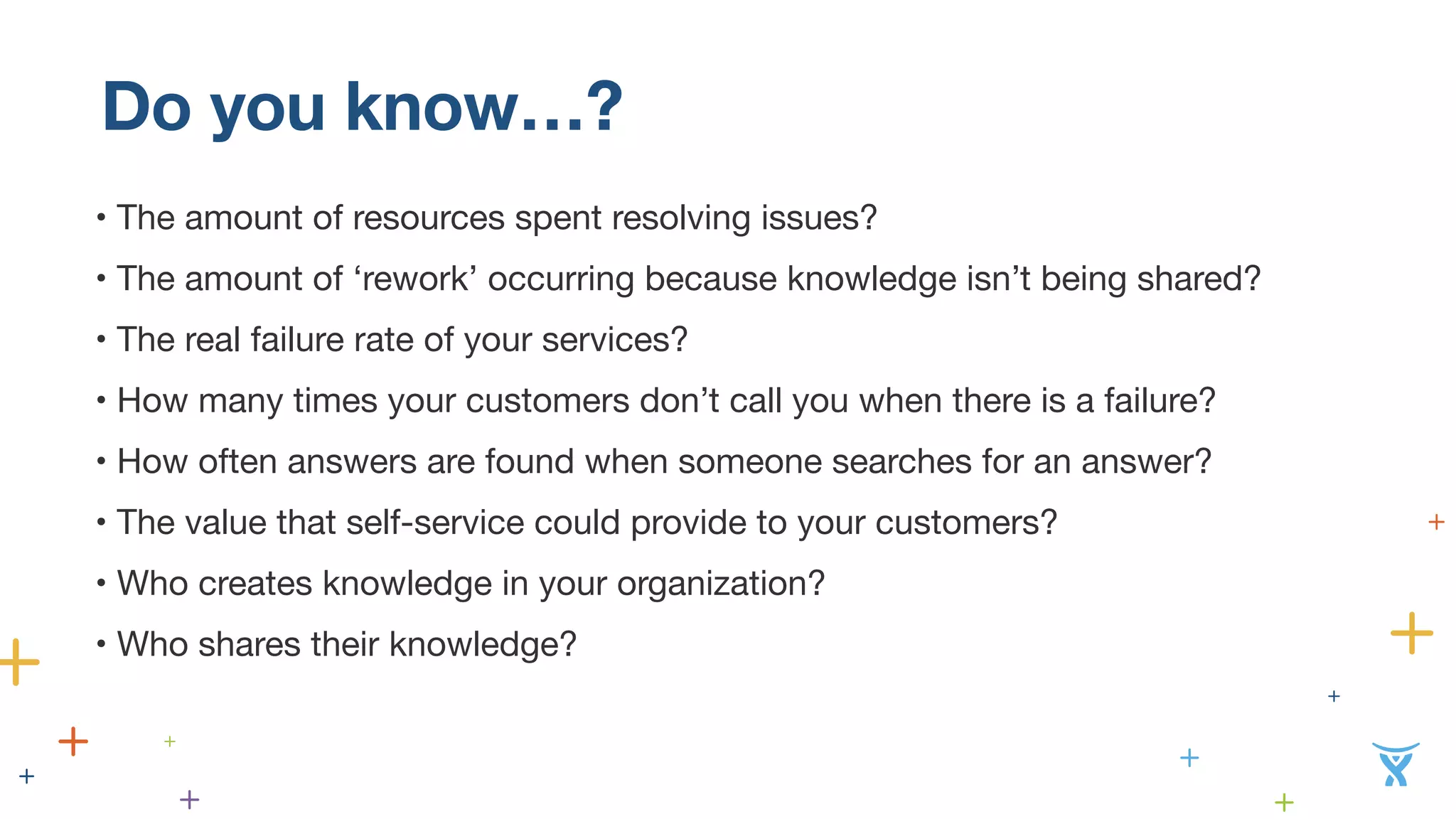
Do you know…?
Do you know…? 
• The amount of resources spent resolving issues? 
• The amount of ‘rework’ occurring because knowledge isn’t being shared? 
• The real failure rate of your services? 
• How many times your customers don’t call you when there is a failure? 
• How often answers are found when someone searches for an answer? 
• The value that self-service could provide to your customers? 
• Who creates knowledge in your organization? 
• Who shares their knowledge?
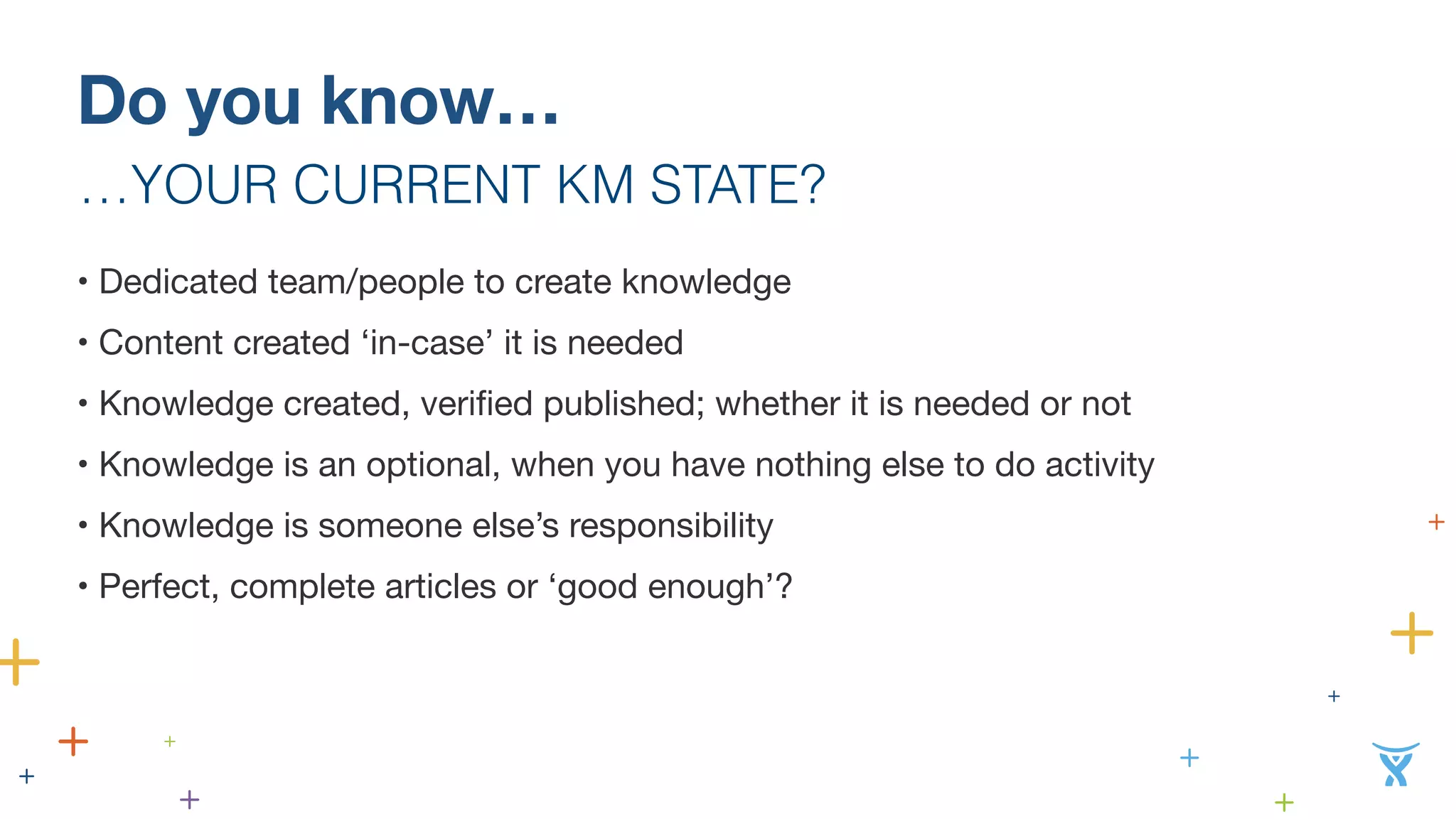
Do you know… 
…YOUR CURRENT KM STATE?
Do you know… 
…YOUR CURRENT KM STATE? 
• Dedicated team/people to create knowledge 
• Content created ‘in-case’ it is needed 
• Knowledge created, verified published; whether it is needed or not 
• Knowledge is an optional, when you have nothing else to do activity 
• Knowledge is someone else’s responsibility 
• Perfect, complete articles or ‘good enough’?
Why your organization 
needs knowledge 
management
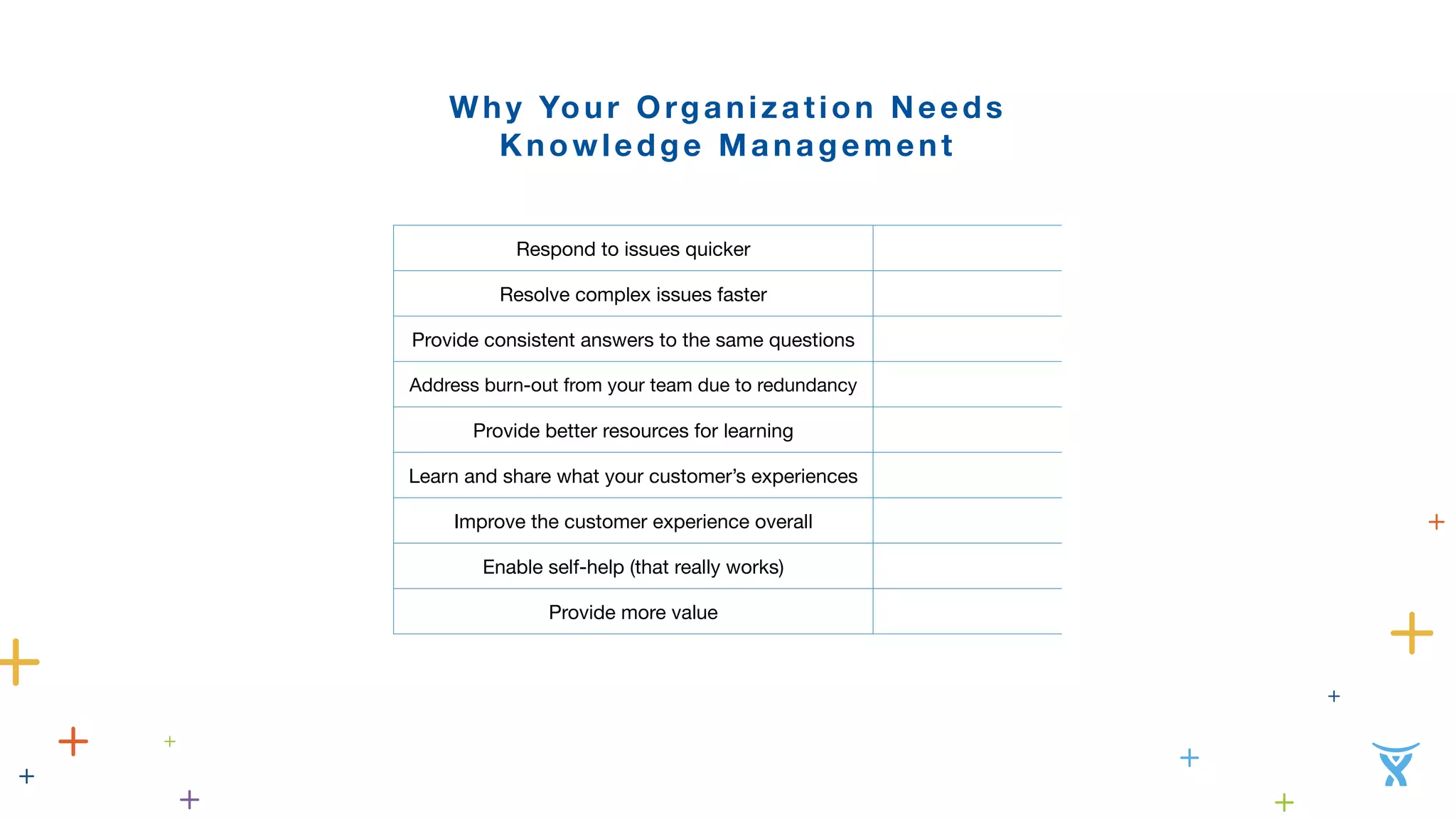
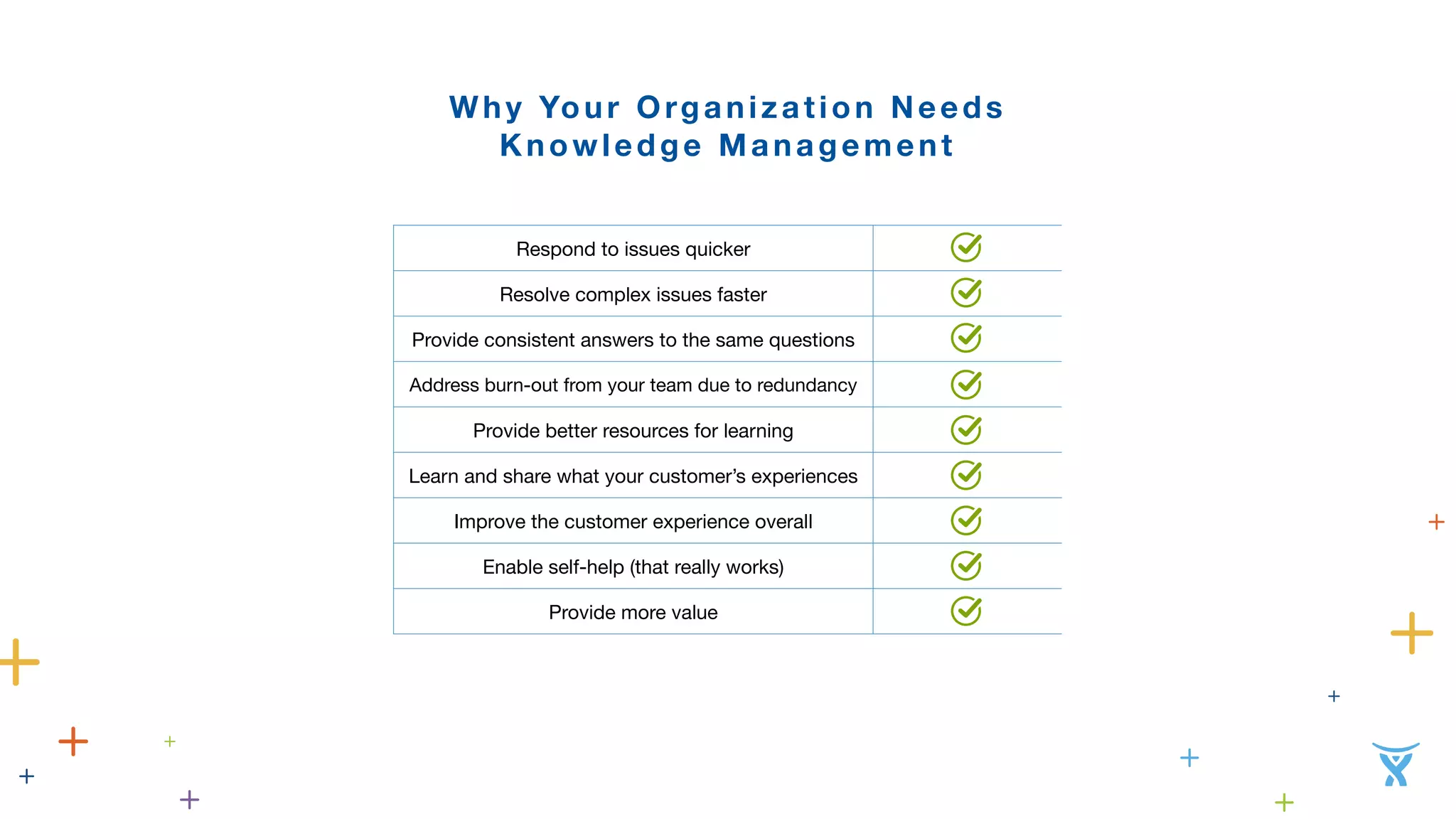
Why Your Organization Needs 
Knowledge Management 
Respond to issues quicker 
Resolve complex issues faster 
Provide consistent answers to the same questions 
Address burn-out from your team due to redundancy 
Provide better resources for learning 
Learn and share what your customer’s experiences 
Improve the customer experience overall 
Enable self-help (that really works) 
Provide more value 
COLUMN TITLE COLUMN TITLE
Why Your Organization Needs 
Knowledge Management 
Respond to issues quicker 
Resolve complex issues faster 
Provide consistent answers to the same questions 
Address burn-out from your team due to redundancy 
Provide better resources for learning 
Learn and share what your customer’s experiences 
Improve the customer experience overall 
Enable self-help (that really works) 
Provide more value 
COLUMN TITLE COLUMN TITLE
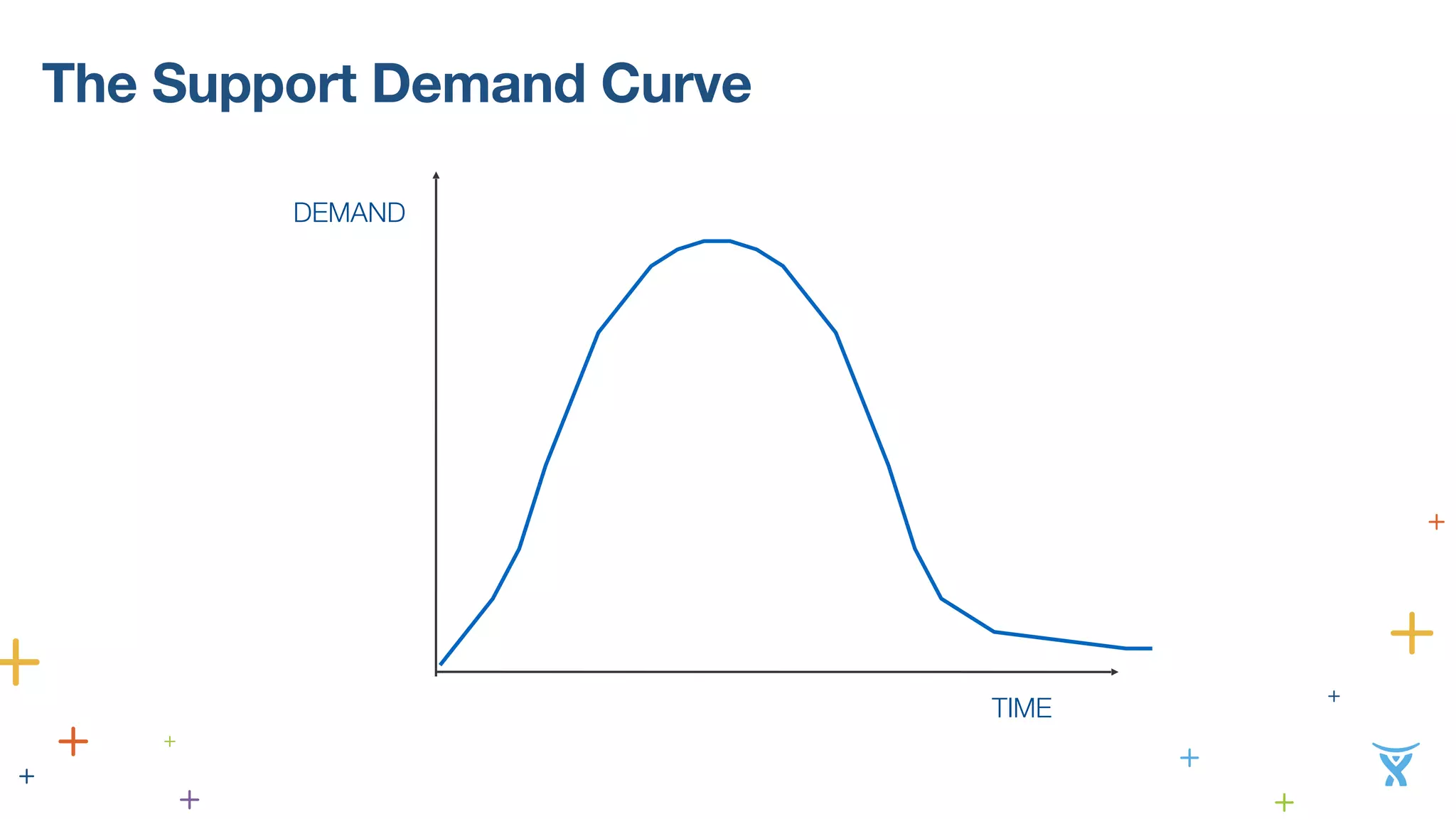
The Support Demand Curve 
DEMAND
The Support Demand Curve 
TIME 
DEMAND
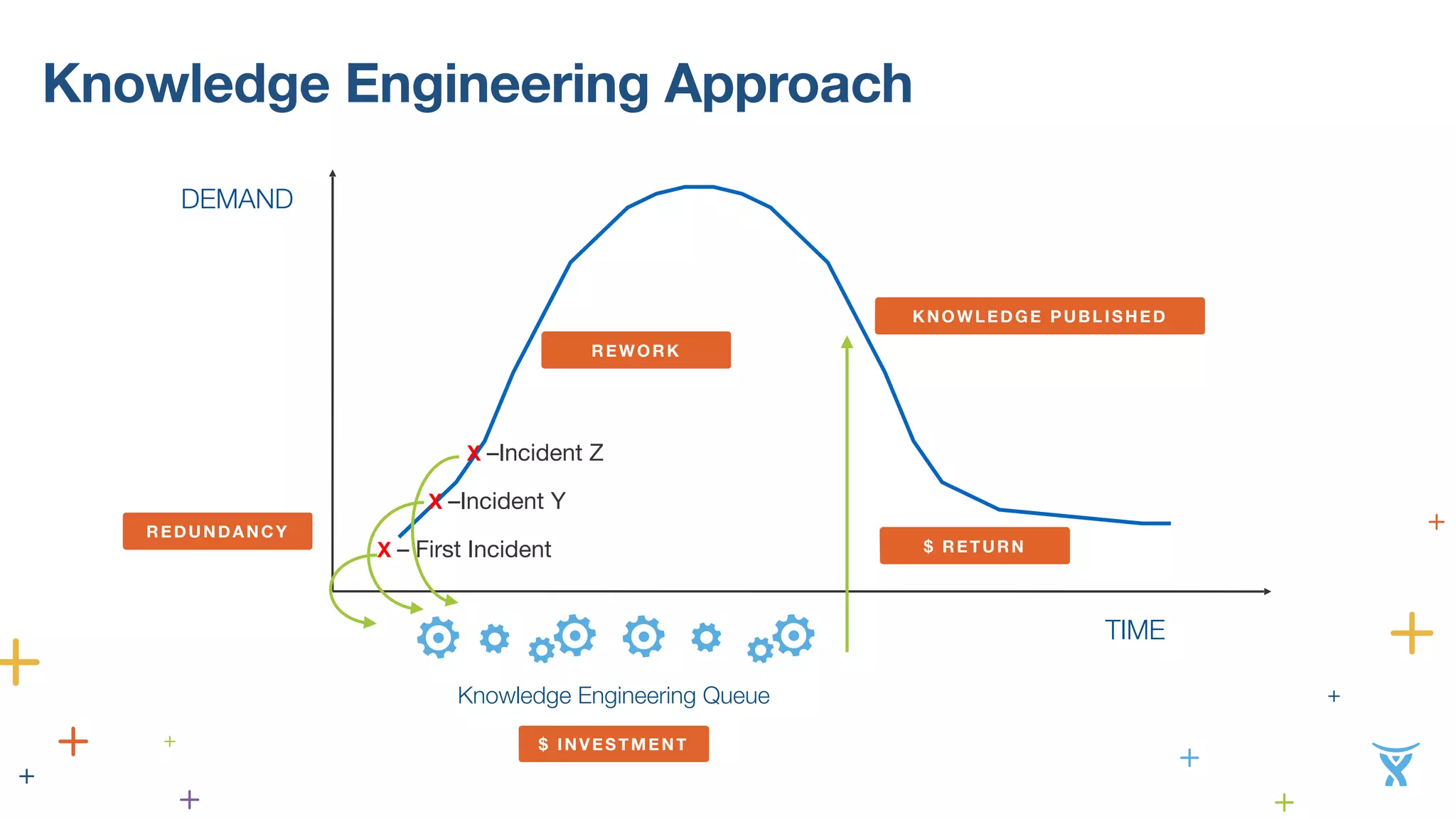
Knowledge Engineering Approach 
TIME 
DEMAND 
Knowledge Engineering Queue
Knowledge Engineering Approach 
TIME 
DEMAND 
REWORK 
X –Incident Z 
X –Incident Y 
X – First Incident 
Knowledge Engineering Queue 
$ RETURN 
REDUNDANCY 
$ INVESTMENT 
KNOWLEDGE PUBLISHED
Knowledge Centered Support 
TIME 
DEMAND
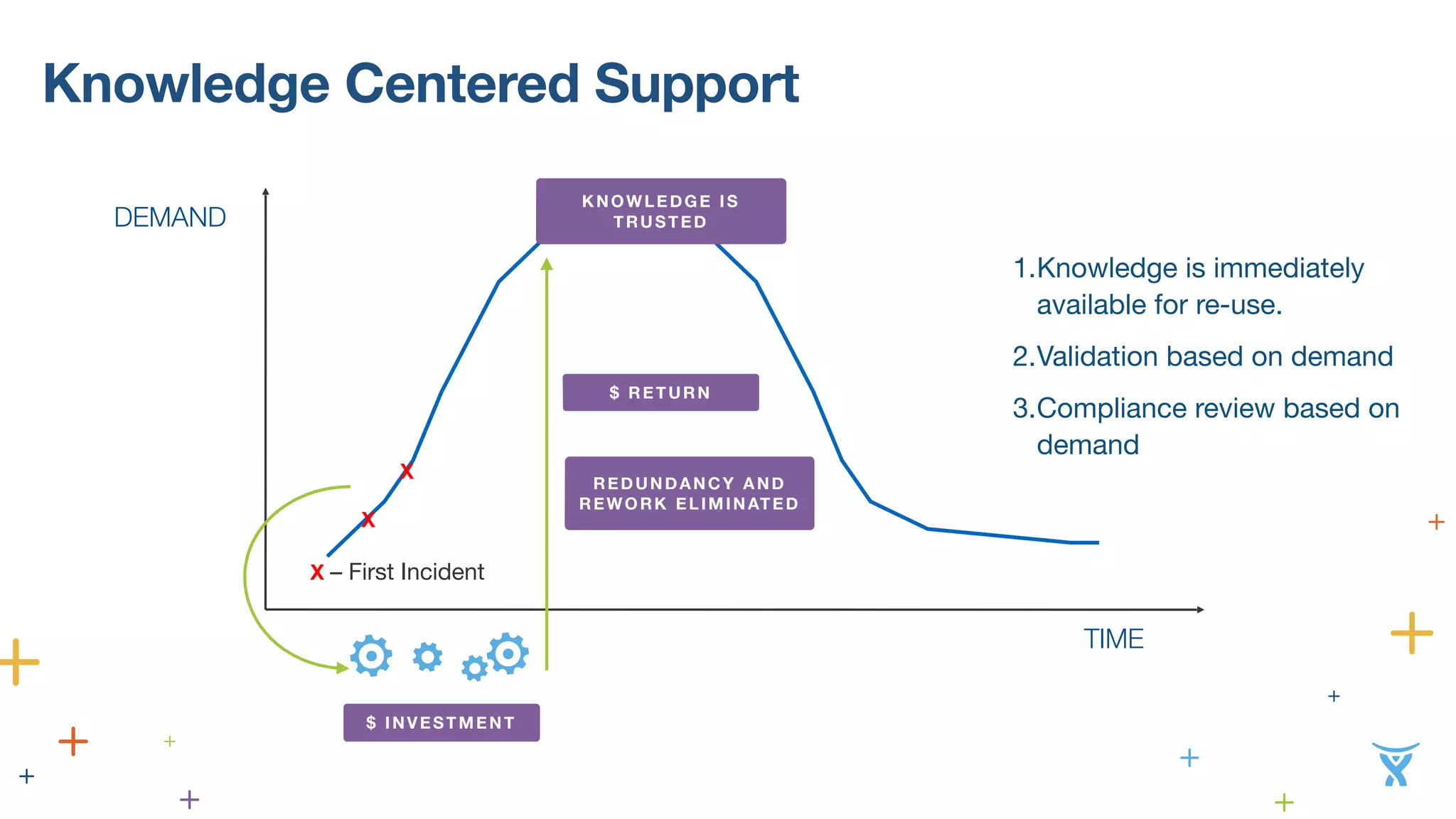
Knowledge Centered Support 
TIME 
DEMAND 
X 
KNOWLEDGE IS 
TRUSTED 
$ RETURN 
X REDUNDANCY AND 
X – First Incident 
REWORK ELIMINATED 
$ INVESTMENT 
1.Knowledge is immediately 
available for re-use. 
2.Validation based on demand 
3.Compliance review based on 
demand
Knowledge Management Best Practice @ITSMNinja
Knowledge Management Best Practice 
• Content is created as a by-product of resolving issues 
• Content is evolved based on demand 
• Knowledge is the collective, collaborative experience 
of the team 
• People and teams are rewarded for learning, 
collaboration, sharing and improving 
@ITSMNinja
Knowledge Centered Support is a 
methodology and set of practices that 
focuses on knowledge as a key asset 
of the organization.
KCS is not something we do in addition 
to solving issues, KCS becomes 
the way in which we resolve issues.
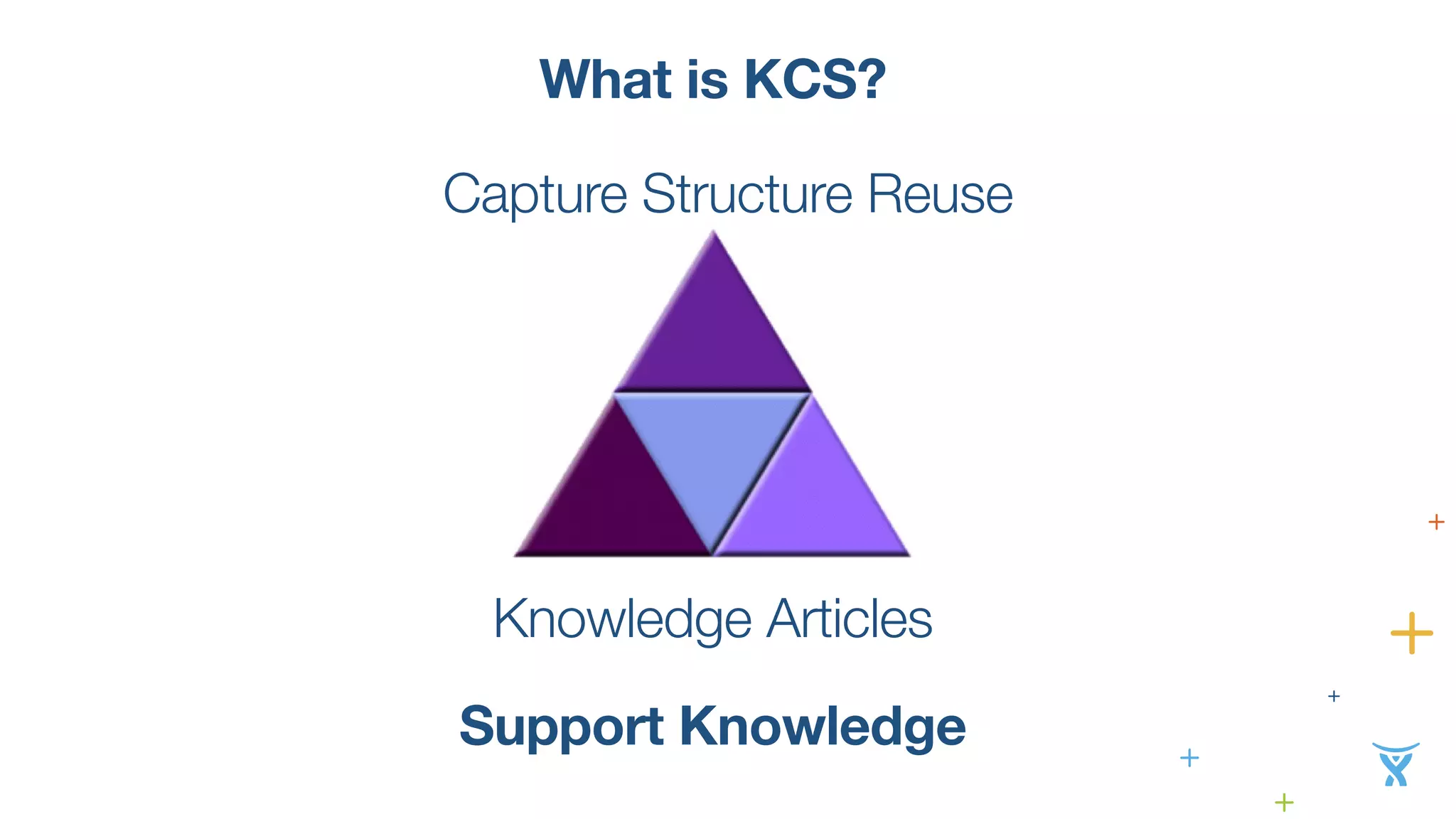
What is KCS? 
Capture Structure Reuse 
Knowledge Articles 
Support Knowledge
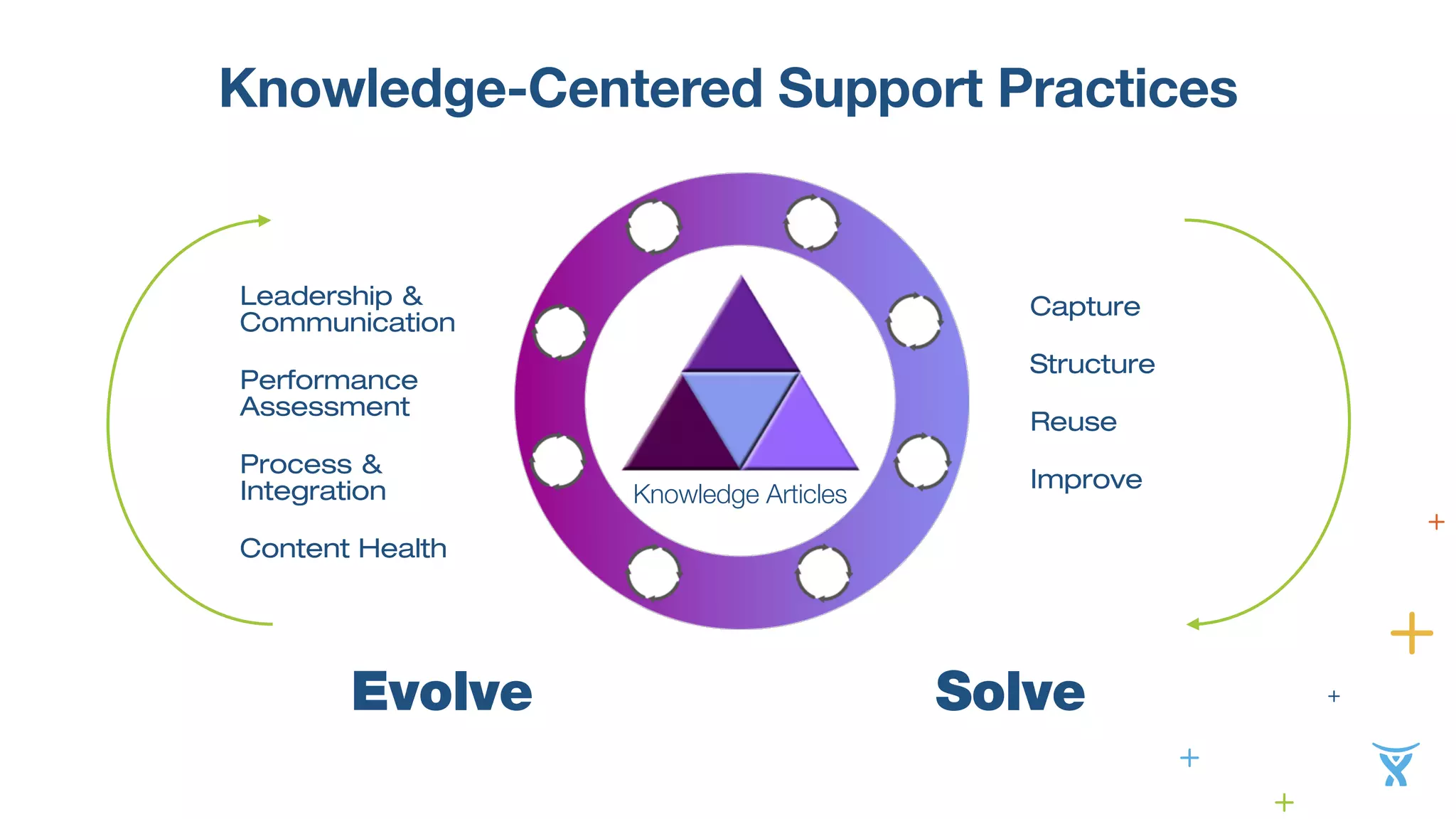
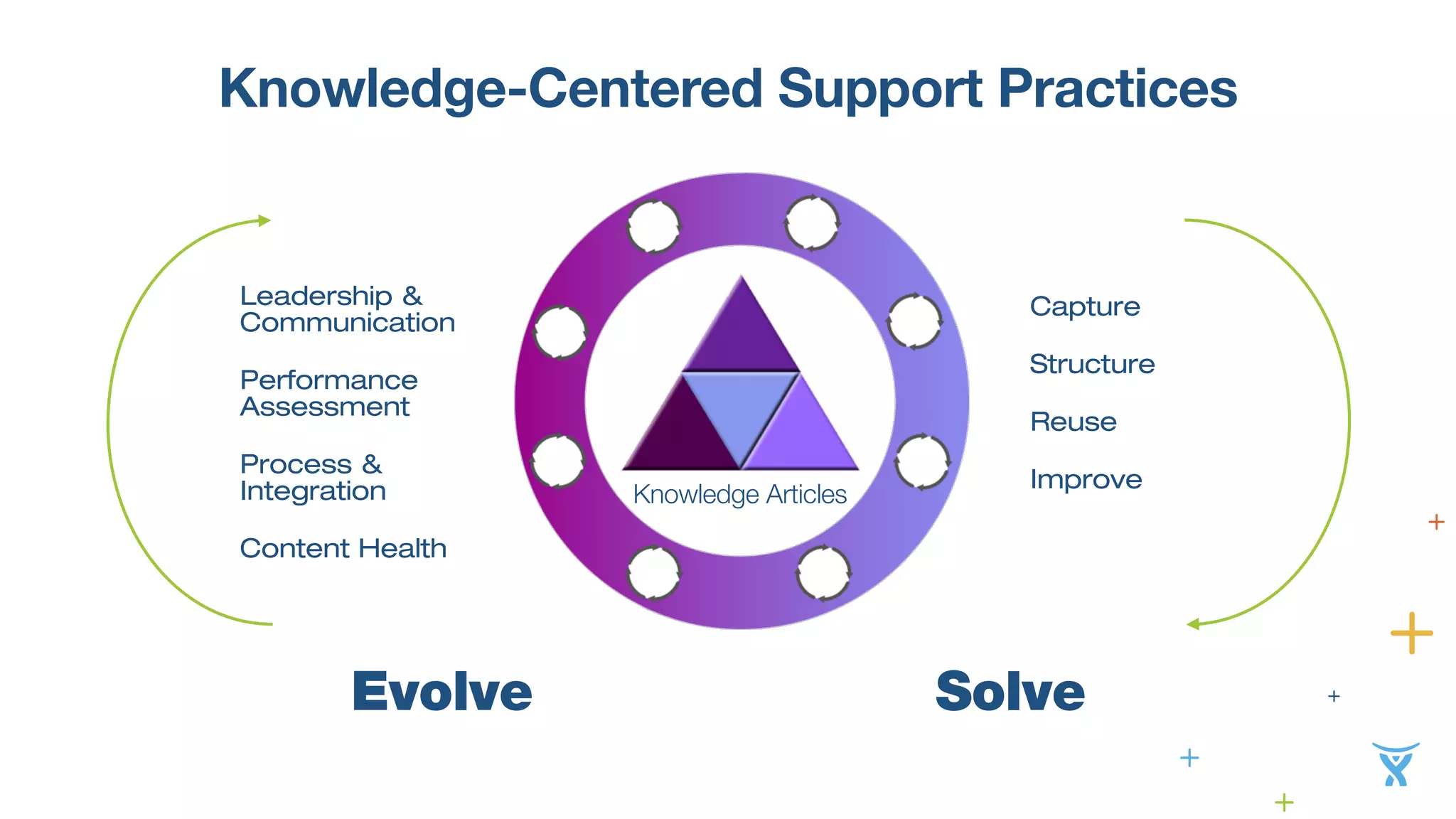
Knowledge-Centered Support Practices
Knowledge-Centered Support Practices 
Knowledge Articles 
Capture 
Structure 
Reuse 
Improve 
Leadership & 
Communication 
Performance 
Assessment 
Process & 
Integration 
Content Health 
Evolve Solve
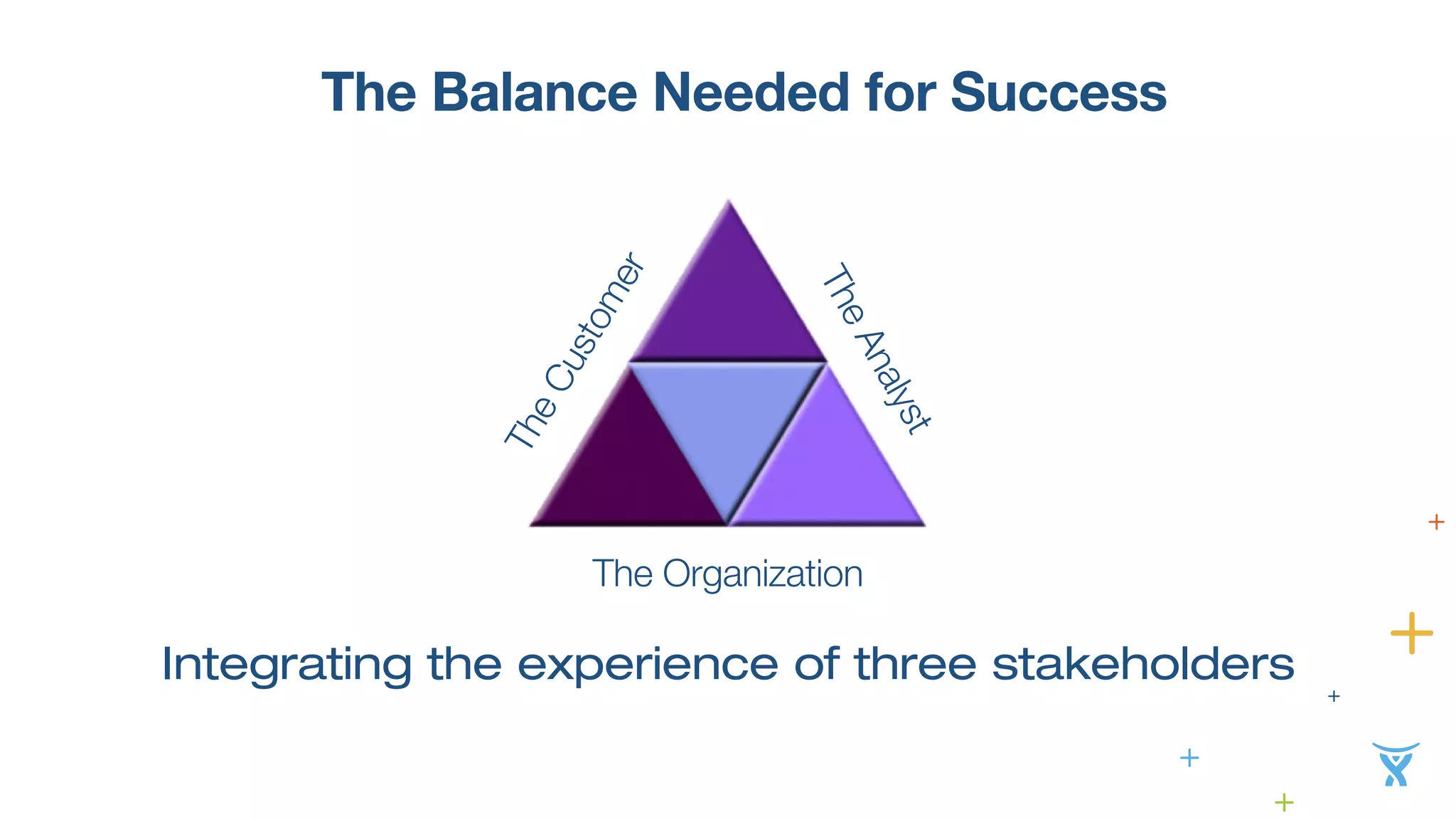
The Balance Needed for Success 
The Customer 
The Analyst 
The Organization 
Integrating the experience of three stakeholders
Stakeholder Benefits of KCS @ITSMNinja
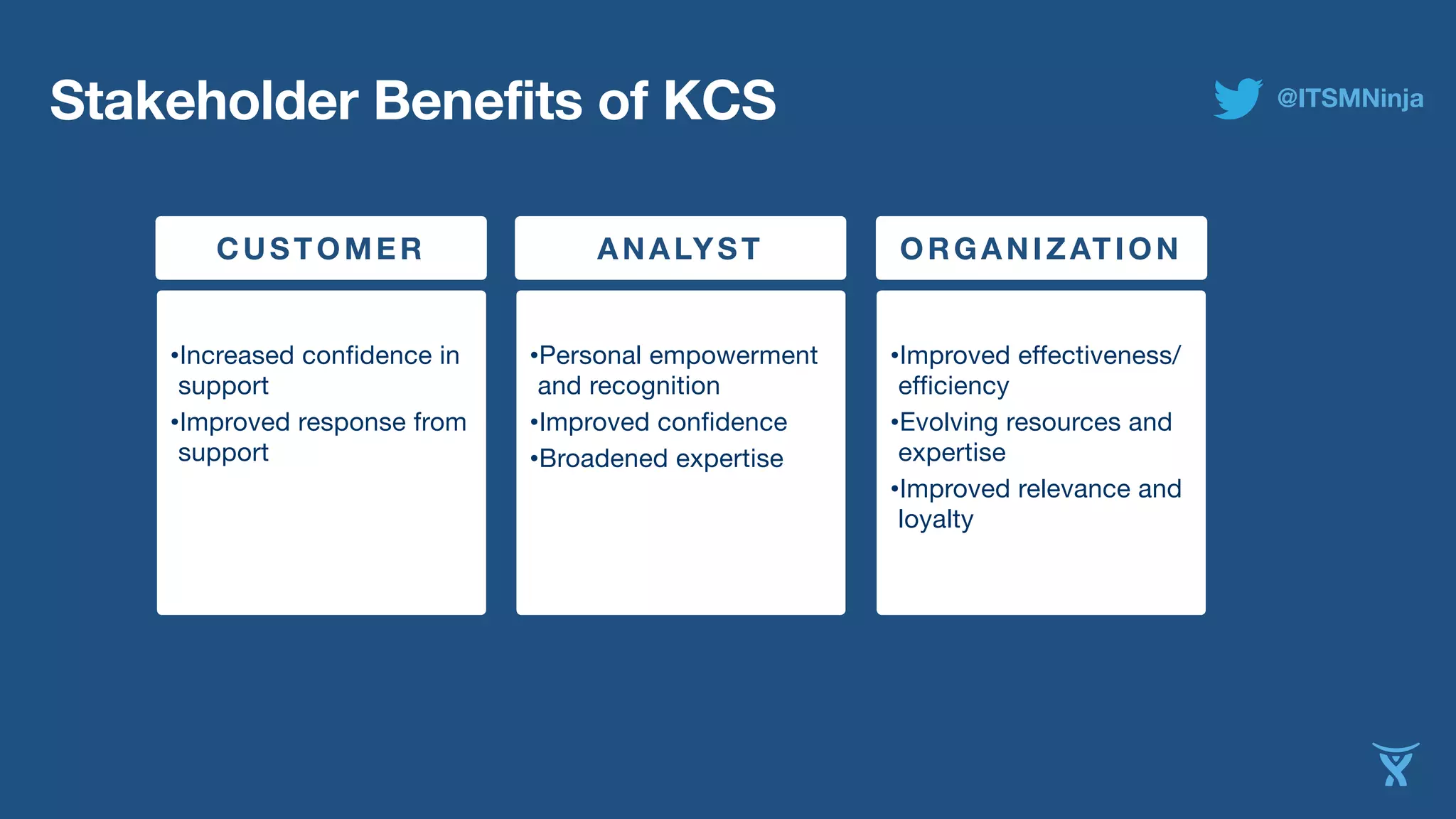
Stakeholder Benefits of KCS @ITSMNinja 
CUSTOMER 
! 
•Increased confidence in 
support 
•Improved response from 
support 
ANALYST 
! 
•Personal empowerment 
and recognition 
•Improved confidence 
•Broadened expertise 
ORGANIZATION 
! 
•Improved effectiveness/ 
efficiency 
•Evolving resources and 
expertise 
•Improved relevance and 
loyalty
Organizational Benefits of KCS
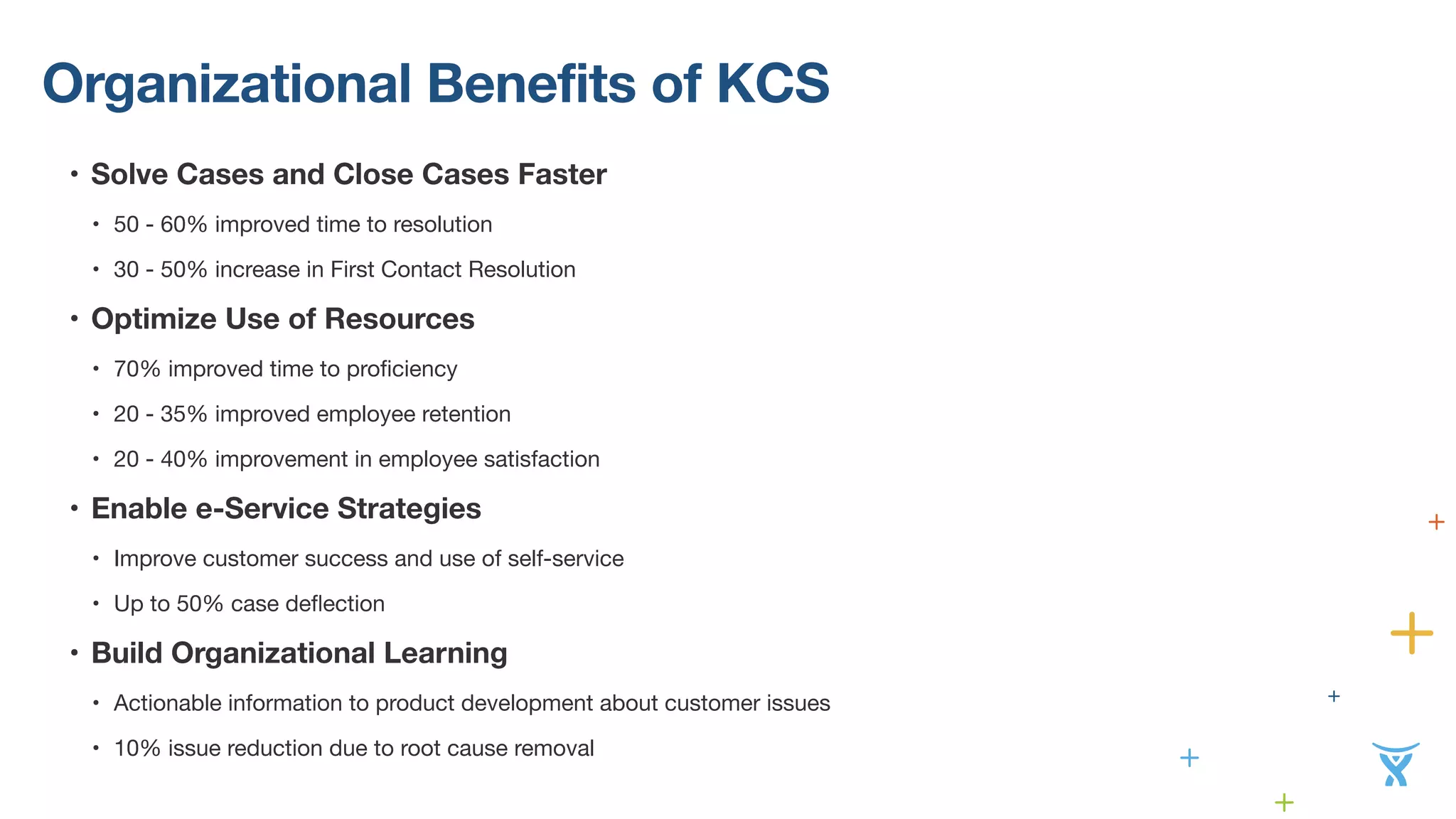
Organizational Benefits of KCS 
• Solve Cases and Close Cases Faster 
• 50 - 60% improved time to resolution 
• 30 - 50% increase in First Contact Resolution 
• Optimize Use of Resources 
• 70% improved time to proficiency 
• 20 - 35% improved employee retention 
• 20 - 40% improvement in employee satisfaction 
• Enable e-Service Strategies 
• Improve customer success and use of self-service 
• Up to 50% case deflection 
• Build Organizational Learning 
• Actionable information to product development about customer issues 
• 10% issue reduction due to root cause removal
KCS Leverages Knowledge 
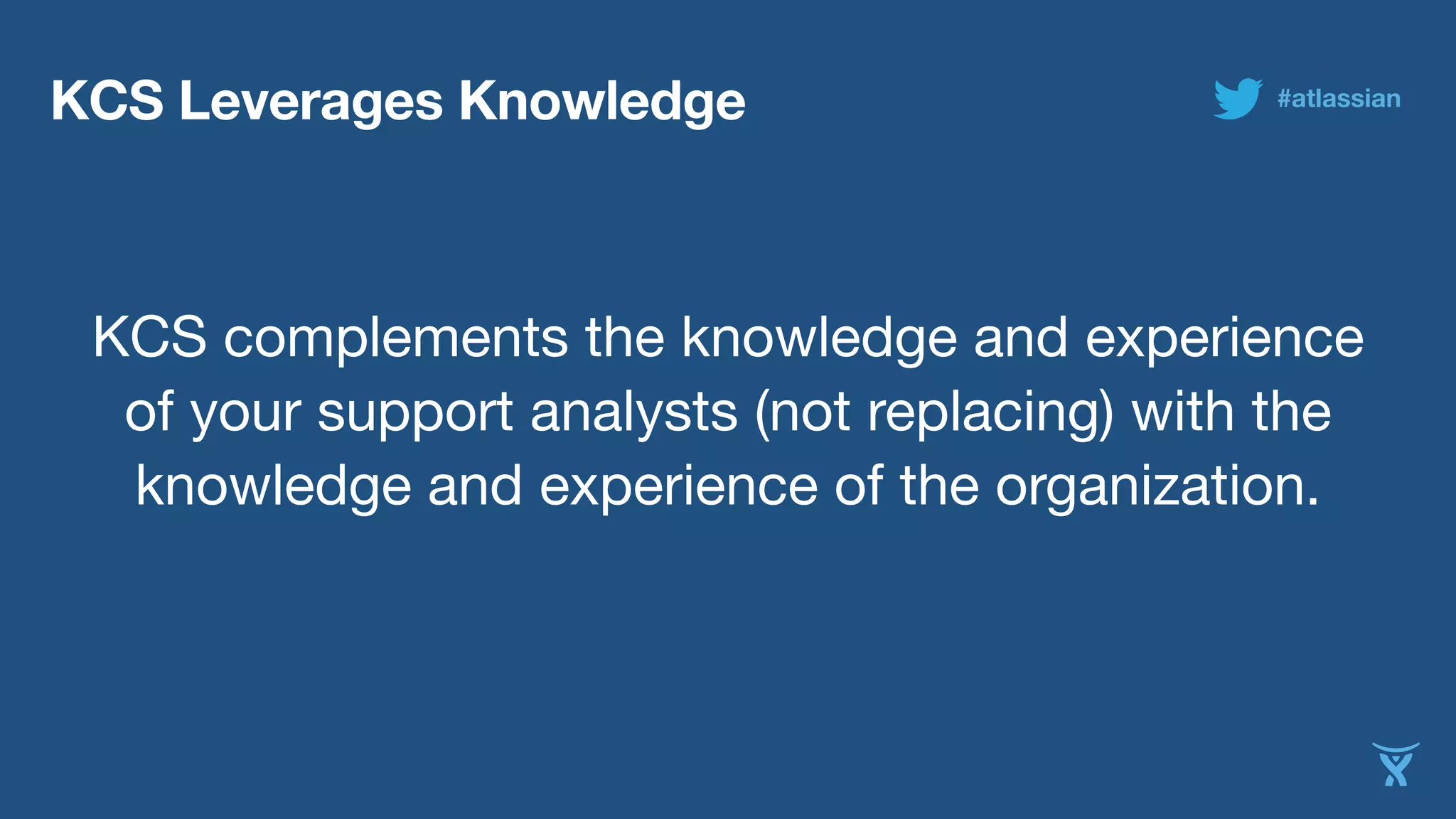
#atlassian 
KCS complements the knowledge and experience 
of your support analysts (not replacing) with the 
knowledge and experience of the organization.
KCS Leverages Knowledge 
KCS complements core ITSM processes: 
Incident Management 
Request Fulfillment 
Problem Management 
Change Management 
Release Management 
#atlassian
KCS 
Problem-Solving Model
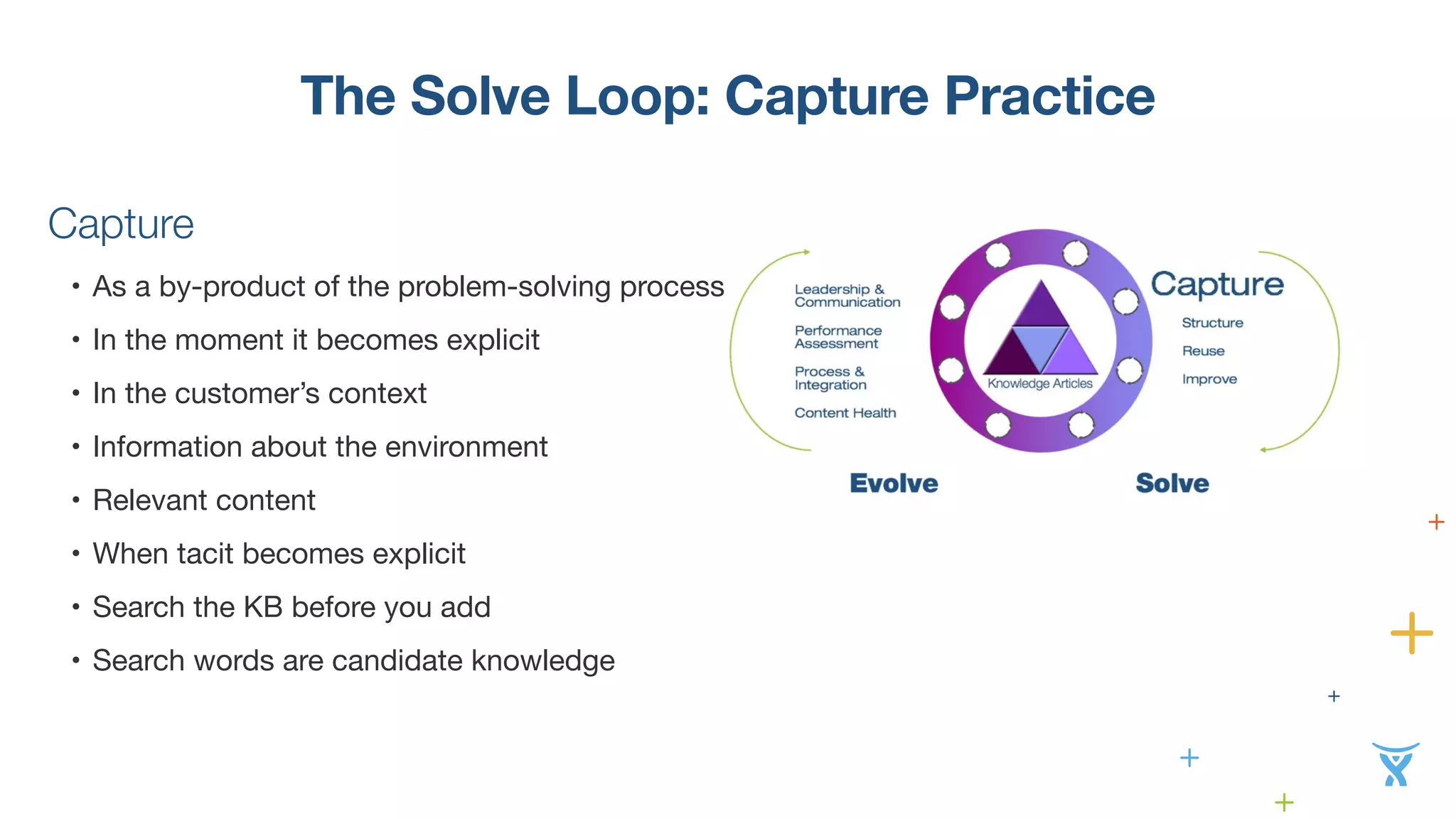
The Solve Loop: Capture Practice 
Capture 
• As a by-product of the problem-solving process 
• In the moment it becomes explicit 
• In the customer’s context 
• Information about the environment 
• Relevant content 
• When tacit becomes explicit 
• Search the KB before you add 
• Search words are candidate knowledge
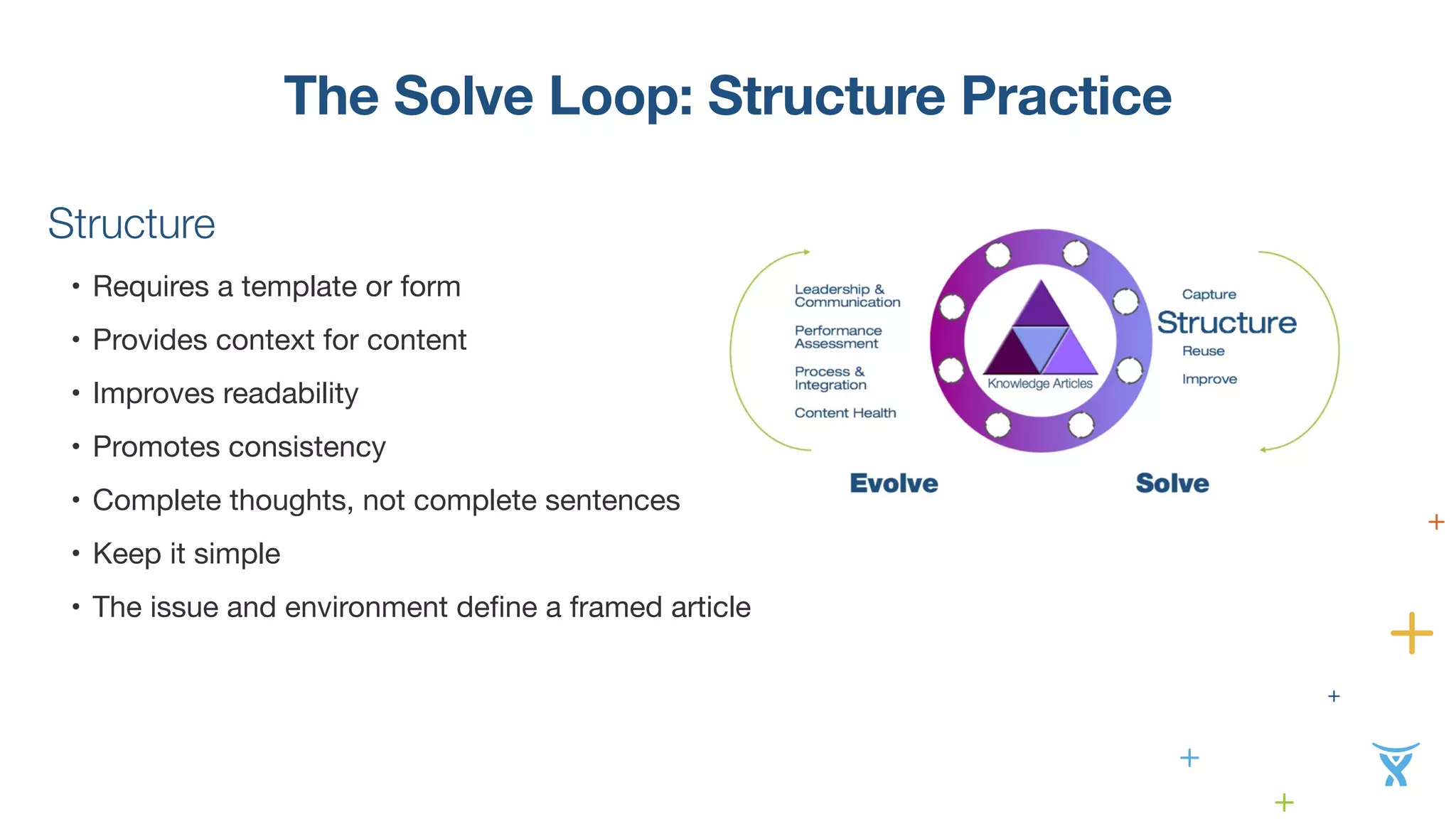
The Solve Loop: Structure Practice 
Structure 
• Requires a template or form 
• Provides context for content 
• Improves readability 
• Promotes consistency 
• Complete thoughts, not complete sentences 
• Keep it simple 
• The issue and environment define a framed article
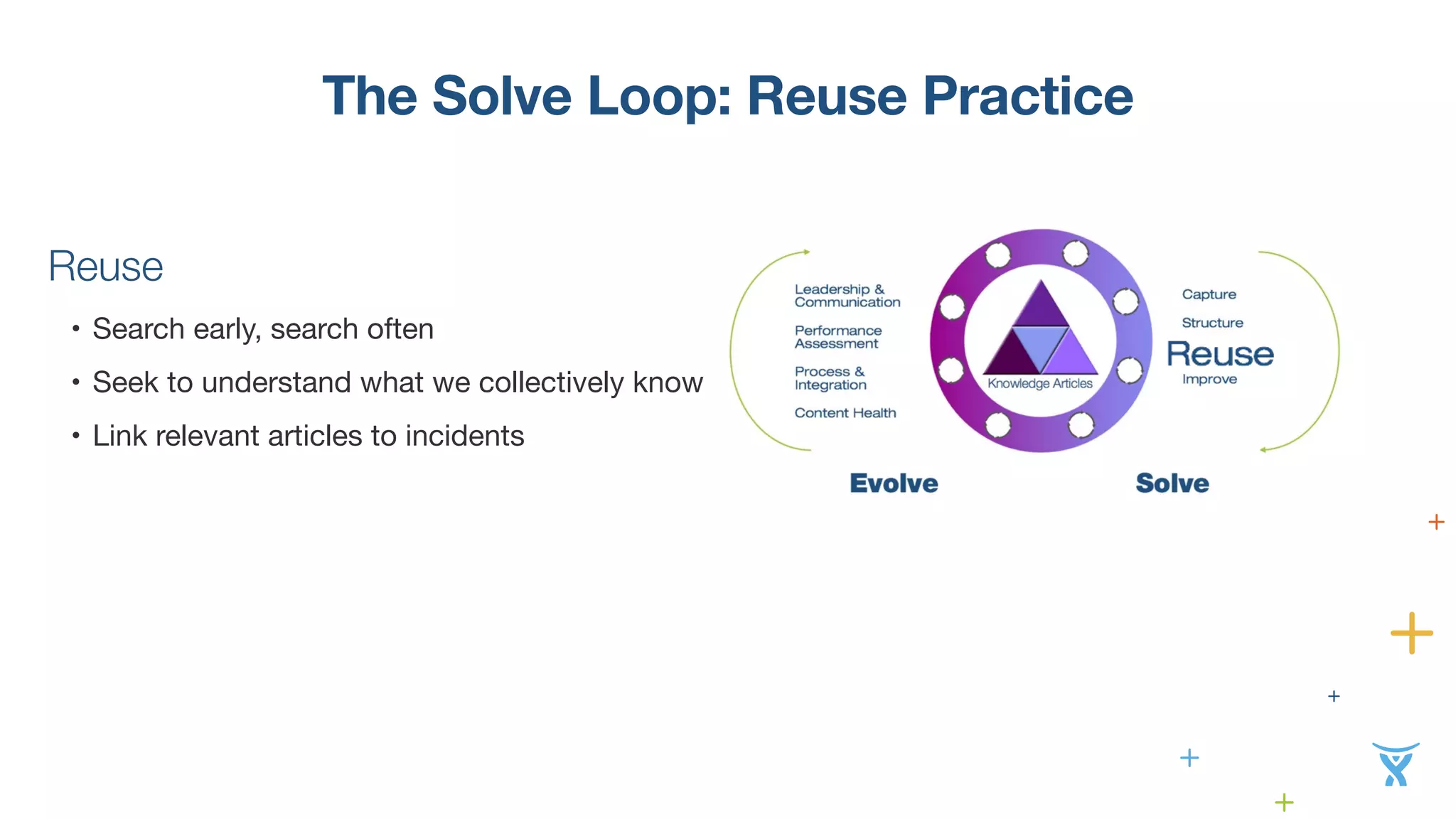
The Solve Loop: Reuse Practice 
Reuse 
• Search early, search often 
• Seek to understand what we collectively know 
• Link relevant articles to incidents
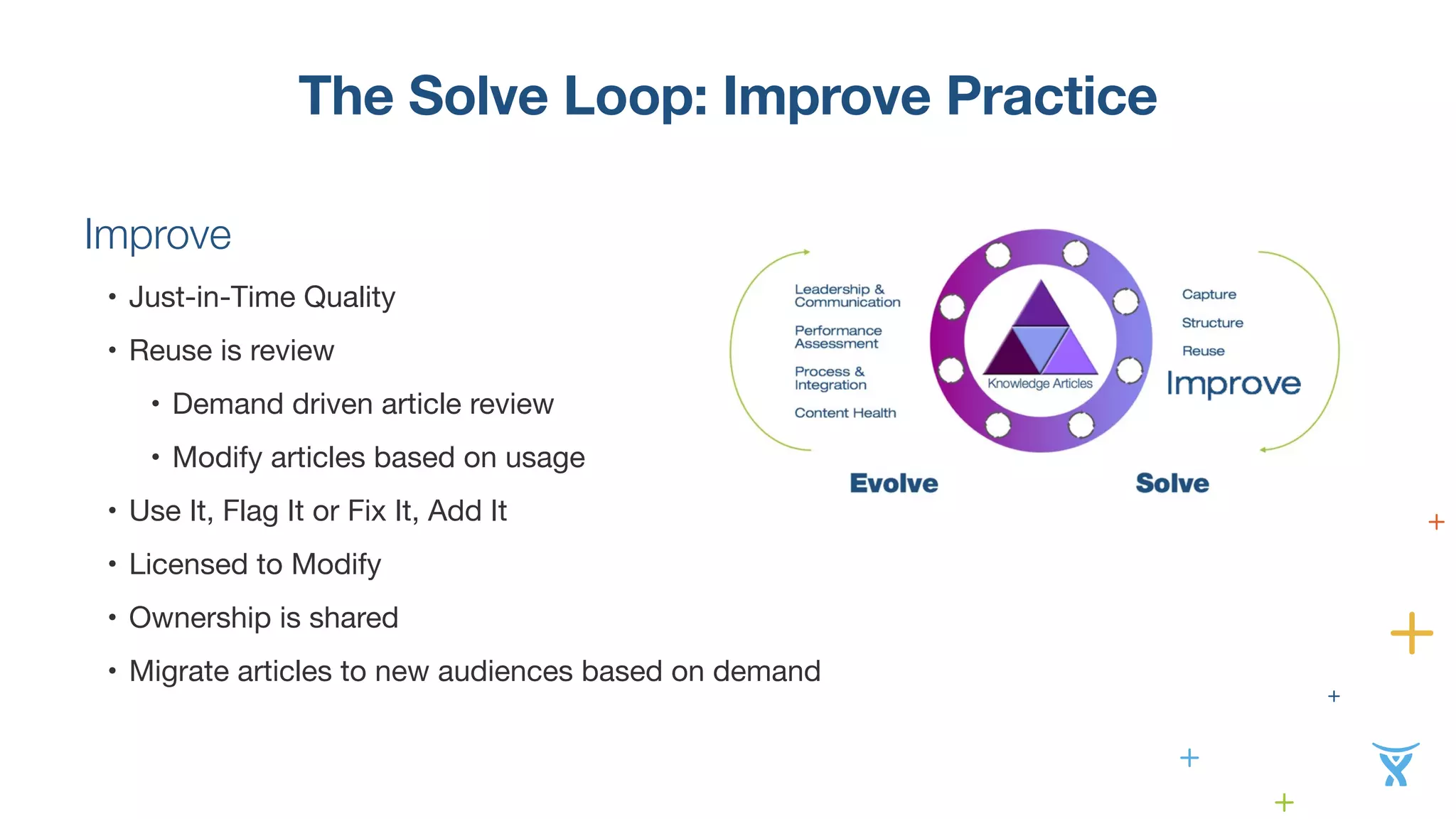
The Solve Loop: Improve Practice 
Improve 
• Just-in-Time Quality 
• Reuse is review 
• Demand driven article review 
• Modify articles based on usage 
• Use It, Flag It or Fix It, Add It 
• Licensed to Modify 
• Ownership is shared 
• Migrate articles to new audiences based on demand
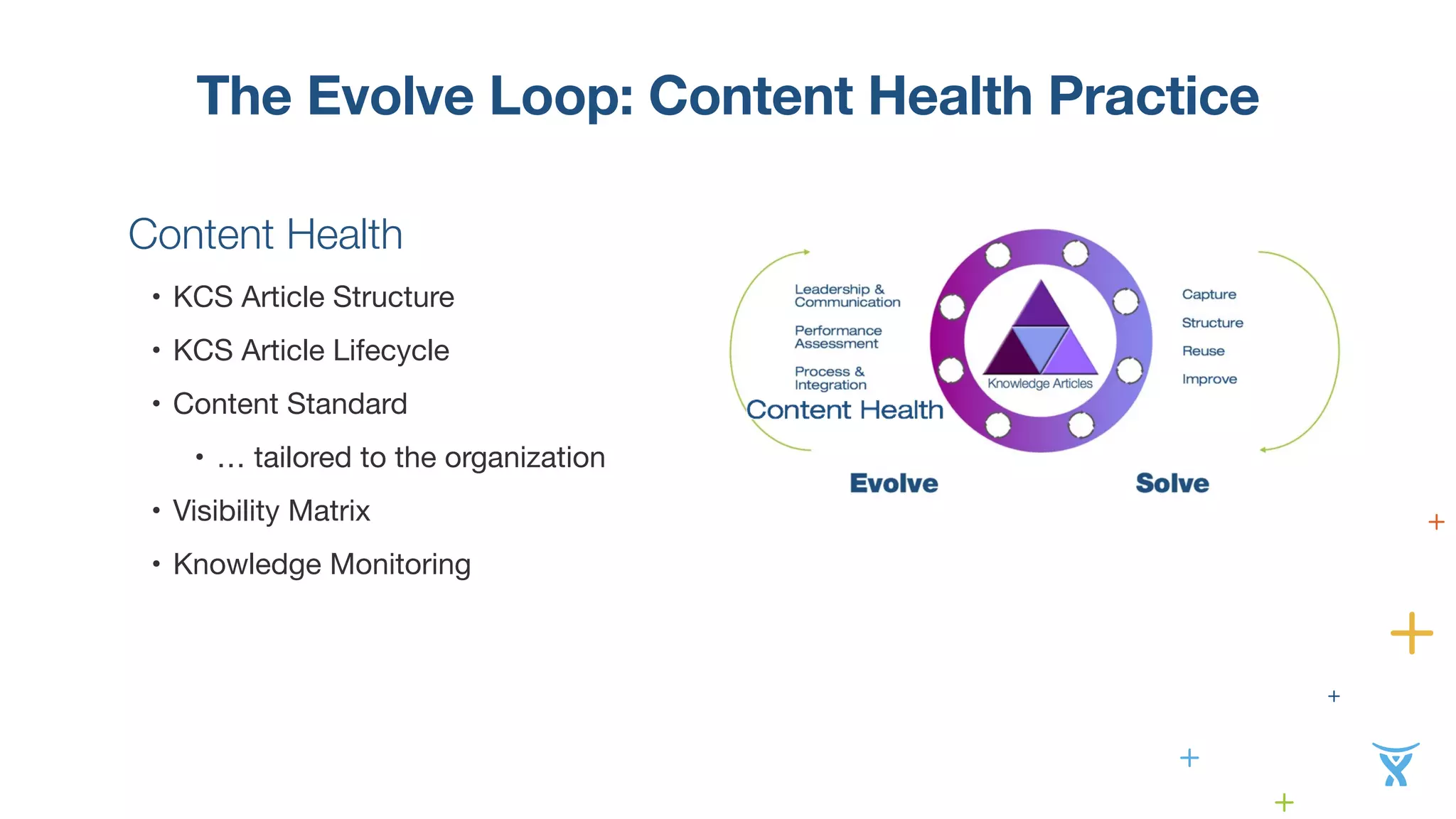
The Evolve Loop: Content Health Practice 
Content Health 
• KCS Article Structure 
• KCS Article Lifecycle 
• Content Standard 
• … tailored to the organization 
• Visibility Matrix 
• Knowledge Monitoring
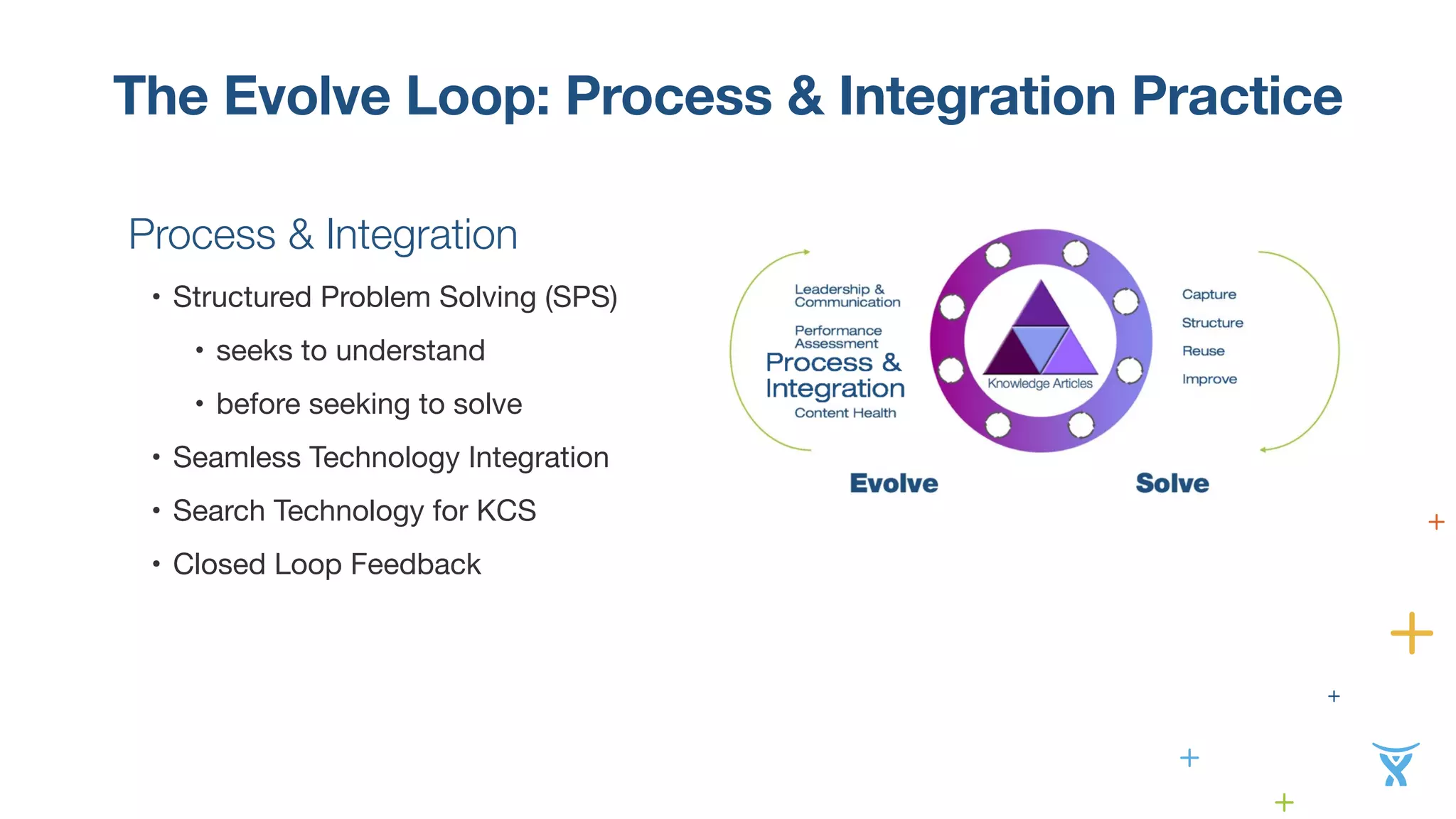
The Evolve Loop: Process & Integration Practice 
Process & Integration 
• Structured Problem Solving (SPS) 
• seeks to understand 
• before seeking to solve 
• Seamless Technology Integration 
• Search Technology for KCS 
• Closed Loop Feedback
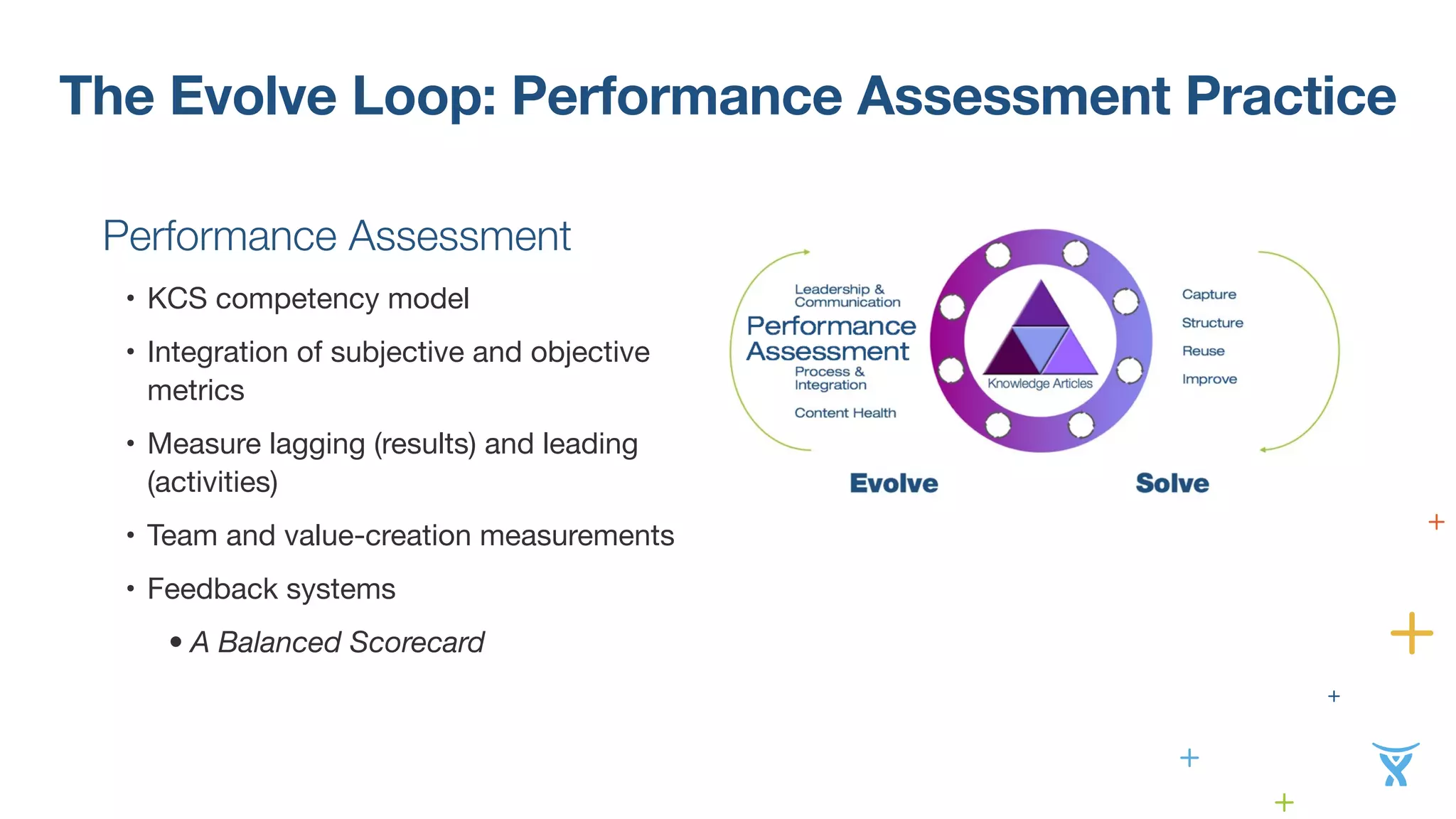
The Evolve Loop: Performance Assessment Practice 
Performance Assessment 
• KCS competency model 
• Integration of subjective and objective 
metrics 
• Measure lagging (results) and leading 
(activities) 
• Team and value-creation measurements 
• Feedback systems 
• A Balanced Scorecard
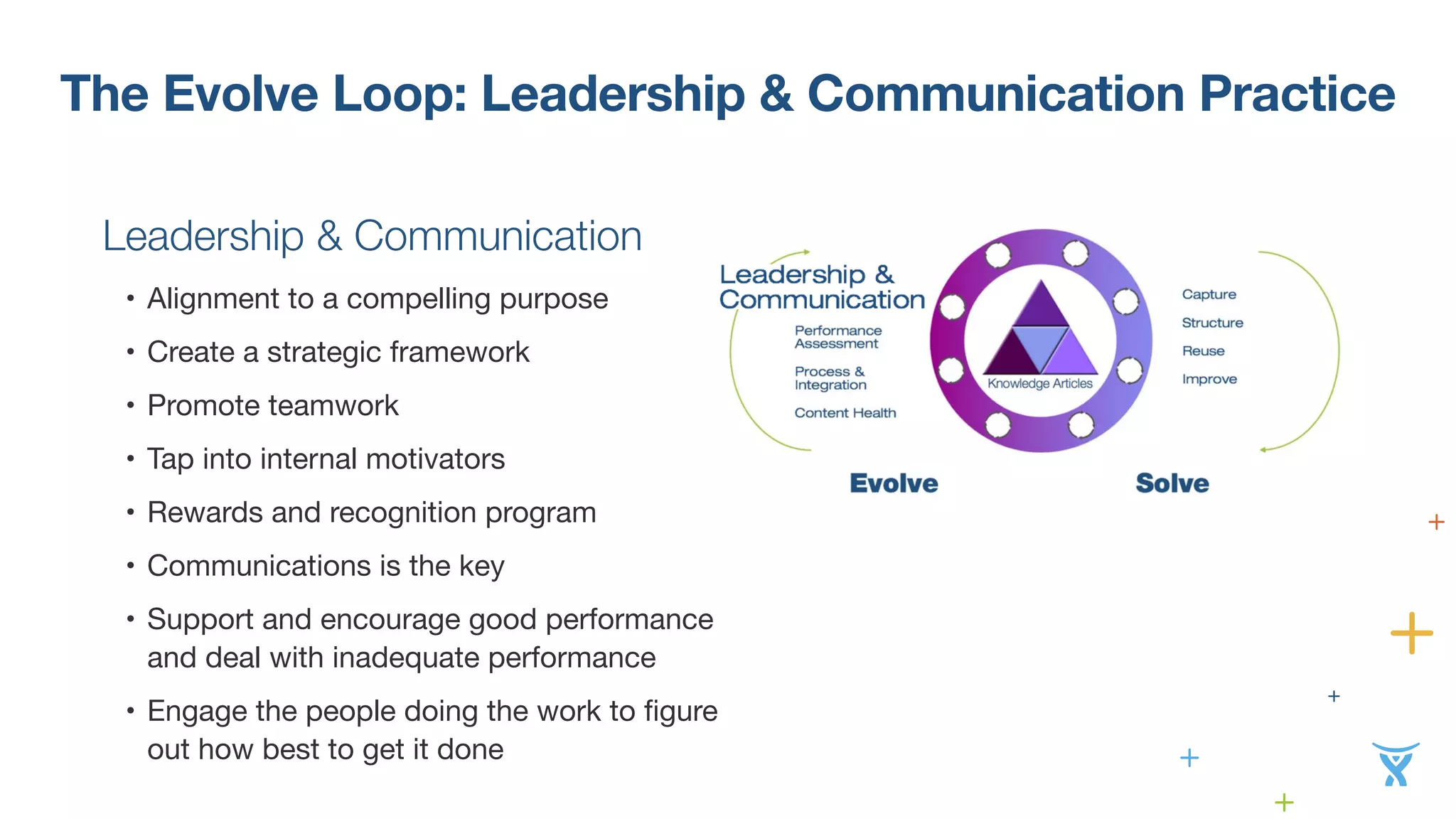
The Evolve Loop: Leadership & Communication Practice 
Leadership & Communication 
• Alignment to a compelling purpose 
• Create a strategic framework 
• Promote teamwork 
• Tap into internal motivators 
• Rewards and recognition program 
• Communications is the key 
• Support and encourage good performance 
and deal with inadequate performance 
• Engage the people doing the work to figure 
out how best to get it done
Knowledge-Centered Support Practices
Knowledge-Centered Support Practices 
Knowledge Articles 
Capture 
Structure 
Reuse 
Improve 
Leadership & 
Communication 
Performance 
Assessment 
Process & 
Integration 
Content Health 
Evolve Solve
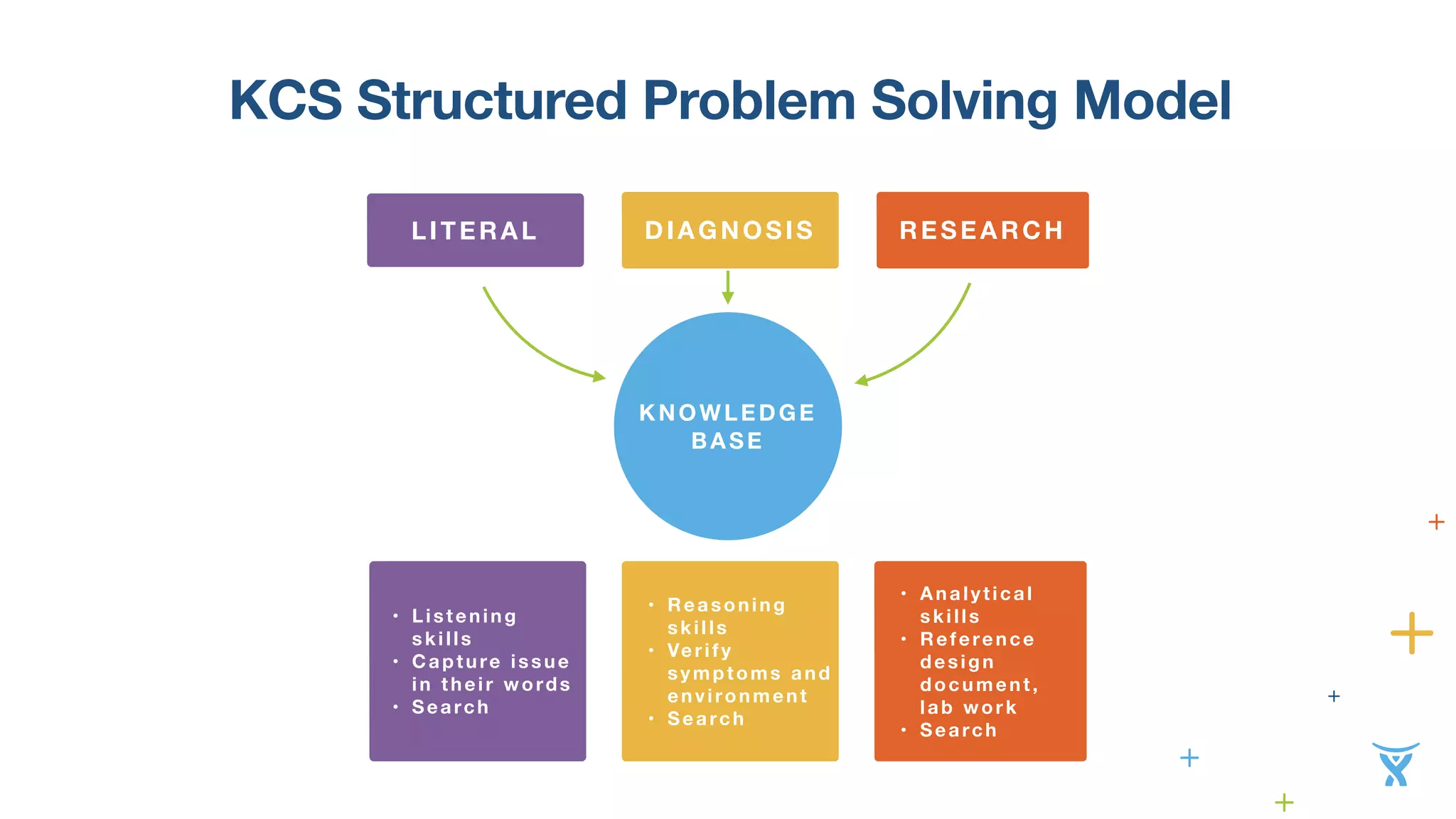
KCS Structured Problem Solving Model 
LITERAL DIAGNOSIS RESEARCH 
KNOWLEDGE 
BASE 
• Listening 
s k i l l s 
• Capture issue 
in their words 
• Search 
• Reasoning 
s k i l l s 
• Ver i fy 
symptoms and 
environment 
• Search 
• Analytical 
s k i l l s 
• Reference 
design 
document, 
lab work 
• Search
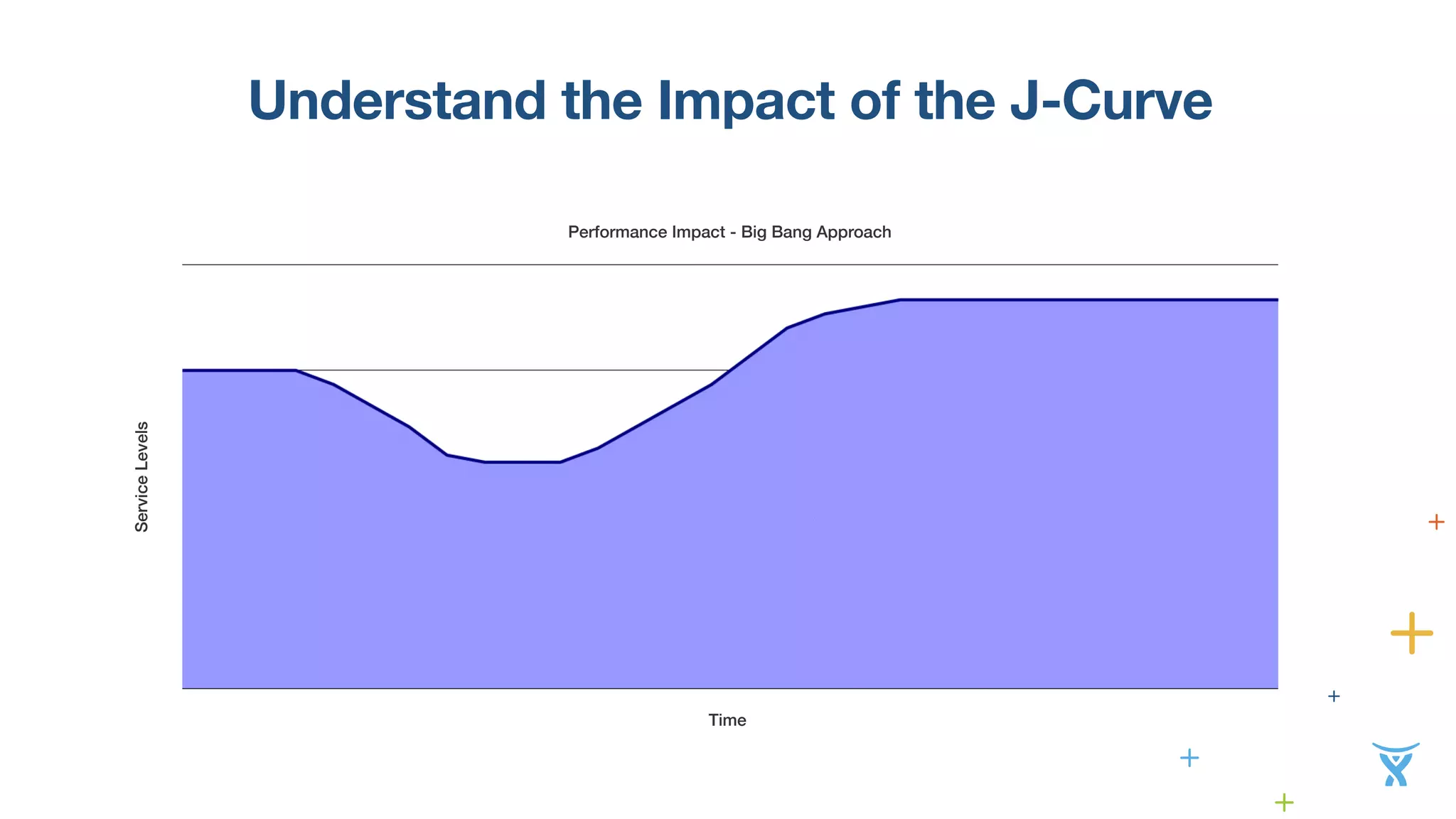
Understand the Impact of the J-Curve 
Performance Impact - Big Bang Approach 
Time 
Service Levels
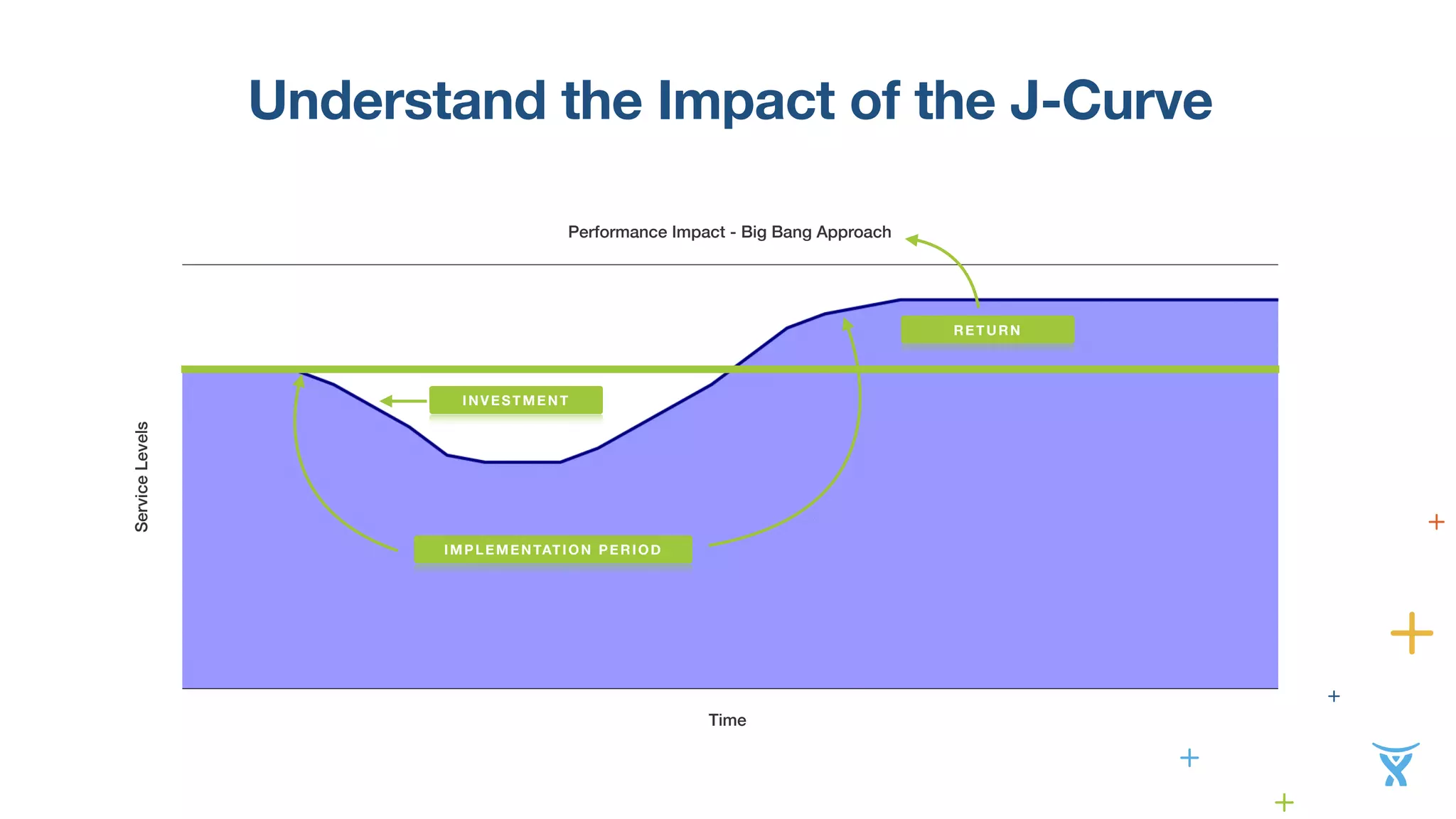
Understand the Impact of the J-Curve 
Performance Impact - Big Bang Approach 
Time 
Service Levels 
INVESTMENT 
RETURN 
IMPLEMENTATION PERIOD
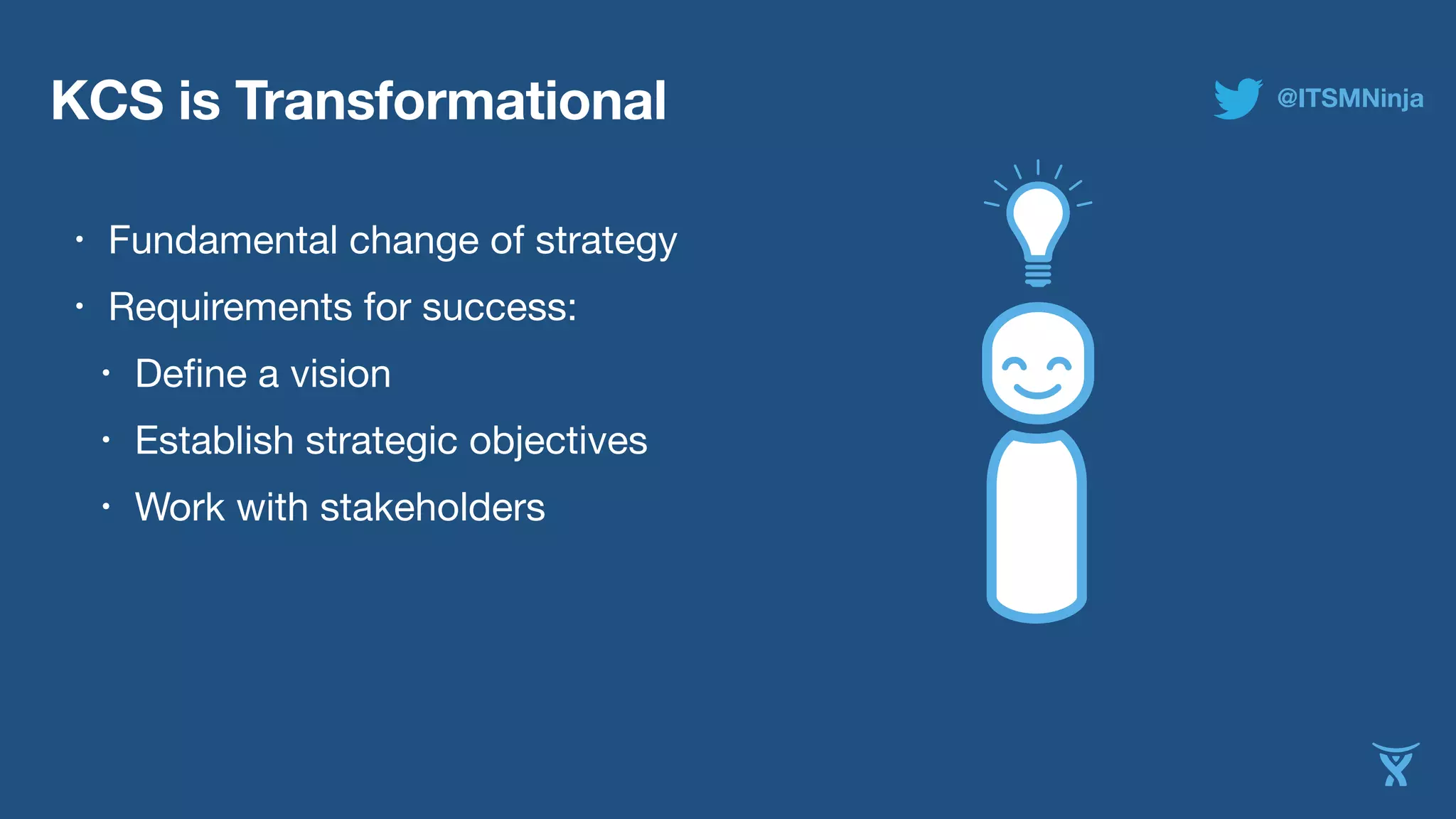
KCS is Transformational 
• Fundamental change of strategy 
• Requirements for success: 
• Define a vision 
• Establish strategic objectives 
• Work with stakeholders 
@ITSMNinja
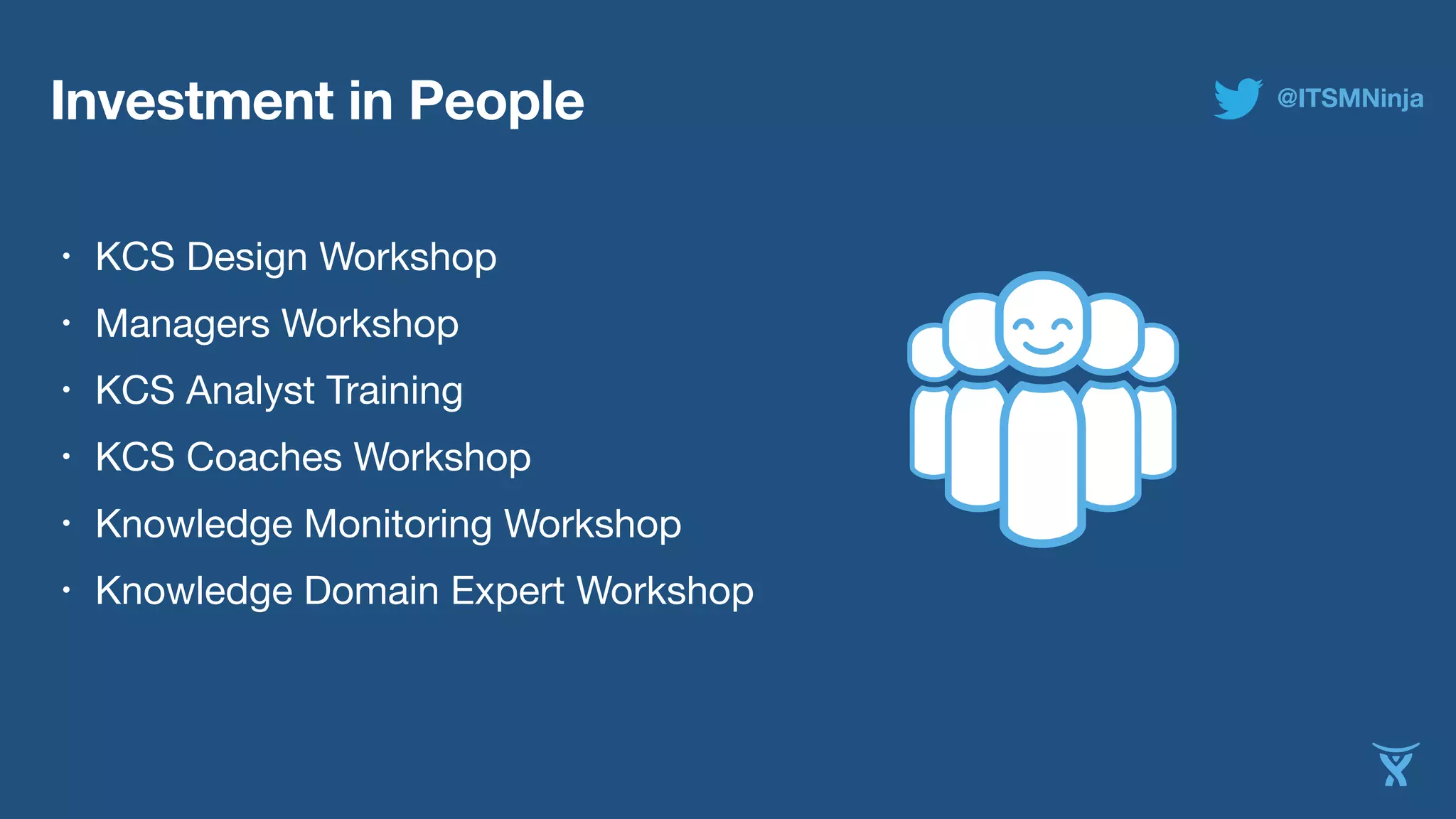
Investment in People 
• KCS Design Workshop 
• Managers Workshop 
• KCS Analyst Training 
• KCS Coaches Workshop 
• Knowledge Monitoring Workshop 
• Knowledge Domain Expert Workshop 
@ITSMNinja
Investment in Process 
• Incident Management 
• Knowledge Management 
• Knowledge Monitoring 
• Performance Assessment 
• Problem Management 
@ITSMNinja
Investment in Technology 
• Knowledge Management System 
• Integrated with the Incident Management System 
• Reporting 
• Self-Service Portal 
@ITSMNinja
Critical Success Factors 
• Executive commitment 
• Coaching 
• Selection 
• Time to coach 
• Coaching yourself out of a job 
• Measuring the right things 
• Goals for the outcomes / results 
• Trends for the leading indicators (e.g., activities) 
• Deployment attitude 
• Organizational change vs. just a tool 
• Picking the right players
Mindset Changes 
• Collaborative Knowledge vs. Individual Experience 
• Just-in-Time vs. Just-in-Case 
• Teams (collective wisdom) vs. Individuals (one person) 
• Collaborative, Knowledge enabled network vs. Linear, serial process 
• KCS vs. Knowledge Engineering methodology
Knowledge managed at 
the point of creation, in the 
context of the demand!
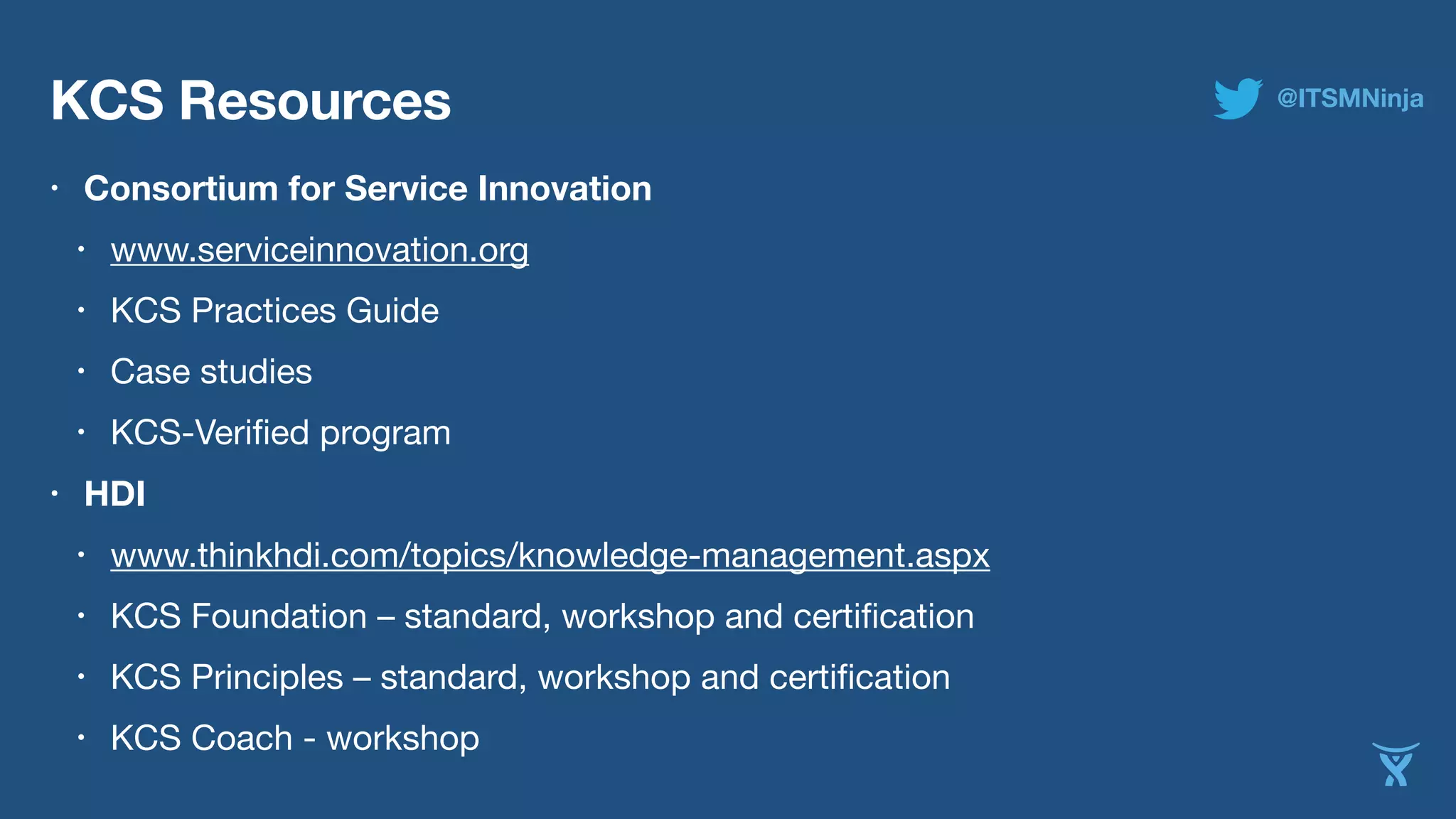
KCS Resources 
• Consortium for Service Innovation 
• www.serviceinnovation.org 
• KCS Practices Guide 
• Case studies 
• KCS-Verified program 
• HDI 
• www.thinkhdi.com/topics/knowledge-management.aspx 
• KCS Foundation – standard, workshop and certification 
• KCS Principles – standard, workshop and certification 
• KCS Coach - workshop 
@ITSMNinja
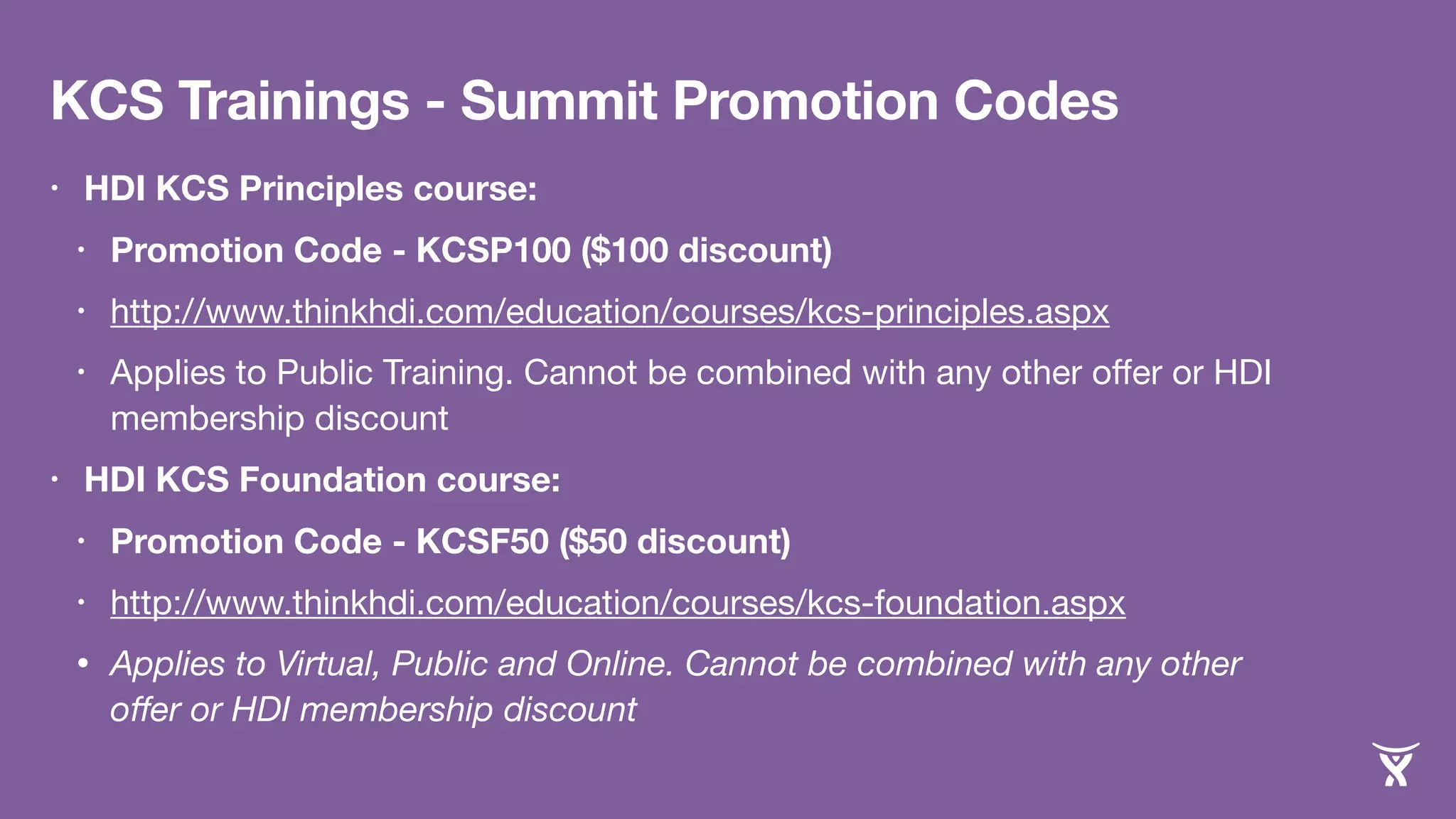
KCS Trainings - Summit Promotion Codes 
• HDI KCS Principles course: 
• Promotion Code - KCSP100 ($100 discount) 
• http://www.thinkhdi.com/education/courses/kcs-principles.aspx 
• Applies to Public Training. Cannot be combined with any other offer or HDI 
membership discount 
• HDI KCS Foundation course: 
• Promotion Code - KCSF50 ($50 discount) 
• http://www.thinkhdi.com/education/courses/kcs-foundation.aspx 
• Applies to Virtual, Public and Online. Cannot be combined with any other 
offer or HDI membership discount
Thank you! 
! 
What Will You Do to Increase the Value of 
Your Services? 
JOHN CUSTY • MANAGING CONSULTANT • JPC GROUP • @ITSMNINJA

Knowledge-Centered Support – The Methodology That Really Works - John Custy

  • 1.
  • 2.
    Knowledge-Centered Support (KCSSM) The knowledge management methodology that works! JOHN CUSTY • MANAGING CONSULTANT • JPC GROUP • @ITSMNINJA
  • 3.
    Agenda INTRO TOKCS SUPPORT-DEMAND CURVE BENEFITS & PRACTICES KCS PROBLEM SOLVING MODEL
  • 4.
    About John Custy Service Management Practitioner, Consultant And Educator • Distinguished Professional in IT Service Management • ITIL Expert & ITIL Service Manager • ITIL Intermediate – SS, SD, ST, SO, CSI, OSA, SOA, PPO, RCV • KT Certified Instructor • ITIL Accredited Trainer • KCS Verified Consultant • ISO/IEC 20000 Consultant • ISFS, ISMAS based on ISO/IEC 27002 • HDI Faculty & Certified Instructor
  • 5.
  • 6.
    Do you know…? • The amount of resources spent resolving issues? • The amount of ‘rework’ occurring because knowledge isn’t being shared? • The real failure rate of your services? • How many times your customers don’t call you when there is a failure? • How often answers are found when someone searches for an answer? • The value that self-service could provide to your customers? • Who creates knowledge in your organization? • Who shares their knowledge?
  • 7.
    Do you know… …YOUR CURRENT KM STATE?
  • 8.
    Do you know… …YOUR CURRENT KM STATE? • Dedicated team/people to create knowledge • Content created ‘in-case’ it is needed • Knowledge created, verified published; whether it is needed or not • Knowledge is an optional, when you have nothing else to do activity • Knowledge is someone else’s responsibility • Perfect, complete articles or ‘good enough’?
  • 9.
    Why your organization needs knowledge management
  • 10.
    Why Your OrganizationNeeds Knowledge Management Respond to issues quicker Resolve complex issues faster Provide consistent answers to the same questions Address burn-out from your team due to redundancy Provide better resources for learning Learn and share what your customer’s experiences Improve the customer experience overall Enable self-help (that really works) Provide more value COLUMN TITLE COLUMN TITLE
  • 11.
    Why Your OrganizationNeeds Knowledge Management Respond to issues quicker Resolve complex issues faster Provide consistent answers to the same questions Address burn-out from your team due to redundancy Provide better resources for learning Learn and share what your customer’s experiences Improve the customer experience overall Enable self-help (that really works) Provide more value COLUMN TITLE COLUMN TITLE
  • 12.
    The Support DemandCurve DEMAND
  • 13.
    The Support DemandCurve TIME DEMAND
  • 14.
    Knowledge Engineering Approach TIME DEMAND Knowledge Engineering Queue
  • 15.
    Knowledge Engineering Approach TIME DEMAND REWORK X –Incident Z X –Incident Y X – First Incident Knowledge Engineering Queue $ RETURN REDUNDANCY $ INVESTMENT KNOWLEDGE PUBLISHED
  • 16.
  • 17.
    Knowledge Centered Support TIME DEMAND X KNOWLEDGE IS TRUSTED $ RETURN X REDUNDANCY AND X – First Incident REWORK ELIMINATED $ INVESTMENT 1.Knowledge is immediately available for re-use. 2.Validation based on demand 3.Compliance review based on demand
  • 18.
    Knowledge Management BestPractice @ITSMNinja
  • 19.
    Knowledge Management BestPractice • Content is created as a by-product of resolving issues • Content is evolved based on demand • Knowledge is the collective, collaborative experience of the team • People and teams are rewarded for learning, collaboration, sharing and improving @ITSMNinja
  • 20.
    Knowledge Centered Supportis a methodology and set of practices that focuses on knowledge as a key asset of the organization.
  • 21.
    KCS is notsomething we do in addition to solving issues, KCS becomes the way in which we resolve issues.
  • 22.
    What is KCS? Capture Structure Reuse Knowledge Articles Support Knowledge
  • 23.
  • 24.
    Knowledge-Centered Support Practices Knowledge Articles Capture Structure Reuse Improve Leadership & Communication Performance Assessment Process & Integration Content Health Evolve Solve
  • 25.
    The Balance Neededfor Success The Customer The Analyst The Organization Integrating the experience of three stakeholders
  • 26.
  • 27.
    Stakeholder Benefits ofKCS @ITSMNinja CUSTOMER ! •Increased confidence in support •Improved response from support ANALYST ! •Personal empowerment and recognition •Improved confidence •Broadened expertise ORGANIZATION ! •Improved effectiveness/ efficiency •Evolving resources and expertise •Improved relevance and loyalty
  • 28.
  • 29.
    Organizational Benefits ofKCS • Solve Cases and Close Cases Faster • 50 - 60% improved time to resolution • 30 - 50% increase in First Contact Resolution • Optimize Use of Resources • 70% improved time to proficiency • 20 - 35% improved employee retention • 20 - 40% improvement in employee satisfaction • Enable e-Service Strategies • Improve customer success and use of self-service • Up to 50% case deflection • Build Organizational Learning • Actionable information to product development about customer issues • 10% issue reduction due to root cause removal
  • 30.
    KCS Leverages Knowledge #atlassian KCS complements the knowledge and experience of your support analysts (not replacing) with the knowledge and experience of the organization.
  • 31.
    KCS Leverages Knowledge KCS complements core ITSM processes: Incident Management Request Fulfillment Problem Management Change Management Release Management #atlassian
  • 32.
  • 33.
    The Solve Loop:Capture Practice Capture • As a by-product of the problem-solving process • In the moment it becomes explicit • In the customer’s context • Information about the environment • Relevant content • When tacit becomes explicit • Search the KB before you add • Search words are candidate knowledge
  • 34.
    The Solve Loop:Structure Practice Structure • Requires a template or form • Provides context for content • Improves readability • Promotes consistency • Complete thoughts, not complete sentences • Keep it simple • The issue and environment define a framed article
  • 35.
    The Solve Loop:Reuse Practice Reuse • Search early, search often • Seek to understand what we collectively know • Link relevant articles to incidents
  • 36.
    The Solve Loop:Improve Practice Improve • Just-in-Time Quality • Reuse is review • Demand driven article review • Modify articles based on usage • Use It, Flag It or Fix It, Add It • Licensed to Modify • Ownership is shared • Migrate articles to new audiences based on demand
  • 37.
    The Evolve Loop:Content Health Practice Content Health • KCS Article Structure • KCS Article Lifecycle • Content Standard • … tailored to the organization • Visibility Matrix • Knowledge Monitoring
  • 38.
    The Evolve Loop:Process & Integration Practice Process & Integration • Structured Problem Solving (SPS) • seeks to understand • before seeking to solve • Seamless Technology Integration • Search Technology for KCS • Closed Loop Feedback
  • 39.
    The Evolve Loop:Performance Assessment Practice Performance Assessment • KCS competency model • Integration of subjective and objective metrics • Measure lagging (results) and leading (activities) • Team and value-creation measurements • Feedback systems • A Balanced Scorecard
  • 40.
    The Evolve Loop:Leadership & Communication Practice Leadership & Communication • Alignment to a compelling purpose • Create a strategic framework • Promote teamwork • Tap into internal motivators • Rewards and recognition program • Communications is the key • Support and encourage good performance and deal with inadequate performance • Engage the people doing the work to figure out how best to get it done
  • 41.
  • 42.
    Knowledge-Centered Support Practices Knowledge Articles Capture Structure Reuse Improve Leadership & Communication Performance Assessment Process & Integration Content Health Evolve Solve
  • 43.
    KCS Structured ProblemSolving Model LITERAL DIAGNOSIS RESEARCH KNOWLEDGE BASE • Listening s k i l l s • Capture issue in their words • Search • Reasoning s k i l l s • Ver i fy symptoms and environment • Search • Analytical s k i l l s • Reference design document, lab work • Search
  • 44.
    Understand the Impactof the J-Curve Performance Impact - Big Bang Approach Time Service Levels
  • 45.
    Understand the Impactof the J-Curve Performance Impact - Big Bang Approach Time Service Levels INVESTMENT RETURN IMPLEMENTATION PERIOD
  • 46.
    KCS is Transformational • Fundamental change of strategy • Requirements for success: • Define a vision • Establish strategic objectives • Work with stakeholders @ITSMNinja
  • 47.
    Investment in People • KCS Design Workshop • Managers Workshop • KCS Analyst Training • KCS Coaches Workshop • Knowledge Monitoring Workshop • Knowledge Domain Expert Workshop @ITSMNinja
  • 48.
    Investment in Process • Incident Management • Knowledge Management • Knowledge Monitoring • Performance Assessment • Problem Management @ITSMNinja
  • 49.
    Investment in Technology • Knowledge Management System • Integrated with the Incident Management System • Reporting • Self-Service Portal @ITSMNinja
  • 50.
    Critical Success Factors • Executive commitment • Coaching • Selection • Time to coach • Coaching yourself out of a job • Measuring the right things • Goals for the outcomes / results • Trends for the leading indicators (e.g., activities) • Deployment attitude • Organizational change vs. just a tool • Picking the right players
  • 51.
    Mindset Changes •Collaborative Knowledge vs. Individual Experience • Just-in-Time vs. Just-in-Case • Teams (collective wisdom) vs. Individuals (one person) • Collaborative, Knowledge enabled network vs. Linear, serial process • KCS vs. Knowledge Engineering methodology
  • 52.
    Knowledge managed at the point of creation, in the context of the demand!
  • 53.
    KCS Resources •Consortium for Service Innovation • www.serviceinnovation.org • KCS Practices Guide • Case studies • KCS-Verified program • HDI • www.thinkhdi.com/topics/knowledge-management.aspx • KCS Foundation – standard, workshop and certification • KCS Principles – standard, workshop and certification • KCS Coach - workshop @ITSMNinja
  • 54.
    KCS Trainings -Summit Promotion Codes • HDI KCS Principles course: • Promotion Code - KCSP100 ($100 discount) • http://www.thinkhdi.com/education/courses/kcs-principles.aspx • Applies to Public Training. Cannot be combined with any other offer or HDI membership discount • HDI KCS Foundation course: • Promotion Code - KCSF50 ($50 discount) • http://www.thinkhdi.com/education/courses/kcs-foundation.aspx • Applies to Virtual, Public and Online. Cannot be combined with any other offer or HDI membership discount
  • 55.
    Thank you! ! What Will You Do to Increase the Value of Your Services? JOHN CUSTY • MANAGING CONSULTANT • JPC GROUP • @ITSMNINJA