

Knowledge Management in Service Management:A KCSSM OverviewKCS is a service mark of the Consortium for Service Innovation
Do you successfully leverage knowledge?Share the following information:What percentage of incidents reported are actually logged in your service management system?What percentage of incidents engaged a knowledge base?What is the percentage of success when searching knowledge?
Knowledge Management Best PracticesThe old way:Dedicated knowledge management team
Content created in preparation of demand
Knowledge is verified, validated, and published
Knowledge is an optional resource
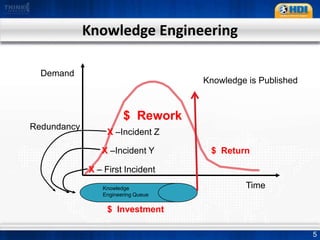
Knowledge is someone else’s responsibilityKnown as Knowledge EngineeringFollows a manufacturing processThe Support Demand CurveDemandTime
Knowledge EngineeringDemandKnowledge is PublishedRedundancyX –Incident Z$  ReworkX –Incident Y$  ReturnTimeX – First IncidentKnowledge Engineering Queue$  Investment
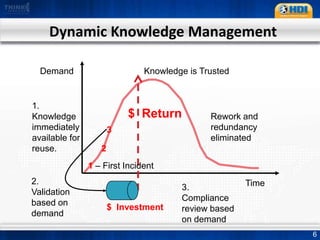
Dynamic Knowledge ManagementDemandKnowledge is Trusted1. Knowledge immediately available for reuse.$  ReturnRework and redundancy eliminated321 – First Incident2. Validation based on demandTime3. Compliance review based on demand$  Investment
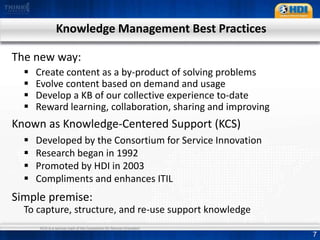
Knowledge Management Best PracticesThe new way:Create content as a by-product of solving problems
Evolve content based on demand and usage
Develop a KB of our collective experience to-date
Reward learning, collaboration, sharing and improvingKnown as Knowledge-Centered Support (KCS)Developed by the Consortium for Service Innovation
Research began in 1992
Promoted by HDI in 2003
Compliments and enhances ITILSimple premise: To capture, structure, and re-use support knowledgeKCS is a service mark of the Consortium for Service Innovation
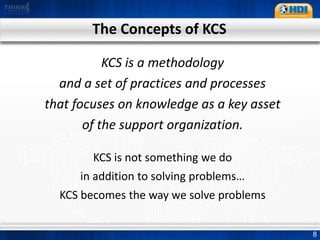
The Concepts of KCSKCS is a methodology and a set of practices and processes that focuses on knowledge as a key asset of the support organization.KCS is not something we do in addition to solving problems…KCS becomes the way we solve problems
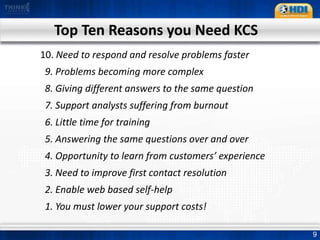
Top Ten Reasons you Need KCS10. Need to respond and resolve problems faster  9. Problems becoming more complex  8. Giving different answers to the same question  7. Support analysts suffering from burnout  6. Little time for training   5. Answering the same questions over and over  4. Opportunity to learn from customers’ experience  3. Need to improve first contact resolution  2. Enable web based self-help  1. You must lower your support costs!
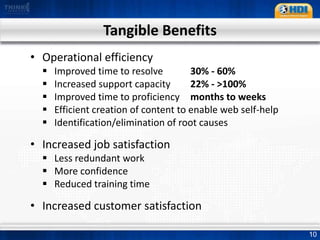
Tangible BenefitsOperational efficiencyImproved time to resolve 		30% - 60%
Increased support capacity 		22% - >100%
Improved time to proficiency 	months to weeks
Efficient creation of content to enable web self-help
Identification/elimination of root causes Increased job satisfactionLess redundant work
More confidence
Reduced training timeIncreased customer satisfaction
Who Has Invested in KCS?Lucent
Nortel Networks
Motorola
3Com
Unisys
Peregrine Systems
Intel
Network App.
BMC Software
QAD
SGI
Texas Instruments
Abbot Labs
JP Morgan Chase
Sanofi-Aventis
VeriSign

Kcs overview for detroit 2010

  • 1.
    Knowledge Management inService Management:A KCSSM OverviewKCS is a service mark of the Consortium for Service Innovation
  • 2.
    Do you successfullyleverage knowledge?Share the following information:What percentage of incidents reported are actually logged in your service management system?What percentage of incidents engaged a knowledge base?What is the percentage of success when searching knowledge?
  • 3.
    Knowledge Management BestPracticesThe old way:Dedicated knowledge management team
  • 4.
    Content created inpreparation of demand
  • 5.
    Knowledge is verified,validated, and published
  • 6.
    Knowledge is anoptional resource
  • 7.
    Knowledge is someoneelse’s responsibilityKnown as Knowledge EngineeringFollows a manufacturing processThe Support Demand CurveDemandTime
  • 8.
    Knowledge EngineeringDemandKnowledge isPublishedRedundancyX –Incident Z$ ReworkX –Incident Y$ ReturnTimeX – First IncidentKnowledge Engineering Queue$ Investment
  • 9.
    Dynamic Knowledge ManagementDemandKnowledgeis Trusted1. Knowledge immediately available for reuse.$ ReturnRework and redundancy eliminated321 – First Incident2. Validation based on demandTime3. Compliance review based on demand$ Investment
  • 10.
    Knowledge Management BestPracticesThe new way:Create content as a by-product of solving problems
  • 11.
    Evolve content basedon demand and usage
  • 12.
    Develop a KBof our collective experience to-date
  • 13.
    Reward learning, collaboration,sharing and improvingKnown as Knowledge-Centered Support (KCS)Developed by the Consortium for Service Innovation
  • 14.
  • 15.
  • 16.
    Compliments and enhancesITILSimple premise: To capture, structure, and re-use support knowledgeKCS is a service mark of the Consortium for Service Innovation
  • 17.
    The Concepts ofKCSKCS is a methodology and a set of practices and processes that focuses on knowledge as a key asset of the support organization.KCS is not something we do in addition to solving problems…KCS becomes the way we solve problems
  • 18.
    Top Ten Reasonsyou Need KCS10. Need to respond and resolve problems faster 9. Problems becoming more complex 8. Giving different answers to the same question 7. Support analysts suffering from burnout 6. Little time for training 5. Answering the same questions over and over 4. Opportunity to learn from customers’ experience 3. Need to improve first contact resolution 2. Enable web based self-help 1. You must lower your support costs!
  • 19.
  • 20.
  • 21.
    Improved time toproficiency months to weeks
  • 22.
    Efficient creation ofcontent to enable web self-help
  • 23.
    Identification/elimination of rootcauses Increased job satisfactionLess redundant work
  • 24.
  • 25.
    Reduced training timeIncreasedcustomer satisfaction
  • 26.
    Who Has Investedin KCS?Lucent
  • 27.
  • 28.
  • 29.
  • 30.
  • 31.
  • 32.
  • 33.
  • 34.
  • 35.
  • 36.
  • 37.
  • 38.
  • 39.
  • 40.
  • 41.
  • 42.
  • 43.
  • 44.
  • 45.
  • 46.
  • 47.
  • 48.
  • 49.
  • 50.
  • 51.
  • 52.
  • 53.
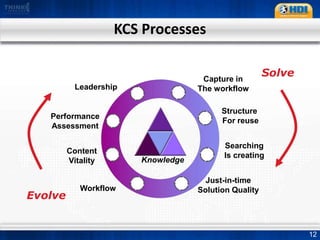
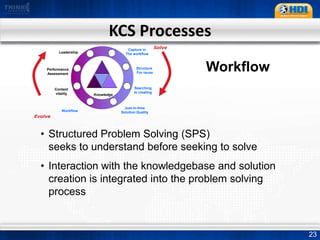
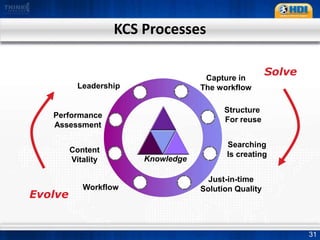
    SolveCapture inThe workflowLeadershipStructureFor reusePerformanceAssessmentSearchingIs creatingContentVitalityKnowledgeJust-in-timeSolution QualityWorkflowEvolveKCS Processes
  • 54.
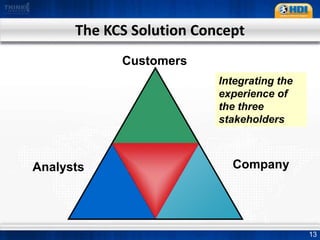
    The KCS SolutionConceptCustomersIntegrating the experience of the three stakeholdersCompanyAnalysts
  • 55.
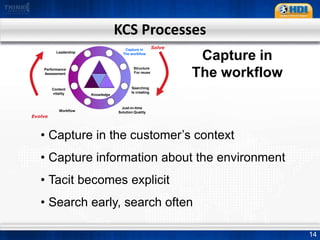
    KnowledgeKCS ProcessesSolveCapture inTheworkflowCapture inThe workflowLeadershipStructure For reusePerformanceAssessmentSearchingIs creatingContentvitalityJust-in-timeSolution QualityWorkflowEvolveCapture in the customer’s context
  • 56.
  • 57.
  • 58.
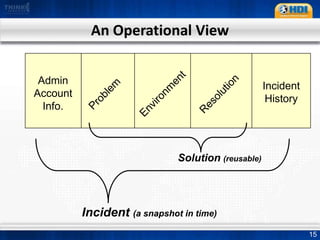
    Search early, searchoftenSolution (reusable)An Operational ViewAdminAccountInfo.Incident HistoryResolutionEnvironmentProblemIncident (a snapshot in time)
  • 59.
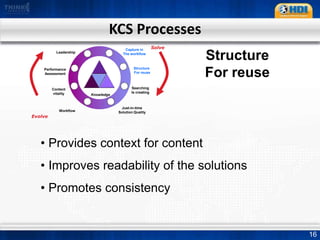
    KnowledgeKCS ProcessesSolveStructureFor reuseCaptureinThe workflowLeadershipStructure For reusePerformanceAssessmentSearchingIs creatingContentvitalityJust-in-timeSolution QualityWorkflowEvolveProvides context for content
  • 60.
  • 61.
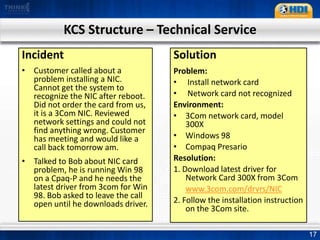
    Promotes consistencyKCS Structure– Technical ServiceIncidentCustomer called about a problem installing a NIC. Cannot get the system to recognize the NIC after reboot. Did not order the card from us, it is a 3Com NIC. Reviewed network settings and could not find anything wrong. Customer has meeting and would like a call back tomorrow am. Talked to Bob about NIC card problem, he is running Win 98 on a Cpaq-P and he needs the latest driver from 3com for Win 98. Bob asked to leave the call open until he downloads driver. SolutionProblem: Install network card
  • 62.
    Network cardnot recognizedEnvironment:3Com network card, model 300X
  • 63.
  • 64.
    Compaq PresarioResolution:1. Downloadlatest driver for Network Card 300X from 3Comwww.3com.com/drvrs/NIC2. Follow the installation instruction on the 3Com site.
  • 65.
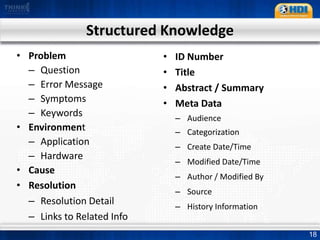
    ProblemQuestionError MessageSymptomsKeywordsEnvironmentApplicationHardwareCauseResolutionResolution DetailLinksto Related InfoID NumberTitleAbstract / SummaryMeta DataAudienceCategorizationCreate Date/TimeModified Date/TimeAuthor / Modified BySourceHistory InformationStructured Knowledge
  • 66.
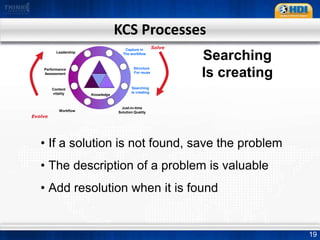
    KnowledgeKCS ProcessesSolveSearchingIs creatingCaptureinThe workflowLeadershipStructure For reusePerformanceAssessmentSearchingIs creatingContentvitalityJust-in-timeSolution QualityWorkflowEvolveIf a solution is not found, save the problem
  • 67.
    The description ofa problem is valuable
  • 68.
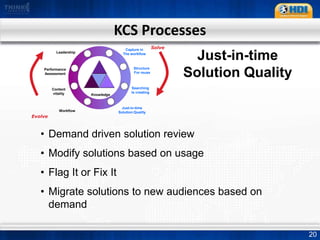
    Add resolution whenit is foundKnowledgeKCS ProcessesSolveJust-in-timeSolution QualityCapture inThe workflowLeadershipStructure For reusePerformanceAssessmentSearchingIs creatingContentvitalityJust-in-timeSolution QualityWorkflowEvolveDemand driven solution review
  • 69.
  • 70.
  • 71.
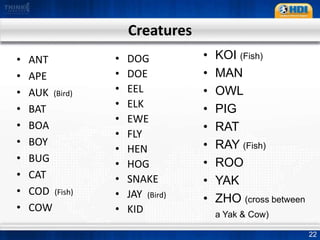
    Migrate solutions tonew audiences based on demandWhat are all of the names of three-lettered creatures you can think of? Record your answers. Creatures Exercise
  • 72.
  • 73.
  • 74.
  • 75.
  • 76.
  • 77.
  • 78.
  • 79.
  • 80.
    ZHO (cross betweena Yak & Cow)ANTAPEAUK (Bird)BATBOABOYBUGCATCOD (Fish)COWDOGDOEEELELKEWEFLYHENHOGSNAKEJAY (Bird)KID
  • 81.
    KnowledgeKCS ProcessesSolveCapture inTheworkflowLeadershipWorkflowStructure For reusePerformanceAssessmentSearchingIs creatingContentvitalityJust-in-timeSolution QualityWorkflowEvolveStructured Problem Solving (SPS)seeks to understand before seeking to solve
  • 82.
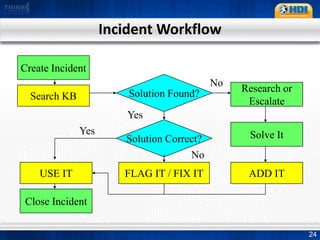
    Interaction with theknowledgebase and solution creation is integrated into the problem solving processIncident WorkflowCreate IncidentSolution Found?NoResearch orEscalateSearch KBYesSolution Correct?YesSolve ItNoUSE ITFLAG IT / FIX ITADD ITClose Incident
  • 83.
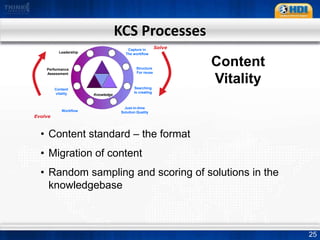
    KnowledgeKCS ProcessesSolveCapture inTheworkflowLeadershipContentVitalityStructure For reusePerformanceAssessmentSearchingIs creatingContentvitalityJust-in-timeSolution QualityWorkflowEvolveContent standard – the format
  • 84.
  • 85.
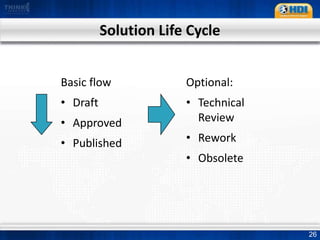
    Random sampling andscoring of solutions in the knowledgebaseSolution Life CycleBasic flowDraftApprovedPublishedOptional:Technical ReviewReworkObsolete
  • 86.
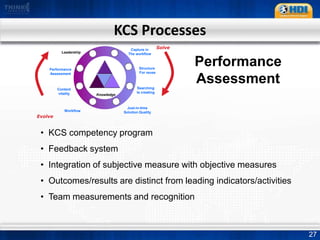
    KnowledgeKCS ProcessesSolveCapture inTheworkflowLeadershipPerformanceAssessmentStructure For reusePerformanceAssessmentSearchingIs creatingContentvitalityJust-in-timeSolution QualityWorkflowEvolveKCS competency program
  • 87.
  • 88.
    Integration of subjectivemeasure with objective measures
  • 89.
    Outcomes/results are distinctfrom leading indicators/activities
  • 90.
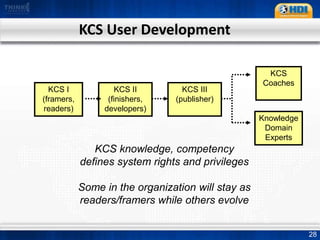
    Team measurements andrecognitionKCS User Development KCS CoachesKCS I(framers, readers)KCS II(finishers, developers)KCS III(publisher)KnowledgeDomainExpertsKCS knowledge, competencydefines system rights and privilegesSome in the organization will stay as readers/framers while others evolve
  • 91.
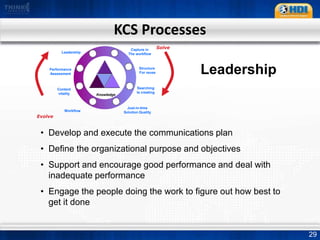
    KnowledgeKCS ProcessesSolveCapture inTheworkflowLeadershipLeadershipStructure For reusePerformanceAssessmentSearchingIs creatingContentvitalityJust-in-timeSolution QualityWorkflowEvolveDevelop and execute the communications plan
  • 92.
    Define the organizationalpurpose and objectives
  • 93.
    Support and encouragegood performance and deal with inadequate performance
  • 94.
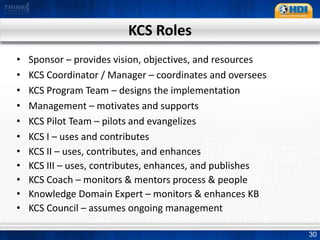
    Engage the peopledoing the work to figure out how best to get it doneKCS RolesSponsor – provides vision, objectives, and resourcesKCS Coordinator / Manager – coordinates and oversees KCS Program Team – designs the implementationManagement – motivates and supportsKCS Pilot Team – pilots and evangelizesKCS I – uses and contributesKCS II – uses, contributes, and enhancesKCS III – uses, contributes, enhances, and publishesKCS Coach – monitors & mentors process & peopleKnowledge Domain Expert – monitors & enhances KBKCS Council – assumes ongoing management
  • 95.
    SolveCapture inThe workflowLeadershipStructureFor reusePerformanceAssessmentSearchingIs creatingContentVitalityKnowledgeJust-in-timeSolution QualityWorkflowEvolveKCS Processes
  • 96.
    How does KCSAlign with ITIL?
  • 97.
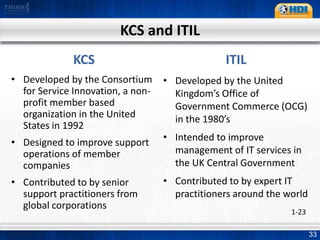
    KCS and ITILKCSITILDevelopedby the Consortium for Service Innovation, a non-profit member based organization in the United States in 1992Designed to improve support operations of member companiesContributed to by senior support practitioners from global corporationsDeveloped by the United Kingdom’s Office of Government Commerce (OCG) in the 1980’sIntended to improve management of IT services in the UK Central GovernmentContributed to by expert IT practitioners around the world1-23
  • 98.
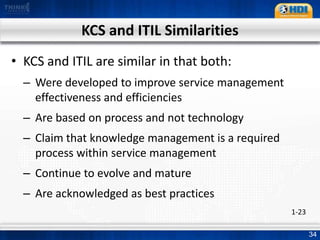
    KCS and ITILSimilaritiesKCS and ITIL are similar in that both:Were developed to improve service management effectiveness and efficienciesAre based on process and not technologyClaim that knowledge management is a required process within service managementContinue to evolve and matureAre acknowledged as best practices 1-23
  • 99.
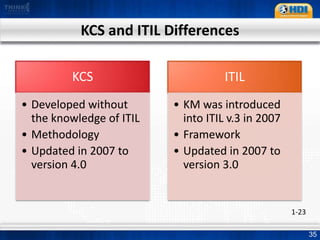
    KCS and ITILDifferences1-23
  • 100.
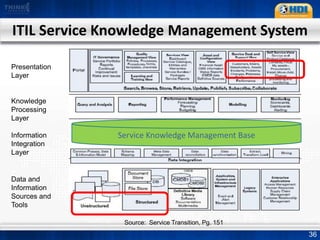
    ITIL Service KnowledgeManagement SystemPresentation LayerKnowledge Processing LayerService Knowledge Management BaseInformation IntegrationLayerData and Information Sources and ToolsSource: Service Transition, Pg. 151
  • 101.
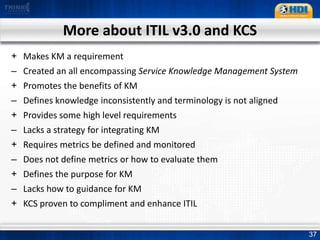
    More about ITILv3.0 and KCSMakes KM a requirement
  • 102.
    Created an allencompassing Service Knowledge Management System
  • 103.
  • 104.
    Defines knowledge inconsistentlyand terminology is not aligned
  • 105.
    Provides some highlevel requirements
  • 106.
    Lacks a strategyfor integrating KM
  • 107.
    Requires metrics bedefined and monitored
  • 108.
    Does not definemetrics or how to evaluate them
  • 109.
  • 110.
    Lacks how toguidance for KM
  • 111.
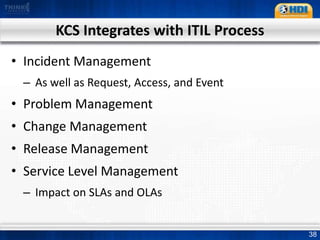
    KCS proven tocompliment and enhance ITILKCS Integrates with ITIL ProcessIncident ManagementAs well as Request, Access, and EventProblem ManagementChange ManagementRelease ManagementService Level ManagementImpact on SLAs and OLAs
  • 112.
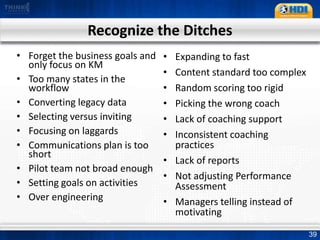
    Forget the businessgoals and only focus on KMToo many states in the workflowConverting legacy dataSelecting versus invitingFocusing on laggardsCommunications plan is too shortPilot team not broad enoughSetting goals on activitiesOver engineeringRecognize the DitchesExpanding to fastContent standard too complexRandom scoring too rigidPicking the wrong coachLack of coaching supportInconsistent coaching practicesLack of reportsNot adjusting Performance AssessmentManagers telling instead of motivating
  • 113.
    DISCUSSIONWe don’t havea KM system, how can you get started now?We have a KM system, what should we do now?
  • 114.
    Where to learnmore…HDI’s Knowledge Management Foundations: KCS Principles workshopHDI’s Knowledge-Centered Support Fundamentals HDI Webinar ArchivesHDI Focus Book: Knowledge Management Maturity Modelwww.serviceinnovations.org
  • 115.
    Knowledge Management inIT Service Management:A KCSSM OverviewRick JoslinExecutive Director, Certification & Trainingrjoslin@thinkhdi.comKCS is a service mark of the Consortium for Service Innovation

Editor's Notes

  • #5 There are two categories of incidents that occur in support environments. The first are those that occur once or periodically, which we will call “infrequent”. The second are those that we call “repeatable” or “frequent”. In most support environments there is a general rule of thumb that 80% of all incidents are generated by 20% of all problems. It is these 80% where knowledge management can have a big impact.When a new change is implemented into the environment, such as a product release, we can predict that the support center will see an increase in incidents for a period of time. This is generally 30 to 60 days. The Support Demand Curve has two axis: demand – the number of incidents received in a given period of time, and time. When the support center receives a repeatable incident for the first time, we start the curve. We then begin to see this incident more frequently for a number of days and then the frequency or demand will begin to reduce. Ultimately if the problem is not removed from the environment, we will continue to see it reported to the support center but on a less frequent period of time. If we map the demand for support for this problem over time we end up with a curve that looks like the bell curve.
  • #6 Let’s look at the impact knowledge management has as incidents are reported to the support center. The When the first incident is reported it is an unknown problem. The analyst must do work to solve the problem. They are then expected to capture the knowledge and report it to the Knowledge Engineering team. The new knowledge is submitted to the knowledge engineering queue. The Knowledge Engineers have the responsibility to validate and verify that the problem has been properly documented and the resolution is correct. Once they have completed their task, they publish the knowledge to the knowledge base for reuse.In most environments the time it takes for new knowledge to be processed and then published is measured in days or even weeks. By the time the knowledge is published, the demand curve will have been missed. Consider this from business view point. The knowledge engineering process is an investment that the company is making. The return is then collected through the reuse of that knowledge after it is published. So what is happening while the knowledge is in the queue? When the next incident is reported to the support center, an analyst will search the knowledge base and not find it because it has not been published yet. While this is a now a known problem to the organization, the analyst assumes that it is an unknown problem and must do work to solve the problem. This is actually rework which as a cost to the organization. Once the analyst solves the problem, he or she submits the knowledge to the knowledge engineering queue. Unknowing to the analyst, this problem was already submitted and they just submitted a redundant solution. This process continues until the knowledge engineers publish the known problem in the knowledge base. During this time, the knowledge queue is getting longer with work that the knowledge engineers should not be doing, only adding to the delay in publishing new knowledge.Because this model has the delay in publishing new knowledge, the organization is working inefficiently and the return on investment for knowledge is low.
  • #7 Now let’s look at the same scenario following the Knowledge-Centered Support methodology.After the first incident is reported the analyst contributes the new knowledge directly to the knowledge base for reuse by other analysts. This makes the known problem visible so that other analysts do not do rework. However, this knowledge has not been validated or verified. So the trust level is low. We will mark this knowledge as “Draft”As additional analysts interact with the Draft knowledge, they are responsible for ensuring that the resolution is correct before providing it to the customer. If they identify any errors or omissions in the knowledge, they are responsible to correct it before giving it to the customer and for correcting it in the knowledge base. In this methodology, we are letting the customer demand drive the need to review the knowledge just-in-time instead of the just-in-case model of knowledge engineering. And most importantly, we have eliminated the rework for resolving the same problem.Once we have evidence of demand, such as 3 or 4 reuses of the same knowledge, we can then elect to submit the knowledge to a compliance process for review. Since we are allowing demand to drive the items that are sent to the compliance process, only those problems that are repeatable are receiving the additional investment. This means that 80% of the problems are not being reviewed because the demand is not there and therefore the return will not be there as well. We have just reduced the workload in the compliance process by 80%. In addition, we have also removed the redundancy from this workload for an additional savings. Furthermore, the validation of the resolution will have already been completed by the 3 or 4 analysts that reused the solution before it was sent to the compliance process. Once the solution or knowledge goes through thru the compliance process, the knowledge will be marked as either Approved or Published. Both imply that the company trusts the knowledge to be correct. The knowledge would be marked Approved if it is for internal use. This lets the analyst know that the customer cannot see the knowledge via a self-service portal and that they can trust it. The knowledge would be marked “Published” if the knowledge is now available for customer self-service as well as analyst use.