KM SOLUTIONS
IDENTIFYING AND UTILIZING APPROPRIATE SOLUTION
Presented by
GROUP 4
JHA PRAVINKUMAR (I-15-18-7)
SHINGALA SANKET (I-15-18-17)
TRIPATHI MANISH (I-15-18-19)
BOURA SANJAY (I-15-18-24)
Thakur Institute of Management Studies
&
Research
(Sunday, 3 September 2017)
1
2
3
4
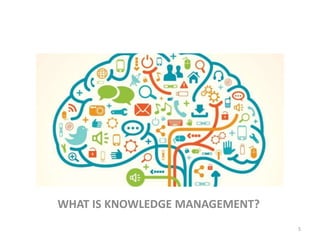
WHAT IS KNOWLEDGE MANAGEMENT?
5
• Knowledge management (KM) is the process of
creating, sharing, using and managing the
knowledge and information of an organisation
• It refers to a multidisciplinary approach to
achieving organisational objectives by making the
best use of knowledge
6
• Knowledge management (KM) is a business
process that formalizes the management and use
of an enterprise’s intellectual assets
• KM promotes a collaborative and integrative
approach to the creation, capture, organization,
access and use of information assets, including
the tacit, uncaptured knowledge of people
7
• Knowledge management is codifying the
knowledge that your company creates and
disseminating it to people who need it, when
they need it.
8
HOW TO IDENTIFY AN APPROPIATE KNOWLEDGE
MANAGEMENT SOLUTION?
9
How to identify a KMS?
• Based on the research article “How to Select
Knowledge Management Systems: A Framework to
Support Managers”
• By Marco Greco, Michele Grimaldi, Musadaq
Hanandi
• First Published January 1, 2013
• Provides a methodological framework which could
support managers in the selection of Knowledge
Management Systems
10
How to identify a KMS?
• The framework is based on the Analytic Hierarchy
Process approach
• This methodological framework offers a good
applicability to different business contexts, since
its hierarchical arrangement suits most of the
needs of numerous organizations
• Consequently, it can be regarded as a holistic
approach able to assist decision makers in their
Knowledge Management System selection process
11
ESSENTIAL CRITERIA FOR SELECTING A KNOWLEDGE
MANAGEMENT SOLUTION?
12
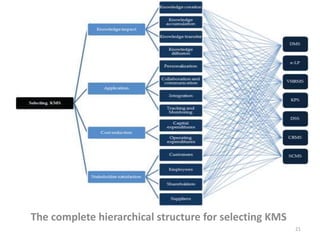
#1 Knowledge impact
• Knowledge creation
• Knowledge accumulation
• Knowledge transfer
• Knowledge diffusion
13
#2 Application
• Personalization
• Collaboration and communication
• Integration
• Tracking and Monitoring
14
#3 cost reduction
• Capital expenditures
• Operating expenditures
15
#4 Stakeholder satisfaction
• Customers
• Employees
• Shareholders
• Suppliers
16
The Analytic Hierarchy Process
17
The Analytic Hierarchy Process
• The AHP, originally introduced by Saaty , is a
flexible, structured technique for dealing with
complex decisions
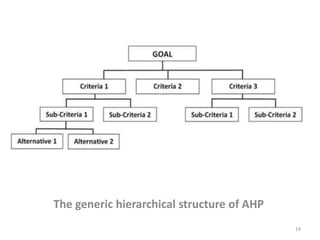
• It is aimed at breaking down different choices
arising within a hierarchical structure consisting of
goal, criteria, sub-criteria and alternatives
• AHP structures the decision hierarchy from the
top, where the goal of the decision maker is
placed, passing through the intermediate levels
(criteria and sub-criteria on which subsequent
elements depend) to the lowest level (which
usually is a set of the alternatives)
18
The generic hierarchical structure of AHP
19
Possible alternatives in the choice of the most suitable KMS
• Document Management System (DMS)
• Learning platform (e-LP)
• Virtual Human Resource Management System (VHRMS)
• Knowledge Portal System (KPS)
• Decision Support System (DSS)
•
• Customer Relationship Management System (CRMS)
• Supply Chain Management System (SCMS)
20
The complete hierarchical structure for selecting KMS
21
Application of AHP framework
• Once the hierarchical structure has been defined,
it is possible to start implementing the AHP in
order to calculate the relative weighting of each
component of the hierarchy
• Then, the obtained weights are aggregated and
synthesized for the final measurement of given
decision alternatives
• The computation of the weights is made by asking
the importance of each component with respect
to each of the others, at a peer level
• The verbal responses are then quantified and
translated into a score using the nine-point scale 22
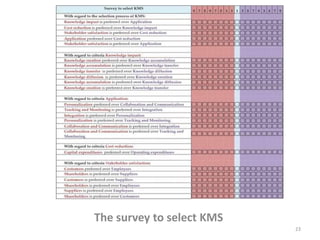
The survey to select KMS
23
Application of AHP framework
• The survey synthesizes the questions that
managers are asked to answer with regard to
criteria and sub-criteria
• The relative weights of the criteria and the sub-
criteria are estimated by calculating the
eigenvalues for their judgment matrixes with these
relative weights aggregated
• Then, managers are asked to pair-wise compare all
the alternatives (DMS, e-LP, VHRMS, KPS, DSS,
CRMS, SCMS) with regard to all the sub-criteria of
every criteria (knowledge, application, cost
reduction and stakeholder satisfaction)
24
Application of AHP framework
• Once all the pair-wise comparison matrixes are
formed and filled by managers, the weights of
components are calculated by solving the
eigenvector of the pair-wise comparison matrix
• In this way, by making use of the AHP
methodology, the weights are synthesized for the
final measurement of the given decision
alternatives
• The selection and the decision are based on the
alternative KMS with the highest weight
25
How to choose KMS
• Imagine your customer service agent interacting with a customer. They
mean well, but it takes them forever to find the right information using
your current knowledge management (KM) system. What score do you
think the caller would give them on their post-call customer satisfaction
survey? How likely are they to recommend your company or buy from you
again?
• Was the customer service agent at fault? Maybe not. They may have
simply been victimized by a slow, outdated knowledge management
system.
• Years ago, companies began storing policies, product information, and
marketing promotions in internal intranets, wikis, and sometimes even
in Excel spreadsheets. As the sheer amount of information grew, they
stayed with their current system as it got bloated.
• State of the art knowledge management systems, however, make it easy
to find the right answers quickly, reduce average handle time (AHT), and
improve customer satisfaction (CSAT) and net promoter scores (NPS.)
1. Accuracy & 2.Relevancy
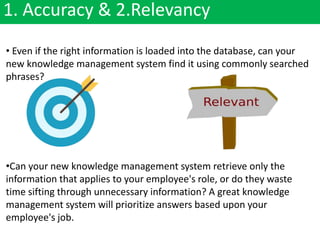
• Even if the right information is loaded into the database, can your
new knowledge management system find it using commonly searched
phrases?
•Can your new knowledge management system retrieve only the
information that applies to your employee's role, or do they waste
time sifting through unnecessary information? A great knowledge
management system will prioritize answers based upon your
employee's job.
3. Speed & 4. Compliance
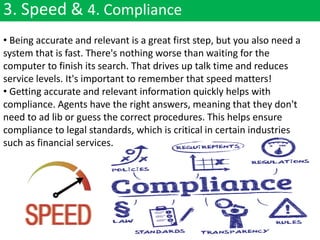
• Being accurate and relevant is a great first step, but you also need a
system that is fast. There's nothing worse than waiting for the
computer to finish its search. That drives up talk time and reduces
service levels. It's important to remember that speed matters!
• Getting accurate and relevant information quickly helps with
compliance. Agents have the right answers, meaning that they don't
need to ad lib or guess the correct procedures. This helps ensure
compliance to legal standards, which is critical in certain industries
such as financial services.
5. Ease of knowledge migration
• Migration is sometimes viewed as a
pain point, but it is also a great
opportunity to review and update
your knowledge articles. Edit them for
accuracy, scan ability, and
effectiveness. As for the migration
itself, the right vendor will have
processes in place to make it move as
seamlessly as possible
6. Ability to update information and add new content
• Can your new KM system be administered by your own employees?
Great knowledge management systems make it easy for your team to
keep the information up to date. It also allows you to add new content
and search terms without having to call customer support.
7. Feedback loop to create employee
engagement
• Does your new knowledge management system provide agents with a
built-in opportunity to provide feedback on content accuracy? Can
they request new search terms and expanded descriptions? An
excellent KM system allows users to leverage the system to produce
improvements.
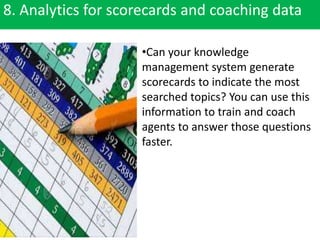
8. Analytics for scorecards and coaching data
•Can your knowledge
management system generate
scorecards to indicate the most
searched topics? You can use this
information to train and coach
agents to answer those questions
faster.
9. Provision for daily knowledge updates
and training
•A great KM system allows agents to sign in for their shift and
automatically see the day's updates and key messages. It can also host
eLearning modules so that agents are up to speed before their first call
of the day.
10. Ability to be deployed enterprise wide
• Having separate knowledge management systems for your contact
center, sales team, and web site increases administrative overhead. It
also creates corporate silos. Says knowledge management system
provider Infinite in their white paper Tools to Accelerate Business
Results.
• You can use these ten criteria to choose the right knowledge
management system for better customer service and sales support.
The only thing worse than the expense of a new system is the cost of
poor customer service and lost sales.
7 Steps to implementing knowledge
management in your organization
A successful knowledge management program will consider more than just
technology. An organization should also consider:
• People. They represent how you increase the ability of individuals
within the organization to influence others with their knowledge.
• Processes. They involve how you establish best practices and
governance for the efficient and accurate identification, management,
and dissemination of knowledge.
• Technology. It addresses how you choose, configure, and utilize tools
and automation to enable knowledge management.
• Structure. It directs how you transform organizational structures to
facilitate and encourage cross-discipline awareness and expertise.
• Culture. It embodies how you establish and cultivate a knowledge-
sharing, knowledge-driven culture.
7 Steps to implementing knowledge
management in your organization
Step 1: Establish Knowledge Management Program Objectives
• Defining a process and developing workflows.
• Identify and document the business problems.
• Short-term and Long-term objectives
Step 2: Prepare for Change
• Cultural changes in the employees.
• Reward individual performance.
7 Steps to implementing knowledge
management in your organization
Step 3: Define High-Level Process
• High-level knowledge management process.
• How knowledge is identified, captured, categorized, and disseminated will
be ad hoc at best.
• Activities include knowledge strategy, creation, identification, classification,
capture, validation, transfer, maintenance, archival, measurement, and
reporting.
Step 4: Determine and Prioritize Technology Needs
• Prioritize your knowledge management technology needs.
• Understand the cost and benefit of each type of technology and the
primary technology providers in the marketplace.
Step 5: Build a Knowledge Management Implementation Roadmap
• Re-confirm senior leadership's support and commitment
• Specify gaps identified by the assessment.
7 Steps to implementing knowledge
management in your organization
Step 6: Implementation
• Implementing a knowledge management program and maturing the
overall effectiveness of your organization will require significant
personnel resources and funding.
Step 7: Measure and Improve the Knowledge Management Program
• Measuring your actual effectiveness and comparing that to anticipated
results.
• The key point behind establishing a knowledge management is that it
provides valuable insight into what's working and what's not. You can
then take the necessary actions to mitigate compliance, performance,
quality, and value gaps, thus improving overall efficacy of the
knowledge management program.
KNOWLWDGE MANAGEMENT
@
BUCKMAN LABORATORIES
39
BUCKMAN LABORATORIES
• Buckman is a global specialty chemical company
headquartered in Memphis, Tennessee, USA
• The company conducts business in over 90 countries,
operates out of ten global locations - Memphis, TN;
Cadet, MO; Canada, Europe, Mexico, Brazil, Australia,
South Africa, Singapore, and China
• Employs approximately 1700 associates
• Core industries are pulp and paper, leather, water
treatment and process chemistry
• Secondary industries include performance chemicals
(paint, coatings, plastics, water formulators, wood
treatment, and agriculture)
40
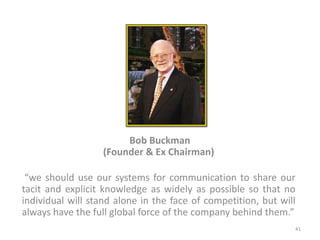
Bob Buckman
(Founder & Ex Chairman)
“we should use our systems for communication to share our
tacit and explicit knowledge as widely as possible so that no
individual will stand alone in the face of competition, but will
always have the full global force of the company behind them.”
41
Buckman Laboratories enterprise mission statement
“we will excel in providing measurable, cost effective
improvements in output and quality for our customers by
delivering customer specific services and products, and
the creative application of knowledge”
42
KM STRATEGY
Buckman Laboratories’ knowledge strategy has been
developed with five objectives:
• Accelerate the accumulation and dissemination of
knowledge by Buckman Laboratories’ associates worldwide
• Provide easy and rapid access to Buckman Lab’s global
database of knowledge
• Eliminate time and space constraints in communications
• Stimulate associates to experience the value of sharing
knowledge in providing custom-tailored service to
customers
• Respect the dignity of each individual by cultivating an
environment that enhances his or her professional
development and recognises each person as a valued
member of a service-oriented team
43
INITIATIVES
Knowledge Portal, K'netix, featuring:
• Asset library encompassing all organizational knowledge and
experience
• Discussion forum allows employees to share tacit knowledge;
threads are captured and stored as assets
• Communities meetings are held within the forum focusing on
different areas of interest
• Also have a message bulletin board, a knowledge library and
virtual conference rooms
• A key advantage is simplicity and adaptability: it is easy to
contribute and easy to access knowledge
Total estimated cost of the knowledge management and learning
initiative within Buckman is US$7500 per employee per year; or
$10.5m annual enterprise total (includes all hardware, software and
network costs associated with knowledge sharing and collaboration) 44
LEADERSHIP
Knowledge mentors – leading by example
In common with other world-class knowledge management enterprises, the
senior leadership were clearly seen to be acting as knowledge mentors:
• Ex CEO, Bob Buckman, routinely sent personal communications to
employees demonstrating a low level of knowledge-sharing: he would
ask if they were experiencing problems or required training and asked
what help the leadership could offer
• Middle managers were seen to have a critical role as mentors and
coaches - encouraging knowledge sharing and enterprise-wide customer
problem-solving
• Knowledge sharing and collaboration has now evolved from a few at the
top pushing knowledge sharing to an organizational imperative on
everybody’s agenda
• The company highlights that they have not one Chief Knowledge Office,
but rather every leadership role is part knowledge leader
45
CULTURE
• Key effort is focused on changing organizational culture
“[Our focus has been ] 90% culture change and 10% technology change.
Technology is the easy part… the focus needs to be on culture change and
how to shift to a networked communication model” – Bob Buckman, ex
CEO
• Develop a common value system, built into recruitment and reward
system
• Quality not quantity
Employees do not get praise for responding to numerous emails, adding
value is the key and paving the way for best practices. Knowledge sharing is
pro active as an associate is not considered for promotion unless there are
active in their knowledge sharing
46
PROCESS
• Information at speed – No taxonomy
Buckman Laboratories do not believe in having taxonomies because they need
information at speed and believe tagging data is time consuming and lacks
consistency
“[we] do not want to wait for a good piece of information to become available just
because we are waiting for someone to code it, we can’t afford to wait that long”
Bob Buckman, ex CEO
What they do have are knowledge areas based upon business functions across all
the different systems and repositories with a common interface. They access all this
information through a search engine
• A human touch
K’Netic has highly trained librarians, with access to the entire global network, who
manage and monitor content threads – if they see employees searching for
information they can guide them effectively and rapidly to the correct content
47
TECHNOLOGY
Technology as a facilitator
Technology needs to meet the requirements of its users, for
Buckman this was a global network, allowing quick response
time and collaboration
• In house document repository
• Microsoft Outlook based collaboration tool
• Verity search engine
• eLearning tool
“‘Use simple tools in imaginative ways with a higher purpose in
mind’ Bob Buckman, ex CEO, Chairman
48
BENEFITS
• 50% rise in sales from new products indicating a
sharp rise in profitability from innovation
• 51% rise in sales per associate
• 93% increase in operating costs per associate
• Cost of training with the learning center decreased
from $1,000 per hour to $25- $40
• Global speed of response to the customer has
improved from days and weeks to hours
49
50

Km solutions-group4

  • 1.
    KM SOLUTIONS IDENTIFYING ANDUTILIZING APPROPRIATE SOLUTION Presented by GROUP 4 JHA PRAVINKUMAR (I-15-18-7) SHINGALA SANKET (I-15-18-17) TRIPATHI MANISH (I-15-18-19) BOURA SANJAY (I-15-18-24) Thakur Institute of Management Studies & Research (Sunday, 3 September 2017) 1
  • 2.
  • 3.
  • 4.
  • 5.
    WHAT IS KNOWLEDGEMANAGEMENT? 5
  • 6.
    • Knowledge management(KM) is the process of creating, sharing, using and managing the knowledge and information of an organisation • It refers to a multidisciplinary approach to achieving organisational objectives by making the best use of knowledge 6
  • 7.
    • Knowledge management(KM) is a business process that formalizes the management and use of an enterprise’s intellectual assets • KM promotes a collaborative and integrative approach to the creation, capture, organization, access and use of information assets, including the tacit, uncaptured knowledge of people 7
  • 8.
    • Knowledge managementis codifying the knowledge that your company creates and disseminating it to people who need it, when they need it. 8
  • 9.
    HOW TO IDENTIFYAN APPROPIATE KNOWLEDGE MANAGEMENT SOLUTION? 9
  • 10.
    How to identifya KMS? • Based on the research article “How to Select Knowledge Management Systems: A Framework to Support Managers” • By Marco Greco, Michele Grimaldi, Musadaq Hanandi • First Published January 1, 2013 • Provides a methodological framework which could support managers in the selection of Knowledge Management Systems 10
  • 11.
    How to identifya KMS? • The framework is based on the Analytic Hierarchy Process approach • This methodological framework offers a good applicability to different business contexts, since its hierarchical arrangement suits most of the needs of numerous organizations • Consequently, it can be regarded as a holistic approach able to assist decision makers in their Knowledge Management System selection process 11
  • 12.
    ESSENTIAL CRITERIA FORSELECTING A KNOWLEDGE MANAGEMENT SOLUTION? 12
  • 13.
    #1 Knowledge impact •Knowledge creation • Knowledge accumulation • Knowledge transfer • Knowledge diffusion 13
  • 14.
    #2 Application • Personalization •Collaboration and communication • Integration • Tracking and Monitoring 14
  • 15.
    #3 cost reduction •Capital expenditures • Operating expenditures 15
  • 16.
    #4 Stakeholder satisfaction •Customers • Employees • Shareholders • Suppliers 16
  • 17.
  • 18.
    The Analytic HierarchyProcess • The AHP, originally introduced by Saaty , is a flexible, structured technique for dealing with complex decisions • It is aimed at breaking down different choices arising within a hierarchical structure consisting of goal, criteria, sub-criteria and alternatives • AHP structures the decision hierarchy from the top, where the goal of the decision maker is placed, passing through the intermediate levels (criteria and sub-criteria on which subsequent elements depend) to the lowest level (which usually is a set of the alternatives) 18
  • 19.
    The generic hierarchicalstructure of AHP 19
  • 20.
    Possible alternatives inthe choice of the most suitable KMS • Document Management System (DMS) • Learning platform (e-LP) • Virtual Human Resource Management System (VHRMS) • Knowledge Portal System (KPS) • Decision Support System (DSS) • • Customer Relationship Management System (CRMS) • Supply Chain Management System (SCMS) 20
  • 21.
    The complete hierarchicalstructure for selecting KMS 21
  • 22.
    Application of AHPframework • Once the hierarchical structure has been defined, it is possible to start implementing the AHP in order to calculate the relative weighting of each component of the hierarchy • Then, the obtained weights are aggregated and synthesized for the final measurement of given decision alternatives • The computation of the weights is made by asking the importance of each component with respect to each of the others, at a peer level • The verbal responses are then quantified and translated into a score using the nine-point scale 22
  • 23.
    The survey toselect KMS 23
  • 24.
    Application of AHPframework • The survey synthesizes the questions that managers are asked to answer with regard to criteria and sub-criteria • The relative weights of the criteria and the sub- criteria are estimated by calculating the eigenvalues for their judgment matrixes with these relative weights aggregated • Then, managers are asked to pair-wise compare all the alternatives (DMS, e-LP, VHRMS, KPS, DSS, CRMS, SCMS) with regard to all the sub-criteria of every criteria (knowledge, application, cost reduction and stakeholder satisfaction) 24
  • 25.
    Application of AHPframework • Once all the pair-wise comparison matrixes are formed and filled by managers, the weights of components are calculated by solving the eigenvector of the pair-wise comparison matrix • In this way, by making use of the AHP methodology, the weights are synthesized for the final measurement of the given decision alternatives • The selection and the decision are based on the alternative KMS with the highest weight 25
  • 26.
    How to chooseKMS • Imagine your customer service agent interacting with a customer. They mean well, but it takes them forever to find the right information using your current knowledge management (KM) system. What score do you think the caller would give them on their post-call customer satisfaction survey? How likely are they to recommend your company or buy from you again? • Was the customer service agent at fault? Maybe not. They may have simply been victimized by a slow, outdated knowledge management system. • Years ago, companies began storing policies, product information, and marketing promotions in internal intranets, wikis, and sometimes even in Excel spreadsheets. As the sheer amount of information grew, they stayed with their current system as it got bloated. • State of the art knowledge management systems, however, make it easy to find the right answers quickly, reduce average handle time (AHT), and improve customer satisfaction (CSAT) and net promoter scores (NPS.)
  • 27.
    1. Accuracy &2.Relevancy • Even if the right information is loaded into the database, can your new knowledge management system find it using commonly searched phrases? •Can your new knowledge management system retrieve only the information that applies to your employee's role, or do they waste time sifting through unnecessary information? A great knowledge management system will prioritize answers based upon your employee's job.
  • 28.
    3. Speed &4. Compliance • Being accurate and relevant is a great first step, but you also need a system that is fast. There's nothing worse than waiting for the computer to finish its search. That drives up talk time and reduces service levels. It's important to remember that speed matters! • Getting accurate and relevant information quickly helps with compliance. Agents have the right answers, meaning that they don't need to ad lib or guess the correct procedures. This helps ensure compliance to legal standards, which is critical in certain industries such as financial services.
  • 29.
    5. Ease ofknowledge migration • Migration is sometimes viewed as a pain point, but it is also a great opportunity to review and update your knowledge articles. Edit them for accuracy, scan ability, and effectiveness. As for the migration itself, the right vendor will have processes in place to make it move as seamlessly as possible
  • 30.
    6. Ability toupdate information and add new content • Can your new KM system be administered by your own employees? Great knowledge management systems make it easy for your team to keep the information up to date. It also allows you to add new content and search terms without having to call customer support.
  • 31.
    7. Feedback loopto create employee engagement • Does your new knowledge management system provide agents with a built-in opportunity to provide feedback on content accuracy? Can they request new search terms and expanded descriptions? An excellent KM system allows users to leverage the system to produce improvements.
  • 32.
    8. Analytics forscorecards and coaching data •Can your knowledge management system generate scorecards to indicate the most searched topics? You can use this information to train and coach agents to answer those questions faster.
  • 33.
    9. Provision fordaily knowledge updates and training •A great KM system allows agents to sign in for their shift and automatically see the day's updates and key messages. It can also host eLearning modules so that agents are up to speed before their first call of the day.
  • 34.
    10. Ability tobe deployed enterprise wide • Having separate knowledge management systems for your contact center, sales team, and web site increases administrative overhead. It also creates corporate silos. Says knowledge management system provider Infinite in their white paper Tools to Accelerate Business Results. • You can use these ten criteria to choose the right knowledge management system for better customer service and sales support. The only thing worse than the expense of a new system is the cost of poor customer service and lost sales.
  • 35.
    7 Steps toimplementing knowledge management in your organization A successful knowledge management program will consider more than just technology. An organization should also consider: • People. They represent how you increase the ability of individuals within the organization to influence others with their knowledge. • Processes. They involve how you establish best practices and governance for the efficient and accurate identification, management, and dissemination of knowledge. • Technology. It addresses how you choose, configure, and utilize tools and automation to enable knowledge management. • Structure. It directs how you transform organizational structures to facilitate and encourage cross-discipline awareness and expertise. • Culture. It embodies how you establish and cultivate a knowledge- sharing, knowledge-driven culture.
  • 36.
    7 Steps toimplementing knowledge management in your organization Step 1: Establish Knowledge Management Program Objectives • Defining a process and developing workflows. • Identify and document the business problems. • Short-term and Long-term objectives Step 2: Prepare for Change • Cultural changes in the employees. • Reward individual performance.
  • 37.
    7 Steps toimplementing knowledge management in your organization Step 3: Define High-Level Process • High-level knowledge management process. • How knowledge is identified, captured, categorized, and disseminated will be ad hoc at best. • Activities include knowledge strategy, creation, identification, classification, capture, validation, transfer, maintenance, archival, measurement, and reporting. Step 4: Determine and Prioritize Technology Needs • Prioritize your knowledge management technology needs. • Understand the cost and benefit of each type of technology and the primary technology providers in the marketplace. Step 5: Build a Knowledge Management Implementation Roadmap • Re-confirm senior leadership's support and commitment • Specify gaps identified by the assessment.
  • 38.
    7 Steps toimplementing knowledge management in your organization Step 6: Implementation • Implementing a knowledge management program and maturing the overall effectiveness of your organization will require significant personnel resources and funding. Step 7: Measure and Improve the Knowledge Management Program • Measuring your actual effectiveness and comparing that to anticipated results. • The key point behind establishing a knowledge management is that it provides valuable insight into what's working and what's not. You can then take the necessary actions to mitigate compliance, performance, quality, and value gaps, thus improving overall efficacy of the knowledge management program.
  • 39.
  • 40.
    BUCKMAN LABORATORIES • Buckmanis a global specialty chemical company headquartered in Memphis, Tennessee, USA • The company conducts business in over 90 countries, operates out of ten global locations - Memphis, TN; Cadet, MO; Canada, Europe, Mexico, Brazil, Australia, South Africa, Singapore, and China • Employs approximately 1700 associates • Core industries are pulp and paper, leather, water treatment and process chemistry • Secondary industries include performance chemicals (paint, coatings, plastics, water formulators, wood treatment, and agriculture) 40
  • 41.
    Bob Buckman (Founder &Ex Chairman) “we should use our systems for communication to share our tacit and explicit knowledge as widely as possible so that no individual will stand alone in the face of competition, but will always have the full global force of the company behind them.” 41
  • 42.
    Buckman Laboratories enterprisemission statement “we will excel in providing measurable, cost effective improvements in output and quality for our customers by delivering customer specific services and products, and the creative application of knowledge” 42
  • 43.
    KM STRATEGY Buckman Laboratories’knowledge strategy has been developed with five objectives: • Accelerate the accumulation and dissemination of knowledge by Buckman Laboratories’ associates worldwide • Provide easy and rapid access to Buckman Lab’s global database of knowledge • Eliminate time and space constraints in communications • Stimulate associates to experience the value of sharing knowledge in providing custom-tailored service to customers • Respect the dignity of each individual by cultivating an environment that enhances his or her professional development and recognises each person as a valued member of a service-oriented team 43
  • 44.
    INITIATIVES Knowledge Portal, K'netix,featuring: • Asset library encompassing all organizational knowledge and experience • Discussion forum allows employees to share tacit knowledge; threads are captured and stored as assets • Communities meetings are held within the forum focusing on different areas of interest • Also have a message bulletin board, a knowledge library and virtual conference rooms • A key advantage is simplicity and adaptability: it is easy to contribute and easy to access knowledge Total estimated cost of the knowledge management and learning initiative within Buckman is US$7500 per employee per year; or $10.5m annual enterprise total (includes all hardware, software and network costs associated with knowledge sharing and collaboration) 44
  • 45.
    LEADERSHIP Knowledge mentors –leading by example In common with other world-class knowledge management enterprises, the senior leadership were clearly seen to be acting as knowledge mentors: • Ex CEO, Bob Buckman, routinely sent personal communications to employees demonstrating a low level of knowledge-sharing: he would ask if they were experiencing problems or required training and asked what help the leadership could offer • Middle managers were seen to have a critical role as mentors and coaches - encouraging knowledge sharing and enterprise-wide customer problem-solving • Knowledge sharing and collaboration has now evolved from a few at the top pushing knowledge sharing to an organizational imperative on everybody’s agenda • The company highlights that they have not one Chief Knowledge Office, but rather every leadership role is part knowledge leader 45
  • 46.
    CULTURE • Key effortis focused on changing organizational culture “[Our focus has been ] 90% culture change and 10% technology change. Technology is the easy part… the focus needs to be on culture change and how to shift to a networked communication model” – Bob Buckman, ex CEO • Develop a common value system, built into recruitment and reward system • Quality not quantity Employees do not get praise for responding to numerous emails, adding value is the key and paving the way for best practices. Knowledge sharing is pro active as an associate is not considered for promotion unless there are active in their knowledge sharing 46
  • 47.
    PROCESS • Information atspeed – No taxonomy Buckman Laboratories do not believe in having taxonomies because they need information at speed and believe tagging data is time consuming and lacks consistency “[we] do not want to wait for a good piece of information to become available just because we are waiting for someone to code it, we can’t afford to wait that long” Bob Buckman, ex CEO What they do have are knowledge areas based upon business functions across all the different systems and repositories with a common interface. They access all this information through a search engine • A human touch K’Netic has highly trained librarians, with access to the entire global network, who manage and monitor content threads – if they see employees searching for information they can guide them effectively and rapidly to the correct content 47
  • 48.
    TECHNOLOGY Technology as afacilitator Technology needs to meet the requirements of its users, for Buckman this was a global network, allowing quick response time and collaboration • In house document repository • Microsoft Outlook based collaboration tool • Verity search engine • eLearning tool “‘Use simple tools in imaginative ways with a higher purpose in mind’ Bob Buckman, ex CEO, Chairman 48
  • 49.
    BENEFITS • 50% risein sales from new products indicating a sharp rise in profitability from innovation • 51% rise in sales per associate • 93% increase in operating costs per associate • Cost of training with the learning center decreased from $1,000 per hour to $25- $40 • Global speed of response to the customer has improved from days and weeks to hours 49
  • 50.