Developing an Effective Knowledge
Service: Knowledge
Services, Knowledge
Service Contributors
Knowledge Services
• Enterprise-wide service sphere
• Cross-functional collaboration
• Knowledge Relationship or hub
• Higher-value service ethos
• Added value
• Awareness raising/CRM
• Strategic learning
• Service delivery opportunities
• Advocates, champions, sponsors
• The world-class knowledge services business unit is
understood within its organization to be managed from
a holistic perspective, and its work is integrated into
the larger business purpose of the parent organization.
The products and services offered include identifying
knowledge needed in the organization, building project
teams to work with other divisions, constructing
databases and corporate intranet resources, and
developing other tools that enable the library (now the
“Knowledge Center”) to publish directories, guides to
research resource collections, and similar products for
the company’s entire workforce
• Cross-functional collaboration (with no
disincentives for collaboration) is a critical feature
of the knowledge services unit’s operation.
• Example: In a research and development
organization in Pretoria, South Africa the staff of
the IT department has teamed up with members
of the research asset management unit to work
together on a project to enable staff to access all
organizational content
• The knowledge services unit is recognized as the central
information/knowledge connection for the organization.
• Example: In Northern Virginia, in one of the Washington
suburbs, a large GSE—government sponsored enterprise—
was created by the U.S. Congress to work with the home
financing industry. With the whole -hearted support of
senior management, the knowledge services staff has built
a knowledge services “hub” for the company. The company
is a large organization with a multi-faceted operational
framework, and having established one functional unit as
the preferred (and first-thought-of) source for
information, knowledge, and strategic learning enables
everyone in the company to reap the benefits.
• The service ethos in the knowledge services
unit builds on higher value services. Queries
brought to the knowledge services staff
demand highly intensive approaches to
research. There are few “simple” queries, as
users generally find this type of information
for themselves.
• Adding value to information
services, products, and consultations is
standard practice in the knowledge services
unit.
• Awareness building within the constituent
user base is a given, as is marketing. There is
no assumption that everyone who can use the
organization’s knowledge assets knows about
them or knows and understands all the
services that are available through the
knowledge services business unit.
• Customer needs are tracked on an on-going
basis, as is their satisfaction with service
delivery. Customer service and CRM (client
relationship management) are key elements of
the management picture in the knowledge
services business unit.
• Strategic learning is recognized as a critical
organizational function, and continuous
efforts are made to review training and
learning needs and to provide opportunities
for organizational employees to gain new skills
and competencies to help them with their
work.
• New paradigms of service delivery (including the
development of specific products and services by internal
staff, or purchased from external vendors) are recognized
as opportunities for enhancing knowledge services for the
parent organization with which the knowledge services unit
is affiliated.
• Example: In a large company in upstate New York, the
manager of the knowledge services unit works with clients
as they advise retailers and manufacturers about quality
assurance in their products, to assist them in meeting
regulatory, quality, and performance requirements, and
help them to assess manufacturing facilities to ensure
social compliance, review processes, and audit capabilities
• Advocates and users recognize the value of the
knowledge services unit and make efforts to
see that it is supported and that sponsors are
recruited to demonstrate their commitment
to the role of knowledge services in achieving
the organizational mission.
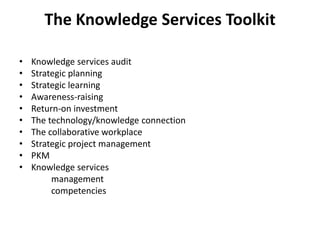
The Knowledge Services Toolkit
• Knowledge services audit
• Strategic planning
• Strategic learning
• Awareness-raising
• Return-on investment
• The technology/knowledge connection
• The collaborative workplace
• Strategic project management
• PKM
• Knowledge services
management
competencies
• The knowledge services audit is a systematic
examination of an organization’s knowledge
resources. Often referred to as a catalog or
inventory of a company’s intellectual
infrastructure, the knowledge services audit—
as an audit—actually goes beyond identifying
knowledge assets to evaluating those assets
and how they are used in support of the
organizational mission
• Strategic planning has been variously
defined, and in the knowledge services
environment refers most often to developing
vision, mission, and values statements for
aligning knowledge services with organizational
priorities. With strategic planning, we identify
critical steps—including change management and
change implementation—for launching or
enhancing service delivery for the benefit of the
larger organization.
• Strategic learning as an element of the
knowledge services discipline is usually
thought of as the critical foundation for KD/
KS, since the way people interact with one
another and understand their work
environment as a learning/teaching
organization affect how knowledge is used in
support of the organizational mission.
• Awareness-raising, CRM, customer
service, and marketing provide the necessary
entrepreneurial perspective for the successful
management of knowledge services and
ensure that all affiliated persons know about
and understand the KD/KS purpose and the
business value of knowledge in their work.
• Return-on-investment (ROI), metrics, and
measurement constitute one of the most
valuable elements of the knowledge services
construct, with relevance and effectiveness
measures providing a direct correlation with
the parent organization’s other constituent
functions and determining enterprise-wide
success.
• The relationship between technology and
knowledge and establishing how technology is
used to connect people with knowledge have
become critical components in determining the
success of knowledge services management in
the larger organization. KD/KS and its connection
with workplace success is seriously impacted by
how well knowledge services addresses
increasingly digital and electronic information
formats.
• The evolution of the collaborative workplace
affects organizational management in many
ways, and the role of KD/KS, resource
sharing, and the management of knowledge
services continues to provide enterprise
leadership with useful and measurable
success opportunities for meeting
organizational mission-critical goals.
• Strategic project management is no longer
thought of as something “extra” or to be
looked at “when needed.” In today’s
knowledge centric workplace, project
management and a commitment to
understanding and relating to new structures
and frameworks requires those with
management responsibility for knowledge
services to take on important enterprise-wide
leadership roles.
• Personal knowledge management (PKM)
continues to bring forward demands from
organizational colleagues for guidance in
learning about (and utilizing) new products
and services. In the knowledge services
environment, the ever-growing presence of
social networking and other offers challenging
opportunities for service delivery.
• Competencies, skills, and qualifications for
knowledge leaders in the organizations (and
specifically for managing knowledge services
for the larger enterprise) all require greater
and continuous attention to strategic
learning, to ensure that classic management
and executive skills keep in step with the
demands of the knowledge-centric workplace.

Developing an effective knowledge service

  • 1.
    Developing an EffectiveKnowledge Service: Knowledge Services, Knowledge Service Contributors
  • 2.
    Knowledge Services • Enterprise-wideservice sphere • Cross-functional collaboration • Knowledge Relationship or hub • Higher-value service ethos • Added value • Awareness raising/CRM • Strategic learning • Service delivery opportunities • Advocates, champions, sponsors
  • 3.
    • The world-classknowledge services business unit is understood within its organization to be managed from a holistic perspective, and its work is integrated into the larger business purpose of the parent organization. The products and services offered include identifying knowledge needed in the organization, building project teams to work with other divisions, constructing databases and corporate intranet resources, and developing other tools that enable the library (now the “Knowledge Center”) to publish directories, guides to research resource collections, and similar products for the company’s entire workforce
  • 4.
    • Cross-functional collaboration(with no disincentives for collaboration) is a critical feature of the knowledge services unit’s operation. • Example: In a research and development organization in Pretoria, South Africa the staff of the IT department has teamed up with members of the research asset management unit to work together on a project to enable staff to access all organizational content
  • 5.
    • The knowledgeservices unit is recognized as the central information/knowledge connection for the organization. • Example: In Northern Virginia, in one of the Washington suburbs, a large GSE—government sponsored enterprise— was created by the U.S. Congress to work with the home financing industry. With the whole -hearted support of senior management, the knowledge services staff has built a knowledge services “hub” for the company. The company is a large organization with a multi-faceted operational framework, and having established one functional unit as the preferred (and first-thought-of) source for information, knowledge, and strategic learning enables everyone in the company to reap the benefits.
  • 6.
    • The serviceethos in the knowledge services unit builds on higher value services. Queries brought to the knowledge services staff demand highly intensive approaches to research. There are few “simple” queries, as users generally find this type of information for themselves.
  • 7.
    • Adding valueto information services, products, and consultations is standard practice in the knowledge services unit.
  • 8.
    • Awareness buildingwithin the constituent user base is a given, as is marketing. There is no assumption that everyone who can use the organization’s knowledge assets knows about them or knows and understands all the services that are available through the knowledge services business unit.
  • 9.
    • Customer needsare tracked on an on-going basis, as is their satisfaction with service delivery. Customer service and CRM (client relationship management) are key elements of the management picture in the knowledge services business unit.
  • 10.
    • Strategic learningis recognized as a critical organizational function, and continuous efforts are made to review training and learning needs and to provide opportunities for organizational employees to gain new skills and competencies to help them with their work.
  • 11.
    • New paradigmsof service delivery (including the development of specific products and services by internal staff, or purchased from external vendors) are recognized as opportunities for enhancing knowledge services for the parent organization with which the knowledge services unit is affiliated. • Example: In a large company in upstate New York, the manager of the knowledge services unit works with clients as they advise retailers and manufacturers about quality assurance in their products, to assist them in meeting regulatory, quality, and performance requirements, and help them to assess manufacturing facilities to ensure social compliance, review processes, and audit capabilities
  • 12.
    • Advocates andusers recognize the value of the knowledge services unit and make efforts to see that it is supported and that sponsors are recruited to demonstrate their commitment to the role of knowledge services in achieving the organizational mission.
  • 13.
    The Knowledge ServicesToolkit • Knowledge services audit • Strategic planning • Strategic learning • Awareness-raising • Return-on investment • The technology/knowledge connection • The collaborative workplace • Strategic project management • PKM • Knowledge services management competencies
  • 14.
    • The knowledgeservices audit is a systematic examination of an organization’s knowledge resources. Often referred to as a catalog or inventory of a company’s intellectual infrastructure, the knowledge services audit— as an audit—actually goes beyond identifying knowledge assets to evaluating those assets and how they are used in support of the organizational mission
  • 15.
    • Strategic planninghas been variously defined, and in the knowledge services environment refers most often to developing vision, mission, and values statements for aligning knowledge services with organizational priorities. With strategic planning, we identify critical steps—including change management and change implementation—for launching or enhancing service delivery for the benefit of the larger organization.
  • 16.
    • Strategic learningas an element of the knowledge services discipline is usually thought of as the critical foundation for KD/ KS, since the way people interact with one another and understand their work environment as a learning/teaching organization affect how knowledge is used in support of the organizational mission.
  • 17.
    • Awareness-raising, CRM,customer service, and marketing provide the necessary entrepreneurial perspective for the successful management of knowledge services and ensure that all affiliated persons know about and understand the KD/KS purpose and the business value of knowledge in their work.
  • 18.
    • Return-on-investment (ROI),metrics, and measurement constitute one of the most valuable elements of the knowledge services construct, with relevance and effectiveness measures providing a direct correlation with the parent organization’s other constituent functions and determining enterprise-wide success.
  • 19.
    • The relationshipbetween technology and knowledge and establishing how technology is used to connect people with knowledge have become critical components in determining the success of knowledge services management in the larger organization. KD/KS and its connection with workplace success is seriously impacted by how well knowledge services addresses increasingly digital and electronic information formats.
  • 20.
    • The evolutionof the collaborative workplace affects organizational management in many ways, and the role of KD/KS, resource sharing, and the management of knowledge services continues to provide enterprise leadership with useful and measurable success opportunities for meeting organizational mission-critical goals.
  • 21.
    • Strategic projectmanagement is no longer thought of as something “extra” or to be looked at “when needed.” In today’s knowledge centric workplace, project management and a commitment to understanding and relating to new structures and frameworks requires those with management responsibility for knowledge services to take on important enterprise-wide leadership roles.
  • 22.
    • Personal knowledgemanagement (PKM) continues to bring forward demands from organizational colleagues for guidance in learning about (and utilizing) new products and services. In the knowledge services environment, the ever-growing presence of social networking and other offers challenging opportunities for service delivery.
  • 23.
    • Competencies, skills,and qualifications for knowledge leaders in the organizations (and specifically for managing knowledge services for the larger enterprise) all require greater and continuous attention to strategic learning, to ensure that classic management and executive skills keep in step with the demands of the knowledge-centric workplace.