KNOWLEDGE MANAGEMENT
SYSTEM
&
KNOWLEDGE BASED EXPERT
SYSTEM
PRESENTED BY,
JERRIN MARY JOHN
WHY KNOWLEDGE IS
IMPORTANT???
• Knowledge is dependent to
knowledge
• Useful information
• Information adapted to purpose
• Partial solution is still knowledge
• Personalized information
• State of knowing and understanding
• An object to be stored and manipulated
• A process of applying expertise
• A condition of information
• Potential to influence action
Capabilities of Knowledge
Management System
• To compete effectively, companies must
leverage their existing knowledge and create
new knowledge that favorably positions them in
their chosen markets
• To accomplish this, companies must develop
the ability to use prior knowledge to recognize
the value of new information, assimilate it, and
apply it to new knowledge and capabilities
• Many researchers have proposed capabilities
influencing knowledge management as
preconditions or organizational resources for
effective knowledge management
• Managers are bombarded with an almost
constant stream of data every day
• According to David Derbyshire, ”Scientists
have worked out exactly how much data is
sent to a typical person in the course of a
year” This overload of data is making
knowledge management increasingly more
important
• Three key reasons why actively managing
knowledge is important to a company’s
success are:
1) Facilitates decision-making capabilities
2) Builds learning organizations by making
learning routine
3) Stimulate cultural change & innovation
Capabilities of Knowledge
Based Expert System
• Expert system provides the high quality
performance which solves difficult programs in a
domain as good as or better than human experts
• Expert system possess vast quantities of domain
specific knowledge to the minute details
• It have explanation capability. It enables to
review its own reasoning and explain its
decisions
• It employ symbolic reasoning when solving a
problem. Symbols are used to represent
different types of knowledge such as facts,
concepts & rules
• It can advice, modifies, update, expand & deals
with uncertain & irrelevant data
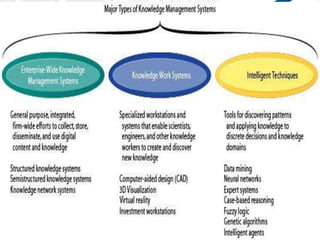
TYPES OF KNOWLEDGE MANAGEMENT
SYSTEMS
1) ENTEPRISE- WIDE KNOWLEDGE
MANAGEMENT SYSTEMS
2) KNOWLEDGE WORK SYSTEMS
3) INTELLIGENCE TECHNIQUES
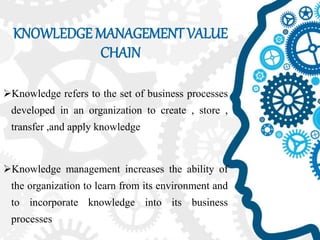
KNOWLEDGE MANAGEMENT VALUE
CHAIN
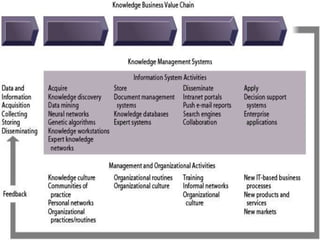
Knowledge refers to the set of business processes
developed in an organization to create , store ,
transfer ,and apply knowledge
Knowledge management increases the ability of
the organization to learn from its environment and
to incorporate knowledge into its business
processes
Development of knowledge
management systemand expert
system
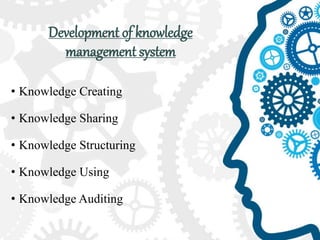
Development of knowledge
management system
• Knowledge Creating
• Knowledge Sharing
• Knowledge Structuring
• Knowledge Using
• Knowledge Auditing
CLASSIFICATION OF KNOWLEDGE
CREATION
• Tacit knowledge: That type of knowledge
which people carry in their mind ,and is
therefore, difficult to access
• Explicit knowledge :That type of
knowledge which has been or can be
articulated ,codified ,and stored in certain
media
FEATURES
EXPLICIT
KNOWLEDGE
Tangible
Physical objects
Context
independent
Easily shared
Reproducible
TACIT
KNOWLEDGE
Intangible
Mental objects
Context affects
meaning
Sharing involves
learning
Not identically
replicated
CLASSIFICATION OF KNOWLEDGE
SHARING
 Social Communication Infrastructure
 Technical Communication Infrastructure
CLASSIFICATION OF KNOWLEDGE
STRUCTURING
• Information Mapping :it is a process by which
organization’s can identify and categories knowledge
assets within their organization
• Information Storaging : it contains knowledge
repositories such as databases ,data warehouses , and
information centres and indicates electronic
environment of organizational memory
• Information retrieving :in this stage ,knowledge is
stored and retrieved via information retrieval
systems.
KNOWLEDGE USING
Product
Service
Process
KNOWLEDGE AUDITING
It means what amount of
knowledge can be used in
organization’s products, services
and process.
Organizations use Knowledge
for three reasons
Knowledge can be used for determining
organization’s work processes and making
strategies for sustainable competitive
advantage
Knowledge can be used for designing and
marketing product
Knowledge plays a critical role of
organization’s service quality
Expert system development
Implementing Results
Construct Expert System Components
Identifying Experts
Determining Requirements
Knowledge management system

Knowledge management system

  • 1.
    KNOWLEDGE MANAGEMENT SYSTEM & KNOWLEDGE BASEDEXPERT SYSTEM PRESENTED BY, JERRIN MARY JOHN
  • 3.
    WHY KNOWLEDGE IS IMPORTANT??? •Knowledge is dependent to knowledge • Useful information • Information adapted to purpose • Partial solution is still knowledge
  • 4.
    • Personalized information •State of knowing and understanding • An object to be stored and manipulated • A process of applying expertise • A condition of information • Potential to influence action
  • 7.
    Capabilities of Knowledge ManagementSystem • To compete effectively, companies must leverage their existing knowledge and create new knowledge that favorably positions them in their chosen markets • To accomplish this, companies must develop the ability to use prior knowledge to recognize the value of new information, assimilate it, and apply it to new knowledge and capabilities • Many researchers have proposed capabilities influencing knowledge management as preconditions or organizational resources for effective knowledge management
  • 8.
    • Managers arebombarded with an almost constant stream of data every day • According to David Derbyshire, ”Scientists have worked out exactly how much data is sent to a typical person in the course of a year” This overload of data is making knowledge management increasingly more important • Three key reasons why actively managing knowledge is important to a company’s success are: 1) Facilitates decision-making capabilities 2) Builds learning organizations by making learning routine 3) Stimulate cultural change & innovation
  • 9.
    Capabilities of Knowledge BasedExpert System • Expert system provides the high quality performance which solves difficult programs in a domain as good as or better than human experts • Expert system possess vast quantities of domain specific knowledge to the minute details • It have explanation capability. It enables to review its own reasoning and explain its decisions • It employ symbolic reasoning when solving a problem. Symbols are used to represent different types of knowledge such as facts, concepts & rules • It can advice, modifies, update, expand & deals with uncertain & irrelevant data
  • 10.
    TYPES OF KNOWLEDGEMANAGEMENT SYSTEMS 1) ENTEPRISE- WIDE KNOWLEDGE MANAGEMENT SYSTEMS 2) KNOWLEDGE WORK SYSTEMS 3) INTELLIGENCE TECHNIQUES
  • 12.
    KNOWLEDGE MANAGEMENT VALUE CHAIN Knowledgerefers to the set of business processes developed in an organization to create , store , transfer ,and apply knowledge Knowledge management increases the ability of the organization to learn from its environment and to incorporate knowledge into its business processes
  • 14.
    Development of knowledge managementsystemand expert system
  • 15.
    Development of knowledge managementsystem • Knowledge Creating • Knowledge Sharing • Knowledge Structuring • Knowledge Using • Knowledge Auditing
  • 16.
    CLASSIFICATION OF KNOWLEDGE CREATION •Tacit knowledge: That type of knowledge which people carry in their mind ,and is therefore, difficult to access • Explicit knowledge :That type of knowledge which has been or can be articulated ,codified ,and stored in certain media
  • 17.
  • 18.
    CLASSIFICATION OF KNOWLEDGE SHARING Social Communication Infrastructure  Technical Communication Infrastructure
  • 19.
    CLASSIFICATION OF KNOWLEDGE STRUCTURING •Information Mapping :it is a process by which organization’s can identify and categories knowledge assets within their organization • Information Storaging : it contains knowledge repositories such as databases ,data warehouses , and information centres and indicates electronic environment of organizational memory • Information retrieving :in this stage ,knowledge is stored and retrieved via information retrieval systems.
  • 20.
    KNOWLEDGE USING Product Service Process KNOWLEDGE AUDITING Itmeans what amount of knowledge can be used in organization’s products, services and process.
  • 21.
    Organizations use Knowledge forthree reasons Knowledge can be used for determining organization’s work processes and making strategies for sustainable competitive advantage Knowledge can be used for designing and marketing product Knowledge plays a critical role of organization’s service quality
  • 22.
    Expert system development ImplementingResults Construct Expert System Components Identifying Experts Determining Requirements