Self Guided Lecture #3 Knowledge Management Cristin Howell-Vischer, MIM MANAGEMENT II – MAN 2600
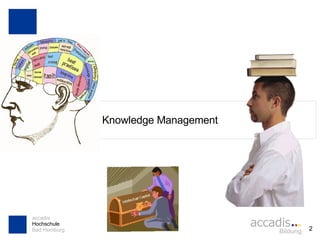
Knowledge Management
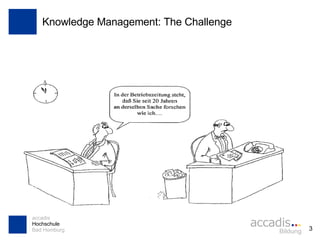
Knowledge Management: The Challenge
History of Knowledge Management The trend towards Knowledge Management (KM) was fueled by the development of IT systems which made it simple to store, display and archive classified, indexed information In the 1980’s KM began to be viewed as a competitive asset KM has many connections to: Change management Benchmarking Risk Management Best Practices
Why is KM Important? Organizations now face the following challenges: The increasing value of the intellectual capital which is embedded in end products and services The increasing convergence of technologies that enable organizations to globalize at the press of the button The rapid growth of Internet "Economies are increasingly based on knowledge….What is new is that a growing chunk of production in the modern economy is in the form of intangibles, based on the exploitation of ideas rather than material things …" Economist Newspaper. September, 23, 2000
The Value of KM It is important to manage knowledge assets because – Organizations compete increasingly on the base of knowledge (the only sustainable competitive advantage, according to some) Most of our work is information based (and often immersed in a computing environment) Our products, services, and environment are more complex than ever before Workforces are increasingly unstable leading to escalating demands for knowledge replacement/acquisition
KM – A Cross-Disciplinary Approach Knowledge management draws from a wide range of disciplines and technologies: Cognitive science:  How do we learn? Expert systems & “Artificial Intelligence”: Using computers to understand human intelligence Technical writing Document management Decision support systems Relational and object databases Simulation Organizational science
What is Knowledge Management? Treating the knowledge component of business activities as an explicit concern of business reflected in strategy, policy and practice at all levels of the organization Making a direct connection between an organization’s intellectual assets and positive business results
Aren’t we Already Managing Knowledge? Well, no…..  In fact, most of the time we’re making a really ugly mess of managing information  The terms information and knowledge are often used interchangeably
Data vs. Knowledge Data is unorganized words, numbers and images Data alone has no meaning or context. Example:  The name Bob Jones in a database is merely data Bob Jones is a regular customer of our products.  This is information Information is  - organized or categorized data. It has meaning or value Knowledge is the  use  of information An organization using information that Bob Jones is a regular customer of our products and take initiative to establish a special relationship with Bob Jones is using the information and thus creating customer knowledge If the information we gained is not used, then the knowledge remains passive. It cannot be considered as an active intangible asset Similarly if employees have skills but he/she does not  use  them, then such skills remain passive and of no benefit to the organization
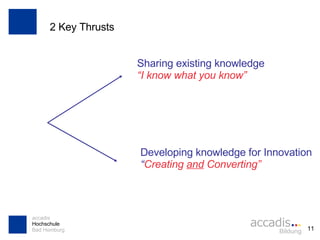
2 Key Thrusts Sharing existing knowledge “ I know what you know” Developing knowledge for Innovation “ Creating  and  Converting”
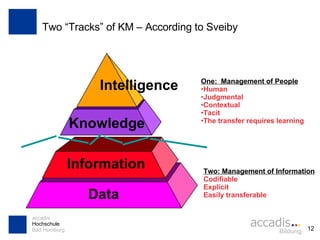
Two “Tracks” of KM – According to Sveiby Data Information Knowledge Intelligence Two: Management of Information Codifiable Explicit Easily transferable One:  Management of People Human Judgmental Contextual Tacit The transfer requires learning
Knowledge Assets There are two types of knowledge assets  Explicit or formal assets   copyrights, patents, templates, publications, reports, archives, etc. Tacit or informal assets   Which are rooted in human experience and include personal belief, perspective, and values
Knowledge Agenda ... in Practice Knowledge Teams - multi-disciplinary, cross-functional Knowledge ( Data) bases - experts, best practice Knowledge Centres - hubs of knowledge Learning Organization - personal/team/org development Communities of Practice - peers in execution of work Technology Infrastructure - Intranets, doc mgt
Seven Levers Customer Knowledge  - the most vital knowledge Knowledge in Products  - ‘smarts’ add value  Knowledge in People  - but people ‘walk’ Knowledge in Processes  - know-how when needed Organizational Memory  - do we know what we know? Knowledge in Relationships  - richness and depth  Knowledge Assets  - intellectual capital
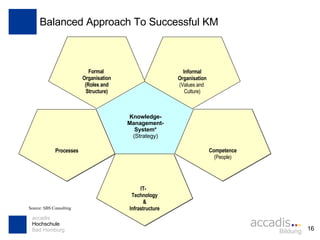
Balanced Approach To Successful KM Source: SBS Consulting Knowledge- Management- System* (Strategy) Informal Organisation (Values and  Culture) Formal  Organisation (Roles and Structure) Processes IT-  Technology & Infrastructure Competence (People)
Knowledge Discovery Knowledge discovery may be defined as the development of new tacit or explicit knowledge from data and information or from the synthesis of prior knowledge
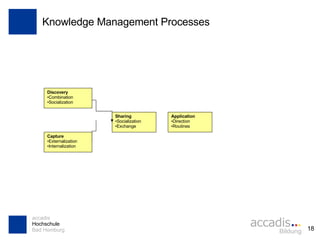
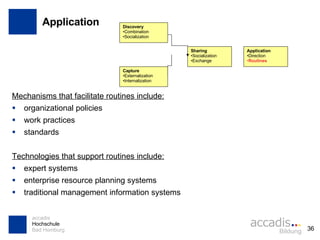
Knowledge Management Processes Discovery Combination Socialization Capture Externalization Internalization Sharing Socialization Exchange Application Direction Routines
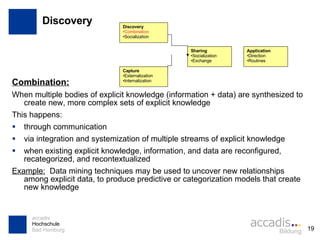
Discovery Combination:   When multiple bodies of explicit knowledge (information + data) are synthesized to create new, more complex sets of explicit knowledge This happens: through communication via integration and systemization of multiple streams of explicit knowledge when existing explicit knowledge, information, and data are reconfigured, recategorized, and recontextualized Example:   Data mining techniques may be used to uncover new relationships among explicit data, to produce predictive or categorization models that create new knowledge Discovery Combination Socialization Capture Externalization Internalization Sharing Socialization Exchange Application Direction Routines
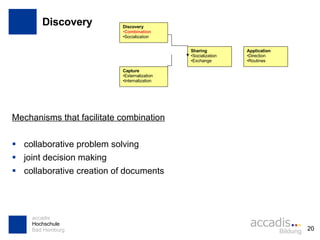
Discovery Mechanisms that facilitate combination collaborative problem solving joint decision making collaborative creation of documents Discovery Combination Socialization Capture Externalization Internalization Sharing Socialization Exchange Application Direction Routines
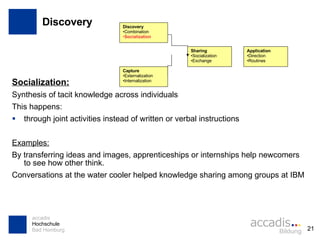
Discovery Socialization:   Synthesis of tacit knowledge across individuals This happens: through joint activities instead of written or verbal instructions Examples:   By transferring ideas and images, apprenticeships or internships help newcomers to see how other think. Conversations at the water cooler helped knowledge sharing among groups at IBM Discovery Combination Socialization Capture Externalization Internalization Sharing Socialization Exchange Application Direction Routines
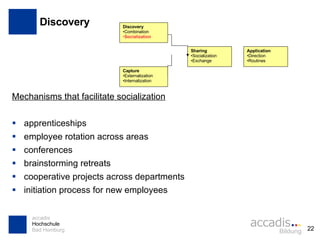
Discovery Mechanisms that facilitate socialization apprenticeships employee rotation across areas conferences brainstorming retreats cooperative projects across departments initiation process for new employees Discovery Combination Socialization Capture Externalization Internalization Sharing Socialization Exchange Application Direction Routines
Knowledge Capture Knowledge capture is defined as the process of retrieving either explicit or tacit knowledge that resides within people, artifacts or organizational entities Examples: Knowledge may reside within an individual’s mind, without that individual having the ability to recognize it and share it with others (tacit knowledge) Knowledge might reside in an explicit form in a manual, but few people might be aware of it (explicit knowledge) Knowledge capture might reside outside the organizational boundaries including consultants, competitors, customers, suppliers and prior employers of the organization’s new employees
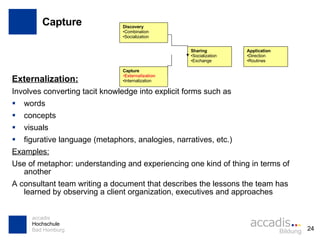
Capture Externalization:   Involves converting tacit knowledge into explicit forms such as words concepts visuals figurative language (metaphors, analogies, narratives, etc.) Examples:   Use of metaphor: understanding and experiencing one kind of thing in terms of another  A consultant team writing a document that describes the lessons the team has learned by observing a client organization, executives and approaches Discovery Combination Socialization Capture Externalization Internalization Sharing Socialization Exchange Application Direction Routines
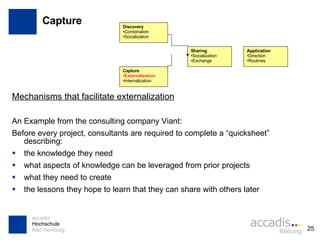
Capture Mechanisms that facilitate externalization An Example from the consulting company Viant: Before every project, consultants are required to complete a “quicksheet” describing: the knowledge they need what aspects of knowledge can be leveraged from prior projects what they need to create the lessons they hope to learn that they can share with others later Discovery Combination Socialization Capture Externalization Internalization Sharing Socialization Exchange Application Direction Routines
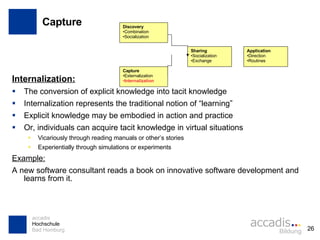
Capture Internalization:   The conversion of explicit knowledge into tacit knowledge Internalization represents the traditional notion of “learning” Explicit knowledge may be embodied in action and practice Or, individuals can acquire tacit knowledge in virtual situations Vicariously through reading manuals or other’s stories Experientially through simulations or experiments Example:   A new software consultant reads a book on innovative software development and learns from it. Discovery Combination Socialization Capture Externalization Internalization Sharing Socialization Exchange Application Direction Routines
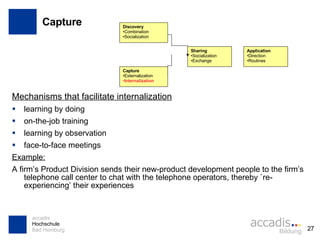
Capture Mechanisms that facilitate internalization learning by doing on-the-job training learning by observation face-to-face meetings Example: A firm’s Product Division sends their new-product development people to the firm’s telephone call center to chat with the telephone operators, thereby `re-experiencing’ their experiences Discovery Combination Socialization Capture Externalization Internalization Sharing Socialization Exchange Application Direction Routines
Knowledge Sharing Knowledge sharing systems support the process through which explicit or implicit knowledge is communicated to other individuals
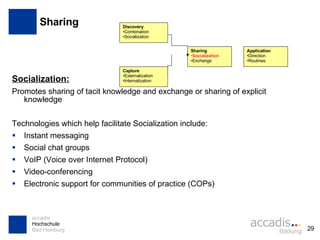
Sharing Socialization:   Promotes sharing of tacit knowledge and exchange or sharing of explicit knowledge Technologies which help facilitate Socialization include: Instant messaging Social chat groups  VoIP (Voice over Internet Protocol) Video-conferencing Electronic support for communities of practice (COPs) Discovery Combination Socialization Capture Externalization Internalization Sharing Socialization Exchange Application Direction Routines
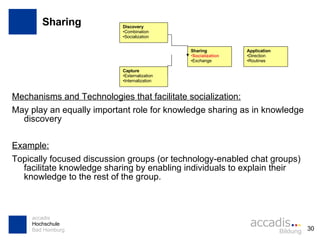
Sharing Mechanisms and Technologies that facilitate socialization: May play an equally important role for knowledge sharing as in knowledge discovery Example: Topically focused discussion groups (or technology-enabled chat groups) facilitate knowledge sharing by enabling individuals to explain their knowledge to the rest of the group. Discovery Combination Socialization Capture Externalization Internalization Sharing Socialization Exchange Application Direction Routines
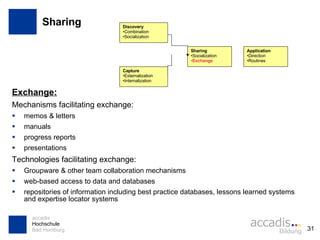
Sharing Exchange:   Mechanisms facilitating exchange: memos & letters manuals progress reports presentations Technologies facilitating exchange: Groupware & other team collaboration mechanisms web-based access to data and databases repositories of information including best practice databases, lessons learned systems and expertise locator systems Discovery Combination Socialization Capture Externalization Internalization Sharing Socialization Exchange Application Direction Routines
Knowledge Application Knowledge Applications systems support the process through which some individuals utilize knowledge possessed by other individuals without actually acquiring, or learning that knowledge Mechanisms and technologies support knowledge application systems by facilitating routines and direction
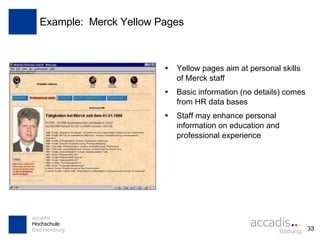
Example:  Merck Yellow Pages Yellow pages aim at personal skills of Merck staff Basic information (no details) comes from HR data bases Staff may enhance personal information on education and professional experience
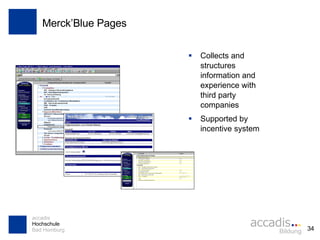
Merck’Blue Pages Collects and structures information and experience with third party companies  Supported by incentive system
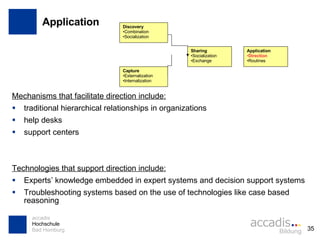
Application Mechanisms that facilitate direction include: traditional hierarchical relationships in organizations help desks support centers Technologies that support direction include: Experts’ knowledge embedded in expert systems and decision support systems Troubleshooting systems based on the use of technologies like case based reasoning Discovery Combination Socialization Capture Externalization Internalization Sharing Socialization Exchange Application Direction Routines
Application Mechanisms that facilitate routines include: organizational policies work practices standards Technologies that support routines include: expert systems enterprise resource planning systems traditional management information systems Discovery Combination Socialization Capture Externalization Internalization Sharing Socialization Exchange Application Direction Routines

Knowledge Management Webinar

  • 1.
    Self Guided Lecture#3 Knowledge Management Cristin Howell-Vischer, MIM MANAGEMENT II – MAN 2600
  • 2.
  • 3.
  • 4.
    History of KnowledgeManagement The trend towards Knowledge Management (KM) was fueled by the development of IT systems which made it simple to store, display and archive classified, indexed information In the 1980’s KM began to be viewed as a competitive asset KM has many connections to: Change management Benchmarking Risk Management Best Practices
  • 5.
    Why is KMImportant? Organizations now face the following challenges: The increasing value of the intellectual capital which is embedded in end products and services The increasing convergence of technologies that enable organizations to globalize at the press of the button The rapid growth of Internet "Economies are increasingly based on knowledge….What is new is that a growing chunk of production in the modern economy is in the form of intangibles, based on the exploitation of ideas rather than material things …" Economist Newspaper. September, 23, 2000
  • 6.
    The Value ofKM It is important to manage knowledge assets because – Organizations compete increasingly on the base of knowledge (the only sustainable competitive advantage, according to some) Most of our work is information based (and often immersed in a computing environment) Our products, services, and environment are more complex than ever before Workforces are increasingly unstable leading to escalating demands for knowledge replacement/acquisition
  • 7.
    KM – ACross-Disciplinary Approach Knowledge management draws from a wide range of disciplines and technologies: Cognitive science: How do we learn? Expert systems & “Artificial Intelligence”: Using computers to understand human intelligence Technical writing Document management Decision support systems Relational and object databases Simulation Organizational science
  • 8.
    What is KnowledgeManagement? Treating the knowledge component of business activities as an explicit concern of business reflected in strategy, policy and practice at all levels of the organization Making a direct connection between an organization’s intellectual assets and positive business results
  • 9.
    Aren’t we AlreadyManaging Knowledge? Well, no….. In fact, most of the time we’re making a really ugly mess of managing information The terms information and knowledge are often used interchangeably
  • 10.
    Data vs. KnowledgeData is unorganized words, numbers and images Data alone has no meaning or context. Example: The name Bob Jones in a database is merely data Bob Jones is a regular customer of our products. This is information Information is - organized or categorized data. It has meaning or value Knowledge is the use of information An organization using information that Bob Jones is a regular customer of our products and take initiative to establish a special relationship with Bob Jones is using the information and thus creating customer knowledge If the information we gained is not used, then the knowledge remains passive. It cannot be considered as an active intangible asset Similarly if employees have skills but he/she does not use them, then such skills remain passive and of no benefit to the organization
  • 11.
    2 Key ThrustsSharing existing knowledge “ I know what you know” Developing knowledge for Innovation “ Creating and Converting”
  • 12.
    Two “Tracks” ofKM – According to Sveiby Data Information Knowledge Intelligence Two: Management of Information Codifiable Explicit Easily transferable One: Management of People Human Judgmental Contextual Tacit The transfer requires learning
  • 13.
    Knowledge Assets Thereare two types of knowledge assets Explicit or formal assets copyrights, patents, templates, publications, reports, archives, etc. Tacit or informal assets Which are rooted in human experience and include personal belief, perspective, and values
  • 14.
    Knowledge Agenda ...in Practice Knowledge Teams - multi-disciplinary, cross-functional Knowledge ( Data) bases - experts, best practice Knowledge Centres - hubs of knowledge Learning Organization - personal/team/org development Communities of Practice - peers in execution of work Technology Infrastructure - Intranets, doc mgt
  • 15.
    Seven Levers CustomerKnowledge - the most vital knowledge Knowledge in Products - ‘smarts’ add value Knowledge in People - but people ‘walk’ Knowledge in Processes - know-how when needed Organizational Memory - do we know what we know? Knowledge in Relationships - richness and depth Knowledge Assets - intellectual capital
  • 16.
    Balanced Approach ToSuccessful KM Source: SBS Consulting Knowledge- Management- System* (Strategy) Informal Organisation (Values and Culture) Formal Organisation (Roles and Structure) Processes IT- Technology & Infrastructure Competence (People)
  • 17.
    Knowledge Discovery Knowledgediscovery may be defined as the development of new tacit or explicit knowledge from data and information or from the synthesis of prior knowledge
  • 18.
    Knowledge Management ProcessesDiscovery Combination Socialization Capture Externalization Internalization Sharing Socialization Exchange Application Direction Routines
  • 19.
    Discovery Combination: When multiple bodies of explicit knowledge (information + data) are synthesized to create new, more complex sets of explicit knowledge This happens: through communication via integration and systemization of multiple streams of explicit knowledge when existing explicit knowledge, information, and data are reconfigured, recategorized, and recontextualized Example: Data mining techniques may be used to uncover new relationships among explicit data, to produce predictive or categorization models that create new knowledge Discovery Combination Socialization Capture Externalization Internalization Sharing Socialization Exchange Application Direction Routines
  • 20.
    Discovery Mechanisms thatfacilitate combination collaborative problem solving joint decision making collaborative creation of documents Discovery Combination Socialization Capture Externalization Internalization Sharing Socialization Exchange Application Direction Routines
  • 21.
    Discovery Socialization: Synthesis of tacit knowledge across individuals This happens: through joint activities instead of written or verbal instructions Examples: By transferring ideas and images, apprenticeships or internships help newcomers to see how other think. Conversations at the water cooler helped knowledge sharing among groups at IBM Discovery Combination Socialization Capture Externalization Internalization Sharing Socialization Exchange Application Direction Routines
  • 22.
    Discovery Mechanisms thatfacilitate socialization apprenticeships employee rotation across areas conferences brainstorming retreats cooperative projects across departments initiation process for new employees Discovery Combination Socialization Capture Externalization Internalization Sharing Socialization Exchange Application Direction Routines
  • 23.
    Knowledge Capture Knowledgecapture is defined as the process of retrieving either explicit or tacit knowledge that resides within people, artifacts or organizational entities Examples: Knowledge may reside within an individual’s mind, without that individual having the ability to recognize it and share it with others (tacit knowledge) Knowledge might reside in an explicit form in a manual, but few people might be aware of it (explicit knowledge) Knowledge capture might reside outside the organizational boundaries including consultants, competitors, customers, suppliers and prior employers of the organization’s new employees
  • 24.
    Capture Externalization: Involves converting tacit knowledge into explicit forms such as words concepts visuals figurative language (metaphors, analogies, narratives, etc.) Examples: Use of metaphor: understanding and experiencing one kind of thing in terms of another A consultant team writing a document that describes the lessons the team has learned by observing a client organization, executives and approaches Discovery Combination Socialization Capture Externalization Internalization Sharing Socialization Exchange Application Direction Routines
  • 25.
    Capture Mechanisms thatfacilitate externalization An Example from the consulting company Viant: Before every project, consultants are required to complete a “quicksheet” describing: the knowledge they need what aspects of knowledge can be leveraged from prior projects what they need to create the lessons they hope to learn that they can share with others later Discovery Combination Socialization Capture Externalization Internalization Sharing Socialization Exchange Application Direction Routines
  • 26.
    Capture Internalization: The conversion of explicit knowledge into tacit knowledge Internalization represents the traditional notion of “learning” Explicit knowledge may be embodied in action and practice Or, individuals can acquire tacit knowledge in virtual situations Vicariously through reading manuals or other’s stories Experientially through simulations or experiments Example: A new software consultant reads a book on innovative software development and learns from it. Discovery Combination Socialization Capture Externalization Internalization Sharing Socialization Exchange Application Direction Routines
  • 27.
    Capture Mechanisms thatfacilitate internalization learning by doing on-the-job training learning by observation face-to-face meetings Example: A firm’s Product Division sends their new-product development people to the firm’s telephone call center to chat with the telephone operators, thereby `re-experiencing’ their experiences Discovery Combination Socialization Capture Externalization Internalization Sharing Socialization Exchange Application Direction Routines
  • 28.
    Knowledge Sharing Knowledgesharing systems support the process through which explicit or implicit knowledge is communicated to other individuals
  • 29.
    Sharing Socialization: Promotes sharing of tacit knowledge and exchange or sharing of explicit knowledge Technologies which help facilitate Socialization include: Instant messaging Social chat groups VoIP (Voice over Internet Protocol) Video-conferencing Electronic support for communities of practice (COPs) Discovery Combination Socialization Capture Externalization Internalization Sharing Socialization Exchange Application Direction Routines
  • 30.
    Sharing Mechanisms andTechnologies that facilitate socialization: May play an equally important role for knowledge sharing as in knowledge discovery Example: Topically focused discussion groups (or technology-enabled chat groups) facilitate knowledge sharing by enabling individuals to explain their knowledge to the rest of the group. Discovery Combination Socialization Capture Externalization Internalization Sharing Socialization Exchange Application Direction Routines
  • 31.
    Sharing Exchange: Mechanisms facilitating exchange: memos & letters manuals progress reports presentations Technologies facilitating exchange: Groupware & other team collaboration mechanisms web-based access to data and databases repositories of information including best practice databases, lessons learned systems and expertise locator systems Discovery Combination Socialization Capture Externalization Internalization Sharing Socialization Exchange Application Direction Routines
  • 32.
    Knowledge Application KnowledgeApplications systems support the process through which some individuals utilize knowledge possessed by other individuals without actually acquiring, or learning that knowledge Mechanisms and technologies support knowledge application systems by facilitating routines and direction
  • 33.
    Example: MerckYellow Pages Yellow pages aim at personal skills of Merck staff Basic information (no details) comes from HR data bases Staff may enhance personal information on education and professional experience
  • 34.
    Merck’Blue Pages Collectsand structures information and experience with third party companies Supported by incentive system
  • 35.
    Application Mechanisms thatfacilitate direction include: traditional hierarchical relationships in organizations help desks support centers Technologies that support direction include: Experts’ knowledge embedded in expert systems and decision support systems Troubleshooting systems based on the use of technologies like case based reasoning Discovery Combination Socialization Capture Externalization Internalization Sharing Socialization Exchange Application Direction Routines
  • 36.
    Application Mechanisms thatfacilitate routines include: organizational policies work practices standards Technologies that support routines include: expert systems enterprise resource planning systems traditional management information systems Discovery Combination Socialization Capture Externalization Internalization Sharing Socialization Exchange Application Direction Routines