Innovation & Knowledge
Management

Dr. Siddhan
Clariant - Colour-Chem Ltd.
Thane
Why this topic when we talk of
Challenges to Indian MNCs ?

If we don’t manage creativity and
innovation in the areas of
Intellectual property, technology
& distribution, India will be
challenged in the market place
A great wind is blowing and
that gives you either
imagination or a headache.
Catherine II (the Great)
Empress of Russia
Knowledge Management
definitions
 ♦ A multi-disciplined approach to achieving
   organisational objectives by making the best use of
   knowledge


 ♦ The systematic processes by which knowledge needed
   for an organisation to succeed is created, captured,
   shared and leveraged


 ♦ The art of creating commercial value from intangible
   assets
Innovation

♦ I am convinced that if the rate of change inside the
  institution is less that the rate of change outside,
  the end is in sight. The only question is timing of
  the end.
  Jack Welch, GE.
What is Innovation?

♦ Innovation means renewal or alter

♦ Prerequisite for innovation is the
  dissatisfaction with the current status and an
  inquisitive mind
Defining Innovation, Creativity &
Intelligence

♦ Innovation is using an existing idea for a
  laterally different purpose or application

♦ Creativity is doing things that has not been
  done before

♦ Intelligence is the ability to learn and think
Demonstrated creativity examples
♦ George de Mestral's observation of how
  cockleburs attach to clothing
  leading to
  invent the hook-and-loop fastener known as
  Velcro®

♦ Art Fry's development of Post-It® removable
  notes at 3M Corporation in 1974 Dr. Spencer
  Silver, another 3M scientist, had developed a
  polymer adhesive that formed microscopic spheres
  instead of a uniform coating, and thus was a poor
  adhesive that took years to set
Managing Creativity
♦ "If you do not know where you are
 going, you will not know when you
 arrive." – conventional view
♦ "If I knew what I was doing, it would
 not be research." – unorthodox view
Managing Creativity
♦ Instead of asking for one solution, require the A
  students to give two different methods of solving
  one problem. Encourage students to find creative
  solutions instead of prosaic solutions.
♦ Give problems that are unreasonably difficult to
  answer correctly, and have the students find a
  rough approximation.
♦ Give students problems without adequate
  information; let them go to the library and find the
  information that they need.
♦ Give more problems that ask the student to design
  a circuit, interpret data, design a method of doing
  an experiment, ...
Managing Creativity
♦ Assign term papers that require reading from
  multiple sources, making a creative synthesis of
  the information, and finding contradictions or
  inconsistencies in authoritative, published works.
♦ Occasionally assign exercises that show an
  incorrect solution to a problem (e.g., computer
  program that contains at least one bug, electronic
  circuit that will not function properly) and have
  the students find the defect and suggest a
  correction.
♦ Assign laboratory experiments that allow students
  freedom to choose techniques) and topics.
♦ Arrange or compose music, not merely playing
  music.
Intelligence
♦ Synthetic intelligence. The ability to
 combine existing information in a new
 way.
♦ Analytic intelligence. The ability to
 distinguish between new ideas that
 have potential, and new ideas that are
 not worth further work. This ability is
 essential to an effective allocation of
 resources, by evaluating the quality of
 new ideas.
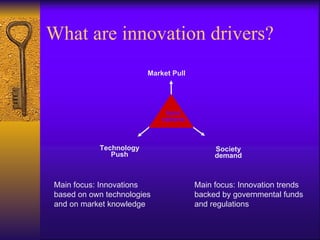
What are innovation drivers?
                        Market Pull


                             Inno
                            vations


           Technology                      Society
              Push                         demand


Main focus: Innovations               Main focus: Innovation trends
based on own technologies             backed by governmental funds
and on market knowledge               and regulations
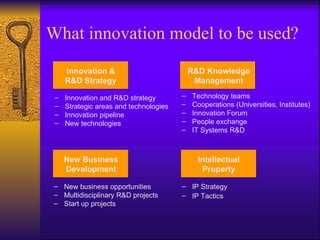
What innovation model to be used?
     Innovation &                           R&D Knowledge
     R&D Strategy                            Management

 –   Innovation and R&D strategy        –   Technology teams
 –   Strategic areas and technologies   –   Cooperations (Universities, Institutes)
 –   Innovation pipeline                –   Innovation Forum
 –   New technologies                   –   People exchange
                                        –   IT Systems R&D


     New Business                             Intellectual
     Development                               Property

 – New business opportunities           – IP Strategy
 – Multidisciplinary R&D projects       – IP Tactics
 – Start up projects
Thinking provides
knowledge, Knowledge
makes you great.
Dr. APJ Abdul Kalam
Honorable President of India
from annual address at Saurashtra University, Rajkot, Gujarat
What is Knowledge?

♦ Explicit – can be codified: books, reports,
  journals, memos, documents
♦ Tacit – “know-how” typically unwritten
  – Experiences and expertise gained over time
  – Insights and observations resulting from
    discussion and collaboration
  – Often most valuable because difficult for
    competition to replicate
Knowledge is more than
knowing
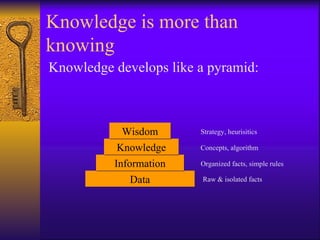
Knowledge develops like a pyramid:


            Wisdom      Strategy, heurisitics

           Knowledge    Concepts, algorithm

          Information   Organized facts, simple rules

              Data      Raw & isolated facts
Knowledge is more than
knowing
Overload = Noise:

♦Business workers are flooded with data and
drowning in information
♦Volume of technical literature is overwhelming
♦To read one year of chemistry publication will
take 700 yrs.
♦Biomedical literature will take 2200 yrs.
Knowledge is more than
knowing
♦Where is the wisdom we have lost in
knowledge?

♦Where is the knowledge we have lost in
information?

♦Where is the information lost in data?

TS Eliot in his poem “The Rock”
Knowledge is more than
knowing
Overloaded knowledge workers suffer:

♦Half of managers can’t cope with data they
receive
♦Two thirds said they needed high levels of
information but believed info was underutilized
♦Ca. 50% felt that acquiring information detracted
from their main job responsibilities
♦Information overload lessened job satisfaction
Knowledge is more than
knowing
Explicit and tacit knowledge:

♦Physics student can write equation of a ball
propelled in space and its trajectory - this is
explicit knowledge

♦Basket ball player knows how to propel
into the hoop - this is tacit knowledge -
experience, skill & muscle memory
Knowledge is more than
knowing
Effective knowledge management:

♦Deals with both explicit and tacit
knowledge
♦While explicit knowledge is copied, tacit
knowledge is not

♦Prefer tacit knowledge based projects for
sustained success
Knowledge is more than
knowing
Who do you hire?

♦Worker who knows how to operate a machine but
does pick up new skills?

♦One who knows how to learn independently but
not familiar with the machine?

Your brand of machine will change !!!
Skills are easier to acquire than attitude !!!
Knowledge is more than
knowing
Another way to look at KM

♦How group of people make themselves
collectively smarter

♦While training educates individuals, KM
educates the entire organization
Knowledge is more than
knowing
Early knowledge management system

♦Beehive - every spring day, hundreds of
bees sortie forth in quest of honey. One of
the emissaries locates a promising patc, he
flies back and does a jig – unique 8 figure
dance. This angle of figure 8 tells rest where
the patch of flowers are
The Role of Knowledge

The creation, diffusion and use of
knowledge have become the vital
ingredient in economic growth and
change. The innovation-driven
economy builds upon these
processes. (OECD, 2002)
knowledge management mythology


 1. Connectivity is the issue - sharing of info &
    knowledge will follow
 2. It’s a “solution” - must be good for our problems
 3. Ubiquity, access, any time, any place is always
    needed
 4. It’s available, I need it
 5. We can talk KM with no reference to
    organizational issues
knowledge management mythology


 6. If we ask people what they want, they will tell us and
    we will know what to do
 7. KM is corporate information services + an expensive
    portal + a new VP or CKO
 8. We can talk and understand & fully realise KM with
    no reference to traditional knowledge disciplines
 9. KM is now an old, mature concept; there are
    sophisticated packages available
 10. Amazon.com is a bookseller
Organizational conditions for KM

 ♦ Trust
 ♦ Confidence
 ♦ Credibility
 ♦ Direct connection knowledge
   acquisition/sharing - reward
 ♦ professionals = ambassadors or bosses
 ♦ Systems support
Why manage knowledge
♦ Enables effective and timely decision-
  making
♦ Fosters creativity & innovation
♦ Enhances communication
♦ Supports culture of learning, customer-
  focus, and moving from “good” to “best”
The Tacit Knowledge Problem
♦ Unique properties of Knowledge
♦ Access to people and their ideas, and
  expertise
♦ Not all knowledge easily codified
♦ Trust
♦ Community context
♦ Peer rating feedback also important
Managing knowledge
‘Knowledge has become the key to success,
it is simply to valuable a resource to be left
to chance’ (Wenger)


Knowledge management (KM) is :
‘A trans-disciplinary approach to
improving organisational outcomes and
learning, through maximising the use of
knowledge’
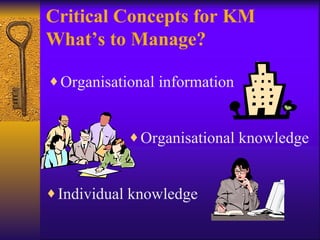
Critical Concepts for KM
What’s to Manage?

♦ Organisational information


            ♦ Organisational knowledge


♦ Individual knowledge
A KM interpretation

– Recognizing the value of knowledge in decision
  making and innovation
– Developing a culture of challenge existing
  beliefs and ‘ways of doing’
– Embracing new knowledge -use the specialized
  knowledge of experts
– Looking for patterns and trends in information
  and processes
Paradoxes of Knowledge
• Using knowledge does not consume it but
  it does get obsolete.
♦ Transferring knowledge does not lose it but
  market mechanisms allow ownership.
♦ Knowledge is abundant, but the ability to use it is
  scarce.
♦ Producing knowledge resists organisation.

♦ Much of it walks out the door at the end of the day.
The Challenge of Knowledge
Management
Not only of how to develop new knowledge, BUT

♦   how to locate and acquire others’ knowledge
♦   how to diffuse knowledge in your organisation
♦   how to recognize knowledge interconnections
♦   how to embody knowledge in products
♦   how to get access to the learning experiences of
    customers
looking at key elements


• people
• processes
• technology
The KM Journey - the Fivefold
                        Way
  Establish effective information capture and
  management systems & processes
♦ Identify/map organisational & individual
  knowledge capabilities – your knowledge asset
  register
♦ Codify knowledge where possible, but don’t discard
  non-codifiable (tacit) components
♦ Nourish a culture that supports and rewards
  knowledge sharing
♦ Promote individual knowledge development

 AND THEY ALL INTERACT!
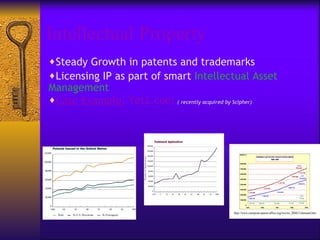
Intellectual Property
♦Steady Growth in patents and trademarks
♦Licensing IP as part of smart Intellectual Asset
Management
♦Case Example: Yet2.com ( recently acquired by Scipher)


                                                  http://www.european-patent-office.org/tws/tsr_2000/31demand.htm
What are the challenges?
• attaining understanding & commitment
• developing trust across the organisation
• addressing the people and cultural issues
• not allowing technology to dictate KM
• have a specific business goal for KM
• quantify the up-front and in-service costs and benefits
• measuring performance
• considering regulatory requirements, best practices,
  guidelines
• leadership
• integrating KM across the organisation
Who is involved
  Knowledge management is everyone’s
  responsibility.
• leaders need to demonstrate a vision for the
  organisation and actively support knowledge
  management initiatives
• managers need to support knowledge workers
  and provide environments conducive to
  knowledge sharing and creation
• knowledge workers need to share knowledge
  with each other and ensure that their knowledge
  management work is visibly linked to
  organisational objectives
Introduction
♦ Innovation is more than a good idea
♦ It is the process that takes a good idea,
 improves it and implements it.
  – Purpose
  – Commitment
  – Ability
  – Support
Are we open to new ideas?
Is your company open and receptive to new ideas?
What happens when someone comes up with an
   idea?
What sort of reaction do new ideas get form the
   rest of the organisation?
   We tried all that before, It is too expensive,
   ……
Let us see some famous “impulsive remarks”
Famous Remarks
♦ On the Microchip:
  “But what is it good for?”
  Engineer at Advanced Computing Systems Division of
  IBM      1968
♦ Home PC:
  “There is no reason anyone would want a computer
  in their home”
  Ken Olsen, President, Chairman and Founder of Digital
  Equipment Corp, 1977
♦ Memory
  “ 640K is ought to be enough for anybody”
  Bill Gates, 1981
Famous Remarks
♦ Telephone:
  “This telephone has too many shortcomings to be
  seriously considered as a means of communication.
  This device is inherently of no value to us”
  Western Union—Internal memo
♦ Radio
  “The wireless music box has no imaginable commercial
  value. Who would pay for a message sent to nobody in
  particular”
  David Sarnoff’s associates in response to his urgings for
  investments in the Radio in the 1920’s
♦ Talking Pictures
  “Who the hell wants to hear the actors talk?”
  HM Warner, Warner Brothers,1927
Famous Remarks
♦ Beatles
  “We don’t like their sound, and guitar music is on their
  way out.”
  Decca Recording Corporation, rejecting Beatles, 1962
♦ Airplanes
  “Heavier-than-air Flying machines are impossible”
  Lord Kelvin, President, Royal Society , 1895
  “Airplanes are interesting toys but of no military value”
  Marechal Ferdinand Foch, Professor of Strategy, Ecole
    Superieure de Guerre
♦ Oil
  “Drill for Oil ? You mean drill into the ground to try and
    find oil? You’re crazy”
  Drillers whom Edwin L Drake tried to enlist to his project
Getting Innovation started
♦ Innovation is like juggling. The organisation needs to
    focus on purpose, commitment, ideas and support
♦   Most companies are not short of ideas. What they lack
    is the commitment of others, the weight required to
    overcome the obstacles
♦   Innovation needs people who think in different ways
♦   People who are good at problem solving and analysis
♦   People who are capable of following hunches and
    convert them into ideas
♦   People who are capable of implementing them
    Innovation will fail if it is left to a creative few
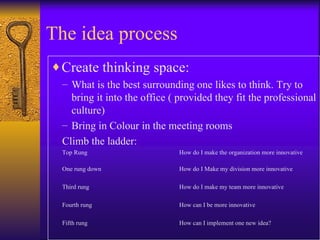
The idea process
♦ Create thinking space:
 – What is the best surrounding one likes to think. Try to
   bring it into the office ( provided they fit the professional
   culture)
 – Bring in Colour in the meeting rooms
 Climb the ladder:
 Top Rung                     How do I make the organization more innovative

 One rung down                How do I Make my division more innovative

 Third rung                   How do I make my team more innovative

 Fourth rung                  How can I be more innovative

 Fifth rung                   How can I implement one new idea?
Tools of the Trade-Exploring
♦ Brainstorming
  – Best in groups
  – Get the maximum number
  – Do not evaluate ideas before the session finishes
  – Clearly stated problem
  – One person to jot the ideas
♦ Mixing Metaphors
  – Have something in mind that you want ideas about
  – Pick an object to use as a metaphor
  – List all characteristics of the object
  – Stop and think about each characteristic
  – If they give any ideas, list them
  – Use another object if you want more ideas
Acting the Idea process

♦ Selecting the ideas with the greatest potential
♦ Developing them further and modifying them
♦ Being very clear about the final shape and what it will
  look like
♦ Well-thought-through Plan for turning the idea into
  reality

   Walking Back
6. Just imagine
7. Take one step backwards
8. Keep walking backwards or catch it by the tail
Support
♦ Is the key to success of innovation
♦ Example: standing in a an election
  – Ticket, media campaigns, promotional material,
     fundraising schemes, volunteers from the party
  It is only people you know who will support your ideas
    In Politics, the best candidate does not always win,
               but the best supported candidate
  What we should we stop, what we should start and
     what we should continue to do to foster innovation
Support
♦ Improve company memory
    – Too many good ideas are lost before they see the light of the day
    – We should keep a record of the ideas. They may be full of stuff
      with little value but some gems may be hidden!!!
♦   Give people time
♦   Risk taking ability to be fostered
♦   People should enjoy the innovation process
♦   Networking ability
    – Be good at remembering faces and names
    – Make yourself available to others
    – Ask for help from coworkers and not managers
    – Become aware of the informal communication channels
Celebration and Rewards
♦ Publicity and celebration of success are key to promote
  the innovation process
♦ Recognition is the key to motivate the people.
♦ Apart from tangible rewards, recognition is also a very
  nice way of recognition
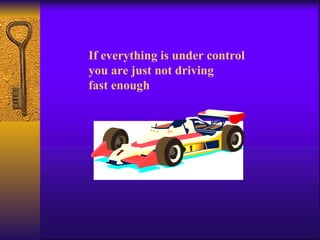
If everything is under control
you are just not driving
fast enough
Siddhan

Siddhan

  • 1.
    Innovation & Knowledge Management Dr.Siddhan Clariant - Colour-Chem Ltd. Thane
  • 2.
    Why this topicwhen we talk of Challenges to Indian MNCs ? If we don’t manage creativity and innovation in the areas of Intellectual property, technology & distribution, India will be challenged in the market place
  • 3.
    A great windis blowing and that gives you either imagination or a headache. Catherine II (the Great) Empress of Russia
  • 4.
    Knowledge Management definitions ♦A multi-disciplined approach to achieving organisational objectives by making the best use of knowledge ♦ The systematic processes by which knowledge needed for an organisation to succeed is created, captured, shared and leveraged ♦ The art of creating commercial value from intangible assets
  • 5.
    Innovation ♦ I amconvinced that if the rate of change inside the institution is less that the rate of change outside, the end is in sight. The only question is timing of the end. Jack Welch, GE.
  • 6.
    What is Innovation? ♦Innovation means renewal or alter ♦ Prerequisite for innovation is the dissatisfaction with the current status and an inquisitive mind
  • 7.
    Defining Innovation, Creativity& Intelligence ♦ Innovation is using an existing idea for a laterally different purpose or application ♦ Creativity is doing things that has not been done before ♦ Intelligence is the ability to learn and think
  • 8.
    Demonstrated creativity examples ♦George de Mestral's observation of how cockleburs attach to clothing leading to invent the hook-and-loop fastener known as Velcro® ♦ Art Fry's development of Post-It® removable notes at 3M Corporation in 1974 Dr. Spencer Silver, another 3M scientist, had developed a polymer adhesive that formed microscopic spheres instead of a uniform coating, and thus was a poor adhesive that took years to set
  • 9.
    Managing Creativity ♦ "Ifyou do not know where you are going, you will not know when you arrive." – conventional view ♦ "If I knew what I was doing, it would not be research." – unorthodox view
  • 10.
    Managing Creativity ♦ Insteadof asking for one solution, require the A students to give two different methods of solving one problem. Encourage students to find creative solutions instead of prosaic solutions. ♦ Give problems that are unreasonably difficult to answer correctly, and have the students find a rough approximation. ♦ Give students problems without adequate information; let them go to the library and find the information that they need. ♦ Give more problems that ask the student to design a circuit, interpret data, design a method of doing an experiment, ...
  • 11.
    Managing Creativity ♦ Assignterm papers that require reading from multiple sources, making a creative synthesis of the information, and finding contradictions or inconsistencies in authoritative, published works. ♦ Occasionally assign exercises that show an incorrect solution to a problem (e.g., computer program that contains at least one bug, electronic circuit that will not function properly) and have the students find the defect and suggest a correction. ♦ Assign laboratory experiments that allow students freedom to choose techniques) and topics. ♦ Arrange or compose music, not merely playing music.
  • 12.
    Intelligence ♦ Synthetic intelligence.The ability to combine existing information in a new way. ♦ Analytic intelligence. The ability to distinguish between new ideas that have potential, and new ideas that are not worth further work. This ability is essential to an effective allocation of resources, by evaluating the quality of new ideas.
  • 13.
    What are innovationdrivers? Market Pull Inno vations Technology Society Push demand Main focus: Innovations Main focus: Innovation trends based on own technologies backed by governmental funds and on market knowledge and regulations
  • 14.
    What innovation modelto be used? Innovation & R&D Knowledge R&D Strategy Management – Innovation and R&D strategy – Technology teams – Strategic areas and technologies – Cooperations (Universities, Institutes) – Innovation pipeline – Innovation Forum – New technologies – People exchange – IT Systems R&D New Business Intellectual Development Property – New business opportunities – IP Strategy – Multidisciplinary R&D projects – IP Tactics – Start up projects
  • 15.
    Thinking provides knowledge, Knowledge makesyou great. Dr. APJ Abdul Kalam Honorable President of India from annual address at Saurashtra University, Rajkot, Gujarat
  • 16.
    What is Knowledge? ♦Explicit – can be codified: books, reports, journals, memos, documents ♦ Tacit – “know-how” typically unwritten – Experiences and expertise gained over time – Insights and observations resulting from discussion and collaboration – Often most valuable because difficult for competition to replicate
  • 17.
    Knowledge is morethan knowing Knowledge develops like a pyramid: Wisdom Strategy, heurisitics Knowledge Concepts, algorithm Information Organized facts, simple rules Data Raw & isolated facts
  • 18.
    Knowledge is morethan knowing Overload = Noise: ♦Business workers are flooded with data and drowning in information ♦Volume of technical literature is overwhelming ♦To read one year of chemistry publication will take 700 yrs. ♦Biomedical literature will take 2200 yrs.
  • 19.
    Knowledge is morethan knowing ♦Where is the wisdom we have lost in knowledge? ♦Where is the knowledge we have lost in information? ♦Where is the information lost in data? TS Eliot in his poem “The Rock”
  • 20.
    Knowledge is morethan knowing Overloaded knowledge workers suffer: ♦Half of managers can’t cope with data they receive ♦Two thirds said they needed high levels of information but believed info was underutilized ♦Ca. 50% felt that acquiring information detracted from their main job responsibilities ♦Information overload lessened job satisfaction
  • 21.
    Knowledge is morethan knowing Explicit and tacit knowledge: ♦Physics student can write equation of a ball propelled in space and its trajectory - this is explicit knowledge ♦Basket ball player knows how to propel into the hoop - this is tacit knowledge - experience, skill & muscle memory
  • 22.
    Knowledge is morethan knowing Effective knowledge management: ♦Deals with both explicit and tacit knowledge ♦While explicit knowledge is copied, tacit knowledge is not ♦Prefer tacit knowledge based projects for sustained success
  • 23.
    Knowledge is morethan knowing Who do you hire? ♦Worker who knows how to operate a machine but does pick up new skills? ♦One who knows how to learn independently but not familiar with the machine? Your brand of machine will change !!! Skills are easier to acquire than attitude !!!
  • 24.
    Knowledge is morethan knowing Another way to look at KM ♦How group of people make themselves collectively smarter ♦While training educates individuals, KM educates the entire organization
  • 25.
    Knowledge is morethan knowing Early knowledge management system ♦Beehive - every spring day, hundreds of bees sortie forth in quest of honey. One of the emissaries locates a promising patc, he flies back and does a jig – unique 8 figure dance. This angle of figure 8 tells rest where the patch of flowers are
  • 26.
    The Role ofKnowledge The creation, diffusion and use of knowledge have become the vital ingredient in economic growth and change. The innovation-driven economy builds upon these processes. (OECD, 2002)
  • 27.
    knowledge management mythology 1. Connectivity is the issue - sharing of info & knowledge will follow 2. It’s a “solution” - must be good for our problems 3. Ubiquity, access, any time, any place is always needed 4. It’s available, I need it 5. We can talk KM with no reference to organizational issues
  • 28.
    knowledge management mythology 6. If we ask people what they want, they will tell us and we will know what to do 7. KM is corporate information services + an expensive portal + a new VP or CKO 8. We can talk and understand & fully realise KM with no reference to traditional knowledge disciplines 9. KM is now an old, mature concept; there are sophisticated packages available 10. Amazon.com is a bookseller
  • 29.
    Organizational conditions forKM ♦ Trust ♦ Confidence ♦ Credibility ♦ Direct connection knowledge acquisition/sharing - reward ♦ professionals = ambassadors or bosses ♦ Systems support
  • 30.
    Why manage knowledge ♦Enables effective and timely decision- making ♦ Fosters creativity & innovation ♦ Enhances communication ♦ Supports culture of learning, customer- focus, and moving from “good” to “best”
  • 31.
    The Tacit KnowledgeProblem ♦ Unique properties of Knowledge ♦ Access to people and their ideas, and expertise ♦ Not all knowledge easily codified ♦ Trust ♦ Community context ♦ Peer rating feedback also important
  • 32.
    Managing knowledge ‘Knowledge hasbecome the key to success, it is simply to valuable a resource to be left to chance’ (Wenger) Knowledge management (KM) is : ‘A trans-disciplinary approach to improving organisational outcomes and learning, through maximising the use of knowledge’
  • 33.
    Critical Concepts forKM What’s to Manage? ♦ Organisational information ♦ Organisational knowledge ♦ Individual knowledge
  • 34.
    A KM interpretation –Recognizing the value of knowledge in decision making and innovation – Developing a culture of challenge existing beliefs and ‘ways of doing’ – Embracing new knowledge -use the specialized knowledge of experts – Looking for patterns and trends in information and processes
  • 35.
    Paradoxes of Knowledge •Using knowledge does not consume it but it does get obsolete. ♦ Transferring knowledge does not lose it but market mechanisms allow ownership. ♦ Knowledge is abundant, but the ability to use it is scarce. ♦ Producing knowledge resists organisation. ♦ Much of it walks out the door at the end of the day.
  • 36.
    The Challenge ofKnowledge Management Not only of how to develop new knowledge, BUT ♦ how to locate and acquire others’ knowledge ♦ how to diffuse knowledge in your organisation ♦ how to recognize knowledge interconnections ♦ how to embody knowledge in products ♦ how to get access to the learning experiences of customers
  • 37.
    looking at keyelements • people • processes • technology
  • 38.
    The KM Journey- the Fivefold Way Establish effective information capture and management systems & processes ♦ Identify/map organisational & individual knowledge capabilities – your knowledge asset register ♦ Codify knowledge where possible, but don’t discard non-codifiable (tacit) components ♦ Nourish a culture that supports and rewards knowledge sharing ♦ Promote individual knowledge development AND THEY ALL INTERACT!
  • 39.
    Intellectual Property ♦Steady Growthin patents and trademarks ♦Licensing IP as part of smart Intellectual Asset Management ♦Case Example: Yet2.com ( recently acquired by Scipher) http://www.european-patent-office.org/tws/tsr_2000/31demand.htm
  • 40.
    What are thechallenges? • attaining understanding & commitment • developing trust across the organisation • addressing the people and cultural issues • not allowing technology to dictate KM • have a specific business goal for KM • quantify the up-front and in-service costs and benefits • measuring performance • considering regulatory requirements, best practices, guidelines • leadership • integrating KM across the organisation
  • 41.
    Who is involved Knowledge management is everyone’s responsibility. • leaders need to demonstrate a vision for the organisation and actively support knowledge management initiatives • managers need to support knowledge workers and provide environments conducive to knowledge sharing and creation • knowledge workers need to share knowledge with each other and ensure that their knowledge management work is visibly linked to organisational objectives
  • 42.
    Introduction ♦ Innovation ismore than a good idea ♦ It is the process that takes a good idea, improves it and implements it. – Purpose – Commitment – Ability – Support
  • 43.
    Are we opento new ideas? Is your company open and receptive to new ideas? What happens when someone comes up with an idea? What sort of reaction do new ideas get form the rest of the organisation? We tried all that before, It is too expensive, …… Let us see some famous “impulsive remarks”
  • 44.
    Famous Remarks ♦ Onthe Microchip: “But what is it good for?” Engineer at Advanced Computing Systems Division of IBM 1968 ♦ Home PC: “There is no reason anyone would want a computer in their home” Ken Olsen, President, Chairman and Founder of Digital Equipment Corp, 1977 ♦ Memory “ 640K is ought to be enough for anybody” Bill Gates, 1981
  • 45.
    Famous Remarks ♦ Telephone: “This telephone has too many shortcomings to be seriously considered as a means of communication. This device is inherently of no value to us” Western Union—Internal memo ♦ Radio “The wireless music box has no imaginable commercial value. Who would pay for a message sent to nobody in particular” David Sarnoff’s associates in response to his urgings for investments in the Radio in the 1920’s ♦ Talking Pictures “Who the hell wants to hear the actors talk?” HM Warner, Warner Brothers,1927
  • 46.
    Famous Remarks ♦ Beatles “We don’t like their sound, and guitar music is on their way out.” Decca Recording Corporation, rejecting Beatles, 1962 ♦ Airplanes “Heavier-than-air Flying machines are impossible” Lord Kelvin, President, Royal Society , 1895 “Airplanes are interesting toys but of no military value” Marechal Ferdinand Foch, Professor of Strategy, Ecole Superieure de Guerre ♦ Oil “Drill for Oil ? You mean drill into the ground to try and find oil? You’re crazy” Drillers whom Edwin L Drake tried to enlist to his project
  • 47.
    Getting Innovation started ♦Innovation is like juggling. The organisation needs to focus on purpose, commitment, ideas and support ♦ Most companies are not short of ideas. What they lack is the commitment of others, the weight required to overcome the obstacles ♦ Innovation needs people who think in different ways ♦ People who are good at problem solving and analysis ♦ People who are capable of following hunches and convert them into ideas ♦ People who are capable of implementing them Innovation will fail if it is left to a creative few
  • 48.
    The idea process ♦Create thinking space: – What is the best surrounding one likes to think. Try to bring it into the office ( provided they fit the professional culture) – Bring in Colour in the meeting rooms Climb the ladder: Top Rung How do I make the organization more innovative One rung down How do I Make my division more innovative Third rung How do I make my team more innovative Fourth rung How can I be more innovative Fifth rung How can I implement one new idea?
  • 49.
    Tools of theTrade-Exploring ♦ Brainstorming – Best in groups – Get the maximum number – Do not evaluate ideas before the session finishes – Clearly stated problem – One person to jot the ideas ♦ Mixing Metaphors – Have something in mind that you want ideas about – Pick an object to use as a metaphor – List all characteristics of the object – Stop and think about each characteristic – If they give any ideas, list them – Use another object if you want more ideas
  • 50.
    Acting the Ideaprocess ♦ Selecting the ideas with the greatest potential ♦ Developing them further and modifying them ♦ Being very clear about the final shape and what it will look like ♦ Well-thought-through Plan for turning the idea into reality Walking Back 6. Just imagine 7. Take one step backwards 8. Keep walking backwards or catch it by the tail
  • 51.
    Support ♦ Is thekey to success of innovation ♦ Example: standing in a an election – Ticket, media campaigns, promotional material, fundraising schemes, volunteers from the party It is only people you know who will support your ideas In Politics, the best candidate does not always win, but the best supported candidate What we should we stop, what we should start and what we should continue to do to foster innovation
  • 52.
    Support ♦ Improve companymemory – Too many good ideas are lost before they see the light of the day – We should keep a record of the ideas. They may be full of stuff with little value but some gems may be hidden!!! ♦ Give people time ♦ Risk taking ability to be fostered ♦ People should enjoy the innovation process ♦ Networking ability – Be good at remembering faces and names – Make yourself available to others – Ask for help from coworkers and not managers – Become aware of the informal communication channels
  • 53.
    Celebration and Rewards ♦Publicity and celebration of success are key to promote the innovation process ♦ Recognition is the key to motivate the people. ♦ Apart from tangible rewards, recognition is also a very nice way of recognition
  • 54.
    If everything isunder control you are just not driving fast enough

Editor's Notes

  • #3 Better, quicker, faster, cheaper…these are the challenges and demands of our times…the so-called information age. Never before have we had access to so much information and never before have we had so little time for assimilation, reflection, and study. When it comes to the knowledge “explosion”, Catherine the Great foretold our condition…our abundance can be both a blessing and a curse. A human-centered approach, KM melds people, processes and technology to foster “imagination” and alleviate the “pain”.
  • #4 Better, quicker, faster, cheaper…these are the challenges and demands of our times…the so-called information age. Never before have we had access to so much information and never before have we had so little time for assimilation, reflection, and study. When it comes to the knowledge “explosion”, Catherine the Great foretold our condition…our abundance can be both a blessing and a curse. A human-centered approach, KM melds people, processes and technology to foster “imagination” and alleviate the “pain”.
  • #5 When it comes to knowledge management, the definitions are more contentious. Some theorists have argued that unlike information, the tacit aspect makes it virtually impossible to 'manage' knowledge. Instead they talk about 'knowledge flows' or 'knowledge sharing'. Although the term knowledge management is used, it is still not well understood and is often incorrectly associated purely with technology. According to Standards Australia International, knowledge management is "a multi-disciplined approach to achieving organisational objectives by making the best use of knowledge" Standards Australia HB275-2001. Karl Erik Sveiby defines knowledge management more simply as "the art of creating commercial value from intangible assets."
  • #7 Knowledge is created by the interaction of experience with information . Fundamentally, there are two types of knowledge: explicit and tacit (read definitions/examples from slide) Our bookshelves, libraries, and the internet are full of explicit knowledge. Of the two knowledge types, it is the easier type to access. Tacit knowledge, on the other hand, is described as ‘know-how’…it’s what you and I carry around in our heads…the result of years of learning and experience. Tacit knowledge is much harder to harness and can very easily walk out of the door! Think about the gap that is often created when a key person at HCC leaves or retires. Years of experience, wisdom, professional relationships, etc. go with him/her and are lost to the organization. Tacit knowledge is often also the most valuable because it is difficult for others to replicate and is often the source of competitive advantage…
  • #8 Knowledge is created by the interaction of experience with information . Fundamentally, there are two types of knowledge: explicit and tacit (read definitions/examples from slide) Our bookshelves, libraries, and the internet are full of explicit knowledge. Of the two knowledge types, it is the easier type to access. Tacit knowledge, on the other hand, is described as ‘know-how’…it’s what you and I carry around in our heads…the result of years of learning and experience. Tacit knowledge is much harder to harness and can very easily walk out of the door! Think about the gap that is often created when a key person at HCC leaves or retires. Years of experience, wisdom, professional relationships, etc. go with him/her and are lost to the organization. Tacit knowledge is often also the most valuable because it is difficult for others to replicate and is often the source of competitive advantage…
  • #9 Knowledge is created by the interaction of experience with information . Fundamentally, there are two types of knowledge: explicit and tacit (read definitions/examples from slide) Our bookshelves, libraries, and the internet are full of explicit knowledge. Of the two knowledge types, it is the easier type to access. Tacit knowledge, on the other hand, is described as ‘know-how’…it’s what you and I carry around in our heads…the result of years of learning and experience. Tacit knowledge is much harder to harness and can very easily walk out of the door! Think about the gap that is often created when a key person at HCC leaves or retires. Years of experience, wisdom, professional relationships, etc. go with him/her and are lost to the organization. Tacit knowledge is often also the most valuable because it is difficult for others to replicate and is often the source of competitive advantage…
  • #10 Knowledge is created by the interaction of experience with information . Fundamentally, there are two types of knowledge: explicit and tacit (read definitions/examples from slide) Our bookshelves, libraries, and the internet are full of explicit knowledge. Of the two knowledge types, it is the easier type to access. Tacit knowledge, on the other hand, is described as ‘know-how’…it’s what you and I carry around in our heads…the result of years of learning and experience. Tacit knowledge is much harder to harness and can very easily walk out of the door! Think about the gap that is often created when a key person at HCC leaves or retires. Years of experience, wisdom, professional relationships, etc. go with him/her and are lost to the organization. Tacit knowledge is often also the most valuable because it is difficult for others to replicate and is often the source of competitive advantage…
  • #11 Knowledge is created by the interaction of experience with information . Fundamentally, there are two types of knowledge: explicit and tacit (read definitions/examples from slide) Our bookshelves, libraries, and the internet are full of explicit knowledge. Of the two knowledge types, it is the easier type to access. Tacit knowledge, on the other hand, is described as ‘know-how’…it’s what you and I carry around in our heads…the result of years of learning and experience. Tacit knowledge is much harder to harness and can very easily walk out of the door! Think about the gap that is often created when a key person at HCC leaves or retires. Years of experience, wisdom, professional relationships, etc. go with him/her and are lost to the organization. Tacit knowledge is often also the most valuable because it is difficult for others to replicate and is often the source of competitive advantage…
  • #12 Knowledge is created by the interaction of experience with information . Fundamentally, there are two types of knowledge: explicit and tacit (read definitions/examples from slide) Our bookshelves, libraries, and the internet are full of explicit knowledge. Of the two knowledge types, it is the easier type to access. Tacit knowledge, on the other hand, is described as ‘know-how’…it’s what you and I carry around in our heads…the result of years of learning and experience. Tacit knowledge is much harder to harness and can very easily walk out of the door! Think about the gap that is often created when a key person at HCC leaves or retires. Years of experience, wisdom, professional relationships, etc. go with him/her and are lost to the organization. Tacit knowledge is often also the most valuable because it is difficult for others to replicate and is often the source of competitive advantage…
  • #13 Knowledge is created by the interaction of experience with information . Fundamentally, there are two types of knowledge: explicit and tacit (read definitions/examples from slide) Our bookshelves, libraries, and the internet are full of explicit knowledge. Of the two knowledge types, it is the easier type to access. Tacit knowledge, on the other hand, is described as ‘know-how’…it’s what you and I carry around in our heads…the result of years of learning and experience. Tacit knowledge is much harder to harness and can very easily walk out of the door! Think about the gap that is often created when a key person at HCC leaves or retires. Years of experience, wisdom, professional relationships, etc. go with him/her and are lost to the organization. Tacit knowledge is often also the most valuable because it is difficult for others to replicate and is often the source of competitive advantage…
  • #14 Knowledge is created by the interaction of experience with information . Fundamentally, there are two types of knowledge: explicit and tacit (read definitions/examples from slide) Our bookshelves, libraries, and the internet are full of explicit knowledge. Of the two knowledge types, it is the easier type to access. Tacit knowledge, on the other hand, is described as ‘know-how’…it’s what you and I carry around in our heads…the result of years of learning and experience. Tacit knowledge is much harder to harness and can very easily walk out of the door! Think about the gap that is often created when a key person at HCC leaves or retires. Years of experience, wisdom, professional relationships, etc. go with him/her and are lost to the organization. Tacit knowledge is often also the most valuable because it is difficult for others to replicate and is often the source of competitive advantage…
  • #15 Knowledge is created by the interaction of experience with information . Fundamentally, there are two types of knowledge: explicit and tacit (read definitions/examples from slide) Our bookshelves, libraries, and the internet are full of explicit knowledge. Of the two knowledge types, it is the easier type to access. Tacit knowledge, on the other hand, is described as ‘know-how’…it’s what you and I carry around in our heads…the result of years of learning and experience. Tacit knowledge is much harder to harness and can very easily walk out of the door! Think about the gap that is often created when a key person at HCC leaves or retires. Years of experience, wisdom, professional relationships, etc. go with him/her and are lost to the organization. Tacit knowledge is often also the most valuable because it is difficult for others to replicate and is often the source of competitive advantage…
  • #16 Better, quicker, faster, cheaper…these are the challenges and demands of our times…the so-called information age. Never before have we had access to so much information and never before have we had so little time for assimilation, reflection, and study. When it comes to the knowledge “explosion”, Catherine the Great foretold our condition…our abundance can be both a blessing and a curse. A human-centered approach, KM melds people, processes and technology to foster “imagination” and alleviate the “pain”.
  • #17 Knowledge is created by the interaction of experience with information . Fundamentally, there are two types of knowledge: explicit and tacit (read definitions/examples from slide) Our bookshelves, libraries, and the internet are full of explicit knowledge. Of the two knowledge types, it is the easier type to access. Tacit knowledge, on the other hand, is described as ‘know-how’…it’s what you and I carry around in our heads…the result of years of learning and experience. Tacit knowledge is much harder to harness and can very easily walk out of the door! Think about the gap that is often created when a key person at HCC leaves or retires. Years of experience, wisdom, professional relationships, etc. go with him/her and are lost to the organization. Tacit knowledge is often also the most valuable because it is difficult for others to replicate and is often the source of competitive advantage…
  • #18 What is it that we are talking about when we discuss systematically managing or sharing knowledge? It is the discipline & framework that helps an organization capture, acquire, package and share “what we know”.
  • #19 What is it that we are talking about when we discuss systematically managing or sharing knowledge? It is the discipline & framework that helps an organization capture, acquire, package and share “what we know”.
  • #20 What is it that we are talking about when we discuss systematically managing or sharing knowledge? It is the discipline & framework that helps an organization capture, acquire, package and share “what we know”.
  • #21 What is it that we are talking about when we discuss systematically managing or sharing knowledge? It is the discipline & framework that helps an organization capture, acquire, package and share “what we know”.
  • #22 What is it that we are talking about when we discuss systematically managing or sharing knowledge? It is the discipline & framework that helps an organization capture, acquire, package and share “what we know”.
  • #23 What is it that we are talking about when we discuss systematically managing or sharing knowledge? It is the discipline & framework that helps an organization capture, acquire, package and share “what we know”.
  • #24 What is it that we are talking about when we discuss systematically managing or sharing knowledge? It is the discipline & framework that helps an organization capture, acquire, package and share “what we know”.
  • #25 What is it that we are talking about when we discuss systematically managing or sharing knowledge? It is the discipline & framework that helps an organization capture, acquire, package and share “what we know”.
  • #26 What is it that we are talking about when we discuss systematically managing or sharing knowledge? It is the discipline & framework that helps an organization capture, acquire, package and share “what we know”.
  • #27 What is it that we are talking about when we discuss systematically managing or sharing knowledge? It is the discipline & framework that helps an organization capture, acquire, package and share “what we know”.
  • #31 As an institution of higher education, we fully realize that knowledge is our key asset. The practice of KM is particularly appropriate. The democratization of data and the sharing of information encourages people at all levels to contribute, participate, interact, grow and learn. (Read bullets from slide…)
  • #33 The transition into the knowledge era means that knowledge has become the core resource, capability and asset for many organisations, it is the competitive edge – using and leveraging knowledge supports winning organisations. According to Etienne Wenger, a key thinker in the area of organisations and knowledge ‘Knowledge has become the key to success it is simply to valuable a resource to be left to chance’ It is against this background that Knowledge management has emerged from a variety of other disciplines, such as human resource management, IT, information management and communications.  Its foundations lie in the management of explicit knowledge including information, documents and records as well as the management of tacit knowledge including networks, skills transfer and learning.  Its strength lies in its power to combine the organisational elements of people, content, process and technology into a coherent approach to address gaps in organisational capability.
  • #35 There are a number of lessons for managing knowledge in a sports business that flow from the story of the Oakland As they are: Recognition of the value of knowledge in decision making and innovation Developing a culture of challenge existing beliefs and ‘ways of doing’ Embraced new knowledge -use the specialized knowledge of experts Look for patterns and trends in information
  • #41 Before looking at any knowledge management program or piece of technology, it is essential to spend time planning what is required and to consider the pitfalls. Some of the traps to be avoided are:  Failure to align knowledge management efforts with the organisation's strategic objectives;  Creation of repositories without addressing the need to manage content;  Failure to understand and connect knowledge management into individuals' daily work activities;  An overemphasis on formal learning efforts as a mechanism for sharing knowledge; and  Focusing knowledge management efforts only within organisational boundaries. Knowledge management programs must address real business needs and be tied closely to organisational outcomes and goals. They must also deliver demonstrable value-adding or savings to the organisation – that is, increase its intellectual capital.
  • #42 While knowledge management is 'everyone's responsibility', within the one organisation there may be knowledge leaders, champions, and knowledge workers – all with a role to play.