Part 4.
Organizational Learning
david.vallat@univ-lyon1.fr
Part 4. Contents
From Individual to Organzsational Learning
Organizational Traps
Avoiding Organizational Traps
Espoused theory and Theory-in-use
A Loop Story…
Model I
Model II
Model I Observed

Deutero-Learning and the Learning Organization

Does Organizational Development is Possible?
Summary
Exercise
Ladder of Inference
david.vallat@univ-lyon1.fr
From Individual to
Organizational Learning
« A learning organization actively creates, captures,
transfers, and mobilizes knowledge to enable it to
adapt to a changing environment »
http://en.wikipedia.org/wiki/Organizational_learning

An organization is much more than the sum of
individuals
How to implement Organizational Learning?
Avoid Organizational Trap
Think « Double Loop Learning »
david.vallat@univ-lyon1.fr
Organizational Traps
Levitt, B. and March, J. (1988), « Organizational Learning », Annual
Review of Sociology, vol 14, pp. 319–40.

Knowledge in Organization = Routines

Competency Trap
The Innovator’s Dilemma (C. Christensen)
http://www.forbes.com/sites/stevedenning/2012/04/05/
clayton-christensen-and-the-innovators-smackdown/
http://www.youtube.com/watch?v=35z03U3wugs
Surpersticious Learning
http://blogs.hbr.org/2011/07/superstitious-learning/
= GOD
COMPLEXhttp://www.youtube.com/watch?v=K5wCfYujRd
E

david.vallat@univ-lyon1.fr
The Innovator’s Dilemma
(C. Christensen) - 1
The Innovator’s Dilemma (C. Christensen, 1997)
http://www.forbes.com/sites/stevedenning/2012/04/05/claytonchristensen-and-the-innovators-smackdown/
“That book documents how market-leading companies have
missed game-changing transformations in industry after
industry—computers (mainframes to PCs), telephony (landline
to mobile), photography (film to digital), stock markets (floor
to online)—not because of ‘bad’ management, but because they
followed the dictates of ‘good’ management. They listened
closely to their customers. They carefully studied market trends.
They allocated capital to the innovations that promised the
largest returns. And in the process, they missed disruptive
innovations that opened up new customers and markets for
lower-margin, blockbuster products.”

david.vallat@univ-lyon1.fr
The Innovator’s Dilemma
(C. Christensen) - 2
Example: “Similarly when Toyota was making rusty little
subcompacts, it made no sense for General Motors to go after
the subcompact market, when the profits they could get on
bigger SUVs and pickup trucks made all the sense in the world.
Toyota just made their products better and better, until
eventually customers who used to bigger General Motors cars
could now buy cheaper ones. Now Toyota is making the best in
the world, while at the bottom, the Koreans, Kia and Hyundai,
have stolen the low end of the market. It’s not because Toyota is
asleep at the switch. They have to decide, ‘Should we go down
and compete against Kia? Or should we go up and compete
against Mercedes?’”

david.vallat@univ-lyon1.fr
Surpersticious Learning
http://blogs.hbr.org/2011/07/superstitious-learning/
« Superstitious learning takes place when the connection
between the cause of an action and the outcomes
experienced aren’t clear, or are misattributed. »
« For instance, a major retailer prided itself on the steady,
profitable growth of its music CD business over a long
period of time. […] The real story was not one of success.
Rather, it was one of grabbing share from a market that
was in deep decline. »
david.vallat@univ-lyon1.fr
Avoiding Organizational
Traps
A lot of traps…
How to avoid them?
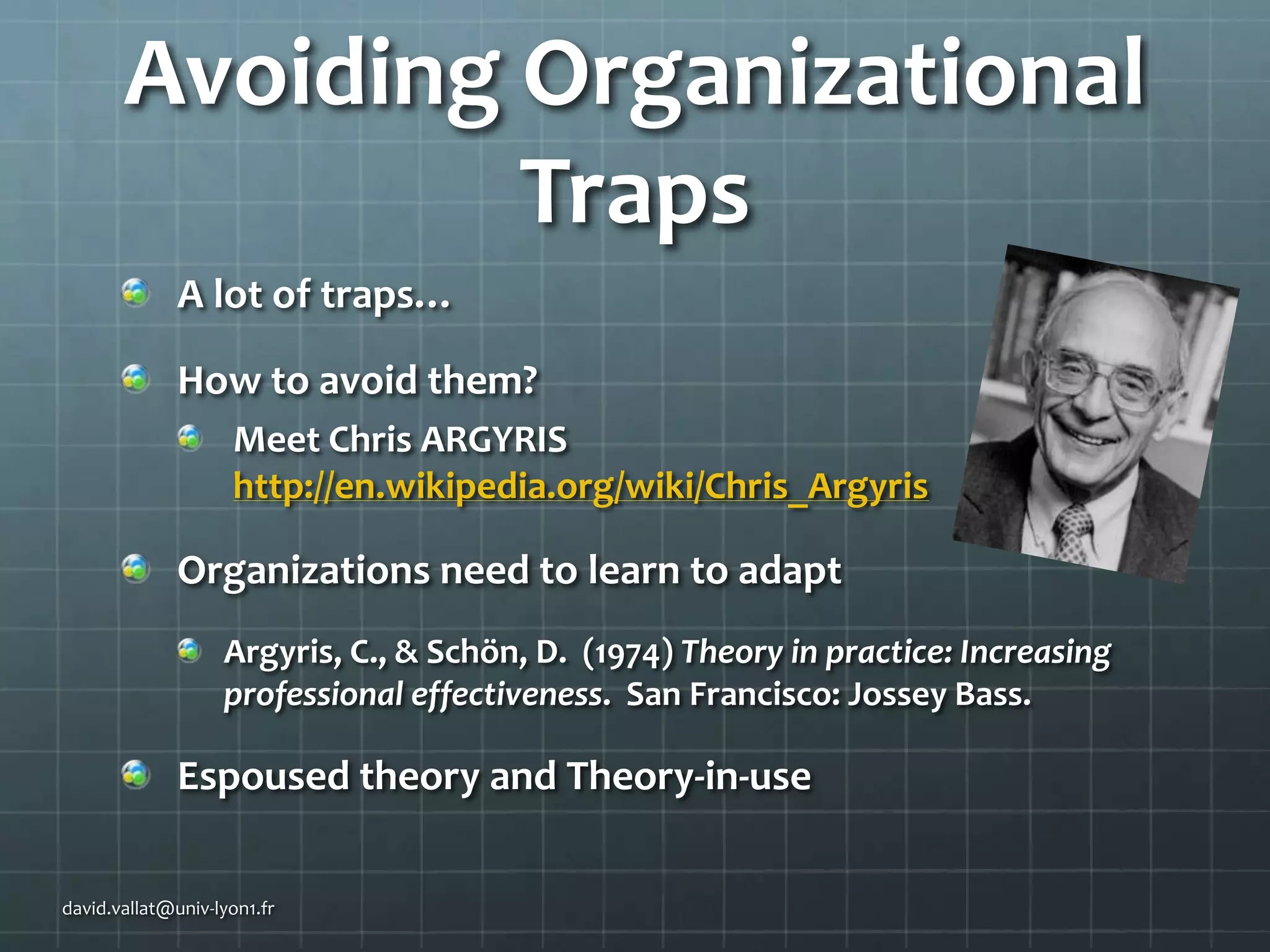
Meet Chris ARGYRIS
http://en.wikipedia.org/wiki/Chris_Argyris

Organizations need to learn to adapt
Argyris, C., & Schön, D. (1974) Theory in practice: Increasing
professional effectiveness. San Francisco: Jossey Bass.

Espoused theory and Theory-in-use
david.vallat@univ-lyon1.fr
Espoused theory and
Theory-in-use
Espoused theory: values people believe their behaviour is
based on - what individuals believe is how they would
behave in a particular circumstance
Theory-in-use: values implied by their behaviour, or the
maps they use to take action - how individuals actually
behave in that circumstance
When someone is asked how he would behave under certain circumstances, the
answer he usually gives is his espoused theory of action for that situation. This is
the theory of action to which he gives allegiance and which, upon request, he
communicates to others. However, the theory that actually governs his actions is
his theory-in-use; furthermore, the individual may or may not be aware of the
incompatibility of the two theories (Argyris and Schön, Theory in Practice, JosseyBass, 1974, p 11.)
david.vallat@univ-lyon1.fr
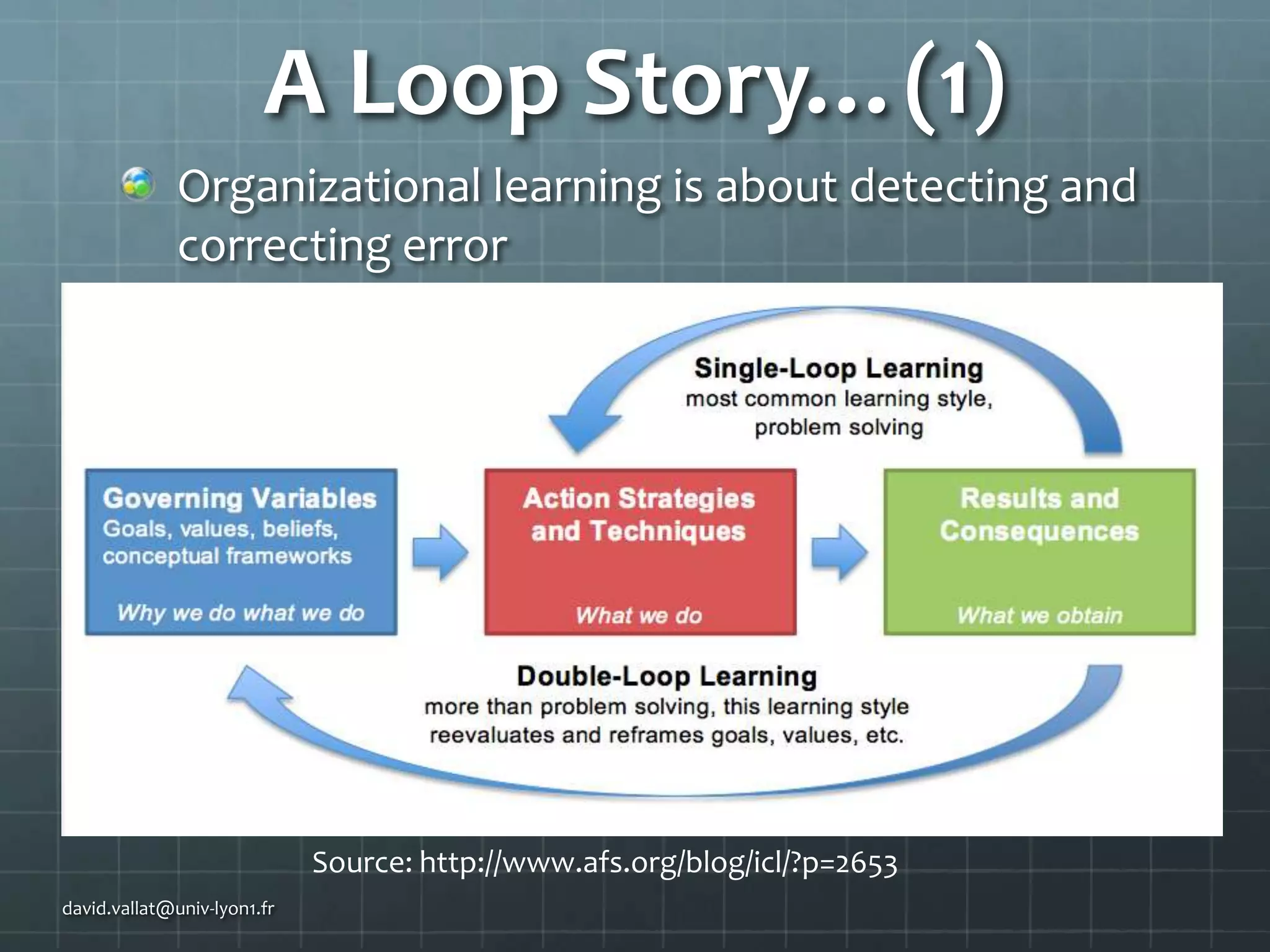
A Loop Story…(1)
Organizational learning is about detecting and
correcting error

Source: http://www.afs.org/blog/icl/?p=2653
david.vallat@univ-lyon1.fr
A Loop Story…(2)
C. Argyris, “Double-Loop Learning in Organisations“, Harvard Business
Review Vol 55, No 5, 1977, pp 115–125.
C. Argyris & D. Schön, Organizational Learning: A Theory of Action
Perspective, Addison-Wesley, 1978.

Single-Loop learning => Model I (theory-inuse)

Double-Loop learning => Model II (theory
espoused)

david.vallat@univ-lyon1.fr
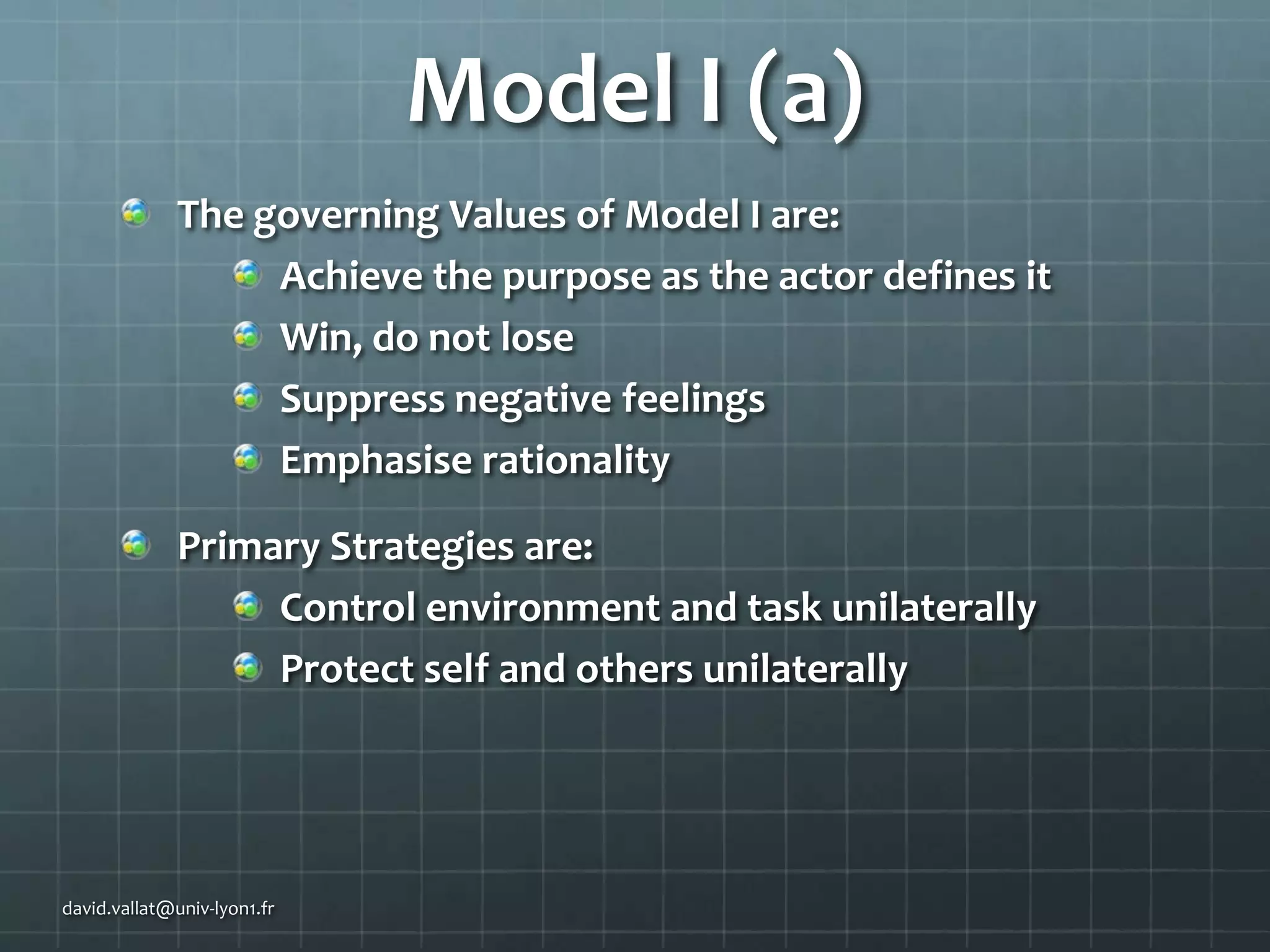
Model I (a)
The governing Values of Model I are:
Achieve the purpose as the actor defines it
Win, do not lose
Suppress negative feelings
Emphasise rationality
Primary Strategies are:
Control environment and task unilaterally
Protect self and others unilaterally

david.vallat@univ-lyon1.fr
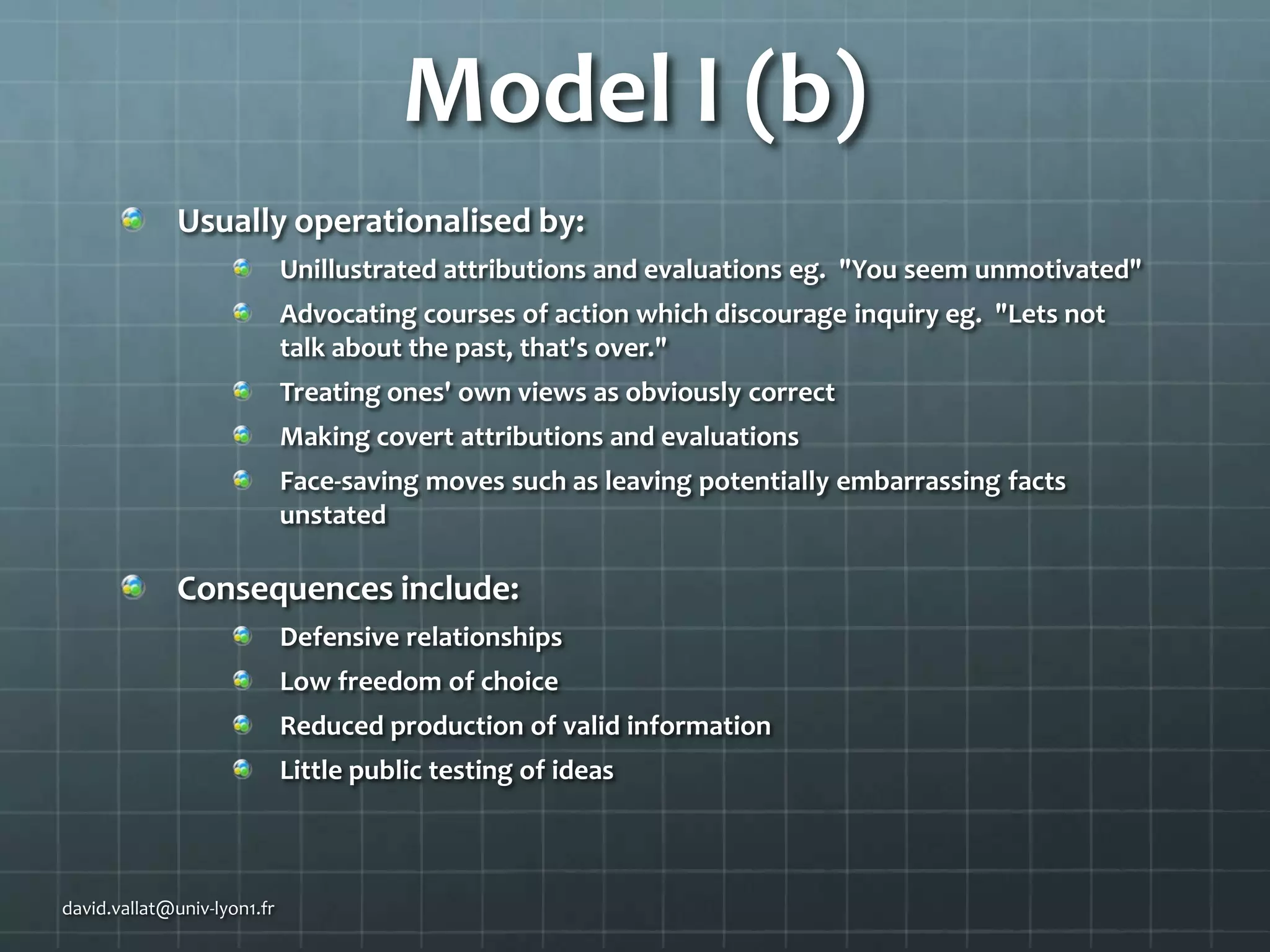
Model I (b)
Usually operationalised by:
Unillustrated attributions and evaluations eg. "You seem unmotivated"
Advocating courses of action which discourage inquiry eg. "Lets not
talk about the past, that's over."

Treating ones' own views as obviously correct
Making covert attributions and evaluations
Face-saving moves such as leaving potentially embarrassing facts
unstated

Consequences include:
Defensive relationships
Low freedom of choice
Reduced production of valid information
Little public testing of ideas

david.vallat@univ-lyon1.fr
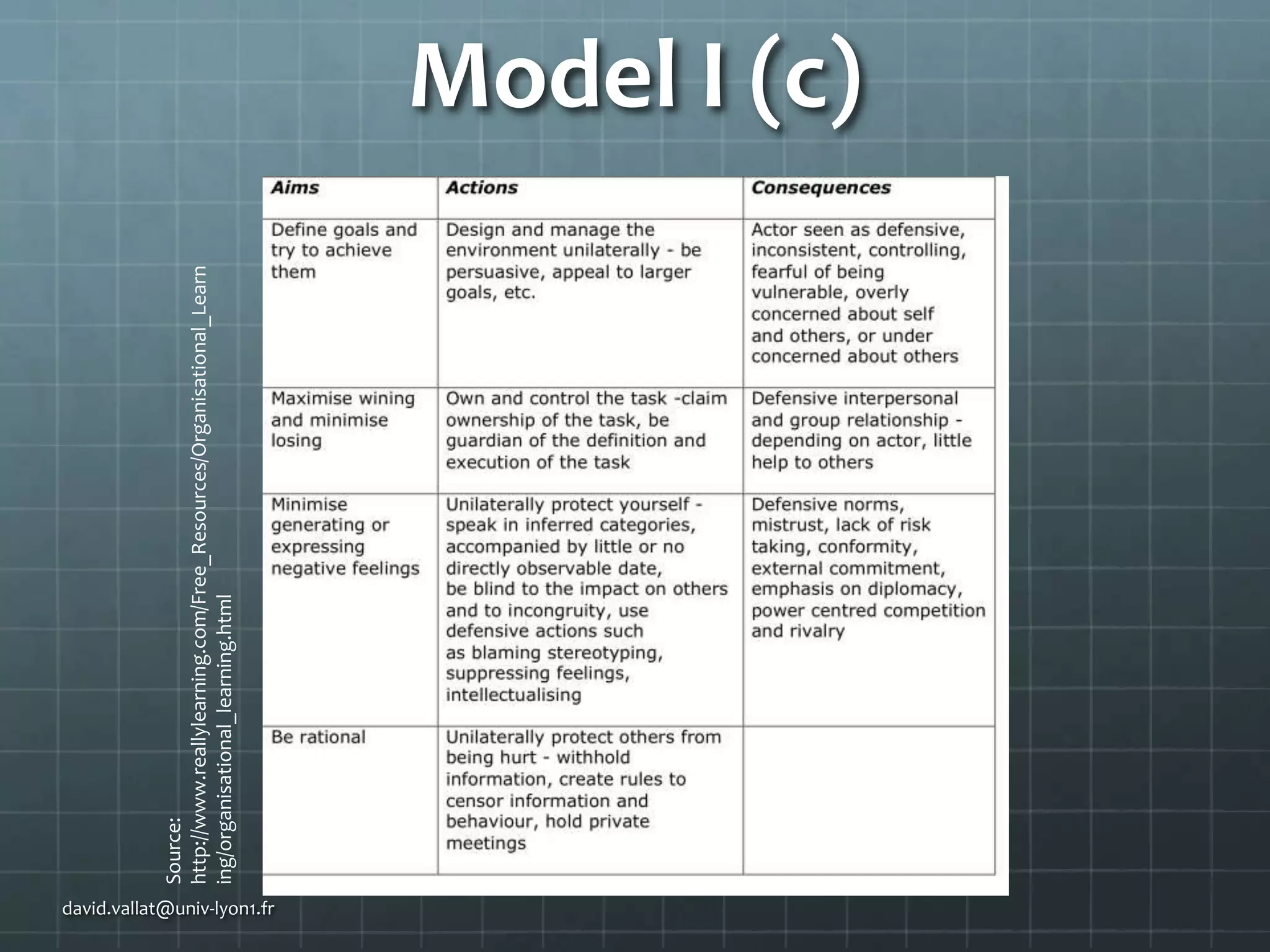
Source:
http://www.reallylearning.com/Free_Resources/Organisational_Learn
ing/organisational_learning.html

Model I (c)

david.vallat@univ-lyon1.fr
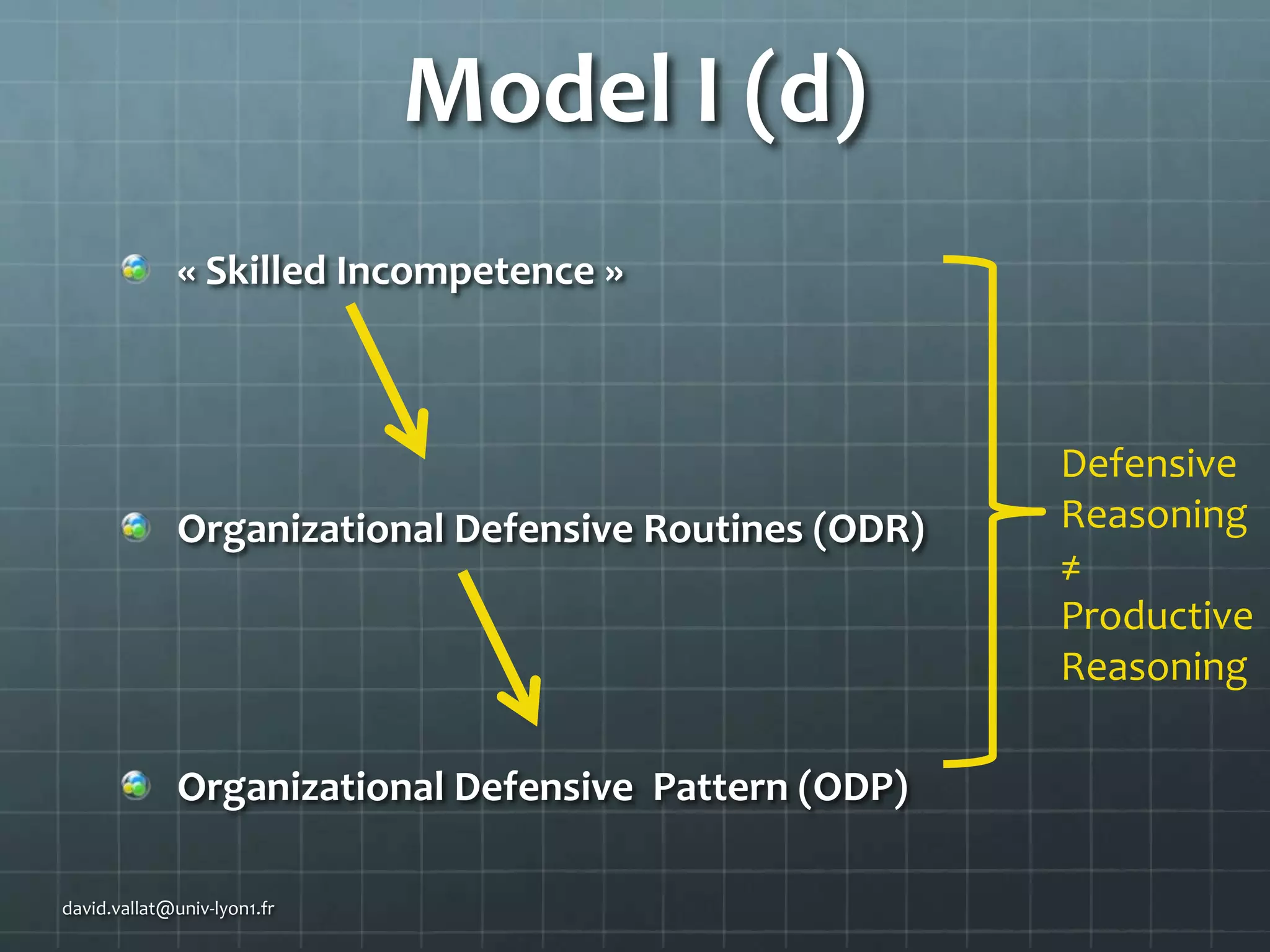
Model I (d)
« Skilled Incompetence »

Organizational Defensive Routines (ODR)

Organizational Defensive Pattern (ODP)
david.vallat@univ-lyon1.fr

Defensive
Reasoning
≠
Productive
Reasoning
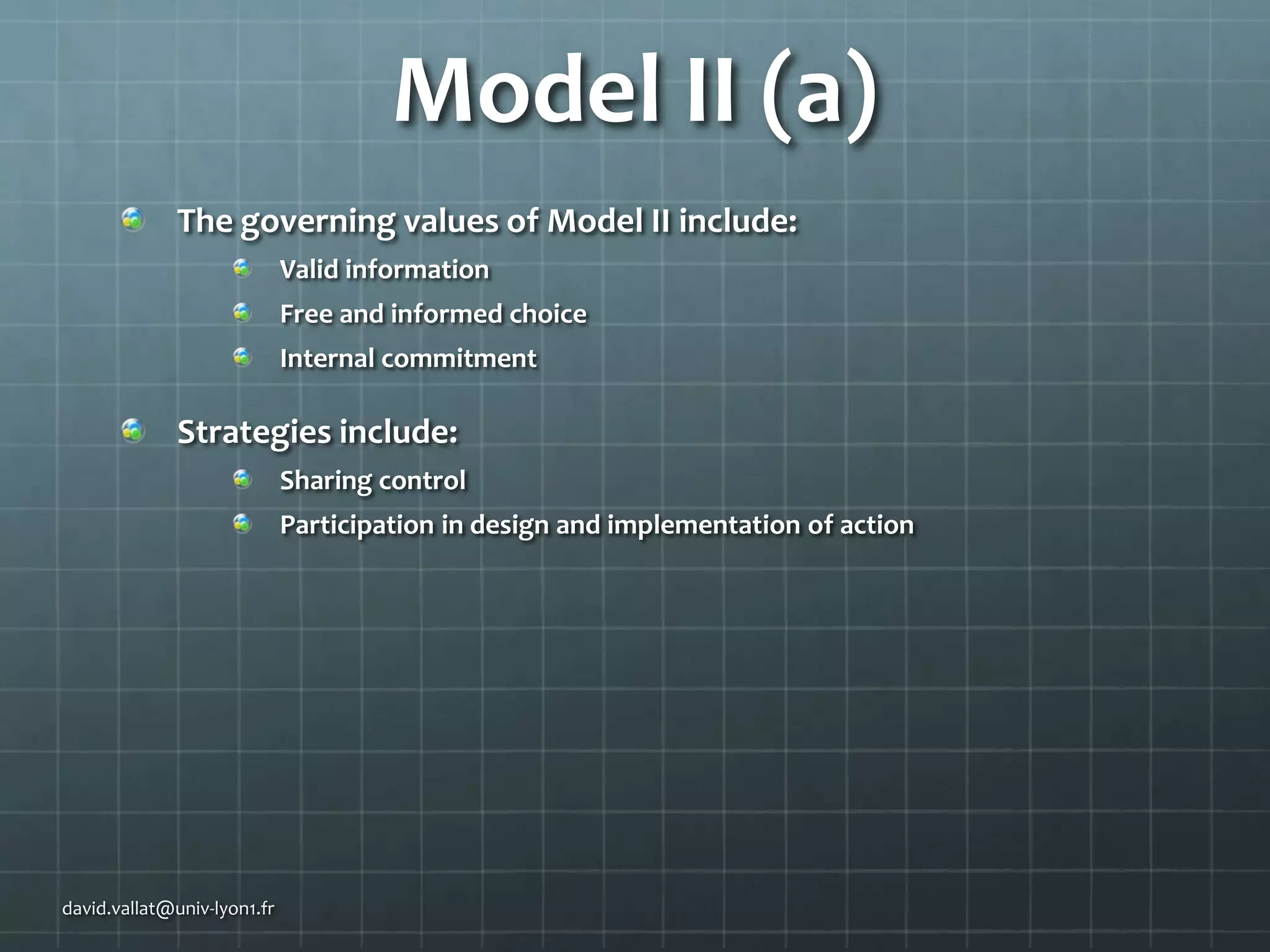
Model II (a)
The governing values of Model II include:
Valid information
Free and informed choice
Internal commitment

Strategies include:
Sharing control
Participation in design and implementation of action

david.vallat@univ-lyon1.fr
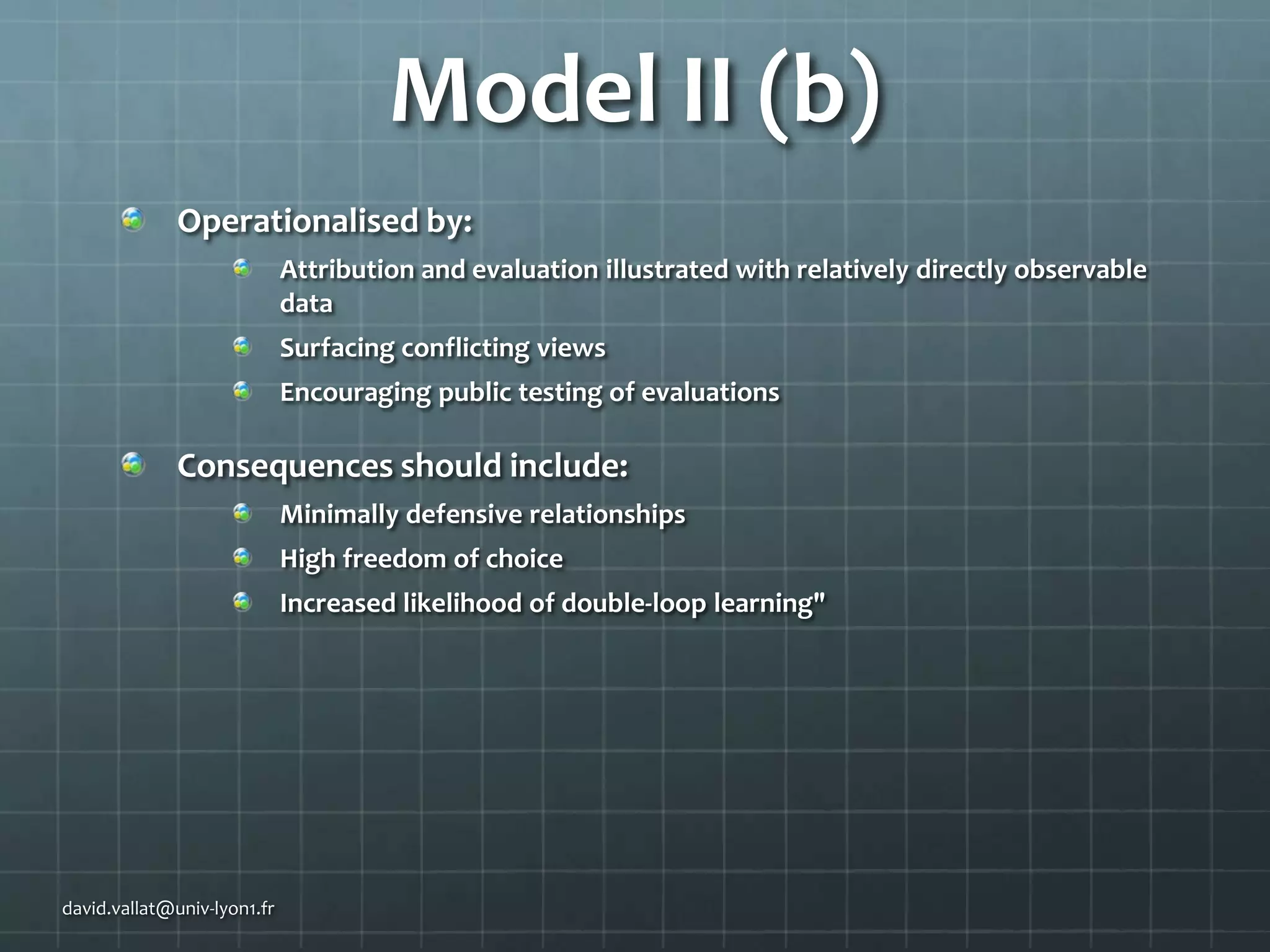
Model II (b)
Operationalised by:
Attribution and evaluation illustrated with relatively directly observable
data
Surfacing conflicting views

Encouraging public testing of evaluations

Consequences should include:
Minimally defensive relationships
High freedom of choice

Increased likelihood of double-loop learning"

david.vallat@univ-lyon1.fr
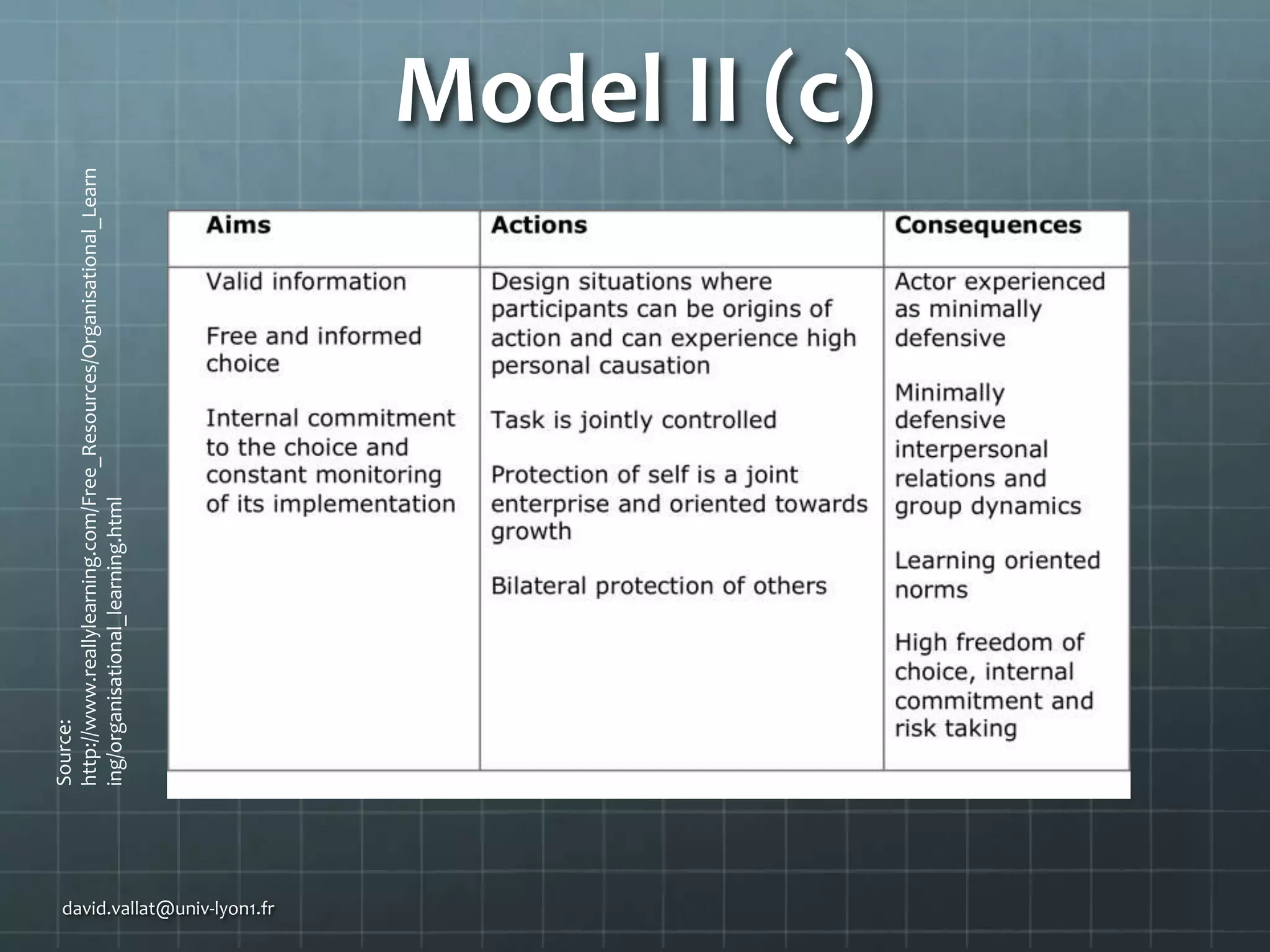
Source:
http://www.reallylearning.com/Free_Resources/Organisational_Learn
ing/organisational_learning.html

Model II (c)

david.vallat@univ-lyon1.fr
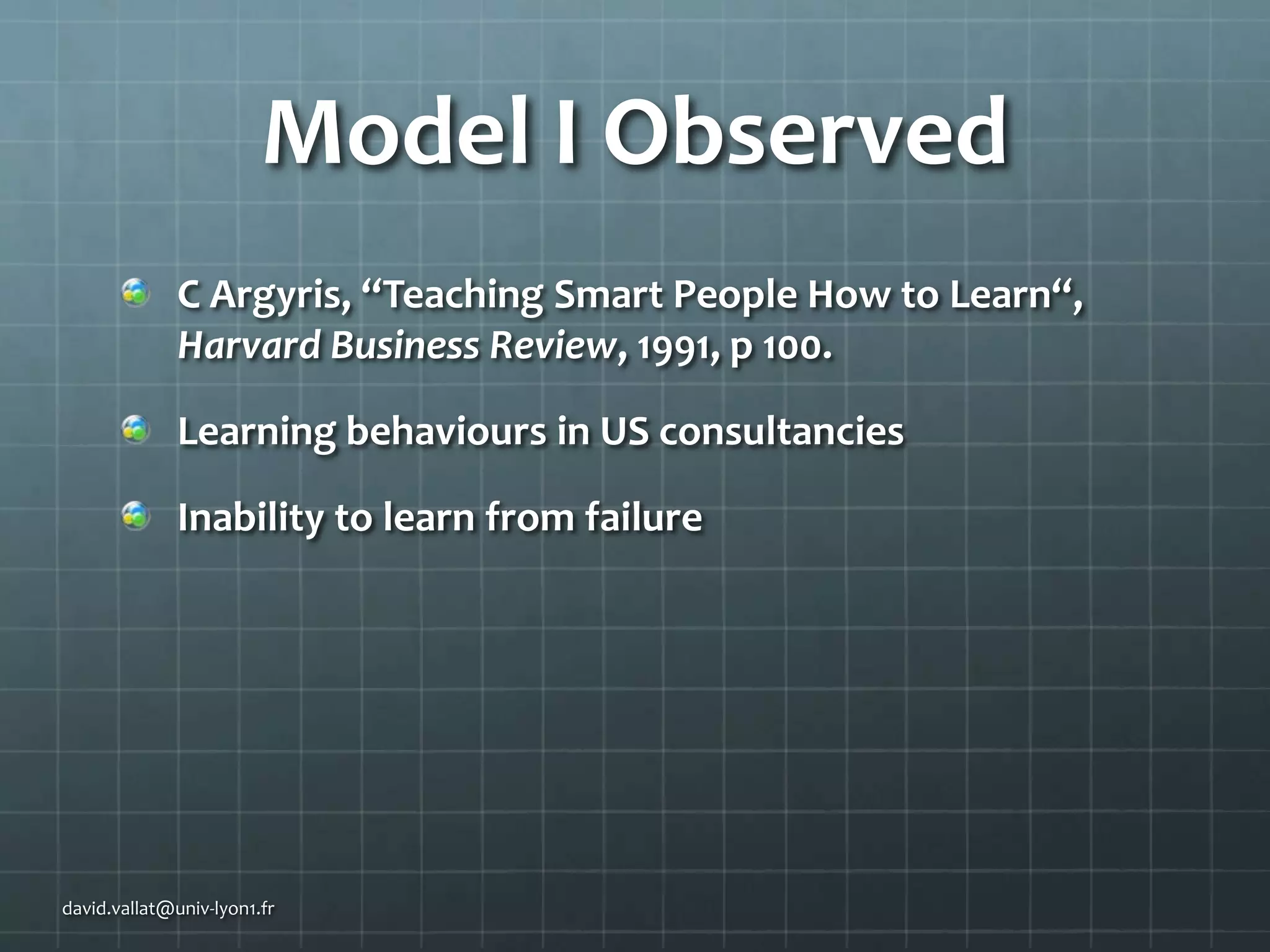
Model I Observed
C Argyris, “Teaching Smart People How to Learn“,
Harvard Business Review, 1991, p 100.
Learning behaviours in US consultancies
Inability to learn from failure

david.vallat@univ-lyon1.fr
Deutero-Learning and
the Learning Org.
When an organization engages in deutero-learning, its
members learn, too, about previous contexts for
learning. They reflect on and enquire into previous
episodes of organizational learning or failure to learn.
They discover what they did that facilitated or
inhibited learning, they invent new strategies for
learning, and they evaluate and generalise what they
have produced. The results become encoded in
individual maps and images and are reflected in
organizational learning practice (Argyris and Schön,
Theory in Practice, Jossey-Bass, 1974, p 27).

david.vallat@univ-lyon1.fr
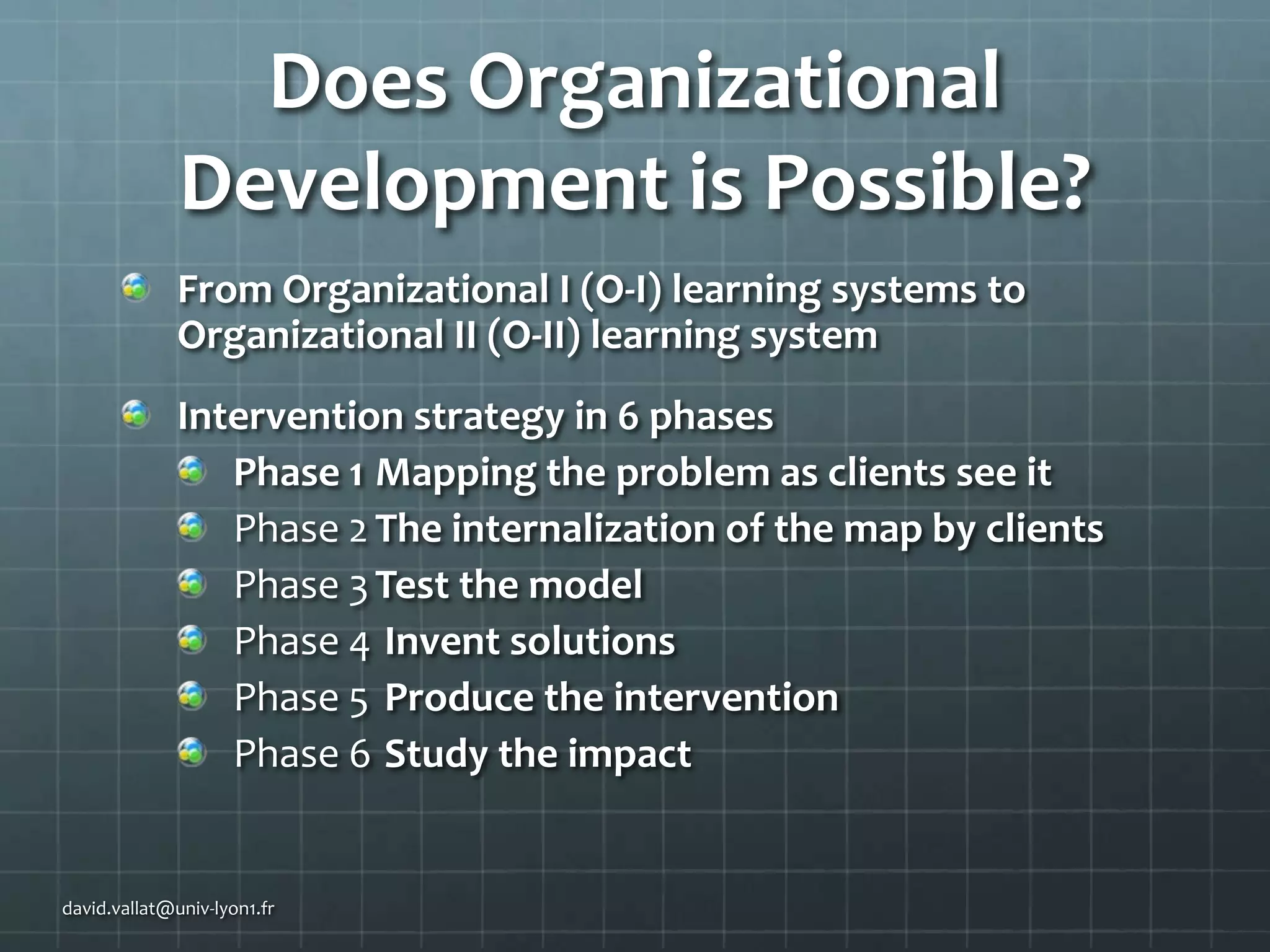
Does Organizational
Development is Possible?
From Organizational I (O-I) learning systems to
Organizational II (O-II) learning system
Intervention strategy in 6 phases
Phase 1 Mapping the problem as clients see it
Phase 2 The internalization of the map by clients
Phase 3 Test the model
Phase 4 Invent solutions
Phase 5 Produce the intervention
Phase 6 Study the impact

david.vallat@univ-lyon1.fr
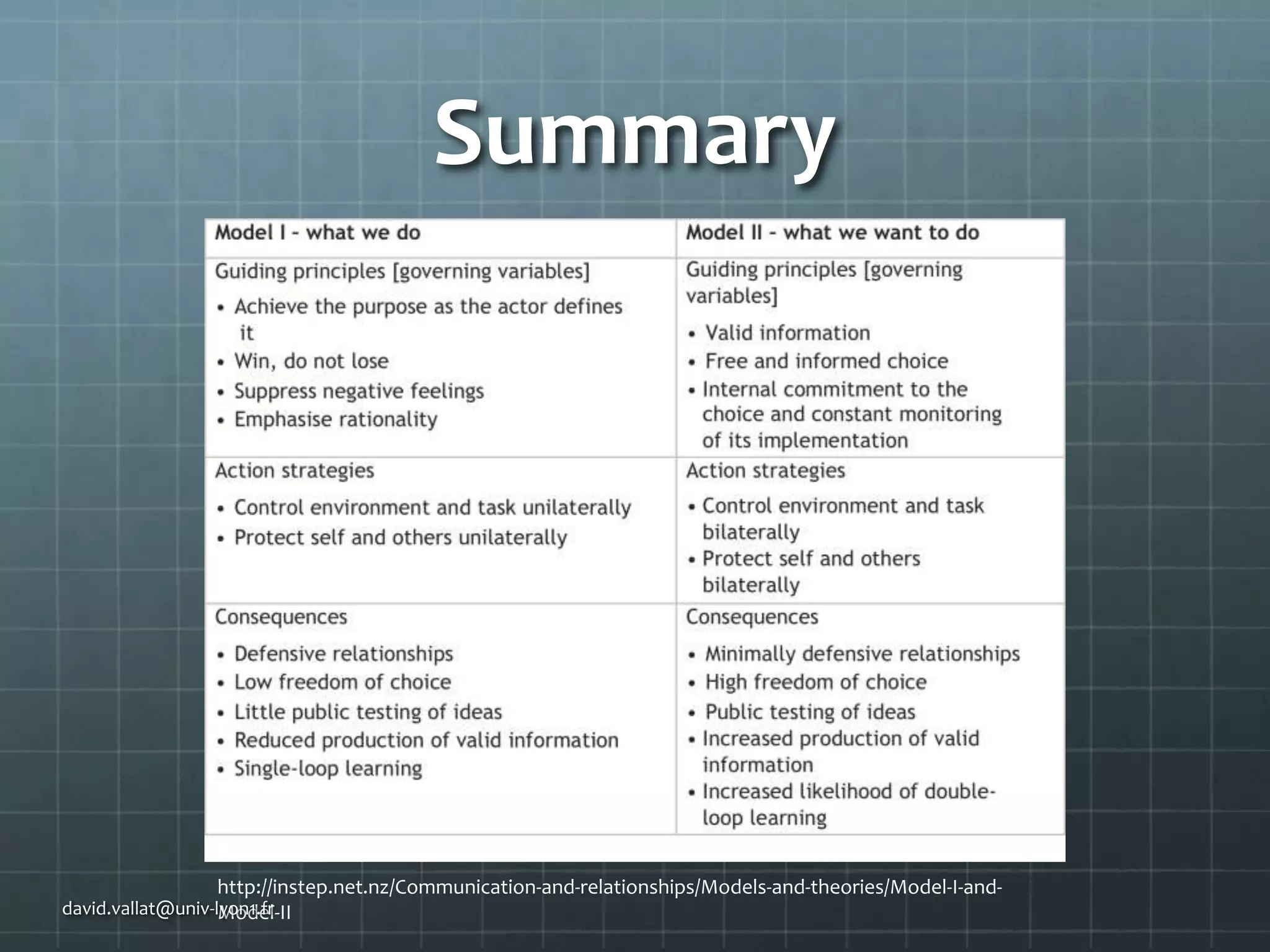
Summary

http://instep.net.nz/Communication-and-relationships/Models-and-theories/Model-I-anddavid.vallat@univ-lyon1.fr
Model-II
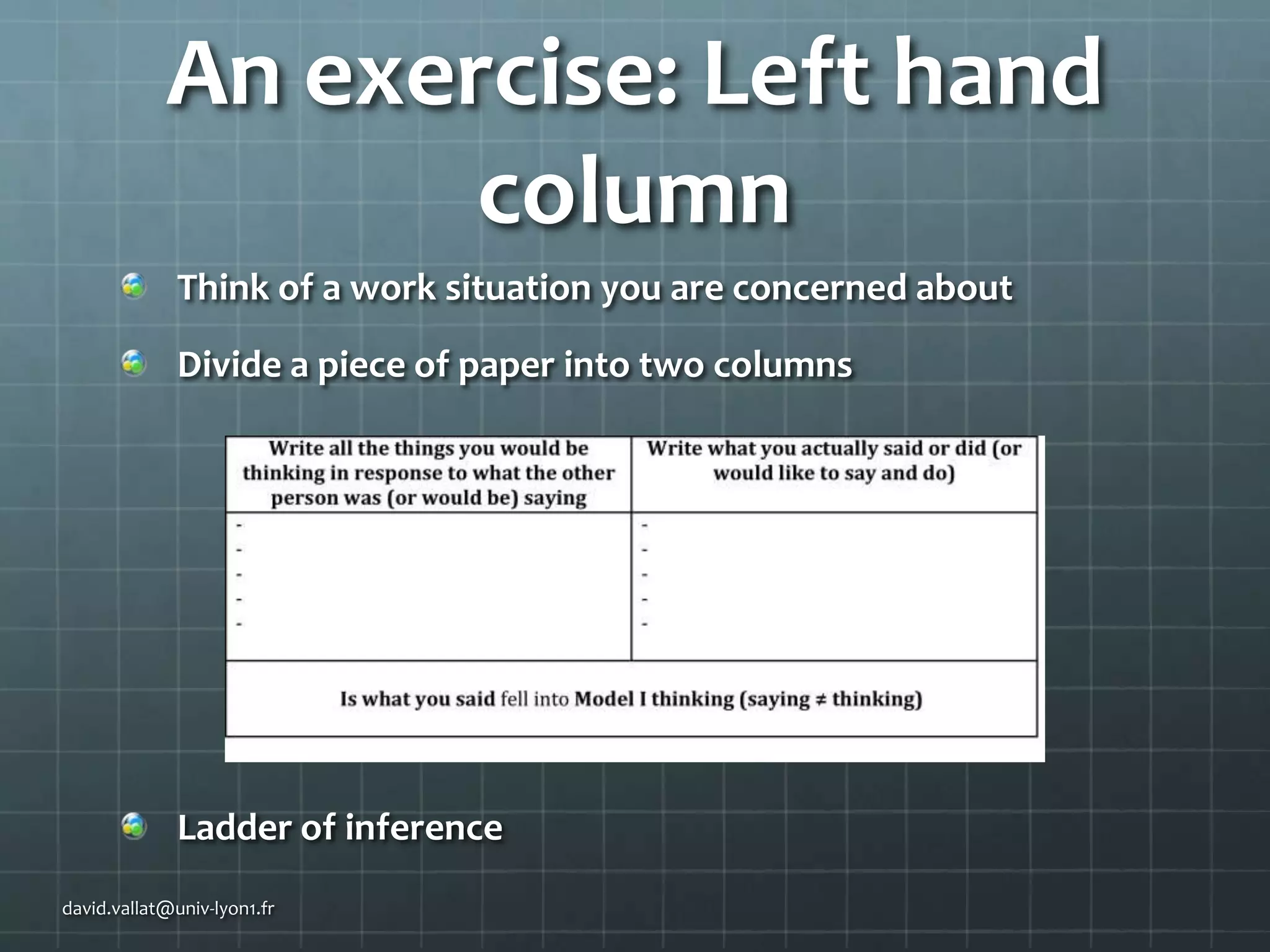
An exercise: Left hand
column
Think of a work situation you are concerned about
Divide a piece of paper into two columns

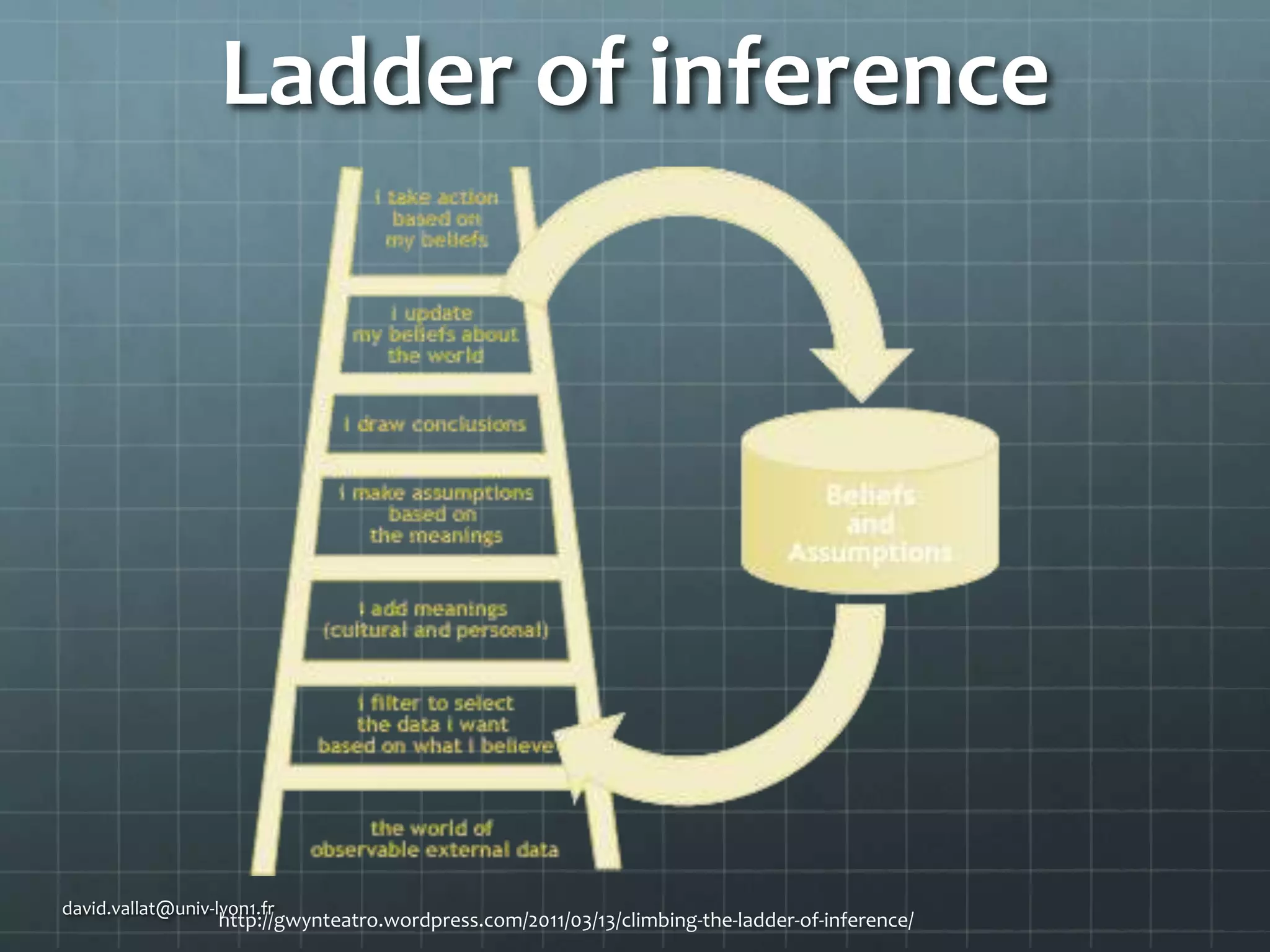
Ladder of inference
david.vallat@univ-lyon1.fr
Ladder of inference

david.vallat@univ-lyon1.fr

http://gwynteatro.wordpress.com/2011/03/13/climbing-the-ladder-of-inference/

Knowledge management 4 (organizational learning)

  • 1.
  • 2.
    Part 4. Contents FromIndividual to Organzsational Learning Organizational Traps Avoiding Organizational Traps Espoused theory and Theory-in-use A Loop Story… Model I Model II Model I Observed Deutero-Learning and the Learning Organization Does Organizational Development is Possible? Summary Exercise Ladder of Inference david.vallat@univ-lyon1.fr
  • 3.
    From Individual to OrganizationalLearning « A learning organization actively creates, captures, transfers, and mobilizes knowledge to enable it to adapt to a changing environment » http://en.wikipedia.org/wiki/Organizational_learning An organization is much more than the sum of individuals How to implement Organizational Learning? Avoid Organizational Trap Think « Double Loop Learning » david.vallat@univ-lyon1.fr
  • 4.
    Organizational Traps Levitt, B.and March, J. (1988), « Organizational Learning », Annual Review of Sociology, vol 14, pp. 319–40. Knowledge in Organization = Routines Competency Trap The Innovator’s Dilemma (C. Christensen) http://www.forbes.com/sites/stevedenning/2012/04/05/ clayton-christensen-and-the-innovators-smackdown/ http://www.youtube.com/watch?v=35z03U3wugs Surpersticious Learning http://blogs.hbr.org/2011/07/superstitious-learning/ = GOD COMPLEXhttp://www.youtube.com/watch?v=K5wCfYujRd E david.vallat@univ-lyon1.fr
  • 5.
    The Innovator’s Dilemma (C.Christensen) - 1 The Innovator’s Dilemma (C. Christensen, 1997) http://www.forbes.com/sites/stevedenning/2012/04/05/claytonchristensen-and-the-innovators-smackdown/ “That book documents how market-leading companies have missed game-changing transformations in industry after industry—computers (mainframes to PCs), telephony (landline to mobile), photography (film to digital), stock markets (floor to online)—not because of ‘bad’ management, but because they followed the dictates of ‘good’ management. They listened closely to their customers. They carefully studied market trends. They allocated capital to the innovations that promised the largest returns. And in the process, they missed disruptive innovations that opened up new customers and markets for lower-margin, blockbuster products.” david.vallat@univ-lyon1.fr
  • 6.
    The Innovator’s Dilemma (C.Christensen) - 2 Example: “Similarly when Toyota was making rusty little subcompacts, it made no sense for General Motors to go after the subcompact market, when the profits they could get on bigger SUVs and pickup trucks made all the sense in the world. Toyota just made their products better and better, until eventually customers who used to bigger General Motors cars could now buy cheaper ones. Now Toyota is making the best in the world, while at the bottom, the Koreans, Kia and Hyundai, have stolen the low end of the market. It’s not because Toyota is asleep at the switch. They have to decide, ‘Should we go down and compete against Kia? Or should we go up and compete against Mercedes?’” david.vallat@univ-lyon1.fr
  • 7.
    Surpersticious Learning Surpersticious Learning http://blogs.hbr.org/2011/07/superstitious-learning/ «Superstitious learning takes place when the connection between the cause of an action and the outcomes experienced aren’t clear, or are misattributed. » « For instance, a major retailer prided itself on the steady, profitable growth of its music CD business over a long period of time. […] The real story was not one of success. Rather, it was one of grabbing share from a market that was in deep decline. » david.vallat@univ-lyon1.fr
  • 8.
    Avoiding Organizational Traps A lotof traps… How to avoid them? Meet Chris ARGYRIS http://en.wikipedia.org/wiki/Chris_Argyris Organizations need to learn to adapt Argyris, C., & Schön, D. (1974) Theory in practice: Increasing professional effectiveness. San Francisco: Jossey Bass. Espoused theory and Theory-in-use david.vallat@univ-lyon1.fr
  • 9.
    Espoused theory and Theory-in-use Espousedtheory: values people believe their behaviour is based on - what individuals believe is how they would behave in a particular circumstance Theory-in-use: values implied by their behaviour, or the maps they use to take action - how individuals actually behave in that circumstance When someone is asked how he would behave under certain circumstances, the answer he usually gives is his espoused theory of action for that situation. This is the theory of action to which he gives allegiance and which, upon request, he communicates to others. However, the theory that actually governs his actions is his theory-in-use; furthermore, the individual may or may not be aware of the incompatibility of the two theories (Argyris and Schön, Theory in Practice, JosseyBass, 1974, p 11.) david.vallat@univ-lyon1.fr
  • 10.
    A Loop Story…(1) Organizationallearning is about detecting and correcting error Source: http://www.afs.org/blog/icl/?p=2653 david.vallat@univ-lyon1.fr
  • 11.
    A Loop Story…(2) C.Argyris, “Double-Loop Learning in Organisations“, Harvard Business Review Vol 55, No 5, 1977, pp 115–125. C. Argyris & D. Schön, Organizational Learning: A Theory of Action Perspective, Addison-Wesley, 1978. Single-Loop learning => Model I (theory-inuse) Double-Loop learning => Model II (theory espoused) david.vallat@univ-lyon1.fr
  • 12.
    Model I (a) Thegoverning Values of Model I are: Achieve the purpose as the actor defines it Win, do not lose Suppress negative feelings Emphasise rationality Primary Strategies are: Control environment and task unilaterally Protect self and others unilaterally david.vallat@univ-lyon1.fr
  • 13.
    Model I (b) Usuallyoperationalised by: Unillustrated attributions and evaluations eg. "You seem unmotivated" Advocating courses of action which discourage inquiry eg. "Lets not talk about the past, that's over." Treating ones' own views as obviously correct Making covert attributions and evaluations Face-saving moves such as leaving potentially embarrassing facts unstated Consequences include: Defensive relationships Low freedom of choice Reduced production of valid information Little public testing of ideas david.vallat@univ-lyon1.fr
  • 14.
  • 15.
    Model I (d) «Skilled Incompetence » Organizational Defensive Routines (ODR) Organizational Defensive Pattern (ODP) david.vallat@univ-lyon1.fr Defensive Reasoning ≠ Productive Reasoning
  • 16.
    Model II (a) Thegoverning values of Model II include: Valid information Free and informed choice Internal commitment Strategies include: Sharing control Participation in design and implementation of action david.vallat@univ-lyon1.fr
  • 17.
    Model II (b) Operationalisedby: Attribution and evaluation illustrated with relatively directly observable data Surfacing conflicting views Encouraging public testing of evaluations Consequences should include: Minimally defensive relationships High freedom of choice Increased likelihood of double-loop learning" david.vallat@univ-lyon1.fr
  • 18.
  • 19.
    Model I Observed CArgyris, “Teaching Smart People How to Learn“, Harvard Business Review, 1991, p 100. Learning behaviours in US consultancies Inability to learn from failure david.vallat@univ-lyon1.fr
  • 20.
    Deutero-Learning and the LearningOrg. When an organization engages in deutero-learning, its members learn, too, about previous contexts for learning. They reflect on and enquire into previous episodes of organizational learning or failure to learn. They discover what they did that facilitated or inhibited learning, they invent new strategies for learning, and they evaluate and generalise what they have produced. The results become encoded in individual maps and images and are reflected in organizational learning practice (Argyris and Schön, Theory in Practice, Jossey-Bass, 1974, p 27). david.vallat@univ-lyon1.fr
  • 21.
    Does Organizational Development isPossible? From Organizational I (O-I) learning systems to Organizational II (O-II) learning system Intervention strategy in 6 phases Phase 1 Mapping the problem as clients see it Phase 2 The internalization of the map by clients Phase 3 Test the model Phase 4 Invent solutions Phase 5 Produce the intervention Phase 6 Study the impact david.vallat@univ-lyon1.fr
  • 22.
  • 23.
    An exercise: Lefthand column Think of a work situation you are concerned about Divide a piece of paper into two columns Ladder of inference david.vallat@univ-lyon1.fr
  • 24.