K nowledge is treated more and more as a principle success factor and major driving force behind the successful business It will be a powerful tool to enhance productivity and reduce cost
What is Knowledge Management? Key words : Data, Information And Knowledge.  Data  can be illustrated as a fact, which has not been structured.  Information  is the relevant, structured and meaningful data.  Knowledge,  on the other hand, is acquired through personal experience or the study of factual information.
Knowledge Management
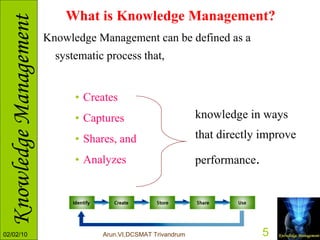
What is Knowledge Management? Knowledge Management can be defined as a systematic process that, Creates Captures Shares, and  Analyzes  knowledge in ways that directly improve performance .
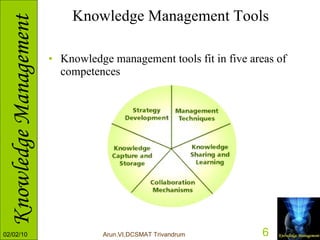
Knowledge Management Tools Knowledge management tools fit in five areas of competences
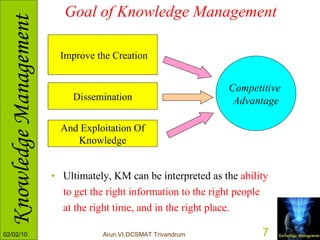
Goal of Knowledge Management Ultimately, KM can be interpreted as the  ability to get the right information to the right people at the right time, and in the right place.   Improve the Creation And Exploitation Of Knowledge Dissemination Competitive  Advantage
Goal of Knowledge Management contd. Improved performance Innovation The sharing of lessons learned Competitive advantage Continuous improvement of the organisation KM focus on organizational objectives Management of  knowledge as a strategic asset
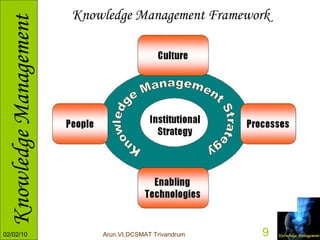
Knowledge Management Framework
Knowledge management (KM) Comprises a range of practices used in an organisation to  Identify, Create  Represent Distribute And  Enable Adoption Of Insights And Experiences .  Such insights and experiences comprise knowledge, either embodied in individuals or embedded in organisational processes or practice .
Knowledge Management To  share  valuable organisational insights ,  To  reduce redundant work To  avoid reinventing   To  reduce training time  for new employees, To  retain intellectual capital   as  employees turnover in an organisation& To  adapt to changing   environments and market KM efforts can help individuals and groups;
KM efforts can help individuals and groups; To  share valuable organisational insights ,  to  reduce redundant work To  avoid reinventing   to  reduce training time  for new employees, To  retain intellectual capital  as employees  turnover in an organisation, and To  adapt to changing  environments and markets  (mcadam & mccreedy 2000) (thompson & Walsham 2004).
Research KM emerged as a scientific discipline in the earlier  1990s . It was initially supported by only practitioners, when Scandia hired  Leif Edvinsson of Sweden  as the world’s first  Chief Knowledge Officer (CKO).
Core components of KM include  People, Processes, Technology  (or)  Culture, Structure, Technology , depending on the specific perspective  Different KM schools of thoughts include   community of practice  (Wenger, McDermott & Synder 2001)  social network analysis  intellectual capital  information theory  complexity science constructivism
Dimensions Different frameworks for distinguishing between knowledge exist.  One proposed framework  for categorising the dimensions of knowledge distinguishes between  tacit knowledge and explicit knowledge .
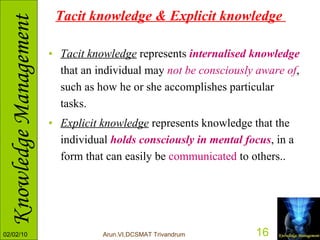
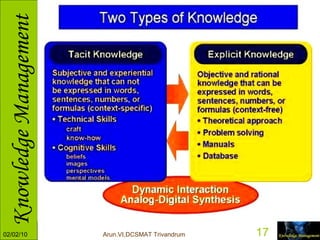
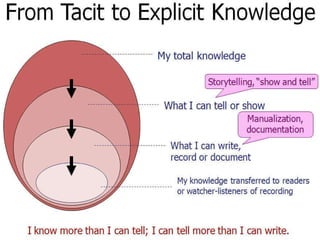
Tacit knowledge & Explicit knowledge  Tacit knowledge  represents  internalised knowledge  that an individual may  not be consciously aware of , such as how he or she accomplishes particular tasks.  Explicit knowledge  represents knowledge that the individual  holds consciously in mental focus , in a form that can easily be  communicated  to others..
 
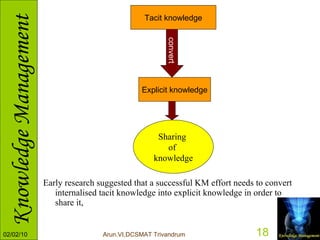
Early research suggested that a successful KM effort needs to convert internalised tacit knowledge into explicit knowledge in order to share it,  Tacit knowledge Explicit knowledge convert Sharing  of  knowledge
 
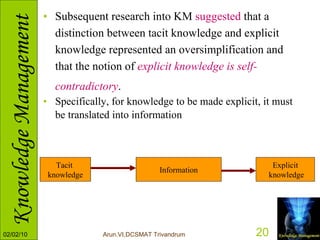
Subsequent research into KM  suggested  that a distinction between tacit knowledge and explicit knowledge represented an oversimplification and that the notion of  explicit knowledge is self-contradictory .   Specifically, for knowledge to be made explicit, it must be translated into information   Tacit  knowledge Information Explicit knowledge
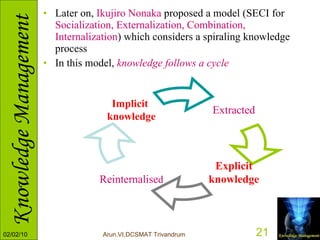
Later on,  Ikujiro Nonaka  proposed a model (SECI for  Socialization, Externalization, Combination, Internalization ) which considers a spiraling knowledge process In this model,  knowledge follows a cycle Reinternalise d Explicit knowledge Extracted Implicit  knowledge
Second proposed framework A second proposed framework for categorising the  dimensions of knowledge distinguishes between embedded knowledge of a system outside of a human individual  (e.g., an information system may have knowledge embedded into its design) and embodied knowledge representing a  learned capability of a human body’s nervous and endocrine systems  (Sensky 2002)
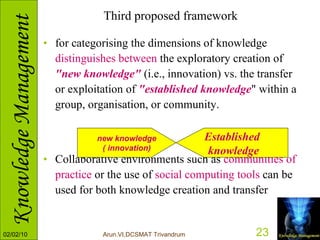
Third proposed framework for categorising the dimensions of knowledge  distinguishes between  the exploratory creation of  "new knowledge"  (i.e., innovation) vs. the transfer or exploitation of  "established knowledge " within a group, organisation, or community. Collaborative environments such as  communities of practice  or the use of  social computing tools  can be used for both knowledge creation and transfer new knowledge ( innovation) Established knowledge
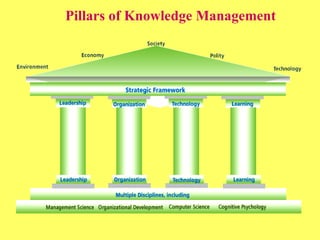
Pillars of Knowledge Management
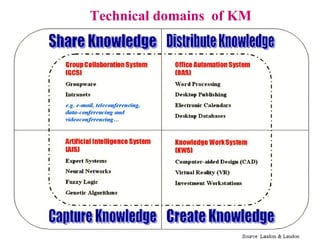
Technical domains  of KM
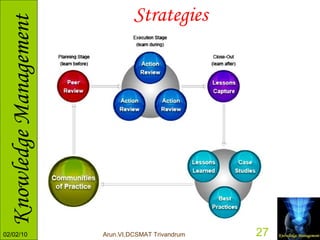
Strategies Knowledge may be accessed at three stages:  Before during  after KM-related activities .
Strategies
 
Strategies contd.. One strategy  to KM involves actively managing knowledge ( push strategy )   In such an instance, individuals strive to  explicitly encode their knowledge  into a shared knowledge repository, such as a database, as well as retrieving knowledge they need that other individuals have provided to the repository. This is also commonly known as the  Codification approach to KM .
Strategies contd.. Another strategy to KM involves  individuals making knowledge requests of experts associated with a particular subject on an ad hoc basis ( pull strategy ).  In such an instance, expert individual(s) can provide their insights to the particular person or people needing this  (Snowden 2002)   This is also commonly known as the -  Personalization approach to KM.
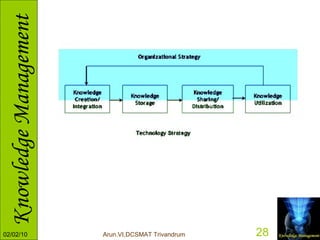
Other knowledge management strategies for companies include: Rewards  (as a means of motivating for knowledge sharing)  Storytelling   (as a means of transferring tacit knowledge)   Cross-project learning   After action reviews   Knowledge mapping   (a map of knowledge repositories within a company accessible by all)  Communities of practice   Expert directories   (to enable knowledge seeker to reach to the experts)   Best practice transfer   Competence management   (systematic evaluation and planning of competences of individual organization members)
Other knowledge management strategies for companies include : Proximity & architecture   (the physical situation of employees can be either conducive or obstructive to knowledge sharing)  Master-apprentice relationship   Collaborative technologies   (groupware, etc)   Knowledge repositories   (databases, bookmarking engines, etc)  Measuring and reporting intellectual capital   (a way of making explicit knowledge for companies)   Knowledge brokers   (some organizational members take on responsibility  for a specific "field" and act as first reference on whom to talk about a specific subject)   Social software
Benefits Making available  increased knowledge content  in the development and provision of products and services  Achieving  shorter new product development cycles   Facilitating and managing innovation  and organizational learning  Leveraging the expertise of people  across the organization  Increasing network connectivity  between internal and external individuals
Benefits contd.. Managing business environments  and allowing employees to obtain relevant insights and ideas appropriate to their work  Solving  intractable or  wicked problems   Managing intellectual capital and intellectual assets  in the workforce (such as the expertise and know-how possessed by key individuals)
Referances http://www.adb.org/Evaluation/Linking-to-Results/OED-Learning-Cycle.asp http://www.ugc.edu.hk/tlqpr01/site/abstracts/098_hui.htm   www.wikepedia.com http://apintalisayon.files.wordpress.com/2008/11/tacit-to-explicit-v2.jpg http://apintalisayon.wordpress.com/2008/11/28/d4-converting-tacit-to-explicit-knowledge-and-vice-versa/
Thank You

Knowledge Management Arun VI

  • 1.
  • 2.
    K nowledge istreated more and more as a principle success factor and major driving force behind the successful business It will be a powerful tool to enhance productivity and reduce cost
  • 3.
    What is KnowledgeManagement? Key words : Data, Information And Knowledge. Data can be illustrated as a fact, which has not been structured. Information is the relevant, structured and meaningful data. Knowledge, on the other hand, is acquired through personal experience or the study of factual information.
  • 4.
  • 5.
    What is KnowledgeManagement? Knowledge Management can be defined as a systematic process that, Creates Captures Shares, and Analyzes knowledge in ways that directly improve performance .
  • 6.
    Knowledge Management ToolsKnowledge management tools fit in five areas of competences
  • 7.
    Goal of KnowledgeManagement Ultimately, KM can be interpreted as the ability to get the right information to the right people at the right time, and in the right place. Improve the Creation And Exploitation Of Knowledge Dissemination Competitive Advantage
  • 8.
    Goal of KnowledgeManagement contd. Improved performance Innovation The sharing of lessons learned Competitive advantage Continuous improvement of the organisation KM focus on organizational objectives Management of knowledge as a strategic asset
  • 9.
  • 10.
    Knowledge management (KM)Comprises a range of practices used in an organisation to Identify, Create Represent Distribute And Enable Adoption Of Insights And Experiences . Such insights and experiences comprise knowledge, either embodied in individuals or embedded in organisational processes or practice .
  • 11.
    Knowledge Management To share valuable organisational insights , To reduce redundant work To avoid reinventing To reduce training time for new employees, To retain intellectual capital as employees turnover in an organisation& To adapt to changing environments and market KM efforts can help individuals and groups;
  • 12.
    KM efforts canhelp individuals and groups; To share valuable organisational insights , to reduce redundant work To avoid reinventing to reduce training time for new employees, To retain intellectual capital as employees turnover in an organisation, and To adapt to changing environments and markets (mcadam & mccreedy 2000) (thompson & Walsham 2004).
  • 13.
    Research KM emergedas a scientific discipline in the earlier 1990s . It was initially supported by only practitioners, when Scandia hired Leif Edvinsson of Sweden as the world’s first Chief Knowledge Officer (CKO).
  • 14.
    Core components ofKM include People, Processes, Technology (or) Culture, Structure, Technology , depending on the specific perspective Different KM schools of thoughts include community of practice (Wenger, McDermott & Synder 2001) social network analysis intellectual capital information theory complexity science constructivism
  • 15.
    Dimensions Different frameworksfor distinguishing between knowledge exist. One proposed framework for categorising the dimensions of knowledge distinguishes between tacit knowledge and explicit knowledge .
  • 16.
    Tacit knowledge &Explicit knowledge Tacit knowledge represents internalised knowledge that an individual may not be consciously aware of , such as how he or she accomplishes particular tasks. Explicit knowledge represents knowledge that the individual holds consciously in mental focus , in a form that can easily be communicated to others..
  • 17.
  • 18.
    Early research suggestedthat a successful KM effort needs to convert internalised tacit knowledge into explicit knowledge in order to share it, Tacit knowledge Explicit knowledge convert Sharing of knowledge
  • 19.
  • 20.
    Subsequent research intoKM suggested that a distinction between tacit knowledge and explicit knowledge represented an oversimplification and that the notion of explicit knowledge is self-contradictory . Specifically, for knowledge to be made explicit, it must be translated into information Tacit knowledge Information Explicit knowledge
  • 21.
    Later on, Ikujiro Nonaka proposed a model (SECI for Socialization, Externalization, Combination, Internalization ) which considers a spiraling knowledge process In this model, knowledge follows a cycle Reinternalise d Explicit knowledge Extracted Implicit knowledge
  • 22.
    Second proposed frameworkA second proposed framework for categorising the dimensions of knowledge distinguishes between embedded knowledge of a system outside of a human individual (e.g., an information system may have knowledge embedded into its design) and embodied knowledge representing a learned capability of a human body’s nervous and endocrine systems (Sensky 2002)
  • 23.
    Third proposed frameworkfor categorising the dimensions of knowledge distinguishes between the exploratory creation of "new knowledge" (i.e., innovation) vs. the transfer or exploitation of "established knowledge " within a group, organisation, or community. Collaborative environments such as communities of practice or the use of social computing tools can be used for both knowledge creation and transfer new knowledge ( innovation) Established knowledge
  • 24.
  • 25.
  • 26.
    Strategies Knowledge maybe accessed at three stages: Before during after KM-related activities .
  • 27.
  • 28.
  • 29.
    Strategies contd.. Onestrategy to KM involves actively managing knowledge ( push strategy ) In such an instance, individuals strive to explicitly encode their knowledge into a shared knowledge repository, such as a database, as well as retrieving knowledge they need that other individuals have provided to the repository. This is also commonly known as the Codification approach to KM .
  • 30.
    Strategies contd.. Anotherstrategy to KM involves individuals making knowledge requests of experts associated with a particular subject on an ad hoc basis ( pull strategy ). In such an instance, expert individual(s) can provide their insights to the particular person or people needing this (Snowden 2002) This is also commonly known as the - Personalization approach to KM.
  • 31.
    Other knowledge managementstrategies for companies include: Rewards (as a means of motivating for knowledge sharing) Storytelling (as a means of transferring tacit knowledge) Cross-project learning After action reviews Knowledge mapping (a map of knowledge repositories within a company accessible by all) Communities of practice Expert directories (to enable knowledge seeker to reach to the experts) Best practice transfer Competence management (systematic evaluation and planning of competences of individual organization members)
  • 32.
    Other knowledge managementstrategies for companies include : Proximity & architecture (the physical situation of employees can be either conducive or obstructive to knowledge sharing) Master-apprentice relationship Collaborative technologies (groupware, etc) Knowledge repositories (databases, bookmarking engines, etc) Measuring and reporting intellectual capital (a way of making explicit knowledge for companies) Knowledge brokers (some organizational members take on responsibility for a specific "field" and act as first reference on whom to talk about a specific subject) Social software
  • 33.
    Benefits Making available increased knowledge content in the development and provision of products and services Achieving shorter new product development cycles Facilitating and managing innovation and organizational learning Leveraging the expertise of people across the organization Increasing network connectivity between internal and external individuals
  • 34.
    Benefits contd.. Managingbusiness environments and allowing employees to obtain relevant insights and ideas appropriate to their work Solving intractable or wicked problems Managing intellectual capital and intellectual assets in the workforce (such as the expertise and know-how possessed by key individuals)
  • 35.
    Referances http://www.adb.org/Evaluation/Linking-to-Results/OED-Learning-Cycle.asp http://www.ugc.edu.hk/tlqpr01/site/abstracts/098_hui.htm www.wikepedia.com http://apintalisayon.files.wordpress.com/2008/11/tacit-to-explicit-v2.jpg http://apintalisayon.wordpress.com/2008/11/28/d4-converting-tacit-to-explicit-knowledge-and-vice-versa/
  • 36.