


1


Auditing HR Function
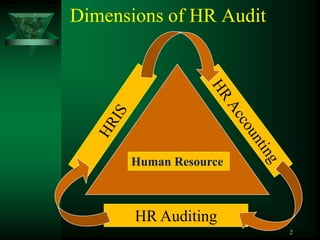
Dimensions of HR Audit


      Human Resource


       HR Auditing
                         2
Human Resource Information
               System (HRIS)

 A method by which an Organization
  collects, analyses, and reports information
  about people and jobs.
 An integration between IT System and
  HRM process.
 Offers an adequate, comprehensive and
  on-going information system about people
  and jobs.
                                            3
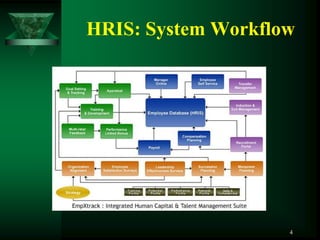
HRIS: System Workflow


                    4
HR Accounting
 First developed by Rensis Likert , and he pointed
  out that the expenses on human resource are fixed
  in nature and do not offer any immediate return.

 According to Flamhotiz, “HRA is accounting for
  people as an organizational resource. It involves
  measuring the costs incurred by organization to
  recruit , select , hire, train and develop human
  assets. It also involves the measuring economic
  value of people to the organization.”
                                                5
Objectives of HR Accounting
 Provide cost value information about acquiring,
  developing , allocating and maintaining human
  resources.
 Enable management to effectively monitor the use of
  human resources.
 Find whether human assets are appreciating or
  depreciating over a period of time.
 Assist in development of effective management
  practices on the basis of financial consequences.

                                                    6
Approaches of HRA


   Monetary Measures


 Non Monetary Measures


                          7
Monetary Methods
 Historical cost method
 Replacement cost method
 Opportunity cost method
 Economic value method
 Assets multiplier method
 Discounted present value of future earnings method

       Non-monetary Measures
 Expected realizable value method
                                                       8
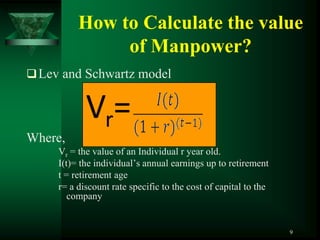
Vr=

                How to Calculate the value
                     of Manpower?
       Lev and Schwartz model


                  Vr=
      Where,
           Vr = the value of an Individual r year old.
           I(t)= the individual’s annual earnings up to retirement
           t = retirement age
           r= a discount rate specific to the cost of capital to the
              company


                                                                       9
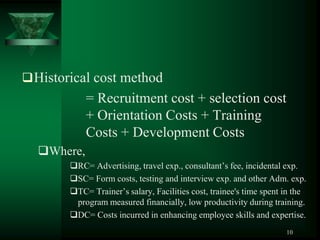
 Historical cost method
            = Recruitment cost + selection cost
            + Orientation Costs + Training
            Costs + Development Costs
  Where,
        RC= Advertising, travel exp., consultant’s fee, incidental exp.
        SC= Form costs, testing and interview exp. and other Adm. exp.
        TC= Trainer’s salary, Facilities cost, trainee's time spent in the
         program measured financially, low productivity during training.
        DC= Costs incurred in enhancing employee skills and expertise.
                                                                     10
Controlling Cost of
                  Manpower
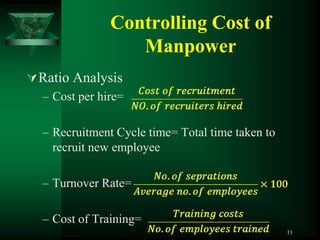
 Ratio Analysis
  – Cost per hire=

  – Recruitment Cycle time= Total time taken to
    recruit new employee

  – Turnover Rate=

  – Cost of Training=
                                                  11
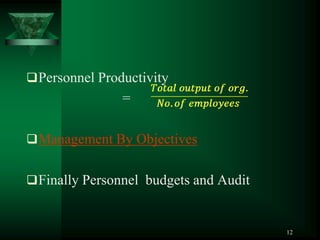
 Personnel Productivity
                =

 Management By Objectives


 Finally Personnel budgets and Audit


                                        12
Auditing HR Functions


                    13
What is AUDIT ?

 Latin verb-audire-means-to listen


 Listening implies an attempt to know the
  state of the affairs as they exist & as they
  are expected to exist


                                                 14
AUDIT
 An audit is an evaluation of a
  person, organization, system, process, proje
  ct or product. Audits are performed to
  ascertain the validity and reliability of
  information; also to provide an assessment
  of a system's internal control.


                                             15
What is HR audit?

     An HR audit is a process to review
   implementation of policies, strategies,
structure and procedures with respect to the
organization's HRM, ensure compliance with
 employment law, eliminate liabilities (gap) ,
   and educate the managers (feedback).


                                           16
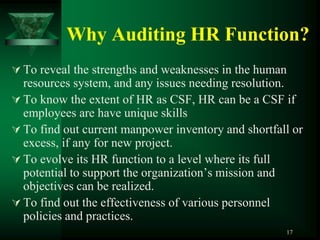
Why Auditing HR Function?
 To reveal the strengths and weaknesses in the human
  resources system, and any issues needing resolution.
 To know the extent of HR as CSF, HR can be a CSF if
  employees are have unique skills
 To find out current manpower inventory and shortfall or
  excess, if any for new project.
 To evolve its HR function to a level where its full
  potential to support the organization’s mission and
  objectives can be realized.
 To find out the effectiveness of various personnel
  policies and practices.
                                                     17
Approaches of HR Audit


   Legal Approach
 Functional Approach
  Strategic Approach


                        18
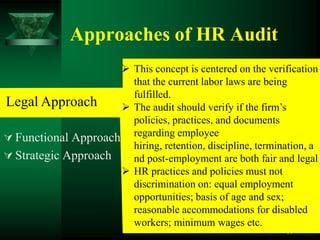
Approaches of HR Audit
                      This concept is centered on the verification
                       that the current labor laws are being
                       fulfilled.
Legal Approach        The audit should verify if the firm’s
                       policies, practices, and documents
 Functional Approach regarding employee
                       hiring, retention, discipline, termination, a
 Strategic Approach   nd post-employment are both fair and legal
                      HR practices and policies must not
                       discrimination on: equal employment
                       opportunities; basis of age and sex;
                       reasonable accommodations for disabled
                       workers; minimum wages etc.
                                                             19
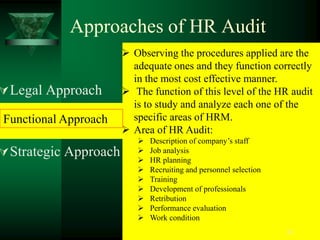
Approaches of HR Audit
                        Observing the procedures applied are the
                         adequate ones and they function correctly
                         in the most cost effective manner.
 Legal Approach        The function of this level of the HR audit
                         is to study and analyze each one of the
Functional Approach      specific areas of HRM.
                        Area of HR Audit:
                             Description of company’s staff
 Strategic Approach         Job analysis
                             HR planning
                             Recruiting and personnel selection
                             Training
                             Development of professionals
                             Retribution
                             Performance evaluation
                             Work condition
                                                                   20
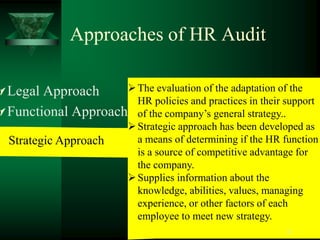
Approaches of HR Audit

 Legal Approach      The evaluation of the adaptation of the
                       HR policies and practices in their support
 Functional Approach of the company’s general strategy..
                      Strategic approach has been developed as
  Strategic Approach   a means of determining if the HR function
                       is a source of competitive advantage for
                       the company.
                      Supplies information about the
                       knowledge, abilities, values, managing
                       experience, or other factors of each
                       employee to meet new strategy.
                                                          21
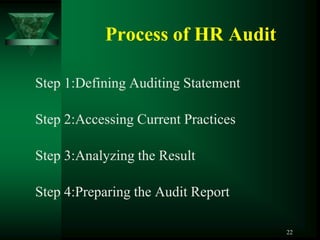
Process of HR Audit

Step 1:Defining Auditing Statement

Step 2:Accessing Current Practices

Step 3:Analyzing the Result

Step 4:Preparing the Audit Report

                                     22
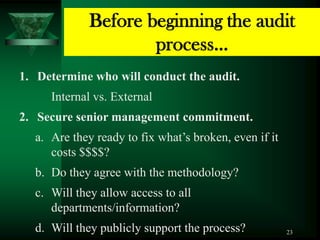
Before beginning the audit
                     process…
1. Determine who will conduct the audit.
     Internal vs. External
2. Secure senior management commitment.
  a. Are they ready to fix what’s broken, even if it
     costs $$$$?
  b. Do they agree with the methodology?
  c. Will they allow access to all
     departments/information?
  d. Will they publicly support the process?           23
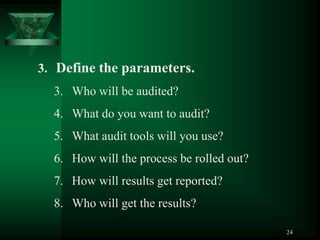
3. Define the parameters.
  3. Who will be audited?
  4. What do you want to audit?
  5. What audit tools will you use?
  6. How will the process be rolled out?
  7. How will results get reported?
  8. Who will get the results?

                                           24
4. Introduce the audit process to your
   managers.


                                         25
Step 1: Defining Audit
                  Statements
 Determine whether legal, functional or
  strategic audit.
 Determine the area of the HR audit where
  auditor wants to audit.
 Determining the every aspects of the each
  area (detailed)
 Areas like quality of lifecycle, team based
  work system and other contemporary issues
  on HR are should be considered              26
Step 2: Accessing Current
                  Practices
 It is much objective in nature
 Collection of data and information from
  current policies and procedures, employee
  surveys, interviews with key customers,
  Human Resource Information System,
  reports issued to regulatory departments,
  statistics, etc.
      But how to conduct ?
                                              27
Step 3: Analysis of Results

 The purpose of analysis is to sort through the areas
  of strength and opportunities for improvement in
  order to take positive action steps to improve the
  effectiveness of the HR function
 Examining different indices, ratios
 Finding out strength and weakness point and
  opportunity for improvements.


                                                 28
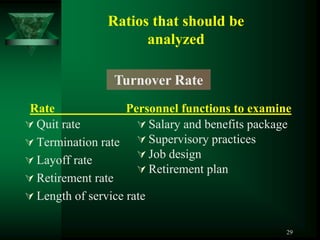
Ratios that should be
                     analyzed

                 Turnover Rate
 Rate               Personnel functions to examine
 Quit rate            Salary and benefits package
 Termination rate     Supervisory practices
                       Job design
 Layoff rate
                       Retirement plan
 Retirement rate
 Length of service rate


                                                  29
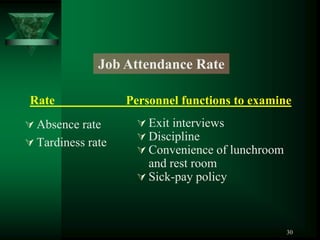
Job Attendance Rate

 Rate              Personnel functions to examine
 Absence rate       Exit interviews
                     Discipline
 Tardiness rate
                     Convenience of lunchroom
                      and rest room
                     Sick-pay policy


                                                 30
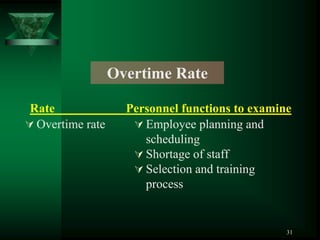
Overtime Rate

 Rate               Personnel functions to examine
 Overtime rate       Employee planning and
                       scheduling
                      Shortage of staff
                      Selection and training
                       process


                                                 31
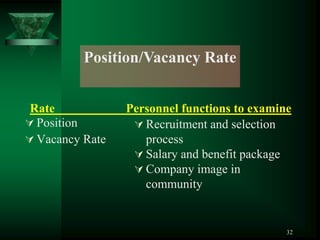
Position/Vacancy Rate


 Rate            Personnel functions to examine
 Position         Recruitment and selection
 Vacancy Rate      process
                   Salary and benefit package
                   Company image in
                    community


                                              32
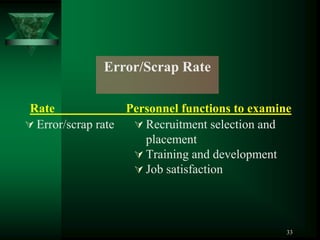
Error/Scrap Rate

 Rate              Personnel functions to examine
 Error/scrap rate   Recruitment selection and
                      placement
                     Training and development
                     Job satisfaction


                                                33
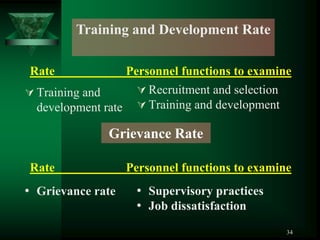
Training and Development Rate

Rate                 Personnel functions to examine
 Training and         Recruitment and selection
  development rate     Training and development

                 Grievance Rate

Rate                 Personnel functions to examine
• Grievance rate      • Supervisory practices
                      • Job dissatisfaction
                                                    34
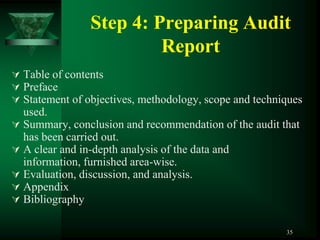
Step 4: Preparing Audit
                         Report
 Table of contents
 Preface
 Statement of objectives, methodology, scope and techniques
  used.
 Summary, conclusion and recommendation of the audit that
  has been carried out.
 A clear and in-depth analysis of the data and
  information, furnished area-wise.
 Evaluation, discussion, and analysis.
 Appendix
 Bibliography


                                                        35
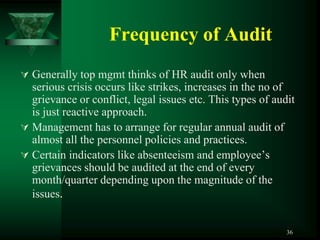
Frequency of Audit
 Generally top mgmt thinks of HR audit only when
  serious crisis occurs like strikes, increases in the no of
  grievance or conflict, legal issues etc. This types of audit
  is just reactive approach.
 Management has to arrange for regular annual audit of
  almost all the personnel policies and practices.
 Certain indicators like absenteeism and employee’s
  grievances should be audited at the end of every
  month/quarter depending upon the magnitude of the
  issues.


                                                            36
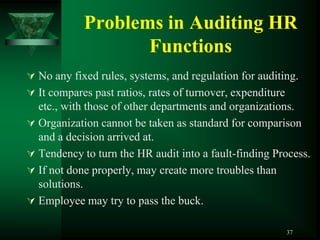
Problems in Auditing HR
                   Functions
 No any fixed rules, systems, and regulation for auditing.
 It compares past ratios, rates of turnover, expenditure
  etc., with those of other departments and organizations.
 Organization cannot be taken as standard for comparison
  and a decision arrived at.
 Tendency to turn the HR audit into a fault-finding Process.
 If not done properly, may create more troubles than
  solutions.
 Employee may try to pass the buck.

                                                            37
38
39
Prepared By:

   Tola Kanta Neupane
 MBA , 2nd semester, IB&MS


                             40

Human resource auditing

  • 1.
  • 2.
    Dimensions of HRAudit Human Resource HR Auditing 2
  • 3.
    Human Resource Information System (HRIS)  A method by which an Organization collects, analyses, and reports information about people and jobs.  An integration between IT System and HRM process.  Offers an adequate, comprehensive and on-going information system about people and jobs. 3
  • 4.
  • 5.
    HR Accounting  Firstdeveloped by Rensis Likert , and he pointed out that the expenses on human resource are fixed in nature and do not offer any immediate return.  According to Flamhotiz, “HRA is accounting for people as an organizational resource. It involves measuring the costs incurred by organization to recruit , select , hire, train and develop human assets. It also involves the measuring economic value of people to the organization.” 5
  • 6.
    Objectives of HRAccounting  Provide cost value information about acquiring, developing , allocating and maintaining human resources.  Enable management to effectively monitor the use of human resources.  Find whether human assets are appreciating or depreciating over a period of time.  Assist in development of effective management practices on the basis of financial consequences. 6
  • 7.
    Approaches of HRA  Monetary Measures  Non Monetary Measures 7
  • 8.
    Monetary Methods  Historicalcost method  Replacement cost method  Opportunity cost method  Economic value method  Assets multiplier method  Discounted present value of future earnings method Non-monetary Measures  Expected realizable value method 8
  • 9.
    Vr= How to Calculate the value of Manpower?  Lev and Schwartz model Vr= Where, Vr = the value of an Individual r year old. I(t)= the individual’s annual earnings up to retirement t = retirement age r= a discount rate specific to the cost of capital to the company 9
  • 10.
     Historical costmethod = Recruitment cost + selection cost + Orientation Costs + Training Costs + Development Costs Where, RC= Advertising, travel exp., consultant’s fee, incidental exp. SC= Form costs, testing and interview exp. and other Adm. exp. TC= Trainer’s salary, Facilities cost, trainee's time spent in the program measured financially, low productivity during training. DC= Costs incurred in enhancing employee skills and expertise. 10
  • 11.
    Controlling Cost of Manpower  Ratio Analysis – Cost per hire= – Recruitment Cycle time= Total time taken to recruit new employee – Turnover Rate= – Cost of Training= 11
  • 12.
     Personnel Productivity =  Management By Objectives  Finally Personnel budgets and Audit 12
  • 13.
  • 14.
    What is AUDIT?  Latin verb-audire-means-to listen  Listening implies an attempt to know the state of the affairs as they exist & as they are expected to exist 14
  • 15.
    AUDIT  An auditis an evaluation of a person, organization, system, process, proje ct or product. Audits are performed to ascertain the validity and reliability of information; also to provide an assessment of a system's internal control. 15
  • 16.
    What is HRaudit? An HR audit is a process to review implementation of policies, strategies, structure and procedures with respect to the organization's HRM, ensure compliance with employment law, eliminate liabilities (gap) , and educate the managers (feedback). 16
  • 17.
    Why Auditing HRFunction?  To reveal the strengths and weaknesses in the human resources system, and any issues needing resolution.  To know the extent of HR as CSF, HR can be a CSF if employees are have unique skills  To find out current manpower inventory and shortfall or excess, if any for new project.  To evolve its HR function to a level where its full potential to support the organization’s mission and objectives can be realized.  To find out the effectiveness of various personnel policies and practices. 17
  • 18.
    Approaches of HRAudit  Legal Approach  Functional Approach  Strategic Approach 18
  • 19.
    Approaches of HRAudit  This concept is centered on the verification that the current labor laws are being fulfilled. Legal Approach  The audit should verify if the firm’s policies, practices, and documents  Functional Approach regarding employee hiring, retention, discipline, termination, a  Strategic Approach nd post-employment are both fair and legal  HR practices and policies must not discrimination on: equal employment opportunities; basis of age and sex; reasonable accommodations for disabled workers; minimum wages etc. 19
  • 20.
    Approaches of HRAudit  Observing the procedures applied are the adequate ones and they function correctly in the most cost effective manner.  Legal Approach  The function of this level of the HR audit is to study and analyze each one of the Functional Approach specific areas of HRM.  Area of HR Audit:  Description of company’s staff  Strategic Approach  Job analysis  HR planning  Recruiting and personnel selection  Training  Development of professionals  Retribution  Performance evaluation  Work condition 20
  • 21.
    Approaches of HRAudit  Legal Approach  The evaluation of the adaptation of the HR policies and practices in their support  Functional Approach of the company’s general strategy..  Strategic approach has been developed as Strategic Approach a means of determining if the HR function is a source of competitive advantage for the company.  Supplies information about the knowledge, abilities, values, managing experience, or other factors of each employee to meet new strategy. 21
  • 22.
    Process of HRAudit Step 1:Defining Auditing Statement Step 2:Accessing Current Practices Step 3:Analyzing the Result Step 4:Preparing the Audit Report 22
  • 23.
    Before beginning theaudit process… 1. Determine who will conduct the audit. Internal vs. External 2. Secure senior management commitment. a. Are they ready to fix what’s broken, even if it costs $$$$? b. Do they agree with the methodology? c. Will they allow access to all departments/information? d. Will they publicly support the process? 23
  • 24.
    3. Define theparameters. 3. Who will be audited? 4. What do you want to audit? 5. What audit tools will you use? 6. How will the process be rolled out? 7. How will results get reported? 8. Who will get the results? 24
  • 25.
    4. Introduce theaudit process to your managers. 25
  • 26.
    Step 1: DefiningAudit Statements  Determine whether legal, functional or strategic audit.  Determine the area of the HR audit where auditor wants to audit.  Determining the every aspects of the each area (detailed)  Areas like quality of lifecycle, team based work system and other contemporary issues on HR are should be considered 26
  • 27.
    Step 2: AccessingCurrent Practices  It is much objective in nature  Collection of data and information from current policies and procedures, employee surveys, interviews with key customers, Human Resource Information System, reports issued to regulatory departments, statistics, etc. But how to conduct ? 27
  • 28.
    Step 3: Analysisof Results  The purpose of analysis is to sort through the areas of strength and opportunities for improvement in order to take positive action steps to improve the effectiveness of the HR function  Examining different indices, ratios  Finding out strength and weakness point and opportunity for improvements. 28
  • 29.
    Ratios that shouldbe analyzed Turnover Rate Rate Personnel functions to examine  Quit rate  Salary and benefits package  Termination rate  Supervisory practices  Job design  Layoff rate  Retirement plan  Retirement rate  Length of service rate 29
  • 30.
    Job Attendance Rate Rate Personnel functions to examine  Absence rate  Exit interviews  Discipline  Tardiness rate  Convenience of lunchroom and rest room  Sick-pay policy 30
  • 31.
    Overtime Rate Rate Personnel functions to examine  Overtime rate  Employee planning and scheduling  Shortage of staff  Selection and training process 31
  • 32.
    Position/Vacancy Rate Rate Personnel functions to examine  Position  Recruitment and selection  Vacancy Rate process  Salary and benefit package  Company image in community 32
  • 33.
    Error/Scrap Rate Rate Personnel functions to examine  Error/scrap rate  Recruitment selection and placement  Training and development  Job satisfaction 33
  • 34.
    Training and DevelopmentRate Rate Personnel functions to examine  Training and  Recruitment and selection development rate  Training and development Grievance Rate Rate Personnel functions to examine • Grievance rate • Supervisory practices • Job dissatisfaction 34
  • 35.
    Step 4: PreparingAudit Report  Table of contents  Preface  Statement of objectives, methodology, scope and techniques used.  Summary, conclusion and recommendation of the audit that has been carried out.  A clear and in-depth analysis of the data and information, furnished area-wise.  Evaluation, discussion, and analysis.  Appendix  Bibliography 35
  • 36.
    Frequency of Audit Generally top mgmt thinks of HR audit only when serious crisis occurs like strikes, increases in the no of grievance or conflict, legal issues etc. This types of audit is just reactive approach.  Management has to arrange for regular annual audit of almost all the personnel policies and practices.  Certain indicators like absenteeism and employee’s grievances should be audited at the end of every month/quarter depending upon the magnitude of the issues. 36
  • 37.
    Problems in AuditingHR Functions  No any fixed rules, systems, and regulation for auditing.  It compares past ratios, rates of turnover, expenditure etc., with those of other departments and organizations.  Organization cannot be taken as standard for comparison and a decision arrived at.  Tendency to turn the HR audit into a fault-finding Process.  If not done properly, may create more troubles than solutions.  Employee may try to pass the buck. 37
  • 38.
  • 39.
  • 40.
    Prepared By: Tola Kanta Neupane MBA , 2nd semester, IB&MS 40