5 activities of Information Resources Management (Willard – 1993) ; 
Identification: What information is there? How is it identified and coded? 
Ownership: Who is responsible for different information entities & coordination? 
Cost and Value: What is a basic model for making judgments on purchase and use? 
Development: How can we increase the value of information or stimulate demand? 
Exploitation: What is the best way to proactively maximize the value for money? 
KM Teaching Group - Universitas TELKOM 
17/12/2013 
2
The result of KM audit: 
Identification of core knowledge assets and flows—who creates, who uses. 
Identification of gaps in information and knowledge needed to manage the business effectively. 
Areas of information policy and ownership that need improving. 
Opportunities to reduce information-handling costs. 
Opportunities to improve coordination and access to commonly needed information. 
A clearer understanding of the contribution of knowledge to business results 
KM Teaching Group - Universitas TELKOM 
17/12/2013 
3
KM audit provides evidence-based information about current knowledge status (knowledge health). 
As a basis to set up new knowledge management program. 
KM audit function as a regular review and assessment of existing knowledge management practices in the company. 
KM audit must be focused on people 
Once the ―as is‖ portrait of the organization has been completed through information gathering and the knowledge audit, a gap analysis can be performed 
KM Teaching Group - Universitas TELKOM 
17/12/2013 
4
The difference between the organization‘s existing and desired KM state is analyzed in terms of enablers and barriers to successful KM implementation 
Gap analysis should consider these points ; 
What are the major differences between the current and desired KM 
states of the organization? 
List barriers to KM implementation (e.g., culture where ―knowledge is power‖ or where individual possession of knowledge is consistently rewarded). 
List KM leverage points or enablers (e.g., existing initiatives that could be built upon) 
KM Teaching Group - Universitas TELKOM 
17/12/2013 
5
Gap analysis should consider these points ; 
Identify opportunities to collaborate with other business initiatives (e.g., combine knowledge continuity goals with succession planning initiatives in Human Resources). 
Conduct a risk analysis (e.g., knowledge that will soon ―walk out the door‖ due to imminent retirements or knowledge that is at risk because only a few individuals are competent in this area and very little of their expertise exists in coded or tangible knowledge assets). 
Are there redundancies within the organization (e.g., the case of the right hand not knowing what the left hand is doing)? 
KM Teaching Group - Universitas TELKOM 
17/12/2013 
6
Gap analysis should consider these points ; 
Are there knowledge silos (e.g., groups, departments, or individuals that hoard knowledge or block fluid knowledge flows to other groups, departments, or colleagues)? 
How does the organization rank with respect to others within the industry? (e.g., are they early adopters of KM, KM leaders who are emulated by others, or are they just becoming aware of KM needs within their organization?) 
KM Teaching Group - Universitas TELKOM 
17/12/2013 
7
This analysis can then be used to list and prioritize KM objectives to be addressed by the organization. 
The results of the gap analysis should be validated by returning to the stakeholders who were initially involved in the information-gathering and needs analysis phases. 
The priorities should be determined by a consensus of the organization‘s key stakeholders. 
The result will be a KM strategy document that can be used as road map to implement KM within the organization. 
KM Teaching Group - Universitas TELKOM 
17/12/2013 
8
A knowledge audit, is a more of a qualitative evaluation. 
A sound investigation into an organization knowledge ‗health‘. KM audit will look at ; 
What are the organization‘s knowledge needs? 
What knowledge assets or resources does it have and where are they? 
What gaps exist in its knowledge? 
How does knowledge flow around the organization? 
What blockages are there to that flow (to what extent do its people, processes and technology currently support or hamper the effective flow of knowledge? 
17/12/2013 
KM Teaching Group - Universitas TELKOM 
9
The knowledge audit provides an evidence-based assessment of where the organisation needs to focus its knowledge management efforts. 
It can reveal the organization‘s knowledge management needs, strengths, weaknesses, opportunities, threats and risks. 
If properly done, it would provide accurate identification, quantification, measurement and assessment of the sum total of tacit and explicit knowledge in the organization (Ann Hylton, 2002) 
17/12/2013 
KM Teaching Group - Universitas TELKOM 
10
Knowledge audit may also identify the following (Wiig, 1993) : 
Information glut or scarcity 
Lack of awareness of information elsewhere in the organization 
Inability to keep relevant information 
Significant ‗reinventing‘ the wheel 
Common use of out of date information 
Not knowing where to go for expertise in a specific area 
(Knowledge Management Methods: Practical Approaches to Managing Knowledge) 
17/12/2013 
KM Teaching Group - Universitas TELKOM 
11
Knowledge audit is the process to identify 
Every knowledge produced by an organization, 
Who produce and use it, 
How frequent is the knowledge used, and 
Where is the knowledge stored 
17/12/2013 
KM Teaching Group - Universitas TELKOM 
12
KM Teaching Group - Universitas TELKOM 
17/12/2013 
13 
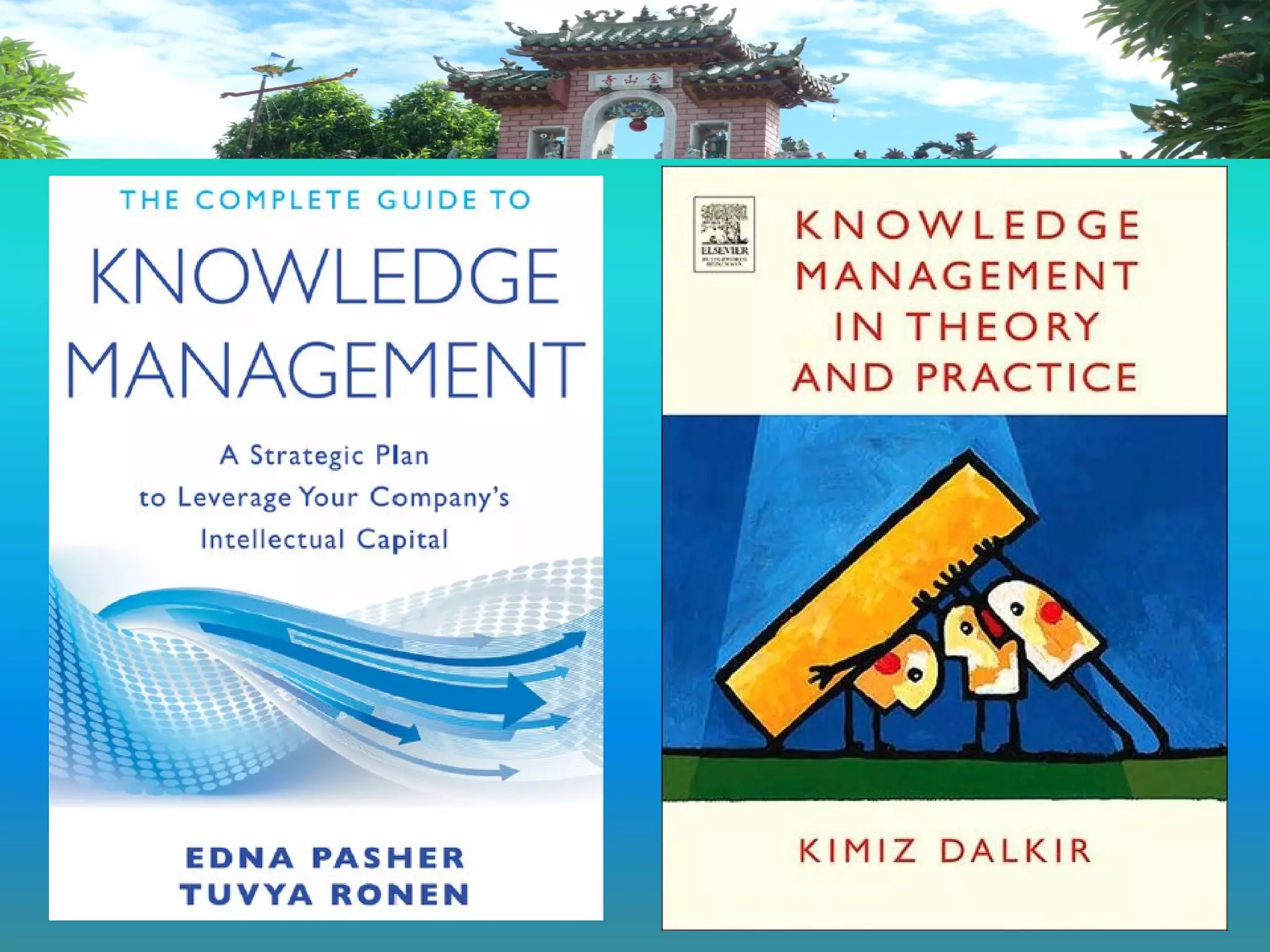
Assembly Hall, Hoi An Vietnam, 2012
Intellectual assets are intellectual materials that have been formalized, captured, and leveraged to produce higher value for the firm 
Intellectual asset classified as ; 
Body of tacit and explicit knowledge about a task, person, or organization. 
The capital resources (human, structural, and relational) that augment this body of knowledge. 
17/12/2013 
KM Teaching Group - Universitas TELKOM 
14
3 categories of knowledge assets (p. 267) 
Human Capital  brainpower that left after 5 pm 
Structural Capital  brainpower that stay after 5 pm (procedures, system, software, policies, patent) 
Customer Capital  relationship value (current & future) 
17/12/2013 
KM Teaching Group - Universitas TELKOM 
15
Organization can take inventories of the IC/IA, or even sell them (training, consultancies) 
Example of IA inventories ; 
Product formula 
Business plan 
Marketing strategies 
Vendor terms 
Employee lists 
Product composition 
New services process 
SWOT analysis 
17/12/2013 
KM Teaching Group - Universitas TELKOM 
16
4 dimensions of business that form Skandia Navigator model 
Financial focus, represented in monetary terms. 
Customer focus, a financial and nonfinancial measure of the value of customer capital. 
Process focus, address the effective use of technology within organization 
Renewal and development focus, attempts to capture the innovative capabilities of the organization. 
All related to human capital 
17/12/2013 
KM Teaching Group - Universitas TELKOM 
17
3 popular approach for measuring KM are ; 
Benchmarking 
Balance scorecard 
House of quality 
17/12/2013 
KM Teaching Group - Universitas TELKOM 
18
Originated from Xerox in 1970‘s, when it learn the logistic of LL Bean (p. 272) 
Learn from the best to become one 
Internal – comparison against other unit 
External – comparison with other companies/industries 
3 types of benchmarking (grasp the idea in p. 273) 
Industry group measurement 
Best practices studies 
Cooperative / collaborative benchmarking 
Competitive benchmarking 
17/12/2013 
KM Teaching Group - Universitas TELKOM 
19
Industry group measurement 
Measurement of various aspects of the operation and compare to similar industry measurements. 
Best practices studies 
Studies and lists of what works best. 
Useful to benchmarking research, but they are not useful as metrics. 
What works best for an entity in its specific environment may not work the same way in another environment. 
Book, consulting, research 
17/12/2013 
KM Teaching Group - Universitas TELKOM 
20
Cooperative benchmarking 
the measurement of key production functions of inputs, outputs, and outcomes with the aim of improving them. 
Performed with the assistance of the entity being studied (the benchmark ―partner‖). 
The entity selected as a benchmark must be the one that has ―best practices‖ in the area of interest or has won a major national or international quality award. 
Collaborative benchmarking 
Both entities study each other and work together to improve. 
17/12/2013 
KM Teaching Group - Universitas TELKOM 
21
Competitive benchmarking 
The study and measurement of a competitor without its cooperation for the purposes of process or product quality improvement. 
A version of competitive benchmarking is the commisioning of a third party to study a group of competitors and share the results. 
The third party consultant is might knows what data belong to which entity. 
17/12/2013 
KM Teaching Group - Universitas TELKOM 
22
Comparison with key leader in the industry to identify any best practices that can be applied in other organization 
Avoiding wheel reinventing, by looking at what has worked and what has not worked for other companies operating in comparable environments or industrial sectors 
Lack of sufficient value & flexibility in the future, leads to other measurement tools and techniques to measure the effectiveness of KM 
17/12/2013 
KM Teaching Group - Universitas TELKOM 
23
The key steps ; 
1.Determine what to benchmark: which knowledge processes, products, services? Why? With what scope? 
2.Form a benchmarking team. 
3.Select a benchmarking short list—which companies will you be benchmarking against? 
4.Collect and analyze data. 
5.Determine what changes should be made as a result of the metrics obtained 
6.Repeat when an appropriate amount of time has lapse to measure progress 
17/12/2013 
KM Teaching Group - Universitas TELKOM 
24
The potential benefit ; 
Overall productivity of knowledge investments. 
Service quality. 
Customer satisfaction and the operational level of customer service. 
Time to market in relation to other competitors. 
Costs, profits, and margins. 
Distribution. 
Relationships and relationship management. 
17/12/2013 
KM Teaching Group - Universitas TELKOM 
25
A measurement and management system that enable organization to clarify its vision & strategy, then translate them into action 
Provides feedback on both the internal business processes and external outcomes in order to continuously improve strategic performance and results. 
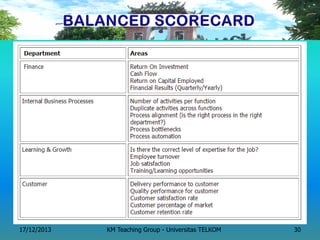
A conceptual framework for translating an organization‘s vision into a set of performance indicators distributed among four dimensions – Financial, Customer, Internal Business Process, Learning & Growth 
See p. 275 for the illustration of BSC 
17/12/2013 
KM Teaching Group - Universitas TELKOM 
26
17/12/2013 
KM Teaching Group - Universitas TELKOM 
27
The BSC keep the balance between ; 
Internal & external measures 
Objective & subjective measures 
Performance result & driver of the future results 
Financial indicator ; 
Operating income 
ROI 
Economic value added 
17/12/2013 
KM Teaching Group - Universitas TELKOM 
28
Customer indicator ; 
Satisfaction 
Retention 
Market share 
IBP indicator ; 
Cost and quality 
Time and resources 
L & G indicator ; 
Employee satisfaction & retention 
Skills set 
Career management 
17/12/2013 
KM Teaching Group - Universitas TELKOM 
29
17/12/2013 
KM Teaching Group - Universitas TELKOM 
30
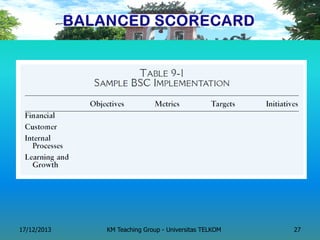
BSC can be expanded to include ; 
Objectives  the major goals to be achieved (e.g., profitable growth). 
Metrics  parameters that will be monitored in order to measure progress toward these stated goals (e.g., growth in net margin). 
Targets  specific thresholds to be met for each metric (e.g., 2% or greater growth in net margin). 
Initiatives  describe the actions, projects, programs, and so on to be put into place in order to be able to meet the stated goals. 
17/12/2013 
KM Teaching Group - Universitas TELKOM 
31
17/12/2013 
KM Teaching Group - Universitas TELKOM 
32
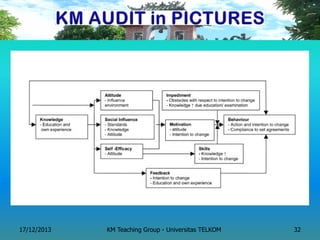
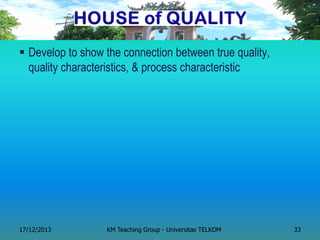
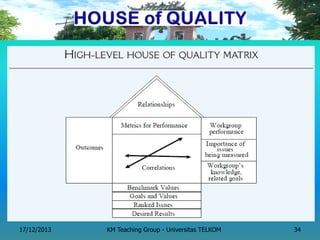
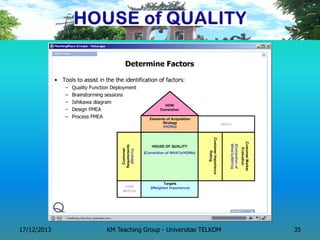
Develop to show the connection between true quality, quality characteristics, & process characteristic 
17/12/2013 
KM Teaching Group - Universitas TELKOM 
33
17/12/2013 
KM Teaching Group - Universitas TELKOM 
34
17/12/2013 
KM Teaching Group - Universitas TELKOM 
35

Knowledge Management Audit

  • 2.
    5 activities ofInformation Resources Management (Willard – 1993) ; Identification: What information is there? How is it identified and coded? Ownership: Who is responsible for different information entities & coordination? Cost and Value: What is a basic model for making judgments on purchase and use? Development: How can we increase the value of information or stimulate demand? Exploitation: What is the best way to proactively maximize the value for money? KM Teaching Group - Universitas TELKOM 17/12/2013 2
  • 3.
    The result ofKM audit: Identification of core knowledge assets and flows—who creates, who uses. Identification of gaps in information and knowledge needed to manage the business effectively. Areas of information policy and ownership that need improving. Opportunities to reduce information-handling costs. Opportunities to improve coordination and access to commonly needed information. A clearer understanding of the contribution of knowledge to business results KM Teaching Group - Universitas TELKOM 17/12/2013 3
  • 4.
    KM audit providesevidence-based information about current knowledge status (knowledge health). As a basis to set up new knowledge management program. KM audit function as a regular review and assessment of existing knowledge management practices in the company. KM audit must be focused on people Once the ―as is‖ portrait of the organization has been completed through information gathering and the knowledge audit, a gap analysis can be performed KM Teaching Group - Universitas TELKOM 17/12/2013 4
  • 5.
    The difference betweenthe organization‘s existing and desired KM state is analyzed in terms of enablers and barriers to successful KM implementation Gap analysis should consider these points ; What are the major differences between the current and desired KM states of the organization? List barriers to KM implementation (e.g., culture where ―knowledge is power‖ or where individual possession of knowledge is consistently rewarded). List KM leverage points or enablers (e.g., existing initiatives that could be built upon) KM Teaching Group - Universitas TELKOM 17/12/2013 5
  • 6.
    Gap analysis shouldconsider these points ; Identify opportunities to collaborate with other business initiatives (e.g., combine knowledge continuity goals with succession planning initiatives in Human Resources). Conduct a risk analysis (e.g., knowledge that will soon ―walk out the door‖ due to imminent retirements or knowledge that is at risk because only a few individuals are competent in this area and very little of their expertise exists in coded or tangible knowledge assets). Are there redundancies within the organization (e.g., the case of the right hand not knowing what the left hand is doing)? KM Teaching Group - Universitas TELKOM 17/12/2013 6
  • 7.
    Gap analysis shouldconsider these points ; Are there knowledge silos (e.g., groups, departments, or individuals that hoard knowledge or block fluid knowledge flows to other groups, departments, or colleagues)? How does the organization rank with respect to others within the industry? (e.g., are they early adopters of KM, KM leaders who are emulated by others, or are they just becoming aware of KM needs within their organization?) KM Teaching Group - Universitas TELKOM 17/12/2013 7
  • 8.
    This analysis canthen be used to list and prioritize KM objectives to be addressed by the organization. The results of the gap analysis should be validated by returning to the stakeholders who were initially involved in the information-gathering and needs analysis phases. The priorities should be determined by a consensus of the organization‘s key stakeholders. The result will be a KM strategy document that can be used as road map to implement KM within the organization. KM Teaching Group - Universitas TELKOM 17/12/2013 8
  • 9.
    A knowledge audit,is a more of a qualitative evaluation. A sound investigation into an organization knowledge ‗health‘. KM audit will look at ; What are the organization‘s knowledge needs? What knowledge assets or resources does it have and where are they? What gaps exist in its knowledge? How does knowledge flow around the organization? What blockages are there to that flow (to what extent do its people, processes and technology currently support or hamper the effective flow of knowledge? 17/12/2013 KM Teaching Group - Universitas TELKOM 9
  • 10.
    The knowledge auditprovides an evidence-based assessment of where the organisation needs to focus its knowledge management efforts. It can reveal the organization‘s knowledge management needs, strengths, weaknesses, opportunities, threats and risks. If properly done, it would provide accurate identification, quantification, measurement and assessment of the sum total of tacit and explicit knowledge in the organization (Ann Hylton, 2002) 17/12/2013 KM Teaching Group - Universitas TELKOM 10
  • 11.
    Knowledge audit mayalso identify the following (Wiig, 1993) : Information glut or scarcity Lack of awareness of information elsewhere in the organization Inability to keep relevant information Significant ‗reinventing‘ the wheel Common use of out of date information Not knowing where to go for expertise in a specific area (Knowledge Management Methods: Practical Approaches to Managing Knowledge) 17/12/2013 KM Teaching Group - Universitas TELKOM 11
  • 12.
    Knowledge audit isthe process to identify Every knowledge produced by an organization, Who produce and use it, How frequent is the knowledge used, and Where is the knowledge stored 17/12/2013 KM Teaching Group - Universitas TELKOM 12
  • 13.
    KM Teaching Group- Universitas TELKOM 17/12/2013 13 Assembly Hall, Hoi An Vietnam, 2012
  • 14.
    Intellectual assets areintellectual materials that have been formalized, captured, and leveraged to produce higher value for the firm Intellectual asset classified as ; Body of tacit and explicit knowledge about a task, person, or organization. The capital resources (human, structural, and relational) that augment this body of knowledge. 17/12/2013 KM Teaching Group - Universitas TELKOM 14
  • 15.
    3 categories ofknowledge assets (p. 267) Human Capital  brainpower that left after 5 pm Structural Capital  brainpower that stay after 5 pm (procedures, system, software, policies, patent) Customer Capital  relationship value (current & future) 17/12/2013 KM Teaching Group - Universitas TELKOM 15
  • 16.
    Organization can takeinventories of the IC/IA, or even sell them (training, consultancies) Example of IA inventories ; Product formula Business plan Marketing strategies Vendor terms Employee lists Product composition New services process SWOT analysis 17/12/2013 KM Teaching Group - Universitas TELKOM 16
  • 17.
    4 dimensions ofbusiness that form Skandia Navigator model Financial focus, represented in monetary terms. Customer focus, a financial and nonfinancial measure of the value of customer capital. Process focus, address the effective use of technology within organization Renewal and development focus, attempts to capture the innovative capabilities of the organization. All related to human capital 17/12/2013 KM Teaching Group - Universitas TELKOM 17
  • 18.
    3 popular approachfor measuring KM are ; Benchmarking Balance scorecard House of quality 17/12/2013 KM Teaching Group - Universitas TELKOM 18
  • 19.
    Originated from Xeroxin 1970‘s, when it learn the logistic of LL Bean (p. 272) Learn from the best to become one Internal – comparison against other unit External – comparison with other companies/industries 3 types of benchmarking (grasp the idea in p. 273) Industry group measurement Best practices studies Cooperative / collaborative benchmarking Competitive benchmarking 17/12/2013 KM Teaching Group - Universitas TELKOM 19
  • 20.
    Industry group measurement Measurement of various aspects of the operation and compare to similar industry measurements. Best practices studies Studies and lists of what works best. Useful to benchmarking research, but they are not useful as metrics. What works best for an entity in its specific environment may not work the same way in another environment. Book, consulting, research 17/12/2013 KM Teaching Group - Universitas TELKOM 20
  • 21.
    Cooperative benchmarking themeasurement of key production functions of inputs, outputs, and outcomes with the aim of improving them. Performed with the assistance of the entity being studied (the benchmark ―partner‖). The entity selected as a benchmark must be the one that has ―best practices‖ in the area of interest or has won a major national or international quality award. Collaborative benchmarking Both entities study each other and work together to improve. 17/12/2013 KM Teaching Group - Universitas TELKOM 21
  • 22.
    Competitive benchmarking Thestudy and measurement of a competitor without its cooperation for the purposes of process or product quality improvement. A version of competitive benchmarking is the commisioning of a third party to study a group of competitors and share the results. The third party consultant is might knows what data belong to which entity. 17/12/2013 KM Teaching Group - Universitas TELKOM 22
  • 23.
    Comparison with keyleader in the industry to identify any best practices that can be applied in other organization Avoiding wheel reinventing, by looking at what has worked and what has not worked for other companies operating in comparable environments or industrial sectors Lack of sufficient value & flexibility in the future, leads to other measurement tools and techniques to measure the effectiveness of KM 17/12/2013 KM Teaching Group - Universitas TELKOM 23
  • 24.
    The key steps; 1.Determine what to benchmark: which knowledge processes, products, services? Why? With what scope? 2.Form a benchmarking team. 3.Select a benchmarking short list—which companies will you be benchmarking against? 4.Collect and analyze data. 5.Determine what changes should be made as a result of the metrics obtained 6.Repeat when an appropriate amount of time has lapse to measure progress 17/12/2013 KM Teaching Group - Universitas TELKOM 24
  • 25.
    The potential benefit; Overall productivity of knowledge investments. Service quality. Customer satisfaction and the operational level of customer service. Time to market in relation to other competitors. Costs, profits, and margins. Distribution. Relationships and relationship management. 17/12/2013 KM Teaching Group - Universitas TELKOM 25
  • 26.
    A measurement andmanagement system that enable organization to clarify its vision & strategy, then translate them into action Provides feedback on both the internal business processes and external outcomes in order to continuously improve strategic performance and results. A conceptual framework for translating an organization‘s vision into a set of performance indicators distributed among four dimensions – Financial, Customer, Internal Business Process, Learning & Growth See p. 275 for the illustration of BSC 17/12/2013 KM Teaching Group - Universitas TELKOM 26
  • 27.
    17/12/2013 KM TeachingGroup - Universitas TELKOM 27
  • 28.
    The BSC keepthe balance between ; Internal & external measures Objective & subjective measures Performance result & driver of the future results Financial indicator ; Operating income ROI Economic value added 17/12/2013 KM Teaching Group - Universitas TELKOM 28
  • 29.
    Customer indicator ; Satisfaction Retention Market share IBP indicator ; Cost and quality Time and resources L & G indicator ; Employee satisfaction & retention Skills set Career management 17/12/2013 KM Teaching Group - Universitas TELKOM 29
  • 30.
    17/12/2013 KM TeachingGroup - Universitas TELKOM 30
  • 31.
    BSC can beexpanded to include ; Objectives  the major goals to be achieved (e.g., profitable growth). Metrics  parameters that will be monitored in order to measure progress toward these stated goals (e.g., growth in net margin). Targets  specific thresholds to be met for each metric (e.g., 2% or greater growth in net margin). Initiatives  describe the actions, projects, programs, and so on to be put into place in order to be able to meet the stated goals. 17/12/2013 KM Teaching Group - Universitas TELKOM 31
  • 32.
    17/12/2013 KM TeachingGroup - Universitas TELKOM 32
  • 33.
    Develop to showthe connection between true quality, quality characteristics, & process characteristic 17/12/2013 KM Teaching Group - Universitas TELKOM 33
  • 34.
    17/12/2013 KM TeachingGroup - Universitas TELKOM 34
  • 35.
    17/12/2013 KM TeachingGroup - Universitas TELKOM 35