Knowledge Management
 for the clusters’ success


     Thought-provoking
       KDRIK workshop
Székesfehérvár, 2012.october 1-2.


             Tibor Gyulay
• More than 25 years experience in
                 organization development and
Introduction     training market (BME
Tibor Gyulay     teacher, trainer, consultant, coach
                 )
               • Founder owner of POZITEAM
               • Focusing on KM during the last 5
                 years
               • Knoco Ltd. franchise partner
               • Successful KM projects
               • IAEA expert
               • Tudásmenedzsment és Innováció advantage!
                  KM: competitive
POZITEAM – KNOCO HUNGARY INTRODUCTION
•   25 years experience on the field of consultancy and
    organization development
        KNOWLEDGE MANAGEMENT!!!
•   2010: franchise contract, Knoco Ltd. (UK)
•   Profile: development, implementation and operation of
    knowledge management systems on both organizational
    and national (international) level
•   Wide range of KM training programs
•   Our most important references:
• Why is the KM important for
                          clusters?
The logical structure
of the day              • Experience sharing (teamwork)
                        • Introduction to KM
                        • Relationship between KM and
                          innovation
                        • KM in clusters
                        • Cluster Management’s tasks
                        • New community model of
                          developing KM
                        • Cluster Managers’ community of
                          practice: trying KM for their own
                          benefit.
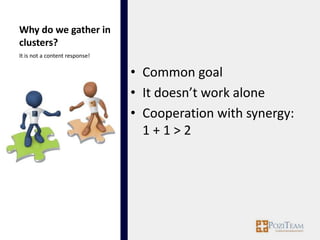
Why do we gather in
clusters?
It is not a content response!


                                • Common goal
                                • It doesn’t work alone
                                • Cooperation with synergy:
                                  1+1>2
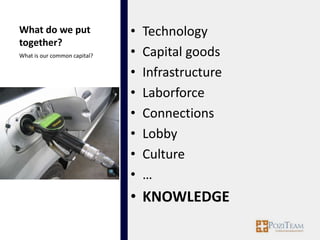
What do we put                •   Technology
together?
What is our common capital?   •   Capital goods
                              •   Infrastructure
                              •   Laborforce
                              •   Connections
                              •   Lobby
                              •   Culture
                              •   …
                              • KNOWLEDGE
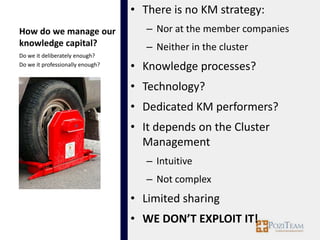
• There is no KM strategy:
How do we manage our                 – Nor at the member companies
knowledge capital?                   – Neither in the cluster
Do we it deliberately enough?
Do we it professionally enough?
                                  • Knowledge processes?
                                  • Technology?
                                  • Dedicated KM performers?
                                  • It depends on the Cluster
                                    Management
                                     – Intuitive
                                     – Not complex
                                  • Limited sharing
                                  • WE DON’T EXPLOIT IT!
Teamwork
Introduction to Knowledge Management
Sound familiar?
• ‘I’m sure I heard someone mention that to me the other day, now who
  was it?’
• ‘Someone must have done this before - but who?’
• When that guy left, he took all that knowledge with him.’
• ‘It was pure luck that I met Freddy – he had just the answer I was
  looking for”
• ‘That went very well – how do we repeat that success?’
• ‘We made this mistake in our other office too’

                       If only we all knew what we all knew,…
        If only we could find that knowledge when we needed it,…
                                If only we could never forget,…


     © Minden jog fenntartva.
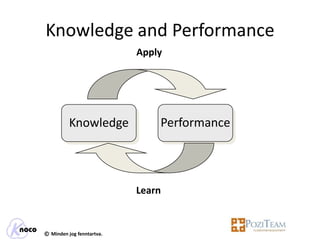
Knowledge and Performance
                           Apply


          Knowledge            Performance


                           Learn


© Minden jog fenntartva.
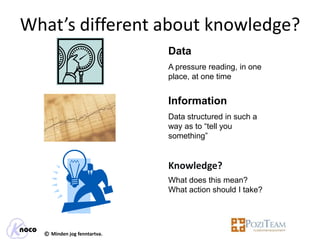
What’s different about knowledge?
                             Data
                             A pressure reading, in one
                             place, at one time


                             Information
                             Data structured in such a
                             way as to “tell you
                             something”


                             Knowledge?
                             What does this mean?
                             What action should I take?


  © Minden jog fenntartva.
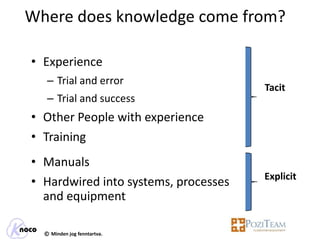
Where does knowledge come from?

• Experience
   – Trial and error
                                      Tacit
   – Trial and success
• Other People with experience
• Training
• Manuals
                                      Explicit
• Hardwired into systems, processes
  and equipment

  © Minden jog fenntartva.
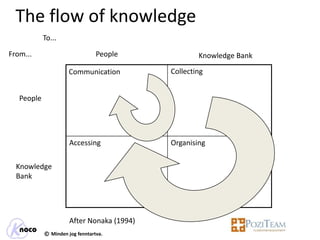
The flow of knowledge
            To...

From...                          People             Knowledge Bank

                      Communication         Collecting


   People


                      Accessing             Organising

  Knowledge
  Bank


                      After Nonaka (1994)
            © Minden jog fenntartva.
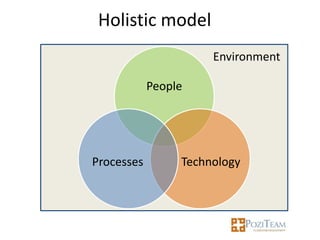
Holistic model
                      Environment

            People


Processes        Technology
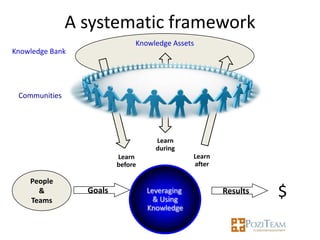
A systematic framework
                              Knowledge Assets
Knowledge Bank


 Communities


                                    Learn
                                    during
                         Learn                 Learn
                         before                after

    People
      &
    Teams
                 Goals            Leveraging
                                    & Using
                                                       Results   $
                                  Knowledge
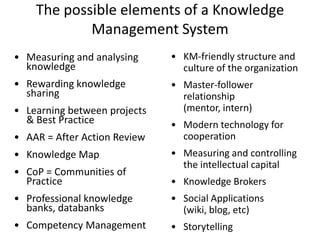
The possible elements of a Knowledge
            Management System
• Measuring and analysing     • KM-friendly structure and
  knowledge                     culture of the organization
• Rewarding knowledge         • Master-follower
  sharing                       relationship
• Learning between projects     (mentor, intern)
  & Best Practice             • Modern technology for
• AAR = After Action Review     cooperation
• Knowledge Map               • Measuring and controlling
                                the intellectual capital
• CoP = Communities of
  Practice                    • Knowledge Brokers
• Professional knowledge      • Social Applications
  banks, databanks              (wiki, blog, etc)
• Competency Management       • Storytelling
Knowledge Management
    and Innovation


 Tibor Gyulay, POZITEAM – Knoco Hungary
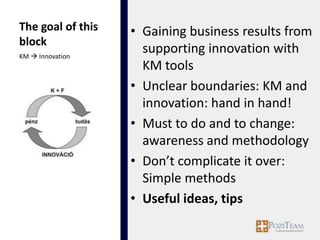
The goal of this   • Gaining business results from
block
KM  Innovation
                     supporting innovation with
                     KM tools
                   • Unclear boundaries: KM and
                     innovation: hand in hand!
                   • Must to do and to change:
                     awareness and methodology
                   • Don’t complicate it over:
                     Simple methods
                   • Useful ideas, tips
Relationship between
Knowledge Management         •   Knowledge  Performance
and Innovation               •   New Knowledge  Innovation
Awareness of KM  growing
organizational creativity.
                             •   Knowledge sharing culture
Unclearness? It doesn’t
matter!
                             •   KM techniques, tools
                             •   Fitting in process
                             •   Technologies
                             •   „Reinvent the wheel"
                             •   Innovation Management as
                                 an important knowledge
Techniques
suggested by Knoco
What is out of the training


                              • Business Driven Action
                                Learning
                              • Action learning teams
                              • Technical barrier
• Business Driven Action Learning
KM tools in the              • Action learning teams
Innovation Process           • Technical barrier
Awareness of KM  growing
organizational creativity.   • Knowledge Map
With simple tools            • Knowledge sharing forums
                             • Idea management
                             • Communities of prectice
                             • Talent management
                             • Web2 technologies
                             • Knowledge sharing
                               culture, motivation
                             • Innovation as an important
                               knowledge content!
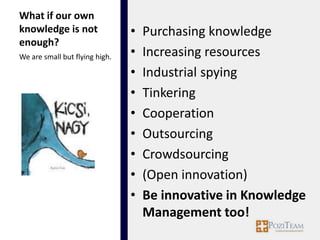
What if our own
knowledge is not                •   Purchasing knowledge
enough?
We are small but flying high.   •   Increasing resources
                                •   Industrial spying
                                •   Tinkering
                                •   Cooperation
                                •   Outsourcing
                                •   Crowdsourcing
                                •   (Open innovation)
                                •   Be innovative in Knowledge
                                    Management too!
Knowledge Management in Clusters
Do we need this?
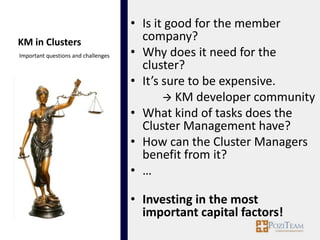
• Is it good for the member
KM in Clusters                         company?
Important questions and challenges   • Why does it need for the
                                       cluster?
                                     • It’s sure to be expensive.
                                             KM developer community
                                     • What kind of tasks does the
                                       Cluster Management have?
                                     • How can the Cluster Managers
                                       benefit from it?
                                     • …

                                     • Investing in the most
                                       important capital factors!
Benefit for the member companies derived
      from Knowledge Management
• More efficient operating
   - Better decisions, faster work
   - Less error
   - Less time for searching the appropriate knowledge
• More innovative organization
   - Knowledge integration, creativity
   - Knowledge sharing culture
• Reducing the risk of losing knowledge
   - Awareness in managing the key knowledge and key people
   - Building experiences in the operation
   - Knowledge of the organization > knowledge of the individuals
• More committed and more motivated staff
• Quick return!
Benefit for the Cluster derived from KM
• Synergy of the member companies’ knowledge
   - Learn from each other
   - Creative knowledge combinations
   - Inspiring knowledge sharing
• Common developments
   - Product,
   - Technology
   - …
• Networking relations intensify
   - Professional confidence
   - Community
• Achiving profesionally one of the cluster’s basic goals.
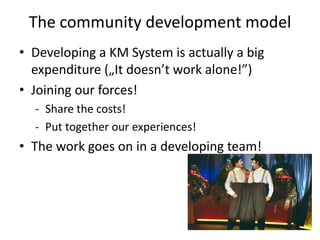
The community development model
• Developing a KM System is actually a big
  expenditure („It doesn’t work alone!”)
• Joining our forces!
  - Share the costs!
  - Put together our experiences!
• The work goes on in a developing team!
How does the developing team work?
          (first 6 months)
Executive informative meeting for the inquiring companies.
Kick off meeting for the participants („Contracting”, getting know
each other, scheduling the program)
2 days knowledge management training
 o   Conceptual basis of the KM
 o   Own experience exercises for learning the importance of knowledge sharing
 o   Casestudies, succes stories
 o   Methodological guidance
 o   Planning KMS implementation for each organization
Regular team meeting (8-10 times)
Communication, knowledge and experiance sharing (web2)
Personal consultant meetings (4x2 hours)
Consultant support for auditing the KM maturity of the
company by an online survey
Outputs of the 1st development stage
             (6 months)
 Prepared, comitted „champions”
 Exact picture of the actual KM situation at the
 company
  Existing strengths and developing areas of the KMS
  Risks of losing knowledge
 Development proposal for KMS
  Where is it worth for intervention?
  How does this investment return?
 Realized quick win actions, started (completed) pilot
 projects  Demonstrable results!!!

 Proposal for developing the cluster’s KM activities
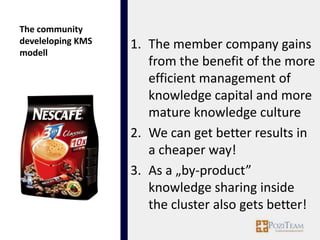
The community
develeloping KMS   1. The member company gains
modell
                      from the benefit of the more
                      efficient management of
                      knowledge capital and more
                      mature knowledge culture
                   2. We can get better results in
                      a cheaper way!
                   3. As a „by-product”
                      knowledge sharing inside
                      the cluster also gets better!
Tasks of the Cluster Management in
      the Knowledge Management
• Recognise the exact opportunities where KM can help to achieve
  the cluster’s goals.
• Agree with the member companies on the KM goals and the
  intergation level of the KM Systems.
• Integrate the knowledge processes into the cluster’s operation.
• Build up the cluster’s knowledge sharing technology (SharePoint?).
• Determine the KM roles and prepare the members.
• The implementation of the KMS for the cluster.
• Bulid up a supportive and inspiring culture of knowledge sharing.
• The operation and continuous development of the KMS.
Cluster Managers’             • Why now do we speak about
Community of Practice
How can we benefit from the
                                this?
Knowledge Management
personally?
                              • What are the Communities of
                                Practice?
                              • How could the CoP of CM
                                work?
                              • What can the POZITEAM –
                                Knoco Hungary add to this?
                              • Next steps
The relevance of the Topic
• 13 personal interview with the organizations of the Cluster
  Management
    The proficiency level of the Cluster Management has a key role
     in the success of the cluster.
    Great experiance has been collected during the last time.
    The majority would be happy if they can share their knowledge
     with other Cluster Managers.
• There is a very low proportion of clusters working well.
• The MAG Zrt. has also recognised the neccesity of the
  communication between Cluster Managers.
• Teh efficiency of knowledge transfer and the sustainability
  of the community can be raised by the state-of-the-art KM
  techniquies.
What are the Communities of
               Practice?
- Group of people with common professional
  interest
- The main target is personal learning
- Knowledge transfer (personal meetings and
  knowledge sharing platforms)
What can POZITEAM add to this?
• Participation in the process of preparing the program, forming the
  conception and buliding up the operatioanl model.
• Moderator role in launhing the community – organising and
  moderate the start occasion after our ‚Community launch’ training
  worked out especially for this purpose
• Work out the requirements on a knowledge sharing platform and
  support the implementation (or maybe managing the entire build-
  up and launch process).
• Consultative support of the operative organizer team and the core
  of the community (until the operation stabilizes).
• Methodological support at the knowledge sharing events or the
  moderation of it if it is neccesary.
• Work out the suggestions for developing the community according
  to the operatioanl experiences.
Next steps
• Involve the critical mass (10-12 people) in the
  conception.
• Work out the starting conception
• Aquire the support of MAG Zrt.
• Organize the launch meeting
• Examine the support possibilities
• Launch the communication and knowledge
  sharing platform
• Community launch meeting
• Successful CoP

Innoskart ws 121001 eng2

  • 1.
    Knowledge Management forthe clusters’ success Thought-provoking KDRIK workshop Székesfehérvár, 2012.october 1-2. Tibor Gyulay
  • 2.
    • More than25 years experience in organization development and Introduction training market (BME Tibor Gyulay teacher, trainer, consultant, coach ) • Founder owner of POZITEAM • Focusing on KM during the last 5 years • Knoco Ltd. franchise partner • Successful KM projects • IAEA expert • Tudásmenedzsment és Innováció advantage! KM: competitive
  • 3.
    POZITEAM – KNOCOHUNGARY INTRODUCTION • 25 years experience on the field of consultancy and organization development  KNOWLEDGE MANAGEMENT!!! • 2010: franchise contract, Knoco Ltd. (UK) • Profile: development, implementation and operation of knowledge management systems on both organizational and national (international) level • Wide range of KM training programs • Our most important references:
  • 4.
    • Why isthe KM important for clusters? The logical structure of the day • Experience sharing (teamwork) • Introduction to KM • Relationship between KM and innovation • KM in clusters • Cluster Management’s tasks • New community model of developing KM • Cluster Managers’ community of practice: trying KM for their own benefit.
  • 5.
    Why do wegather in clusters? It is not a content response! • Common goal • It doesn’t work alone • Cooperation with synergy: 1+1>2
  • 6.
    What do weput • Technology together? What is our common capital? • Capital goods • Infrastructure • Laborforce • Connections • Lobby • Culture • … • KNOWLEDGE
  • 7.
    • There isno KM strategy: How do we manage our – Nor at the member companies knowledge capital? – Neither in the cluster Do we it deliberately enough? Do we it professionally enough? • Knowledge processes? • Technology? • Dedicated KM performers? • It depends on the Cluster Management – Intuitive – Not complex • Limited sharing • WE DON’T EXPLOIT IT!
  • 8.
  • 9.
  • 10.
    Sound familiar? • ‘I’msure I heard someone mention that to me the other day, now who was it?’ • ‘Someone must have done this before - but who?’ • When that guy left, he took all that knowledge with him.’ • ‘It was pure luck that I met Freddy – he had just the answer I was looking for” • ‘That went very well – how do we repeat that success?’ • ‘We made this mistake in our other office too’ If only we all knew what we all knew,… If only we could find that knowledge when we needed it,… If only we could never forget,… © Minden jog fenntartva.
  • 11.
    Knowledge and Performance Apply Knowledge Performance Learn © Minden jog fenntartva.
  • 12.
    What’s different aboutknowledge? Data A pressure reading, in one place, at one time Information Data structured in such a way as to “tell you something” Knowledge? What does this mean? What action should I take? © Minden jog fenntartva.
  • 13.
    Where does knowledgecome from? • Experience – Trial and error Tacit – Trial and success • Other People with experience • Training • Manuals Explicit • Hardwired into systems, processes and equipment © Minden jog fenntartva.
  • 14.
    The flow ofknowledge To... From... People Knowledge Bank Communication Collecting People Accessing Organising Knowledge Bank After Nonaka (1994) © Minden jog fenntartva.
  • 15.
    Holistic model Environment People Processes Technology
  • 16.
    A systematic framework Knowledge Assets Knowledge Bank Communities Learn during Learn Learn before after People & Teams Goals Leveraging & Using Results $ Knowledge
  • 17.
    The possible elementsof a Knowledge Management System • Measuring and analysing • KM-friendly structure and knowledge culture of the organization • Rewarding knowledge • Master-follower sharing relationship • Learning between projects (mentor, intern) & Best Practice • Modern technology for • AAR = After Action Review cooperation • Knowledge Map • Measuring and controlling the intellectual capital • CoP = Communities of Practice • Knowledge Brokers • Professional knowledge • Social Applications banks, databanks (wiki, blog, etc) • Competency Management • Storytelling
  • 18.
    Knowledge Management and Innovation Tibor Gyulay, POZITEAM – Knoco Hungary
  • 19.
    The goal ofthis • Gaining business results from block KM  Innovation supporting innovation with KM tools • Unclear boundaries: KM and innovation: hand in hand! • Must to do and to change: awareness and methodology • Don’t complicate it over: Simple methods • Useful ideas, tips
  • 20.
    Relationship between Knowledge Management • Knowledge  Performance and Innovation • New Knowledge  Innovation Awareness of KM  growing organizational creativity. • Knowledge sharing culture Unclearness? It doesn’t matter! • KM techniques, tools • Fitting in process • Technologies • „Reinvent the wheel" • Innovation Management as an important knowledge
  • 21.
    Techniques suggested by Knoco Whatis out of the training • Business Driven Action Learning • Action learning teams • Technical barrier
  • 22.
    • Business DrivenAction Learning KM tools in the • Action learning teams Innovation Process • Technical barrier Awareness of KM  growing organizational creativity. • Knowledge Map With simple tools • Knowledge sharing forums • Idea management • Communities of prectice • Talent management • Web2 technologies • Knowledge sharing culture, motivation • Innovation as an important knowledge content!
  • 23.
    What if ourown knowledge is not • Purchasing knowledge enough? We are small but flying high. • Increasing resources • Industrial spying • Tinkering • Cooperation • Outsourcing • Crowdsourcing • (Open innovation) • Be innovative in Knowledge Management too!
  • 24.
  • 25.
  • 26.
    • Is itgood for the member KM in Clusters company? Important questions and challenges • Why does it need for the cluster? • It’s sure to be expensive.  KM developer community • What kind of tasks does the Cluster Management have? • How can the Cluster Managers benefit from it? • … • Investing in the most important capital factors!
  • 27.
    Benefit for themember companies derived from Knowledge Management • More efficient operating - Better decisions, faster work - Less error - Less time for searching the appropriate knowledge • More innovative organization - Knowledge integration, creativity - Knowledge sharing culture • Reducing the risk of losing knowledge - Awareness in managing the key knowledge and key people - Building experiences in the operation - Knowledge of the organization > knowledge of the individuals • More committed and more motivated staff • Quick return!
  • 28.
    Benefit for theCluster derived from KM • Synergy of the member companies’ knowledge - Learn from each other - Creative knowledge combinations - Inspiring knowledge sharing • Common developments - Product, - Technology - … • Networking relations intensify - Professional confidence - Community • Achiving profesionally one of the cluster’s basic goals.
  • 29.
    The community developmentmodel • Developing a KM System is actually a big expenditure („It doesn’t work alone!”) • Joining our forces! - Share the costs! - Put together our experiences! • The work goes on in a developing team!
  • 30.
    How does thedeveloping team work? (first 6 months) Executive informative meeting for the inquiring companies. Kick off meeting for the participants („Contracting”, getting know each other, scheduling the program) 2 days knowledge management training o Conceptual basis of the KM o Own experience exercises for learning the importance of knowledge sharing o Casestudies, succes stories o Methodological guidance o Planning KMS implementation for each organization Regular team meeting (8-10 times) Communication, knowledge and experiance sharing (web2) Personal consultant meetings (4x2 hours) Consultant support for auditing the KM maturity of the company by an online survey
  • 31.
    Outputs of the1st development stage (6 months) Prepared, comitted „champions” Exact picture of the actual KM situation at the company  Existing strengths and developing areas of the KMS  Risks of losing knowledge Development proposal for KMS  Where is it worth for intervention?  How does this investment return? Realized quick win actions, started (completed) pilot projects  Demonstrable results!!! Proposal for developing the cluster’s KM activities
  • 32.
    The community develeloping KMS 1. The member company gains modell from the benefit of the more efficient management of knowledge capital and more mature knowledge culture 2. We can get better results in a cheaper way! 3. As a „by-product” knowledge sharing inside the cluster also gets better!
  • 33.
    Tasks of theCluster Management in the Knowledge Management • Recognise the exact opportunities where KM can help to achieve the cluster’s goals. • Agree with the member companies on the KM goals and the intergation level of the KM Systems. • Integrate the knowledge processes into the cluster’s operation. • Build up the cluster’s knowledge sharing technology (SharePoint?). • Determine the KM roles and prepare the members. • The implementation of the KMS for the cluster. • Bulid up a supportive and inspiring culture of knowledge sharing. • The operation and continuous development of the KMS.
  • 34.
    Cluster Managers’ • Why now do we speak about Community of Practice How can we benefit from the this? Knowledge Management personally? • What are the Communities of Practice? • How could the CoP of CM work? • What can the POZITEAM – Knoco Hungary add to this? • Next steps
  • 35.
    The relevance ofthe Topic • 13 personal interview with the organizations of the Cluster Management  The proficiency level of the Cluster Management has a key role in the success of the cluster.  Great experiance has been collected during the last time.  The majority would be happy if they can share their knowledge with other Cluster Managers. • There is a very low proportion of clusters working well. • The MAG Zrt. has also recognised the neccesity of the communication between Cluster Managers. • Teh efficiency of knowledge transfer and the sustainability of the community can be raised by the state-of-the-art KM techniquies.
  • 36.
    What are theCommunities of Practice? - Group of people with common professional interest - The main target is personal learning - Knowledge transfer (personal meetings and knowledge sharing platforms)
  • 37.
    What can POZITEAMadd to this? • Participation in the process of preparing the program, forming the conception and buliding up the operatioanl model. • Moderator role in launhing the community – organising and moderate the start occasion after our ‚Community launch’ training worked out especially for this purpose • Work out the requirements on a knowledge sharing platform and support the implementation (or maybe managing the entire build- up and launch process). • Consultative support of the operative organizer team and the core of the community (until the operation stabilizes). • Methodological support at the knowledge sharing events or the moderation of it if it is neccesary. • Work out the suggestions for developing the community according to the operatioanl experiences.
  • 38.
    Next steps • Involvethe critical mass (10-12 people) in the conception. • Work out the starting conception • Aquire the support of MAG Zrt. • Organize the launch meeting • Examine the support possibilities • Launch the communication and knowledge sharing platform • Community launch meeting • Successful CoP

Editor's Notes

  • #12 Ez a kapcsolat a tudás és teljesítmény között alapvető a tudásmenedzsment számáraMinél többet tudunk, annál jobban teljesítünk, ha meg tudjuk találni a tudásunkat Minél többet tanulnunk saját teljesítményünkből, annál többet fogunk tudniEz egy önmagát erősítő körbe tesz minket – egy folyamatos fejlődési szakaszba – amely által folyamatosan fejlődik a tudásunk, javítva a teljesítményünket is TM, a legegyszerűbben nézve, biztosítja, hogy ez a kör bezároljon, szisztematikusan és menedzselt módon
  • #13 Egészen alapszinten kell kezdenünk és megkülönböztetnünk a tudást az adattól és információtól. A 3 hasonló, összekapcsolódott, mégsem ugyanaz és máshogy kell őket kezelni is. A definíciók használata helyett, inkább hadd mondjuk el egy történettel. Sztori; Egy gyárban vagy és kibetűzöl egy nyomásmérő eszközt egy csövön. Azt látod rajta, hogy 25,000 psi, és péntek 5 óra van. Ez adat: nyomás, hely, idő. Bemész az ellenőrző szobába és megnézed a nyomástervét a csőnek és azt találod, hogy a nyomás gyorsan emelkedik. Ez már információ – valami történik! Kérdezd meg a résztvevőket: „Milyen tudásra van most szükségünk?” Írd a válaszaikat egy flipchartra. Kezdetben azt mondják majd, „tudnunk kell, a csőben milyenre értékeljük a nyomást”; „ez normális-e”; „hol van a vészkijárat” stb. de kérdezgesd tovább, míg valaki azt nem mondja „tudnunk kell, mit kell tegyünk”. Mondd, hogy igen és mutass rá, hogy a többi tudás (hogy ez normális-e stb.) olyan dolgok, amiket tudnod kell, de azért, hogy tudd, mit kell tenned. A hasznos tudás az, ami segít meghoznia jó döntést. A történet megmutatja, hogy szükség van adatra és információra, de a tudás valami extrát ad hozzá, nevezetesen a képességet a jó döntés meghozásához. Állj meg és kérdezd meg, van-e ennek az illusztrálásnak szerintük értelme.
  • #14 Most kérdezd meg, mielőtt animálod a slide-ot, honnan jöhet a tudás. Írd a válaszaikat egy flipchartra. Ha befejezték, mutasd meg a válaszokat és mutasd meg a tudás két fajtáját. (plusz a 3-at, a struktúrákba ágyazott tudást)