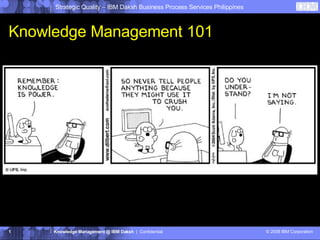
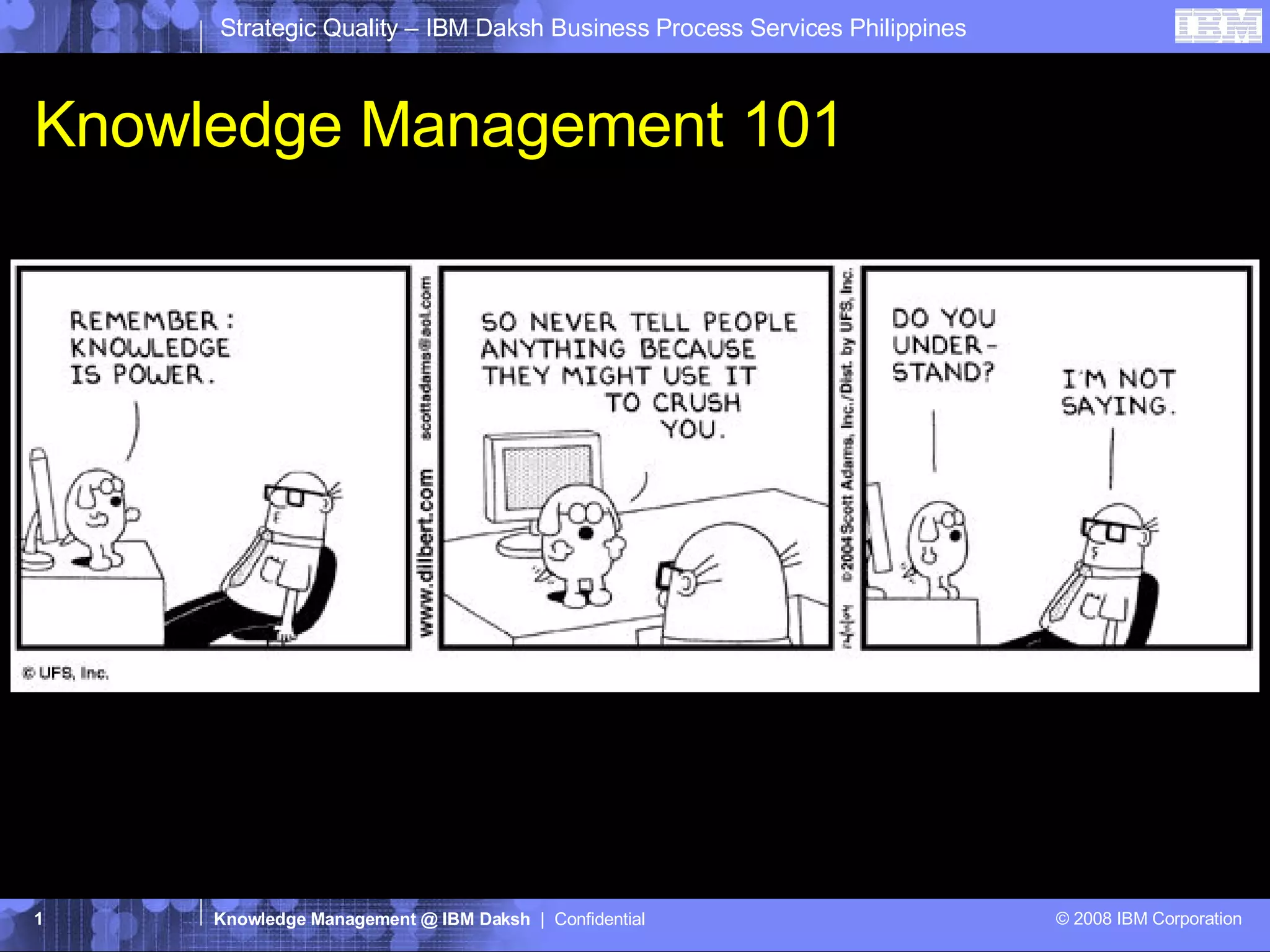
Knowledge Management 101 Strategic Quality – IBM Daksh Business Process Services Philippines Knowledge Management @ IBM Daksh   |  Confidential © 2008 IBM Corporation
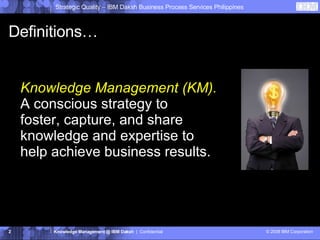
Definitions… Knowledge.   Information in action!  The mental capacity to produce results (e.g., solve a customer’s problem, make business decisions, etc.). Management.   The act or art of directing or controlling. Strategic Quality – IBM Daksh Business Process Services Philippines Knowledge Management @ IBM Daksh   |  Confidential © 2008 IBM Corporation Knowledge Management (KM).  A conscious strategy to foster, capture, and share  knowledge and expertise to help achieve business results.
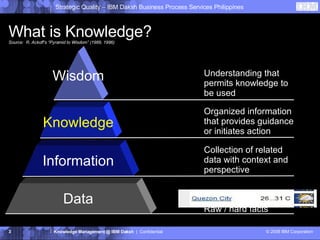
What is Knowledge? Source:  R. Ackoff’s “Pyramid to Wisdom” (1989, 1996) Data Information Knowledge Wisdom Strategic Quality – IBM Daksh Business Process Services Philippines Knowledge Management @ IBM Daksh   |  Confidential © 2008 IBM Corporation Raw / hard facts Collection of related data with context and perspective Organized information that provides guidance or initiates action Understanding that permits knowledge to be used
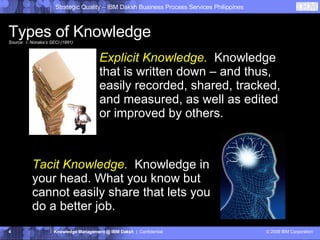
Types of Knowledge Source:  I. Nonaka’s SECI (1991) Explicit Knowledge.   Knowledge that is written down – and thus, easily recorded, shared, tracked, and measured, as well as edited or improved by others.  Strategic Quality – IBM Daksh Business Process Services Philippines Knowledge Management @ IBM Daksh   |  Confidential © 2008 IBM Corporation Tacit Knowledge.   Knowledge in your head. What you know but cannot easily share that lets you do a better job.
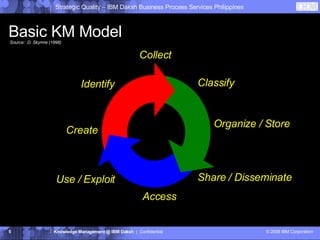
Basic KM Model   Source:  D. Skyrme (1998) Strategic Quality – IBM Daksh Business Process Services Philippines Knowledge Management @ IBM Daksh   |  Confidential © 2008 IBM Corporation Create Identify Classify Access Use / Exploit Collect Organize / Store Share / Disseminate
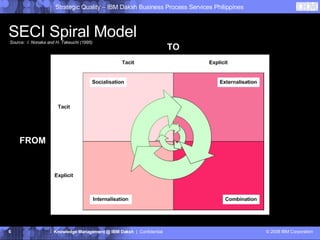
SECI Spiral Model   Source:  I. Nonaka and H. Takeuchi (1995) Strategic Quality – IBM Daksh Business Process Services Philippines Knowledge Management @ IBM Daksh   |  Confidential © 2008 IBM Corporation FROM TO
SECI Spiral Model   Source:  I. Nonaka and H. Takeuchi (1995) Strategic Quality – IBM Daksh Business Process Services Philippines Knowledge Management @ IBM Daksh   |  Confidential © 2008 IBM Corporation
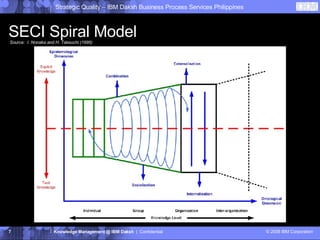
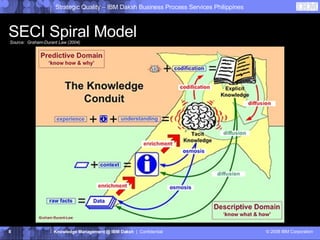
SECI Spiral Model   Source:  Graham-Durant Law (2004) Strategic Quality – IBM Daksh Business Process Services Philippines Knowledge Management @ IBM Daksh   |  Confidential © 2008 IBM Corporation
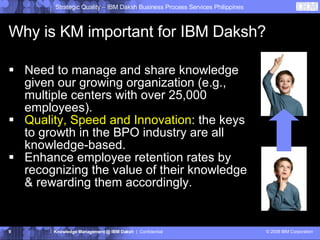
Why is KM important for IBM Daksh? Need to manage and share knowledge given our growing organization (e.g., multiple centers with over 25,000 employees). Quality, Speed and Innovation : the keys to growth in the BPO industry are all knowledge-based. Enhance employee retention rates by recognizing the value of their knowledge  & rewarding them accordingly. Strategic Quality – IBM Daksh Business Process Services Philippines Knowledge Management @ IBM Daksh   |  Confidential © 2008 IBM Corporation
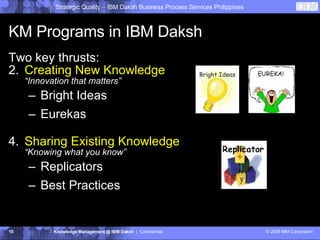
KM Programs in IBM Daksh Two key thrusts: Creating New Knowledge “Innovation that matters” Bright Ideas Eurekas Sharing Existing Knowledge “Knowing what you know” Replicators Best Practices Strategic Quality – IBM Daksh Business Process Services Philippines Knowledge Management @ IBM Daksh   |  Confidential © 2008 IBM Corporation
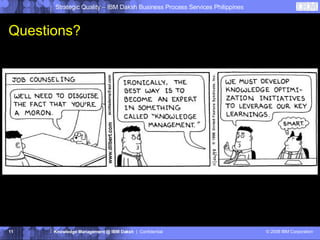
Questions? Strategic Quality – IBM Daksh Business Process Services Philippines Knowledge Management @ IBM Daksh   |  Confidential © 2008 IBM Corporation

Knowledge Management 101

  • 1.
    Knowledge Management 101Strategic Quality – IBM Daksh Business Process Services Philippines Knowledge Management @ IBM Daksh | Confidential © 2008 IBM Corporation
  • 2.
    Definitions… Knowledge. Information in action! The mental capacity to produce results (e.g., solve a customer’s problem, make business decisions, etc.). Management. The act or art of directing or controlling. Strategic Quality – IBM Daksh Business Process Services Philippines Knowledge Management @ IBM Daksh | Confidential © 2008 IBM Corporation Knowledge Management (KM). A conscious strategy to foster, capture, and share knowledge and expertise to help achieve business results.
  • 3.
    What is Knowledge?Source: R. Ackoff’s “Pyramid to Wisdom” (1989, 1996) Data Information Knowledge Wisdom Strategic Quality – IBM Daksh Business Process Services Philippines Knowledge Management @ IBM Daksh | Confidential © 2008 IBM Corporation Raw / hard facts Collection of related data with context and perspective Organized information that provides guidance or initiates action Understanding that permits knowledge to be used
  • 4.
    Types of KnowledgeSource: I. Nonaka’s SECI (1991) Explicit Knowledge. Knowledge that is written down – and thus, easily recorded, shared, tracked, and measured, as well as edited or improved by others. Strategic Quality – IBM Daksh Business Process Services Philippines Knowledge Management @ IBM Daksh | Confidential © 2008 IBM Corporation Tacit Knowledge. Knowledge in your head. What you know but cannot easily share that lets you do a better job.
  • 5.
    Basic KM Model Source: D. Skyrme (1998) Strategic Quality – IBM Daksh Business Process Services Philippines Knowledge Management @ IBM Daksh | Confidential © 2008 IBM Corporation Create Identify Classify Access Use / Exploit Collect Organize / Store Share / Disseminate
  • 6.
    SECI Spiral Model Source: I. Nonaka and H. Takeuchi (1995) Strategic Quality – IBM Daksh Business Process Services Philippines Knowledge Management @ IBM Daksh | Confidential © 2008 IBM Corporation FROM TO
  • 7.
    SECI Spiral Model Source: I. Nonaka and H. Takeuchi (1995) Strategic Quality – IBM Daksh Business Process Services Philippines Knowledge Management @ IBM Daksh | Confidential © 2008 IBM Corporation
  • 8.
    SECI Spiral Model Source: Graham-Durant Law (2004) Strategic Quality – IBM Daksh Business Process Services Philippines Knowledge Management @ IBM Daksh | Confidential © 2008 IBM Corporation
  • 9.
    Why is KMimportant for IBM Daksh? Need to manage and share knowledge given our growing organization (e.g., multiple centers with over 25,000 employees). Quality, Speed and Innovation : the keys to growth in the BPO industry are all knowledge-based. Enhance employee retention rates by recognizing the value of their knowledge & rewarding them accordingly. Strategic Quality – IBM Daksh Business Process Services Philippines Knowledge Management @ IBM Daksh | Confidential © 2008 IBM Corporation
  • 10.
    KM Programs inIBM Daksh Two key thrusts: Creating New Knowledge “Innovation that matters” Bright Ideas Eurekas Sharing Existing Knowledge “Knowing what you know” Replicators Best Practices Strategic Quality – IBM Daksh Business Process Services Philippines Knowledge Management @ IBM Daksh | Confidential © 2008 IBM Corporation
  • 11.
    Questions? Strategic Quality– IBM Daksh Business Process Services Philippines Knowledge Management @ IBM Daksh | Confidential © 2008 IBM Corporation