A Unified Framework for
Recommendations Based on
Quaternary Semantic Analysis
       Wei Chen*, Wynne Hsu*, Mong Li Lee*

  *School of Computing, National University of Singapore


                                                           1
Introduction
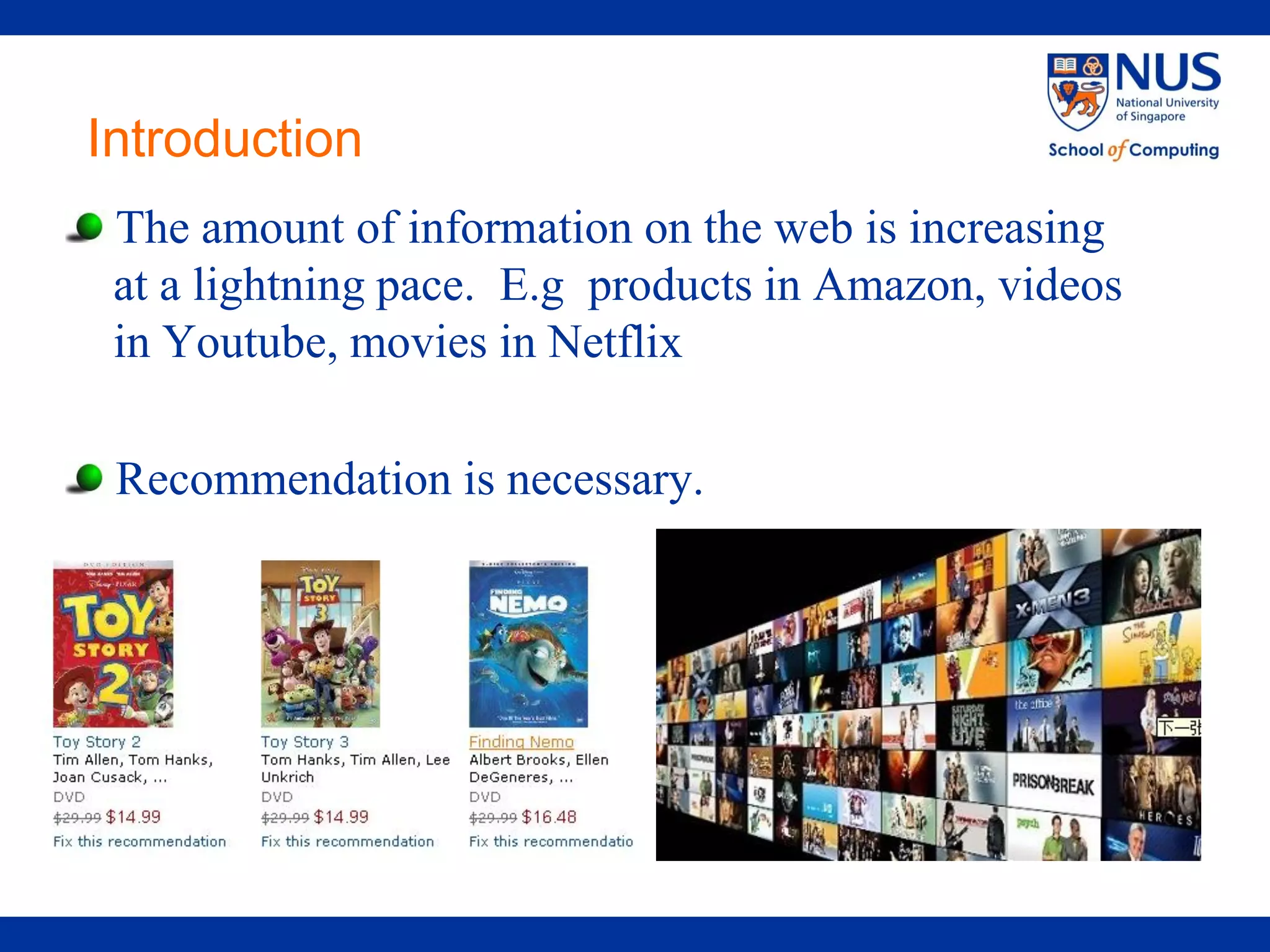
 The amount of information on the web is increasing
 at a lightning pace. E.g products in Amazon, videos
 in Youtube, movies in Netflix

 Recommendation is necessary.
Introduction

  Recommendation systems are typically classified
  according to four types :

 User recommendation

 Item recommendation

 Tag recommendation

 Item rating prediction
Related Work
Most of the work in recommendation systems
utilize only ternary relationships in generating
recommendations.

The collaborative filtering-based recommendation
systems use <user ,rating, items >
[B. Sarwar,WWW’01,SIGIR’09]

Tag-based recommendation systems utilize the
<users, tags, items >.
Motivation


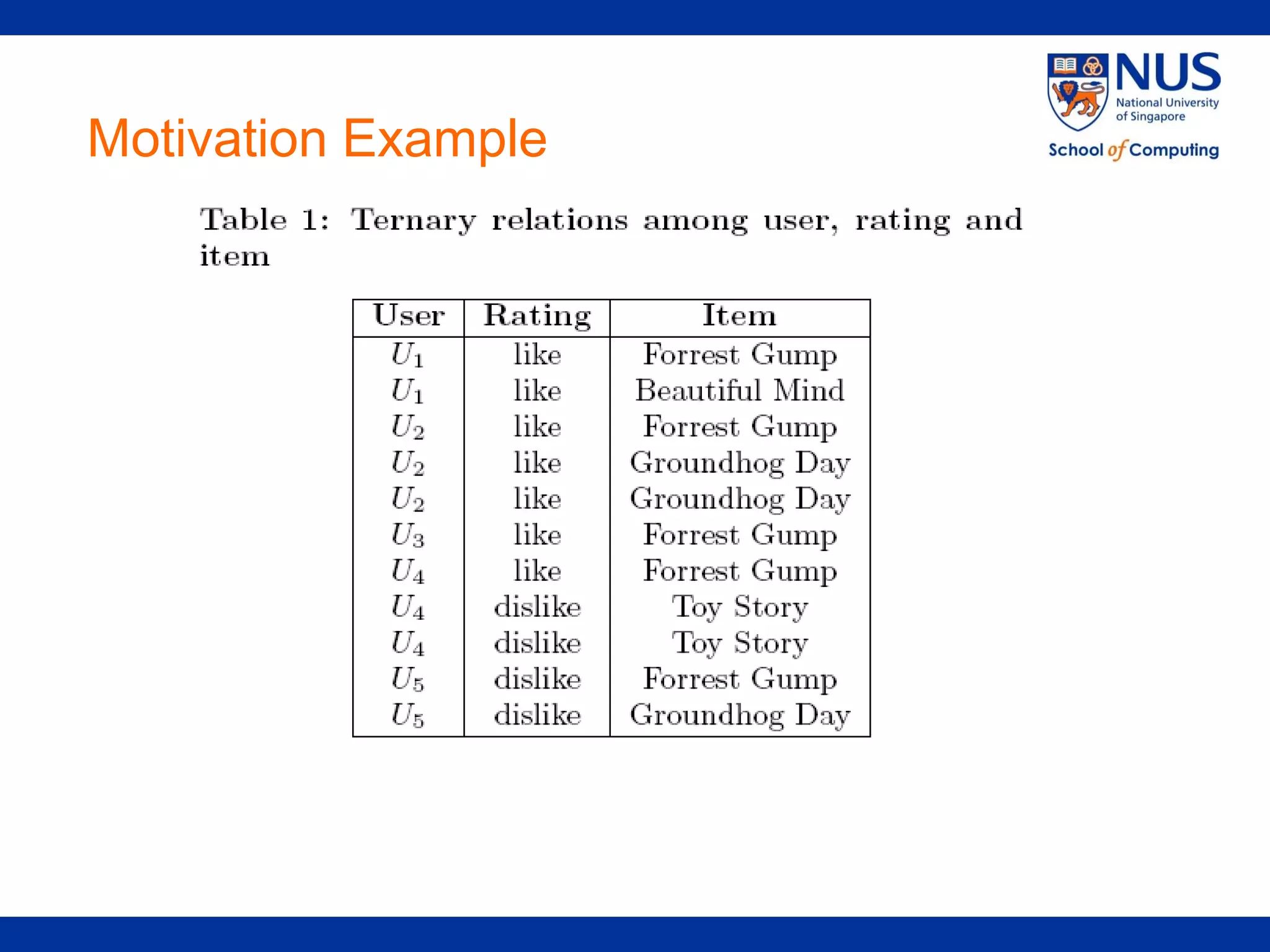
 We argue that recommendations based on ternary
 relationships are not accurate as they would have
 missed out important associations
Motivation Example
Motivation Example


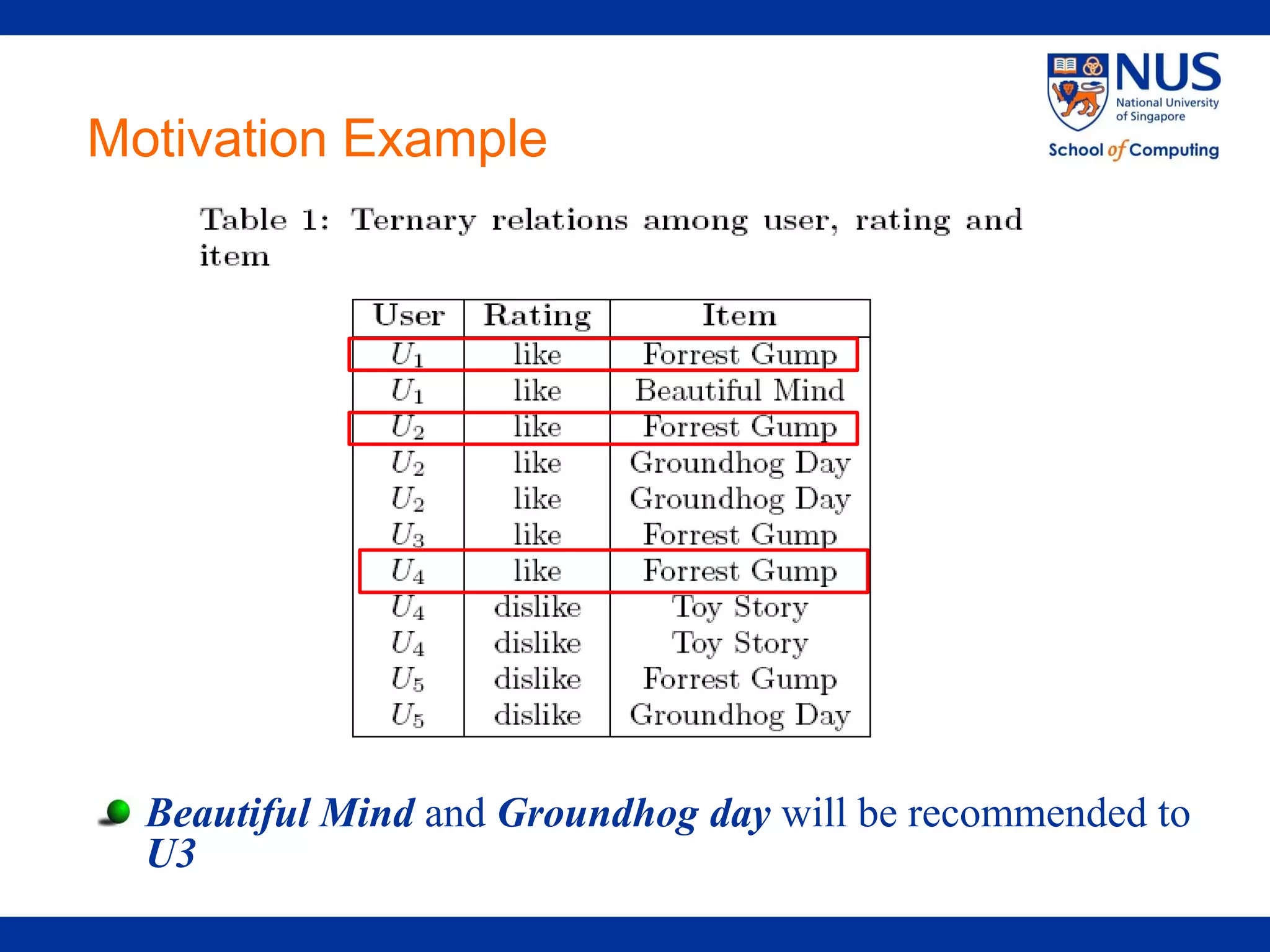
  Beautiful Mind and Groundhog day will be recommended to
  U3
Motivation example
Motivation example


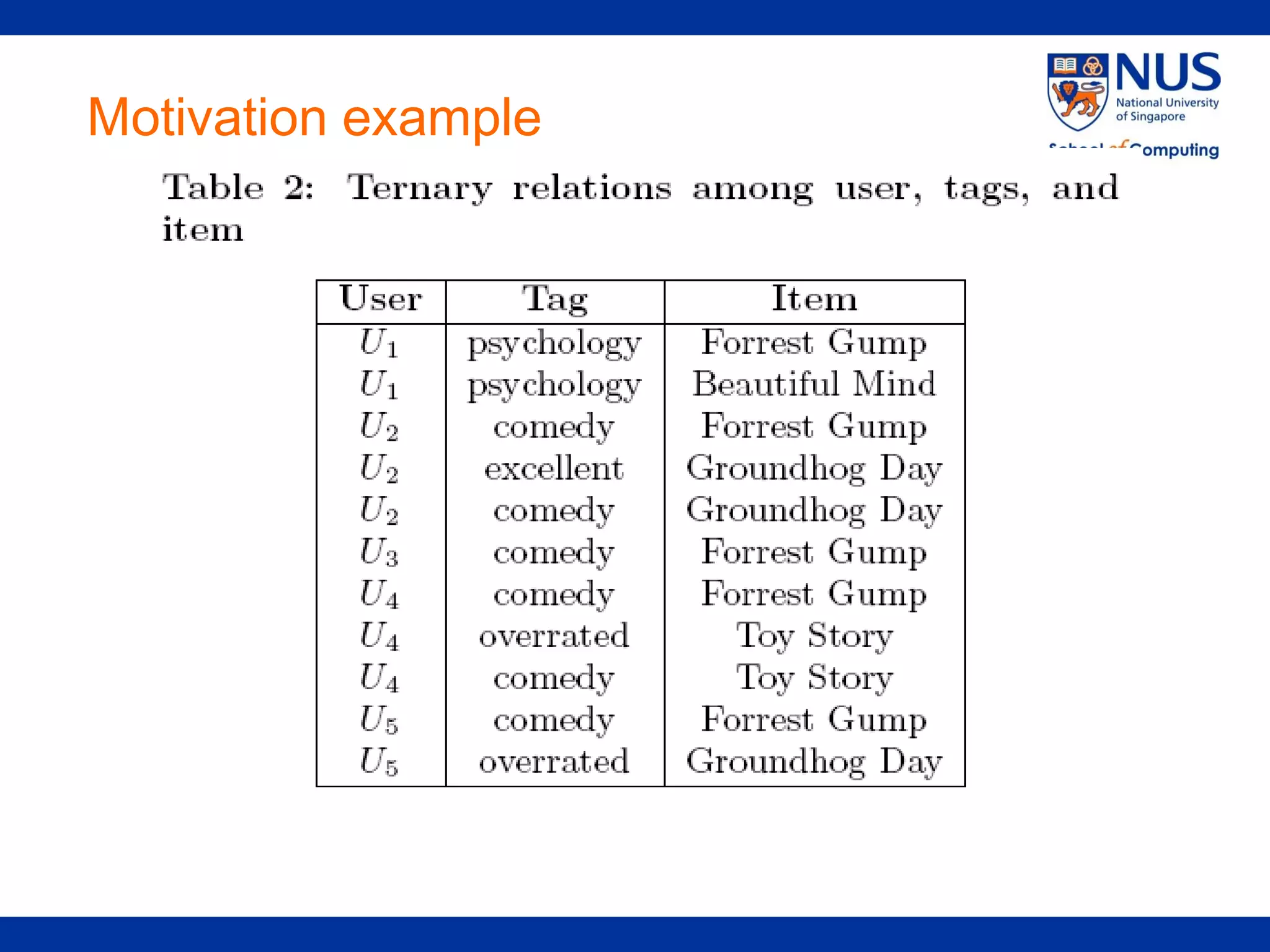
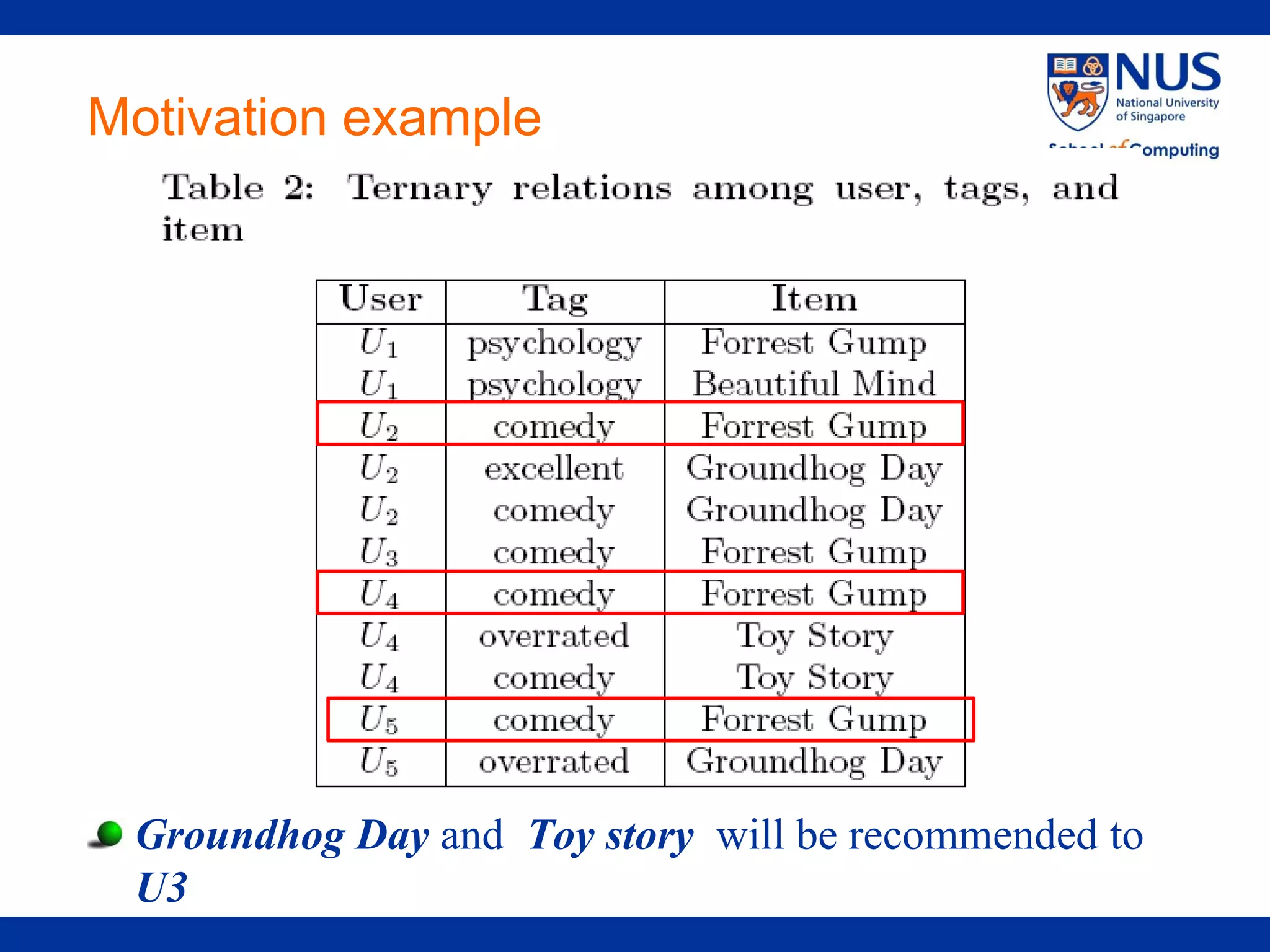
 Groundhog Day and Toy story will be recommended to
 U3
Motivation example
Motivation example


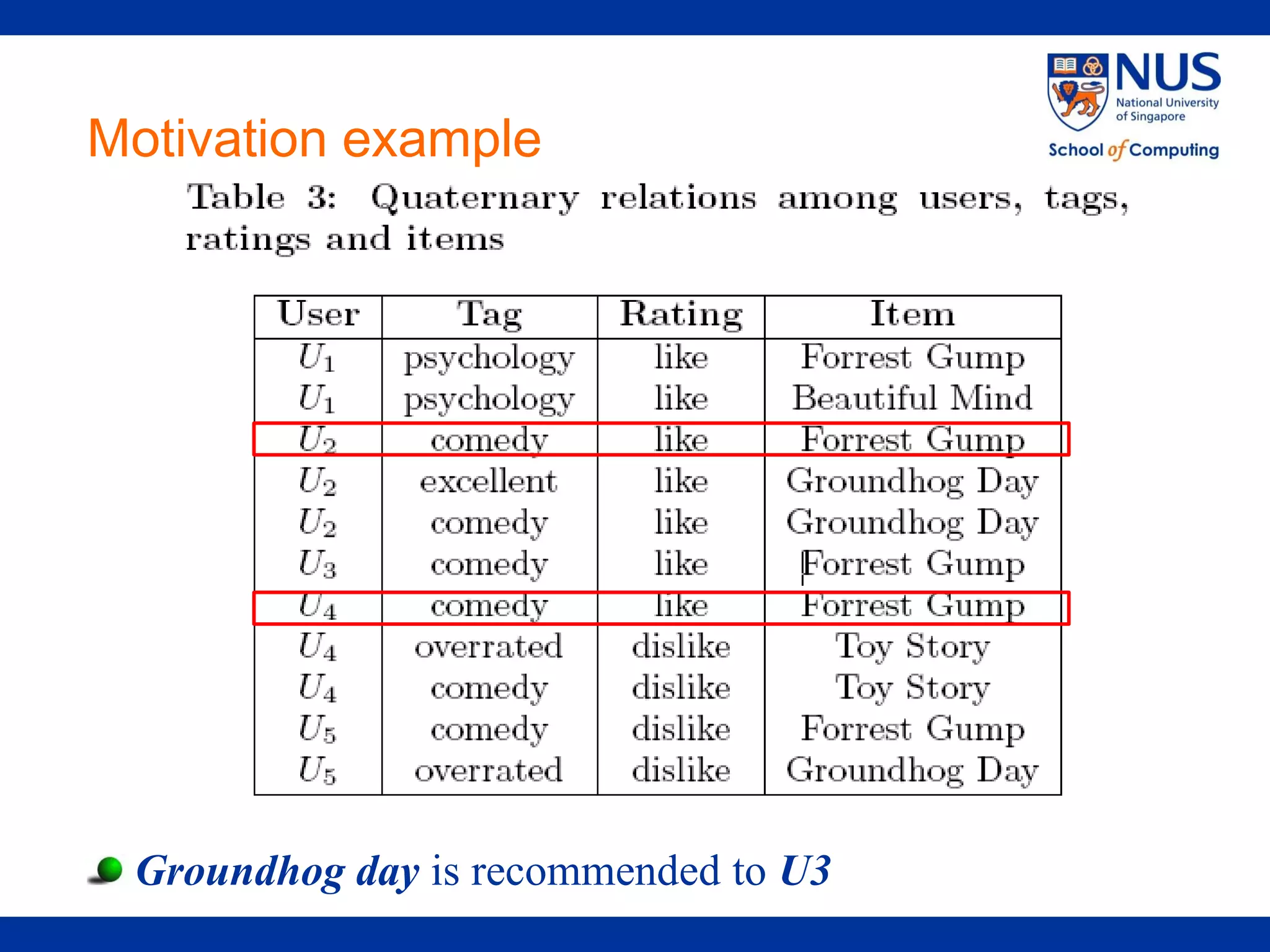
 Groundhog day is recommended to U3
Motivation
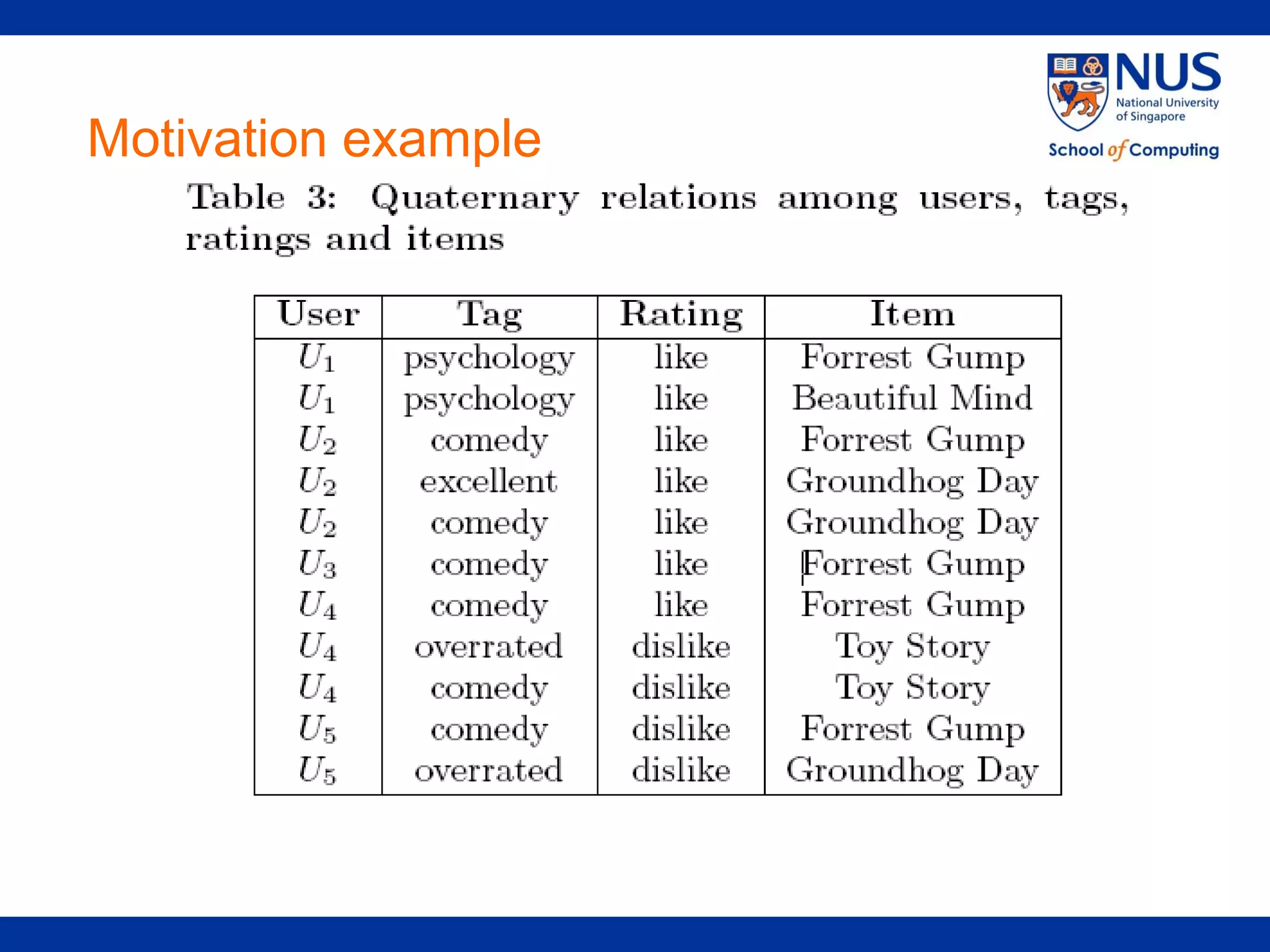
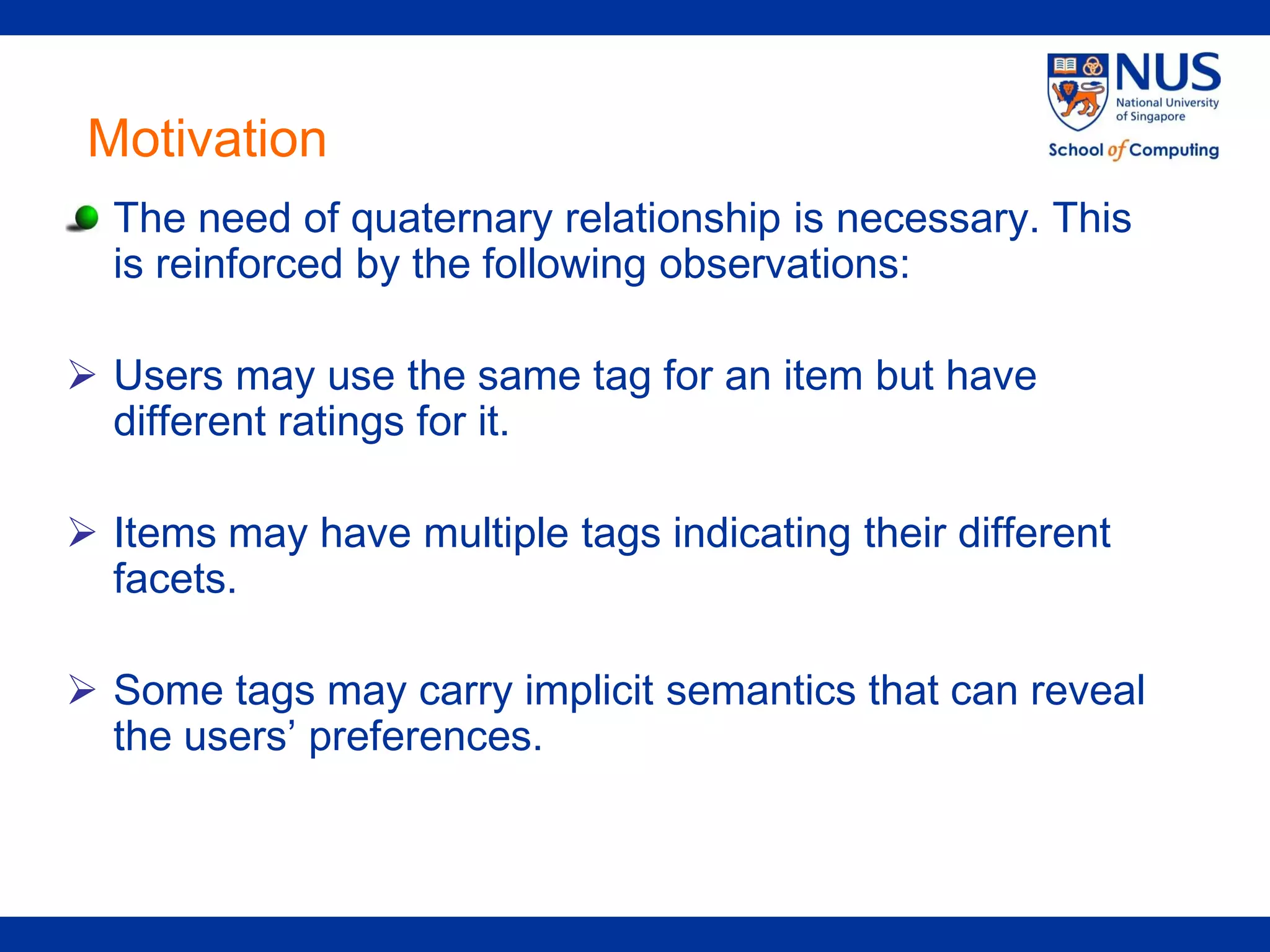
  The need of quaternary relationship is necessary. This
  is reinforced by the following observations:

 Users may use the same tag for an item but have
  different ratings for it.

 Items may have multiple tags indicating their different
  facets.

 Some tags may carry implicit semantics that can reveal
  the users’ preferences.
Overview of the paper

 We propose a model: using tensor to model the
 quaternary relationship.


 Higher-Order Singular Value Decomposition
 (HOSVD) is applied in the 4-order tensor to reveal
 the latent semantic associations among users,
 items, tags and ratings.
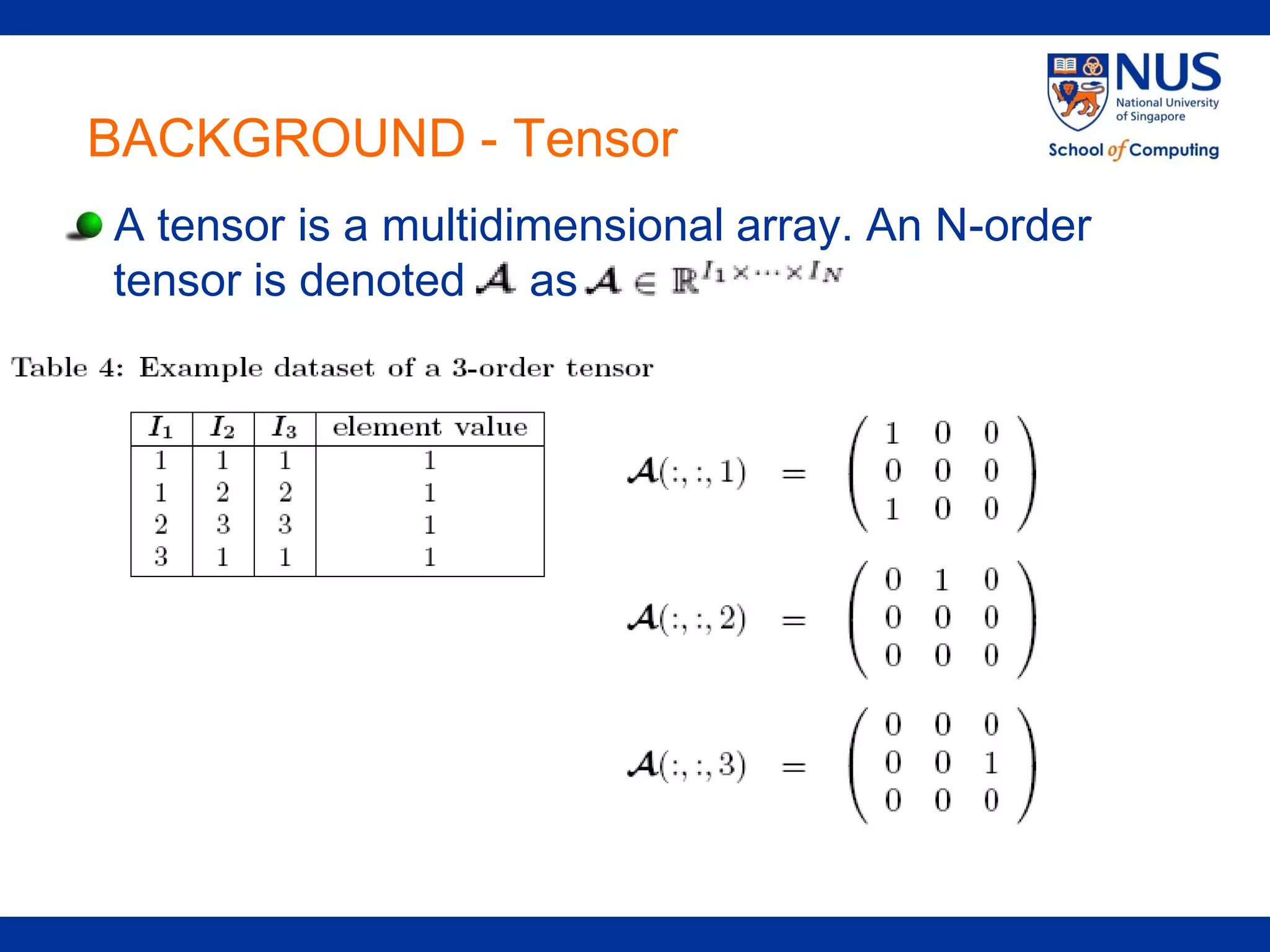
BACKGROUND - Tensor
A tensor is a multidimensional array. An N-order
tensor is denoted as
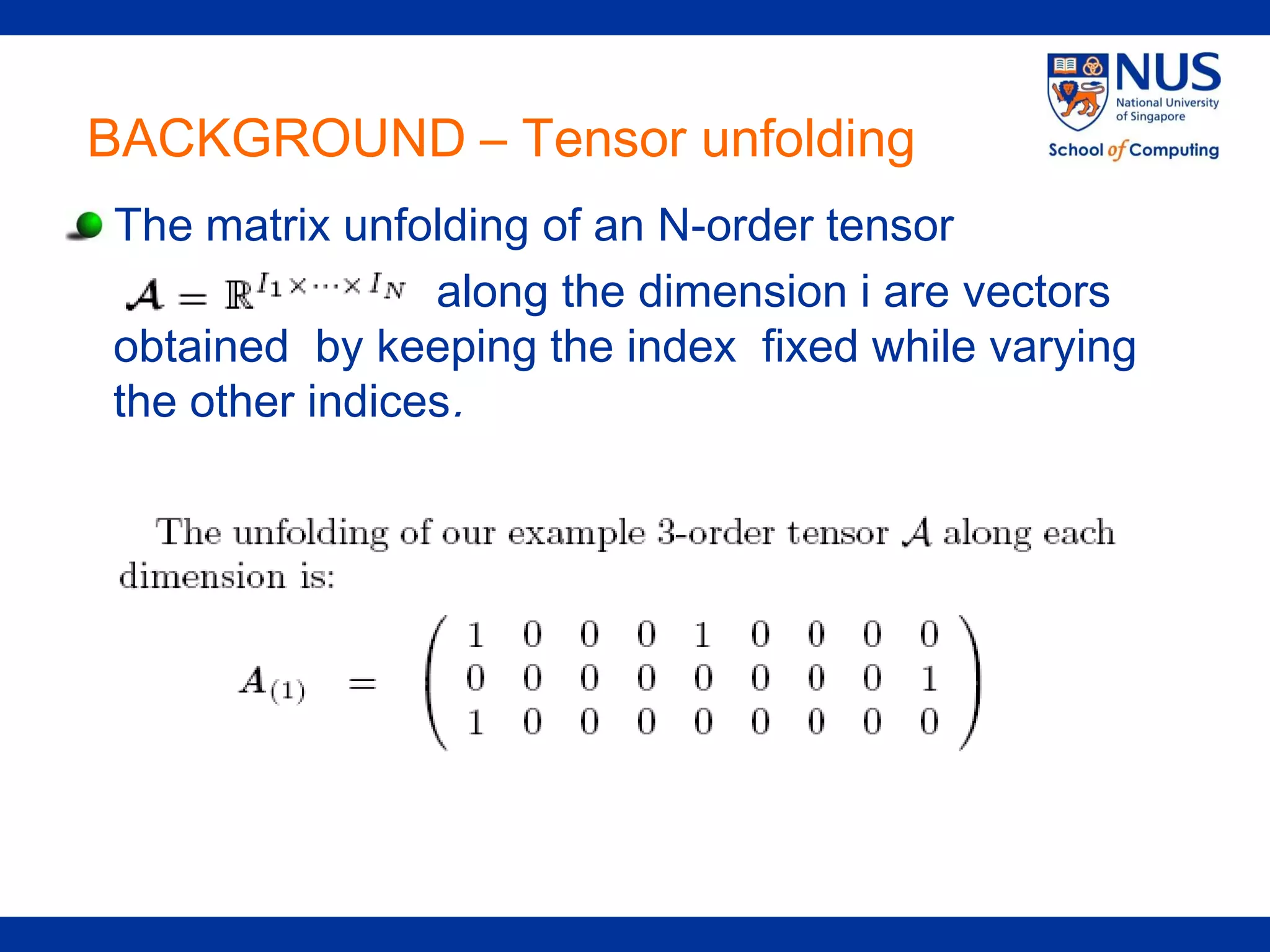
BACKGROUND – Tensor unfolding
The matrix unfolding of an N-order tensor
                along the dimension i are vectors
obtained by keeping the index fixed while varying
the other indices.
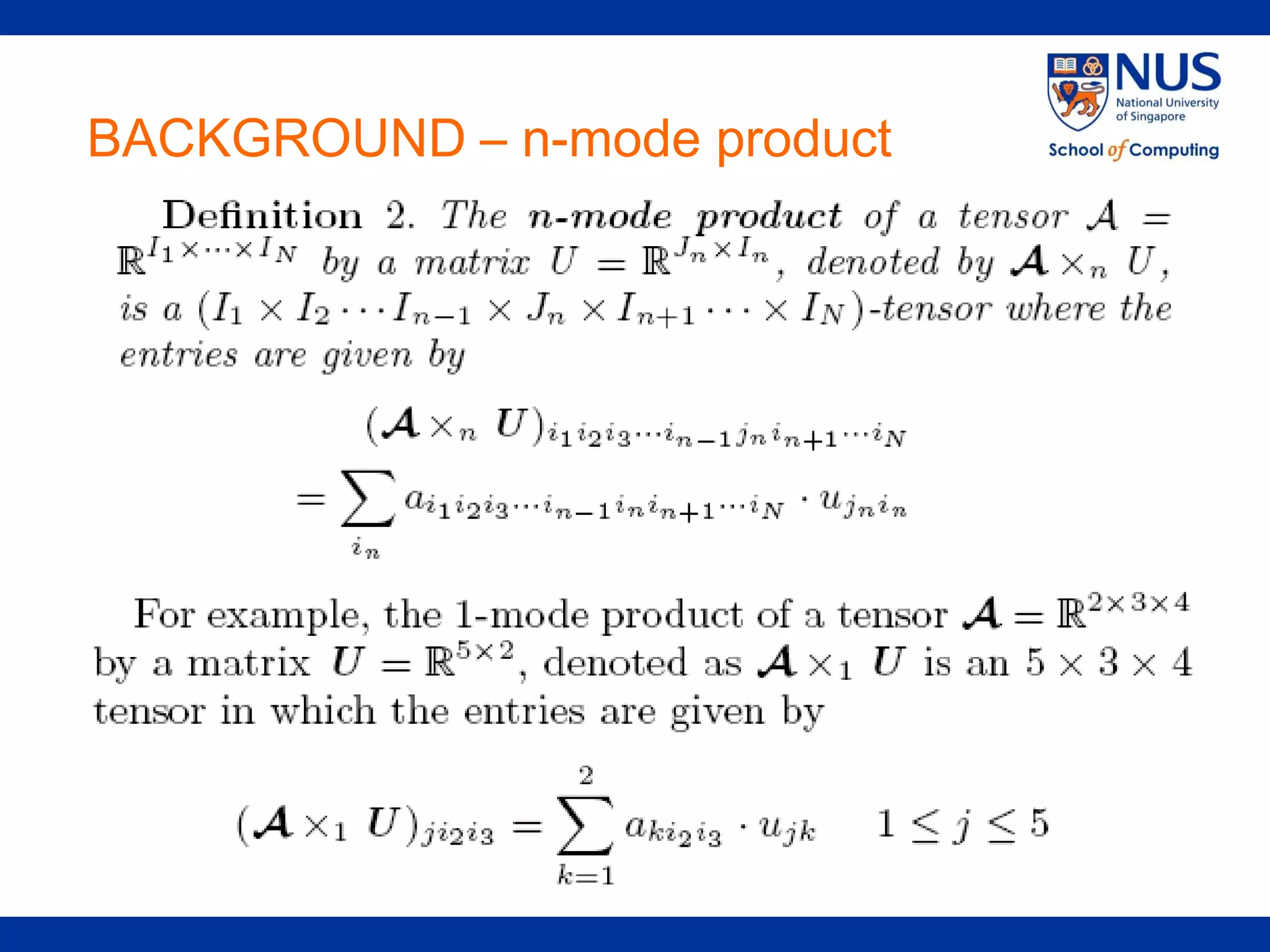
BACKGROUND – n-mode product
BACKGROUND – HOSVD
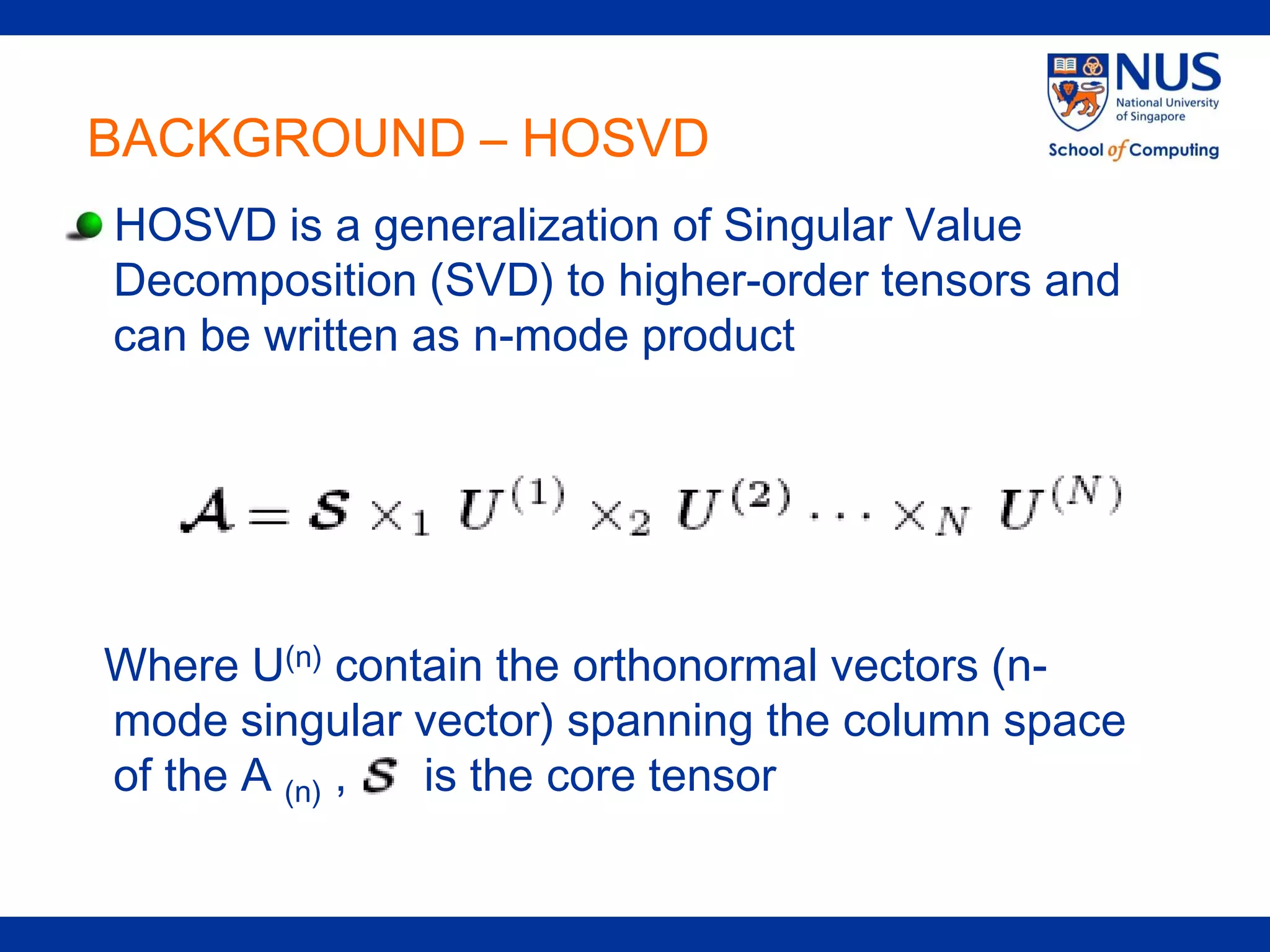
HOSVD is a generalization of Singular Value
Decomposition (SVD) to higher-order tensors and
can be written as n-mode product


Where U(n) contain the orthonormal vectors (n-
mode singular vector) spanning the column space
of the A (n) , is the core tensor
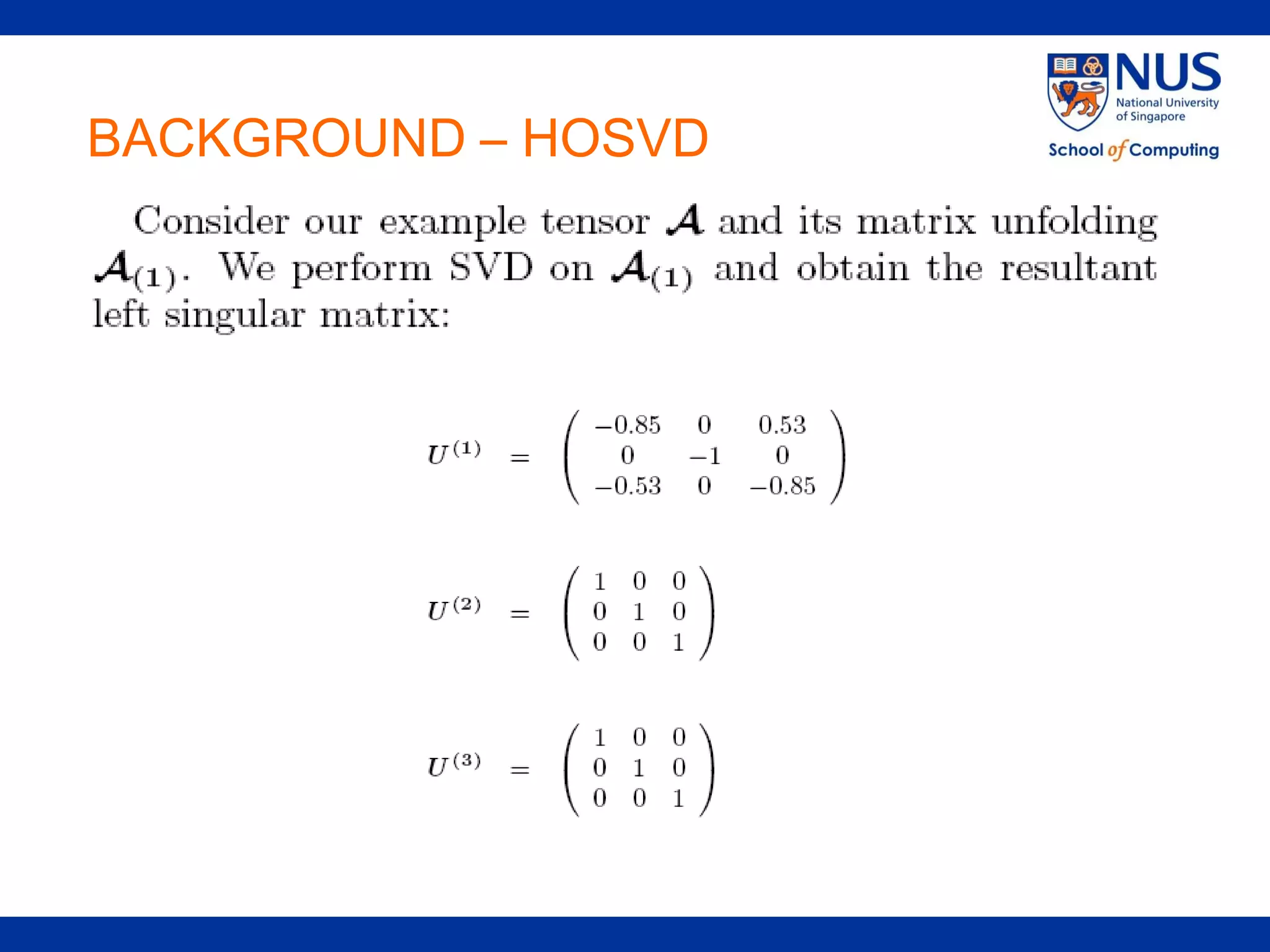
BACKGROUND – HOSVD
BACKGROUND – HOSVD
With this, the core tensor           can be
constructed as described in [L. D.,SIAM 2000], that is
                             and we can get:
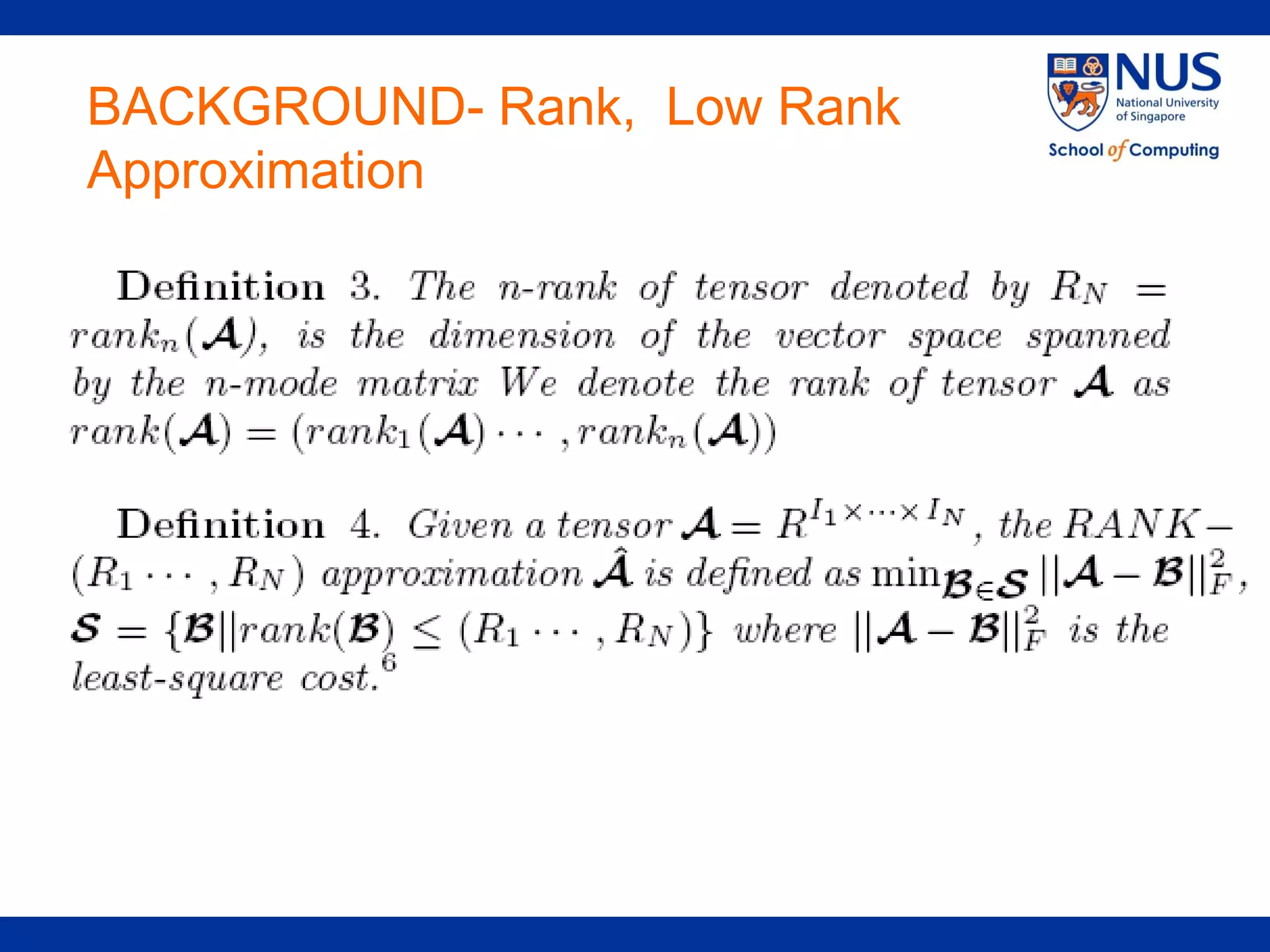
BACKGROUND- Rank, Low Rank
Approximation
BACKGROUND
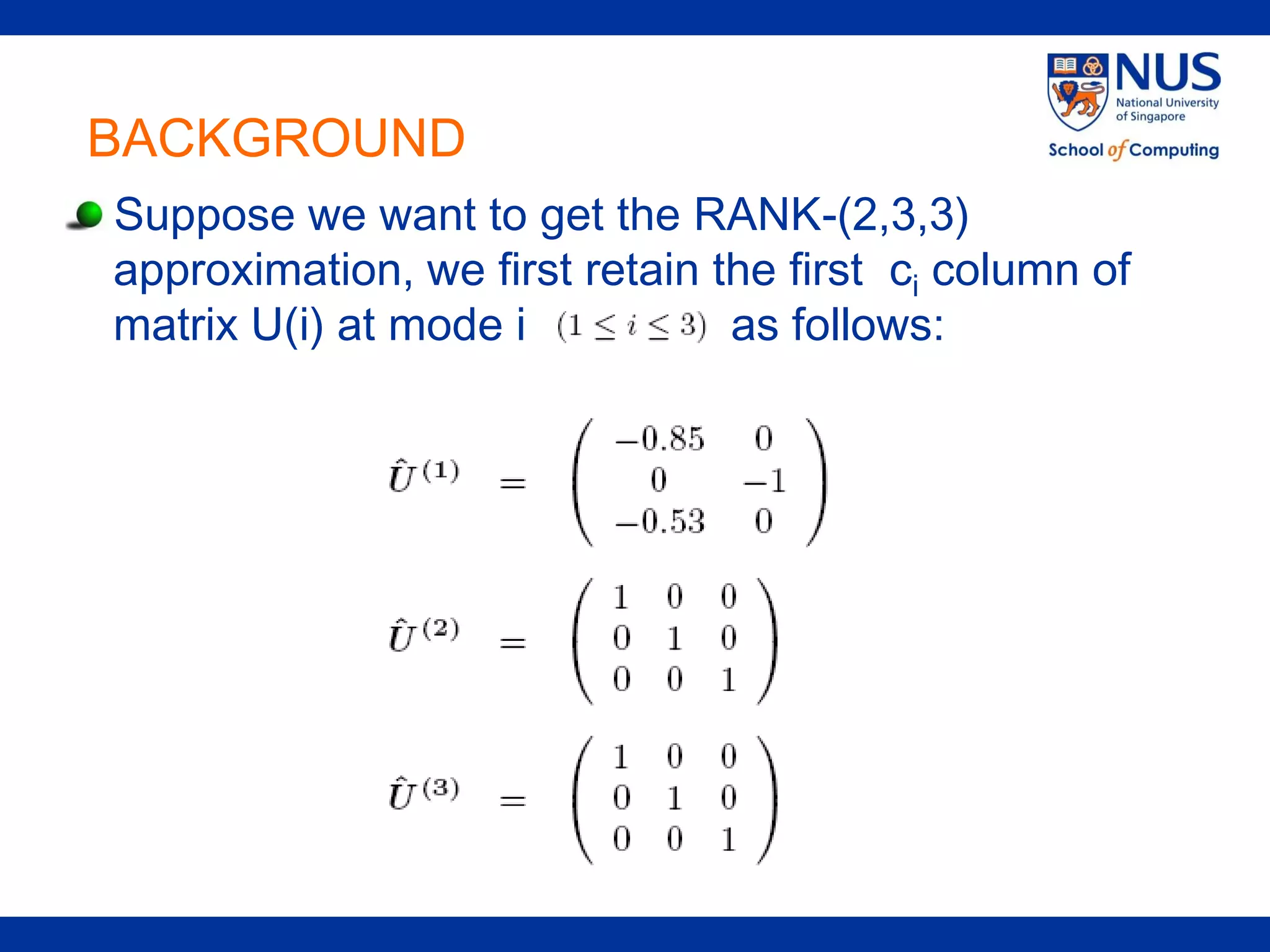
Suppose we want to get the RANK-(2,3,3)
approximation, we first retain the first ci column of
matrix U(i) at mode i           as follows:
BACKGROUND –Tensor
Approximation
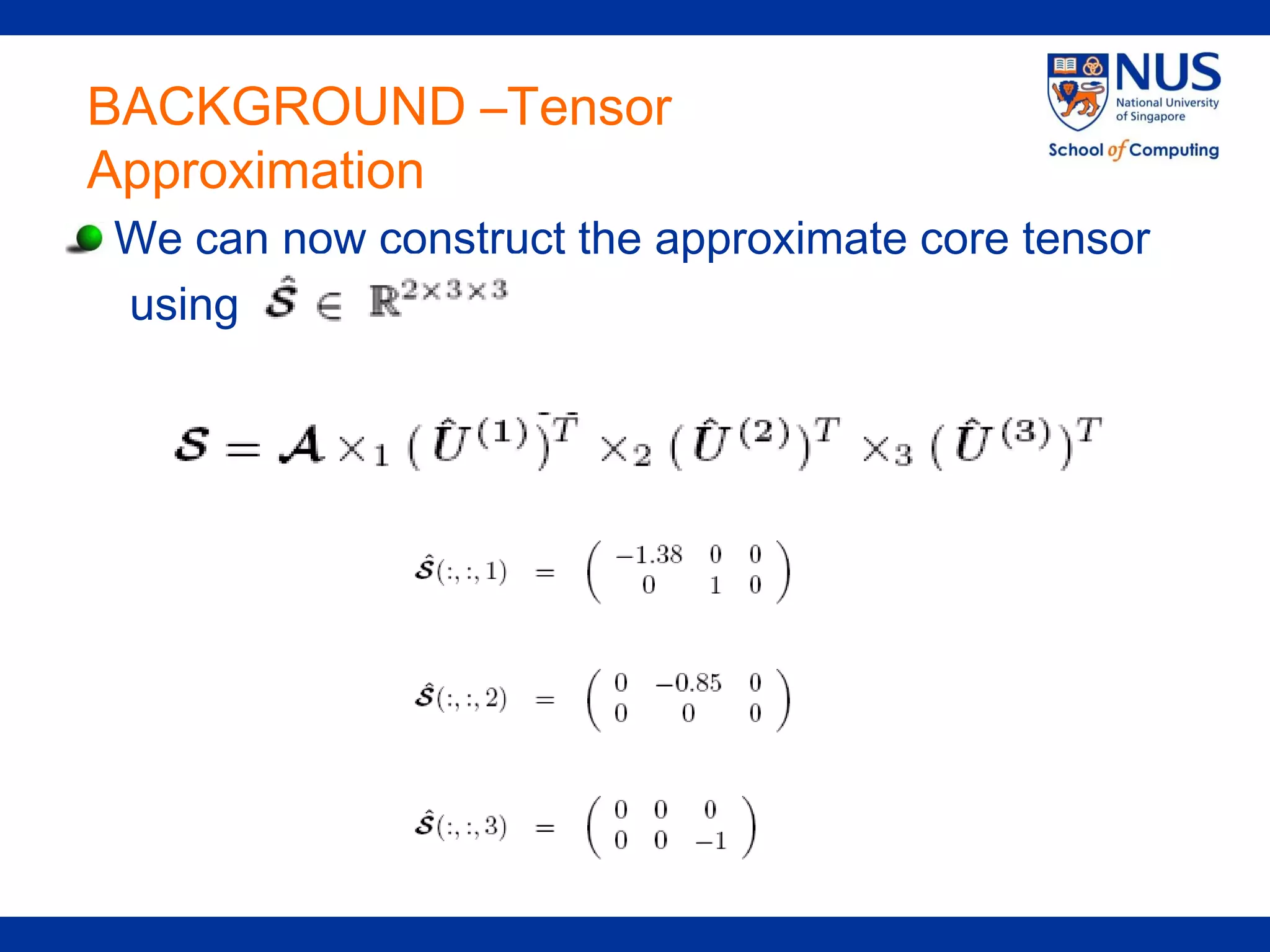
We can now construct the approximate core tensor
using
BACKGROUND
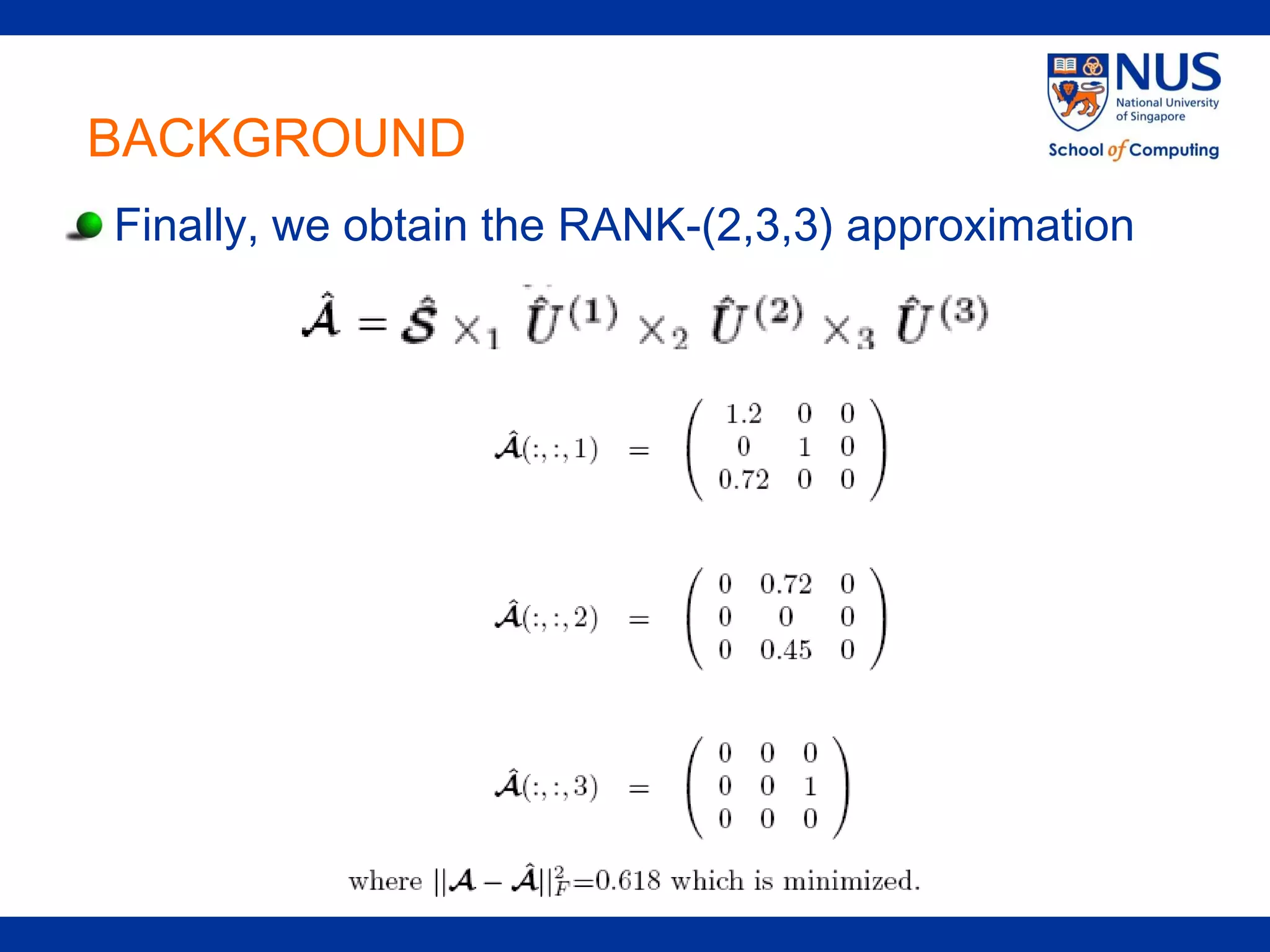
Finally, we obtain the RANK-(2,3,3) approximation
QUATENARY SEMANTIC
ANALYSIS

The main idea is to capture the underlying
relationships among users-tags-items-ratings by
reducing the rank of the original tensor to minimize
the effect of noise on the underlying population
and reduce spareness.
QUATENARY SEMANTIC
ANALYSIS - Initialization
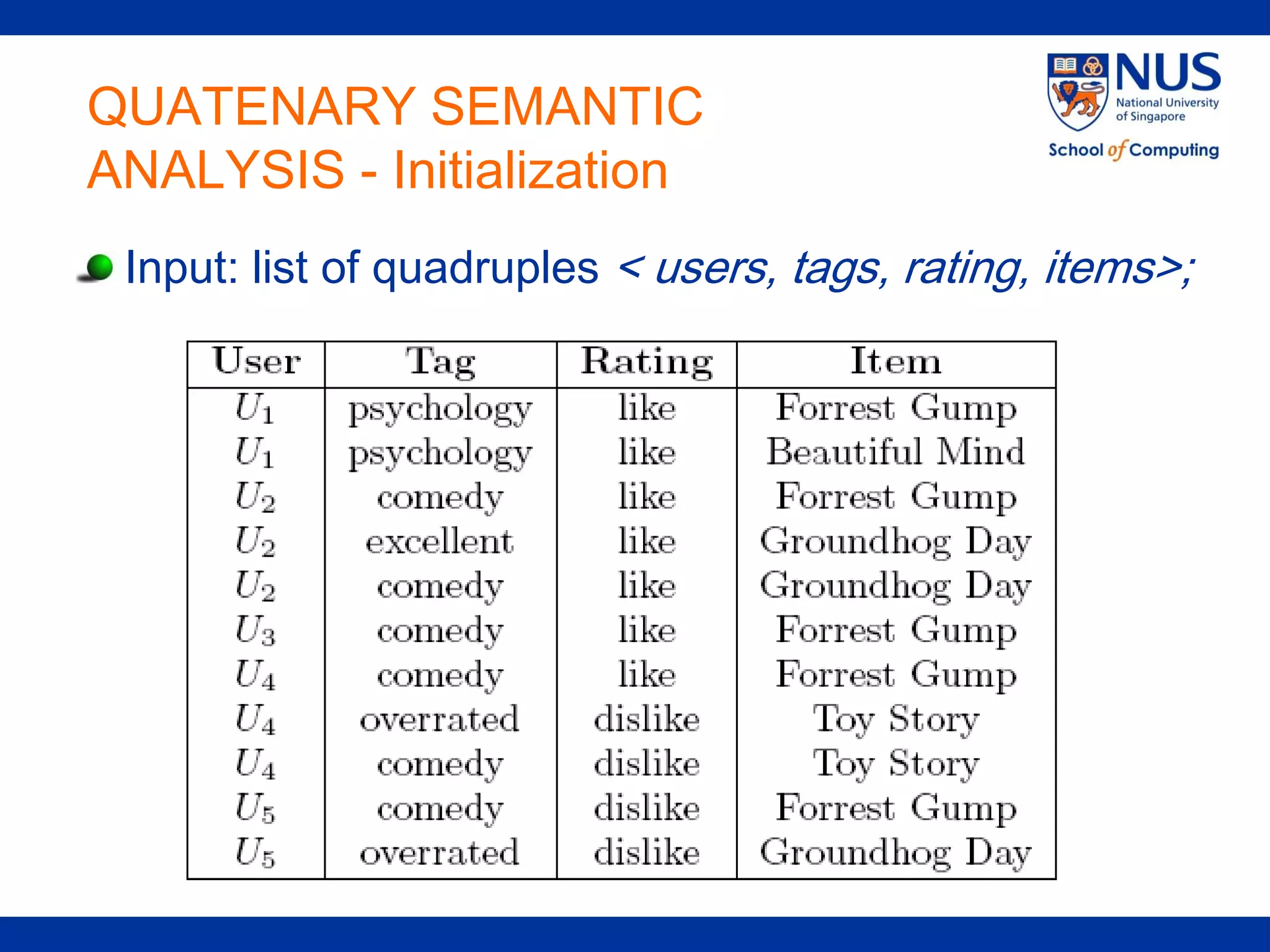
 Input: list of quadruples < users, tags, rating, items>;
QUATENARY SEMANTIC
ANALYSIS - Initialization
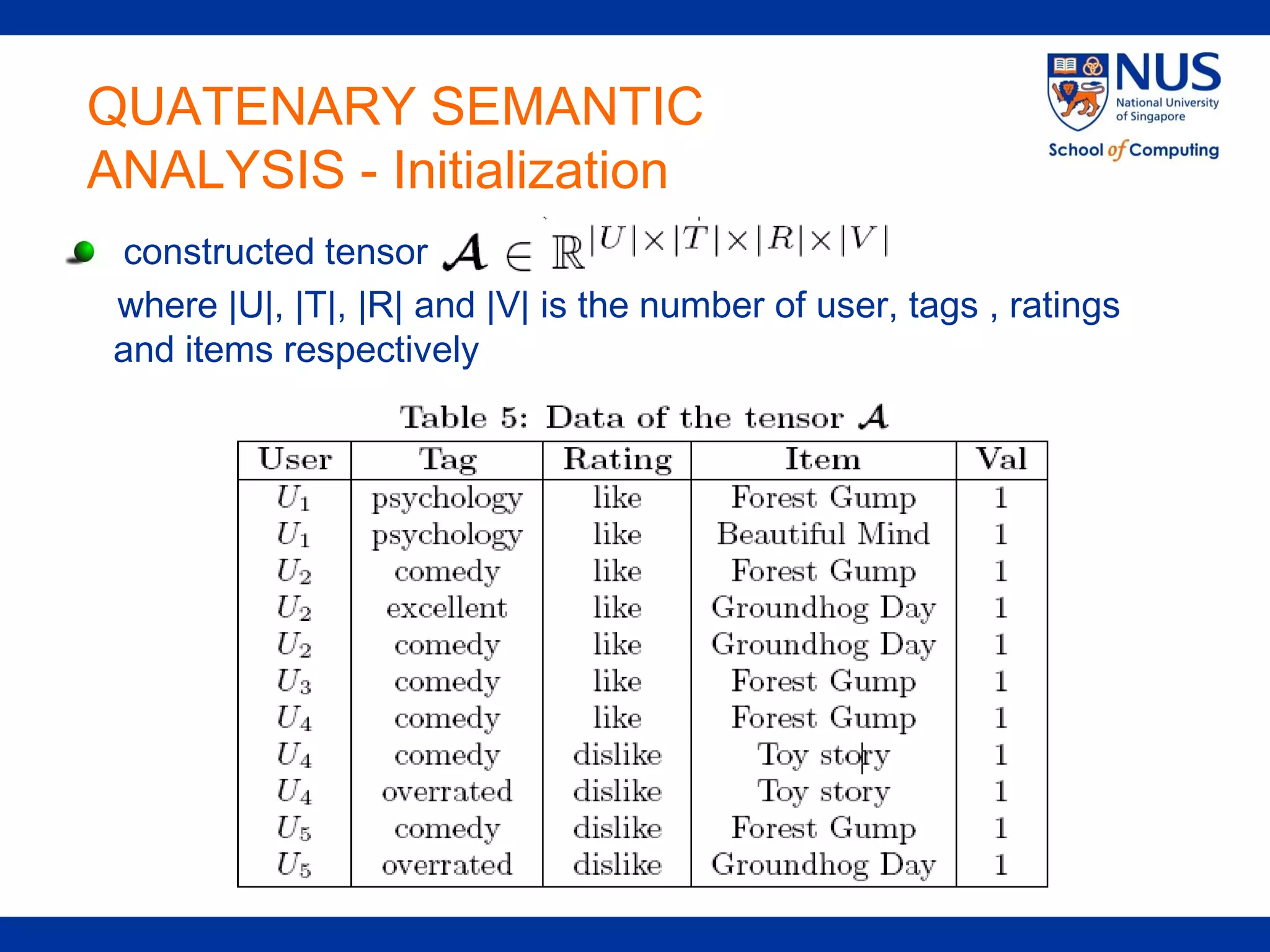
 constructed tensor
 where |U|, |T|, |R| and |V| is the number of user, tags , ratings
 and items respectively
QUATENARY SEMANTIC
ANALYSIS

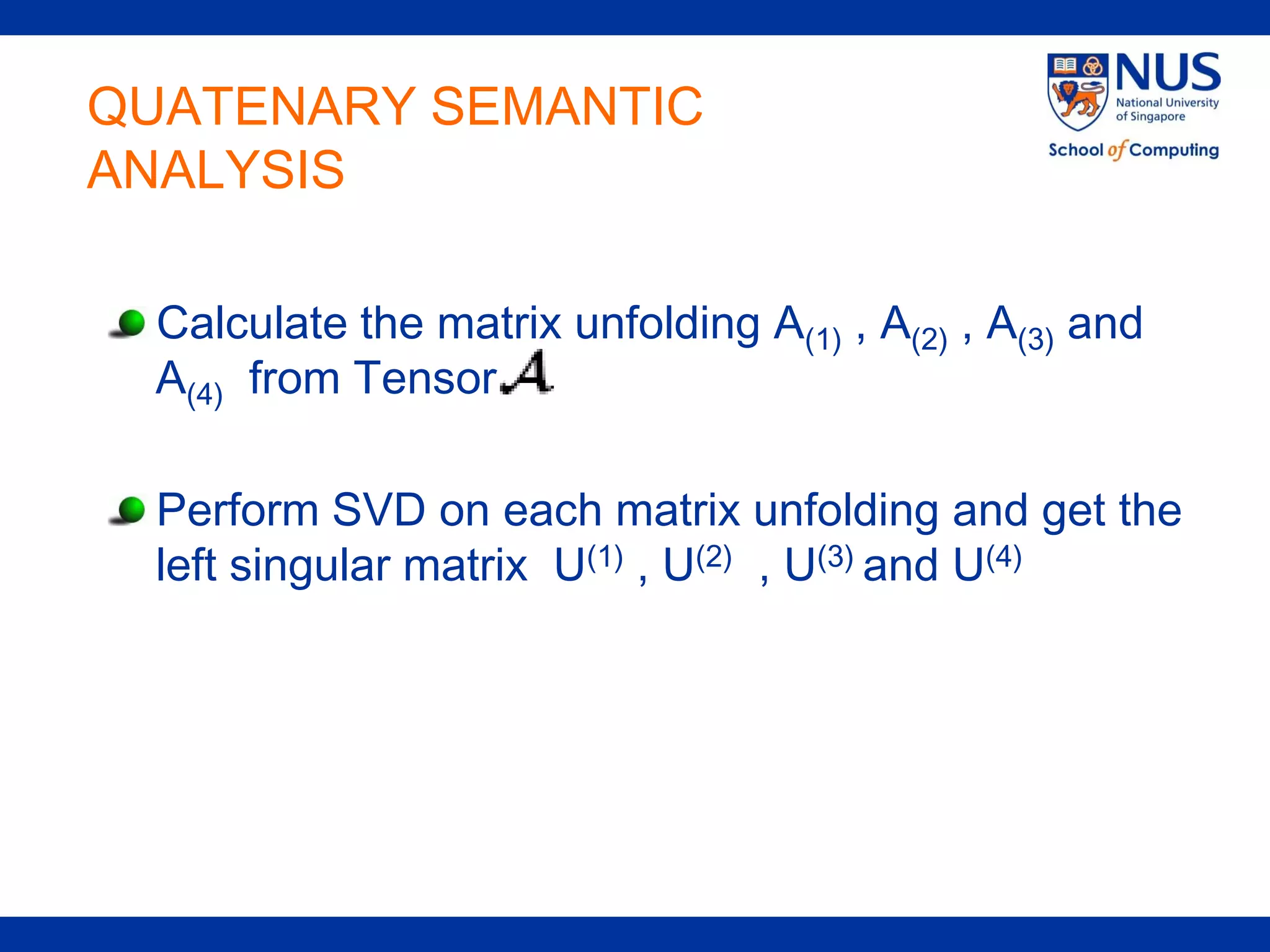
  Calculate the matrix unfolding A(1) , A(2) , A(3) and
  A(4) from Tensor

  Perform SVD on each matrix unfolding and get the
  left singular matrix U(1) , U(2) , U(3) and U(4)
QUATENARY SEMANTIC
ANALYSIS
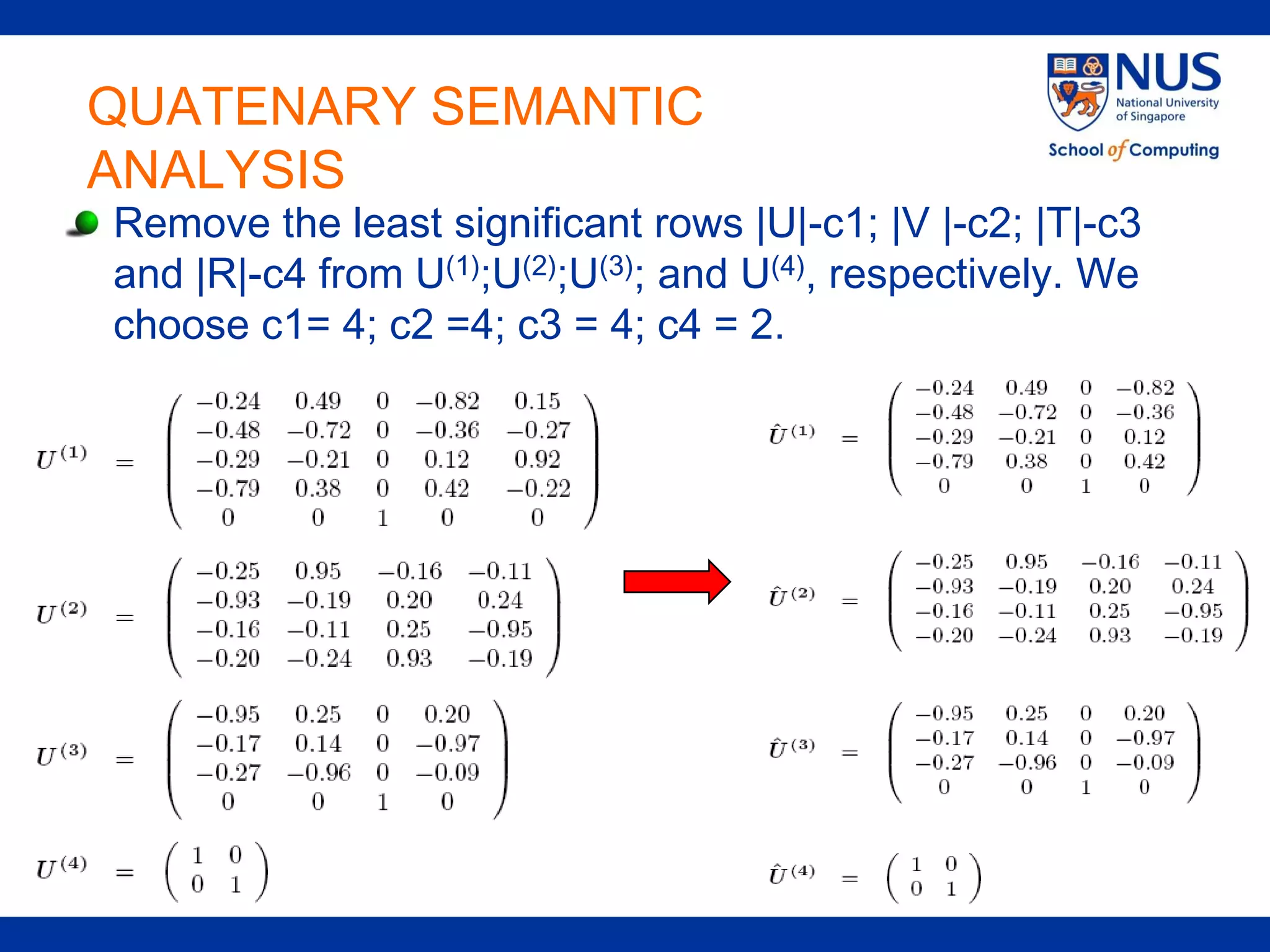
Remove the least significant rows |U|-c1; |V |-c2; |T|-c3
and |R|-c4 from U(1);U(2);U(3); and U(4), respectively. We
choose c1= 4; c2 =4; c3 = 4; c4 = 2.
QUATENARY SEMANTIC
ANALYSIS

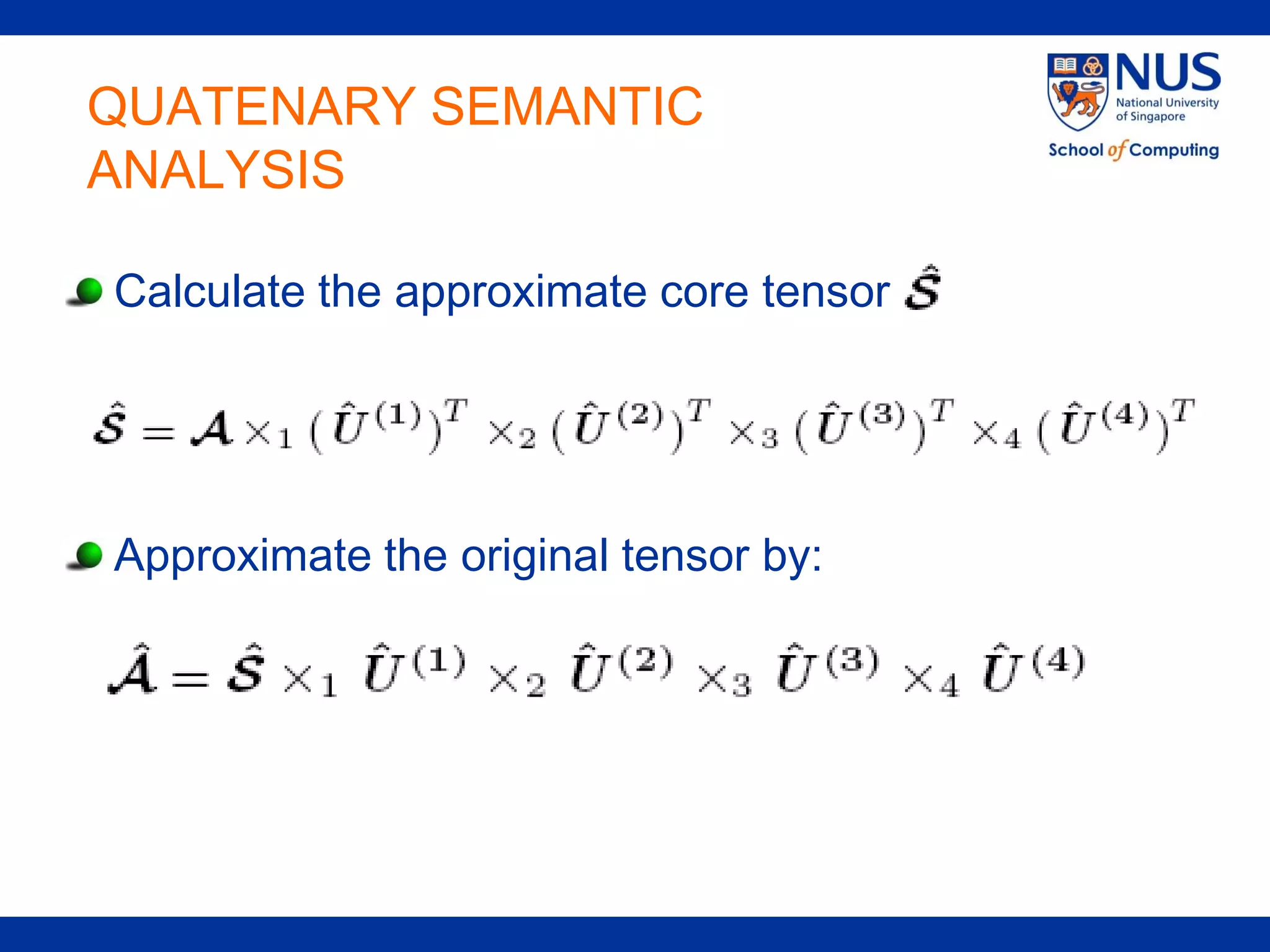
Calculate the approximate core tensor


Approximate the original tensor by:
QUATENARY SEMANTIC
ANALYSIS
QUATENARY SEMANTIC
ANALYSIS
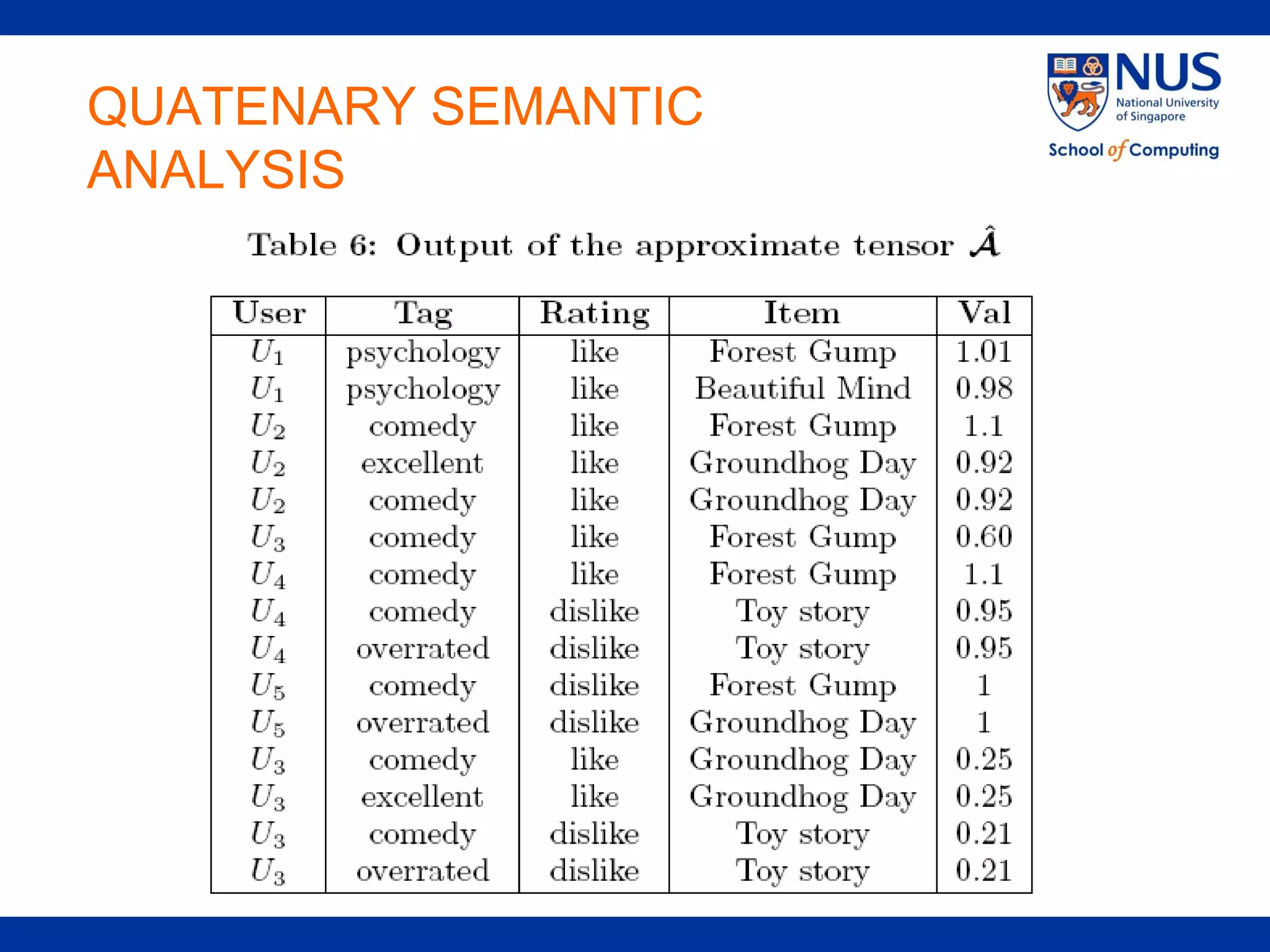
Latent associations such as the newly added
quadruples in Table 6 may not be found if the
tensor data is sparse

We overcome this problem by applying a
smoothing technique to the tensor in Algorithm.
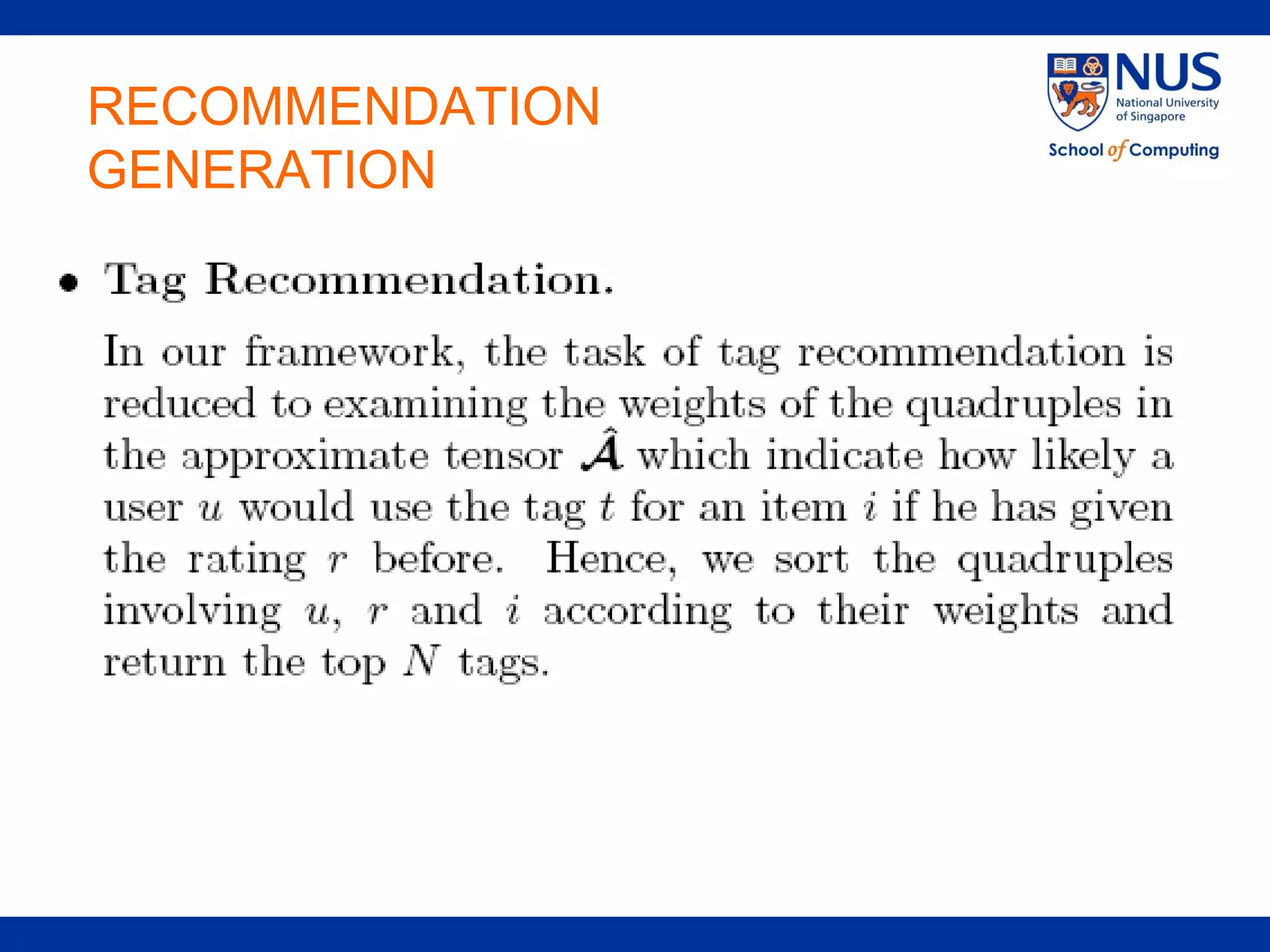
RECOMMENDATION
GENERATION
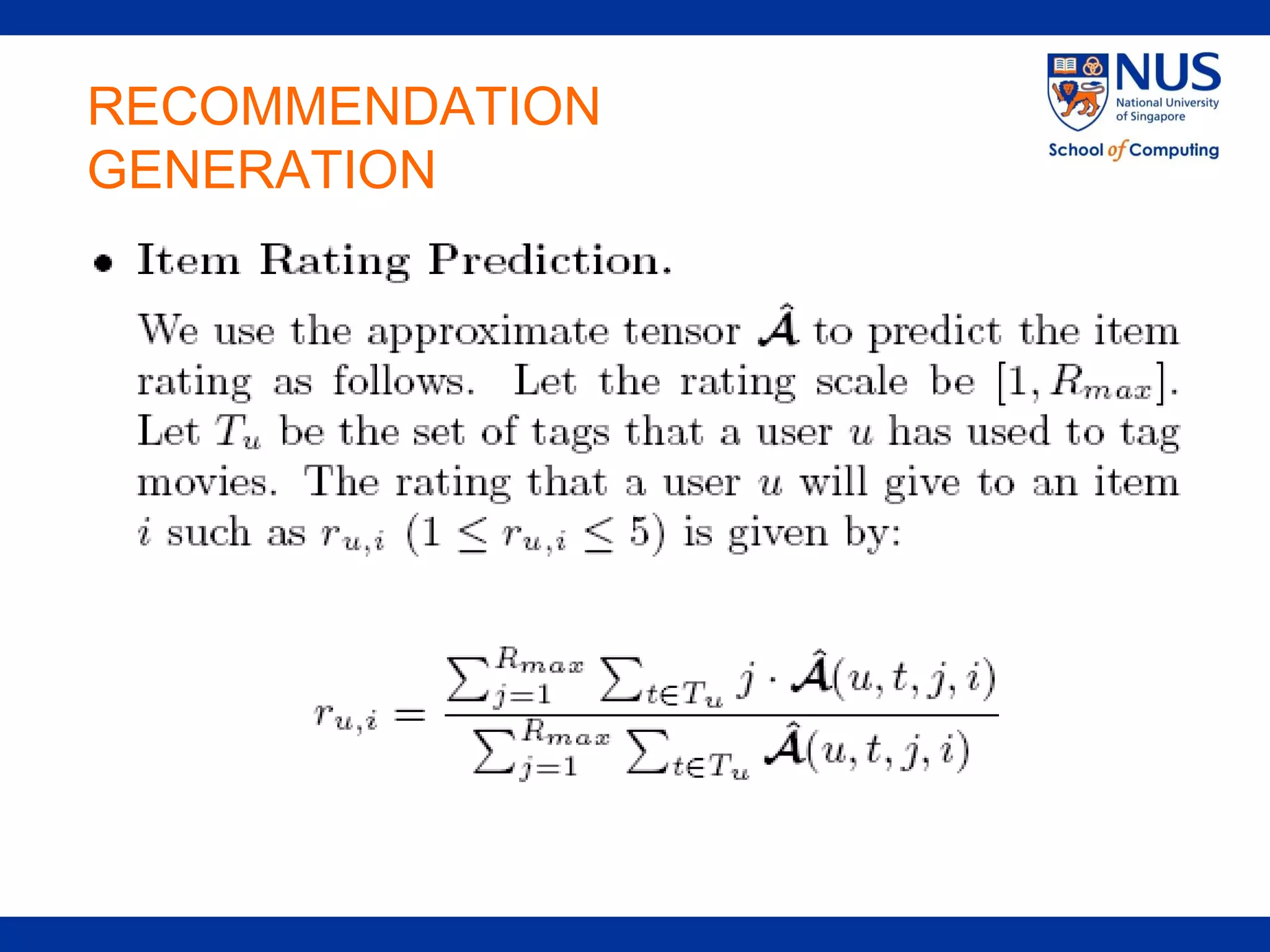
RECOMMENDATION
GENERATION
RECOMMENDATION
GENERATION
RECOMMENDATION
GENERATION
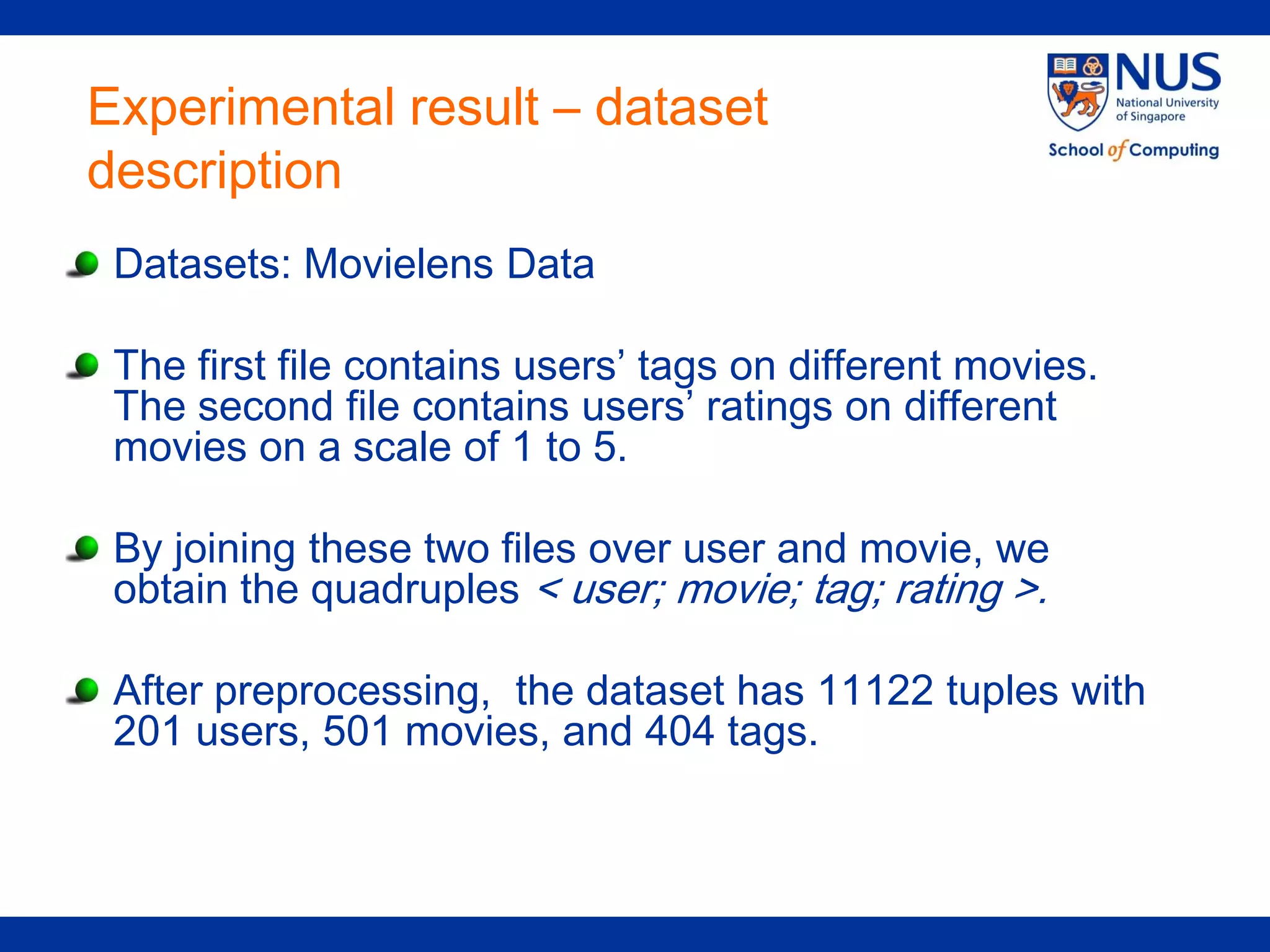
Experimental result – dataset
description
 Datasets: Movielens Data

 The first file contains users’ tags on different movies.
 The second file contains users’ ratings on different
 movies on a scale of 1 to 5.

 By joining these two files over user and movie, we
 obtain the quadruples < user; movie; tag; rating >.

 After preprocessing, the dataset has 11122 tuples with
 201 users, 501 movies, and 404 tags.
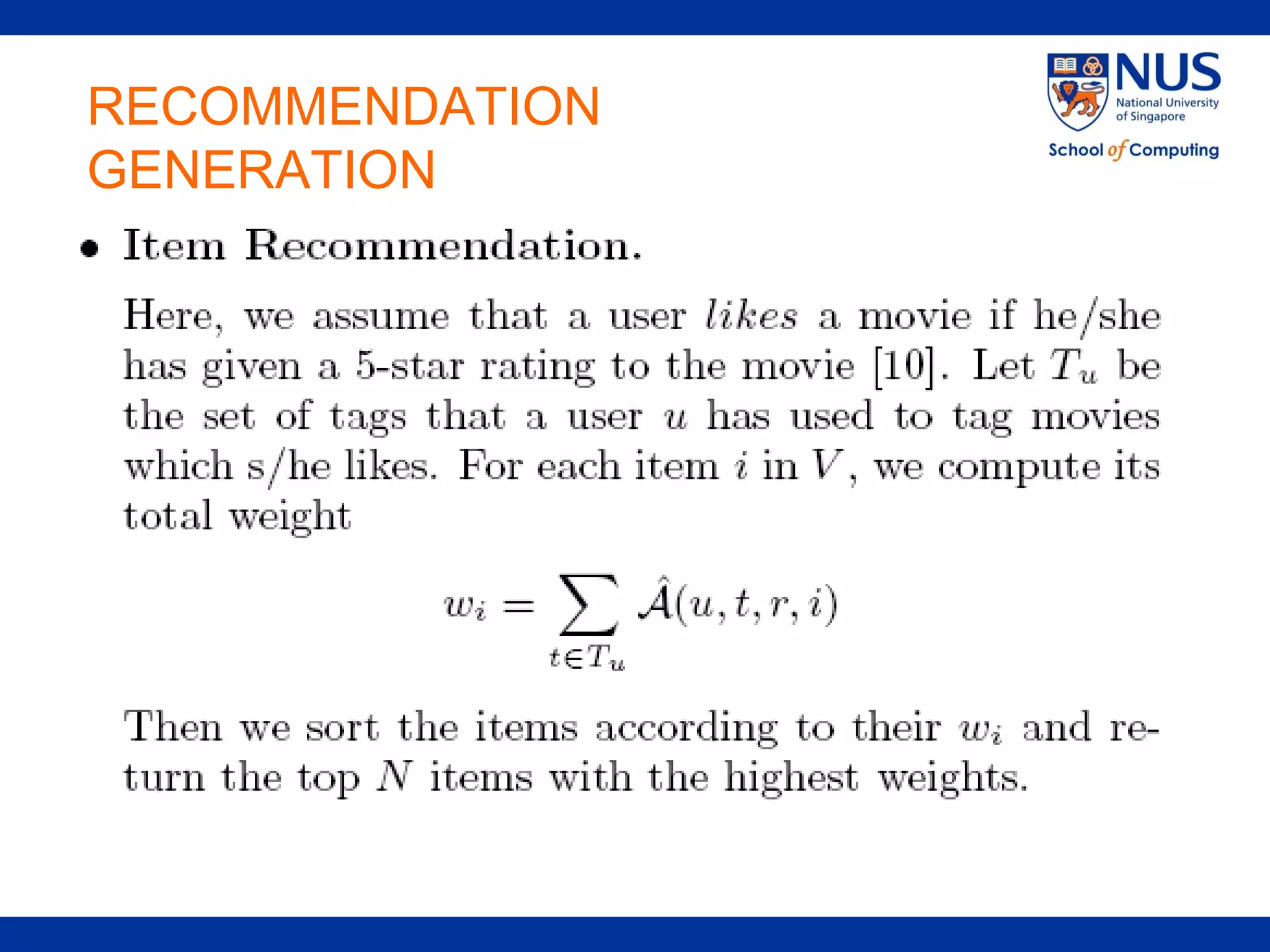
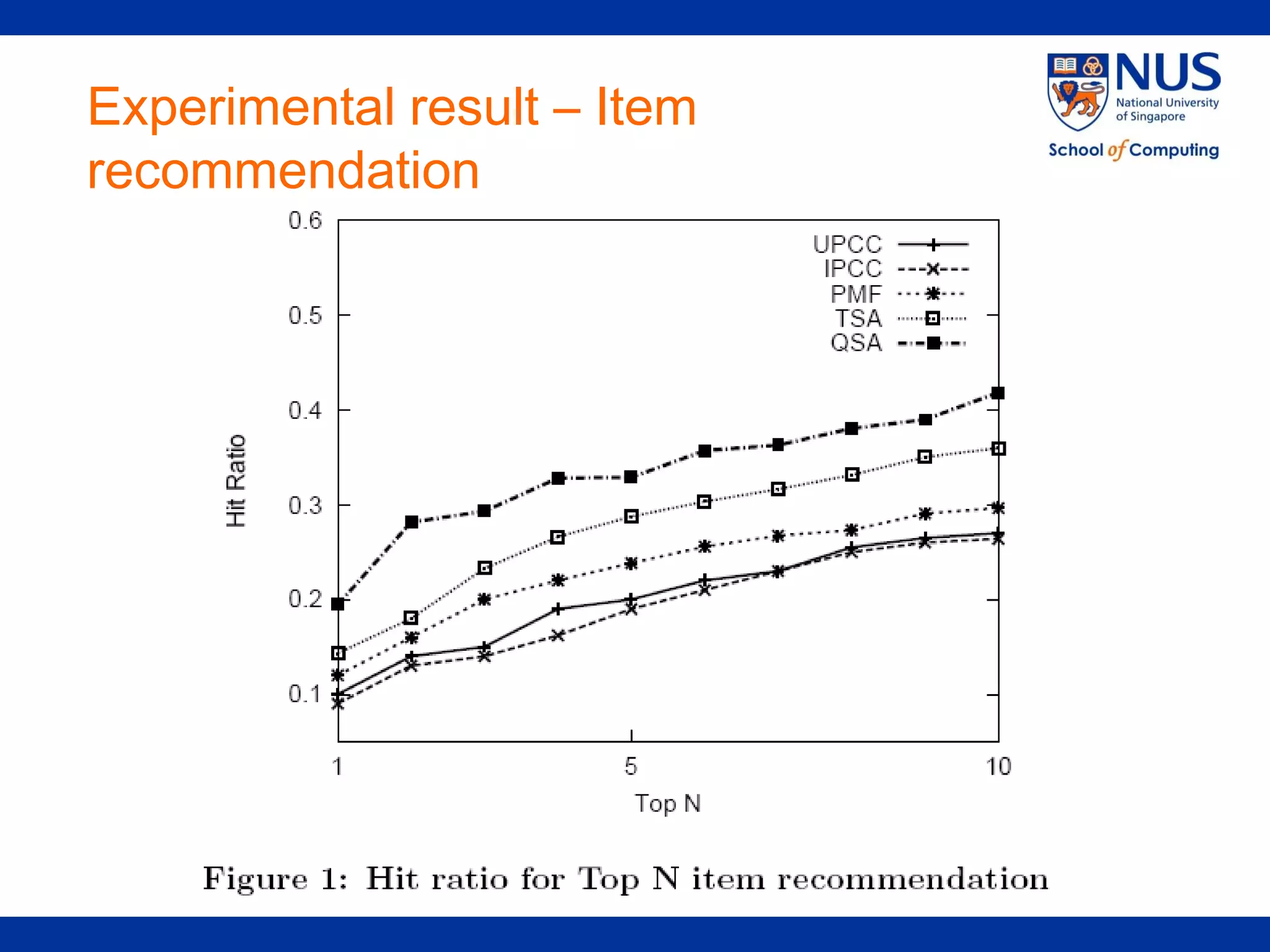
Experimental result – Item
 Recommendation

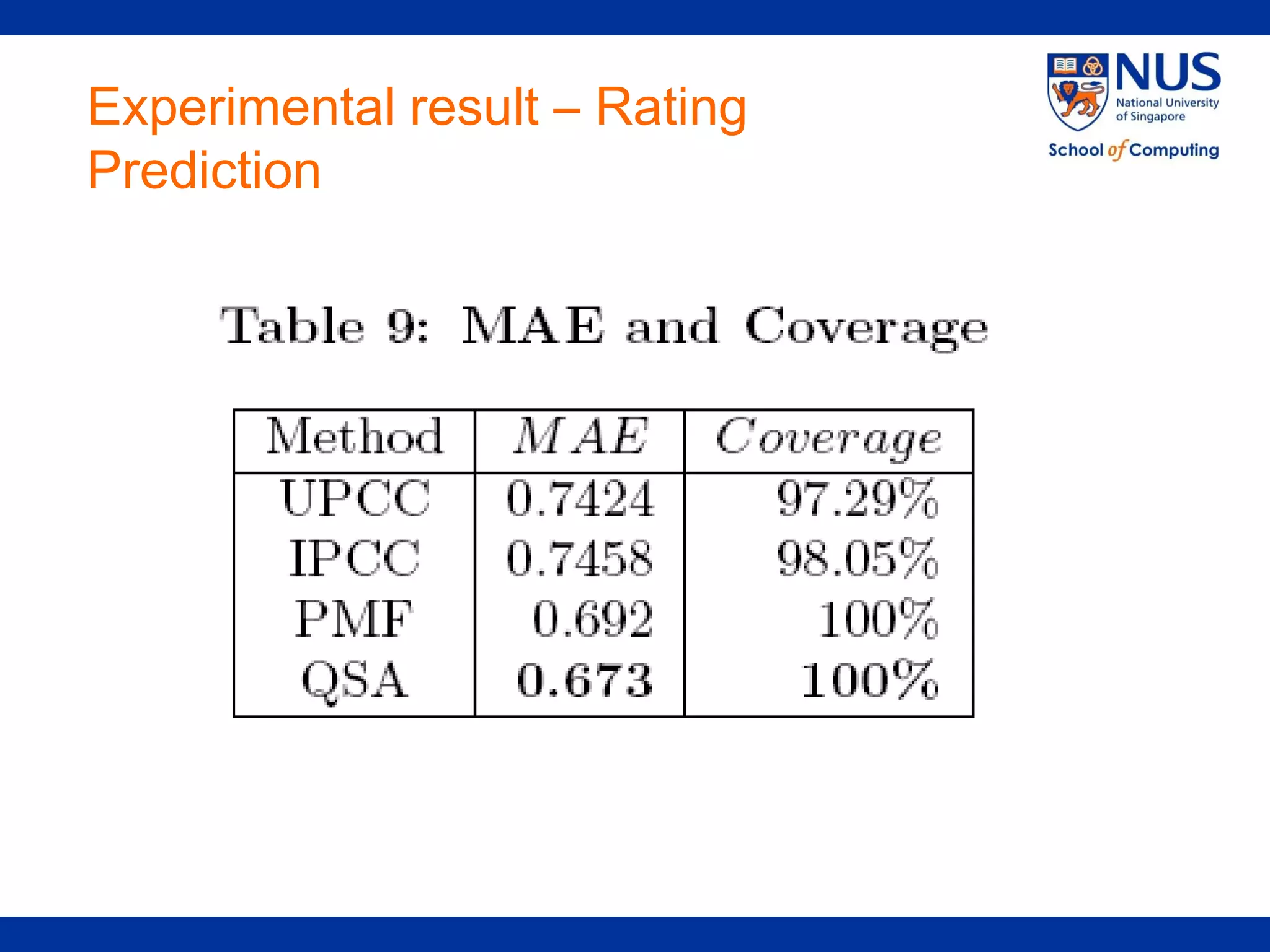
  Compare method:

 UPCC: User based recommendation
 IPCC: Item based recommendation
 Probabilistic Matrix Factorization (PMF)
Experimental result – Item
recommendation
Experimental result – Rating
Prediction
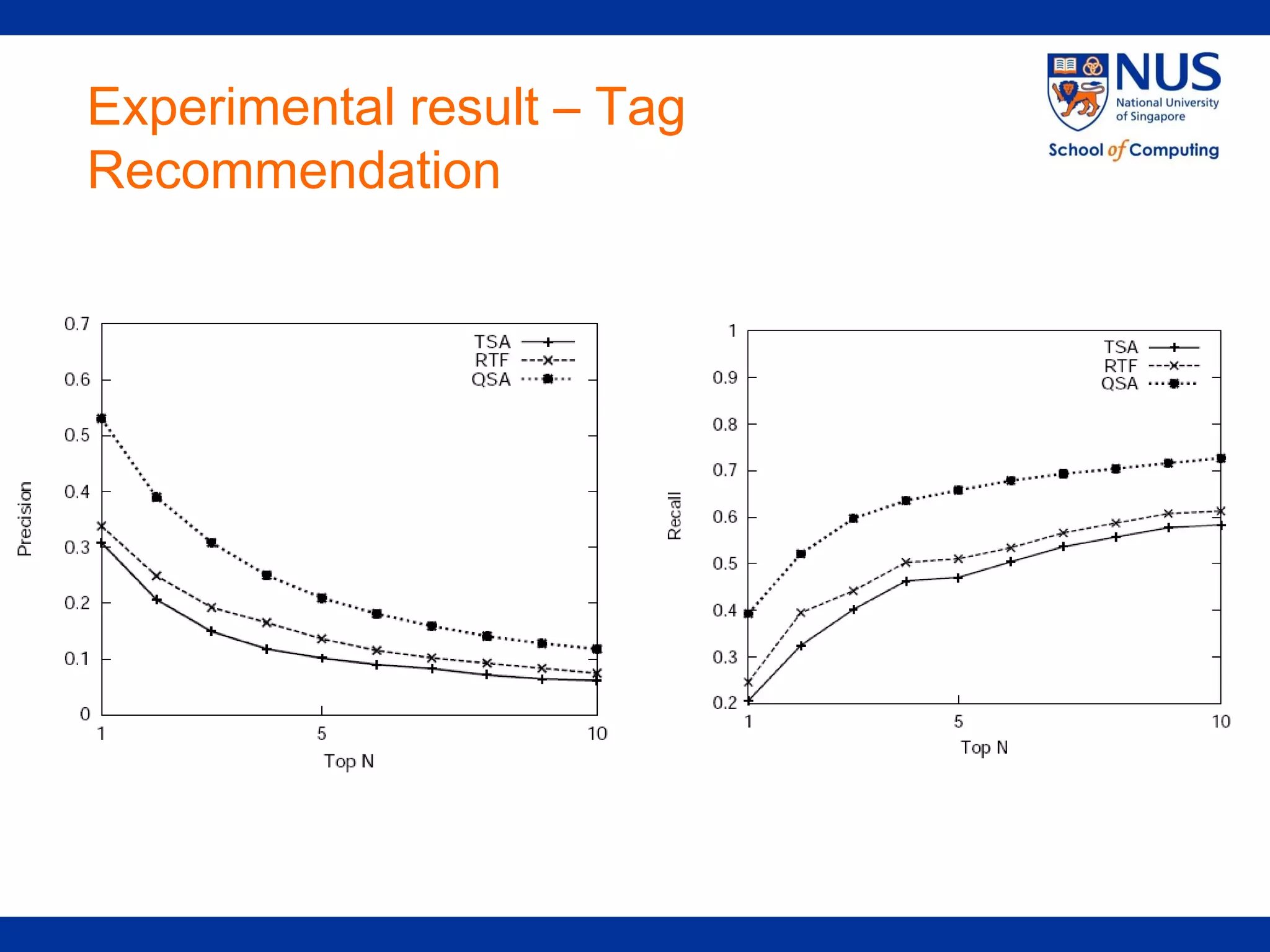
Experimental result – Tag
Recommendation

  Compare method:

 TSA [TKDE10]: Ternary Semantic Analysis

 RTF [KDD.09]: Optimal ranking using tensor
  factorization.
Experimental result – Tag
Recommendation
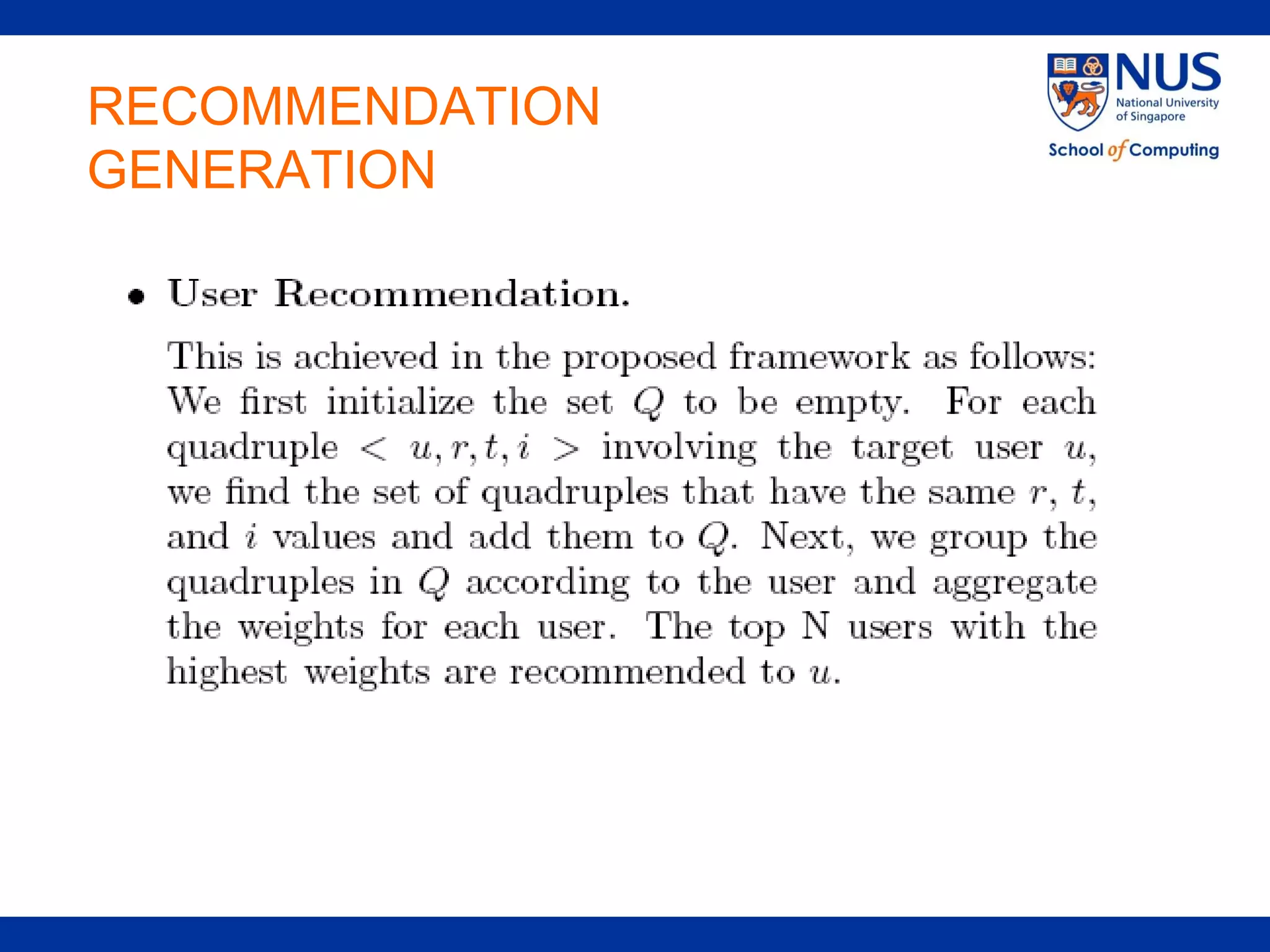
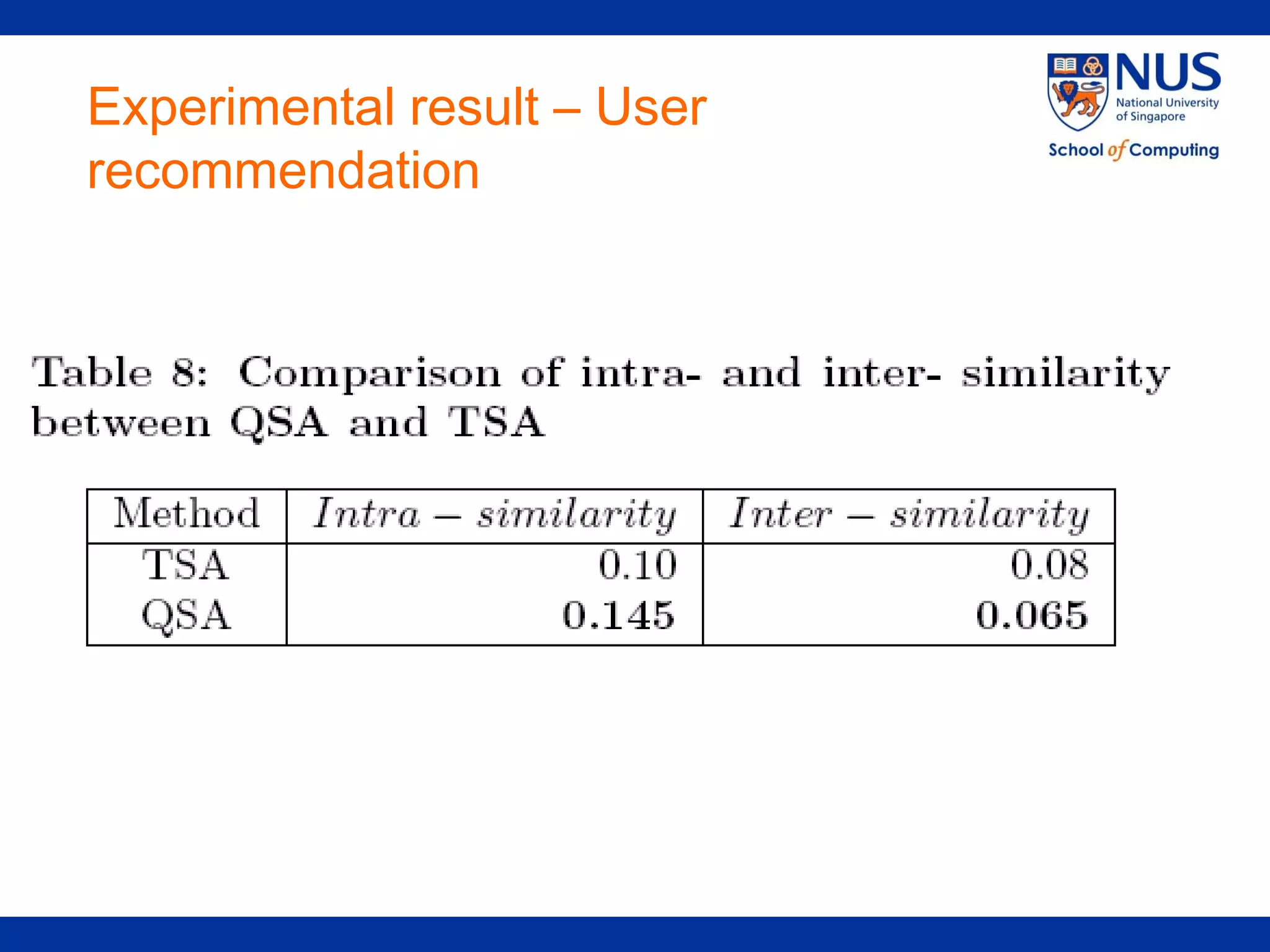
Experimental result – User
recommendation
Conclusion
 We have shown that quaternary semantic analysis
 can lead to more accurate recommendation.

 We have proposed using a 4-order tensor to model
 the four heterogeneous entities: users, items, tags
 and ratings.

 A unified framework is proposed that utilize
 quaternary relation for user recommendation, item
 recommendation, tag recommendation and rating
 prediction.
Thank you very much!
         


  Q/A


                       44

CSTalks-Quaternary Semantics Recomandation System-24 Aug

  • 1.
    A Unified Frameworkfor Recommendations Based on Quaternary Semantic Analysis Wei Chen*, Wynne Hsu*, Mong Li Lee* *School of Computing, National University of Singapore 1
  • 2.
    Introduction The amountof information on the web is increasing at a lightning pace. E.g products in Amazon, videos in Youtube, movies in Netflix Recommendation is necessary.
  • 3.
    Introduction Recommendationsystems are typically classified according to four types :  User recommendation  Item recommendation  Tag recommendation  Item rating prediction
  • 4.
    Related Work Most ofthe work in recommendation systems utilize only ternary relationships in generating recommendations. The collaborative filtering-based recommendation systems use <user ,rating, items > [B. Sarwar,WWW’01,SIGIR’09] Tag-based recommendation systems utilize the <users, tags, items >.
  • 5.
    Motivation We arguethat recommendations based on ternary relationships are not accurate as they would have missed out important associations
  • 6.
  • 7.
    Motivation Example Beautiful Mind and Groundhog day will be recommended to U3
  • 8.
  • 9.
    Motivation example GroundhogDay and Toy story will be recommended to U3
  • 10.
  • 11.
    Motivation example Groundhogday is recommended to U3
  • 12.
    Motivation Theneed of quaternary relationship is necessary. This is reinforced by the following observations:  Users may use the same tag for an item but have different ratings for it.  Items may have multiple tags indicating their different facets.  Some tags may carry implicit semantics that can reveal the users’ preferences.
  • 13.
    Overview of thepaper We propose a model: using tensor to model the quaternary relationship. Higher-Order Singular Value Decomposition (HOSVD) is applied in the 4-order tensor to reveal the latent semantic associations among users, items, tags and ratings.
  • 14.
    BACKGROUND - Tensor Atensor is a multidimensional array. An N-order tensor is denoted as
  • 15.
    BACKGROUND – Tensorunfolding The matrix unfolding of an N-order tensor along the dimension i are vectors obtained by keeping the index fixed while varying the other indices.
  • 16.
  • 17.
    BACKGROUND – HOSVD HOSVDis a generalization of Singular Value Decomposition (SVD) to higher-order tensors and can be written as n-mode product Where U(n) contain the orthonormal vectors (n- mode singular vector) spanning the column space of the A (n) , is the core tensor
  • 18.
  • 19.
    BACKGROUND – HOSVD Withthis, the core tensor can be constructed as described in [L. D.,SIAM 2000], that is and we can get:
  • 20.
    BACKGROUND- Rank, LowRank Approximation
  • 21.
    BACKGROUND Suppose we wantto get the RANK-(2,3,3) approximation, we first retain the first ci column of matrix U(i) at mode i as follows:
  • 22.
    BACKGROUND –Tensor Approximation We cannow construct the approximate core tensor using
  • 23.
    BACKGROUND Finally, we obtainthe RANK-(2,3,3) approximation
  • 24.
    QUATENARY SEMANTIC ANALYSIS The mainidea is to capture the underlying relationships among users-tags-items-ratings by reducing the rank of the original tensor to minimize the effect of noise on the underlying population and reduce spareness.
  • 25.
    QUATENARY SEMANTIC ANALYSIS -Initialization Input: list of quadruples < users, tags, rating, items>;
  • 26.
    QUATENARY SEMANTIC ANALYSIS -Initialization constructed tensor where |U|, |T|, |R| and |V| is the number of user, tags , ratings and items respectively
  • 27.
    QUATENARY SEMANTIC ANALYSIS Calculate the matrix unfolding A(1) , A(2) , A(3) and A(4) from Tensor Perform SVD on each matrix unfolding and get the left singular matrix U(1) , U(2) , U(3) and U(4)
  • 28.
    QUATENARY SEMANTIC ANALYSIS Remove theleast significant rows |U|-c1; |V |-c2; |T|-c3 and |R|-c4 from U(1);U(2);U(3); and U(4), respectively. We choose c1= 4; c2 =4; c3 = 4; c4 = 2.
  • 29.
    QUATENARY SEMANTIC ANALYSIS Calculate theapproximate core tensor Approximate the original tensor by:
  • 30.
  • 31.
    QUATENARY SEMANTIC ANALYSIS Latent associationssuch as the newly added quadruples in Table 6 may not be found if the tensor data is sparse We overcome this problem by applying a smoothing technique to the tensor in Algorithm.
  • 32.
  • 33.
  • 34.
  • 35.
  • 36.
    Experimental result –dataset description Datasets: Movielens Data The first file contains users’ tags on different movies. The second file contains users’ ratings on different movies on a scale of 1 to 5. By joining these two files over user and movie, we obtain the quadruples < user; movie; tag; rating >. After preprocessing, the dataset has 11122 tuples with 201 users, 501 movies, and 404 tags.
  • 37.
    Experimental result –Item Recommendation Compare method:  UPCC: User based recommendation  IPCC: Item based recommendation  Probabilistic Matrix Factorization (PMF)
  • 38.
    Experimental result –Item recommendation
  • 39.
    Experimental result –Rating Prediction
  • 40.
    Experimental result –Tag Recommendation Compare method:  TSA [TKDE10]: Ternary Semantic Analysis  RTF [KDD.09]: Optimal ranking using tensor factorization.
  • 41.
    Experimental result –Tag Recommendation
  • 42.
    Experimental result –User recommendation
  • 43.
    Conclusion We haveshown that quaternary semantic analysis can lead to more accurate recommendation. We have proposed using a 4-order tensor to model the four heterogeneous entities: users, items, tags and ratings. A unified framework is proposed that utilize quaternary relation for user recommendation, item recommendation, tag recommendation and rating prediction.
  • 44.
    Thank you verymuch!  Q/A 44