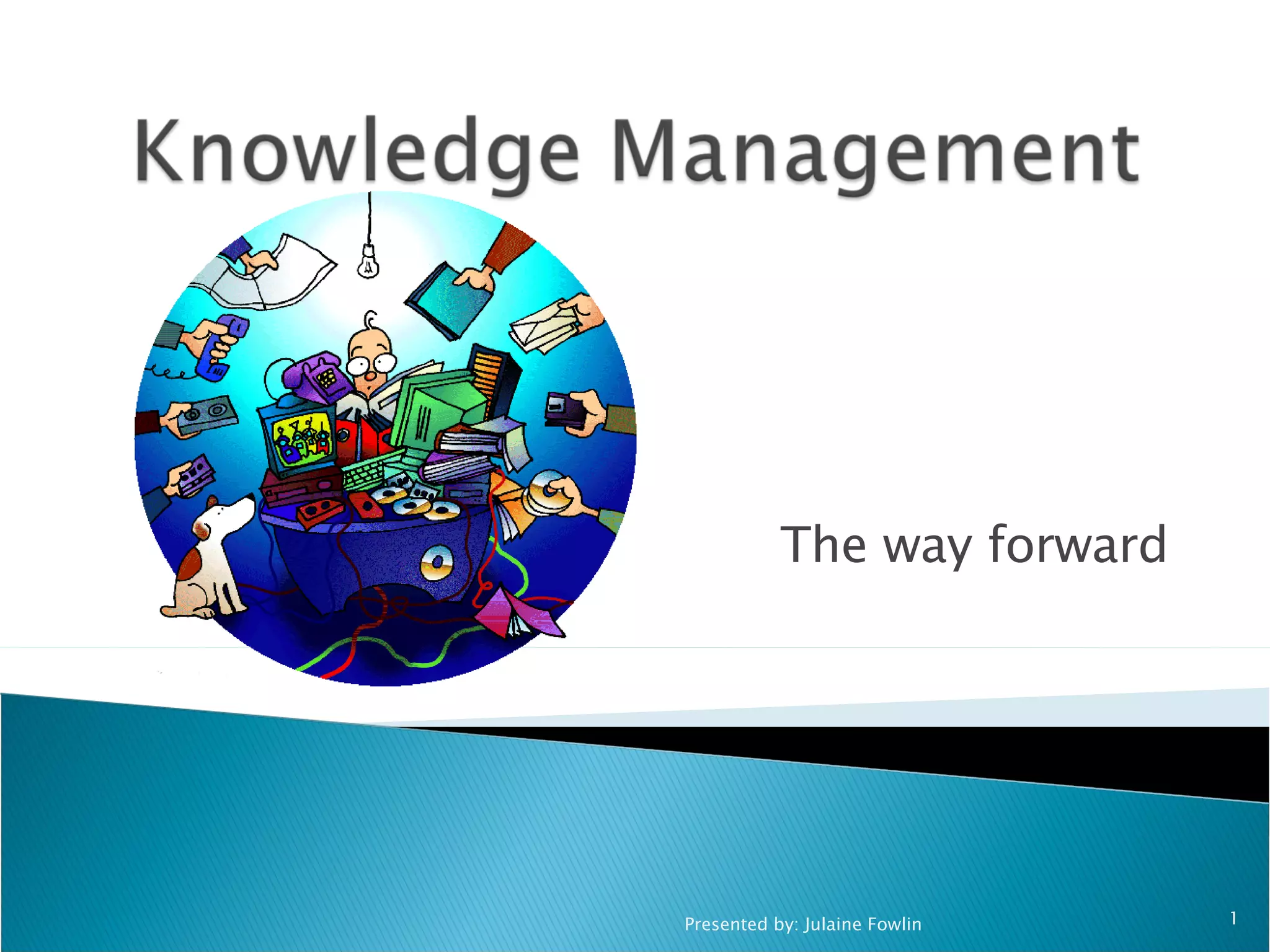
The way forward Presented by: Julaine Fowlin
What is our current organizational structure? We have offices across the united states Limited Collaboration between offices What is our current organizational culture? We are a training organization We are involved in the engineering and design of products. What do we want to have? Collaboration across offices Increase access to material (everything online) More effective teaching and learning processes
Much more than a user interface linked to information databases! Watch Video It involves experience, context and reflection According to Dr. McGraw, Knowledge Management is knowing what we know, capturing and organizing it and using it to produce returns.
 
 
Develop measurable business objectives.  The scope: Managing the development and deployment of training materials. Make sure all the stake holders are explicitly aware of the objectives. Ensure adequate leadership and monetary support Identify areas of possible resistance and address these.  Develop a knowledge management team
Identify key subject matter experts Have a core group (steering committee) and then sub groups based on expertise area. (Example, Technical skills and design tools, sales and marketing). All offices should have be represented in the team. Include outside consultants, vendor representatives and Knowledge Management experts.
Audit existing content Examine existing pedagogical strategies and content creation processes. Emphasize re-usability (SCORM).
 
Meta-Data:  Detailed information on content packaging Evaluation Re-use guidelines Writing Style and Editorial guidelines Update
Communication and Collaboration Open Source or Proprietary? Learning Management System (LMS) or Content Management System (CMS)? Help distinguishing between the two Authoring eXe (Open Source) Lectora (Proprietary)
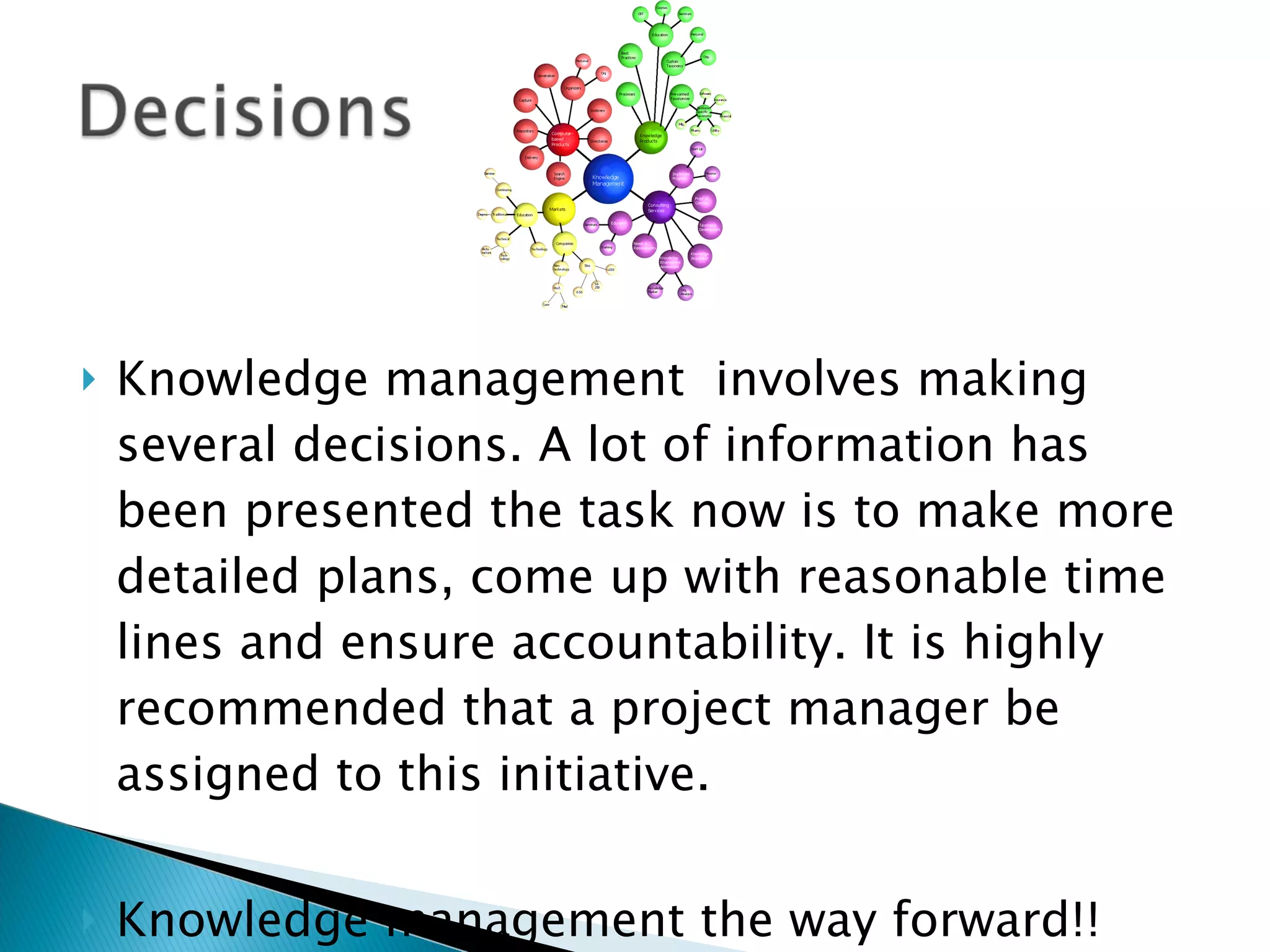
Knowledge management  involves making several decisions. A lot of information has been presented the task now is to make more detailed plans, come up with reasonable time lines and ensure accountability. It is highly recommended that a project manager be assigned to this initiative. Knowledge management the way forward!!
“ [Knowledge management] is not just a tool-set it’s a cultural revolution. The major implementation hurdle in a knowledge-sharing system is not the technology. It is getting people used to it. Sharing ideas freely is one thing when you are at a physical meeting and can see reaction. It is another when you are working electronically. . . .” —  Gig Griffith, Manager of Business Operations for Technical Services, Novell The biggest factor in the success of a knowledge-management initiative is a culture that embraces accountability . . . the support of the executive team, and the harmony between the concept of knowledge management and [thecompany’s] core values. —  Based on an interview with Matt McCabe, Director of Customer Service, dynamicsoft
“ What most organizations don’t realize is that they already have the ingredients of a knowledge culture. People are, by nature, social beings who spend much of their work day talking to each other, passing along information, and transferring knowledge in formal meetings. Much like communities of good friends, companies are made of knowledge communities, groups of employees who band together around work issues.” —Karen L. Case, Consultant, Knowledge and Content Management Group, IBM
Barritt, C. (2002). Learning Objects & ISD.  Performance Improvement, 41(7)  , 28-32. McGraw, K. (n.d.). Ten questions Executives should ask about Knowledge Management.  WhitePaper Cognitive Technologies  , 3-9. Primus Knowledge Solutions. (2002). Knowledge management best practices: turning information into corporate asset for call centers, help desk and other support environments.  White Paper  , 2-9. Talisma Coorporation. (2006). Knowledge Management Best Practices.  White Paper: Talisma  , 1-13.  

Knowledge Management

  • 1.
    The way forwardPresented by: Julaine Fowlin
  • 2.
    What is ourcurrent organizational structure? We have offices across the united states Limited Collaboration between offices What is our current organizational culture? We are a training organization We are involved in the engineering and design of products. What do we want to have? Collaboration across offices Increase access to material (everything online) More effective teaching and learning processes
  • 3.
    Much more thana user interface linked to information databases! Watch Video It involves experience, context and reflection According to Dr. McGraw, Knowledge Management is knowing what we know, capturing and organizing it and using it to produce returns.
  • 4.
  • 5.
  • 6.
    Develop measurable businessobjectives. The scope: Managing the development and deployment of training materials. Make sure all the stake holders are explicitly aware of the objectives. Ensure adequate leadership and monetary support Identify areas of possible resistance and address these. Develop a knowledge management team
  • 7.
    Identify key subjectmatter experts Have a core group (steering committee) and then sub groups based on expertise area. (Example, Technical skills and design tools, sales and marketing). All offices should have be represented in the team. Include outside consultants, vendor representatives and Knowledge Management experts.
  • 8.
    Audit existing contentExamine existing pedagogical strategies and content creation processes. Emphasize re-usability (SCORM).
  • 9.
  • 10.
    Meta-Data: Detailedinformation on content packaging Evaluation Re-use guidelines Writing Style and Editorial guidelines Update
  • 11.
    Communication and CollaborationOpen Source or Proprietary? Learning Management System (LMS) or Content Management System (CMS)? Help distinguishing between the two Authoring eXe (Open Source) Lectora (Proprietary)
  • 12.
    Knowledge management involves making several decisions. A lot of information has been presented the task now is to make more detailed plans, come up with reasonable time lines and ensure accountability. It is highly recommended that a project manager be assigned to this initiative. Knowledge management the way forward!!
  • 13.
    “ [Knowledge management]is not just a tool-set it’s a cultural revolution. The major implementation hurdle in a knowledge-sharing system is not the technology. It is getting people used to it. Sharing ideas freely is one thing when you are at a physical meeting and can see reaction. It is another when you are working electronically. . . .” — Gig Griffith, Manager of Business Operations for Technical Services, Novell The biggest factor in the success of a knowledge-management initiative is a culture that embraces accountability . . . the support of the executive team, and the harmony between the concept of knowledge management and [thecompany’s] core values. — Based on an interview with Matt McCabe, Director of Customer Service, dynamicsoft
  • 14.
    “ What mostorganizations don’t realize is that they already have the ingredients of a knowledge culture. People are, by nature, social beings who spend much of their work day talking to each other, passing along information, and transferring knowledge in formal meetings. Much like communities of good friends, companies are made of knowledge communities, groups of employees who band together around work issues.” —Karen L. Case, Consultant, Knowledge and Content Management Group, IBM
  • 15.
    Barritt, C. (2002).Learning Objects & ISD. Performance Improvement, 41(7) , 28-32. McGraw, K. (n.d.). Ten questions Executives should ask about Knowledge Management. WhitePaper Cognitive Technologies , 3-9. Primus Knowledge Solutions. (2002). Knowledge management best practices: turning information into corporate asset for call centers, help desk and other support environments. White Paper , 2-9. Talisma Coorporation. (2006). Knowledge Management Best Practices. White Paper: Talisma , 1-13.