Knowledge Management: Addressing Business Imperatives Vincent I. Polley    KnowConnect  PLLC  2009
Sound Familiar? Why do we keep having to re-learn this? How do I know where to find this knowledge? Someone mentioned that to me the other day; now who was it? Someone must have done this before – but who? When she left, she took all that knowledge with her. It was pure luck that I met him – he had just the answer I was looking for. That went very well – how do we repeat that success?  We made this mistake in our other office, too.
If only… If only we all knew what we each know. If only we could find it when we need it. If only we could learn who knows what. If only we never forgot.
Knowledge Management What is “ knowledge” ? What is knowledge management? Why do KM?  Why now? Examples:  Schlumberger/BP and The World Bank How to plan and implement a successful KM system
Information Knowledge Cases, Statutes, Treatises, Law Reviews Work product: forms, samples, checklists and precedents; files Corporate records (Articles, Minutes, etc.) Phone lists, calendars Law firm lists Presentations Legal websites Client information Policies Judges What is useful, what is not? What was the context?  Where is it? Quality of materials Advice you have given Who has done it before? Who knows who? Who is the expert?  Who is good, who is not? Presentation notes Missteps you have made Missteps others have made What has worked and what has not?  And, why?
Knowledge Management Definition Systematic approaches to help information and knowledge emerge and flow to the right people at the right time in the right context in the right amount at the right cost …  so they can act more efficiently and effectively.
A vision of how it works The United States Army
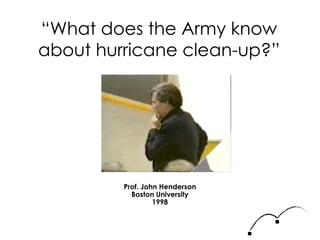
“ What does the Army know about hurricane clean-up?” Prof. John Henderson Boston University 1998
Organizational KM Drivers Cost Pressures Efficiency and Consistency Compliance Initiatives Flexibility and Responsiveness  Training and Learning Recruiting and Retaining People Knowledge Workplace and Professional Satisfaction
Examples Training new employees (e.g., making them more effective, faster) Control or reduction of external spending Use/re-use of work-product (whether internally developed, or by external service providers)—efficiency, consistency Reallocation of lower-value work to junior staff, freeing senior professionals Being able more effectively to compete with other employers for quality professionals Anticipating an “age bubble” of senior, experienced employees who will be retiring Closing/opening offices; moving staff closer to clients Adding new department services; supporting new business services Facilitating more dynamic work-allocation among existing professionals Improving morale; reducing attrition; promoting career development    KnowConnect PLLC 2008
Alignment Discussion What is driving the need for better knowledge sharing?  What’s keeping the CEO awake at night? What’s keeping the business managers awake at night? Reducing cost  Increasing efficiency Improving products & services Making better, faster decisions Professional and career development Time to competence Post-acquisition integration Innovation Productivity Information overload What else?
...and is there a KM component in possible solutions? What are the critical processes that suffer most from information and knowledge gaps?
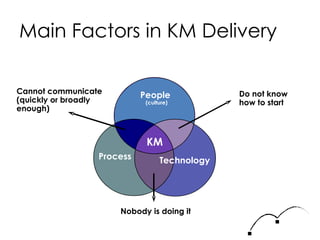
Main Factors in KM Delivery People  (culture) Technology Process KM Cannot communicate (quickly or broadly enough) Nobody is doing it Do not know how to start
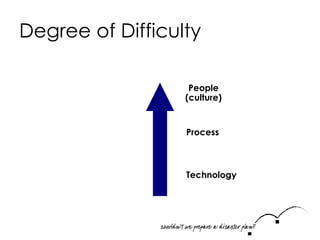
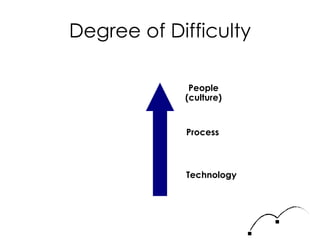
Degree of Difficulty Technology Process People (culture)
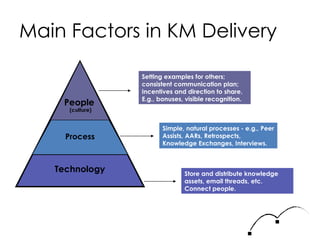
Main Factors in KM Delivery People  (culture) Process Technology Store and distribute knowledge assets, email threads, etc.  Connect people. Simple, natural processes - e.g., Peer Assists, AARs, Retrospects, Knowledge Exchanges, Interviews. Setting examples for others; consistent communication plan; Incentives and direction to share.  E.g., bonuses, visible recognition.
KM Elements Developing and using knowledge assets  Organizing and presenting knowledge assets to users efficiently  Systematically hosting tacit knowledge (who and what you know) Building and fostering communities of practice around operationally-important themes and areas of responsibility Enabling collaboration (within communities of practice and larger communities) Capturing and validating incidental knowledge produced as a by-product of community collaboration Nurturing a cooperative culture
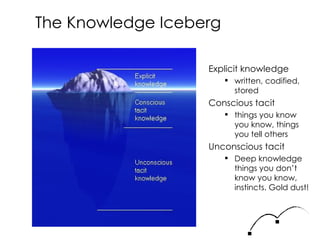
The Knowledge Iceberg Explicit knowledge written, codified, stored Conscious tacit things you know you know, things you tell others Unconscious tacit Deep knowledge things you don’t know you know, instincts. Gold dust!
Similar Initiatives Total Quality Management/Six Sigma Health, Safety, Environment These succeeded when they were embedded in the organization’s culture.  They became recognized contributors to the bottom line.
Is KM Technology? No  – technology only helps facilitate KM Classic KM techniques ( Peer Assists, Connecting People, AARs, Retrospects, and creation of Knowledge Assets ) do not require technology at all Technology  can  provide a force-multiplier … “the tipping point”  Technology … typically not more than 30% of KM costs
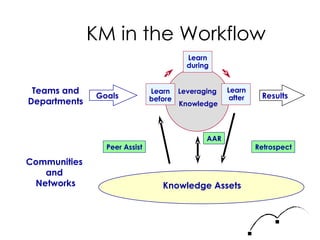
KM in the Workflow Communities  and  Networks Teams and Departments Leveraging    Knowledge Peer Assist Retrospect AAR Knowledge Assets Goals Results Learn during Learn after Learn before
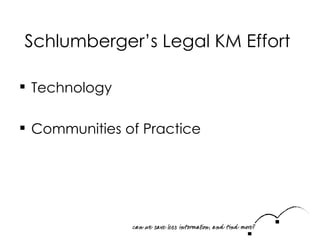
Schlumberger’s Legal KM Effort Technology  Communities of Practice
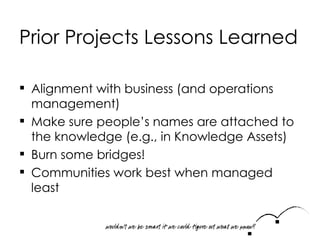
Prior Projects Lessons Learned Alignment with business (and operations management) Make sure people ’ s names are attached to the knowledge (e.g., in Knowledge Assets ) Burn some bridges! Communities work best when managed least
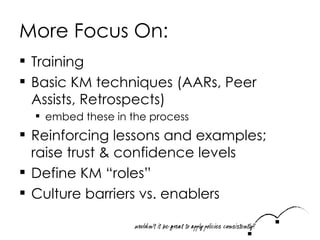
More Focus On: Training Basic KM techniques (AARs, Peer Assists, Retrospects) embed these in the process Reinforcing lessons and examples; raise trust & confidence levels Define KM “roles” Culture barriers vs. enablers
Degree of Difficulty Technology Process People (culture)
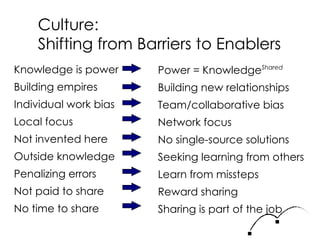
Culture:  Shifting from Barriers to Enablers Knowledge is power Building empires Individual work bias Local focus Not invented here Outside knowledge Penalizing errors Not paid to share No time to share Power = Knowledge Shared Building new relationships Team/collaborative bias Network focus No single-source solutions Seeking learning from others Learn from missteps Reward sharing Sharing is part of the job
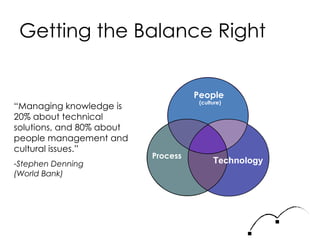
Getting the Balance Right People  (culture) Technology Process “ Managing knowledge is 20% about technical solutions, and 80% about people management and cultural issues.” Stephen Denning (World Bank)
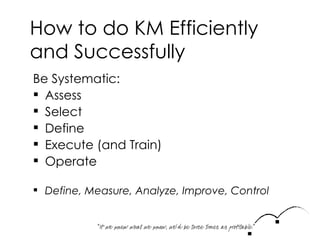
How to do KM Efficiently and Successfully Be Systematic: Assess Select Define Execute (and Train) Operate Define, Measure, Analyze, Improve, Control
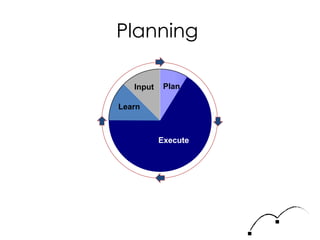
Planning  Execute Learn Input Plan
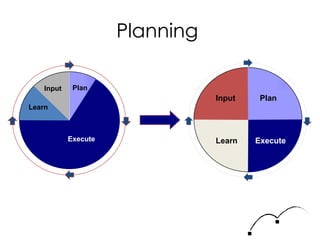
Planning  Input Plan Execute Learn Execute Learn Input Plan
Assessment Process Baseline (for improvement measure) Benchmark (for comparisons) Strengths Weaknesses
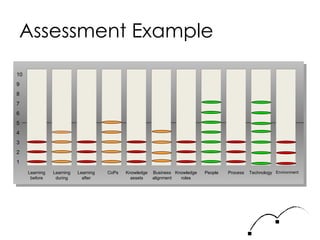
Assessment Example question 10 9 8 7 6 5 4 3 2 1 Learning before Learning during Learning after CoPs Knowledge assets Business alignment Knowledge roles People Process Technology Environment
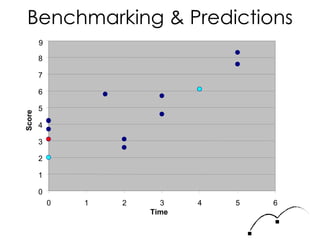
Benchmarking & Predictions 9 Time 0 1 2 3 4 5 6 7 8 0 1 2 3 4 5 6 Score
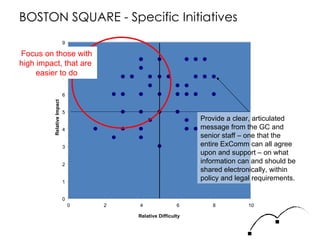
BOSTON SQUARE - Specific Initiatives Relative Difficulty 0 1 2 3 4 5 6 7 8 9 0 2 4 6 8 10 Relative Impact Focus on those with high impact, that are  easier to do Provide a clear, articulated message from the GC and senior staff – one that the entire ExComm can all agree upon and support – on what information can and should be shared electronically, within policy and legal requirements.
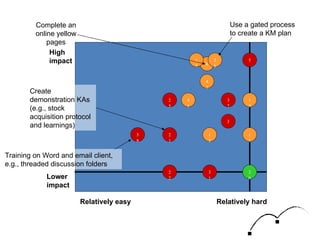
High impact  Lower impact  Relatively easy  Relatively hard  21 11 3 15 6 12 42 26 31 25 20 41 37 38 22 17 5 Use a gated process to create a KM plan Training on Word and email client, e.g., threaded discussion folders   Create demonstration KAs (e.g., stock acquisition protocol and learnings) Complete an online yellow pages
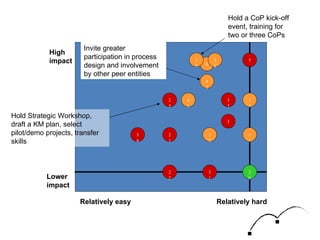
High impact  Lower impact  Relatively easy  Relatively hard  21 11 3 15 6 12 42 26 31 25 20 41 37 38 22 17 5 Hold a CoP kick-off event, training for two or three CoPs Hold Strategic Workshop, draft a KM plan, select pilot/demo projects, transfer skills Invite greater participation in process design and involvement by other peer entities
For More Information on KM Polley, "Share the Wealth: What Knowledge Management Could Mean to your Legal Department"  ABA Business Law Today Nov/Dec 2003 http://www.abanet.org/buslaw/blt/2003-11-12/polley.shtml   and www.knowconnect.com
Questions & Discussion More questions? Contact me.

High Level KM Overview Presentation Public

  • 1.
    Knowledge Management: AddressingBusiness Imperatives Vincent I. Polley  KnowConnect PLLC 2009
  • 2.
    Sound Familiar? Whydo we keep having to re-learn this? How do I know where to find this knowledge? Someone mentioned that to me the other day; now who was it? Someone must have done this before – but who? When she left, she took all that knowledge with her. It was pure luck that I met him – he had just the answer I was looking for. That went very well – how do we repeat that success? We made this mistake in our other office, too.
  • 3.
    If only… Ifonly we all knew what we each know. If only we could find it when we need it. If only we could learn who knows what. If only we never forgot.
  • 4.
    Knowledge Management Whatis “ knowledge” ? What is knowledge management? Why do KM? Why now? Examples: Schlumberger/BP and The World Bank How to plan and implement a successful KM system
  • 5.
    Information Knowledge Cases,Statutes, Treatises, Law Reviews Work product: forms, samples, checklists and precedents; files Corporate records (Articles, Minutes, etc.) Phone lists, calendars Law firm lists Presentations Legal websites Client information Policies Judges What is useful, what is not? What was the context? Where is it? Quality of materials Advice you have given Who has done it before? Who knows who? Who is the expert? Who is good, who is not? Presentation notes Missteps you have made Missteps others have made What has worked and what has not? And, why?
  • 6.
    Knowledge Management DefinitionSystematic approaches to help information and knowledge emerge and flow to the right people at the right time in the right context in the right amount at the right cost … so they can act more efficiently and effectively.
  • 7.
    A vision ofhow it works The United States Army
  • 8.
    “ What doesthe Army know about hurricane clean-up?” Prof. John Henderson Boston University 1998
  • 9.
    Organizational KM DriversCost Pressures Efficiency and Consistency Compliance Initiatives Flexibility and Responsiveness Training and Learning Recruiting and Retaining People Knowledge Workplace and Professional Satisfaction
  • 10.
    Examples Training newemployees (e.g., making them more effective, faster) Control or reduction of external spending Use/re-use of work-product (whether internally developed, or by external service providers)—efficiency, consistency Reallocation of lower-value work to junior staff, freeing senior professionals Being able more effectively to compete with other employers for quality professionals Anticipating an “age bubble” of senior, experienced employees who will be retiring Closing/opening offices; moving staff closer to clients Adding new department services; supporting new business services Facilitating more dynamic work-allocation among existing professionals Improving morale; reducing attrition; promoting career development  KnowConnect PLLC 2008
  • 11.
    Alignment Discussion Whatis driving the need for better knowledge sharing? What’s keeping the CEO awake at night? What’s keeping the business managers awake at night? Reducing cost Increasing efficiency Improving products & services Making better, faster decisions Professional and career development Time to competence Post-acquisition integration Innovation Productivity Information overload What else?
  • 12.
    ...and is therea KM component in possible solutions? What are the critical processes that suffer most from information and knowledge gaps?
  • 13.
    Main Factors inKM Delivery People (culture) Technology Process KM Cannot communicate (quickly or broadly enough) Nobody is doing it Do not know how to start
  • 14.
    Degree of DifficultyTechnology Process People (culture)
  • 15.
    Main Factors inKM Delivery People (culture) Process Technology Store and distribute knowledge assets, email threads, etc. Connect people. Simple, natural processes - e.g., Peer Assists, AARs, Retrospects, Knowledge Exchanges, Interviews. Setting examples for others; consistent communication plan; Incentives and direction to share. E.g., bonuses, visible recognition.
  • 16.
    KM Elements Developingand using knowledge assets Organizing and presenting knowledge assets to users efficiently Systematically hosting tacit knowledge (who and what you know) Building and fostering communities of practice around operationally-important themes and areas of responsibility Enabling collaboration (within communities of practice and larger communities) Capturing and validating incidental knowledge produced as a by-product of community collaboration Nurturing a cooperative culture
  • 17.
    The Knowledge IcebergExplicit knowledge written, codified, stored Conscious tacit things you know you know, things you tell others Unconscious tacit Deep knowledge things you don’t know you know, instincts. Gold dust!
  • 18.
    Similar Initiatives TotalQuality Management/Six Sigma Health, Safety, Environment These succeeded when they were embedded in the organization’s culture. They became recognized contributors to the bottom line.
  • 19.
    Is KM Technology?No – technology only helps facilitate KM Classic KM techniques ( Peer Assists, Connecting People, AARs, Retrospects, and creation of Knowledge Assets ) do not require technology at all Technology can provide a force-multiplier … “the tipping point” Technology … typically not more than 30% of KM costs
  • 20.
    KM in theWorkflow Communities and Networks Teams and Departments Leveraging Knowledge Peer Assist Retrospect AAR Knowledge Assets Goals Results Learn during Learn after Learn before
  • 21.
    Schlumberger’s Legal KMEffort Technology Communities of Practice
  • 22.
    Prior Projects LessonsLearned Alignment with business (and operations management) Make sure people ’ s names are attached to the knowledge (e.g., in Knowledge Assets ) Burn some bridges! Communities work best when managed least
  • 23.
    More Focus On:Training Basic KM techniques (AARs, Peer Assists, Retrospects) embed these in the process Reinforcing lessons and examples; raise trust & confidence levels Define KM “roles” Culture barriers vs. enablers
  • 24.
    Degree of DifficultyTechnology Process People (culture)
  • 25.
    Culture: Shiftingfrom Barriers to Enablers Knowledge is power Building empires Individual work bias Local focus Not invented here Outside knowledge Penalizing errors Not paid to share No time to share Power = Knowledge Shared Building new relationships Team/collaborative bias Network focus No single-source solutions Seeking learning from others Learn from missteps Reward sharing Sharing is part of the job
  • 26.
    Getting the BalanceRight People (culture) Technology Process “ Managing knowledge is 20% about technical solutions, and 80% about people management and cultural issues.” Stephen Denning (World Bank)
  • 27.
    How to doKM Efficiently and Successfully Be Systematic: Assess Select Define Execute (and Train) Operate Define, Measure, Analyze, Improve, Control
  • 28.
    Planning ExecuteLearn Input Plan
  • 29.
    Planning InputPlan Execute Learn Execute Learn Input Plan
  • 30.
    Assessment Process Baseline(for improvement measure) Benchmark (for comparisons) Strengths Weaknesses
  • 31.
    Assessment Example question10 9 8 7 6 5 4 3 2 1 Learning before Learning during Learning after CoPs Knowledge assets Business alignment Knowledge roles People Process Technology Environment
  • 32.
    Benchmarking & Predictions9 Time 0 1 2 3 4 5 6 7 8 0 1 2 3 4 5 6 Score
  • 33.
    BOSTON SQUARE -Specific Initiatives Relative Difficulty 0 1 2 3 4 5 6 7 8 9 0 2 4 6 8 10 Relative Impact Focus on those with high impact, that are easier to do Provide a clear, articulated message from the GC and senior staff – one that the entire ExComm can all agree upon and support – on what information can and should be shared electronically, within policy and legal requirements.
  • 34.
    High impact Lower impact Relatively easy Relatively hard 21 11 3 15 6 12 42 26 31 25 20 41 37 38 22 17 5 Use a gated process to create a KM plan Training on Word and email client, e.g., threaded discussion folders Create demonstration KAs (e.g., stock acquisition protocol and learnings) Complete an online yellow pages
  • 35.
    High impact Lower impact Relatively easy Relatively hard 21 11 3 15 6 12 42 26 31 25 20 41 37 38 22 17 5 Hold a CoP kick-off event, training for two or three CoPs Hold Strategic Workshop, draft a KM plan, select pilot/demo projects, transfer skills Invite greater participation in process design and involvement by other peer entities
  • 36.
    For More Informationon KM Polley, "Share the Wealth: What Knowledge Management Could Mean to your Legal Department" ABA Business Law Today Nov/Dec 2003 http://www.abanet.org/buslaw/blt/2003-11-12/polley.shtml and www.knowconnect.com
  • 37.
    Questions & DiscussionMore questions? Contact me.

Editor's Notes

  • #2 Vincent I. Polley (26b09) [email_address] +1-248-631-6271