Download as PDF, PPTX







The document discusses Bayesian belief networks (BBNs), which represent probabilistic relationships between variables. BBNs consist of a directed acyclic graph showing the dependencies between nodes/variables, and conditional probability tables quantifying the effects. They allow representing conditional independence between non-descendant variables given parents. The document provides an example BBN modeling a home alarm system and neighbors calling police. It then shows calculations to find the probability of a burglary given one neighbor called police using the network. Advantages are handling incomplete data, learning causation, and using prior knowledge, while a disadvantage is more complex graph construction.
Introduction of Bayesian Belief Networks and presenter details from NIT Rourkela.
Outline of key topics including definition, construction, advantages, and examples of Bayesian Belief Networks.
Discusses the purpose of Bayesian Belief Networks in representing probabilistic relationships.
Definition of Bayesian Networks, including its components: directed acyclic graph and conditional probability tables.
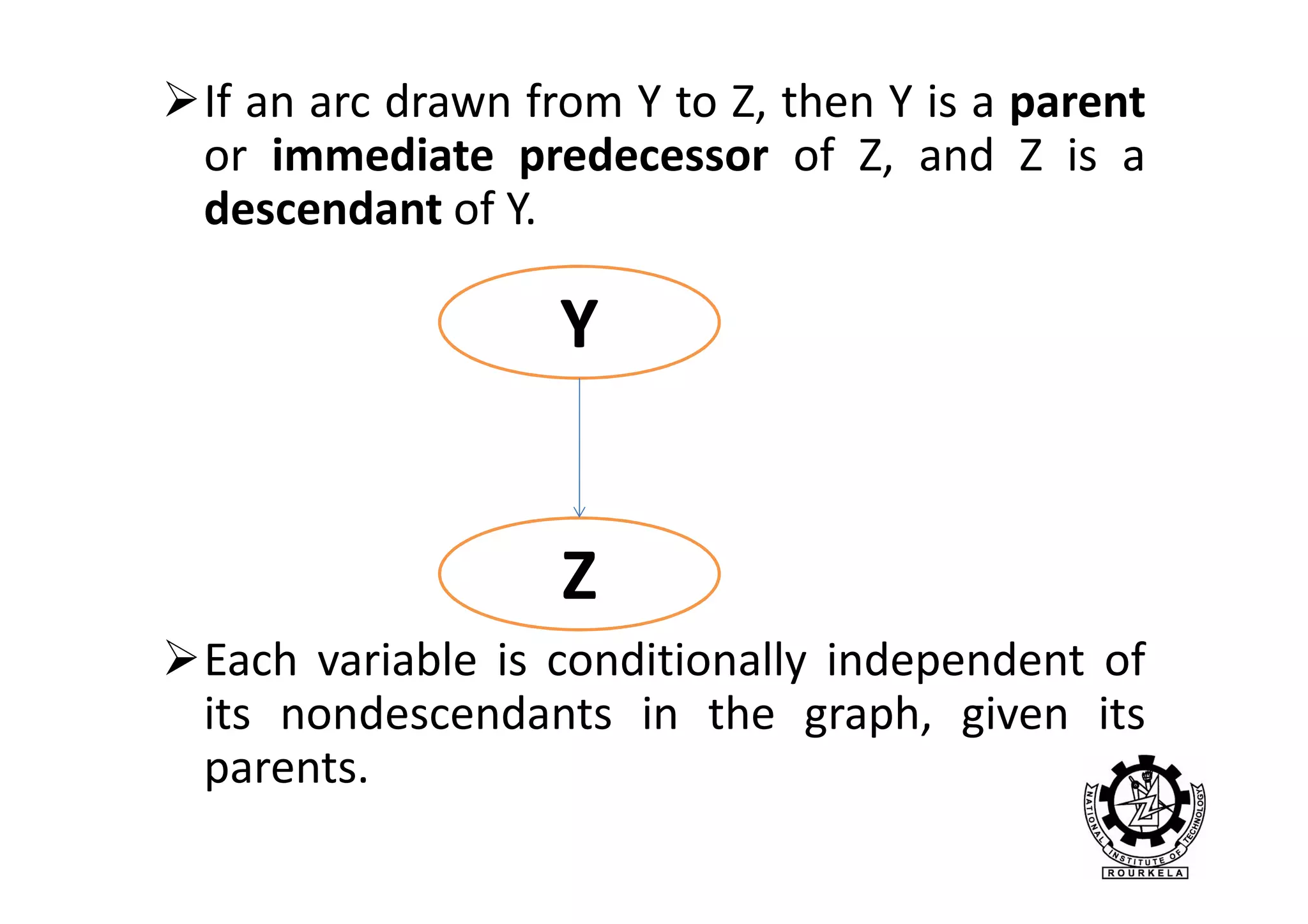
Explains parent-child relationships in Bayesian Networks and the concept of conditional independence.
Describes the process to build Bayesian Networks with relevant variables and defining structures.
Mathematical representation of conditional independence in Bayesian Networks.
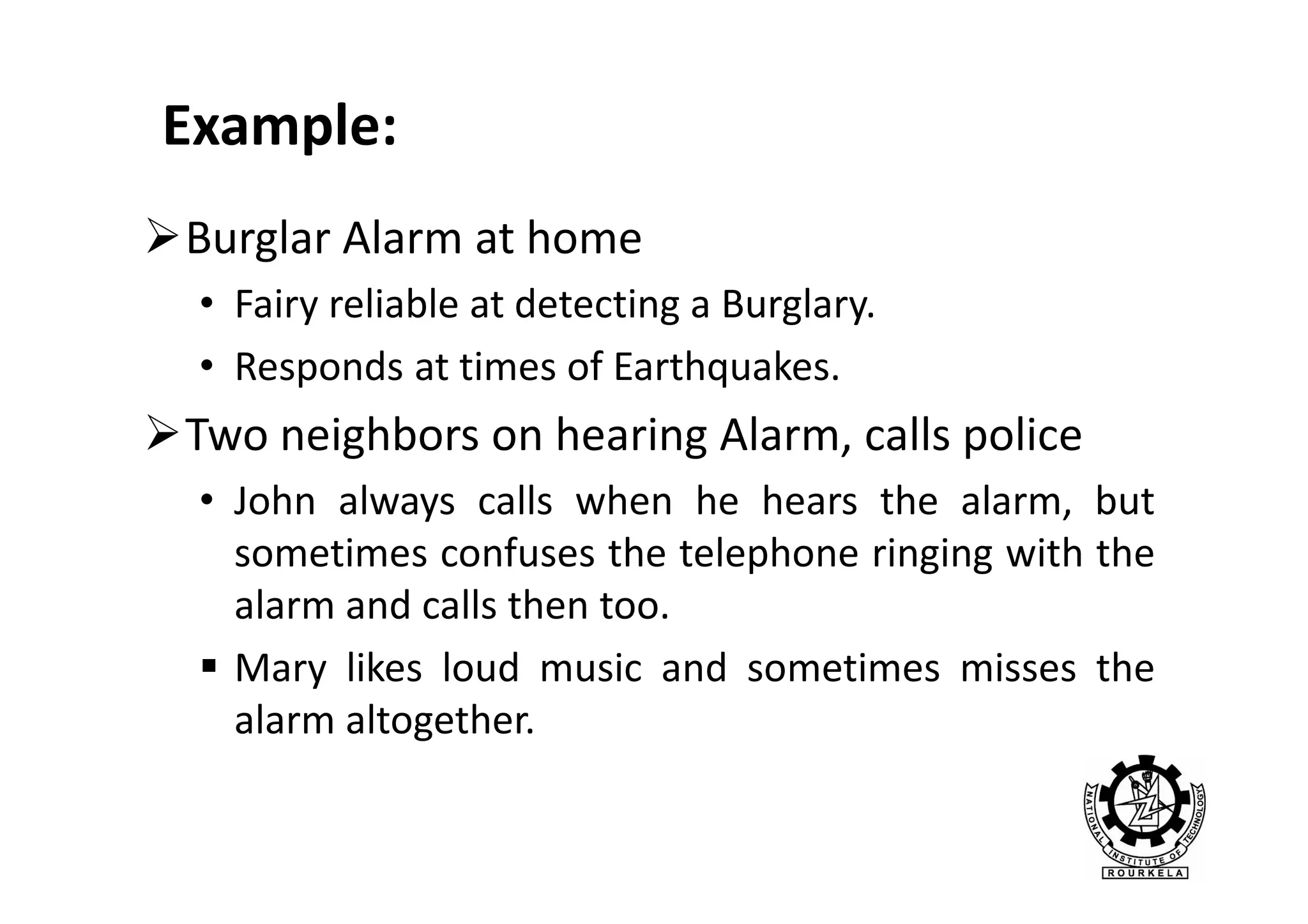
Real-world example of a burglar alarm scenario illustrating Bayesian thinking and the associated probabilities.
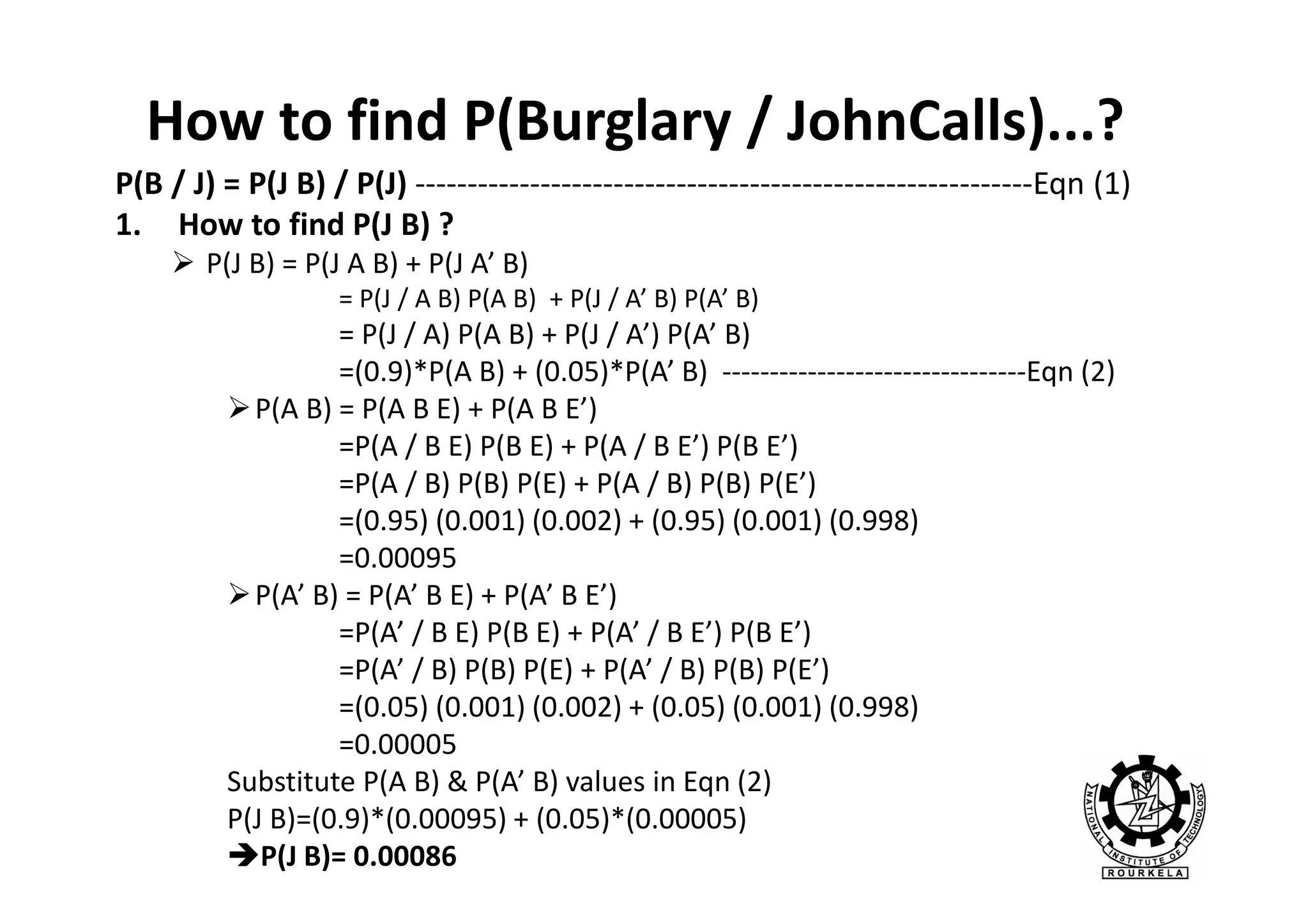
Detailed equations for calculating probabilities in a Bayesian Network, demonstrating the methodology.
Lists advantages such as handling incomplete data and disadvantages like graph complexity in Bayesian Networks.
Conclusion emphasizing that Bayesian Networks effectively represent conditional independence.
Invitation for queries and thank you note from the presenter.


