K-means Clustering:
Algorithm, Evaluation Methods, and Graph
Hello!
I am Iffat Firozy
I am here because I love to
teach.
2
“
We are given a data set of items, with certain features, and
values for these features (like a vector). The task is to
categorize those items into groups. To achieve this, we will
use the kMeans algorithm; an unsupervised learning
algorithm.
3
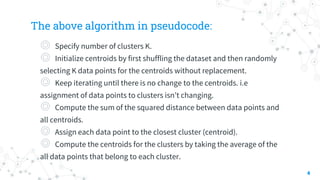
The above algorithm in pseudocode:
◎ Specify number of clusters K.
◎ Initialize centroids by first shuffling the dataset and then randomly
selecting K data points for the centroids without replacement.
◎ Keep iterating until there is no change to the centroids. i.e
assignment of data points to clusters isn’t changing.
◎ Compute the sum of the squared distance between data points and
all centroids.
◎ Assign each data point to the closest cluster (centroid).
◎ Compute the centroids for the clusters by taking the average of the
all data points that belong to each cluster.
4
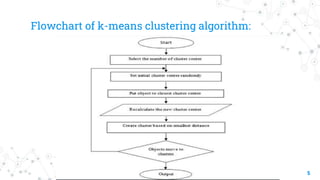
Flowchart of k-means clustering algorithm:
5
LETS’ SOLVE A PROBLEM
6
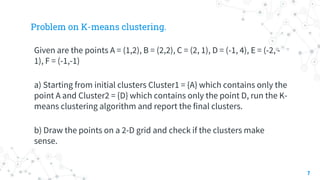
Problem on K-means clustering.
Given are the points A = (1,2), B = (2,2), C = (2, 1), D = (-1, 4), E = (-2, -
1), F = (-1,-1)
a) Starting from initial clusters Cluster1 = {A} which contains only the
point A and Cluster2 = {D} which contains only the point D, run the K-
means clustering algorithm and report the final clusters.
b) Draw the points on a 2-D grid and check if the clusters make
sense.
7
Initially:
8
X Y
A 1 2
B 2 2
C 2 1
D -1 4
E -2 -1
F -1 -1
CLUSTER X Y CENTROID ASSIGHNMENT
K1 1 2 1,2 1
K2 -1 4 -1,4 2
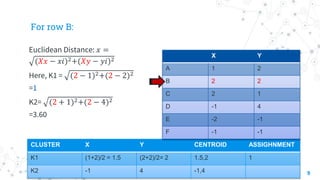
For row B:
Euclidean Distance: 𝑥 =
(𝑋𝑥 − 𝑥𝑖)2+(𝑋𝑦 − 𝑦𝑖)2
Here, K1 = (2 − 1)2+(2 − 2)2
=1
K2= (2 + 1)2+(2 − 4)2
=3.60
9
CLUSTER X Y CENTROID ASSIGHNMENT
K1 (1+2)/2 = 1.5 (2+2)/2= 2 1.5,2 1
K2 -1 4 -1,4
X Y
A 1 2
B 2 2
C 2 1
D -1 4
E -2 -1
F -1 -1
For row C:
Distance: 𝑥 =
(𝑋𝑥 − 𝑥𝑖)2+(𝑋𝑦 − 𝑦𝑖)2
Here, K1 = (2 − 1.5)2+(1 − 2)2
=1.11
K2= (2 + 1)2+(1 − 4)2
=4.24
10
CLUSTER X Y CENTROID ASSIGHNMENT
K1 (1.5+2)/2 = 1.75 (2+1)/2 = 1.5 1.75,1.5 1
K2 -1 4 -1,4
X Y
A 1 2
B 2 2
C 2 1
D -1 4
E -2 -1
F -1 -1
For row E:
Distance: 𝑥 =
(𝑋𝑥 − 𝑥𝑖)2+(𝑋𝑦 − 𝑦𝑖)2
Here, K1 =
(−2 − 1.75)2+(−1 − 1.5)2
=4.50
K2= (−2 + 1)2+(−1 − 4)2
=5.09
11
CLUSTER X Y CENTROID ASSIGHNMENT
K1 (1.75-2)/2 = -
0.125
(1.5-1)/2 = 0.25 -0.125, 0.25 1
K2 -1 4 -1,4
X Y
A 1 2
B 2 2
C 2 1
D -1 4
E -2 -1
F -1 -4
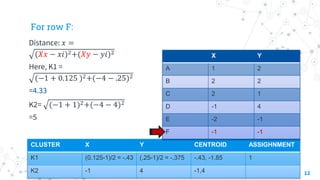
For row F:
Distance: 𝑥 =
(𝑋𝑥 − 𝑥𝑖)2+(𝑋𝑦 − 𝑦𝑖)2
Here, K1 =
(−1 + 0.125 )2+(−4 − .25)2
=4.33
K2= (−1 + 1)2+(−4 − 4)2
=5
12
CLUSTER X Y CENTROID ASSIGHNMENT
K1 (0.125-1)/2 = -.43 (.25-1)/2 = -.375 -.43, -1.85 1
K2 -1 4 -1,4
X Y
A 1 2
B 2 2
C 2 1
D -1 4
E -2 -1
F -1 -1
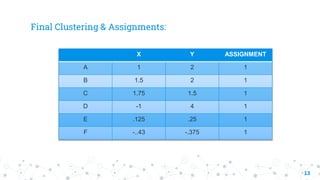
Final Clustering & Assignments:
13
X Y ASSIGNMENT
A 1 2 1
B 1.5 2 1
C 1.75 1.5 1
D -1 4 1
E .125 .25 1
F -..43 -.375 1
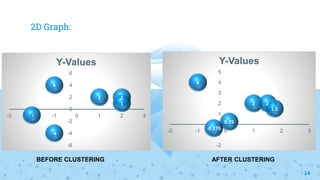
2D Graph:
14
2 2
1
4
-1
-4
-6
-4
-2
0
2
4
6
-3 -2 -1 0 1 2 3
Y-Values
2 2
1.5
4
0.25
-0.375
-2
-1
0
1
2
3
4
5
-2 -1 0 1 2 3
Y-Values
AFTER CLUSTERINGBEFORE CLUSTERING
Thanks!
Any questions?
You can find me at:
ifirozy@gmail.com
15

K-means Clustering || Data Mining

  • 1.
  • 2.
    Hello! I am IffatFirozy I am here because I love to teach. 2
  • 3.
    “ We are givena data set of items, with certain features, and values for these features (like a vector). The task is to categorize those items into groups. To achieve this, we will use the kMeans algorithm; an unsupervised learning algorithm. 3
  • 4.
    The above algorithmin pseudocode: ◎ Specify number of clusters K. ◎ Initialize centroids by first shuffling the dataset and then randomly selecting K data points for the centroids without replacement. ◎ Keep iterating until there is no change to the centroids. i.e assignment of data points to clusters isn’t changing. ◎ Compute the sum of the squared distance between data points and all centroids. ◎ Assign each data point to the closest cluster (centroid). ◎ Compute the centroids for the clusters by taking the average of the all data points that belong to each cluster. 4
  • 5.
    Flowchart of k-meansclustering algorithm: 5
  • 6.
    LETS’ SOLVE APROBLEM 6
  • 7.
    Problem on K-meansclustering. Given are the points A = (1,2), B = (2,2), C = (2, 1), D = (-1, 4), E = (-2, - 1), F = (-1,-1) a) Starting from initial clusters Cluster1 = {A} which contains only the point A and Cluster2 = {D} which contains only the point D, run the K- means clustering algorithm and report the final clusters. b) Draw the points on a 2-D grid and check if the clusters make sense. 7
  • 8.
    Initially: 8 X Y A 12 B 2 2 C 2 1 D -1 4 E -2 -1 F -1 -1 CLUSTER X Y CENTROID ASSIGHNMENT K1 1 2 1,2 1 K2 -1 4 -1,4 2
  • 9.
    For row B: EuclideanDistance: 𝑥 = (𝑋𝑥 − 𝑥𝑖)2+(𝑋𝑦 − 𝑦𝑖)2 Here, K1 = (2 − 1)2+(2 − 2)2 =1 K2= (2 + 1)2+(2 − 4)2 =3.60 9 CLUSTER X Y CENTROID ASSIGHNMENT K1 (1+2)/2 = 1.5 (2+2)/2= 2 1.5,2 1 K2 -1 4 -1,4 X Y A 1 2 B 2 2 C 2 1 D -1 4 E -2 -1 F -1 -1
  • 10.
    For row C: Distance:𝑥 = (𝑋𝑥 − 𝑥𝑖)2+(𝑋𝑦 − 𝑦𝑖)2 Here, K1 = (2 − 1.5)2+(1 − 2)2 =1.11 K2= (2 + 1)2+(1 − 4)2 =4.24 10 CLUSTER X Y CENTROID ASSIGHNMENT K1 (1.5+2)/2 = 1.75 (2+1)/2 = 1.5 1.75,1.5 1 K2 -1 4 -1,4 X Y A 1 2 B 2 2 C 2 1 D -1 4 E -2 -1 F -1 -1
  • 11.
    For row E: Distance:𝑥 = (𝑋𝑥 − 𝑥𝑖)2+(𝑋𝑦 − 𝑦𝑖)2 Here, K1 = (−2 − 1.75)2+(−1 − 1.5)2 =4.50 K2= (−2 + 1)2+(−1 − 4)2 =5.09 11 CLUSTER X Y CENTROID ASSIGHNMENT K1 (1.75-2)/2 = - 0.125 (1.5-1)/2 = 0.25 -0.125, 0.25 1 K2 -1 4 -1,4 X Y A 1 2 B 2 2 C 2 1 D -1 4 E -2 -1 F -1 -4
  • 12.
    For row F: Distance:𝑥 = (𝑋𝑥 − 𝑥𝑖)2+(𝑋𝑦 − 𝑦𝑖)2 Here, K1 = (−1 + 0.125 )2+(−4 − .25)2 =4.33 K2= (−1 + 1)2+(−4 − 4)2 =5 12 CLUSTER X Y CENTROID ASSIGHNMENT K1 (0.125-1)/2 = -.43 (.25-1)/2 = -.375 -.43, -1.85 1 K2 -1 4 -1,4 X Y A 1 2 B 2 2 C 2 1 D -1 4 E -2 -1 F -1 -1
  • 13.
    Final Clustering &Assignments: 13 X Y ASSIGNMENT A 1 2 1 B 1.5 2 1 C 1.75 1.5 1 D -1 4 1 E .125 .25 1 F -..43 -.375 1
  • 14.
    2D Graph: 14 2 2 1 4 -1 -4 -6 -4 -2 0 2 4 6 -3-2 -1 0 1 2 3 Y-Values 2 2 1.5 4 0.25 -0.375 -2 -1 0 1 2 3 4 5 -2 -1 0 1 2 3 Y-Values AFTER CLUSTERINGBEFORE CLUSTERING
  • 15.
    Thanks! Any questions? You canfind me at: ifirozy@gmail.com 15