




Copyright © 2017, edureka and/or its affiliates. All rights reserved.
▪ What is Clustering?
▪ Types of Clustering
▪ What is K- Means Clustering?
▪ How does a K-Means Algorithm works?
▪ K-Means with Python
Copyright © 2018, edureka and/or its affiliates. All rights reserved.
Agenda of Today’s Session
Copyright © 2018, edureka and/or its affiliates. All rights reserved.
What is Clustering?
“Clustering is the process of dividing the datasets
into groups, consisting of similar data-points”
What is
Clustering? ▪ Points in the same group are
as similar as possible
▪ Points in different group are
as dissimilar as possible
What is
Clustering?
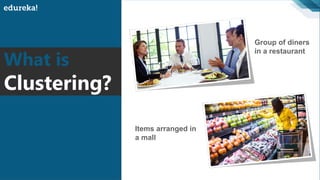
Group of diners
in a restaurant
Items arranged in
a mall
Where is it
Used?
Recommendation System
Recommended Movies
Fickr’s Photos
How
business use
Clustering?
Insurance
Companies
Retail Store
Banking
Types of
Clustering
Exclusive Clustering
Overlapping Clustering
Hierarchical Clustering
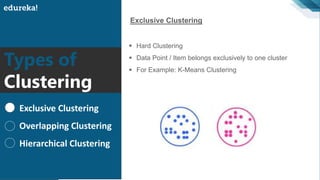
Exclusive Clustering
▪ Hard Clustering
▪ Data Point / Item belongs exclusively to one cluster
▪ For Example: K-Means Clustering
Types of
Clustering
Exclusive Clustering
Overlapping Clustering
Hierarchical Clustering
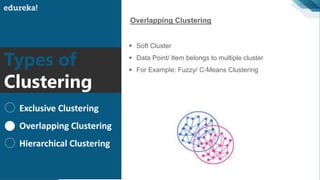
Overlapping Clustering
▪ Soft Cluster
▪ Data Point/ Item belongs to multiple cluster
▪ For Example: Fuzzy/ C-Means Clustering
Types of
Clustering
Exclusive Clustering
Overlapping Clustering
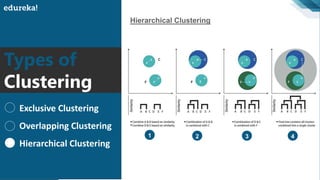
Hierarchical Clustering
1 2 3 4
What is
K-Means
Clustering?
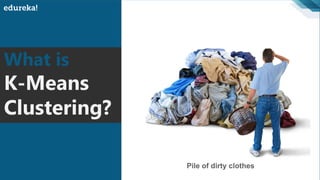
“K-Means is a clustering algorithm whose mail goal is
to group similar elements or data points into a
cluster.”
NOTE: ‘K’ in K-Means represent the number of clusters
What is
K-Means
Clustering?
Pile of dirty clothes
Where Can I
apply
K-Means?
https://gifer.com/en/Ckp3
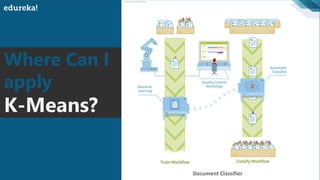
Document Classifier
K-Means
Algorithm
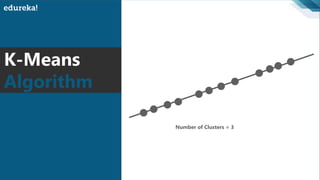
Number of Clusters = 3
K-Means
Algorithm
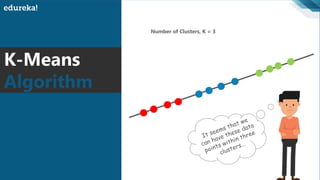
Number of Clusters, K = 3
K-Means
Algorithm
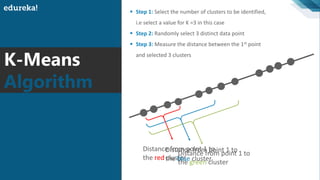
Distance from point 1 to
the red cluster
Distance from point 1 to
the blue cluster
Distance from point 1 to
the green cluster
▪ Step 1: Select the number of clusters to be identified,
i.e select a value for K =3 in this case
▪ Step 2: Randomly select 3 distinct data point
▪ Step 3: Measure the distance between the 1st point
and selected 3 clusters
K-Means
Algorithm
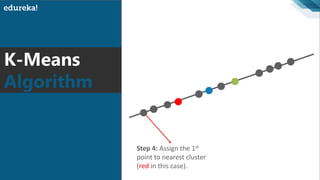
Step 4: Assign the 1st
point to nearest cluster
(red in this case).
K-Means
Algorithm
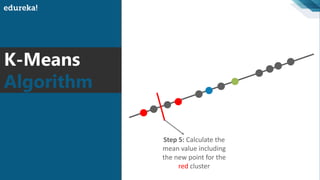
Step 5: Calculate the
mean value including
the new point for the
red cluster
K-Means
Algorithm
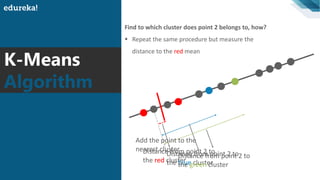
Distance from point 2 to
the red cluster
Distance from point 2 to
the blue cluster
Distance from point 2 to
the green cluster
Find to which cluster does point 2 belongs to, how?
▪ Repeat the same procedure but measure the
distance to the red mean
Add the point to the
nearest cluster
K-Means
Algorithm
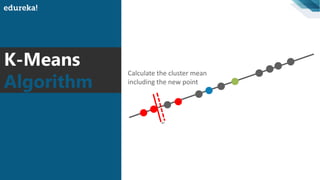
Calculate the cluster mean
including the new point
K-Means
Algorithm
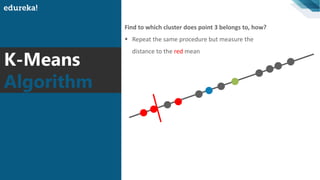
Find to which cluster does point 3 belongs to, how?
▪ Repeat the same procedure but measure the
distance to the red mean
K-Means
Algorithm
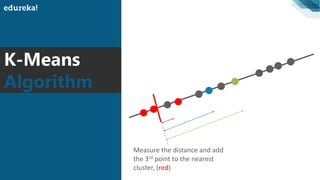
Measure the distance and add
the 3rd point to the nearest
cluster, (red)
K-Means
Algorithm
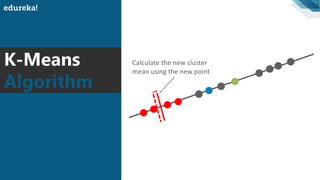
Calculate the new cluster
mean using the new point
K-Means
Algorithm
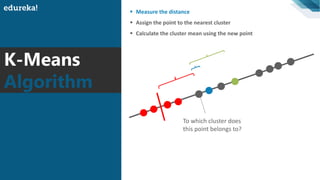
To which cluster does
this point belongs to?
▪ Measure the distance
▪ Assign the point to the nearest cluster
▪ Calculate the cluster mean using the new point
K-Means
Algorithm
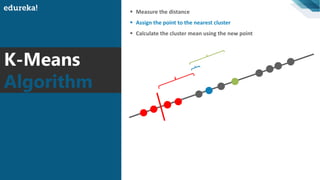
▪ Measure the distance
▪ Assign the point to the nearest cluster
▪ Calculate the cluster mean using the new point
K-Means
Algorithm
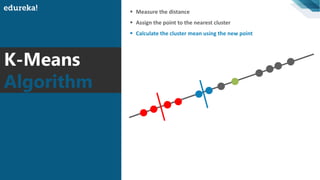
▪ Measure the distance
▪ Assign the point to the nearest cluster
▪ Calculate the cluster mean using the new point
K-Means
Algorithm
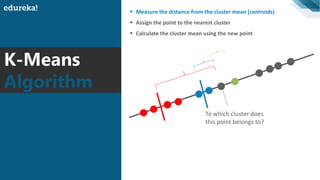
To which cluster does
this point belongs to?
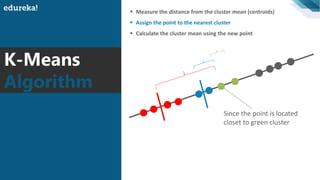
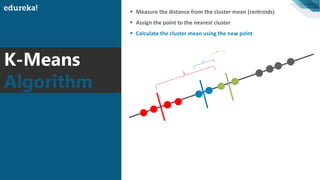
▪ Measure the distance from the cluster mean (centroids)
▪ Assign the point to the nearest cluster
▪ Calculate the cluster mean using the new point
K-Means
Algorithm
▪ Measure the distance from the cluster mean (centroids)
▪ Assign the point to the nearest cluster
▪ Calculate the cluster mean using the new point
Since the point is located
closet to green cluster
K-Means
Algorithm
▪ Measure the distance from the cluster mean (centroids)
▪ Assign the point to the nearest cluster
▪ Calculate the cluster mean using the new point
K-Means
Algorithm
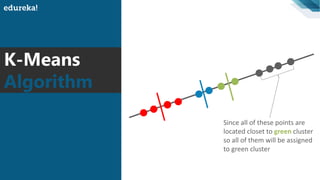
Since all of these points are
located closet to green cluster
so all of them will be assigned
to green cluster
K-Means
Algorithm
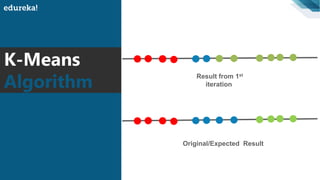
Original/Expected Result
Result from 1st
iteration
K-Means
Algorithm
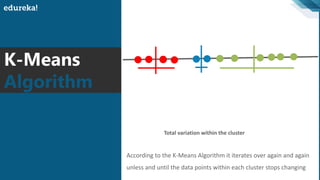
Total variation within the cluster
According to the K-Means Algorithm it iterates over again and again
unless and until the data points within each cluster stops changing
K-Means
Algorithm
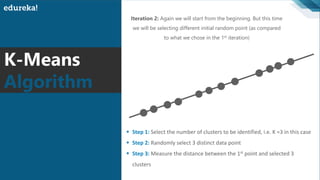
Iteration 2: Again we will start from the beginning. But this time
we will be selecting different initial random point (as compared
to what we chose in the 1st iteration)
▪ Step 1: Select the number of clusters to be identified, i.e. K =3 in this case
▪ Step 2: Randomly select 3 distinct data point
▪ Step 3: Measure the distance between the 1st point and selected 3
clusters
K-Means
Algorithm
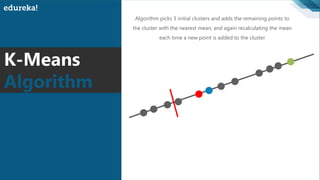
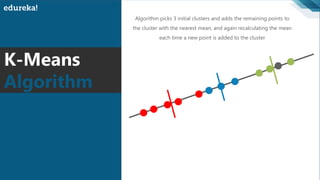
Algorithm picks 3 initial clusters and adds the remaining points to
the cluster with the nearest mean, and again recalculating the mean
each time a new point is added to the cluster
K-Means
Algorithm
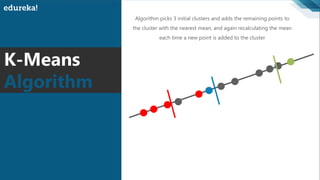
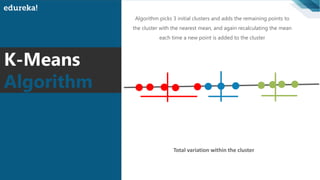
Algorithm picks 3 initial clusters and adds the remaining points to
the cluster with the nearest mean, and again recalculating the mean
each time a new point is added to the cluster
K-Means
Algorithm
Algorithm picks 3 initial clusters and adds the remaining points to
the cluster with the nearest mean, and again recalculating the mean
each time a new point is added to the cluster
K-Means
Algorithm
Algorithm picks 3 initial clusters and adds the remaining points to
the cluster with the nearest mean, and again recalculating the mean
each time a new point is added to the cluster
Total variation within the cluster
K-Means
Algorithm
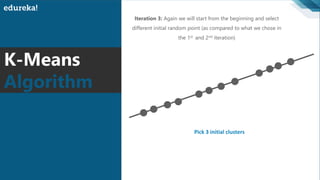
Iteration 3: Again we will start from the beginning and select
different initial random point (as compared to what we chose in
the 1st and 2nd iteration)
Pick 3 initial clusters
K-Means
Algorithm
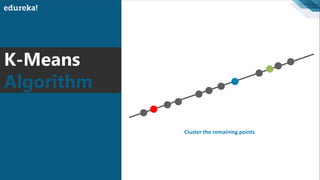
Cluster the remaining points
K-Means
Algorithm
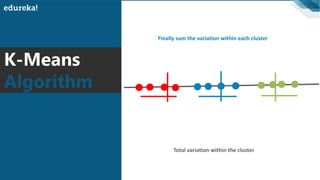
Total variation within the cluster
Finally sum the variation within each cluster
K-Means
Algorithm
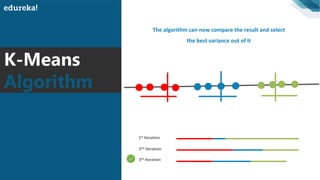
The algorithm can now compare the result and select
the best variance out of it
1st Iteration
2nd Iteration
3rd Iteration
K-Means
Algorithm
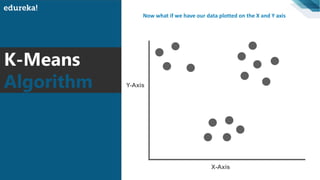
Now what if we have our data plotted on the X and Y axis
X-Axis
Y-Axis
K-Means
Algorithm
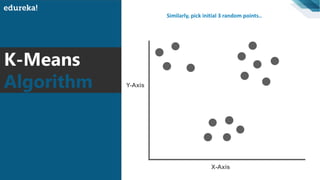
Similarly, pick initial 3 random points..
X-Axis
Y-Axis
K-Means
Algorithm
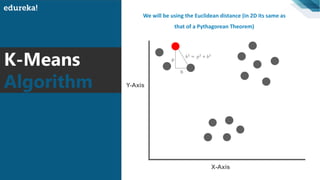
We will be using the Euclidean distance (in 2D its same as
that of a Pythagorean Theorem)
X-Axis
Y-Axis
ℎ2
= 𝑝2
+ 𝑏2
p
b
K-Means
Algorithm
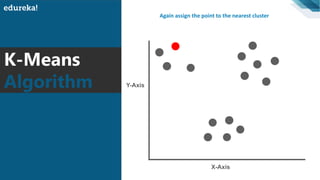
Again assign the point to the nearest cluster
X-Axis
Y-Axis
K-Means
Algorithm
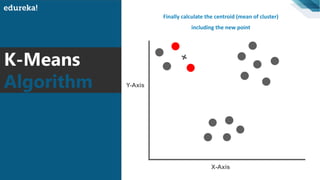
Finally calculate the centroid (mean of cluster)
including the new point
X-Axis
Y-Axis
K-Means
Algorithm
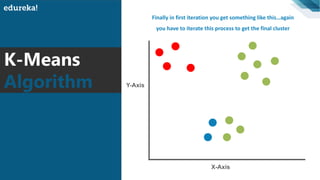
Finally in first iteration you get something like this…again
you have to iterate this process to get the final cluster
X-Axis
Y-Axis
How will you
find
K value
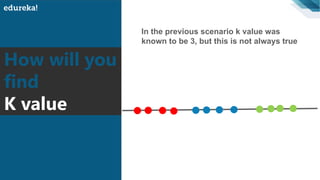
In the previous scenario k value was
known to be 3, but this is not always true
How will you
find
K value
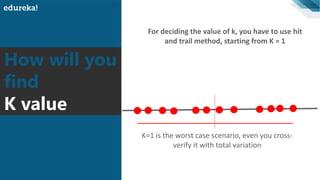
For deciding the value of k, you have to use hit
and trail method, starting from K = 1
K=1 is the worst case scenario, even you cross-
verify it with total variation
How will you
find
K value
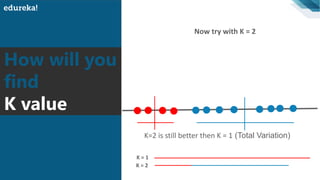
Now try with K = 2
K=2 is still better then K = 1 (Total Variation)
K = 1
K = 2
How will you
find
K value
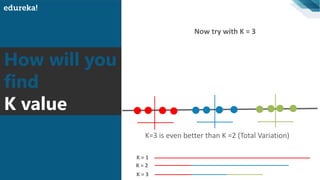
Now try with K = 3
K=3 is even better than K =2 (Total Variation)
K = 1
K = 2
K = 3
How will you
find
K value
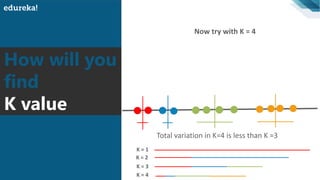
Now try with K = 4
Total variation in K=4 is less than K =3
K = 1
K = 2
K = 3
K = 4
How will you
find
K value
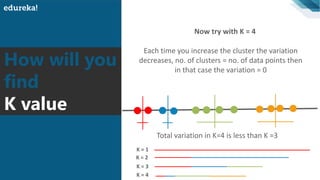
Now try with K = 4
Total variation in K=4 is less than K =3
K = 1
K = 2
K = 3
K = 4
Each time you increase the cluster the variation
decreases, no. of clusters = no. of data points then
in that case the variation = 0
How will you
find
K value
Reductioninvariance
Number of Cluster
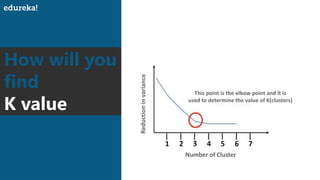
This point is the elbow point and it is
used to determine the value of K(clusters)
Copyright © 2017, edureka and/or its affiliates. All rights reserved.
DEMO
Let’s learn to
code
© MadeByShape Ltd. Web Design Manchester 2018. All Rights Reserved.
K-Means
Algorithm
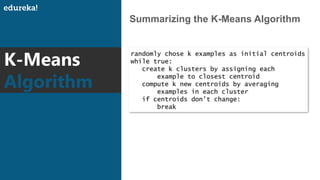
Summarizing the K-Means Algorithm
Copyright © 2017, edureka and/or its affiliates. All rights reserved.

K Means Clustering Algorithm | K Means Example in Python | Machine Learning Algorithms | Edureka