 Large degree B-trees used to represent very large
dictionaries that reside on disk.
 Smaller degree B-trees used for internal-memory
dictionaries to overcome cache-miss penalties.
 Definition assumes external nodes (extended
m-way search tree).
 B-tree of order m.
◦ m-way search tree.
◦ Not empty => root has at least 2 children.
◦ Remaining internal nodes (if any) have at least
ceil(m/2) children.
◦ External (or failure) nodes on same level.
 B-tree of order m.
◦ m-way search tree.
◦ Not empty => root has at least 2 children.
◦ Remaining internal nodes (if any) have at least
ceil(m/2) children.
◦ External (or failure) nodes on same level.
• 2-3 tree is B-tree of order 3.
• 2-3-4 tree is B-tree of order 4.
 B-tree of order m.
◦ m-way search tree.
◦ Not empty => root has at least 2 children.
◦ Remaining internal nodes (if any) have at least
ceil(m/2) children.
◦ External (or failure) nodes on same level.
• B-tree of order 5 is 3-4-5 tree (root may be
2-node though).
• B-tree of order 2 is full binary tree.
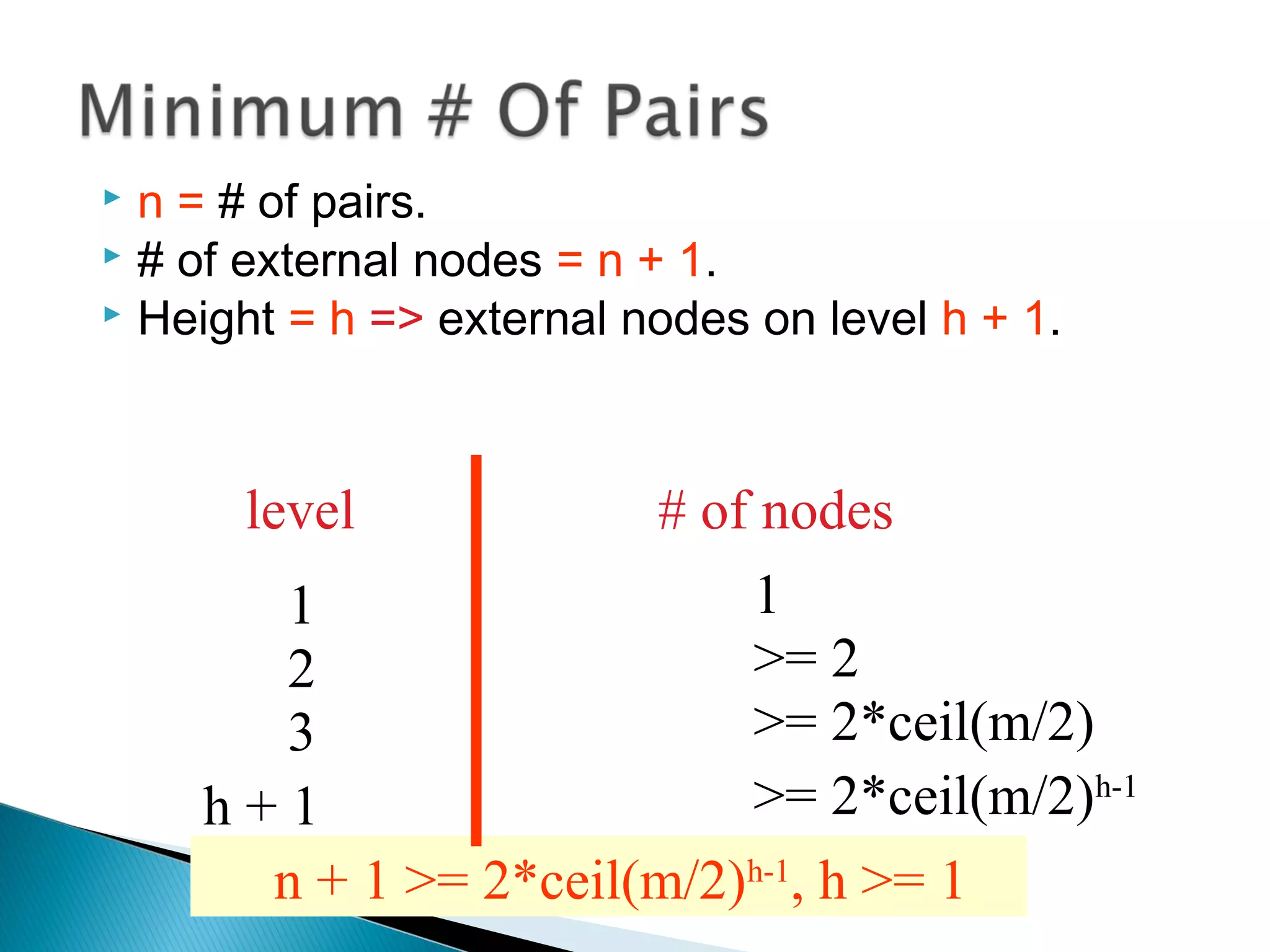
 n = # of pairs.
 # of external nodes = n + 1.
 Height = h => external nodes on level h + 1.
1 1
2 >= 2
3 >= 2*ceil(m/2)
h + 1 >= 2*ceil(m/2)h-1
n + 1 >= 2*ceil(m/2)h-1
, h >= 1
level # of nodes
 m = 200.
n + 1 >= 2*ceil(m/2)h-1
, h >= 1
height # of pairs
2 >= 199
3 >= 19,999
4 >= 2 * 106
–1
5 >= 2 * 108
–1
h <= log ceil(m/2) [(n+1)/2] + 1
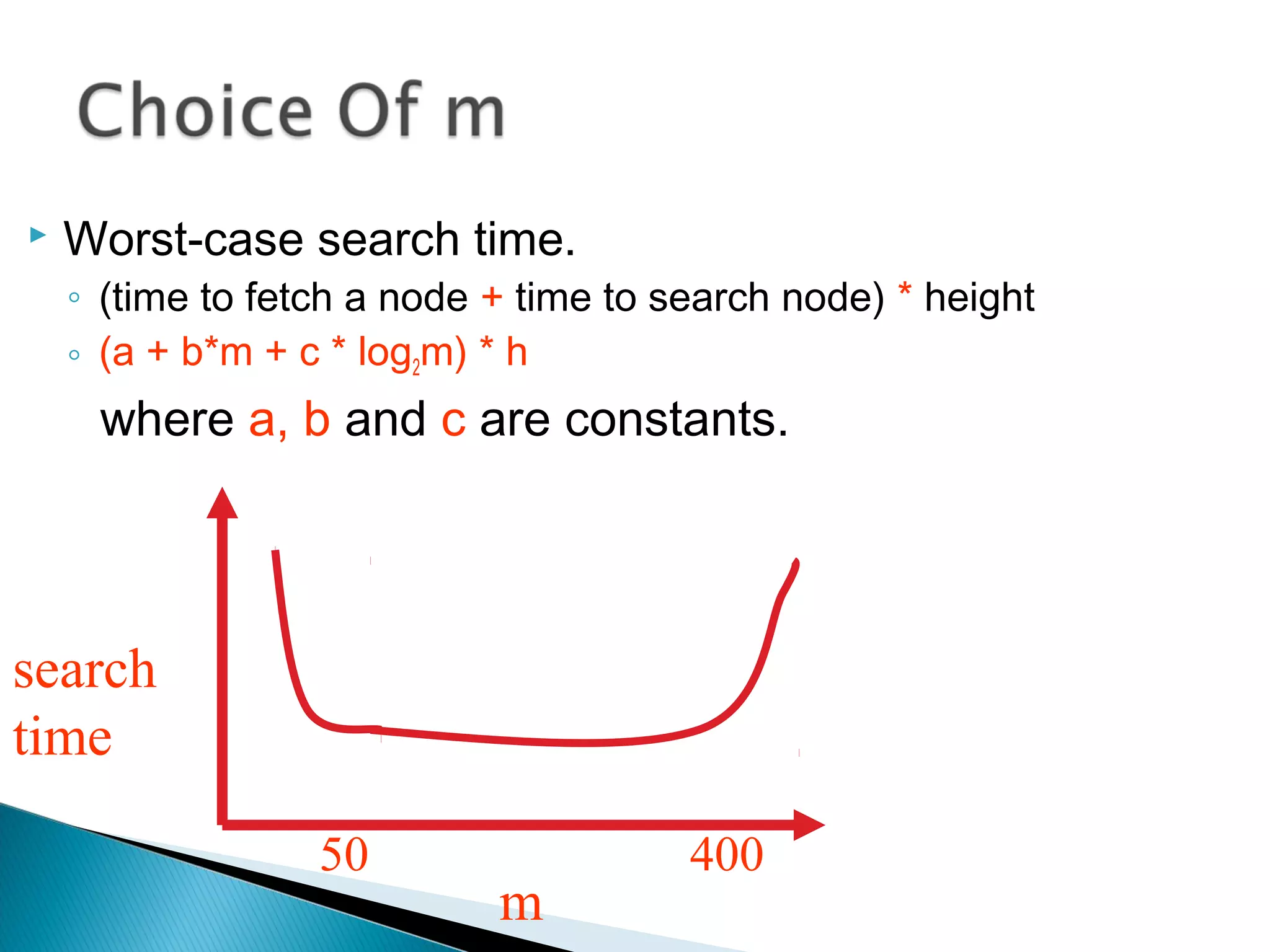
 Worst-case search time.
◦ (time to fetch a node + time to search node) * height
◦ (a + b*m + c * log2m) * h
where a, b and c are constants.
m
search
time
50 400
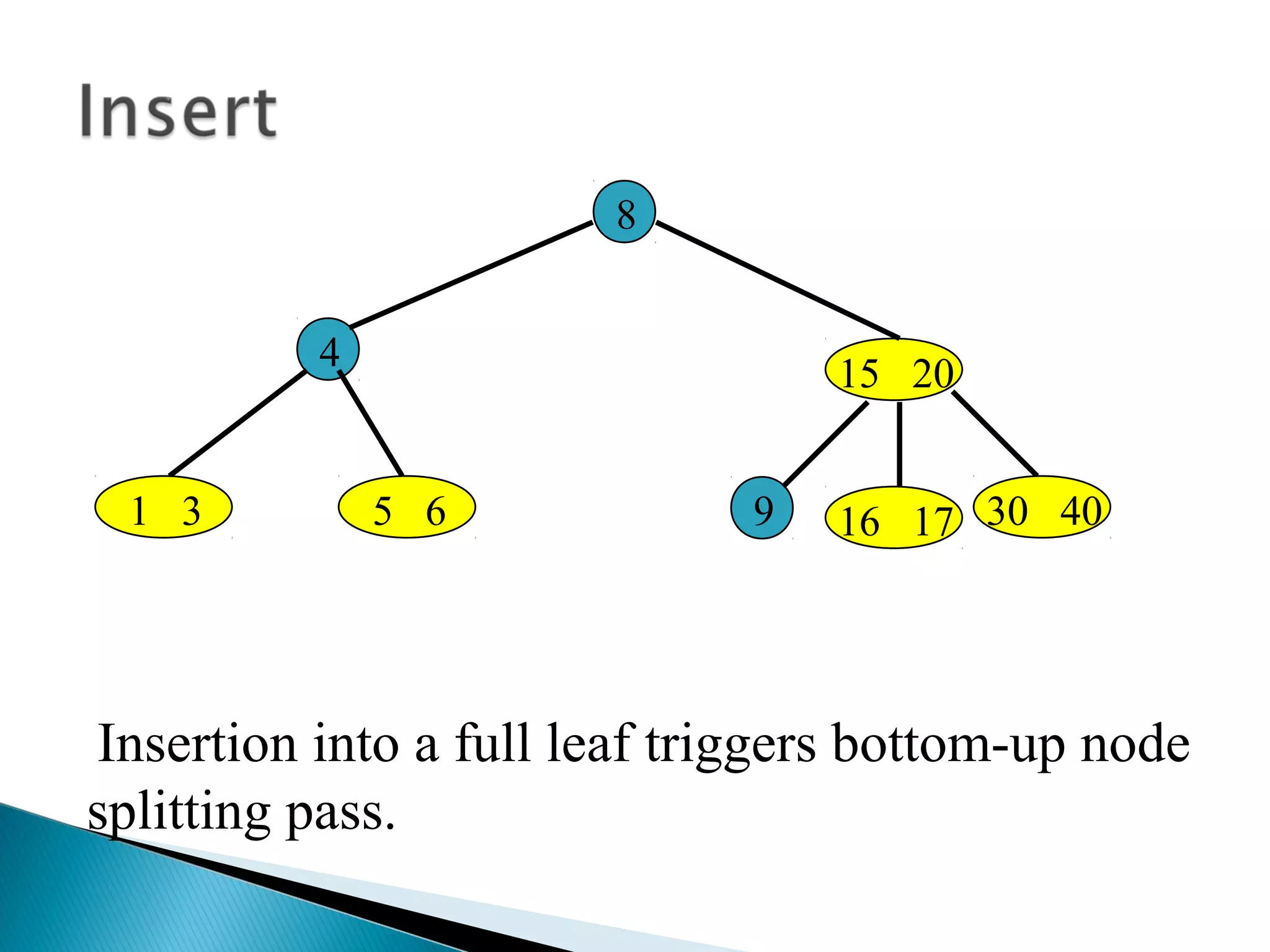
15 20
8
4
1 3 5 6 30 409
Insertion into a full leaf triggers bottom-up node
splitting pass.
16 17
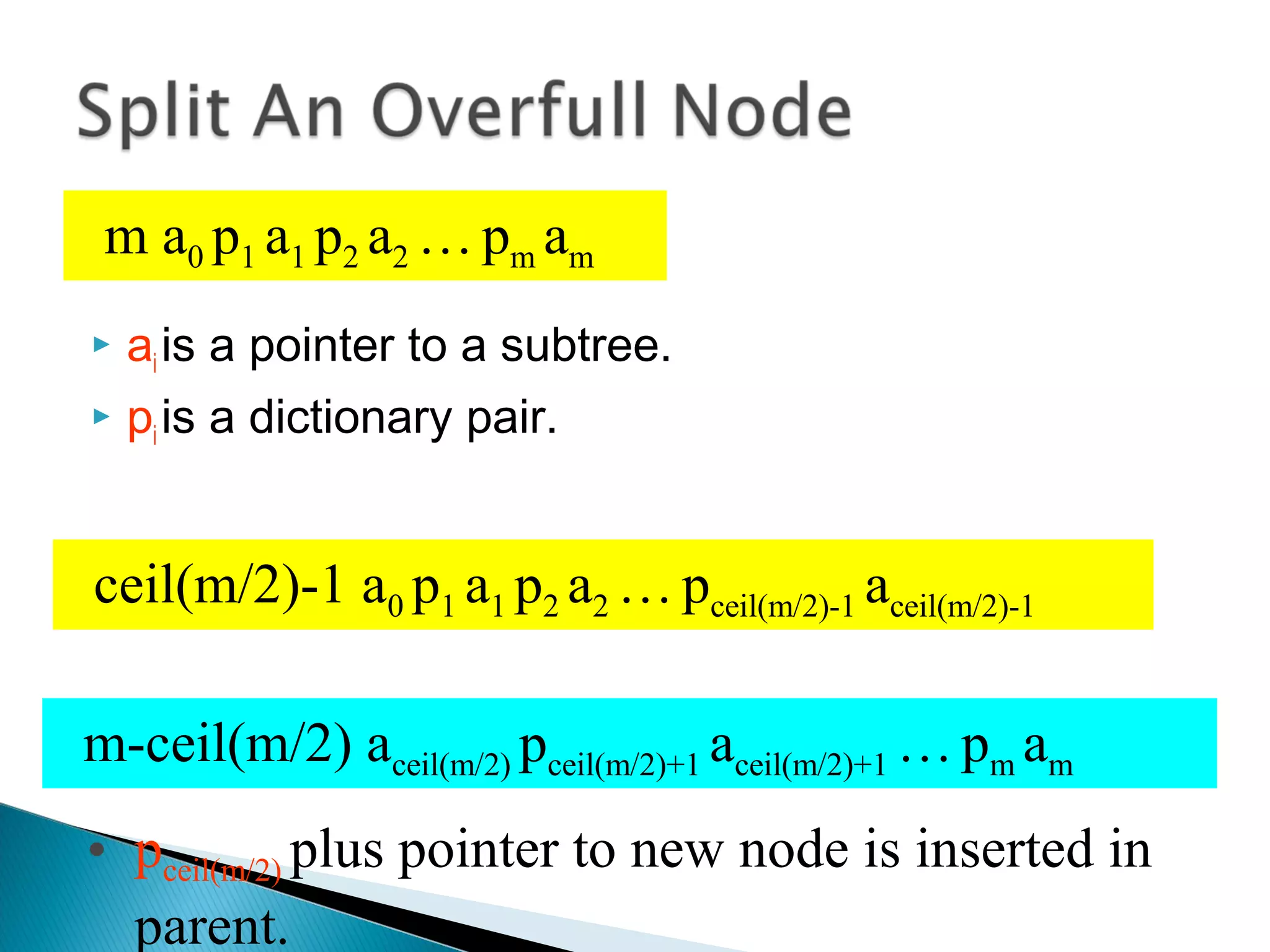
 ai is a pointer to a subtree.
 pi is a dictionary pair.
m a0 p1 a1 p2 a2 …pm am
ceil(m/2)-1 a0 p1 a1 p2 a2 …pceil(m/2)-1 aceil(m/2)-1
m-ceil(m/2) aceil(m/2) pceil(m/2)+1 aceil(m/2)+1 …pm am
• pceil(m/2) plus pointer to new node is inserted in
parent.
15 20
8
4
1 3 5 6 30 409
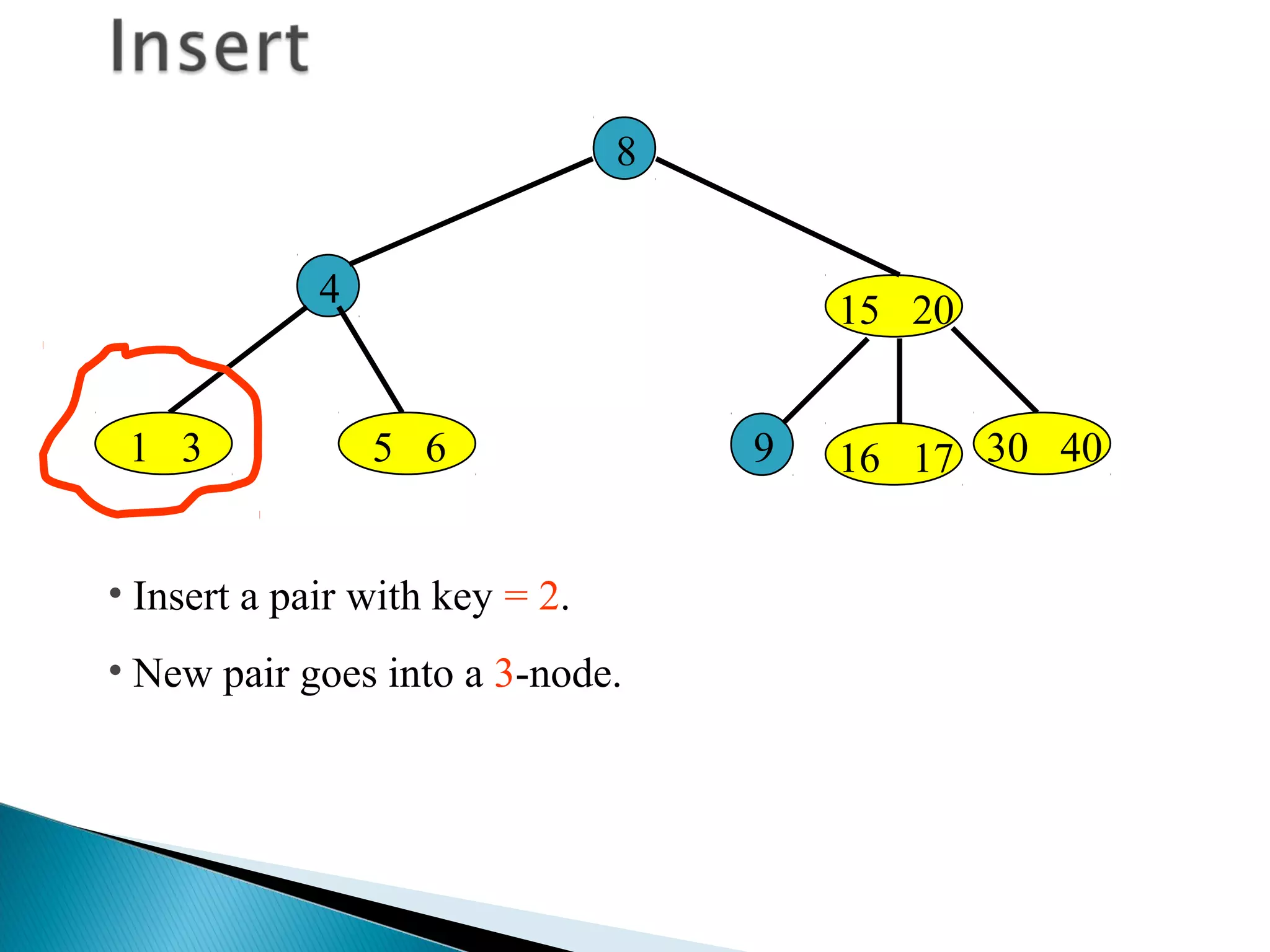
• Insert a pair with key = 2.
• New pair goes into a 3-node.
16 17
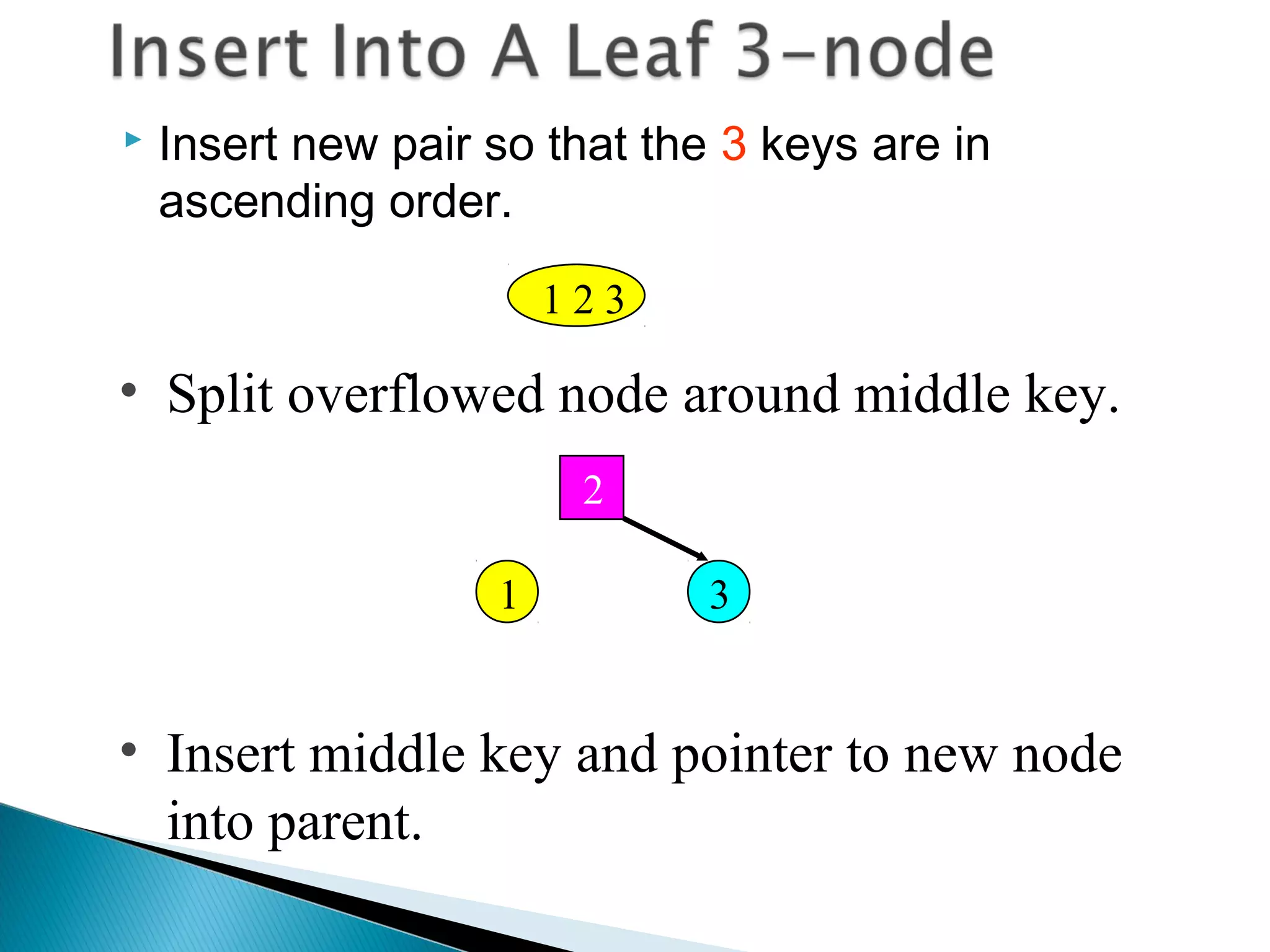
 Insert new pair so that the 3 keys are in
ascending order.
• Split overflowed node around middle key.
1 2 3
• Insert middle key and pointer to new node
into parent.
1 3
2
15 20
8
4
1 3 5 6 30 409
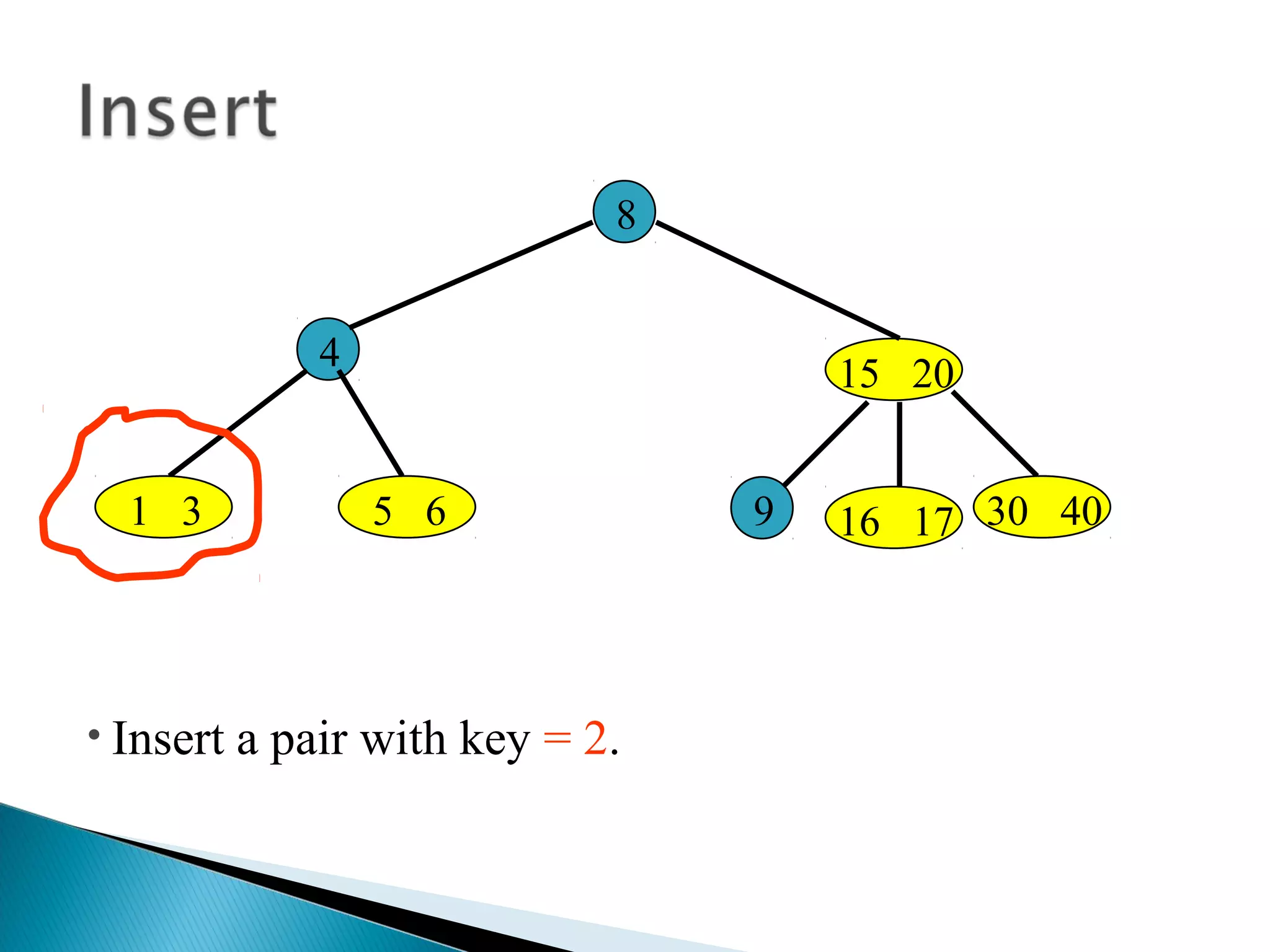
• Insert a pair with key = 2.
16 17
15 20
8
4
5 6 30 409 16 17
3
1
2
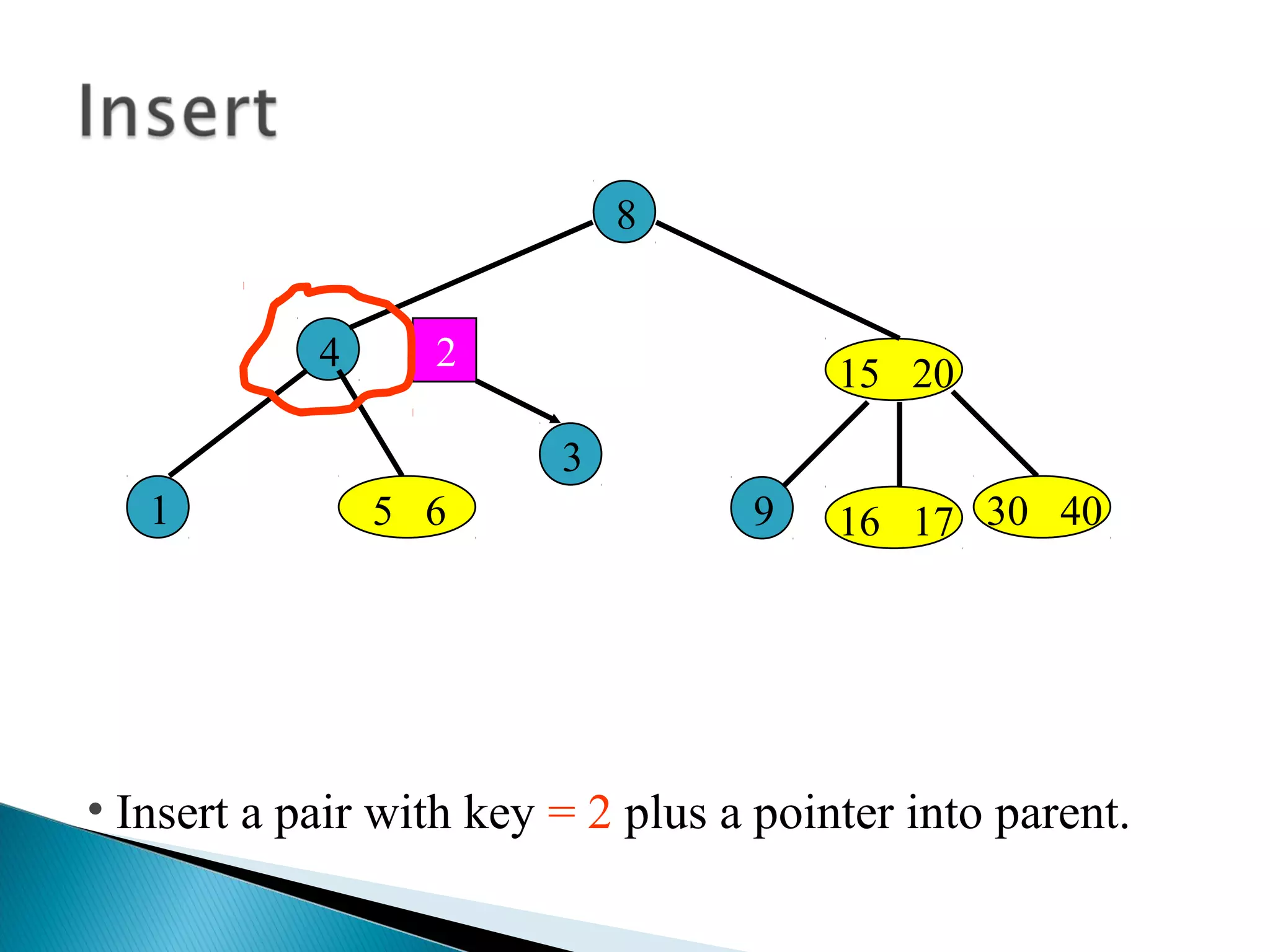
• Insert a pair with key = 2 plus a pointer into parent.
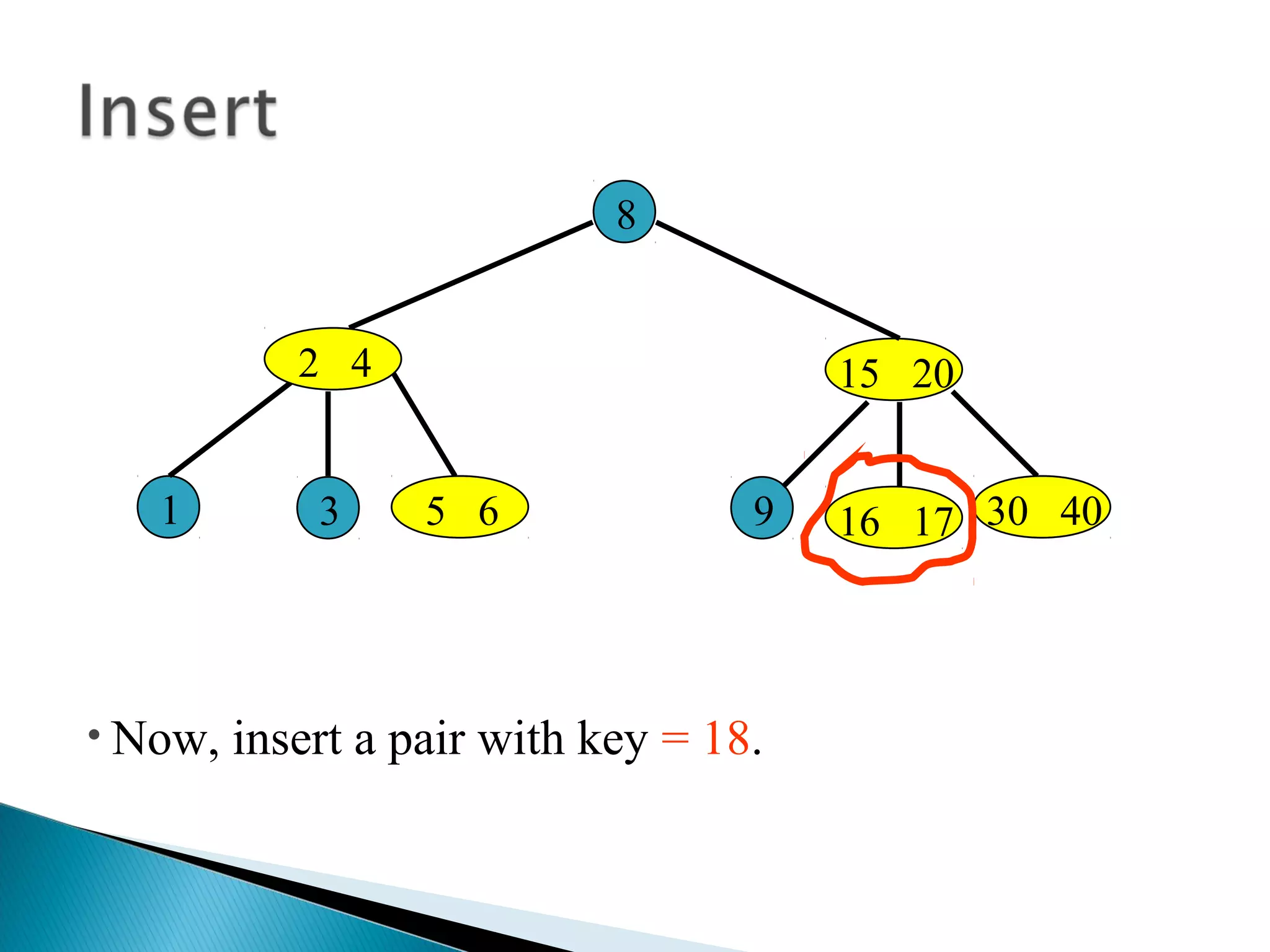
• Now, insert a pair with key = 18.
15 20
8
1
2 4
5 6 30 409 16 173
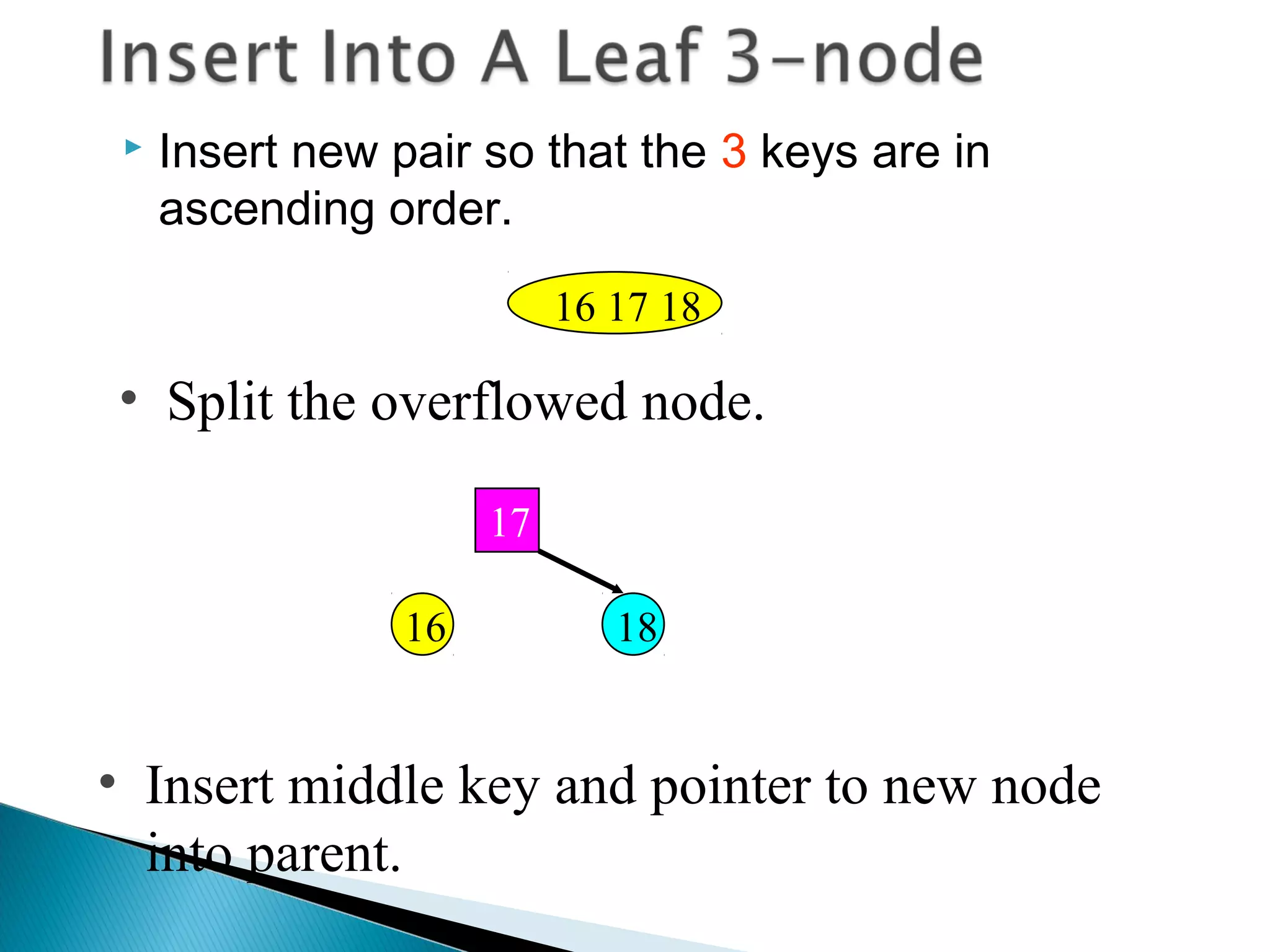
 Insert new pair so that the 3 keys are in
ascending order.
• Split the overflowed node.
16 17 18
• Insert middle key and pointer to new node
into parent.
1816
17
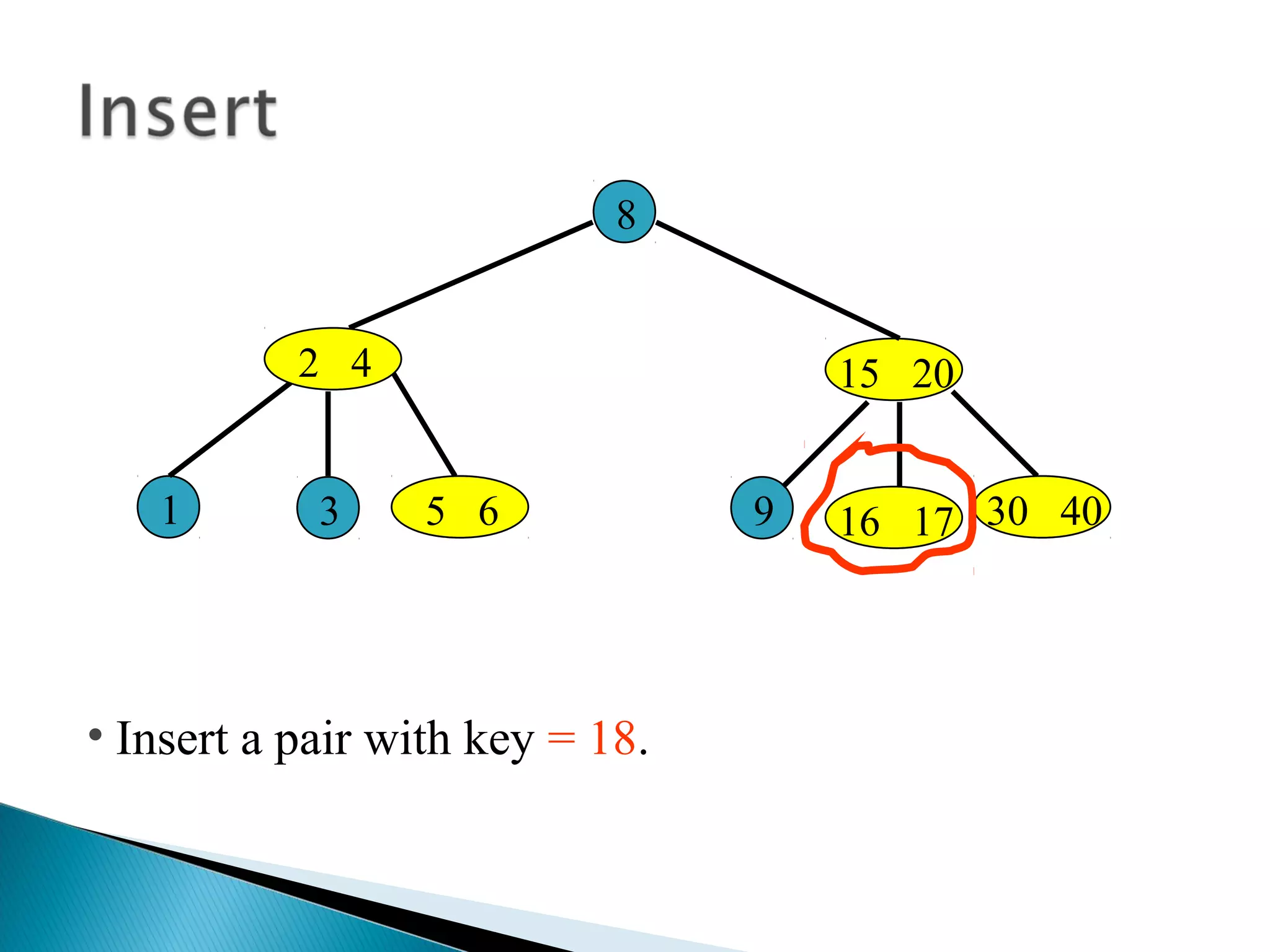
• Insert a pair with key = 18.
15 20
8
1
2 4
5 6 30 409 16 173
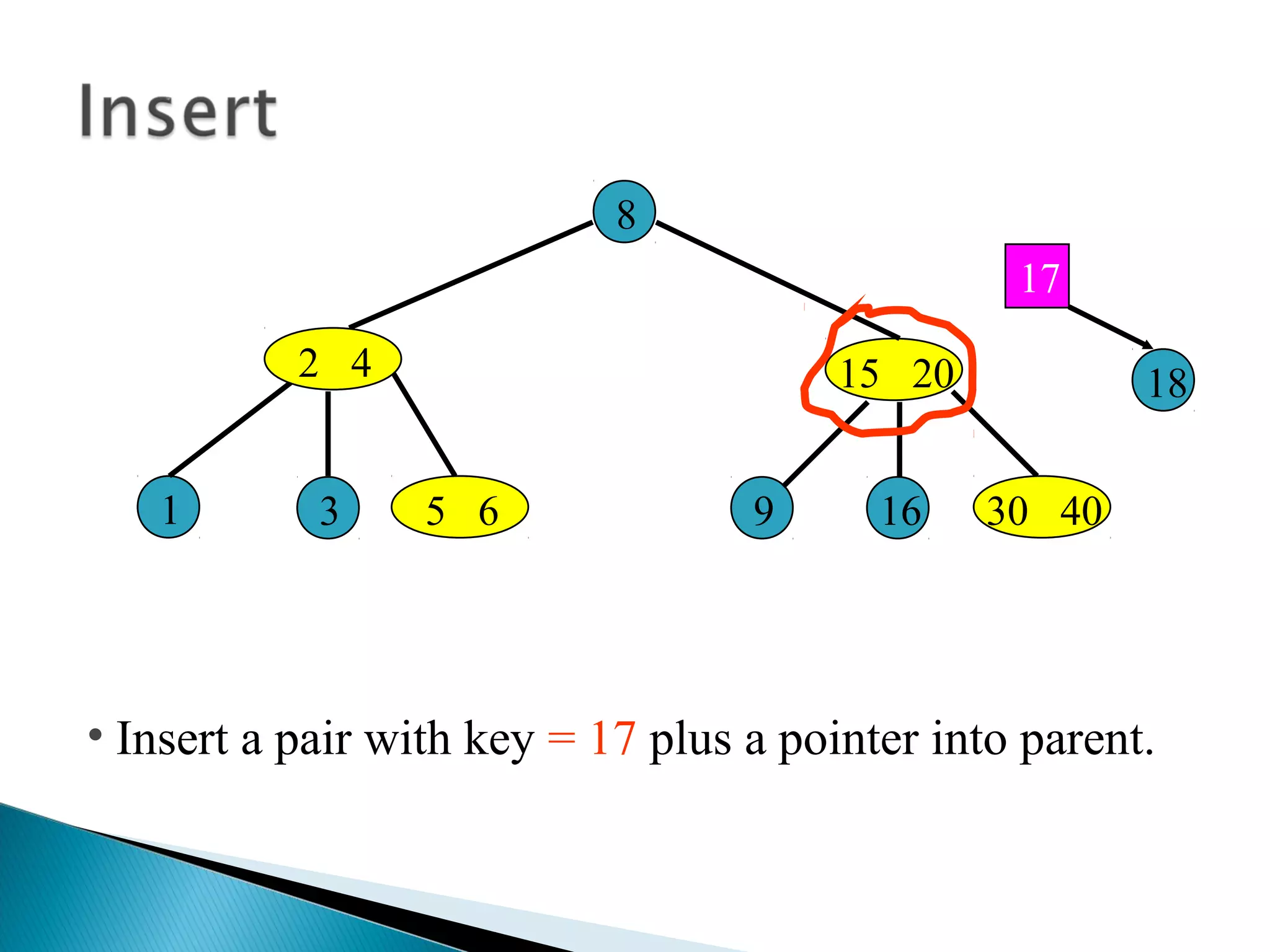
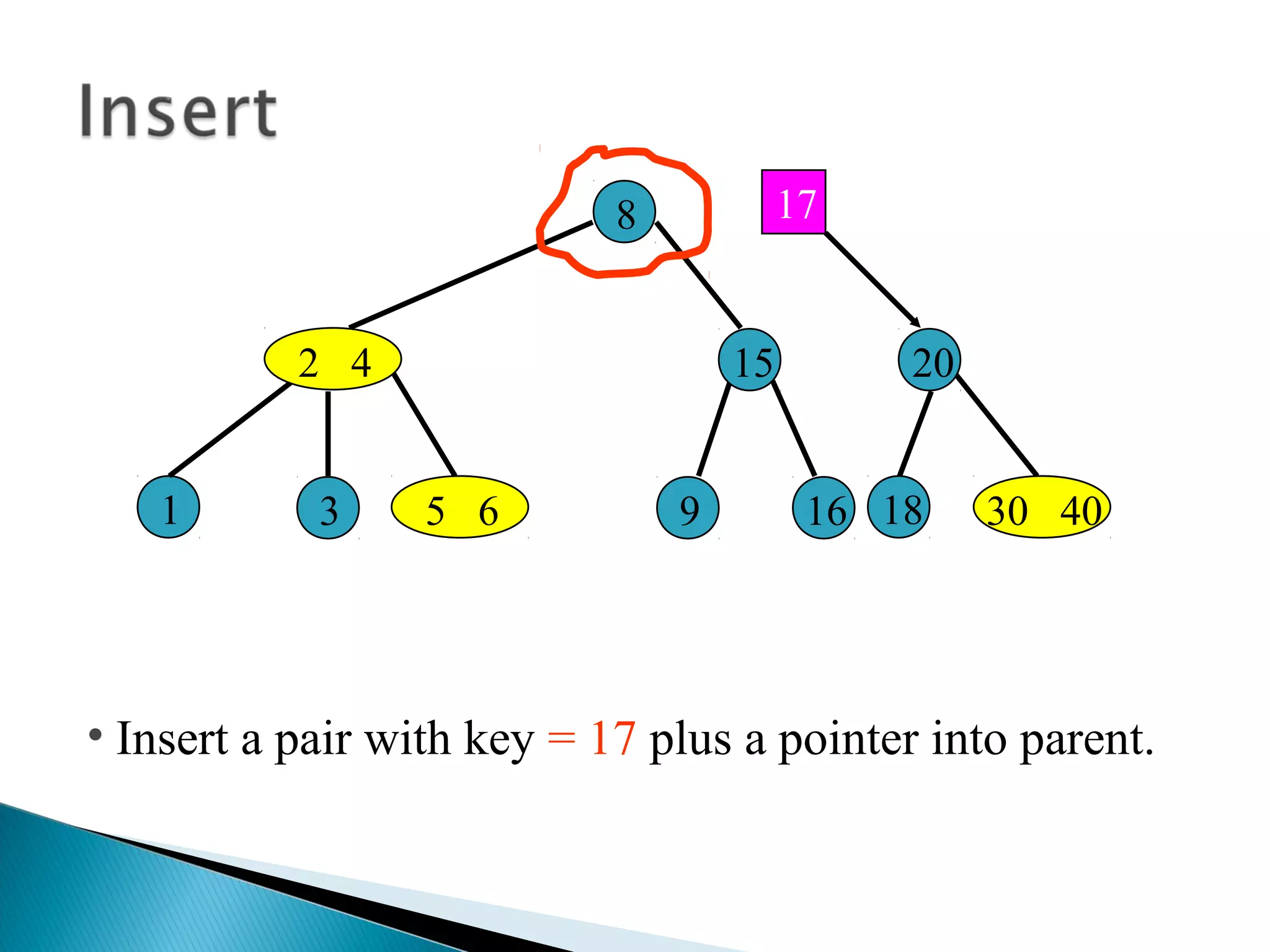
• Insert a pair with key = 17 plus a pointer into parent.
15 20
8
1
2 4
5 6 30 4093
18
16
17
• Insert a pair with key = 17 plus a pointer into parent.
8
1
2 4
5 6 30 4093 16
17
15
18
20
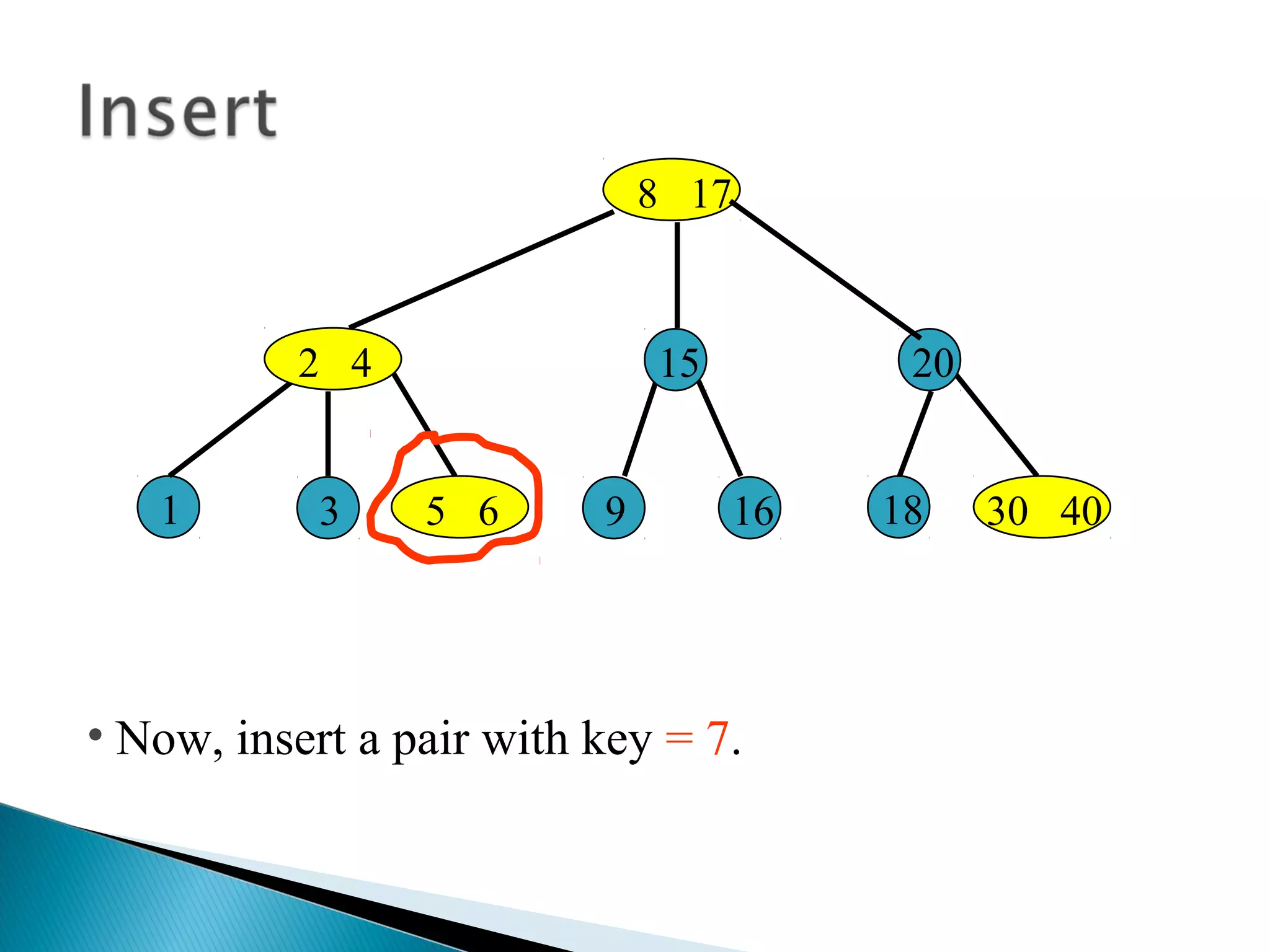
• Now, insert a pair with key = 7.
1
2 4
5 6 30 4093 16
15
18
20
8 17
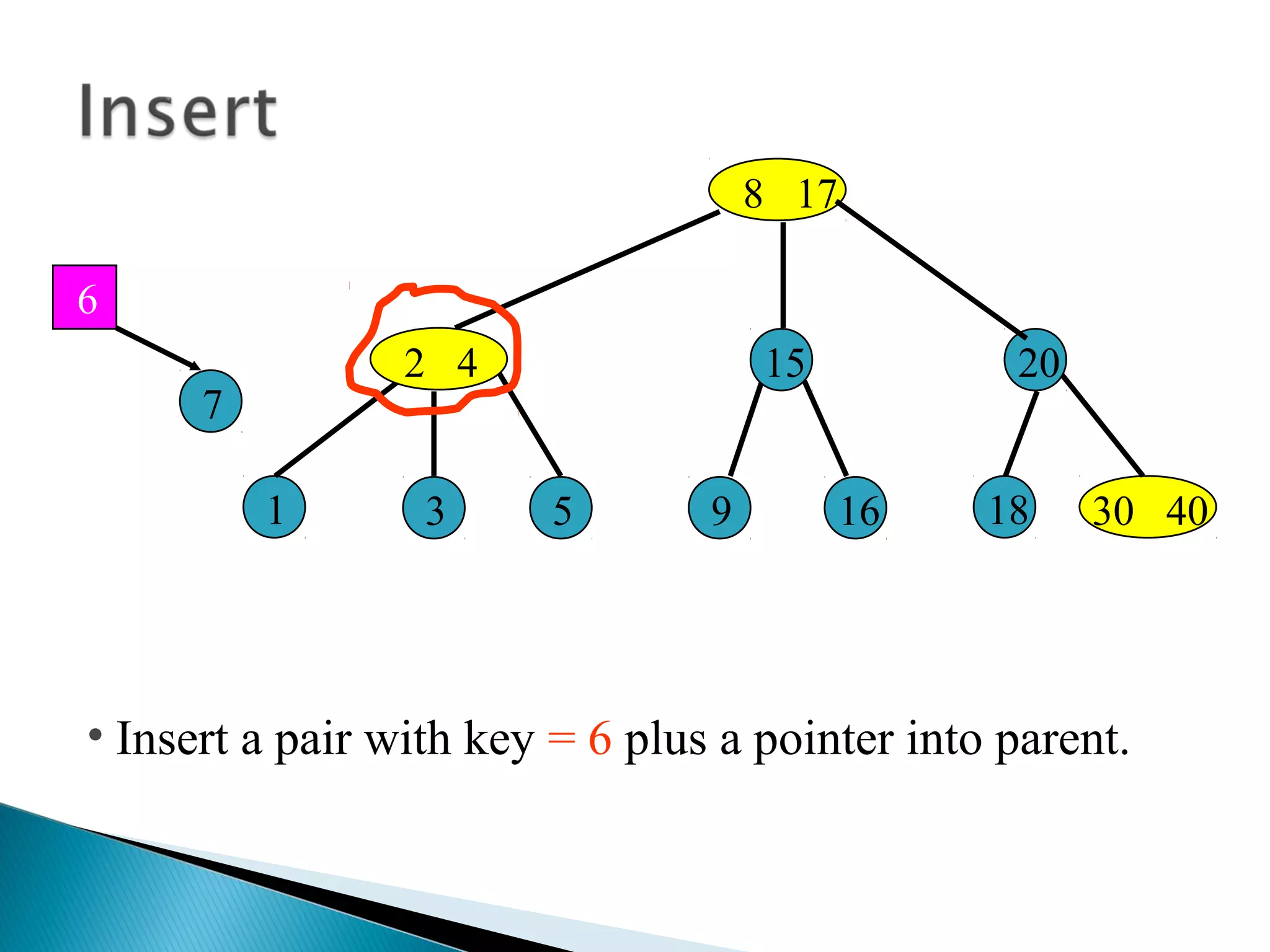
• Insert a pair with key = 6 plus a pointer into parent.
30 401
2 4
93 16
15
18
20
8 17
5
7
6
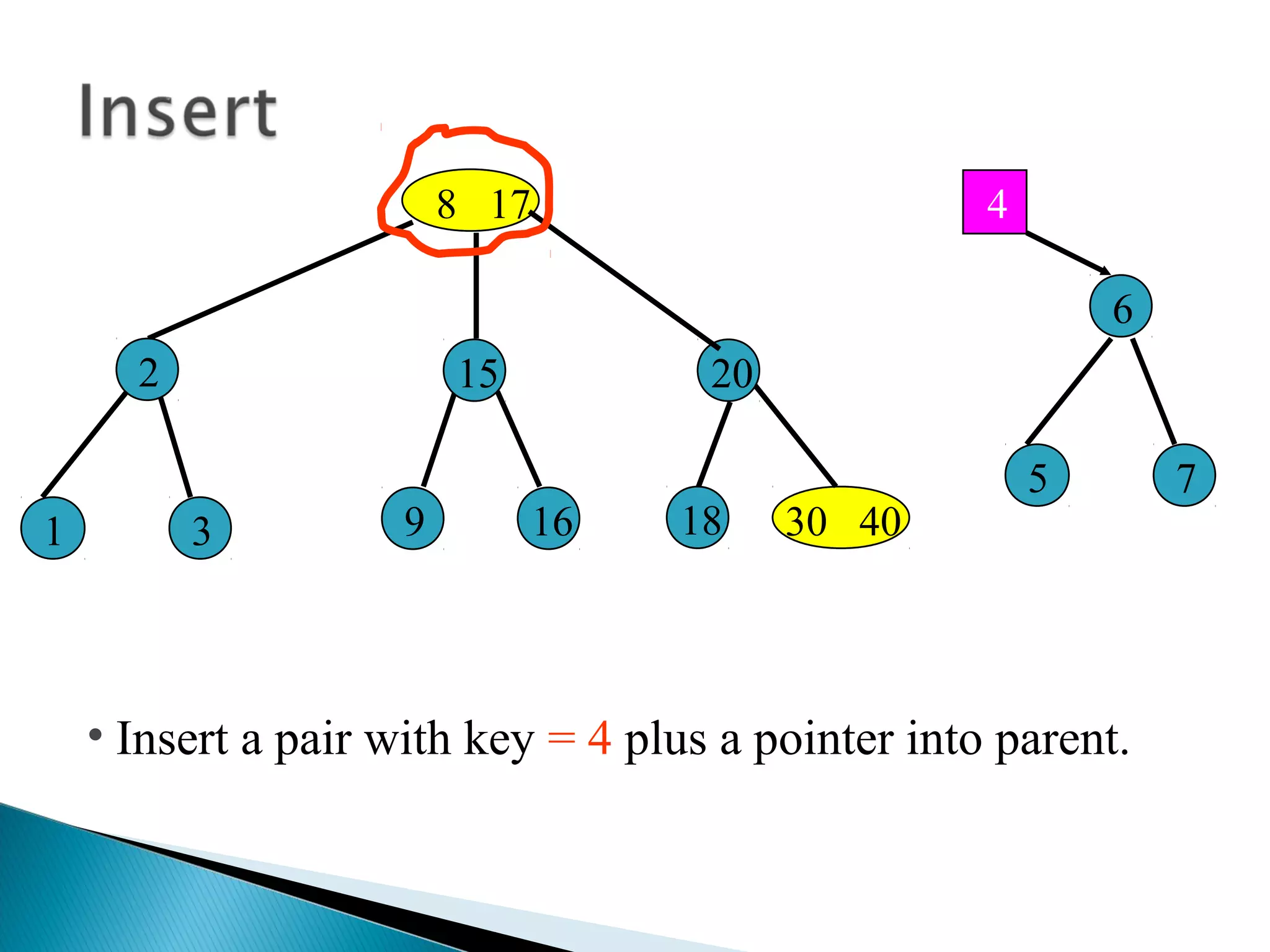
• Insert a pair with key = 4 plus a pointer into parent.
30 401 93 16
15
18
20
8 17
6
4
2
5 7
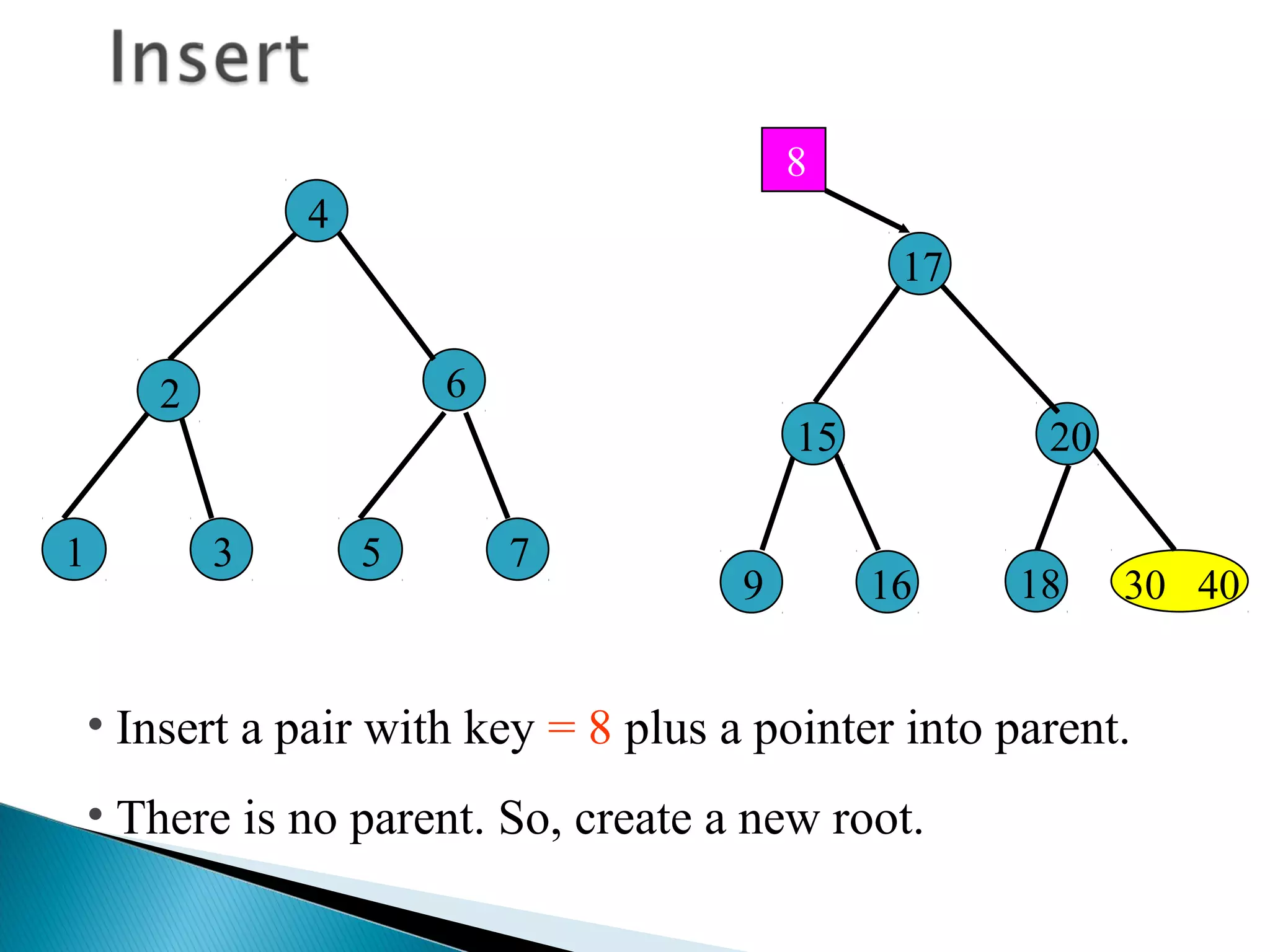
• Insert a pair with key = 8 plus a pointer into parent.
• There is no parent. So, create a new root.
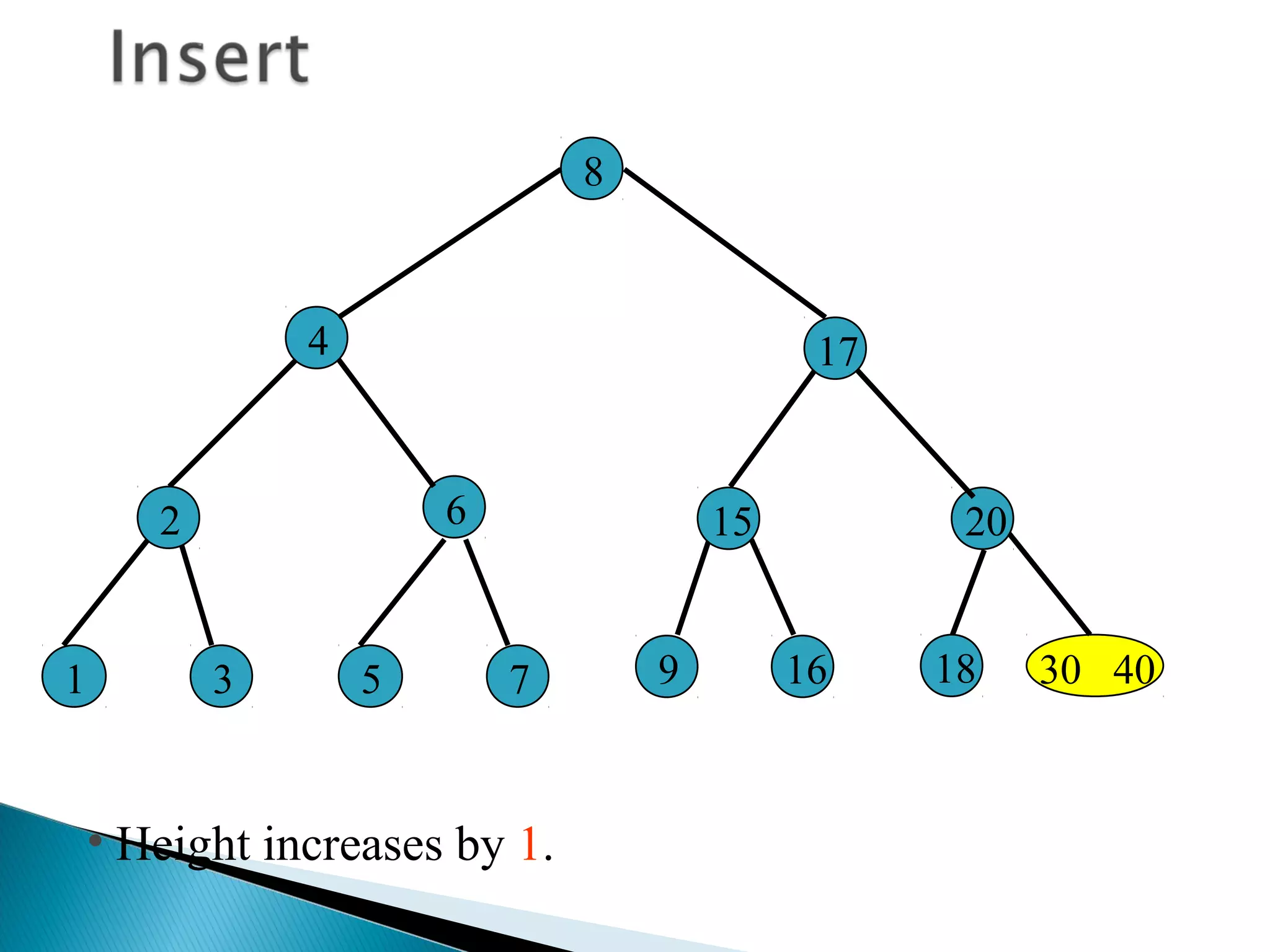
30 40
1
9
3
16
15
18
20
6
8
2
5 7
4
17
• Height increases by 1.
30 401 93 16
15
18
2062
5 7
4 17
8

B tree

  • 1.
     Large degreeB-trees used to represent very large dictionaries that reside on disk.  Smaller degree B-trees used for internal-memory dictionaries to overcome cache-miss penalties.
  • 2.
     Definition assumesexternal nodes (extended m-way search tree).  B-tree of order m. ◦ m-way search tree. ◦ Not empty => root has at least 2 children. ◦ Remaining internal nodes (if any) have at least ceil(m/2) children. ◦ External (or failure) nodes on same level.
  • 3.
     B-tree oforder m. ◦ m-way search tree. ◦ Not empty => root has at least 2 children. ◦ Remaining internal nodes (if any) have at least ceil(m/2) children. ◦ External (or failure) nodes on same level. • 2-3 tree is B-tree of order 3. • 2-3-4 tree is B-tree of order 4.
  • 4.
     B-tree oforder m. ◦ m-way search tree. ◦ Not empty => root has at least 2 children. ◦ Remaining internal nodes (if any) have at least ceil(m/2) children. ◦ External (or failure) nodes on same level. • B-tree of order 5 is 3-4-5 tree (root may be 2-node though). • B-tree of order 2 is full binary tree.
  • 5.
     n =# of pairs.  # of external nodes = n + 1.  Height = h => external nodes on level h + 1. 1 1 2 >= 2 3 >= 2*ceil(m/2) h + 1 >= 2*ceil(m/2)h-1 n + 1 >= 2*ceil(m/2)h-1 , h >= 1 level # of nodes
  • 6.
     m =200. n + 1 >= 2*ceil(m/2)h-1 , h >= 1 height # of pairs 2 >= 199 3 >= 19,999 4 >= 2 * 106 –1 5 >= 2 * 108 –1 h <= log ceil(m/2) [(n+1)/2] + 1
  • 7.
     Worst-case searchtime. ◦ (time to fetch a node + time to search node) * height ◦ (a + b*m + c * log2m) * h where a, b and c are constants. m search time 50 400
  • 8.
    15 20 8 4 1 35 6 30 409 Insertion into a full leaf triggers bottom-up node splitting pass. 16 17
  • 9.
     ai isa pointer to a subtree.  pi is a dictionary pair. m a0 p1 a1 p2 a2 …pm am ceil(m/2)-1 a0 p1 a1 p2 a2 …pceil(m/2)-1 aceil(m/2)-1 m-ceil(m/2) aceil(m/2) pceil(m/2)+1 aceil(m/2)+1 …pm am • pceil(m/2) plus pointer to new node is inserted in parent.
  • 10.
    15 20 8 4 1 35 6 30 409 • Insert a pair with key = 2. • New pair goes into a 3-node. 16 17
  • 11.
     Insert newpair so that the 3 keys are in ascending order. • Split overflowed node around middle key. 1 2 3 • Insert middle key and pointer to new node into parent. 1 3 2
  • 12.
    15 20 8 4 1 35 6 30 409 • Insert a pair with key = 2. 16 17
  • 13.
    15 20 8 4 5 630 409 16 17 3 1 2 • Insert a pair with key = 2 plus a pointer into parent.
  • 14.
    • Now, inserta pair with key = 18. 15 20 8 1 2 4 5 6 30 409 16 173
  • 15.
     Insert newpair so that the 3 keys are in ascending order. • Split the overflowed node. 16 17 18 • Insert middle key and pointer to new node into parent. 1816 17
  • 16.
    • Insert apair with key = 18. 15 20 8 1 2 4 5 6 30 409 16 173
  • 17.
    • Insert apair with key = 17 plus a pointer into parent. 15 20 8 1 2 4 5 6 30 4093 18 16 17
  • 18.
    • Insert apair with key = 17 plus a pointer into parent. 8 1 2 4 5 6 30 4093 16 17 15 18 20
  • 19.
    • Now, inserta pair with key = 7. 1 2 4 5 6 30 4093 16 15 18 20 8 17
  • 20.
    • Insert apair with key = 6 plus a pointer into parent. 30 401 2 4 93 16 15 18 20 8 17 5 7 6
  • 21.
    • Insert apair with key = 4 plus a pointer into parent. 30 401 93 16 15 18 20 8 17 6 4 2 5 7
  • 22.
    • Insert apair with key = 8 plus a pointer into parent. • There is no parent. So, create a new root. 30 40 1 9 3 16 15 18 20 6 8 2 5 7 4 17
  • 23.
    • Height increasesby 1. 30 401 93 16 15 18 2062 5 7 4 17 8

Editor's Notes

  • #2 May also be used internally to reduce cache misses and hence improve performance.
  • #3 Alternative definition has pairs only in leaves; remaining nodes have keys only. Leaf-pushed B-tree or B+-tree.
  • #5 Not possible for an internal node in an extended tree to have only 1 child.
  • #8 Typically pick m so as to fill a block.
  • #9 2-3 Tree. Insert 10, no problem. Insert 18?
  • #10 Node Splitting
  • #12 The code will do all 3 steps as one.