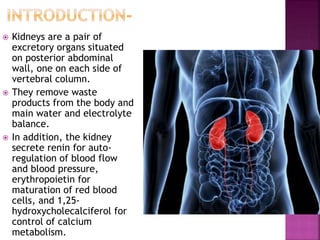
 Kidneys are a pair of
excretory organs situated
on posterior abdominal
wall, one on each side of
vertebral column.
 They remove waste
products from the body and
main water and electrolyte
balance.
 In addition, the kidney
secrete renin for auto-
regulation of blood flow
and blood pressure,
erythropoietin for
maturation of red blood
cells, and 1,25-
hydroxycholecalciferol for
control of calcium
metabolism.
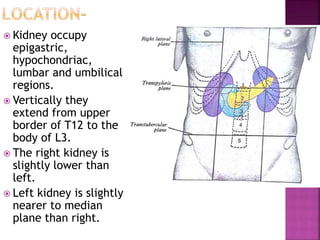
 Kidney occupy
epigastric,
hypochondriac,
lumbar and umbilical
regions.
 Vertically they
extend from upper
border of T12 to the
body of L3.
 The right kidney is
slightly lower than
left.
 Left kidney is slightly
nearer to median
plane than right.
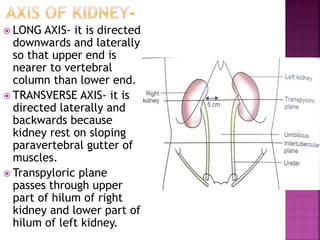
 LONG AXIS- it is directed
downwards and laterally
so that upper end is
nearer to vertebral
column than lower end.
 TRANSVERSE AXIS- it is
directed laterally and
backwards because
kidney rest on sloping
paravertebral gutter of
muscles.
 Transpyloric plane
passes through upper
part of hilum of right
kidney and lower part of
hilum of left kidney.
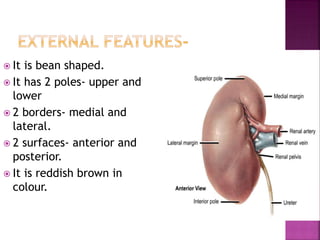
 It is bean shaped.
 It has 2 poles- upper and
lower
 2 borders- medial and
lateral.
 2 surfaces- anterior and
posterior.
 It is reddish brown in
colour.
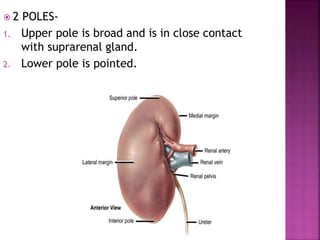
 2 POLES-
1. Upper pole is broad and is in close contact
with suprarenal gland.
2. Lower pole is pointed.
 2 SURFACES-
1. Anterior surface is irregular.
2. Posterior surface is flat.
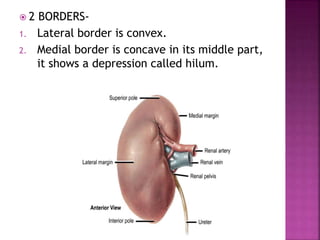
 2 BORDERS-
1. Lateral border is convex.
2. Medial border is concave in its middle part,
it shows a depression called hilum.
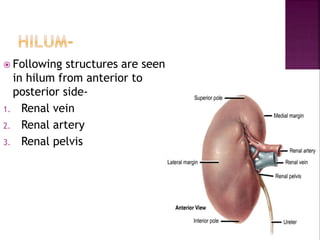
 Following structures are seen
in hilum from anterior to
posterior side-
1. Renal vein
2. Renal artery
3. Renal pelvis
Average measurement of kidney-
 Length- 11 cm
 Breadth- 6 cm
 Thickness- 3 cm
 Weight- male- 150 g
female- 135 g
 Pressure exerted by neighboring viscera, this
is obtained by tone of abdominal muscles.
 By disposition of renal fascia and distribution
of renal fat.
 Pedicles of kidney attached to hilum.
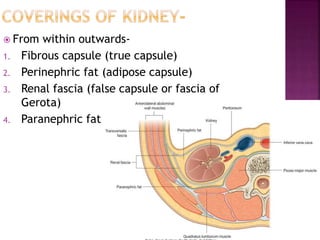
 From within outwards-
1. Fibrous capsule (true capsule)
2. Perinephric fat (adipose capsule)
3. Renal fascia (false capsule or fascia of
Gerota)
4. Paranephric fat
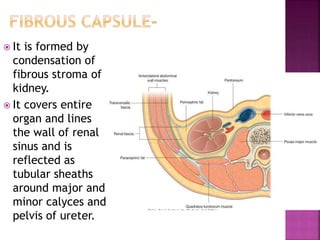
 It is formed by
condensation of
fibrous stroma of
kidney.
 It covers entire
organ and lines
the wall of renal
sinus and is
reflected as
tubular sheaths
around major and
minor calyces and
pelvis of ureter.
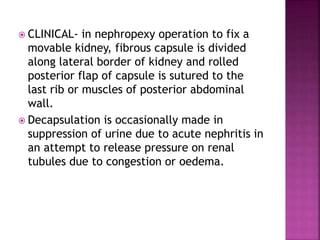
 CLINICAL- in nephropexy operation to fix a
movable kidney, fibrous capsule is divided
along lateral border of kidney and rolled
posterior flap of capsule is sutured to the
last rib or muscles of posterior abdominal
wall.
 Decapsulation is occasionally made in
suppression of urine due to acute nephritis in
an attempt to release pressure on renal
tubules due to congestion or oedema.
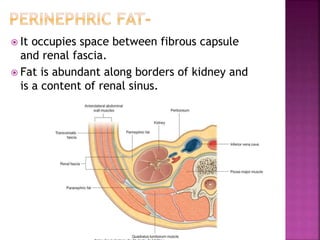
 It occupies space between fibrous capsule
and renal fascia.
 Fat is abundant along borders of kidney and
is a content of renal sinus.
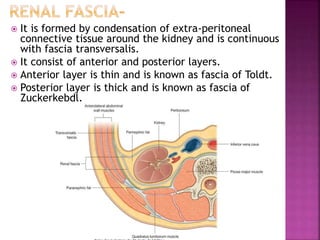
 It is formed by condensation of extra-peritoneal
connective tissue around the kidney and is continuous
with fascia transversalis.
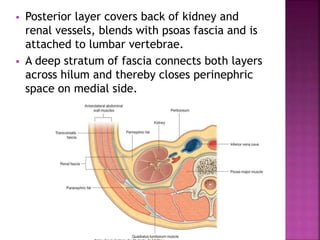
 It consist of anterior and posterior layers.
 Anterior layer is thin and is known as fascia of Toldt.
 Posterior layer is thick and is known as fascia of
Zuckerkebdl.
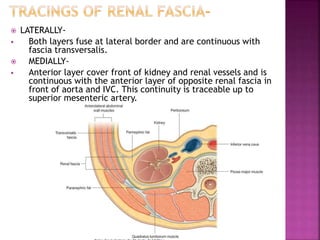
 LATERALLY-
 Both layers fuse at lateral border and are continuous with
fascia transversalis.
 MEDIALLY-
 Anterior layer cover front of kidney and renal vessels and is
continuous with the anterior layer of opposite renal fascia in
front of aorta and IVC. This continuity is traceable up to
superior mesenteric artery.
 Posterior layer covers back of kidney and
renal vessels, blends with psoas fascia and is
attached to lumbar vertebrae.
 A deep stratum of fascia connects both layers
across hilum and thereby closes perinephric
space on medial side.
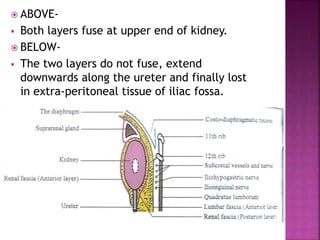
 ABOVE-
 Both layers fuse at upper end of kidney.
 BELOW-
 The two layers do not fuse, extend
downwards along the ureter and finally lost
in extra-peritoneal tissue of iliac fossa.
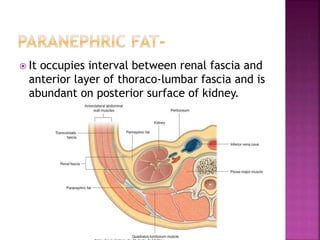
 It occupies interval between renal fascia and
anterior layer of thoraco-lumbar fascia and is
abundant on posterior surface of kidney.
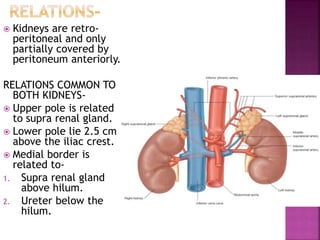
 Kidneys are retro-
peritoneal and only
partially covered by
peritoneum anteriorly.
RELATIONS COMMON TO
BOTH KIDNEYS-
 Upper pole is related
to supra renal gland.
 Lower pole lie 2.5 cm
above the iliac crest.
 Medial border is
related to-
1. Supra renal gland
above hilum.
2. Ureter below the
hilum.
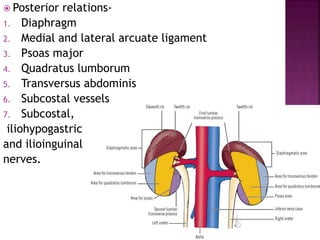
 Posterior relations-
1. Diaphragm
2. Medial and lateral arcuate ligament
3. Psoas major
4. Quadratus lumborum
5. Transversus abdominis
6. Subcostal vessels
7. Subcostal,
iliohypogastric
and ilioinguinal
nerves.
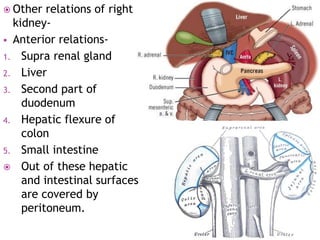
 Other relations of right
kidney-
 Anterior relations-
1. Supra renal gland
2. Liver
3. Second part of
duodenum
4. Hepatic flexure of
colon
5. Small intestine
 Out of these hepatic
and intestinal surfaces
are covered by
peritoneum.
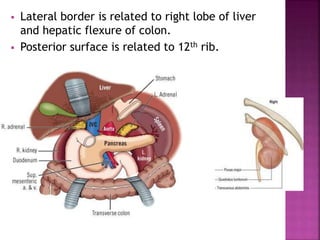
 Lateral border is related to right lobe of liver
and hepatic flexure of colon.
 Posterior surface is related to 12th rib.
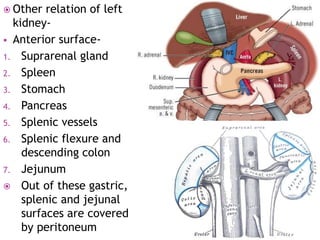
 Other relation of left
kidney-
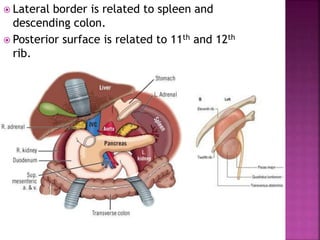
 Anterior surface-
1. Suprarenal gland
2. Spleen
3. Stomach
4. Pancreas
5. Splenic vessels
6. Splenic flexure and
descending colon
7. Jejunum
 Out of these gastric,
splenic and jejunal
surfaces are covered
by peritoneum
 Lateral border is related to spleen and
descending colon.
 Posterior surface is related to 11th and 12th
rib.
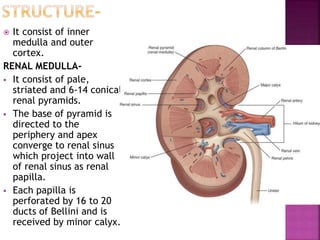
 It consist of inner
medulla and outer
cortex.
RENAL MEDULLA-
 It consist of pale,
striated and 6-14 conical
renal pyramids.
 The base of pyramid is
directed to the
periphery and apex
converge to renal sinus
which project into wall
of renal sinus as renal
papilla.
 Each papilla is
perforated by 16 to 20
ducts of Bellini and is
received by minor calyx.
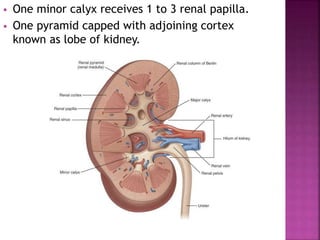
 One minor calyx receives 1 to 3 renal papilla.
 One pyramid capped with adjoining cortex
known as lobe of kidney.
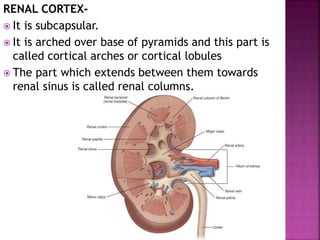
RENAL CORTEX-
 It is subcapsular.
 It is arched over base of pyramids and this part is
called cortical arches or cortical lobules
 The part which extends between them towards
renal sinus is called renal columns.
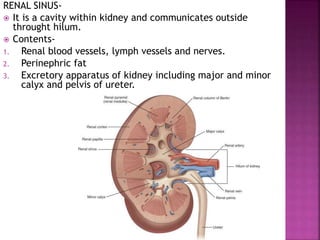
RENAL SINUS-
 It is a cavity within kidney and communicates outside
throught hilum.
 Contents-
1. Renal blood vessels, lymph vessels and nerves.
2. Perinephric fat
3. Excretory apparatus of kidney including major and minor
calyx and pelvis of ureter.
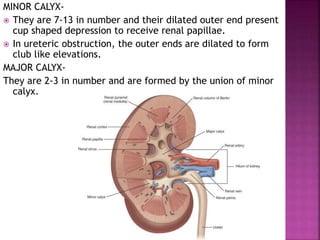
MINOR CALYX-
 They are 7-13 in number and their dilated outer end present
cup shaped depression to receive renal papillae.
 In ureteric obstruction, the outer ends are dilated to form
club like elevations.
MAJOR CALYX-
They are 2-3 in number and are formed by the union of minor
calyx.
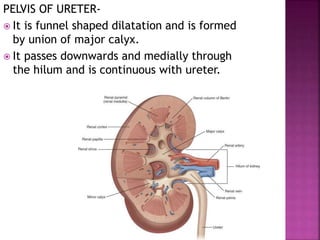
PELVIS OF URETER-
 It is funnel shaped dilatation and is formed
by union of major calyx.
 It passes downwards and medially through
the hilum and is continuous with ureter.
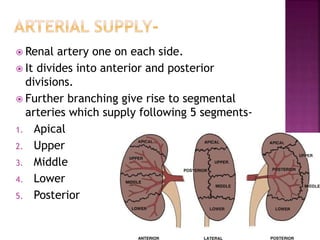
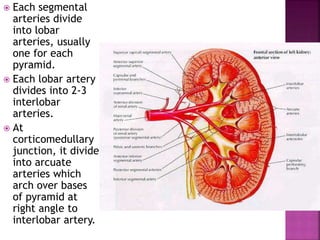
 Renal artery one on each side.
 It divides into anterior and posterior
divisions.
 Further branching give rise to segmental
arteries which supply following 5 segments-
1. Apical
2. Upper
3. Middle
4. Lower
5. Posterior
 Each segmental
arteries divide
into lobar
arteries, usually
one for each
pyramid.
 Each lobar artery
divides into 2-3
interlobar
arteries.
 At
corticomedullary
junction, it divide
into arcuate
arteries which
arch over bases
of pyramid at
right angle to
interlobar artery.
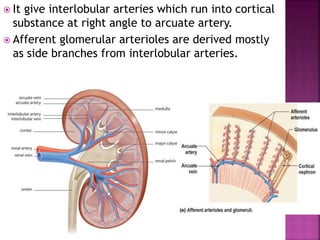
 It give interlobular arteries which run into cortical
substance at right angle to arcuate artery.
 Afferent glomerular arterioles are derived mostly
as side branches from interlobular arteries.
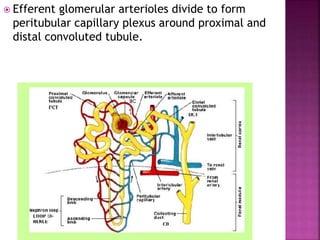
 Efferent glomerular arterioles divide to form
peritubular capillary plexus around proximal and
distal convoluted tubule.
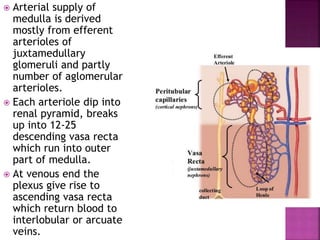
 Arterial supply of
medulla is derived
mostly from efferent
arterioles of
juxtamedullary
glomeruli and partly
number of aglomerular
arterioles.
 Each arteriole dip into
renal pyramid, breaks
up into 12-25
descending vasa recta
which run into outer
part of medulla.
 At venous end the
plexus give rise to
ascending vasa recta
which return blood to
interlobular or arcuate
veins.
Venous end of peritubular capillary plexus
interlobular veins arcuate veins
interlobar vein join to form renal vein
IVC
 Lymphatics drain into lateral aortic nodes
located at level of origin of renal arteries
(L2).
 Supplied by renal plexus.
 It contains sympathetic (T10-T11) fibers and
is supplied by lesser splancnic nerve.
 Parasympathetic is derived from vagus.
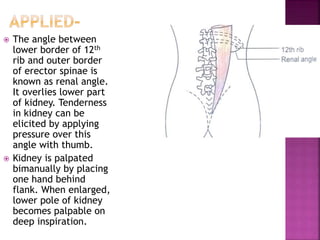
 The angle between
lower border of 12th
rib and outer border
of erector spinae is
known as renal angle.
It overlies lower part
of kidney. Tenderness
in kidney can be
elicited by applying
pressure over this
angle with thumb.
 Kidney is palpated
bimanually by placing
one hand behind
flank. When enlarged,
lower pole of kidney
becomes palpable on
deep inspiration.
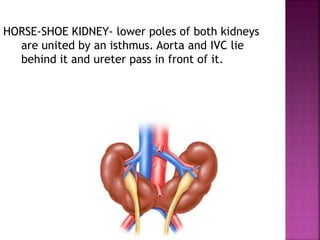
HORSE-SHOE KIDNEY- lower poles of both kidneys
are united by an isthmus. Aorta and IVC lie
behind it and ureter pass in front of it.
FLOATING KIDNEY- kidney is suspended from
posterior abdominal wall by a fold of
peritoneum. In such condition upper pole may
be tilted downwards producing twisting of renal
vessels and pelvis of ureter. This is associated
with anuria and severe pain in loin region. This
phenomenon is known as DIETL’S CRISIS.
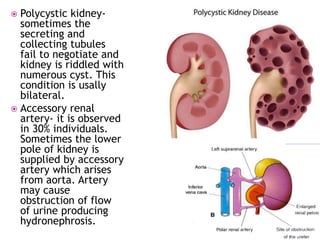
 Polycystic kidney-
sometimes the
secreting and
collecting tubules
fail to negotiate and
kidney is riddled with
numerous cyst. This
condition is usally
bilateral.
 Accessory renal
artery- it is observed
in 30% individuals.
Sometimes the lower
pole of kidney is
supplied by accessory
artery which arises
from aorta. Artery
may cause
obstruction of flow
of urine producing
hydronephrosis.
 Since branches of renal arteries are end arteries,
anastomoses must be made to all arteries of the
donar kidney in renal transplant operations.
 Large stones lodging in the renal calyces may be
fragmented into smaller pieces by extra-
corporeal application of shock-wave therapy.
This method is known as LITHOTRIPSY.
 A kidney with stenosis of renal artery produces
systemic hypertension due to overabundance of
angiotensin. In this condition, surgical
anastomosis of splenic to the renal artery is
made beyond the area of stenosis.
 The common diseases of kidney are
nephritis, pyelonephritis, tuberculosis of
kidney, renal stones and tumours.
 Common manifestations of kidney diseases
are renal oedema and hypertension. Raised
blood urea indicates suppressed kidney
function and renal failure.
 In cases of chronic renal failure dialysis
needs to be done. It can be done as
peritoneal dialysis or haemodialysis.
Kidney
Kidney
Kidney

Kidney

  • 2.
     Kidneys area pair of excretory organs situated on posterior abdominal wall, one on each side of vertebral column.  They remove waste products from the body and main water and electrolyte balance.  In addition, the kidney secrete renin for auto- regulation of blood flow and blood pressure, erythropoietin for maturation of red blood cells, and 1,25- hydroxycholecalciferol for control of calcium metabolism.
  • 3.
     Kidney occupy epigastric, hypochondriac, lumbarand umbilical regions.  Vertically they extend from upper border of T12 to the body of L3.  The right kidney is slightly lower than left.  Left kidney is slightly nearer to median plane than right.
  • 4.
     LONG AXIS-it is directed downwards and laterally so that upper end is nearer to vertebral column than lower end.  TRANSVERSE AXIS- it is directed laterally and backwards because kidney rest on sloping paravertebral gutter of muscles.  Transpyloric plane passes through upper part of hilum of right kidney and lower part of hilum of left kidney.
  • 5.
     It isbean shaped.  It has 2 poles- upper and lower  2 borders- medial and lateral.  2 surfaces- anterior and posterior.  It is reddish brown in colour.
  • 6.
     2 POLES- 1.Upper pole is broad and is in close contact with suprarenal gland. 2. Lower pole is pointed.
  • 7.
     2 SURFACES- 1.Anterior surface is irregular. 2. Posterior surface is flat.
  • 8.
     2 BORDERS- 1.Lateral border is convex. 2. Medial border is concave in its middle part, it shows a depression called hilum.
  • 9.
     Following structuresare seen in hilum from anterior to posterior side- 1. Renal vein 2. Renal artery 3. Renal pelvis
  • 10.
    Average measurement ofkidney-  Length- 11 cm  Breadth- 6 cm  Thickness- 3 cm  Weight- male- 150 g female- 135 g
  • 11.
     Pressure exertedby neighboring viscera, this is obtained by tone of abdominal muscles.  By disposition of renal fascia and distribution of renal fat.  Pedicles of kidney attached to hilum.
  • 12.
     From withinoutwards- 1. Fibrous capsule (true capsule) 2. Perinephric fat (adipose capsule) 3. Renal fascia (false capsule or fascia of Gerota) 4. Paranephric fat
  • 13.
     It isformed by condensation of fibrous stroma of kidney.  It covers entire organ and lines the wall of renal sinus and is reflected as tubular sheaths around major and minor calyces and pelvis of ureter.
  • 14.
     CLINICAL- innephropexy operation to fix a movable kidney, fibrous capsule is divided along lateral border of kidney and rolled posterior flap of capsule is sutured to the last rib or muscles of posterior abdominal wall.  Decapsulation is occasionally made in suppression of urine due to acute nephritis in an attempt to release pressure on renal tubules due to congestion or oedema.
  • 15.
     It occupiesspace between fibrous capsule and renal fascia.  Fat is abundant along borders of kidney and is a content of renal sinus.
  • 16.
     It isformed by condensation of extra-peritoneal connective tissue around the kidney and is continuous with fascia transversalis.  It consist of anterior and posterior layers.  Anterior layer is thin and is known as fascia of Toldt.  Posterior layer is thick and is known as fascia of Zuckerkebdl.
  • 17.
     LATERALLY-  Bothlayers fuse at lateral border and are continuous with fascia transversalis.  MEDIALLY-  Anterior layer cover front of kidney and renal vessels and is continuous with the anterior layer of opposite renal fascia in front of aorta and IVC. This continuity is traceable up to superior mesenteric artery.
  • 18.
     Posterior layercovers back of kidney and renal vessels, blends with psoas fascia and is attached to lumbar vertebrae.  A deep stratum of fascia connects both layers across hilum and thereby closes perinephric space on medial side.
  • 19.
     ABOVE-  Bothlayers fuse at upper end of kidney.  BELOW-  The two layers do not fuse, extend downwards along the ureter and finally lost in extra-peritoneal tissue of iliac fossa.
  • 20.
     It occupiesinterval between renal fascia and anterior layer of thoraco-lumbar fascia and is abundant on posterior surface of kidney.
  • 21.
     Kidneys areretro- peritoneal and only partially covered by peritoneum anteriorly. RELATIONS COMMON TO BOTH KIDNEYS-  Upper pole is related to supra renal gland.  Lower pole lie 2.5 cm above the iliac crest.  Medial border is related to- 1. Supra renal gland above hilum. 2. Ureter below the hilum.
  • 22.
     Posterior relations- 1.Diaphragm 2. Medial and lateral arcuate ligament 3. Psoas major 4. Quadratus lumborum 5. Transversus abdominis 6. Subcostal vessels 7. Subcostal, iliohypogastric and ilioinguinal nerves.
  • 23.
     Other relationsof right kidney-  Anterior relations- 1. Supra renal gland 2. Liver 3. Second part of duodenum 4. Hepatic flexure of colon 5. Small intestine  Out of these hepatic and intestinal surfaces are covered by peritoneum.
  • 24.
     Lateral borderis related to right lobe of liver and hepatic flexure of colon.  Posterior surface is related to 12th rib.
  • 25.
     Other relationof left kidney-  Anterior surface- 1. Suprarenal gland 2. Spleen 3. Stomach 4. Pancreas 5. Splenic vessels 6. Splenic flexure and descending colon 7. Jejunum  Out of these gastric, splenic and jejunal surfaces are covered by peritoneum
  • 26.
     Lateral borderis related to spleen and descending colon.  Posterior surface is related to 11th and 12th rib.
  • 27.
     It consistof inner medulla and outer cortex. RENAL MEDULLA-  It consist of pale, striated and 6-14 conical renal pyramids.  The base of pyramid is directed to the periphery and apex converge to renal sinus which project into wall of renal sinus as renal papilla.  Each papilla is perforated by 16 to 20 ducts of Bellini and is received by minor calyx.
  • 28.
     One minorcalyx receives 1 to 3 renal papilla.  One pyramid capped with adjoining cortex known as lobe of kidney.
  • 29.
    RENAL CORTEX-  Itis subcapsular.  It is arched over base of pyramids and this part is called cortical arches or cortical lobules  The part which extends between them towards renal sinus is called renal columns.
  • 30.
    RENAL SINUS-  Itis a cavity within kidney and communicates outside throught hilum.  Contents- 1. Renal blood vessels, lymph vessels and nerves. 2. Perinephric fat 3. Excretory apparatus of kidney including major and minor calyx and pelvis of ureter.
  • 31.
    MINOR CALYX-  Theyare 7-13 in number and their dilated outer end present cup shaped depression to receive renal papillae.  In ureteric obstruction, the outer ends are dilated to form club like elevations. MAJOR CALYX- They are 2-3 in number and are formed by the union of minor calyx.
  • 32.
    PELVIS OF URETER- It is funnel shaped dilatation and is formed by union of major calyx.  It passes downwards and medially through the hilum and is continuous with ureter.
  • 33.
     Renal arteryone on each side.  It divides into anterior and posterior divisions.  Further branching give rise to segmental arteries which supply following 5 segments- 1. Apical 2. Upper 3. Middle 4. Lower 5. Posterior
  • 34.
     Each segmental arteriesdivide into lobar arteries, usually one for each pyramid.  Each lobar artery divides into 2-3 interlobar arteries.  At corticomedullary junction, it divide into arcuate arteries which arch over bases of pyramid at right angle to interlobar artery.
  • 35.
     It giveinterlobular arteries which run into cortical substance at right angle to arcuate artery.  Afferent glomerular arterioles are derived mostly as side branches from interlobular arteries.
  • 36.
     Efferent glomerulararterioles divide to form peritubular capillary plexus around proximal and distal convoluted tubule.
  • 37.
     Arterial supplyof medulla is derived mostly from efferent arterioles of juxtamedullary glomeruli and partly number of aglomerular arterioles.  Each arteriole dip into renal pyramid, breaks up into 12-25 descending vasa recta which run into outer part of medulla.  At venous end the plexus give rise to ascending vasa recta which return blood to interlobular or arcuate veins.
  • 38.
    Venous end ofperitubular capillary plexus interlobular veins arcuate veins interlobar vein join to form renal vein IVC
  • 39.
     Lymphatics draininto lateral aortic nodes located at level of origin of renal arteries (L2).
  • 40.
     Supplied byrenal plexus.  It contains sympathetic (T10-T11) fibers and is supplied by lesser splancnic nerve.  Parasympathetic is derived from vagus.
  • 41.
     The anglebetween lower border of 12th rib and outer border of erector spinae is known as renal angle. It overlies lower part of kidney. Tenderness in kidney can be elicited by applying pressure over this angle with thumb.  Kidney is palpated bimanually by placing one hand behind flank. When enlarged, lower pole of kidney becomes palpable on deep inspiration.
  • 42.
    HORSE-SHOE KIDNEY- lowerpoles of both kidneys are united by an isthmus. Aorta and IVC lie behind it and ureter pass in front of it.
  • 43.
    FLOATING KIDNEY- kidneyis suspended from posterior abdominal wall by a fold of peritoneum. In such condition upper pole may be tilted downwards producing twisting of renal vessels and pelvis of ureter. This is associated with anuria and severe pain in loin region. This phenomenon is known as DIETL’S CRISIS.
  • 44.
     Polycystic kidney- sometimesthe secreting and collecting tubules fail to negotiate and kidney is riddled with numerous cyst. This condition is usally bilateral.  Accessory renal artery- it is observed in 30% individuals. Sometimes the lower pole of kidney is supplied by accessory artery which arises from aorta. Artery may cause obstruction of flow of urine producing hydronephrosis.
  • 45.
     Since branchesof renal arteries are end arteries, anastomoses must be made to all arteries of the donar kidney in renal transplant operations.  Large stones lodging in the renal calyces may be fragmented into smaller pieces by extra- corporeal application of shock-wave therapy. This method is known as LITHOTRIPSY.  A kidney with stenosis of renal artery produces systemic hypertension due to overabundance of angiotensin. In this condition, surgical anastomosis of splenic to the renal artery is made beyond the area of stenosis.
  • 46.
     The commondiseases of kidney are nephritis, pyelonephritis, tuberculosis of kidney, renal stones and tumours.  Common manifestations of kidney diseases are renal oedema and hypertension. Raised blood urea indicates suppressed kidney function and renal failure.  In cases of chronic renal failure dialysis needs to be done. It can be done as peritoneal dialysis or haemodialysis.