Biological Databases
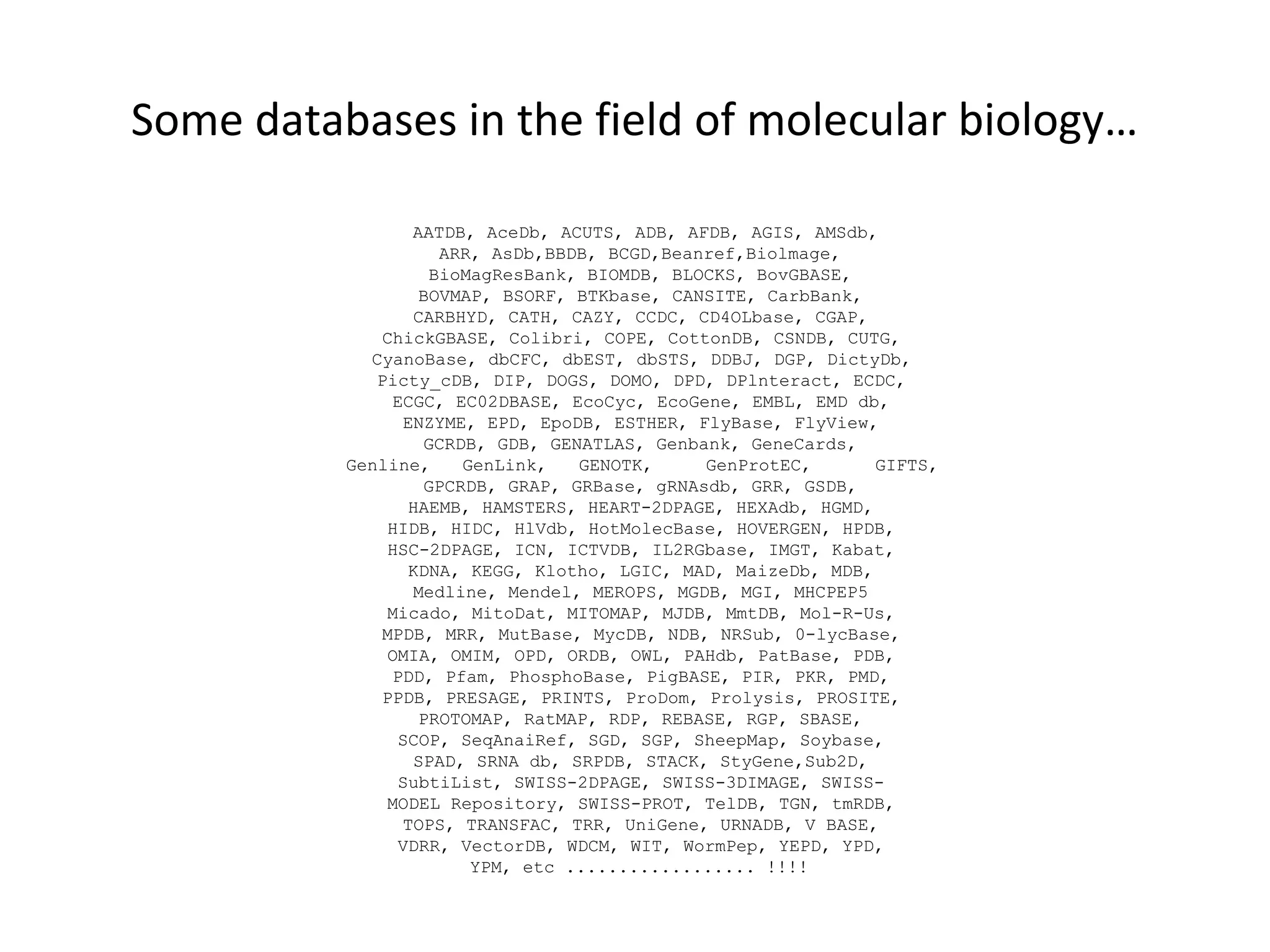
Some databases in the field of molecular biology…
AATDB, AceDb, ACUTS, ADB, AFDB, AGIS, AMSdb,
ARR, AsDb,BBDB, BCGD,Beanref,Biolmage,
BioMagResBank, BIOMDB, BLOCKS, BovGBASE,
BOVMAP, BSORF, BTKbase, CANSITE, CarbBank,
CARBHYD, CATH, CAZY, CCDC, CD4OLbase, CGAP,
ChickGBASE, Colibri, COPE, CottonDB, CSNDB, CUTG,
CyanoBase, dbCFC, dbEST, dbSTS, DDBJ, DGP, DictyDb,
Picty_cDB, DIP, DOGS, DOMO, DPD, DPlnteract, ECDC,
ECGC, EC02DBASE, EcoCyc, EcoGene, EMBL, EMD db,
ENZYME, EPD, EpoDB, ESTHER, FlyBase, FlyView,
GCRDB, GDB, GENATLAS, Genbank, GeneCards,
Genline, GenLink, GENOTK, GenProtEC, GIFTS,
GPCRDB, GRAP, GRBase, gRNAsdb, GRR, GSDB,
HAEMB, HAMSTERS, HEART-2DPAGE, HEXAdb, HGMD,
HIDB, HIDC, HlVdb, HotMolecBase, HOVERGEN, HPDB,
HSC-2DPAGE, ICN, ICTVDB, IL2RGbase, IMGT, Kabat,
KDNA, KEGG, Klotho, LGIC, MAD, MaizeDb, MDB,
Medline, Mendel, MEROPS, MGDB, MGI, MHCPEP5
Micado, MitoDat, MITOMAP, MJDB, MmtDB, Mol-R-Us,
MPDB, MRR, MutBase, MycDB, NDB, NRSub, 0-lycBase,
OMIA, OMIM, OPD, ORDB, OWL, PAHdb, PatBase, PDB,
PDD, Pfam, PhosphoBase, PigBASE, PIR, PKR, PMD,
PPDB, PRESAGE, PRINTS, ProDom, Prolysis, PROSITE,
PROTOMAP, RatMAP, RDP, REBASE, RGP, SBASE,
SCOP, SeqAnaiRef, SGD, SGP, SheepMap, Soybase,
SPAD, SRNA db, SRPDB, STACK, StyGene,Sub2D,
SubtiList, SWISS-2DPAGE, SWISS-3DIMAGE, SWISS-
MODEL Repository, SWISS-PROT, TelDB, TGN, tmRDB,
TOPS, TRANSFAC, TRR, UniGene, URNADB, V BASE,
VDRR, VectorDB, WDCM, WIT, WormPep, YEPD, YPD,
YPM, etc .................. !!!!
What we expect from a database..!!
• Sequence, functional, structural information,
related bibliography
• Well Structured and Indexed
• Well cross-referenced (with other databases)
• Periodically updated
• Tools for analysis and visualization
Biological Databases
• Sequence databases
• Structure databases
Sequence databases
• Nucleotide databases
• Protein databases
Sequence databases
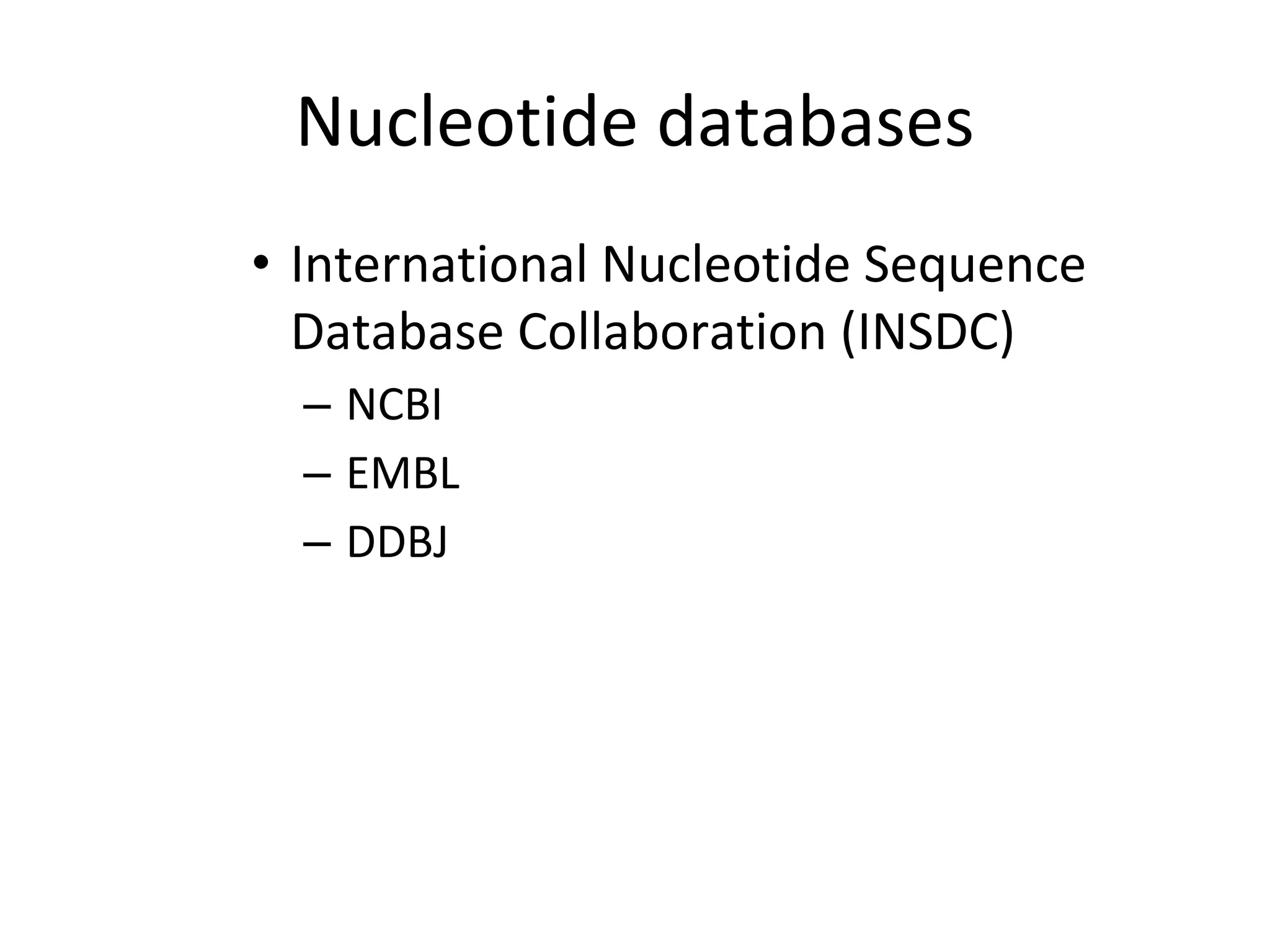
Nucleotide databases
• International Nucleotide Sequence
Database Collaboration (INSDC)
– NCBI
– EMBL
– DDBJ
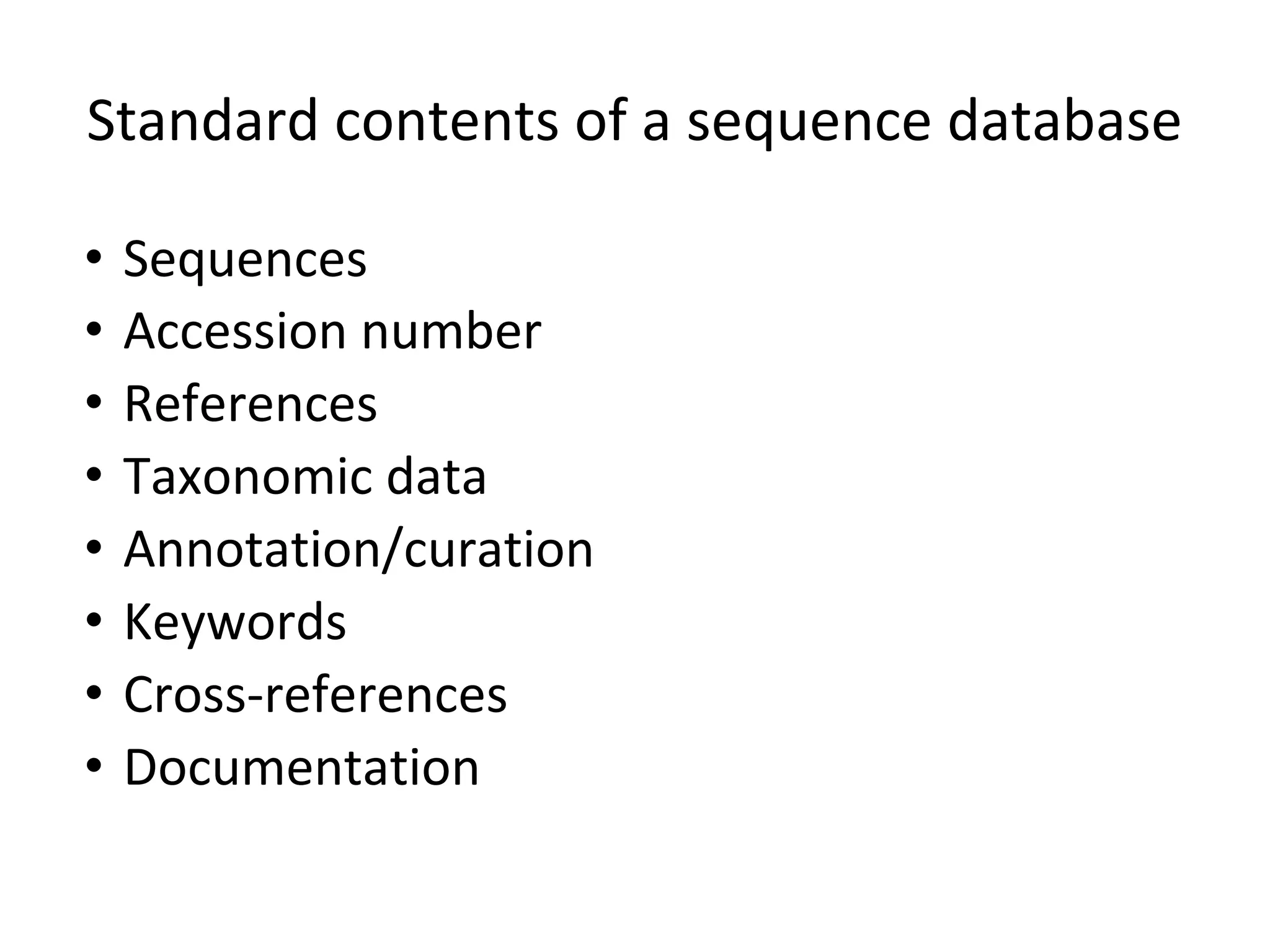
Standard contents of a sequence database
• Sequences
• Accession number
• References
• Taxonomic data
• Annotation/curation
• Keywords
• Cross-references
• Documentation
NCBI
• Very comprehensive biological database
• GENBANK: The nucleotide sequence database
• Provides 42 different resource
• Provides a simple and easy to use web
interface
http://www.ncbi.nlm.nih.gov/
• Sequence submission: done using Bankit or
Sequin
• Search Engine for data retrieval: Entrez
• Retrieves information across all the resources
under NCBI
Example: PubMed, taxonomy, SNP, PubChem
etc.
Tools for analysis
• BLAST
• Primer-BLAST
• B-Link
• ORF finder
• Genome workbench
Protein Sequence databases
• UniProt
• PFAM
• Gene Index project
UniProt
• Universal Protein Resource
• Formed through the merger of :
– SIB
– EBI-SwissProt
– TrEMBL
– PIR-PSD
• Entry names are often the names of the gene
followed by the species.
• Accession numbers are of the following
format:
• e.g. P26367 (PAX6_HUMAN)
Uniprot features
• Blast
• Align
• Retrieve
• ID mapping
Pfam
• Proteins contain conserved regions
• Based on the conserved regions, proteins are
classified into families
• Provides links to external databases like PDB,
SCOP, CATH etc.
Pfam: Features
• Sequence search
• View Pfam family
• View a clan
• View a sequence
• View a structure
• Keyword search
Gene Indices
• Project aimed at indexing genes and their
variants in the various genome sequences.
• Creating a catalogue of genes in a wide range
of organisms
• Reduce redundancy
Gene Indices Software Tools
• TGI Clustering tools
• Clview
• SeqClean
• Cdbfasta/cdbyank
Structural databases
• PDB – Protein Data Bank
• CATH
• SCOP – Structural Classification of Proteins
wwPDB
• Contains information about experimentally
determined structures of proteins, nucleic
acids, and complex assemblies
• RCSB-PDB, PDBe, PDBj, BMRB – repositories of
protein structure data
• Files in PDB, mmCIF, PDBML/XML formats
• Advanced search – provides comprehensive
information about a protein.
• Sequence info, domain info, sequence
similarity, literature, apart from the details of
the structure.
• Cross referenced to SCOP and CATH
CATH
• Classification of proteins based on domain
structures
• Each protein chopped into individual domains
and assigned into homologous superfamilies.
• Hierarchial domain classification of PDB
entries.
CATH hierarchy
• Class – derived from secondary structure content is assigned
automatically
• Architecture – describes gross orientation of secondary
structures, independent of connectivity
•Topology – clusters structures according to their
topological connections and numbers of secondary
structures
•Homologous superfamily – this level groups
together protein domains which are thought to
share a common ancestor and can therefore be
described as homologous
SCOP
• Description of structural and evolutionary
relationships between all the proteins with
known structures
• Uses the PDB entries
• Search using keywords or PDB identifiers
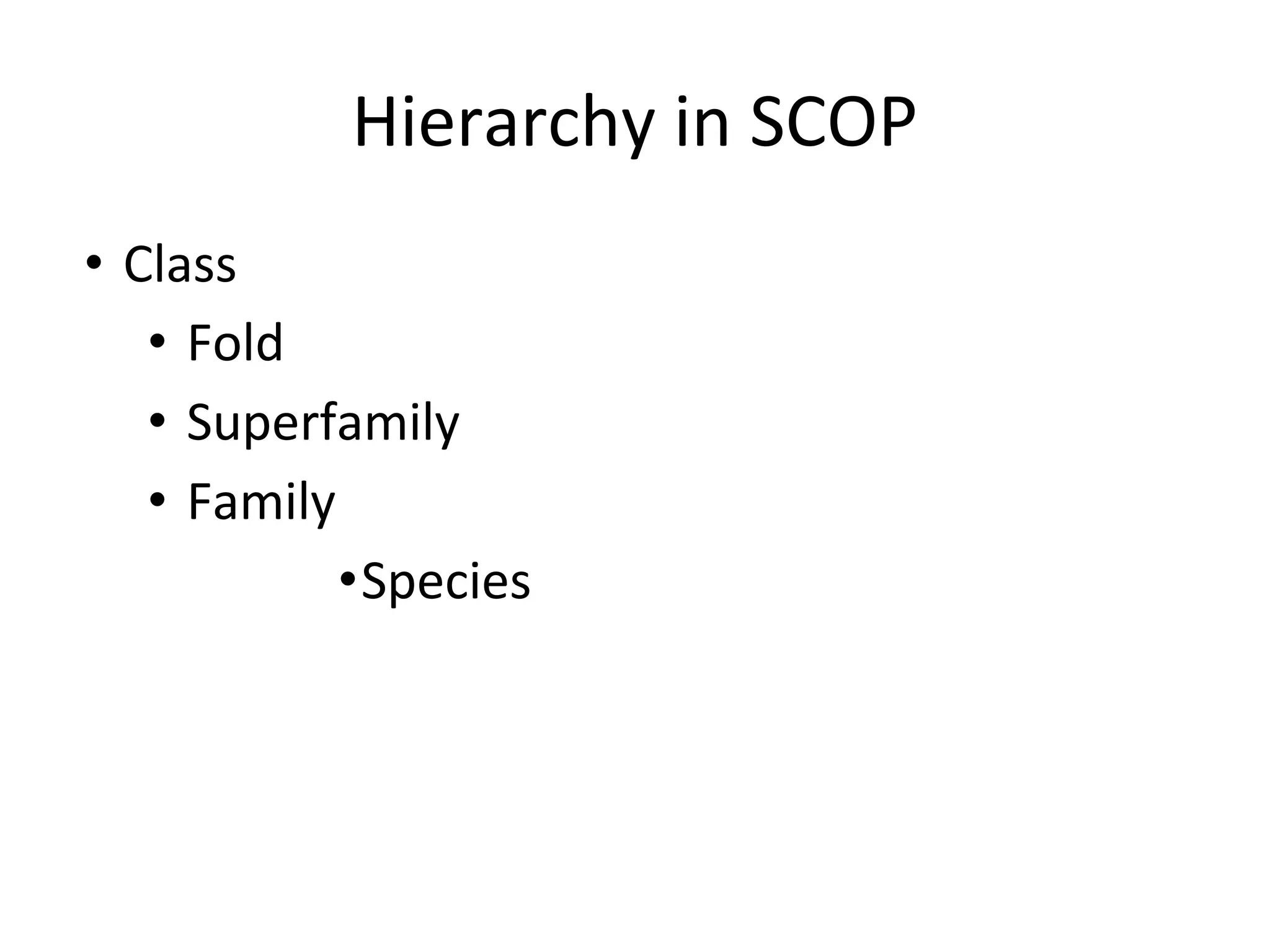
Hierarchy in SCOP
• Class
• Fold
• Superfamily
• Family
•Species
Thank you

PDF文档.pdf

  • 1.
  • 2.
    Some databases inthe field of molecular biology… AATDB, AceDb, ACUTS, ADB, AFDB, AGIS, AMSdb, ARR, AsDb,BBDB, BCGD,Beanref,Biolmage, BioMagResBank, BIOMDB, BLOCKS, BovGBASE, BOVMAP, BSORF, BTKbase, CANSITE, CarbBank, CARBHYD, CATH, CAZY, CCDC, CD4OLbase, CGAP, ChickGBASE, Colibri, COPE, CottonDB, CSNDB, CUTG, CyanoBase, dbCFC, dbEST, dbSTS, DDBJ, DGP, DictyDb, Picty_cDB, DIP, DOGS, DOMO, DPD, DPlnteract, ECDC, ECGC, EC02DBASE, EcoCyc, EcoGene, EMBL, EMD db, ENZYME, EPD, EpoDB, ESTHER, FlyBase, FlyView, GCRDB, GDB, GENATLAS, Genbank, GeneCards, Genline, GenLink, GENOTK, GenProtEC, GIFTS, GPCRDB, GRAP, GRBase, gRNAsdb, GRR, GSDB, HAEMB, HAMSTERS, HEART-2DPAGE, HEXAdb, HGMD, HIDB, HIDC, HlVdb, HotMolecBase, HOVERGEN, HPDB, HSC-2DPAGE, ICN, ICTVDB, IL2RGbase, IMGT, Kabat, KDNA, KEGG, Klotho, LGIC, MAD, MaizeDb, MDB, Medline, Mendel, MEROPS, MGDB, MGI, MHCPEP5 Micado, MitoDat, MITOMAP, MJDB, MmtDB, Mol-R-Us, MPDB, MRR, MutBase, MycDB, NDB, NRSub, 0-lycBase, OMIA, OMIM, OPD, ORDB, OWL, PAHdb, PatBase, PDB, PDD, Pfam, PhosphoBase, PigBASE, PIR, PKR, PMD, PPDB, PRESAGE, PRINTS, ProDom, Prolysis, PROSITE, PROTOMAP, RatMAP, RDP, REBASE, RGP, SBASE, SCOP, SeqAnaiRef, SGD, SGP, SheepMap, Soybase, SPAD, SRNA db, SRPDB, STACK, StyGene,Sub2D, SubtiList, SWISS-2DPAGE, SWISS-3DIMAGE, SWISS- MODEL Repository, SWISS-PROT, TelDB, TGN, tmRDB, TOPS, TRANSFAC, TRR, UniGene, URNADB, V BASE, VDRR, VectorDB, WDCM, WIT, WormPep, YEPD, YPD, YPM, etc .................. !!!!
  • 3.
    What we expectfrom a database..!! • Sequence, functional, structural information, related bibliography • Well Structured and Indexed • Well cross-referenced (with other databases) • Periodically updated • Tools for analysis and visualization
  • 4.
    Biological Databases • Sequencedatabases • Structure databases
  • 5.
    Sequence databases • Nucleotidedatabases • Protein databases
  • 6.
  • 7.
    Nucleotide databases • InternationalNucleotide Sequence Database Collaboration (INSDC) – NCBI – EMBL – DDBJ
  • 8.
    Standard contents ofa sequence database • Sequences • Accession number • References • Taxonomic data • Annotation/curation • Keywords • Cross-references • Documentation
  • 9.
    NCBI • Very comprehensivebiological database • GENBANK: The nucleotide sequence database • Provides 42 different resource • Provides a simple and easy to use web interface http://www.ncbi.nlm.nih.gov/
  • 10.
    • Sequence submission:done using Bankit or Sequin • Search Engine for data retrieval: Entrez • Retrieves information across all the resources under NCBI Example: PubMed, taxonomy, SNP, PubChem etc.
  • 11.
    Tools for analysis •BLAST • Primer-BLAST • B-Link • ORF finder • Genome workbench
  • 12.
    Protein Sequence databases •UniProt • PFAM • Gene Index project
  • 13.
    UniProt • Universal ProteinResource • Formed through the merger of : – SIB – EBI-SwissProt – TrEMBL – PIR-PSD
  • 14.
    • Entry namesare often the names of the gene followed by the species. • Accession numbers are of the following format: • e.g. P26367 (PAX6_HUMAN)
  • 15.
    Uniprot features • Blast •Align • Retrieve • ID mapping
  • 16.
    Pfam • Proteins containconserved regions • Based on the conserved regions, proteins are classified into families • Provides links to external databases like PDB, SCOP, CATH etc.
  • 17.
    Pfam: Features • Sequencesearch • View Pfam family • View a clan • View a sequence • View a structure • Keyword search
  • 18.
    Gene Indices • Projectaimed at indexing genes and their variants in the various genome sequences. • Creating a catalogue of genes in a wide range of organisms • Reduce redundancy
  • 19.
    Gene Indices SoftwareTools • TGI Clustering tools • Clview • SeqClean • Cdbfasta/cdbyank
  • 20.
  • 21.
    • PDB –Protein Data Bank • CATH • SCOP – Structural Classification of Proteins
  • 22.
    wwPDB • Contains informationabout experimentally determined structures of proteins, nucleic acids, and complex assemblies • RCSB-PDB, PDBe, PDBj, BMRB – repositories of protein structure data • Files in PDB, mmCIF, PDBML/XML formats
  • 23.
    • Advanced search– provides comprehensive information about a protein. • Sequence info, domain info, sequence similarity, literature, apart from the details of the structure. • Cross referenced to SCOP and CATH
  • 24.
    CATH • Classification ofproteins based on domain structures • Each protein chopped into individual domains and assigned into homologous superfamilies. • Hierarchial domain classification of PDB entries.
  • 25.
    CATH hierarchy • Class– derived from secondary structure content is assigned automatically • Architecture – describes gross orientation of secondary structures, independent of connectivity •Topology – clusters structures according to their topological connections and numbers of secondary structures •Homologous superfamily – this level groups together protein domains which are thought to share a common ancestor and can therefore be described as homologous
  • 26.
    SCOP • Description ofstructural and evolutionary relationships between all the proteins with known structures • Uses the PDB entries • Search using keywords or PDB identifiers
  • 27.
    Hierarchy in SCOP •Class • Fold • Superfamily • Family •Species
  • 28.