PRESENTATION ON :-Advance separation technology:  high performance liquidchromatography(HPLC)PRESENTED BY:-GAIKWAD OVESH &MD.NADEEM MANSOORI
Basic Principles of HPLC:-
Introduction :-HPLC is a form of liquid chromatography used to separate compounds that are dissolved in solution.
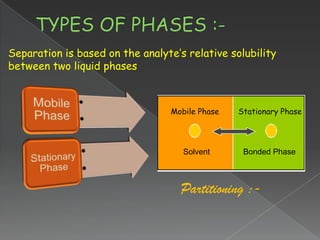
TYPES OF PHASES :-Separation is based on the analyte’s relative solubility between two liquid phasesMobile PhaseStationary PhaseSolventBonded PhasePartitioning :-
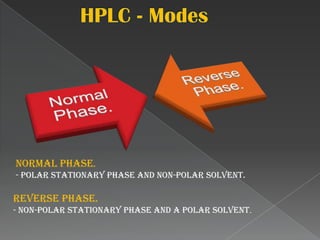
HPLC - ModesNormal Phase.- Polar stationary phase and non-polar solvent. Reverse Phase.- Non-polar stationary phase and a polar solvent.
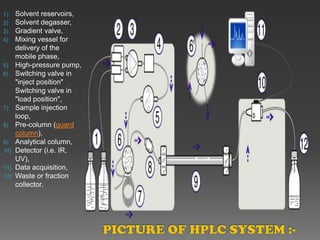
Solvent reservoirs, Solvent degasser, Gradient valve, Mixing vessel for delivery of the mobile phase, High-pressure pump, Switching valve in "inject position" Switching valve in "load position", Sample injection loop, Pre-column (guard column), Analytical column, Detector (i.e. IR, UV), Data acquisition, Waste or fraction  collector.PICTURE OF HPLC SYSTEM :-
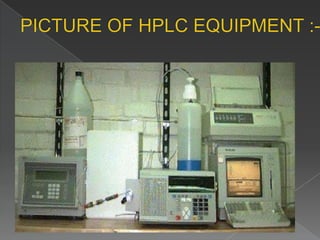
PICTURE OF HPLC EQUIPMENT :-
FOUR TYPES OF HIGH PERFOMANCE LIQUID CHROMATOGRAPHY :-
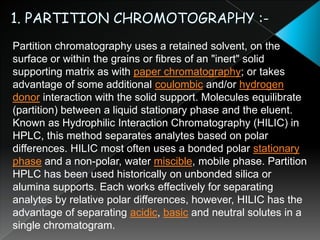
1. PARTITION CHROMOTOGRAPHY :-Partition chromatography uses a retained solvent, on the surface or within the grains or fibres of an "inert" solid supporting matrix as with paper chromatography; or takes advantage of some additional coulombic and/or hydrogen donor interaction with the solid support. Molecules equilibrate (partition) between a liquid stationary phase and the eluent. Known as Hydrophilic Interaction Chromatography (HILIC) in HPLC, this method separates analytes based on polar differences. HILIC most often uses a bonded polar stationary phase and a non-polar, water miscible, mobile phase. Partition HPLC has been used historically on unbonded silica or alumina supports. Each works effectively for separating analytes by relative polar differences, however, HILIC has the advantage of separating acidic, basic and neutral solutes in a single chromatogram.
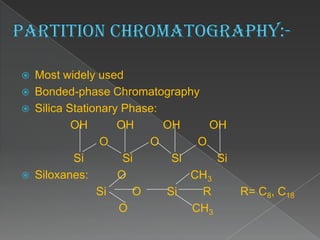
Partition Chromatography:-Most widely usedBonded-phase ChromatographySilica Stationary Phase:           OH         OH         OH         OH
                    O             O            O
            Si            Si            Si           SiSiloxanes:         O                    CH3                   Si        O        Si        R         R= C8, C18
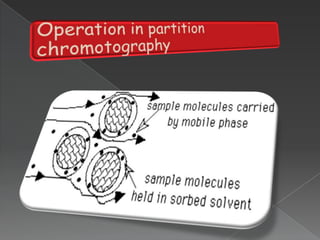
                          O                    CH3Operation in partition chromotography
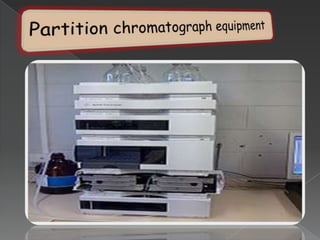
Partition chromatograph equipment
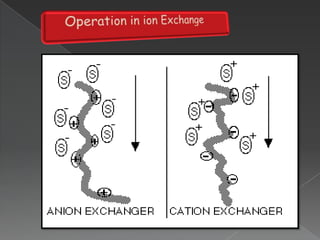
2. ION EXCHANGE CHROMATOGRAPHYIon-exchange chromatography is a process that allows the separation of ions and polar molecules based on their charge. It can be used for almost any kind of charged molecule including large proteins, small nucleotides and amino acids. The solution to be injected is usually called a sample, and the individually separated components are called analytes. It is often used in protein purification, water analysis, and quality controlIon exchange chromatography retains analyte molecules on the column based on coulombic (ionic) interactions. The stationary phase surface displays ionic functional groups (R-X) that interact with analyte ions of opposite charge. This type of chromatography is further subdivided into cation exchange chromatography and anion exchange chromatography. The ionic compound consisting of the cationic species M+ and the anionic species B- can be retained by the stationary phase.
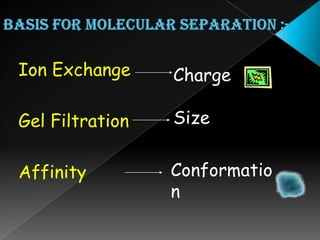
Basis for molecular separation :-Ion ExchangeGel FiltrationAffinity Charge  SizeConformation
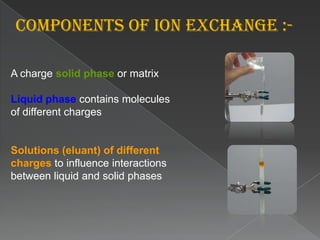
Components of ion exchange :-A charge solid phase or matrix Liquid phase contains molecules of different chargesSolutions (eluant) of different charges to influence interactions between liquid and solid phases
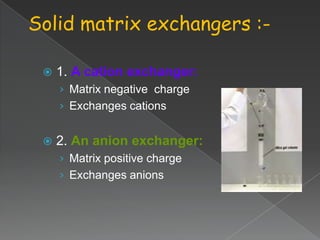
Solid matrix exchangers :-1. A cation exchanger:
Matrix negative  charge
Exchanges cations
2. An anion exchanger:
Matrix positive charge
Exchanges anions    Operation in ion Exchange
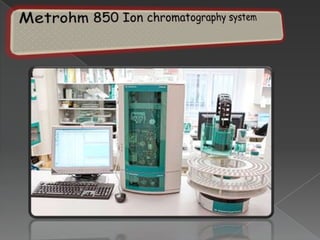
Metrohm 850 Ion chromatography system
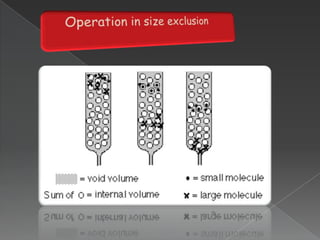
3. Size exclusion chromatography :-Size exclusion chromatography (SEC), also known as gel permeation chromatography or gel filtration chromatography, separates particles on the basis of size. It is generally a low resolution chromatography and thus it is often reserved for the final, "polishing" step of purification. It is also useful for determining the tertiary structure and quaternary structure of purified proteins. SEC is used primarily for the analysis of large molecules such as proteins or polymers. SEC works by trapping these smaller molecules in the pores of a particle. The larger molecules simply pass by the pores as they are too large to enter the pores. Larger molecules therefore flow through the column quicker than smaller molecules, that is, the smaller the molecule, the longer the retention time.
Size Exclusion Chromatography(SEC) :-Gel permeation(GPC), gel filtration(GFC) chromatographyTechnique applicable to separation of high-molecular weight speciesRapid determination of the molecular weight or molecular-weight distribution of larger polymers or natural productsSolute and solvent molecules can diffuse into pores -- trapped and removed from the flow of the mobile phase
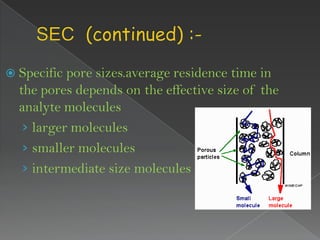
Specific pore sizes.average residence time in the pores depends on the effective size of the analyte moleculeslarger moleculessmaller moleculesintermediate size moleculesSEC  (continued) :-
    Operation in size exclusion
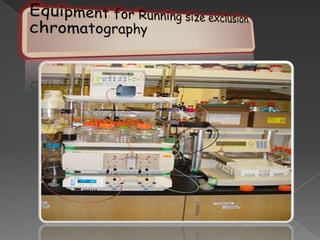
Equipment for Running size exclusion chromatography
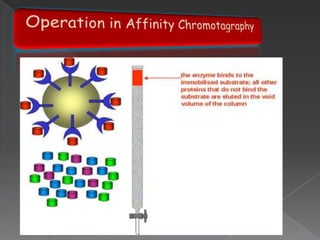
4. AFFINITY CHROMOTAGRAPY :-This is the most selective type of chromatography employed. It utilizes the specific interaction between one kind of solute molecule and a second molecule that is immobilized on a stationary phase. For example, the immobilized molecule may be an antibody to some specific protein. When solutes containing a mixture of proteins are passed by this molecule, only the specific protein is reacted to this antibody, binding it to the stationary phase. This protein is later extracted by changing the ionic strength or pH..
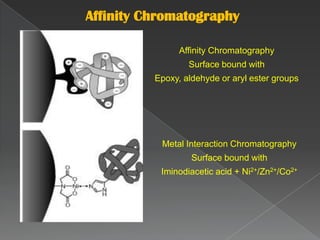
Affinity ChromatographyAffinity ChromatographySurface bound withEpoxy, aldehyde or aryl ester groupsMetal Interaction ChromatographySurface bound withIminodiacetic acid + Ni2+/Zn2+/Co2+
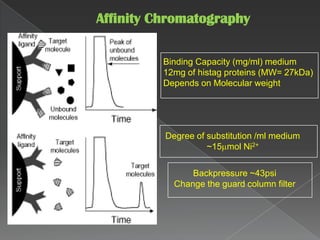
Affinity ChromatographyBinding Capacity (mg/ml) medium 12mg of histag proteins (MW= 27kDa)Depends on Molecular weightDegree of substitution /ml medium~15mmol Ni2+Backpressure ~43psiChange the guard column filter
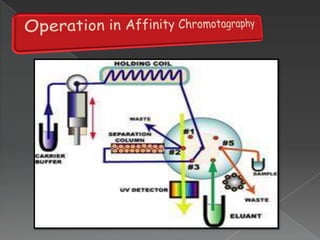
 Operation in Affinity Chromotagraphy
 Operation in Affinity Chromotagraphy
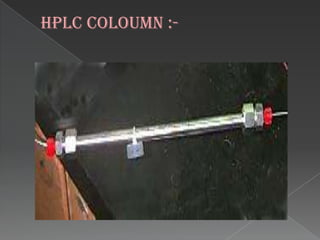
ACCESSORIES FOR HPLC EQUIPMENT :-HPLC COLOUMS:-The column is one of the most important components of the HPLC chromatograph because the separation of the sample components is achieved when those components pass through the column. The High performance liquid chromatography apparatus is made out of stainless steel tubes with a diameter of 3 to 5mm and a length ranging 10 -30cmNormally, columns are filled with silametica gel because its particle shape, surface properties, and pore structure help to get a good separation. Silica can be used to separate a wide variety of chemical compounds, and its chromatographic behavior is generally predictable and reproducible.
HPLC COLOUMN :-
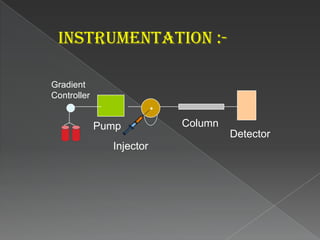
Instrumentation :-Gradient Controller•ColumnPumpDetectorInjector
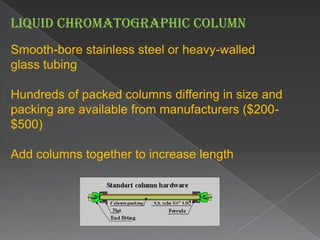
Liquid Chromatographic ColumnSmooth-bore stainless steel or heavy-walled glass tubingHundreds of packed columns differing in size and packing are available from manufacturers ($200-$500)Add columns together to increase length
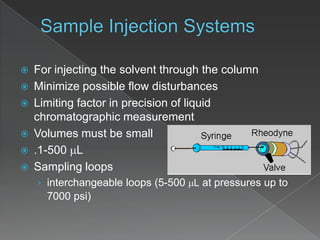
Sample Injection SystemsFor injecting the solvent through the column
Minimize possible flow disturbances

Hplc presentation final

  • 1.
    PRESENTATION ON :-Advanceseparation technology: high performance liquidchromatography(HPLC)PRESENTED BY:-GAIKWAD OVESH &MD.NADEEM MANSOORI
  • 2.
  • 3.
    Introduction :-HPLC isa form of liquid chromatography used to separate compounds that are dissolved in solution.
  • 4.
    TYPES OF PHASES:-Separation is based on the analyte’s relative solubility between two liquid phasesMobile PhaseStationary PhaseSolventBonded PhasePartitioning :-
  • 5.
    HPLC - ModesNormalPhase.- Polar stationary phase and non-polar solvent. Reverse Phase.- Non-polar stationary phase and a polar solvent.
  • 6.
    Solvent reservoirs, Solventdegasser, Gradient valve, Mixing vessel for delivery of the mobile phase, High-pressure pump, Switching valve in "inject position" Switching valve in "load position", Sample injection loop, Pre-column (guard column), Analytical column, Detector (i.e. IR, UV), Data acquisition, Waste or fraction collector.PICTURE OF HPLC SYSTEM :-
  • 7.
    PICTURE OF HPLCEQUIPMENT :-
  • 8.
    FOUR TYPES OFHIGH PERFOMANCE LIQUID CHROMATOGRAPHY :-
  • 9.
    1. PARTITION CHROMOTOGRAPHY:-Partition chromatography uses a retained solvent, on the surface or within the grains or fibres of an "inert" solid supporting matrix as with paper chromatography; or takes advantage of some additional coulombic and/or hydrogen donor interaction with the solid support. Molecules equilibrate (partition) between a liquid stationary phase and the eluent. Known as Hydrophilic Interaction Chromatography (HILIC) in HPLC, this method separates analytes based on polar differences. HILIC most often uses a bonded polar stationary phase and a non-polar, water miscible, mobile phase. Partition HPLC has been used historically on unbonded silica or alumina supports. Each works effectively for separating analytes by relative polar differences, however, HILIC has the advantage of separating acidic, basic and neutral solutes in a single chromatogram.
  • 10.
    Partition Chromatography:-Most widelyusedBonded-phase ChromatographySilica Stationary Phase: OH OH OH OH
  • 11.
    O O O
  • 12.
    Si Si Si SiSiloxanes: O CH3 Si O Si R R= C8, C18
  • 13.
    O CH3Operation in partition chromotography
  • 14.
  • 15.
    2. ION EXCHANGECHROMATOGRAPHYIon-exchange chromatography is a process that allows the separation of ions and polar molecules based on their charge. It can be used for almost any kind of charged molecule including large proteins, small nucleotides and amino acids. The solution to be injected is usually called a sample, and the individually separated components are called analytes. It is often used in protein purification, water analysis, and quality controlIon exchange chromatography retains analyte molecules on the column based on coulombic (ionic) interactions. The stationary phase surface displays ionic functional groups (R-X) that interact with analyte ions of opposite charge. This type of chromatography is further subdivided into cation exchange chromatography and anion exchange chromatography. The ionic compound consisting of the cationic species M+ and the anionic species B- can be retained by the stationary phase.
  • 16.
    Basis for molecularseparation :-Ion ExchangeGel FiltrationAffinity Charge SizeConformation
  • 17.
    Components of ionexchange :-A charge solid phase or matrix Liquid phase contains molecules of different chargesSolutions (eluant) of different charges to influence interactions between liquid and solid phases
  • 18.
    Solid matrix exchangers:-1. A cation exchanger:
  • 19.
  • 20.
  • 21.
    2. An anionexchanger:
  • 22.
  • 23.
    Exchanges anions Operation in ion Exchange
  • 24.
    Metrohm 850 Ionchromatography system
  • 25.
    3. Size exclusionchromatography :-Size exclusion chromatography (SEC), also known as gel permeation chromatography or gel filtration chromatography, separates particles on the basis of size. It is generally a low resolution chromatography and thus it is often reserved for the final, "polishing" step of purification. It is also useful for determining the tertiary structure and quaternary structure of purified proteins. SEC is used primarily for the analysis of large molecules such as proteins or polymers. SEC works by trapping these smaller molecules in the pores of a particle. The larger molecules simply pass by the pores as they are too large to enter the pores. Larger molecules therefore flow through the column quicker than smaller molecules, that is, the smaller the molecule, the longer the retention time.
  • 26.
    Size Exclusion Chromatography(SEC):-Gel permeation(GPC), gel filtration(GFC) chromatographyTechnique applicable to separation of high-molecular weight speciesRapid determination of the molecular weight or molecular-weight distribution of larger polymers or natural productsSolute and solvent molecules can diffuse into pores -- trapped and removed from the flow of the mobile phase
  • 27.
    Specific pore sizes.averageresidence time in the pores depends on the effective size of the analyte moleculeslarger moleculessmaller moleculesintermediate size moleculesSEC (continued) :-
  • 28.
    Operation in size exclusion
  • 29.
    Equipment for Runningsize exclusion chromatography
  • 30.
    4. AFFINITY CHROMOTAGRAPY:-This is the most selective type of chromatography employed. It utilizes the specific interaction between one kind of solute molecule and a second molecule that is immobilized on a stationary phase. For example, the immobilized molecule may be an antibody to some specific protein. When solutes containing a mixture of proteins are passed by this molecule, only the specific protein is reacted to this antibody, binding it to the stationary phase. This protein is later extracted by changing the ionic strength or pH..
  • 31.
    Affinity ChromatographyAffinity ChromatographySurfacebound withEpoxy, aldehyde or aryl ester groupsMetal Interaction ChromatographySurface bound withIminodiacetic acid + Ni2+/Zn2+/Co2+
  • 32.
    Affinity ChromatographyBinding Capacity(mg/ml) medium 12mg of histag proteins (MW= 27kDa)Depends on Molecular weightDegree of substitution /ml medium~15mmol Ni2+Backpressure ~43psiChange the guard column filter
  • 33.
    Operation inAffinity Chromotagraphy
  • 34.
    Operation inAffinity Chromotagraphy
  • 35.
    ACCESSORIES FOR HPLCEQUIPMENT :-HPLC COLOUMS:-The column is one of the most important components of the HPLC chromatograph because the separation of the sample components is achieved when those components pass through the column. The High performance liquid chromatography apparatus is made out of stainless steel tubes with a diameter of 3 to 5mm and a length ranging 10 -30cmNormally, columns are filled with silametica gel because its particle shape, surface properties, and pore structure help to get a good separation. Silica can be used to separate a wide variety of chemical compounds, and its chromatographic behavior is generally predictable and reproducible.
  • 36.
  • 37.
  • 38.
    Liquid Chromatographic ColumnSmooth-borestainless steel or heavy-walled glass tubingHundreds of packed columns differing in size and packing are available from manufacturers ($200-$500)Add columns together to increase length
  • 39.
    Sample Injection SystemsForinjecting the solvent through the column
  • 40.
  • 41.
    Limiting factor inprecision of liquid chromatographic measurement
  • 42.
  • 43.
  • 44.
  • 45.
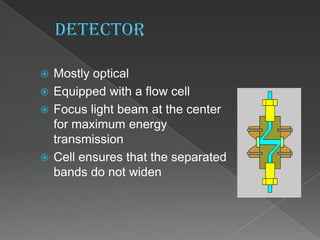
    interchangeable loops (5-500L at pressures up to 7000 psi)DetectorMostly optical
  • 46.
  • 47.
    Focus light beamat the center for maximum energy transmission
  • 48.
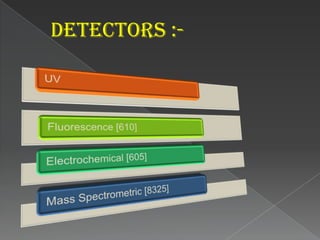
    Cell ensures thatthe separated bands do not widenDetectors :-
  • 49.
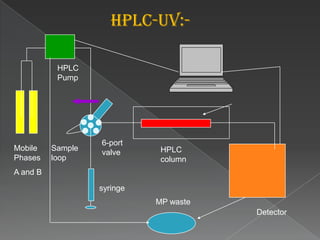
    HPLC-UV:-HPLC Pump6-port valveMobilePhasesA and BSample loopHPLC columnsyringeMP wasteDetector
  • 50.
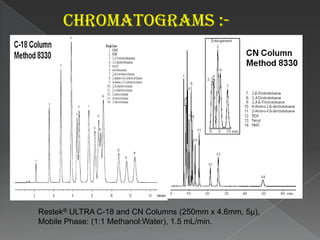
    Chromatograms :-Restek® ULTRAC-18 and CN Columns (250mm x 4.6mm, 5µ), Mobile Phase: (1:1 Methanol:Water), 1.5 mL/min.
  • 51.
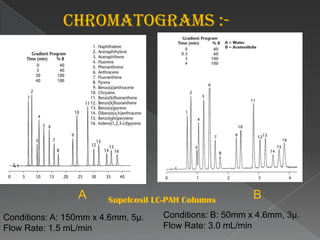
    Chromatograms :-ABSupelcosil LC-PAHColumnsConditions: B: 50mm x 4.6mm, 3µ.Flow Rate: 3.0 mL/minConditions: A: 150mm x 4.6mm, 5µ.Flow Rate: 1.5 mL/min
  • 52.
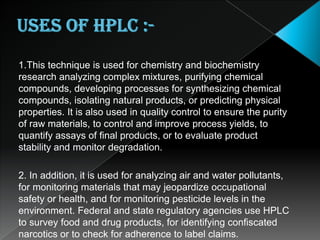
    USES OF HPLC:-1.This technique is used for chemistry and biochemistry research analyzing complex mixtures, purifying chemical compounds, developing processes for synthesizing chemical compounds, isolating natural products, or predicting physical properties. It is also used in quality control to ensure the purity of raw materials, to control and improve process yields, to quantify assays of final products, or to evaluate product stability and monitor degradation. 2. In addition, it is used for analyzing air and water pollutants, for monitoring materials that may jeopardize occupational safety or health, and for monitoring pesticide levels in the environment. Federal and state regulatory agencies use HPLC to survey food and drug products, for identifying confiscated narcotics or to check for adherence to label claims.
  • 53.
    THANK YOU ANYQUESTIONS ???