Optical Rotation &
Polarimeter
Dr. A. Amsavel, M.Sc., B.Ed., Ph.D.
Principle, Theory, Instrumentation
and Application
An Overview
• Introduction
• Isomers and enantiomers
• Specific Optical Rotation
• Polarimeter
• Instrumentation and Operation
• Factors affect the Optical Rotation
• Calibration
• Application Specifically Pharmaceutical Industries
Introduction
• E.L. Malus discovered the rotation of polarised light in
1808, while passed light through reflective glass surfaces
• The scientist Jean Baptiste Biot observed that certain
liquids and gases of organic substances rotates the
polarized light.
• He established that Optical activity is related to the
structure of the chemical compounds.
• Louis Pasteur studied the optical activity of crystal forms
with several salts
• He laid the foundation for the development of
polarimetry and important property of light.
Isomers
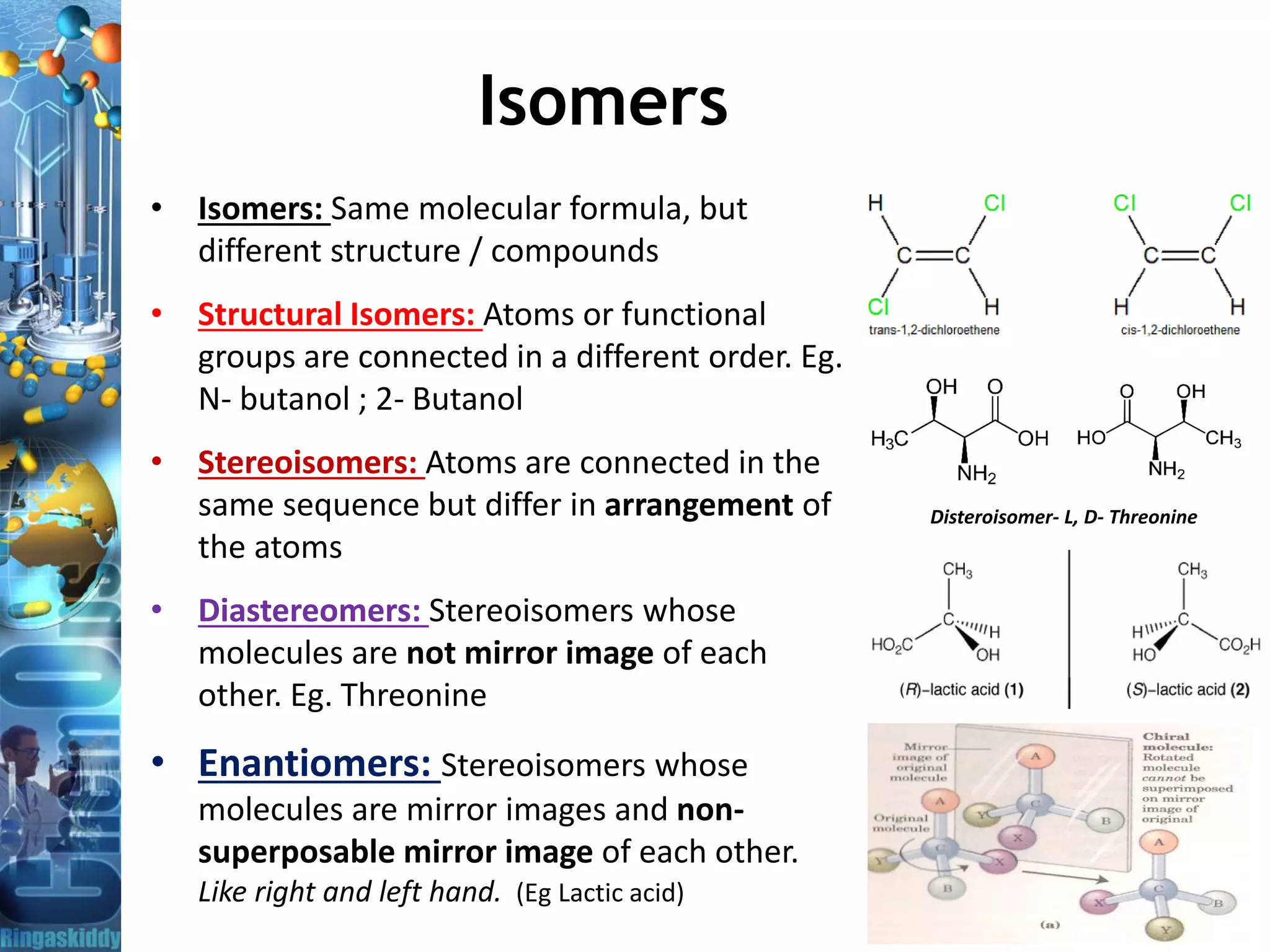
• Isomers: Same molecular formula, but
different structure / compounds
• Structural Isomers: Atoms or functional
groups are connected in a different order. Eg.
N- butanol ; 2- Butanol
• Stereoisomers: Atoms are connected in the
same sequence but differ in arrangement of
the atoms
• Diastereomers: Stereoisomers whose
molecules are not mirror image of each
other. Eg. Threonine
• Enantiomers: Stereoisomers whose
molecules are mirror images and non-
superposable mirror image of each other.
Like right and left hand. (Eg Lactic acid)
Disteroisomer- L, D- Threonine
Stereoisomers
• Stereoisomers have chiral center(s). Two molecules are described
as stereoisomers if they are made of the same atoms connected in
the same sequence, but the atoms are positioned differently in space
( Spatial arrangement).
• Diastereomers have different physical properties like boiling
points, melting points, solubility.. etc
• Enantiomers: Physical properties like melting point, boiling point,
refractive index, etc. are identical and differ in a optical activity.
– Optical activity: Chiral molecules rotate the plane of polarized light as it
passes through solution to clockwise and counter-clockwise.
• Enantiomers turn the polarization plane in opposite directions.
• The angle by which the polarization plane is rotated is called optical
rotation. It is measured in degrees Arc [°] using Polarimeter.
Chiral Molecule
• Carbon attached to 4 different substituent groups is
called Chiral molecule. Even two substituent groups
start with C, also must be different.
Example: (-) 2- Butanol (+) Pseudoephedrine HCl
SOR (-) 13.5° SOR (+) 51.5°
 Carbon attached with 4 groups is called Chiral Center.
Some molecules will have 2 or more chiral centers.
OH
H
H3CH2C
CH3
NHCH3
H
H3C
OH
H
. HCl
Optical Isomers
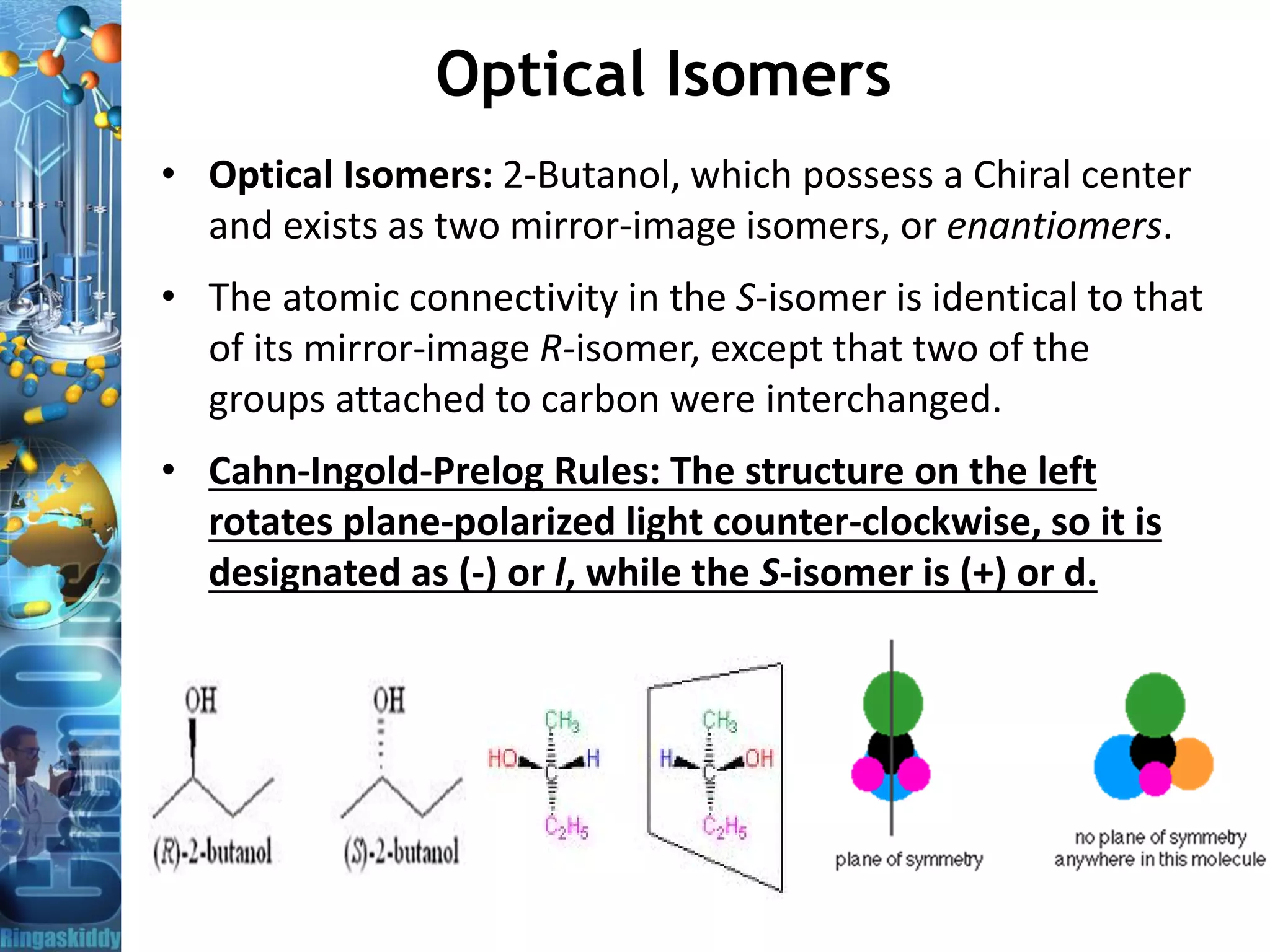
• Optical Isomers: 2-Butanol, which possess a Chiral center
and exists as two mirror-image isomers, or enantiomers.
• The atomic connectivity in the S-isomer is identical to that
of its mirror-image R-isomer, except that two of the
groups attached to carbon were interchanged.
• Cahn-Ingold-Prelog Rules: The structure on the left
rotates plane-polarized light counter-clockwise, so it is
designated as (-) or l, while the S-isomer is (+) or d.
Types of Optical Isomers
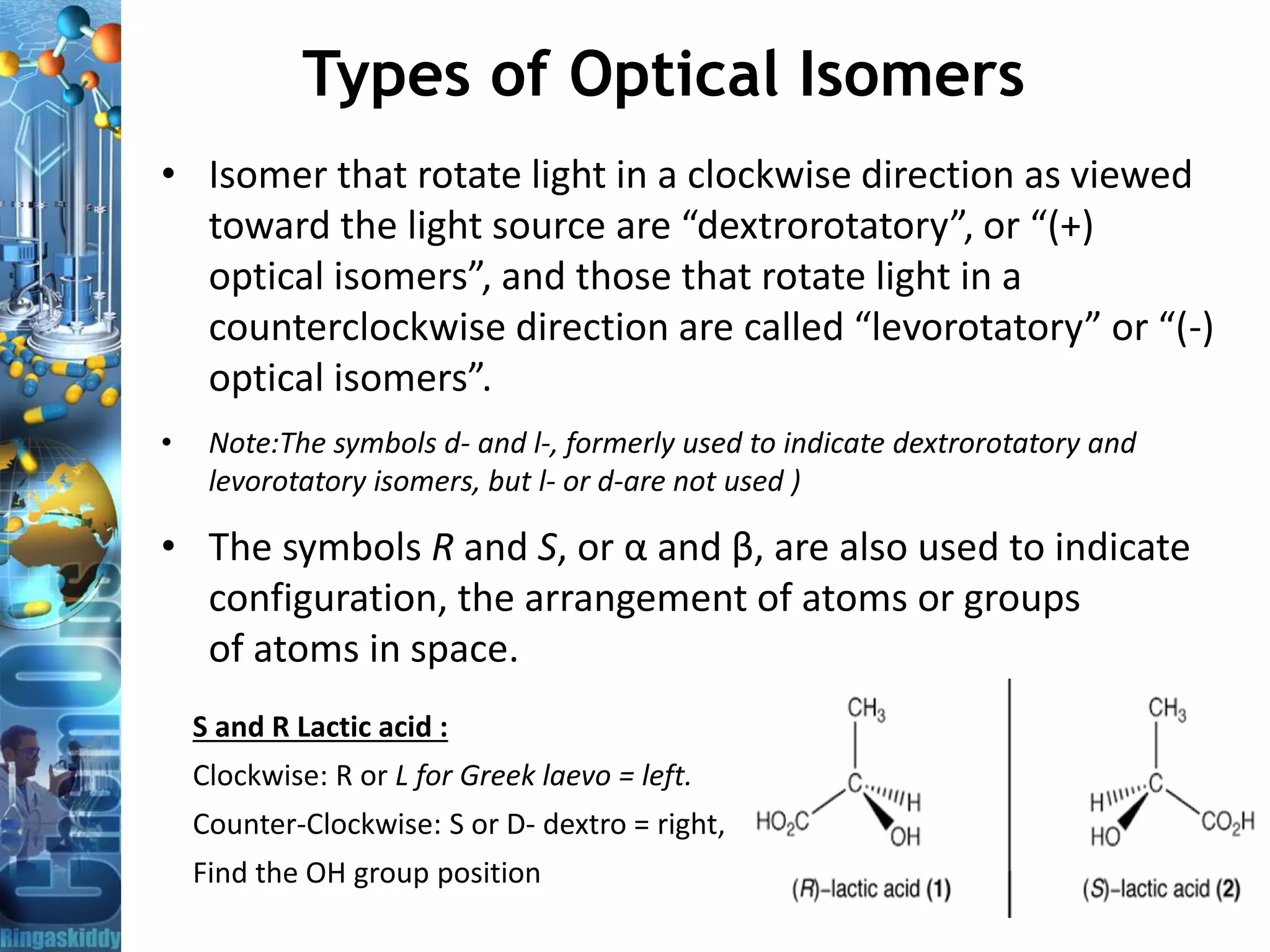
• Isomer that rotate light in a clockwise direction as viewed
toward the light source are “dextrorotatory”, or “(+)
optical isomers”, and those that rotate light in a
counterclockwise direction are called “levorotatory” or “(-)
optical isomers”.
• Note:The symbols d- and l-, formerly used to indicate dextrorotatory and
levorotatory isomers, but l- or d-are not used )
• The symbols R and S, or α and β, are also used to indicate
configuration, the arrangement of atoms or groups
of atoms in space.
S and R Lactic acid :
Clockwise: R or L for Greek laevo = left.
Counter-Clockwise: S or D- dextro = right,
Find the OH group position
Number of Possible Isomers
Number of Optical Isomers
• The number of optical isomers is 2n, where n is the
number of asymmetric centers.
• Eg: Molecule with 2 Chiral centers will have 4 isomers. ie. -
R,S-, R,R- , S,S- & S,R-
• Types of isomers are dextrorotatory or “(+) and
“levorotatory” or “(-) , meso, and racemic mixture.
• A Racemic Mixture Is An Equal Mixture Of Two
Enantiomers And Has A Specific Rotation of 0° (Optically
Inactive)
Enantiomeric Excess (ee)
• One or more asymmetric centers, usually a carbon atom
with four different substituents are enantiomers.
• When a mixture contains more of one enantiomer than
the other. Often called by concept of enantiomeric
excess (ee) to quantify the difference.
• Enantiomeric excess can be expressed as:
What is Polarimeter
• A polarimeter is an optical instrument to
measure the angle of rotation of the
Optically Active Substances in liquid
medium by which the polarization of
light is rotated
• The angle by which the polarization plane is
rotated is called optical rotation
Optical Rotation
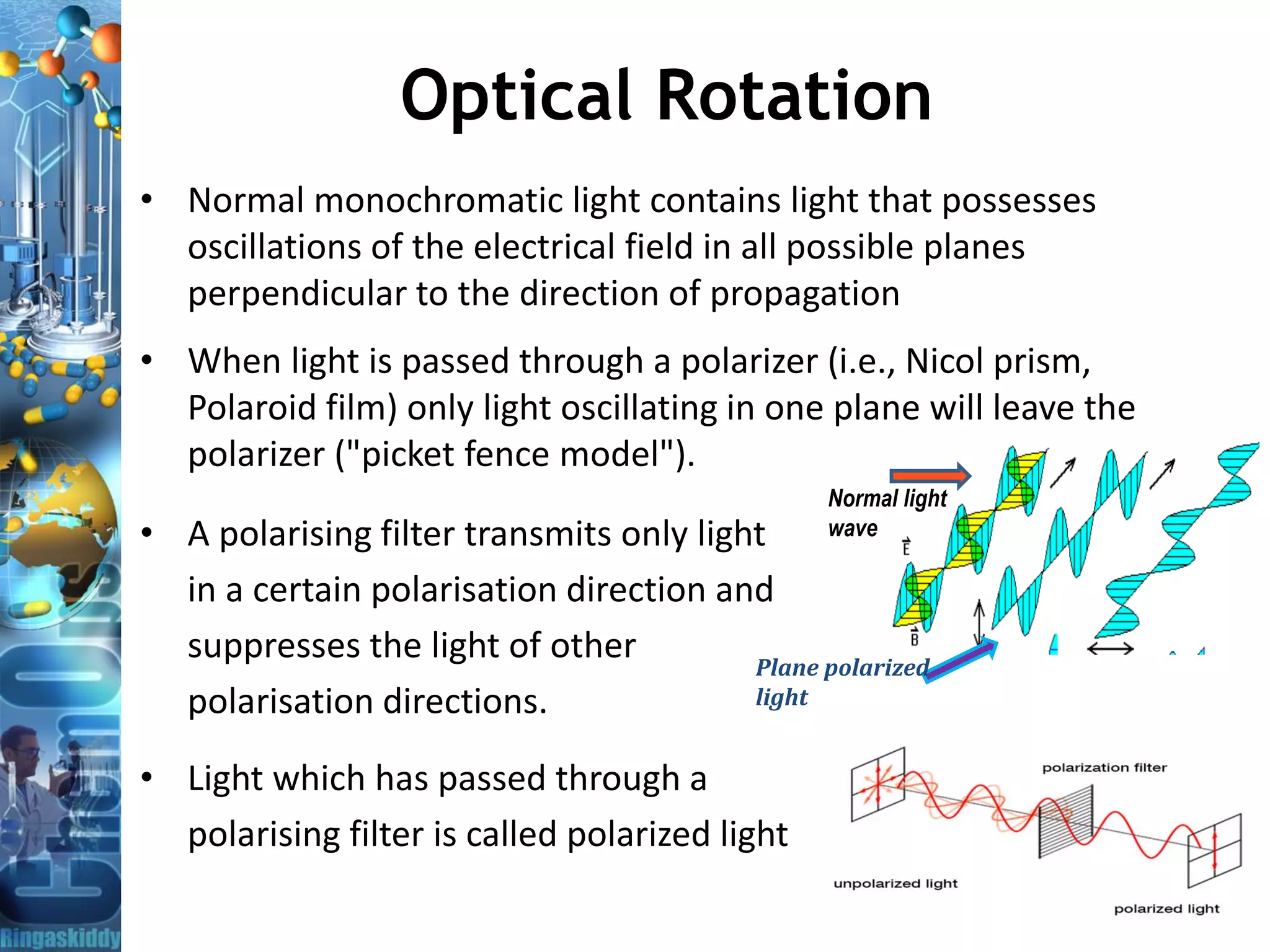
• Normal monochromatic light contains light that possesses
oscillations of the electrical field in all possible planes
perpendicular to the direction of propagation
• When light is passed through a polarizer (i.e., Nicol prism,
Polaroid film) only light oscillating in one plane will leave the
polarizer ("picket fence model").
• A polarising filter transmits only light
in a certain polarisation direction and
suppresses the light of other
polarisation directions.
• Light which has passed through a
polarising filter is called polarized light
Normal light
wave
Plane polarized
light
Specific Optical Rotation
Optical rotation is determined using a polarimeters
The general equation for Specific Optical Rotation;
[α] = specific rotation at wavelength λ
T = temperature #
a = Observed rotation in degrees (°)
l = path length (dm)
C = concentration of the analyte (g/100 mL)
D-line of the sodium lamp at the visible
wavelength of 589.3 nm
As per USP optical rotation are made in a 1.0-dm tube at 589 nm at 25°C ± 0.5 °C
EP/BP -optical rotation are made in a 1.0-dm tube at 589 nm at 20°C ± 0.5 °C
Unit for SOR: There is no unit, but it
is understood as
degree millilitres per decimetre
gram [(°)·ml·dm− 1·g− 1]
Factors Affect The Optical Rotation
The angle of rotation may have influenced by:
1. Concentration of the sample, but SOR will not change, since
concentration is consider in the calculation.
2. Wavelength of light passing through the sample. Angle of
rotation and wavelength tend to be inversely proportional
3. Temperature of the sample (generally the two are directly
proportional)
4. Path length of the sample cell
5. Solvent used for solution preparation #
6. Operation: Filling conditions (bubbles, temperature and
concentration gradients)
# Example, Sample of natural (R,R)-tartaric acid, a change in solvent from water to a 1:1 mixture of
ethanol/chlorobenzene at same concentration, Change of [α]D
20 from +14.4 to –8.09.
Factors Influence the SOR
• The specific rotation is a material constant. It is the optical rotation for
a “given number” of optically active molecules in the light’s way
through the sample.
• Concentration of the optically active substance, c [g/mL]: the higher,
the more molecules
• Length of sample cell, l [mm]: the longer, the more molecules along
the way
• Temperature, T [°C]: influences density via thermal expansion and may
cause changes in molecular structure with effects on the optical
rotation
• Solvent: Changes the optical rotation value
• Another influencing parameter on the measured optical rotation is the
wavelength of the light, λ [nm].
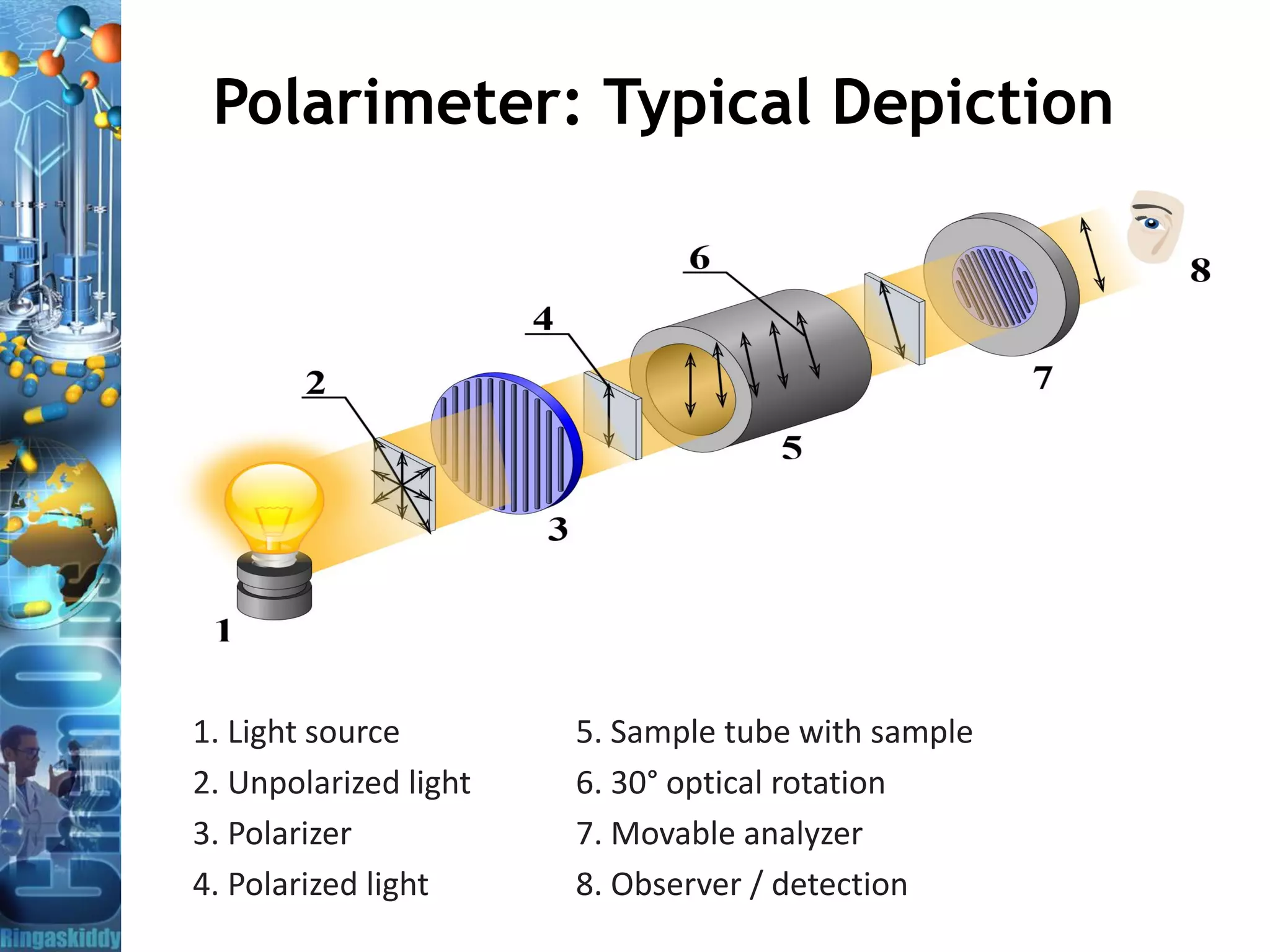
Polarimeter: Typical Depiction
1. Light source
2. Unpolarized light
3. Polarizer
4. Polarized light
5. Sample tube with sample
6. 30° optical rotation
7. Movable analyzer
8. Observer / detection
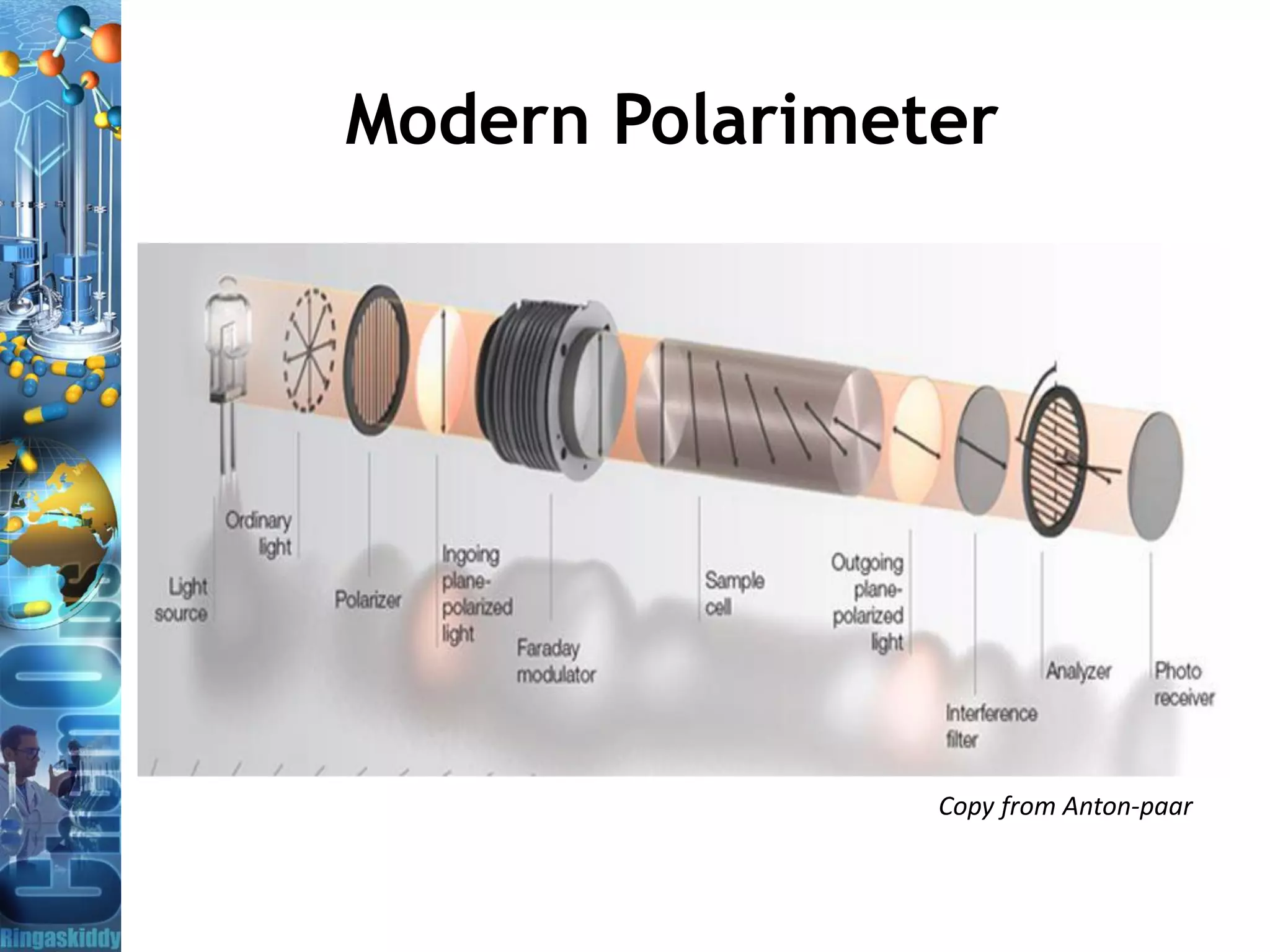
Modern Polarimeter
Copy from Anton-paar
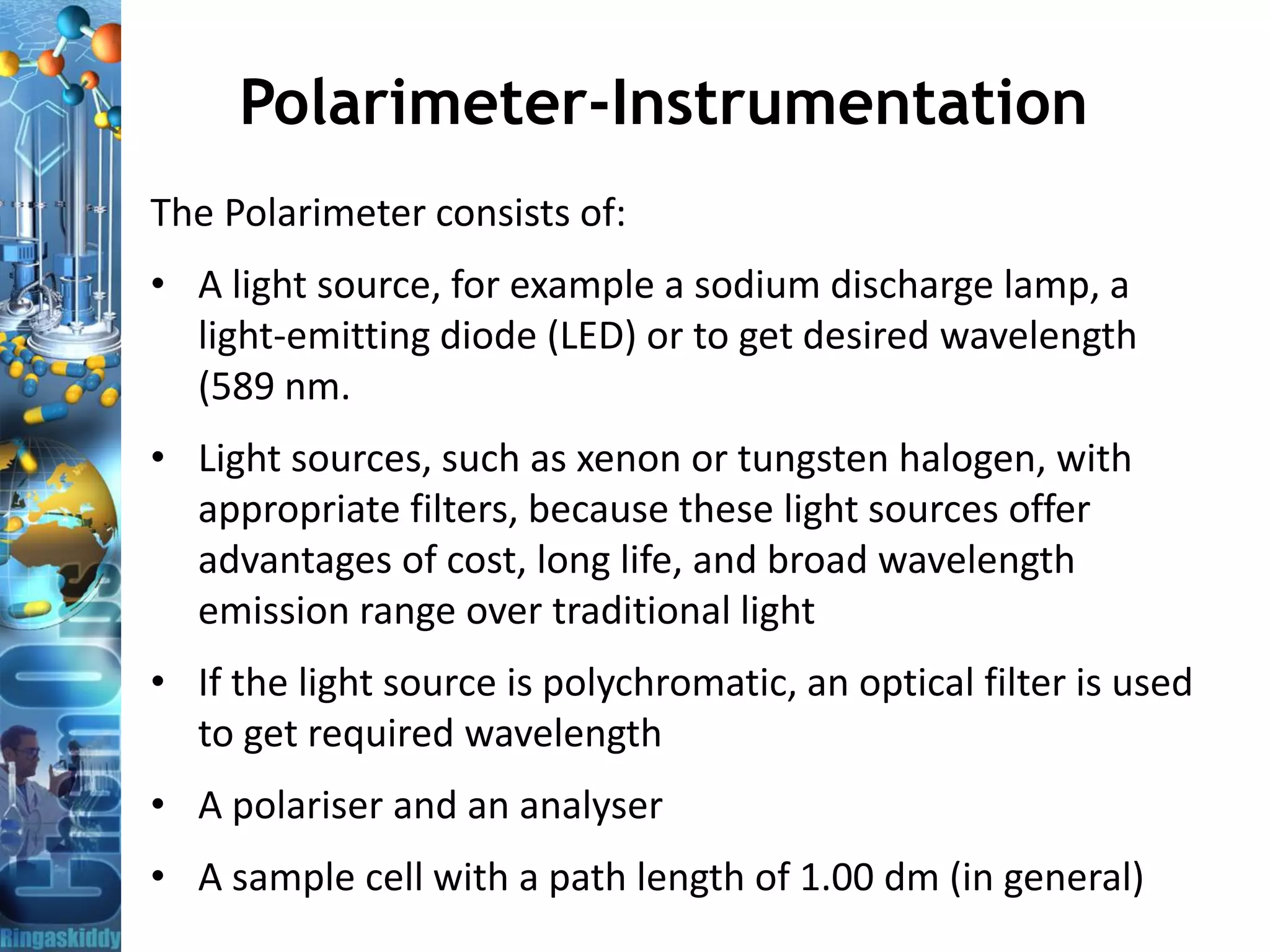
Polarimeter-Instrumentation
The Polarimeter consists of:
• A light source, for example a sodium discharge lamp, a
light-emitting diode (LED) or to get desired wavelength
(589 nm.
• Light sources, such as xenon or tungsten halogen, with
appropriate filters, because these light sources offer
advantages of cost, long life, and broad wavelength
emission range over traditional light
• If the light source is polychromatic, an optical filter is used
to get required wavelength
• A polariser and an analyser
• A sample cell with a path length of 1.00 dm (in general)
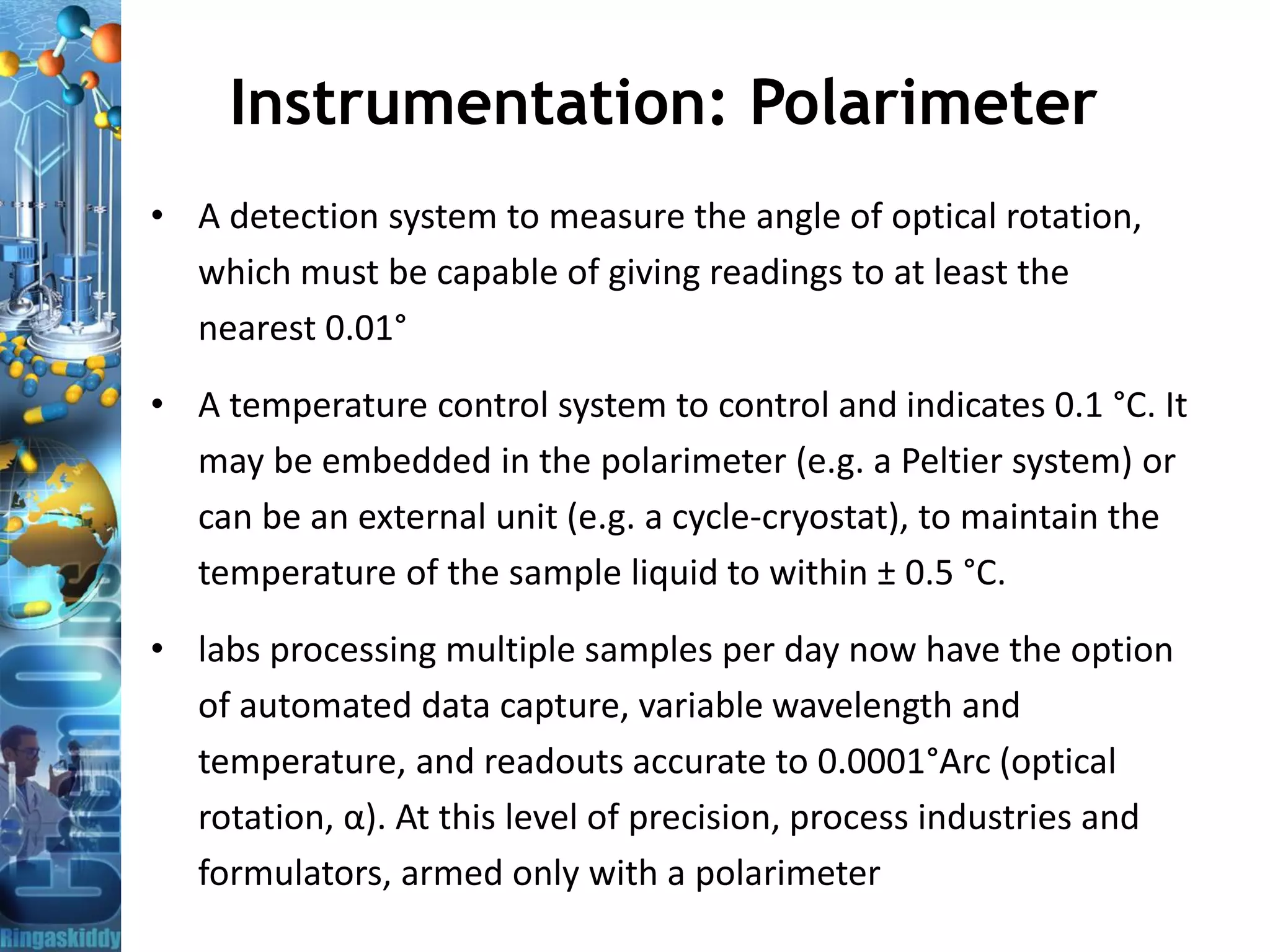
Instrumentation: Polarimeter
• A detection system to measure the angle of optical rotation,
which must be capable of giving readings to at least the
nearest 0.01°
• A temperature control system to control and indicates 0.1 °C. It
may be embedded in the polarimeter (e.g. a Peltier system) or
can be an external unit (e.g. a cycle-cryostat), to maintain the
temperature of the sample liquid to within ± 0.5 °C.
• labs processing multiple samples per day now have the option
of automated data capture, variable wavelength and
temperature, and readouts accurate to 0.0001°Arc (optical
rotation, α). At this level of precision, process industries and
formulators, armed only with a polarimeter
Automatic Polarimeters
• Fully automatic polarimeters are commercially available. It is easy to
operate, and accurate with digital readout.
• Automatic digital polarimeters give accurate result within a second,
regardless of the rotation angle of the sample.
• Also used to get continuous measurement and it can connect with
HPLC for kinetic study and other studies
• Auto polarimeters have Faraday modulator, which creates an
alternating current magnetic field. It oscillates the plane of
polarization to enhance the detection accuracy.
• Auto polarimeters have Peltier elements to control the temperature.
It maintain the set temperature of sample tube to reduce errors.
• Results can directly be transferred to computers or networks for
automatic processing.
• Available with21CFR part-11 compliance
Light Source and Wavelength
• D-line of the sodium lamp at the visible wavelength of
589.3 nm is used in general
• Also other wave length are used using mercury lamp
lines with filters of approx. 546, 436, 405, 365, &325 nm
in a photoelectric polarimeter.
• Sensitivity of optical rotation is high at 436 nm is about
double, and at 365 nm, about 3 times that at 589 nm.
• Advantage is sample concentration can be reduced and
minimize the error
Procedure to Test SOR
• Correct the Zero by using cell with same solvent as blank and use the same cell.
• If a visual polarimeter is employed, report the average of at least five
determinations.
• If A photoelectric polarimeter is used, a single measurement is acceptable.
• Temperature, should be maintained within ±0.5° of the stated temperature.
• Maintain solvent and temperature for sample solution and blank
• Maintain the same angular orientation of the cell in each reading.
• Place the cell so that the light passes through it in the same direction each
time.
• Optical rotation of solutions should be determined within 30 min of
preparation.
• In the case of substances undergo racemization or mutarotation, care should
be taken to standardize the time between adding the solute to the solvent and
introduction of the solution into the polarimeter tube.
• Calculate the SOR on the dried basis or the anhydrous basis
Calibration of Polarimeter
• Commercial Quartz Plates with NIST traceable is available in
single and dual versions.
• Single Quartz Plates have a single rotation value at each
wavelength and are calibrated in °Arc (Optical Rotation) and
°ISS/°Z (Sugar Degrees).
• Dual Plates are also calibrated in °Arc and °ISS, but have three
rotation values at each wavelength.
• Each plate is made up of one left or levo
turning Quartz Plate (i.e. -10° Arc) and
one right or dextro turning plate (i.e.
+12° Arc) which may be used separately
or together for a combined rotation of
2° Arc (+12°-10°).
Rudolph
Why Enantiomer is Important
in Pharma Industries
• Drug enantiomers are very likely to have different pharmacological and
toxicological properties so that to all intents and purposes the body
sees the enantiomers as different drugs.
• The potential for the body is to distinguish between enantiomers. Eg
Thalidomide Tragedy in the late 1950s early 1960s
• The pregnant patients consumed the above drug caused malformations
in pregnancy on the embryo. This demonstrates clearly that analysis of
Optical rotation may have a key role in the pharmaceutical industry.
• While the sedative effect of thalidomide
(racemate 1:1 enantiomeric ratio used)
was attributed to the (R)-enantiomer and
the adverse teratogenic effect due to the
(S)-enantiomer.
Why Enantiomer is Important
in Pharma Industries
• Thalidomide enantiomer tragedy is a rare incident, it brought attention
of testing and impact of enantiomers used in pharma industry
• The above is a simple case of good /bad enantiomer.
• Efficacy of Enantiomer to be ascertained and established in quality.
• Control of enantiomer can be determined by polarimetry (Optical
rotation) or Chiral chromatography ( enantiomeric excess).
• Polarimetry is simple , fast, less expensive compared to HPLC.
• The angle of rotation allows you to ascertain the identity and quality of
substances as well as their concentration in mixtures.
• Also used to monitor the progress
of reactions and conversions.
Application
TYPE OF ANALYSIS PRODUCTS
• Determination of concentration /
purity and identification of
enantiomers in the substances as
per Pharmacopeias.
• Determination of ingredient like
sugar, fructose in pharmaceutical
products.
• Analysis of the enantiomers,
mutarotation of new synthesis
• Alkaloids: cocaine, codeine,
nicotine, morphine
sulphate, etc.
• Amino acids: asparagine,
glutamic acid, etc.
• Steroids, antibiotics,
serums, vitamins,
hormones, painkillers,
amphetamines etc.
• Ascorbic acid, menthol,
camphor, etc.
Pharmaceutical Industries
Application
TYPE OF ANALYSIS TYPES OF SAMPLES
• Measurement of concentration,
Purity and identification, and
characterization of compounds.
• Monitoring of chemical
processes during the production
of optically active substances
• Characterisation tests in
research laboratories.
• Reaction kinetic analysis
• Analysis of optically active organic
compounds, structure analysis,
• Biopolymers, Synthetic polymers
Organic polymers, hydrocarbons and
etc.
Research applications:
• Determination of configuration
changes of resolved molecules
• Monitoring changes in the
concentration of an optically active
component in a reaction mixture,
enzymatic scission
• Investigating kinetic reactions by
measuring optical rotation as a
function of time
• Analyzing molecular structure
Chemical Industries
Application
TYPE OF ANALYSIS TYPES OF SAMPLES
• Identification and
Characterization.
• Quality control: Purity or
content of raw materials, in-
process samples and final
product quality
• Determination of the sugar
concentration in beverages,
food and candies
• Food, Flavor and beverages: Starch, sugar,
polysaccharide, in food and feed, aroma
chemicals, essential oils etc
• Fruit: Analysis of sugar in fruit syrups
(levulose), malic acid and esters etc., Sugar
composition in honey etc
• Dairy: Lactose, sucrose, lacto globuline,
lactic acid, esters, lactose in milk, etc.
• Vine industries: analysis of sugar on the
vine, tartaric acid, esters, Glucose in wine,
etc.
Food And Beverage Industries
Application
Quality control:
• Testing of raw materials,
additives, in-process,
intermediates and final
products.
Cosmetic Industries
• Control of purity and identification of
optically active essential oils and essences
like lemon oil, orange oil, lavender oil,
spearmint oil, etc.
• Other ingredients like glyceric acid, aromas
and perfumes for the food and cosmetics
industry etc.
Sugar Industry
• Determination of the sugar
concentration in raw materials,
and end products
• Processes /manufacture: Purity
and invert sugar.
• Sugar cane, beet pulp, molasses, syrup,
invert sugar etc.
• Sugar (sucrose, levulose, glucose, etc.),
starch, sugar-free sweeteners like iso malt,
etc.
Cosmetics & Fragrances
References
1. United States Pharmacopeia- General Chapter <781>
2. European Pharmacopeia -General Chapter 2.2.7
3. Pharmaceutical Drug Analysis –Ashutosh Kar
4. Basics of polarimetry- Anton Paar
5. rudolphresearch.com
6. Polarimeter – Wikipedia
7. kruess.com/en/campus/polarimetry
31
About Author:
Dr. A. Amsavel, born at Begarahalli, Dharmapuri-District, Tamil Nadu, India.
Completed his M.Sc. in Dept of Analytical Chemistry, University of Madras.
B.Ed. in Annamalai University and Ph.D in Anna University, Chennai.
Started carrier as Lecturer and worked in various Chemical & Pharmaceutical
Industries for the past 34 years. Presently working as Assistant Vice
President- Quality at Malladi Drugs & Pharmaceuticals Ltd.

Optical Rotation and Polarimeter by Dr. A. Amsavel

  • 1.
    Optical Rotation & Polarimeter Dr.A. Amsavel, M.Sc., B.Ed., Ph.D. Principle, Theory, Instrumentation and Application
  • 2.
    An Overview • Introduction •Isomers and enantiomers • Specific Optical Rotation • Polarimeter • Instrumentation and Operation • Factors affect the Optical Rotation • Calibration • Application Specifically Pharmaceutical Industries
  • 3.
    Introduction • E.L. Malusdiscovered the rotation of polarised light in 1808, while passed light through reflective glass surfaces • The scientist Jean Baptiste Biot observed that certain liquids and gases of organic substances rotates the polarized light. • He established that Optical activity is related to the structure of the chemical compounds. • Louis Pasteur studied the optical activity of crystal forms with several salts • He laid the foundation for the development of polarimetry and important property of light.
  • 4.
    Isomers • Isomers: Samemolecular formula, but different structure / compounds • Structural Isomers: Atoms or functional groups are connected in a different order. Eg. N- butanol ; 2- Butanol • Stereoisomers: Atoms are connected in the same sequence but differ in arrangement of the atoms • Diastereomers: Stereoisomers whose molecules are not mirror image of each other. Eg. Threonine • Enantiomers: Stereoisomers whose molecules are mirror images and non- superposable mirror image of each other. Like right and left hand. (Eg Lactic acid) Disteroisomer- L, D- Threonine
  • 5.
    Stereoisomers • Stereoisomers havechiral center(s). Two molecules are described as stereoisomers if they are made of the same atoms connected in the same sequence, but the atoms are positioned differently in space ( Spatial arrangement). • Diastereomers have different physical properties like boiling points, melting points, solubility.. etc • Enantiomers: Physical properties like melting point, boiling point, refractive index, etc. are identical and differ in a optical activity. – Optical activity: Chiral molecules rotate the plane of polarized light as it passes through solution to clockwise and counter-clockwise. • Enantiomers turn the polarization plane in opposite directions. • The angle by which the polarization plane is rotated is called optical rotation. It is measured in degrees Arc [°] using Polarimeter.
  • 6.
    Chiral Molecule • Carbonattached to 4 different substituent groups is called Chiral molecule. Even two substituent groups start with C, also must be different. Example: (-) 2- Butanol (+) Pseudoephedrine HCl SOR (-) 13.5° SOR (+) 51.5°  Carbon attached with 4 groups is called Chiral Center. Some molecules will have 2 or more chiral centers. OH H H3CH2C CH3 NHCH3 H H3C OH H . HCl
  • 7.
    Optical Isomers • OpticalIsomers: 2-Butanol, which possess a Chiral center and exists as two mirror-image isomers, or enantiomers. • The atomic connectivity in the S-isomer is identical to that of its mirror-image R-isomer, except that two of the groups attached to carbon were interchanged. • Cahn-Ingold-Prelog Rules: The structure on the left rotates plane-polarized light counter-clockwise, so it is designated as (-) or l, while the S-isomer is (+) or d.
  • 8.
    Types of OpticalIsomers • Isomer that rotate light in a clockwise direction as viewed toward the light source are “dextrorotatory”, or “(+) optical isomers”, and those that rotate light in a counterclockwise direction are called “levorotatory” or “(-) optical isomers”. • Note:The symbols d- and l-, formerly used to indicate dextrorotatory and levorotatory isomers, but l- or d-are not used ) • The symbols R and S, or α and β, are also used to indicate configuration, the arrangement of atoms or groups of atoms in space. S and R Lactic acid : Clockwise: R or L for Greek laevo = left. Counter-Clockwise: S or D- dextro = right, Find the OH group position
  • 9.
    Number of PossibleIsomers Number of Optical Isomers • The number of optical isomers is 2n, where n is the number of asymmetric centers. • Eg: Molecule with 2 Chiral centers will have 4 isomers. ie. - R,S-, R,R- , S,S- & S,R- • Types of isomers are dextrorotatory or “(+) and “levorotatory” or “(-) , meso, and racemic mixture. • A Racemic Mixture Is An Equal Mixture Of Two Enantiomers And Has A Specific Rotation of 0° (Optically Inactive)
  • 10.
    Enantiomeric Excess (ee) •One or more asymmetric centers, usually a carbon atom with four different substituents are enantiomers. • When a mixture contains more of one enantiomer than the other. Often called by concept of enantiomeric excess (ee) to quantify the difference. • Enantiomeric excess can be expressed as:
  • 11.
    What is Polarimeter •A polarimeter is an optical instrument to measure the angle of rotation of the Optically Active Substances in liquid medium by which the polarization of light is rotated • The angle by which the polarization plane is rotated is called optical rotation
  • 12.
    Optical Rotation • Normalmonochromatic light contains light that possesses oscillations of the electrical field in all possible planes perpendicular to the direction of propagation • When light is passed through a polarizer (i.e., Nicol prism, Polaroid film) only light oscillating in one plane will leave the polarizer ("picket fence model"). • A polarising filter transmits only light in a certain polarisation direction and suppresses the light of other polarisation directions. • Light which has passed through a polarising filter is called polarized light Normal light wave Plane polarized light
  • 13.
    Specific Optical Rotation Opticalrotation is determined using a polarimeters The general equation for Specific Optical Rotation; [α] = specific rotation at wavelength λ T = temperature # a = Observed rotation in degrees (°) l = path length (dm) C = concentration of the analyte (g/100 mL) D-line of the sodium lamp at the visible wavelength of 589.3 nm As per USP optical rotation are made in a 1.0-dm tube at 589 nm at 25°C ± 0.5 °C EP/BP -optical rotation are made in a 1.0-dm tube at 589 nm at 20°C ± 0.5 °C Unit for SOR: There is no unit, but it is understood as degree millilitres per decimetre gram [(°)·ml·dm− 1·g− 1]
  • 14.
    Factors Affect TheOptical Rotation The angle of rotation may have influenced by: 1. Concentration of the sample, but SOR will not change, since concentration is consider in the calculation. 2. Wavelength of light passing through the sample. Angle of rotation and wavelength tend to be inversely proportional 3. Temperature of the sample (generally the two are directly proportional) 4. Path length of the sample cell 5. Solvent used for solution preparation # 6. Operation: Filling conditions (bubbles, temperature and concentration gradients) # Example, Sample of natural (R,R)-tartaric acid, a change in solvent from water to a 1:1 mixture of ethanol/chlorobenzene at same concentration, Change of [α]D 20 from +14.4 to –8.09.
  • 15.
    Factors Influence theSOR • The specific rotation is a material constant. It is the optical rotation for a “given number” of optically active molecules in the light’s way through the sample. • Concentration of the optically active substance, c [g/mL]: the higher, the more molecules • Length of sample cell, l [mm]: the longer, the more molecules along the way • Temperature, T [°C]: influences density via thermal expansion and may cause changes in molecular structure with effects on the optical rotation • Solvent: Changes the optical rotation value • Another influencing parameter on the measured optical rotation is the wavelength of the light, λ [nm].
  • 16.
    Polarimeter: Typical Depiction 1.Light source 2. Unpolarized light 3. Polarizer 4. Polarized light 5. Sample tube with sample 6. 30° optical rotation 7. Movable analyzer 8. Observer / detection
  • 17.
  • 18.
    Polarimeter-Instrumentation The Polarimeter consistsof: • A light source, for example a sodium discharge lamp, a light-emitting diode (LED) or to get desired wavelength (589 nm. • Light sources, such as xenon or tungsten halogen, with appropriate filters, because these light sources offer advantages of cost, long life, and broad wavelength emission range over traditional light • If the light source is polychromatic, an optical filter is used to get required wavelength • A polariser and an analyser • A sample cell with a path length of 1.00 dm (in general)
  • 19.
    Instrumentation: Polarimeter • Adetection system to measure the angle of optical rotation, which must be capable of giving readings to at least the nearest 0.01° • A temperature control system to control and indicates 0.1 °C. It may be embedded in the polarimeter (e.g. a Peltier system) or can be an external unit (e.g. a cycle-cryostat), to maintain the temperature of the sample liquid to within ± 0.5 °C. • labs processing multiple samples per day now have the option of automated data capture, variable wavelength and temperature, and readouts accurate to 0.0001°Arc (optical rotation, α). At this level of precision, process industries and formulators, armed only with a polarimeter
  • 20.
    Automatic Polarimeters • Fullyautomatic polarimeters are commercially available. It is easy to operate, and accurate with digital readout. • Automatic digital polarimeters give accurate result within a second, regardless of the rotation angle of the sample. • Also used to get continuous measurement and it can connect with HPLC for kinetic study and other studies • Auto polarimeters have Faraday modulator, which creates an alternating current magnetic field. It oscillates the plane of polarization to enhance the detection accuracy. • Auto polarimeters have Peltier elements to control the temperature. It maintain the set temperature of sample tube to reduce errors. • Results can directly be transferred to computers or networks for automatic processing. • Available with21CFR part-11 compliance
  • 21.
    Light Source andWavelength • D-line of the sodium lamp at the visible wavelength of 589.3 nm is used in general • Also other wave length are used using mercury lamp lines with filters of approx. 546, 436, 405, 365, &325 nm in a photoelectric polarimeter. • Sensitivity of optical rotation is high at 436 nm is about double, and at 365 nm, about 3 times that at 589 nm. • Advantage is sample concentration can be reduced and minimize the error
  • 22.
    Procedure to TestSOR • Correct the Zero by using cell with same solvent as blank and use the same cell. • If a visual polarimeter is employed, report the average of at least five determinations. • If A photoelectric polarimeter is used, a single measurement is acceptable. • Temperature, should be maintained within ±0.5° of the stated temperature. • Maintain solvent and temperature for sample solution and blank • Maintain the same angular orientation of the cell in each reading. • Place the cell so that the light passes through it in the same direction each time. • Optical rotation of solutions should be determined within 30 min of preparation. • In the case of substances undergo racemization or mutarotation, care should be taken to standardize the time between adding the solute to the solvent and introduction of the solution into the polarimeter tube. • Calculate the SOR on the dried basis or the anhydrous basis
  • 23.
    Calibration of Polarimeter •Commercial Quartz Plates with NIST traceable is available in single and dual versions. • Single Quartz Plates have a single rotation value at each wavelength and are calibrated in °Arc (Optical Rotation) and °ISS/°Z (Sugar Degrees). • Dual Plates are also calibrated in °Arc and °ISS, but have three rotation values at each wavelength. • Each plate is made up of one left or levo turning Quartz Plate (i.e. -10° Arc) and one right or dextro turning plate (i.e. +12° Arc) which may be used separately or together for a combined rotation of 2° Arc (+12°-10°). Rudolph
  • 24.
    Why Enantiomer isImportant in Pharma Industries • Drug enantiomers are very likely to have different pharmacological and toxicological properties so that to all intents and purposes the body sees the enantiomers as different drugs. • The potential for the body is to distinguish between enantiomers. Eg Thalidomide Tragedy in the late 1950s early 1960s • The pregnant patients consumed the above drug caused malformations in pregnancy on the embryo. This demonstrates clearly that analysis of Optical rotation may have a key role in the pharmaceutical industry. • While the sedative effect of thalidomide (racemate 1:1 enantiomeric ratio used) was attributed to the (R)-enantiomer and the adverse teratogenic effect due to the (S)-enantiomer.
  • 25.
    Why Enantiomer isImportant in Pharma Industries • Thalidomide enantiomer tragedy is a rare incident, it brought attention of testing and impact of enantiomers used in pharma industry • The above is a simple case of good /bad enantiomer. • Efficacy of Enantiomer to be ascertained and established in quality. • Control of enantiomer can be determined by polarimetry (Optical rotation) or Chiral chromatography ( enantiomeric excess). • Polarimetry is simple , fast, less expensive compared to HPLC. • The angle of rotation allows you to ascertain the identity and quality of substances as well as their concentration in mixtures. • Also used to monitor the progress of reactions and conversions.
  • 26.
    Application TYPE OF ANALYSISPRODUCTS • Determination of concentration / purity and identification of enantiomers in the substances as per Pharmacopeias. • Determination of ingredient like sugar, fructose in pharmaceutical products. • Analysis of the enantiomers, mutarotation of new synthesis • Alkaloids: cocaine, codeine, nicotine, morphine sulphate, etc. • Amino acids: asparagine, glutamic acid, etc. • Steroids, antibiotics, serums, vitamins, hormones, painkillers, amphetamines etc. • Ascorbic acid, menthol, camphor, etc. Pharmaceutical Industries
  • 27.
    Application TYPE OF ANALYSISTYPES OF SAMPLES • Measurement of concentration, Purity and identification, and characterization of compounds. • Monitoring of chemical processes during the production of optically active substances • Characterisation tests in research laboratories. • Reaction kinetic analysis • Analysis of optically active organic compounds, structure analysis, • Biopolymers, Synthetic polymers Organic polymers, hydrocarbons and etc. Research applications: • Determination of configuration changes of resolved molecules • Monitoring changes in the concentration of an optically active component in a reaction mixture, enzymatic scission • Investigating kinetic reactions by measuring optical rotation as a function of time • Analyzing molecular structure Chemical Industries
  • 28.
    Application TYPE OF ANALYSISTYPES OF SAMPLES • Identification and Characterization. • Quality control: Purity or content of raw materials, in- process samples and final product quality • Determination of the sugar concentration in beverages, food and candies • Food, Flavor and beverages: Starch, sugar, polysaccharide, in food and feed, aroma chemicals, essential oils etc • Fruit: Analysis of sugar in fruit syrups (levulose), malic acid and esters etc., Sugar composition in honey etc • Dairy: Lactose, sucrose, lacto globuline, lactic acid, esters, lactose in milk, etc. • Vine industries: analysis of sugar on the vine, tartaric acid, esters, Glucose in wine, etc. Food And Beverage Industries
  • 29.
    Application Quality control: • Testingof raw materials, additives, in-process, intermediates and final products. Cosmetic Industries • Control of purity and identification of optically active essential oils and essences like lemon oil, orange oil, lavender oil, spearmint oil, etc. • Other ingredients like glyceric acid, aromas and perfumes for the food and cosmetics industry etc. Sugar Industry • Determination of the sugar concentration in raw materials, and end products • Processes /manufacture: Purity and invert sugar. • Sugar cane, beet pulp, molasses, syrup, invert sugar etc. • Sugar (sucrose, levulose, glucose, etc.), starch, sugar-free sweeteners like iso malt, etc. Cosmetics & Fragrances
  • 30.
    References 1. United StatesPharmacopeia- General Chapter <781> 2. European Pharmacopeia -General Chapter 2.2.7 3. Pharmaceutical Drug Analysis –Ashutosh Kar 4. Basics of polarimetry- Anton Paar 5. rudolphresearch.com 6. Polarimeter – Wikipedia 7. kruess.com/en/campus/polarimetry
  • 31.
    31 About Author: Dr. A.Amsavel, born at Begarahalli, Dharmapuri-District, Tamil Nadu, India. Completed his M.Sc. in Dept of Analytical Chemistry, University of Madras. B.Ed. in Annamalai University and Ph.D in Anna University, Chennai. Started carrier as Lecturer and worked in various Chemical & Pharmaceutical Industries for the past 34 years. Presently working as Assistant Vice President- Quality at Malladi Drugs & Pharmaceuticals Ltd.