Karl Fischer Titration for the
determination of water in Sample
Prepared by
Mehak
Roll no 39
Contents
 Introduction
 Karl Fisher Principle
 Types
 Volumetric Titration
 Coulometric Titration
 Influence of pH
 Limitations
 Applications
Karl Fischer Titration
Karl Fischer (KF) titration is the most popular water
determination technique! And it was invented by the
German Chemist Karl Fischer in 1935.
Titration method in analytical chemistry that uses
coulometric or volumetric titration to determine trace
amounts of water in a sample’
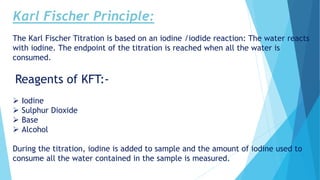
Karl Fischer Principle:
The Karl Fischer Titration is based on an iodine /iodide reaction: The water reacts
with iodine. The endpoint of the titration is reached when all the water is
consumed.
Reagents of KFT:-
 Iodine
 Sulphur Dioxide
 Base
 Alcohol
During the titration, iodine is added to sample and the amount of iodine used to
consume all the water contained in the sample is measured.
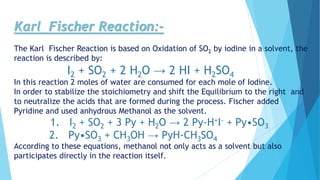
Karl Fischer Reaction:-
The Karl Fischer Reaction is based on Oxidation of SO2 by iodine in a solvent, the
reaction is described by:
I2 + SO2 + 2 H2O → 2 HI + H2SO4
In this reaction 2 moles of water are consumed for each mole of Iodine.
In order to stabilize the stoichiometry and shift the Equilibrium to the right and
to neutralize the acids that are formed during the process. Fischer added
Pyridine and used anhydrous Methanol as the solvent.
1. I2 + SO2 + 3 Py + H2O → 2 Py-H+I- + Py•SO3
2. Py•SO3 + CH3OH → PyH-CH3SO4
According to these equations, methanol not only acts as a solvent but also
participates directly in the reaction itself.
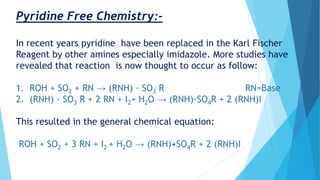
Pyridine Free Chemistry:-
In recent years pyridine have been replaced in the Karl Fischer
Reagent by other amines especially imidazole. More studies have
revealed that reaction is now thought to occur as follow:
1. ROH + SO2 + RN → (RNH) · SO3 R RN=Base
2. (RNH) · SO3 R + 2 RN + I2+ H2O → (RNH)·SO4R + 2 (RNH)I
This resulted in the general chemical equation:
ROH + SO2 + 3 RN + I2 + H2O → (RNH)•SO4R + 2 (RNH)I
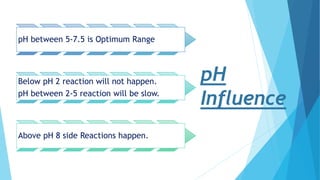
pH between 5-7.5 is Optimum Range
Below pH 2 reaction will not happen.
pH between 2-5 reaction will be slow.
Above pH 8 side Reactions happen.
pH
Influence
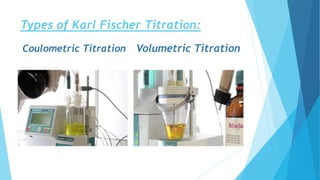
Types of Karl Fischer Titration:
Volumetric TitrationCoulometric Titration
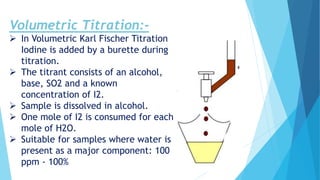
Volumetric Titration:-
 In Volumetric Karl Fischer Titration
Iodine is added by a burette during
titration.
 The titrant consists of an alcohol,
base, SO2 and a known
concentration of I2.
 Sample is dissolved in alcohol.
 One mole of I2 is consumed for each
mole of H2O.
 Suitable for samples where water is
present as a major component: 100
ppm - 100%
End Point Determination:-
When reacting with water, the brown iodine is reduced to
the colorless iodide. At the endpoint of the titration when all
the water is consumed the color of the solution turns
increasingly from yellow to brown. As there is no sharp color
change and the coloration differs in nonpolar solvents (such
as DMF) and polar solvents (as e.g. methanol) , it is not easy
to determine the endpoint of the titration visually. For this
reason, the endpoint of the titration is usually determined
by Biapmerometric indication.
Types of Volumetric KFT:-
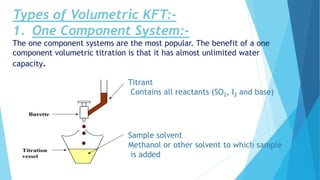
1. One Component System:-
The one component systems are the most popular. The benefit of a one
component volumetric titration is that it has almost unlimited water
capacity.
Titrant
Contains all reactants (SO2, I2 and base)
Sample solvent
Methanol or other solvent to which sample
is added
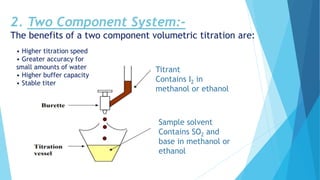
2. Two Component System:-
The benefits of a two component volumetric titration are:
Titrant
Contains I2 in
methanol or ethanol
Sample solvent
Contains SO2 and
base in methanol or
ethanol
• Higher titration speed
• Greater accuracy for
small amounts of water
• Higher buffer capacity
• Stable titer
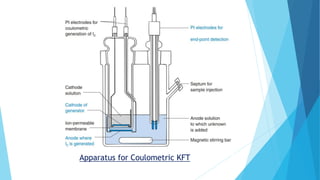
Coulometric KF Titration:-
 Iodine electrochemically generated from the oxidation of
iodide contained in the coulometric KF reagents.
 Suitable for samples where water content
0.001% (10 ppm) 5-10%.
 When all the water is consumed excess iodine is detected
by Biapmerometric Indication.
 It is more sensitive and accurate than volumetric
titration.
 It has higher speed of titration and no need to calibrate
the reagent each time as the iodine is produced
electrically.
Apparatus for Coulometric KFT
Applications:
• Chemical Industry
• Pharmaceutical Industry
• Petrochemical Industry
• Plastic Industry
• Feed
• Food Industry.
• Paints, Adhesives
• Cosmetic Industry
Limitations:
 Inference of compounds.
 High costs of apparatus.
 Highly acidic or basic compounds can not be
determined.
 Ketones and aldehydes, Carboxylic acid and metal
peroxides, as well as hydroxide and carbonates are not
suitable for this titration without modification.
 In coulometric Titration oxidizing agents such as Cu(II),
Fe(III) are not suitable for titration.
 Oxidizable Species such as ascorbic acid not suitable for
this titration.
References:-
 Fundamentals of Analytical
Chemistry.
 Quantitative Chemical Analysis by
Daniel C. Harris.
 Moisture Determination using Karl
Fischer Titration by SK Macleod.
Mehak

Mehak

  • 2.
    Karl Fischer Titrationfor the determination of water in Sample Prepared by Mehak Roll no 39
  • 3.
    Contents  Introduction  KarlFisher Principle  Types  Volumetric Titration  Coulometric Titration  Influence of pH  Limitations  Applications
  • 4.
    Karl Fischer Titration KarlFischer (KF) titration is the most popular water determination technique! And it was invented by the German Chemist Karl Fischer in 1935. Titration method in analytical chemistry that uses coulometric or volumetric titration to determine trace amounts of water in a sample’
  • 5.
    Karl Fischer Principle: TheKarl Fischer Titration is based on an iodine /iodide reaction: The water reacts with iodine. The endpoint of the titration is reached when all the water is consumed. Reagents of KFT:-  Iodine  Sulphur Dioxide  Base  Alcohol During the titration, iodine is added to sample and the amount of iodine used to consume all the water contained in the sample is measured.
  • 6.
    Karl Fischer Reaction:- TheKarl Fischer Reaction is based on Oxidation of SO2 by iodine in a solvent, the reaction is described by: I2 + SO2 + 2 H2O → 2 HI + H2SO4 In this reaction 2 moles of water are consumed for each mole of Iodine. In order to stabilize the stoichiometry and shift the Equilibrium to the right and to neutralize the acids that are formed during the process. Fischer added Pyridine and used anhydrous Methanol as the solvent. 1. I2 + SO2 + 3 Py + H2O → 2 Py-H+I- + Py•SO3 2. Py•SO3 + CH3OH → PyH-CH3SO4 According to these equations, methanol not only acts as a solvent but also participates directly in the reaction itself.
  • 7.
    Pyridine Free Chemistry:- Inrecent years pyridine have been replaced in the Karl Fischer Reagent by other amines especially imidazole. More studies have revealed that reaction is now thought to occur as follow: 1. ROH + SO2 + RN → (RNH) · SO3 R RN=Base 2. (RNH) · SO3 R + 2 RN + I2+ H2O → (RNH)·SO4R + 2 (RNH)I This resulted in the general chemical equation: ROH + SO2 + 3 RN + I2 + H2O → (RNH)•SO4R + 2 (RNH)I
  • 8.
    pH between 5-7.5is Optimum Range Below pH 2 reaction will not happen. pH between 2-5 reaction will be slow. Above pH 8 side Reactions happen. pH Influence
  • 9.
    Types of KarlFischer Titration: Volumetric TitrationCoulometric Titration
  • 10.
    Volumetric Titration:-  InVolumetric Karl Fischer Titration Iodine is added by a burette during titration.  The titrant consists of an alcohol, base, SO2 and a known concentration of I2.  Sample is dissolved in alcohol.  One mole of I2 is consumed for each mole of H2O.  Suitable for samples where water is present as a major component: 100 ppm - 100%
  • 11.
    End Point Determination:- Whenreacting with water, the brown iodine is reduced to the colorless iodide. At the endpoint of the titration when all the water is consumed the color of the solution turns increasingly from yellow to brown. As there is no sharp color change and the coloration differs in nonpolar solvents (such as DMF) and polar solvents (as e.g. methanol) , it is not easy to determine the endpoint of the titration visually. For this reason, the endpoint of the titration is usually determined by Biapmerometric indication.
  • 12.
    Types of VolumetricKFT:- 1. One Component System:- The one component systems are the most popular. The benefit of a one component volumetric titration is that it has almost unlimited water capacity. Titrant Contains all reactants (SO2, I2 and base) Sample solvent Methanol or other solvent to which sample is added
  • 13.
    2. Two ComponentSystem:- The benefits of a two component volumetric titration are: Titrant Contains I2 in methanol or ethanol Sample solvent Contains SO2 and base in methanol or ethanol • Higher titration speed • Greater accuracy for small amounts of water • Higher buffer capacity • Stable titer
  • 14.
    Coulometric KF Titration:- Iodine electrochemically generated from the oxidation of iodide contained in the coulometric KF reagents.  Suitable for samples where water content 0.001% (10 ppm) 5-10%.  When all the water is consumed excess iodine is detected by Biapmerometric Indication.  It is more sensitive and accurate than volumetric titration.  It has higher speed of titration and no need to calibrate the reagent each time as the iodine is produced electrically.
  • 15.
  • 16.
    Applications: • Chemical Industry •Pharmaceutical Industry • Petrochemical Industry • Plastic Industry • Feed • Food Industry. • Paints, Adhesives • Cosmetic Industry
  • 17.
    Limitations:  Inference ofcompounds.  High costs of apparatus.  Highly acidic or basic compounds can not be determined.  Ketones and aldehydes, Carboxylic acid and metal peroxides, as well as hydroxide and carbonates are not suitable for this titration without modification.  In coulometric Titration oxidizing agents such as Cu(II), Fe(III) are not suitable for titration.  Oxidizable Species such as ascorbic acid not suitable for this titration.
  • 18.
    References:-  Fundamentals ofAnalytical Chemistry.  Quantitative Chemical Analysis by Daniel C. Harris.  Moisture Determination using Karl Fischer Titration by SK Macleod.