Introduction
Primary goal.
Logistic
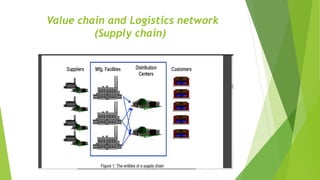
Value chain and Logistics network
(Supply chain)
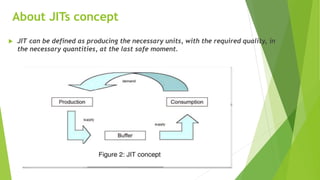
About JITs concept
 JIT can be defined as producing the necessary units, with the required quality, in
the necessary quantities, at the last safe moment.
History of JIT concept
 The technique was first used by the Ford Motor Company during
1920s.
 1954 Japanese giant Toyota implemented JIT.
Philosophy
 A whole philosophy that the company must follow.
 Different disciplines.
 There are views with respect to how inventory is looked upon, what
it says about the management within the company, and the main
principle behind JIT.
“the right material, at the right time, at the right
place, and in the exact amount.”
Benefits
 Reduced set up times in warehouse
 Improved flows of goods in/through/out warehouse
 Employees who possess multi-skills are utilized more efficiently
 Better consistency of scheduling and consistency of employee work hours
 Increased emphasis on supplier relationships
 Supplies continue around the clock keeping workers productive and
businesses focused on turnover
Problems
 supplier and downstream consumers open to supply shocks
 susceptible to an interruption in the flow
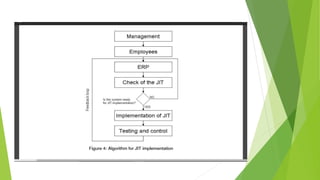
Implementation
 Acceptance
 Employees should understand significance of concept
 Enterprise Resource Planning
Real life examples of
Just in time
 Toyota
 DELL
 Harley Davidson
 Toyota is considered by many to be the poster child for JIT success. The Toyota production
strategy is highlighted by the fact that raw materials are not brought to the production floor
until an order is received and this product is ready to be built. No parts are allowed at a node
unless they are required for the next node, or they are part of an assembly for the next node.
This philosophy has allowed Toyota to keep a minimum amount of inventory which means lower
costs. This also means that Toyota can adapt quickly to changes in demand without having to
worry about disposing of expensive inventory.
Important Factors to Toyota Success
 Raw material inventory
 Accuracy
 Dell has also leveraged JIT Principles to make its manufacturing
process a success. Dell’s approach to JIT is different in that
they leverage their suppliers to achieve the JIT goal. They are
also unique in that Dell is able to provide exceptionally short
lead times to their customers, by forcing their suppliers to
carry inventory instead of carrying it themselves and then
demanding (and receiving) short lead times on components so
that products can be simply assembled by Dell quickly and then
shipped to the customer.
Important Factors to Dell’s Success:
 Dependable suppliers
 seamless system
 inventory on hand
Harley Davidson
 Harley Davidson’s use of JIT is mostly characterized by its
transformation in the late World War 2 era from an inefficient
manufacturer that solved all of its problems with extra
inventory to a nimble manufacturer able to meet demand and
provide short lead times.
Results of Harley Davidson’s JIT
Implementation
 Inventory levels decreased 75 percent.
 Increased productivity.
Just In Time concept

Just In Time concept

  • 2.
  • 3.
    Value chain andLogistics network (Supply chain)
  • 4.
    About JITs concept JIT can be defined as producing the necessary units, with the required quality, in the necessary quantities, at the last safe moment.
  • 5.
    History of JITconcept  The technique was first used by the Ford Motor Company during 1920s.  1954 Japanese giant Toyota implemented JIT.
  • 6.
    Philosophy  A wholephilosophy that the company must follow.  Different disciplines.  There are views with respect to how inventory is looked upon, what it says about the management within the company, and the main principle behind JIT.
  • 7.
    “the right material,at the right time, at the right place, and in the exact amount.”
  • 8.
    Benefits  Reduced setup times in warehouse  Improved flows of goods in/through/out warehouse  Employees who possess multi-skills are utilized more efficiently  Better consistency of scheduling and consistency of employee work hours  Increased emphasis on supplier relationships  Supplies continue around the clock keeping workers productive and businesses focused on turnover
  • 9.
    Problems  supplier anddownstream consumers open to supply shocks  susceptible to an interruption in the flow
  • 10.
    Implementation  Acceptance  Employeesshould understand significance of concept  Enterprise Resource Planning
  • 12.
    Real life examplesof Just in time  Toyota  DELL  Harley Davidson
  • 13.
     Toyota isconsidered by many to be the poster child for JIT success. The Toyota production strategy is highlighted by the fact that raw materials are not brought to the production floor until an order is received and this product is ready to be built. No parts are allowed at a node unless they are required for the next node, or they are part of an assembly for the next node. This philosophy has allowed Toyota to keep a minimum amount of inventory which means lower costs. This also means that Toyota can adapt quickly to changes in demand without having to worry about disposing of expensive inventory.
  • 14.
    Important Factors toToyota Success  Raw material inventory  Accuracy
  • 15.
     Dell hasalso leveraged JIT Principles to make its manufacturing process a success. Dell’s approach to JIT is different in that they leverage their suppliers to achieve the JIT goal. They are also unique in that Dell is able to provide exceptionally short lead times to their customers, by forcing their suppliers to carry inventory instead of carrying it themselves and then demanding (and receiving) short lead times on components so that products can be simply assembled by Dell quickly and then shipped to the customer.
  • 16.
    Important Factors toDell’s Success:  Dependable suppliers  seamless system  inventory on hand
  • 17.
    Harley Davidson  HarleyDavidson’s use of JIT is mostly characterized by its transformation in the late World War 2 era from an inefficient manufacturer that solved all of its problems with extra inventory to a nimble manufacturer able to meet demand and provide short lead times.
  • 18.
    Results of HarleyDavidson’s JIT Implementation  Inventory levels decreased 75 percent.  Increased productivity.