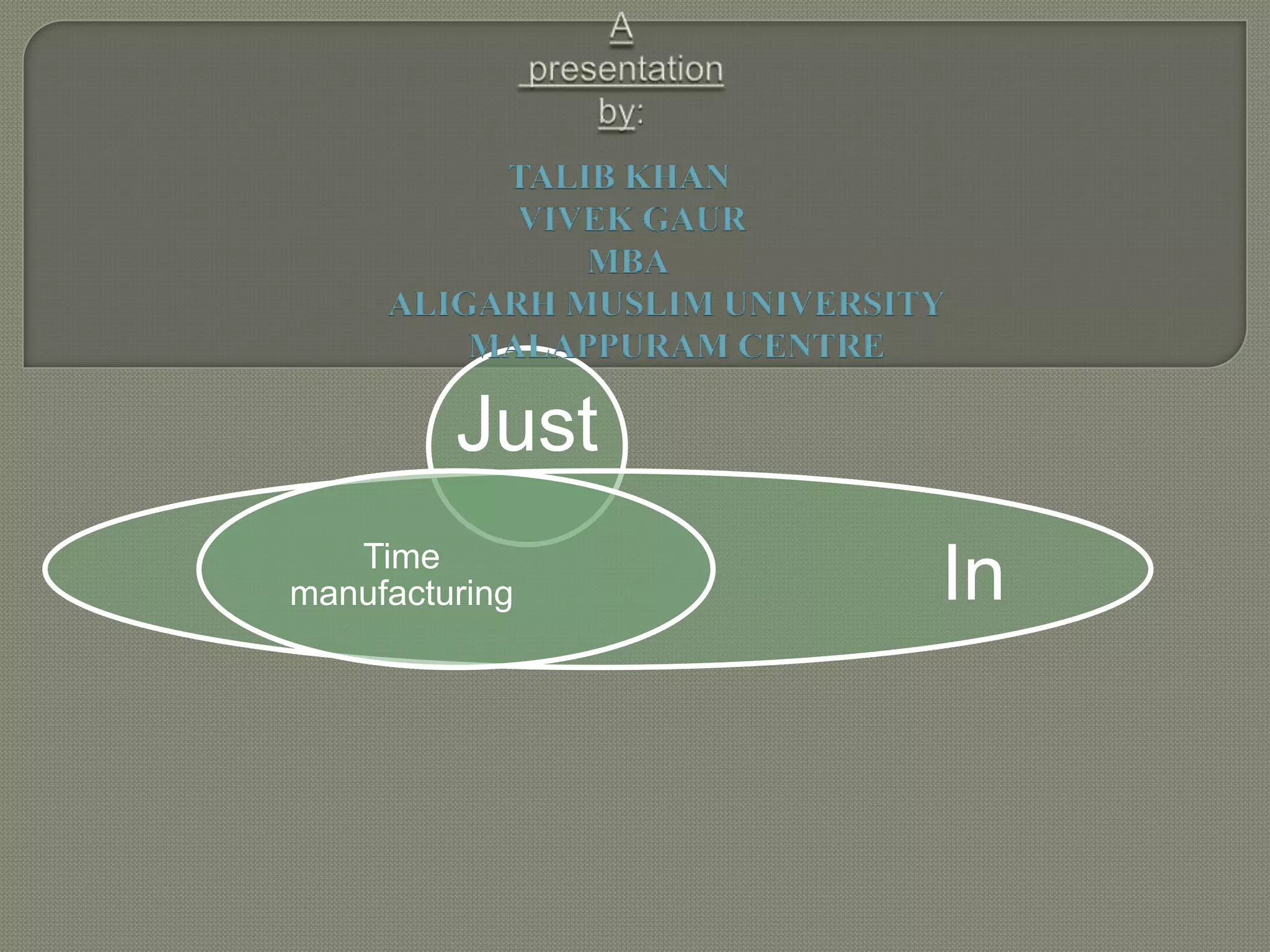
TALIB KHAN
           VIVEK GAUR
              MBA
     ALIGARH MUSLIM UNIVERSITY
         MALAPPURAM CENTRE

         Just
   Time
manufacturing                In
 Introduction
 Just-in-time  manufacturing philosophy
 Elements of just in time manufacturing
 Benefits of Jit manufacturing
 Manufacturing JIT implementation
 conclusion
 What   is just-in-time manufacturing
Jit is philosophy of manufacturing based on
 planned elimination of all waste and continuous
 improvement of productivity it encompasses the
 successful execution of all manufacturing
 activities required to produce a final product from
 design engineering to delivery and including all
 the states of conversion from raw material
 onward.
The philosophy of JIT can be traced back to Henry
 Ford, but formalized JIT originated in Japan as the
 Toyota Production System. W. Edwards Deming’s
 lesson of variability reduction was a huge influence.

JIT is a long-term approach to process improvement. It uses
timeliness as a lever to lower costs, improve quality and improve
responsiveness. However, JIT requires enormous commitment. It
took Toyota more than 25 years to get right!

           The focus of JIT is to improve the
          system of production by eliminating
                 all forms of WASTE.
 Eliminating  wastes
 Total quality management
 Parallel processing
 Jit purchasing
 E-commerce and JIT purchasing
 Reducing inventories through setup
  reduction
 working towards repetitive manufacturing
Traditional
 Goal: maximize production by minimizing disruptions
 Management Assumption: we can sell what we make


JIT
 Goal: Produce salable goods as quickly and efficiently as
  possible
 Management Assumption: we make what we can sell
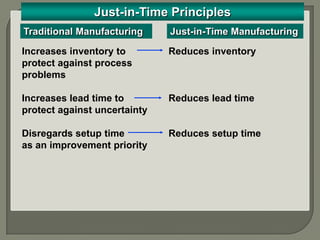
Just-in-Time Principles
Traditional Manufacturing     Just-in-Time Manufacturing

Increases inventory to        Reduces inventory
protect against process
problems

Increases lead time to        Reduces lead time
protect against uncertainty

Disregards setup time         Reduces setup time
as an improvement priority
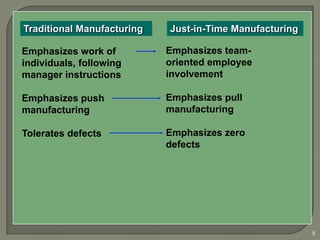
Traditional Manufacturing   Just-in-Time Manufacturing

Emphasizes work of          Emphasizes team-
individuals, following      oriented employee
manager instructions        involvement

Emphasizes push             Emphasizes pull
manufacturing               manufacturing

Tolerates defects           Emphasizes zero
                            defects


                                                         8
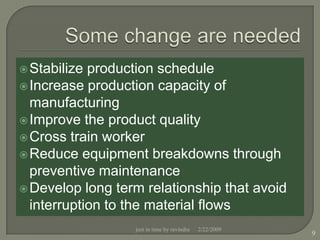
 Stabilize production schedule
 Increase production capacity of
  manufacturing
 Improve the product quality
 Cross train worker
 Reduce equipment breakdowns through
  preventive maintenance
 Develop long term relationship that avoid
  interruption to the material flows
                  just in time by ravindra   2/22/2009
                                                         9
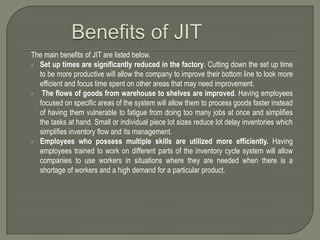
The main benefits of JIT are listed below.
 Set up times are significantly reduced in the factory. Cutting down the set up time
  to be more productive will allow the company to improve their bottom line to look more
  efficient and focus time spent on other areas that may need improvement.
 The flows of goods from warehouse to shelves are improved. Having employees
  focused on specific areas of the system will allow them to process goods faster instead
  of having them vulnerable to fatigue from doing too many jobs at once and simplifies
  the tasks at hand. Small or individual piece lot sizes reduce lot delay inventories which
  simplifies inventory flow and its management.
 Employees who possess multiple skills are utilized more efficiently. Having
  employees trained to work on different parts of the inventory cycle system will allow
  companies to use workers in situations where they are needed when there is a
  shortage of workers and a high demand for a particular product.
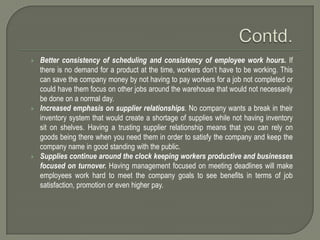
   Better consistency of scheduling and consistency of employee work hours. If
    there is no demand for a product at the time, workers don’t have to be working. This
    can save the company money by not having to pay workers for a job not completed or
    could have them focus on other jobs around the warehouse that would not necessarily
    be done on a normal day.
   Increased emphasis on supplier relationships. No company wants a break in their
    inventory system that would create a shortage of supplies while not having inventory
    sit on shelves. Having a trusting supplier relationship means that you can rely on
    goods being there when you need them in order to satisfy the company and keep the
    company name in good standing with the public.
   Supplies continue around the clock keeping workers productive and businesses
    focused on turnover. Having management focused on meeting deadlines will make
    employees work hard to meet the company goals to see benefits in terms of job
    satisfaction, promotion or even higher pay.
Step 1: Awareness

      The goal of JIT is to eliminate waste in all its forms.
      The assumption of JIT is that we cannot sell everything we make. Thus, we
       must produce salable goods (low cost, high quality, etc...) quickly.
      Operation = Motion (Waste) + Work (Added Value)
      Motion alone is a waste that adds cost (counting things, moving boxes,
       transporting goods, preparation time, waiting, producing defects, over
       production, handling materials, switching things on)
      Inventory decouples individual operations and thereby creates waste (non-
       value-added motion) to buffer the operations against the effect of a different
       form of waste (long setups, poor material handling procedures, production of
       defects, etc.)
      For real improvement, we must ask "why" when we encounter any form of
       waste.
Step 2: Workplace Improvement (the 5 S’s)

       Seiri: Proper arrangement (sort through and sort out, identify what you
        need, discard what you do not need )
       Seiton: Orderliness (assign a separate location for all essential items)
       Seiso: Cleanliness (keep the workplace spotless at all times)
       Seiketsu: Cleanup (maintain equipment and tools)
       Shitsuke: Discipline (stick to the rules scrupulously)
Step 3: Flow Manufacturing (one piece at a time)


      Place the machines in process sequence
      Design a cellular (U-shaped) layout
      Make one piece at a time in the cell
      Produce according to the cycle time
      Have the operators work standing up and walking
      Use slower, dedicated machines that are smaller and less expensive
just in time manufacturing

just in time manufacturing

  • 1.
    TALIB KHAN VIVEK GAUR MBA ALIGARH MUSLIM UNIVERSITY MALAPPURAM CENTRE Just Time manufacturing In
  • 2.
     Introduction  Just-in-time manufacturing philosophy  Elements of just in time manufacturing  Benefits of Jit manufacturing  Manufacturing JIT implementation  conclusion
  • 3.
     What is just-in-time manufacturing Jit is philosophy of manufacturing based on planned elimination of all waste and continuous improvement of productivity it encompasses the successful execution of all manufacturing activities required to produce a final product from design engineering to delivery and including all the states of conversion from raw material onward.
  • 4.
    The philosophy ofJIT can be traced back to Henry Ford, but formalized JIT originated in Japan as the Toyota Production System. W. Edwards Deming’s lesson of variability reduction was a huge influence. JIT is a long-term approach to process improvement. It uses timeliness as a lever to lower costs, improve quality and improve responsiveness. However, JIT requires enormous commitment. It took Toyota more than 25 years to get right! The focus of JIT is to improve the system of production by eliminating all forms of WASTE.
  • 5.
     Eliminating wastes  Total quality management  Parallel processing  Jit purchasing  E-commerce and JIT purchasing  Reducing inventories through setup reduction  working towards repetitive manufacturing
  • 6.
    Traditional  Goal: maximizeproduction by minimizing disruptions  Management Assumption: we can sell what we make JIT  Goal: Produce salable goods as quickly and efficiently as possible  Management Assumption: we make what we can sell
  • 7.
    Just-in-Time Principles Traditional Manufacturing Just-in-Time Manufacturing Increases inventory to Reduces inventory protect against process problems Increases lead time to Reduces lead time protect against uncertainty Disregards setup time Reduces setup time as an improvement priority
  • 8.
    Traditional Manufacturing Just-in-Time Manufacturing Emphasizes work of Emphasizes team- individuals, following oriented employee manager instructions involvement Emphasizes push Emphasizes pull manufacturing manufacturing Tolerates defects Emphasizes zero defects 8
  • 9.
     Stabilize productionschedule  Increase production capacity of manufacturing  Improve the product quality  Cross train worker  Reduce equipment breakdowns through preventive maintenance  Develop long term relationship that avoid interruption to the material flows just in time by ravindra 2/22/2009 9
  • 10.
    The main benefitsof JIT are listed below.  Set up times are significantly reduced in the factory. Cutting down the set up time to be more productive will allow the company to improve their bottom line to look more efficient and focus time spent on other areas that may need improvement.  The flows of goods from warehouse to shelves are improved. Having employees focused on specific areas of the system will allow them to process goods faster instead of having them vulnerable to fatigue from doing too many jobs at once and simplifies the tasks at hand. Small or individual piece lot sizes reduce lot delay inventories which simplifies inventory flow and its management.  Employees who possess multiple skills are utilized more efficiently. Having employees trained to work on different parts of the inventory cycle system will allow companies to use workers in situations where they are needed when there is a shortage of workers and a high demand for a particular product.
  • 11.
    Better consistency of scheduling and consistency of employee work hours. If there is no demand for a product at the time, workers don’t have to be working. This can save the company money by not having to pay workers for a job not completed or could have them focus on other jobs around the warehouse that would not necessarily be done on a normal day.  Increased emphasis on supplier relationships. No company wants a break in their inventory system that would create a shortage of supplies while not having inventory sit on shelves. Having a trusting supplier relationship means that you can rely on goods being there when you need them in order to satisfy the company and keep the company name in good standing with the public.  Supplies continue around the clock keeping workers productive and businesses focused on turnover. Having management focused on meeting deadlines will make employees work hard to meet the company goals to see benefits in terms of job satisfaction, promotion or even higher pay.
  • 12.
    Step 1: Awareness  The goal of JIT is to eliminate waste in all its forms.  The assumption of JIT is that we cannot sell everything we make. Thus, we must produce salable goods (low cost, high quality, etc...) quickly.  Operation = Motion (Waste) + Work (Added Value)  Motion alone is a waste that adds cost (counting things, moving boxes, transporting goods, preparation time, waiting, producing defects, over production, handling materials, switching things on)  Inventory decouples individual operations and thereby creates waste (non- value-added motion) to buffer the operations against the effect of a different form of waste (long setups, poor material handling procedures, production of defects, etc.)  For real improvement, we must ask "why" when we encounter any form of waste.
  • 13.
    Step 2: WorkplaceImprovement (the 5 S’s)  Seiri: Proper arrangement (sort through and sort out, identify what you need, discard what you do not need )  Seiton: Orderliness (assign a separate location for all essential items)  Seiso: Cleanliness (keep the workplace spotless at all times)  Seiketsu: Cleanup (maintain equipment and tools)  Shitsuke: Discipline (stick to the rules scrupulously)
  • 14.
    Step 3: FlowManufacturing (one piece at a time)  Place the machines in process sequence  Design a cellular (U-shaped) layout  Make one piece at a time in the cell  Produce according to the cycle time  Have the operators work standing up and walking  Use slower, dedicated machines that are smaller and less expensive