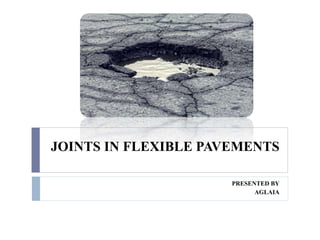

JOINTS IN FLEXIBLE PAVEMENTS
PRESENTED BY
AGLAIA
Types of Failures in Flexible Pavements
 In general, the flexible pavement consists of the following
component layers:
1. Sub-grade
2. Sub-base course
3. Base Course
4. Surface Course
 Instability in any of the layers will result in the complete
failure of the pavement system.
 This makes it necessary to construct each layer with utmost
care and precision.
Types of Failures due to Structural Distresses
 Some of the structural distresses which can cause failures
in flexible pavements are:
1. Alligator Cracking of Flexible Pavements
2. Depressions in Flexible Pavements
3. Corrugations in Flexible Pavements
4. Shoving
5. Potholes in Pavement
6. Rutting of Flexible Pavements
7. Swelling of Flexible Pavements
Alligator cracking/Map cracking
 This is a fatigue failure caused in the asphalt concrete.
 A series of interconnected cracks are observed due to such
distress.
 The tensile stress is maximum at the asphalt surface (base). This
is the position where the cracks are formed, i.e. the area with
maximum tensile stress.
 A parallel of longitudinal cracks will propagate with time and
reaches the surface.
 Repeated loading and stress concentration will help the
individual cracks to get connected.
 These will resemble as a chicken wire or similar to the alligator
skin. This is termed as the alligator cracking. It is also known as
the crocodile cracking.
Alligator Cracks Formed in Flexible Pavements
 These cracking is observed only in areas that have repeated traffic
loading.
 It is one of the major structural distress. This distress is later
accompanied by rutting.
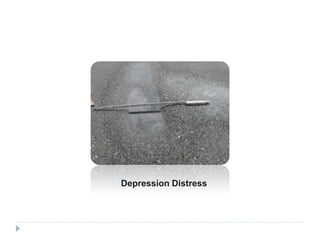
Depressions
 There are certain areas in the pavement that are localized and
have a lower elevation compared to the surrounding pavement
level.
 These lowering are depressions found on the pavement.
 They are mainly noticed only when they are filled with water.
 They are very common distress found in parking lot
construction as well as in overlays.
 They can be caused either by the foundation soil settlement
due to continuous loading or it can be formed during the
construction.
Depression Distress
Corrugations
 They are distress seen in the pavement at regular intervals
in the form of ridges and valleys.
 These are usually less than 5 feet, along with the direction
of the pavement.
 The ridges form of corrugations will be perpendicular to
the traffic direction.
 Unstable pavement plus traffic will create such distress.
 Where the traffic starts and stops, this distress are observed.
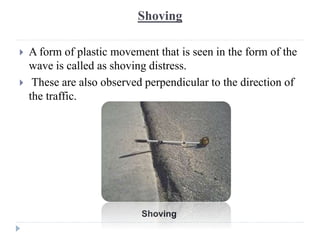
Shoving
 A form of plastic movement that is seen in the form of the
wave is called as shoving distress.
 These are also observed perpendicular to the direction of
the traffic.
Shoving
Potholes
 In road surfaces where a portion of the same has broken
away, cause a disruption by forming a pothole. These are
also called as a kettle.
 The pavement fatigue is the main reason behind the
formation of potholes.
 The occurrence of fatigue cracking will interlock to form
alligator cracking.
 In cold temperatures, the water trapped in the pothole will
carry out the freezing and thawing action that leads to
additional stresses and crack propagation.
 The vehicle tires are damaged due to large potholes.
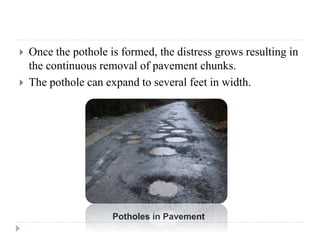
Potholes in Pavement
 Once the pothole is formed, the distress grows resulting in
the continuous removal of pavement chunks.
 The pothole can expand to several feet in width.
Rutting
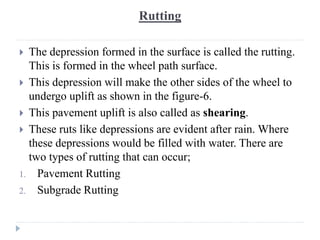
 The depression formed in the surface is called the rutting.
This is formed in the wheel path surface.
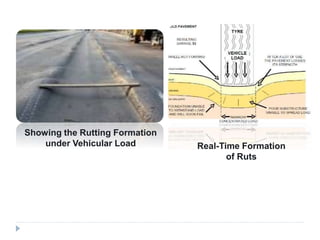
 This depression will make the other sides of the wheel to
undergo uplift as shown in the figure-6.
 This pavement uplift is also called as shearing.
 These ruts like depressions are evident after rain. Where
these depressions would be filled with water. There are
two types of rutting that can occur;
1. Pavement Rutting
2. Subgrade Rutting
Real-Time Formation
of Ruts
Showing the Rutting Formation
under Vehicular Load
Swelling
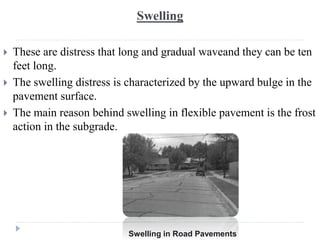
 These are distress that long and gradual waveand they can be ten
feet long.
 The swelling distress is characterized by the upward bulge in the
pavement surface.
 The main reason behind swelling in flexible pavement is the frost
action in the subgrade.
Swelling in Road Pavements
Types of Failures due to Environmental Distresses
1. Bleeding in Flexible Pavements
2. Block cracking
3. Bumps and sags
4. Edge cracking
5. Joint reflection cracking
6. Raveling
7. cold joints
8. Transverse and longitudinal joints
Bleeding
 The phenomenon of formation of a film of asphalt binder over the
surface of the pavement surface is called as bleeding.
 The occurrence of bleeding will give a shiny glass like reflecting
surface.
 The filling of asphalt binder into the aggregate voids during hot
weather conditions and their expansion in later situations will result
in bleeding.
 As the process of bleeding cannot be reverted in cold temperatures,
they remain on the top of the pavement as such.
 The bleeding can be caused due to the following factors:
1. Excessive asphalt binder in the mix
2. Excessive application of the binder during surface treatment
3. Lower air void content
Block Cracking
 This is also called as thermal cracking.
 The cracking is happening in the form of blocks.
 These cracks are interconnected making the pavement to
divide into rectangular pieces (almost rectangular).
 The size of each rectangle may vary from one foot by one
foot to ten foot by ten foot.
 This is spread over a wide pavement area.
 But these are observed in areas of no traffic.
 This is an after effect of environmental exposure, hence it
is called thermal cracking.
 The temperature effects and aging are the possible
reasons.
Bumps and Sags
 Pavement surface that is localized, small in area that has
undergone an upward displacement will be named as
bumps.
 These are caused due to the instability factor of pavement.
 They can be caused even due to buckling or the bulging .
 Plant roots growing under the pavement cause bumps.
 The sags are mainly caused due to the settlement or the
displacement of the pavement surface.
Edge Cracking
 In unconfined asphalt pavements, edge cracking is found
to occur.
 During the compaction process of the pavement, the edges
will start to yield, especially when there is no sort of
confinement like curbs or edge barriers.
 The edges will yield with age, undergo oxidation and
becomes brittle.
 The edge cracking is observed in the shape of ‘C’ formed
along the edges of the street, parking lot or the roads.
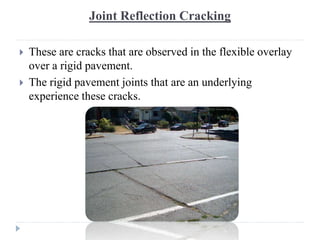
Joint Reflection Cracking
 These are cracks that are observed in the flexible overlay
over a rigid pavement.
 The rigid pavement joints that are an underlying
experience these cracks.
Raveling
 The dislodgement of aggregate particles will result in the
disintegration of the hot mixed asphalt progressively from
the surface to downward direction. This failure is called as
raveling.
 This dislodgement is the loss of bonding between the
aggregate particles and the asphalt binder.
 The aggregates are sometimes coated with dust particles
that result in lack of bonding.
 This will make the aggregate to bind with the dust rather
than the binder.
Cold Joints
 These are longitudinal joints which are formed in the
asphalt pavement.
 This failure occurs when a hot mix asphalt is poured
adjacent to an existing pavement.
 This kind of failure is mainly common in parking lots,
inverted crowns and areas with lower traffic.
 The difference in temperature and the plasticity variation
will bring a different between the two layers.
 This will cause a longitudinal joint to occur between the
asphalt mats that are laid.
 The longitudinal joint possesses a lesser density compared
to other pavements.
Longitudinal and Transverse Cracking Distress
 This distress can be considered as either a structural or an
environmental distress.
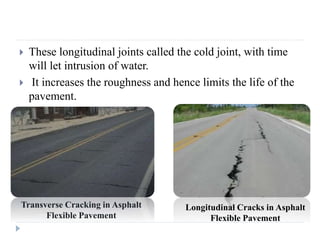
 The longitudinal cracks are formed parallel to the
pavement alignment or the center line of the pavement.
 This is a fatigue cracking.
 The cracking occurs in the direction of traffic flow.
 The transverse cracking is formed perpendicular to the
pavement centerline.
 This is caused as a thermal cracking.
Longitudinal Cracks in Asphalt
Flexible Pavement
Transverse Cracking in Asphalt
Flexible Pavement
 These longitudinal joints called the cold joint, with time
will let intrusion of water.
 It increases the roughness and hence limits the life of the
pavement.
Thank you
Lintels
For more…. Mail to aglaiaconnect2018@gmail.com

Joints in flexible pavements

  • 1.
    JOINTS IN FLEXIBLEPAVEMENTS PRESENTED BY AGLAIA
  • 2.
    Types of Failuresin Flexible Pavements  In general, the flexible pavement consists of the following component layers: 1. Sub-grade 2. Sub-base course 3. Base Course 4. Surface Course  Instability in any of the layers will result in the complete failure of the pavement system.  This makes it necessary to construct each layer with utmost care and precision.
  • 3.
    Types of Failuresdue to Structural Distresses  Some of the structural distresses which can cause failures in flexible pavements are: 1. Alligator Cracking of Flexible Pavements 2. Depressions in Flexible Pavements 3. Corrugations in Flexible Pavements 4. Shoving 5. Potholes in Pavement 6. Rutting of Flexible Pavements 7. Swelling of Flexible Pavements
  • 4.
    Alligator cracking/Map cracking This is a fatigue failure caused in the asphalt concrete.  A series of interconnected cracks are observed due to such distress.  The tensile stress is maximum at the asphalt surface (base). This is the position where the cracks are formed, i.e. the area with maximum tensile stress.  A parallel of longitudinal cracks will propagate with time and reaches the surface.  Repeated loading and stress concentration will help the individual cracks to get connected.  These will resemble as a chicken wire or similar to the alligator skin. This is termed as the alligator cracking. It is also known as the crocodile cracking.
  • 5.
    Alligator Cracks Formedin Flexible Pavements  These cracking is observed only in areas that have repeated traffic loading.  It is one of the major structural distress. This distress is later accompanied by rutting.
  • 6.
    Depressions  There arecertain areas in the pavement that are localized and have a lower elevation compared to the surrounding pavement level.  These lowering are depressions found on the pavement.  They are mainly noticed only when they are filled with water.  They are very common distress found in parking lot construction as well as in overlays.  They can be caused either by the foundation soil settlement due to continuous loading or it can be formed during the construction.
  • 7.
  • 8.
    Corrugations  They aredistress seen in the pavement at regular intervals in the form of ridges and valleys.  These are usually less than 5 feet, along with the direction of the pavement.  The ridges form of corrugations will be perpendicular to the traffic direction.  Unstable pavement plus traffic will create such distress.  Where the traffic starts and stops, this distress are observed.
  • 9.
    Shoving  A formof plastic movement that is seen in the form of the wave is called as shoving distress.  These are also observed perpendicular to the direction of the traffic. Shoving
  • 10.
    Potholes  In roadsurfaces where a portion of the same has broken away, cause a disruption by forming a pothole. These are also called as a kettle.  The pavement fatigue is the main reason behind the formation of potholes.  The occurrence of fatigue cracking will interlock to form alligator cracking.  In cold temperatures, the water trapped in the pothole will carry out the freezing and thawing action that leads to additional stresses and crack propagation.  The vehicle tires are damaged due to large potholes.
  • 11.
    Potholes in Pavement Once the pothole is formed, the distress grows resulting in the continuous removal of pavement chunks.  The pothole can expand to several feet in width.
  • 12.
    Rutting  The depressionformed in the surface is called the rutting. This is formed in the wheel path surface.  This depression will make the other sides of the wheel to undergo uplift as shown in the figure-6.  This pavement uplift is also called as shearing.  These ruts like depressions are evident after rain. Where these depressions would be filled with water. There are two types of rutting that can occur; 1. Pavement Rutting 2. Subgrade Rutting
  • 13.
    Real-Time Formation of Ruts Showingthe Rutting Formation under Vehicular Load
  • 14.
    Swelling  These aredistress that long and gradual waveand they can be ten feet long.  The swelling distress is characterized by the upward bulge in the pavement surface.  The main reason behind swelling in flexible pavement is the frost action in the subgrade. Swelling in Road Pavements
  • 15.
    Types of Failuresdue to Environmental Distresses 1. Bleeding in Flexible Pavements 2. Block cracking 3. Bumps and sags 4. Edge cracking 5. Joint reflection cracking 6. Raveling 7. cold joints 8. Transverse and longitudinal joints
  • 16.
    Bleeding  The phenomenonof formation of a film of asphalt binder over the surface of the pavement surface is called as bleeding.  The occurrence of bleeding will give a shiny glass like reflecting surface.  The filling of asphalt binder into the aggregate voids during hot weather conditions and their expansion in later situations will result in bleeding.  As the process of bleeding cannot be reverted in cold temperatures, they remain on the top of the pavement as such.  The bleeding can be caused due to the following factors: 1. Excessive asphalt binder in the mix 2. Excessive application of the binder during surface treatment 3. Lower air void content
  • 17.
    Block Cracking  Thisis also called as thermal cracking.  The cracking is happening in the form of blocks.  These cracks are interconnected making the pavement to divide into rectangular pieces (almost rectangular).  The size of each rectangle may vary from one foot by one foot to ten foot by ten foot.  This is spread over a wide pavement area.  But these are observed in areas of no traffic.  This is an after effect of environmental exposure, hence it is called thermal cracking.  The temperature effects and aging are the possible reasons.
  • 18.
    Bumps and Sags Pavement surface that is localized, small in area that has undergone an upward displacement will be named as bumps.  These are caused due to the instability factor of pavement.  They can be caused even due to buckling or the bulging .  Plant roots growing under the pavement cause bumps.  The sags are mainly caused due to the settlement or the displacement of the pavement surface.
  • 19.
    Edge Cracking  Inunconfined asphalt pavements, edge cracking is found to occur.  During the compaction process of the pavement, the edges will start to yield, especially when there is no sort of confinement like curbs or edge barriers.  The edges will yield with age, undergo oxidation and becomes brittle.  The edge cracking is observed in the shape of ‘C’ formed along the edges of the street, parking lot or the roads.
  • 20.
    Joint Reflection Cracking These are cracks that are observed in the flexible overlay over a rigid pavement.  The rigid pavement joints that are an underlying experience these cracks.
  • 21.
    Raveling  The dislodgementof aggregate particles will result in the disintegration of the hot mixed asphalt progressively from the surface to downward direction. This failure is called as raveling.  This dislodgement is the loss of bonding between the aggregate particles and the asphalt binder.  The aggregates are sometimes coated with dust particles that result in lack of bonding.  This will make the aggregate to bind with the dust rather than the binder.
  • 22.
    Cold Joints  Theseare longitudinal joints which are formed in the asphalt pavement.  This failure occurs when a hot mix asphalt is poured adjacent to an existing pavement.  This kind of failure is mainly common in parking lots, inverted crowns and areas with lower traffic.  The difference in temperature and the plasticity variation will bring a different between the two layers.  This will cause a longitudinal joint to occur between the asphalt mats that are laid.  The longitudinal joint possesses a lesser density compared to other pavements.
  • 23.
    Longitudinal and TransverseCracking Distress  This distress can be considered as either a structural or an environmental distress.  The longitudinal cracks are formed parallel to the pavement alignment or the center line of the pavement.  This is a fatigue cracking.  The cracking occurs in the direction of traffic flow.  The transverse cracking is formed perpendicular to the pavement centerline.  This is caused as a thermal cracking.
  • 24.
    Longitudinal Cracks inAsphalt Flexible Pavement Transverse Cracking in Asphalt Flexible Pavement  These longitudinal joints called the cold joint, with time will let intrusion of water.  It increases the roughness and hence limits the life of the pavement.
  • 25.
    Thank you Lintels For more….Mail to aglaiaconnect2018@gmail.com