Submitted by:
Abdul Jalil Naibi
Roll No. 19011A0169
 Introduction
 Highway Pavements
 Highway Failure Causes
 Highway failure Types
 Highway Maintenance
 Materials Used
 Highway Maintenance Includes
 Highway Maintenance Materials
 Conclusion
 References
A highway is any public road or other public way on land.
A main road, especially one connecting major towns or
cities.
The first highway was constructed
 on long Island New York in the United States in 1911.
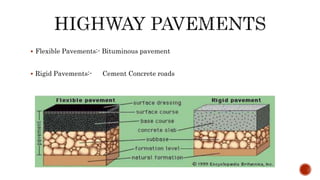
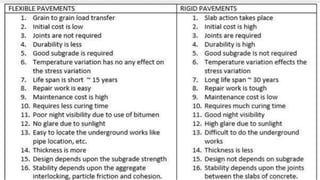
 Flexible Pavements:- Bituminous pavement
 Rigid Pavements:- Cement Concrete roads
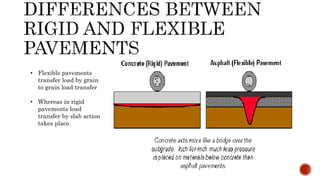
• Flexible pavements
transfer load by grain
to grain load transfer
• Whereas in rigid
pavements load
transfer by slab action
takes place.
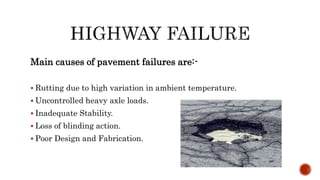
Main causes of pavement failures are:-
 Rutting due to high variation in ambient temperature.
 Uncontrolled heavy axle loads.
 Inadequate Stability.
 Loss of blinding action.
 Poor Design and Fabrication.
The four major types of pavement failure are:
 Cracking (longitudinal cracks, etc.)
 Surface deformation (Rutting, etc.)
 Disintegration (potholes, etc.)
 Surface defects (bleeding, etc.)
Spalling of joints
Scaling of cement concrete
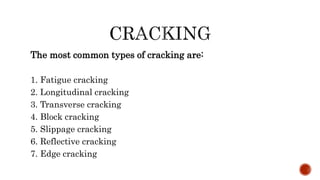
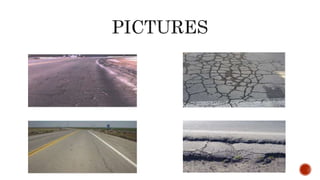
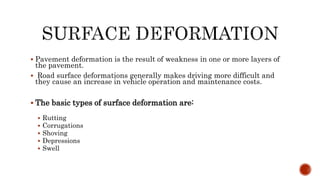
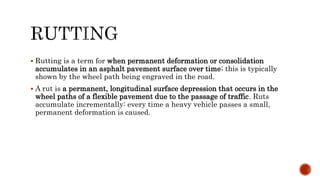
The most common types of cracking are:
1. Fatigue cracking
2. Longitudinal cracking
3. Transverse cracking
4. Block cracking
5. Slippage cracking
6. Reflective cracking
7. Edge cracking
 Pavement deformation is the result of weakness in one or more layers of
the pavement.
 Road surface deformations generally makes driving more difficult and
they cause an increase in vehicle operation and maintenance costs.
 The basic types of surface deformation are:
 Rutting
 Corrugations
 Shoving
 Depressions
 Swell
 Rutting is a term for when permanent deformation or consolidation
accumulates in an asphalt pavement surface over time; this is typically
shown by the wheel path being engraved in the road.
 A rut is a permanent, longitudinal surface depression that occurs in the
wheel paths of a flexible pavement due to the passage of traffic. Ruts
accumulate incrementally: every time a heavy vehicle passes a small,
permanent deformation is caused.
 What is Corrugation? The formation of ripples or waves on the flexible pavement
generally perpendicular to the traffic flow is called corrugation or wash boarding.
It occurs at the points where traffic starts and stops.
 A form of plastic movement typified by ripples (corrugation) or an abrupt wave
(shoving) across the pavement surface. The distortion is perpendicular to the
traffic direction. Usually occurs at points where traffic starts and stops
(corrugation) or areas where HMA abuts a rigid object (shoving).
 The bulging of the pavement surface due to plastic movement of pavement is
called shoving. It occurs at points where a vehicle pulls its brakes or at points
where pavement meets rigid objects.
 Shoving occurs when vehicle loading causes the pavement to move and bulge,
generally parallel to the direction of traffic, with an unstable asphalt layer. It
occurs due to a weakened pavement layer, poor bonding between layers, or
excessive moisture in the subgrade
 A swell is usually caused by frost action in the subgrade or by swelling soil, but a
small swell can also occur on the surface of an asphalt overlay (over PCC) as a
result of a blowup in the PCC slab. Swell is barely visible and has a minor effect
on the pavement's ride quality.
 Swell is characterized by an upward bulge in the pavement’s surface, a long,
gradual wave more than 3 m (10 ft.) long.
 By definition, depressions are small localized areas. A pavement depression
should be investigated to determine the root cause of failure
(i.e., subgrade settlement or frost heave). Depressions should be repaired by
removing the affected pavement then digging out and replacing the area of poor
subgrade.
 Localized pavement surface areas with slightly lower elevations than the
surrounding pavement. Depressions are very noticeable after a rain when they fill
with water.
The Progressive breaking up of the pavement into small, loose pieces
is called disintegration.
If the disintegration is not repaired in its early stages, complete
reconstruction of the pavement may be needed.
The two most common types of disintegration are:
1. Pot Holes
2. Patches
 Cracks turn into potholes, and potholes become craters. The expansion
and contraction of water cause potholes during freeze-thaw cycles, as well
as the quantity of traffic on the road.
 The damage caused by driving through potholes begins at the tyres. While
driving, the tyres get crushed between the road surface and the wheels of
the vehicle. Because of this, the tire experiences forces that are violent and
concentrated. As a result, when your car hits a pothole, the tire may get
punctured.
 Patches are a common method of treating an area of localized distress. Patches
can be either full-depth where they extend from the pavement surface to
the subgrade or partial where they do not extend through the full depth of
existing pavement.
 What is Patch in road?
 Patching is the process of filling potholes or deteriorated parts of asphalt
pavements. Potholes and other pavement disintegration should be repaired as
soon as possible to prevent additional degradation and costly pavement repairs.
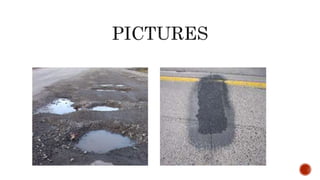
Repair of potholes in bituminous road.
Surface defects are related to problems in the surface layer.
The most common types of surface distress are:
1. Raveling
2. Bleeding
3. Polishing
4. Delamination
 Raveling is the disintegration of an asphalt road surface. It is due to the
dislodgment of the aggregate materials (gravel, sand, and crushed stone). It
reduces skid resistance, roughens the road surface, and exposes the layers
underneath to further deterioration.
 The loss of bond between aggregates and asphalt binder that typically begins at
the bottom of the HMA layer and progresses upward. When stripping begins at
the surface and progresses downward it is usually called raveling.
 Bleeding or flushing is shiny, black surface film of asphalt on the road surface
caused by upward movement of asphalt in the pavement surface. Common causes
of bleeding are too much asphalt in asphalt concrete, hot weather, low space air
void content and quality of asphalt.
 Bleeding occurs when asphalt binder fills the aggregate voids during hot weather
and then expands onto the pavement surface. Since bleeding is not reversible
during cold weather, asphalt binder will accumulate on the pavement surface over
time.
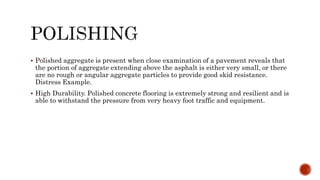
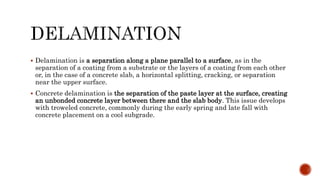
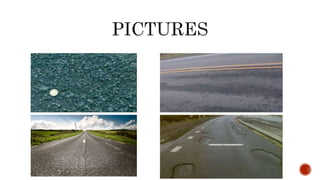
 Polished aggregate is present when close examination of a pavement reveals that
the portion of aggregate extending above the asphalt is either very small, or there
are no rough or angular aggregate particles to provide good skid resistance.
Distress Example.
 High Durability. Polished concrete flooring is extremely strong and resilient and is
able to withstand the pressure from very heavy foot traffic and equipment.
 Delamination is a separation along a plane parallel to a surface, as in the
separation of a coating from a substrate or the layers of a coating from each other
or, in the case of a concrete slab, a horizontal splitting, cracking, or separation
near the upper surface.
 Concrete delamination is the separation of the paste layer at the surface, creating
an unbonded concrete layer between there and the slab body. This issue develops
with troweled concrete, commonly during the early spring and late fall with
concrete placement on a cool subgrade.
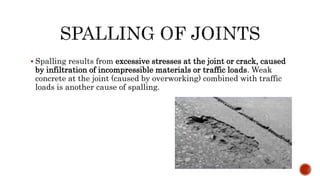
 Spalling results from excessive stresses at the joint or crack, caused
by infiltration of incompressible materials or traffic loads. Weak
concrete at the joint (caused by overworking) combined with traffic
loads is another cause of spalling.
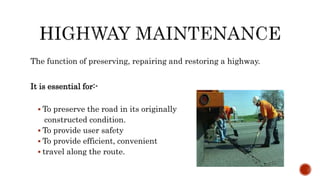
The function of preserving, repairing and restoring a highway.
It is essential for:-
 To preserve the road in its originally
constructed condition.
 To provide user safety
 To provide efficient, convenient
 travel along the route.
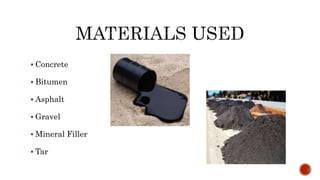
 Concrete
 Bitumen
 Asphalt
 Gravel
 Mineral Filler
 Tar
 Physical maintenance:
Activities such as sealing, patching, filling joints etc.
Traffic service activities:
Including painting pavement markings, remove snow, ice, and litter.
Rehabilitation:
Include restoring or betterment of roadway such as resurfacing.
The various maintenance functions includes:
 Surface maintenance
 Roadside and drainage maintenance
 Shoulder and approaches maintenance
 Snow and ice control
 Bridges maintenance
 Traffic service
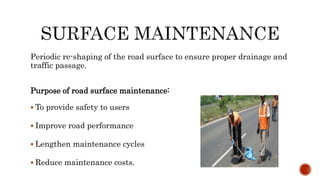
Periodic re-shaping of the road surface to ensure proper drainage and
traffic passage.
Purpose of road surface maintenance:
 To provide safety to users
 Improve road performance
 Lengthen maintenance cycles
 Reduce maintenance costs.
Benefits of surface maintenance:
 Creates a tightly packed road surface.
 Reduces dust generation caused by grinding action of large loose stone
under traffic.
 Minimize loss of road material to erosion.
 Gives a pleasant view.
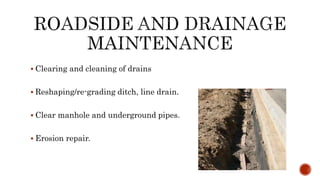
 Clearing and cleaning of drains
 Reshaping/re-grading ditch, line drain.
 Clear manhole and underground pipes.
 Erosion repair.
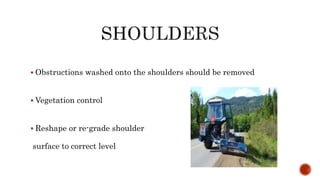
 Obstructions washed onto the shoulders should be removed
 Vegetation control
 Reshape or re-grade shoulder
surface to correct level
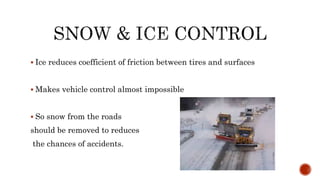
 Ice reduces coefficient of friction between tires and surfaces
 Makes vehicle control almost impossible
 So snow from the roads
should be removed to reduces
the chances of accidents.
 Exposed steel work must be cleaned and repainted.
 Cleaning and resealing of Deck joint.
 Damage to guard rail, must be repaired and strengthened.
 Resurfacing of deck.
 Scour around and under piers and abutments should be removed.
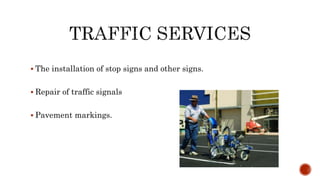
 The installation of stop signs and other signs.
 Repair of traffic signals
 Pavement markings.
 Highway pavements plays and important role in convenience, warning
and direction.
 There should be better management from time to time to keep the
pavements in good condition.
 Designing of pavements should be upgrade for better climate resistance.
 Most road projects today involve modifications to existing roadways, and
the planning, operation, and maintenance of such projects often are
opportunities for improving ecological conditions. A growing body of
information describes such practices for improving aquatic and terrestrial
habitats.
 https://en.wikipedia.org/wiki/Highway_engineeringhttp://www.gjstx-e.cn/ High
technology letters, Volume 26, Issue 12, 2020
 https://www.engineeringhubengineering.in/2021/07/highway-
engineering-and-importance-of.html
 https://www.merriam-webster.com/dictionary/highway%20engineering
 https://www.brandedcivil.com/2020/01/highway-engineering-introduction.html
Review of Highway engineering used for design of structures M Kacha and
Siddarth G Shah. Marwadi University, Rajkot, India
 https://theconstructor.org/concrete/application-of-highway design-in-civil-
engineering/5255/?amp=1- Highway engineering
Highway Failure & their Maintenance Final Project.pptx

Highway Failure & their Maintenance Final Project.pptx

  • 1.
    Submitted by: Abdul JalilNaibi Roll No. 19011A0169
  • 2.
     Introduction  HighwayPavements  Highway Failure Causes  Highway failure Types  Highway Maintenance  Materials Used  Highway Maintenance Includes  Highway Maintenance Materials  Conclusion  References
  • 3.
    A highway isany public road or other public way on land. A main road, especially one connecting major towns or cities. The first highway was constructed  on long Island New York in the United States in 1911.
  • 5.
     Flexible Pavements:-Bituminous pavement  Rigid Pavements:- Cement Concrete roads
  • 6.
    • Flexible pavements transferload by grain to grain load transfer • Whereas in rigid pavements load transfer by slab action takes place.
  • 8.
    Main causes ofpavement failures are:-  Rutting due to high variation in ambient temperature.  Uncontrolled heavy axle loads.  Inadequate Stability.  Loss of blinding action.  Poor Design and Fabrication.
  • 9.
    The four majortypes of pavement failure are:  Cracking (longitudinal cracks, etc.)  Surface deformation (Rutting, etc.)  Disintegration (potholes, etc.)  Surface defects (bleeding, etc.) Spalling of joints Scaling of cement concrete
  • 10.
    The most commontypes of cracking are: 1. Fatigue cracking 2. Longitudinal cracking 3. Transverse cracking 4. Block cracking 5. Slippage cracking 6. Reflective cracking 7. Edge cracking
  • 12.
     Pavement deformationis the result of weakness in one or more layers of the pavement.  Road surface deformations generally makes driving more difficult and they cause an increase in vehicle operation and maintenance costs.  The basic types of surface deformation are:  Rutting  Corrugations  Shoving  Depressions  Swell
  • 13.
     Rutting isa term for when permanent deformation or consolidation accumulates in an asphalt pavement surface over time; this is typically shown by the wheel path being engraved in the road.  A rut is a permanent, longitudinal surface depression that occurs in the wheel paths of a flexible pavement due to the passage of traffic. Ruts accumulate incrementally: every time a heavy vehicle passes a small, permanent deformation is caused.
  • 14.
     What isCorrugation? The formation of ripples or waves on the flexible pavement generally perpendicular to the traffic flow is called corrugation or wash boarding. It occurs at the points where traffic starts and stops.  A form of plastic movement typified by ripples (corrugation) or an abrupt wave (shoving) across the pavement surface. The distortion is perpendicular to the traffic direction. Usually occurs at points where traffic starts and stops (corrugation) or areas where HMA abuts a rigid object (shoving).
  • 15.
     The bulgingof the pavement surface due to plastic movement of pavement is called shoving. It occurs at points where a vehicle pulls its brakes or at points where pavement meets rigid objects.  Shoving occurs when vehicle loading causes the pavement to move and bulge, generally parallel to the direction of traffic, with an unstable asphalt layer. It occurs due to a weakened pavement layer, poor bonding between layers, or excessive moisture in the subgrade
  • 16.
     A swellis usually caused by frost action in the subgrade or by swelling soil, but a small swell can also occur on the surface of an asphalt overlay (over PCC) as a result of a blowup in the PCC slab. Swell is barely visible and has a minor effect on the pavement's ride quality.  Swell is characterized by an upward bulge in the pavement’s surface, a long, gradual wave more than 3 m (10 ft.) long.
  • 17.
     By definition,depressions are small localized areas. A pavement depression should be investigated to determine the root cause of failure (i.e., subgrade settlement or frost heave). Depressions should be repaired by removing the affected pavement then digging out and replacing the area of poor subgrade.  Localized pavement surface areas with slightly lower elevations than the surrounding pavement. Depressions are very noticeable after a rain when they fill with water.
  • 19.
    The Progressive breakingup of the pavement into small, loose pieces is called disintegration. If the disintegration is not repaired in its early stages, complete reconstruction of the pavement may be needed. The two most common types of disintegration are: 1. Pot Holes 2. Patches
  • 20.
     Cracks turninto potholes, and potholes become craters. The expansion and contraction of water cause potholes during freeze-thaw cycles, as well as the quantity of traffic on the road.  The damage caused by driving through potholes begins at the tyres. While driving, the tyres get crushed between the road surface and the wheels of the vehicle. Because of this, the tire experiences forces that are violent and concentrated. As a result, when your car hits a pothole, the tire may get punctured.
  • 21.
     Patches area common method of treating an area of localized distress. Patches can be either full-depth where they extend from the pavement surface to the subgrade or partial where they do not extend through the full depth of existing pavement.  What is Patch in road?  Patching is the process of filling potholes or deteriorated parts of asphalt pavements. Potholes and other pavement disintegration should be repaired as soon as possible to prevent additional degradation and costly pavement repairs. Repair of potholes in bituminous road.
  • 23.
    Surface defects arerelated to problems in the surface layer. The most common types of surface distress are: 1. Raveling 2. Bleeding 3. Polishing 4. Delamination
  • 24.
     Raveling isthe disintegration of an asphalt road surface. It is due to the dislodgment of the aggregate materials (gravel, sand, and crushed stone). It reduces skid resistance, roughens the road surface, and exposes the layers underneath to further deterioration.  The loss of bond between aggregates and asphalt binder that typically begins at the bottom of the HMA layer and progresses upward. When stripping begins at the surface and progresses downward it is usually called raveling.
  • 25.
     Bleeding orflushing is shiny, black surface film of asphalt on the road surface caused by upward movement of asphalt in the pavement surface. Common causes of bleeding are too much asphalt in asphalt concrete, hot weather, low space air void content and quality of asphalt.  Bleeding occurs when asphalt binder fills the aggregate voids during hot weather and then expands onto the pavement surface. Since bleeding is not reversible during cold weather, asphalt binder will accumulate on the pavement surface over time.
  • 26.
     Polished aggregateis present when close examination of a pavement reveals that the portion of aggregate extending above the asphalt is either very small, or there are no rough or angular aggregate particles to provide good skid resistance. Distress Example.  High Durability. Polished concrete flooring is extremely strong and resilient and is able to withstand the pressure from very heavy foot traffic and equipment.
  • 27.
     Delamination isa separation along a plane parallel to a surface, as in the separation of a coating from a substrate or the layers of a coating from each other or, in the case of a concrete slab, a horizontal splitting, cracking, or separation near the upper surface.  Concrete delamination is the separation of the paste layer at the surface, creating an unbonded concrete layer between there and the slab body. This issue develops with troweled concrete, commonly during the early spring and late fall with concrete placement on a cool subgrade.
  • 29.
     Spalling resultsfrom excessive stresses at the joint or crack, caused by infiltration of incompressible materials or traffic loads. Weak concrete at the joint (caused by overworking) combined with traffic loads is another cause of spalling.
  • 30.
    The function ofpreserving, repairing and restoring a highway. It is essential for:-  To preserve the road in its originally constructed condition.  To provide user safety  To provide efficient, convenient  travel along the route.
  • 31.
     Concrete  Bitumen Asphalt  Gravel  Mineral Filler  Tar
  • 32.
     Physical maintenance: Activitiessuch as sealing, patching, filling joints etc. Traffic service activities: Including painting pavement markings, remove snow, ice, and litter. Rehabilitation: Include restoring or betterment of roadway such as resurfacing.
  • 33.
    The various maintenancefunctions includes:  Surface maintenance  Roadside and drainage maintenance  Shoulder and approaches maintenance  Snow and ice control  Bridges maintenance  Traffic service
  • 34.
    Periodic re-shaping ofthe road surface to ensure proper drainage and traffic passage. Purpose of road surface maintenance:  To provide safety to users  Improve road performance  Lengthen maintenance cycles  Reduce maintenance costs.
  • 35.
    Benefits of surfacemaintenance:  Creates a tightly packed road surface.  Reduces dust generation caused by grinding action of large loose stone under traffic.  Minimize loss of road material to erosion.  Gives a pleasant view.
  • 36.
     Clearing andcleaning of drains  Reshaping/re-grading ditch, line drain.  Clear manhole and underground pipes.  Erosion repair.
  • 37.
     Obstructions washedonto the shoulders should be removed  Vegetation control  Reshape or re-grade shoulder surface to correct level
  • 38.
     Ice reducescoefficient of friction between tires and surfaces  Makes vehicle control almost impossible  So snow from the roads should be removed to reduces the chances of accidents.
  • 39.
     Exposed steelwork must be cleaned and repainted.  Cleaning and resealing of Deck joint.  Damage to guard rail, must be repaired and strengthened.  Resurfacing of deck.  Scour around and under piers and abutments should be removed.
  • 40.
     The installationof stop signs and other signs.  Repair of traffic signals  Pavement markings.
  • 41.
     Highway pavementsplays and important role in convenience, warning and direction.  There should be better management from time to time to keep the pavements in good condition.  Designing of pavements should be upgrade for better climate resistance.  Most road projects today involve modifications to existing roadways, and the planning, operation, and maintenance of such projects often are opportunities for improving ecological conditions. A growing body of information describes such practices for improving aquatic and terrestrial habitats.
  • 42.
     https://en.wikipedia.org/wiki/Highway_engineeringhttp://www.gjstx-e.cn/ High technologyletters, Volume 26, Issue 12, 2020  https://www.engineeringhubengineering.in/2021/07/highway- engineering-and-importance-of.html  https://www.merriam-webster.com/dictionary/highway%20engineering  https://www.brandedcivil.com/2020/01/highway-engineering-introduction.html Review of Highway engineering used for design of structures M Kacha and Siddarth G Shah. Marwadi University, Rajkot, India  https://theconstructor.org/concrete/application-of-highway design-in-civil- engineering/5255/?amp=1- Highway engineering