University of Jordan
Faculty of Engineering &Technology
Department of Engineering
Pavement Design
Distress in Flexible & Rigid Pavement
Instructor:
Prof. Adli H. Al-Balbissi
Students:
Hakam Al-Ramoni & Aws Al-Ott
Flexible
Pavement
Distress
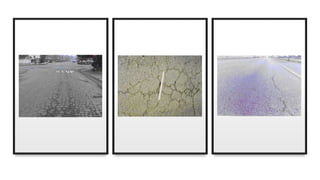
Fatigue (Alligator) Cracking
Description:
Series of interconnected cracks caused by fatigue failure of the
HMA surface (or stabilized base) under repeated traffic loading.
In thin pavements, cracking initiates at the bottom of the HMA
layer where the tensile stress is the highest then propagates to the
surface as one or more longitudinal cracks
 Problem:
Indicator of structural failure, cracks allow moisture infiltration
 Possible Causes:
• Decrease in pavement load supporting characteristics
Loss of base, subbase or subgrade support
(e.g., poor drainage or spring thaw resulting in a less stiff base).
• Increase in loading (e.g., more or heavier loads than anticipated in design)
• Inadequate structural design
• Poor construction (e.g., inadequate compaction)
Fatigue (Alligator) Cracking
 Repair:
• Small, localized fatigue cracking indicative of a loss of subgrade support.
Remove the cracked pavement area then dig out and replace the area of poor subgrade and
improve the drainage of that area if necessary. Patch over the repaired subgrade.
• Large fatigue cracked areas indicative of general structural failure.
Place an HMA overlay over the entire pavement surface. This overlay must be strong
enough structurally to carry the anticipated loading because the underlying fatigue cracked
pavement most likely contributes little or no strength
Fatigue (Alligator) Cracking
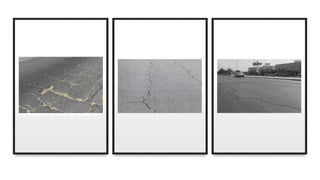
 Description:
• Interconnected cracks that divide the pavement up into rectangular pieces.
• Blocks range in size from approximately 0.1 m2 to 9 m2 .
• Larger blocks are generally classified as longitudinal and transverse
cracking.
• Block cracking normally occurs over a large portion of pavement area but
sometimes will occur only in non-traffic areas.
Block Cracking
 Possible Causes:
• HMA shrinkage and daily temperature cycling.
• Typically caused by an inability of asphalt binder to expand and contract
with temperature cycles because of:
 Asphalt binder aging
 Poor choice of asphalt binder in the mix design
Block Cracking
 Repair:
Strategies depend upon the severity and extent of the block cracking:
• Low severity cracks (< 1/2 inch wide). Crack seal to prevent:
1. entry of moisture into the subgrade through the cracks and
2. further ravelling of the crack edges. HMA can provide years of satisfactory
service after developing small cracks if they are kept sealed.
• High severity cracks (> 1/2 inch wide and cracks with ravelled edges).
Remove and replace the cracked pavement layer with an overlay.
Block Cracking
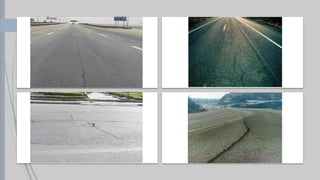
 Description:
Cracks parallel to the pavement's centreline or lay down direction. Usually a type of fatigue cracking.
 Possible Causes:
• Poor joint construction or location. Joints are generally the least dense areas of a
pavement. Therefore, they should be constructed outside of the wheel path so that they are
only infrequently loaded. Joints in the wheel path like those shown in third through fifth
figures above, will general fail prematurely.
• A reflective crack from an underlying layer (not including joint reflection cracking)
• HMA fatigue (indicates the onset of future alligator cracking)
• top-down cracking.
Longitudinal Cracking
 Repair: Strategies depend upon the severity and extent of the cracking:
• Low severity cracks (< 1/2 inch wide and infrequent cracks).
Crack seal to prevent:
1. entry of moisture into the subgrade through the cracks and
2. further ravelling of the crack edges. HMA can provide years of satisfactory
service after developing small cracks if they are kept sealed
• High severity cracks (> 1/2 inch wide and numerous cracks).
Remove and replace the cracked pavement layer with an overlay.
Longitudinal Cracking
 Description:
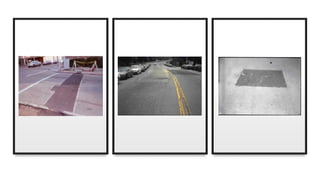
An area of pavement that has been replaced with new material to repair the existing
pavement.
• A patch is considered a defect no matter how well it performs.
 Problem:
Roughness
Possible Causes:
• Previous localized pavement deterioration that has been removed and patched
• Utility cuts
Patching
 Repair:
• Patches are themselves a repair action.
• The only way they can be removed from a pavement's
surface is by either a structural or non-structural overlay.
Patching
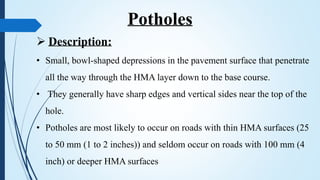
 Description:
• Small, bowl-shaped depressions in the pavement surface that penetrate
all the way through the HMA layer down to the base course.
• They generally have sharp edges and vertical sides near the top of the
hole.
• Potholes are most likely to occur on roads with thin HMA surfaces (25
to 50 mm (1 to 2 inches)) and seldom occur on roads with 100 mm (4
inch) or deeper HMA surfaces
Potholes
 Possible Causes:
• Generally, potholes are the end result of alligator cracking.
• As alligator cracking becomes severe, the interconnected cracks
create small chunks of pavement, which can be dislodged as
vehicles drive over them.
• The remaining hole after the pavement chunk is dislodged is called
a pothole.
Potholes
 Description:
• A form of plastic movement typified by ripples (corrugation) or an
abrupt wave (shoving) across the pavement surface.
• The distortion is perpendicular to the traffic direction.
• Usually occurs at points where traffic starts and stops (corrugation)
or areas where HMA abuts a rigid object (shoving).
Shoving
 Possible Causes:
Usually caused by traffic action (starting and stopping) combined with:
• An unstable (i.e. low stiffness) HMA layer (caused by mix
contamination, poor mix design, poor HMA manufacturing, or lack
of aeration of liquid asphalt emulsions)
• Excessive moisture in the subgrade.
Shoving
 Repair:
A heavily corrugated or shoved pavement should be investigated to
determine the root cause of failure. Repair strategies generally fall into
one of two categories:
• Small, localized areas of corrugation or shoving.
Remove the distorted pavement and patch.
• Large corrugated or shoved areas indicative of general HMA failure.
Remove the damaged pavement and overlay.
Shoving
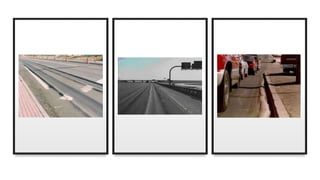
 Description:
• Surface depression in the wheel path. Pavement uplift (shearing) may
occur along the sides of the rut.
• Ruts are particularly evident after a rain when they are filled with water.
• There are two basic types of rutting: mix rutting and subgrade rutting.
• Mix rutting occurs when the subgrade does not rut yet the pavement
surface exhibits wheel path depressions as a result of compaction/mix
design problems.
Rutting
 Subgrade rutting occurs when the subgrade exhibits
wheel path depressions due to loading. In this case,
the pavement settles into the subgrade ruts causing
surface depressions in the wheel path.
Rutting
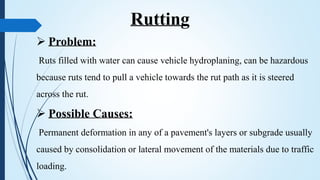
 Problem:
Ruts filled with water can cause vehicle hydroplaning, can be hazardous
because ruts tend to pull a vehicle towards the rut path as it is steered
across the rut.
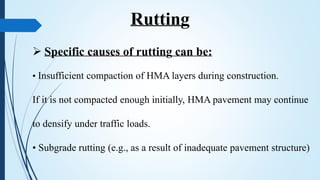
 Possible Causes:
Permanent deformation in any of a pavement's layers or subgrade usually
caused by consolidation or lateral movement of the materials due to traffic
loading.
Rutting
 Specific causes of rutting can be:
• Insufficient compaction of HMA layers during construction.
If it is not compacted enough initially, HMA pavement may continue
to densify under traffic loads.
• Subgrade rutting (e.g., as a result of inadequate pavement structure)
Rutting
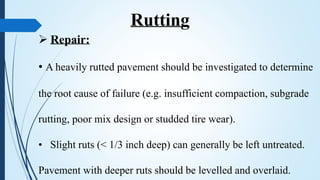
 Repair:
• A heavily rutted pavement should be investigated to determine
the root cause of failure (e.g. insufficient compaction, subgrade
rutting, poor mix design or studded tire wear).
• Slight ruts (< 1/3 inch deep) can generally be left untreated.
Pavement with deeper ruts should be levelled and overlaid.
Rutting
 Description:
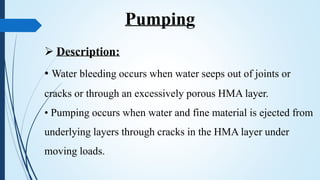
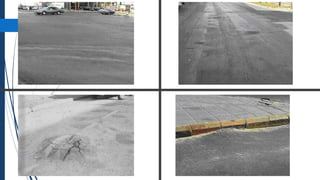
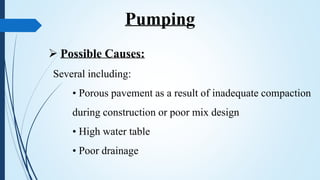
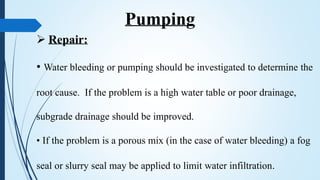
• Water bleeding occurs when water seeps out of joints or
cracks or through an excessively porous HMA layer.
• Pumping occurs when water and fine material is ejected from
underlying layers through cracks in the HMA layer under
moving loads.
Pumping
 Possible Causes:
Several including:
• Porous pavement as a result of inadequate compaction
during construction or poor mix design
• High water table
• Poor drainage
Pumping
 Repair:
• Water bleeding or pumping should be investigated to determine the
root cause. If the problem is a high water table or poor drainage,
subgrade drainage should be improved.
• If the problem is a porous mix (in the case of water bleeding) a fog
seal or slurry seal may be applied to limit water infiltration.
Pumping
 Description:
A film of asphalt binder on the pavement surface. It usually creates
a shiny, glass-like reflecting surface (as in the third photo) that can
become quite sticky.
 Problem:
Loss of skid resistance when wet.
Bleeding
 Possible Causes:
• Bleeding occurs when asphalt binder fills the aggregate voids
during hot weather and then expands onto the pavement surface.
• Since bleeding is not reversible during cold weather, asphalt
binder will accumulate on the pavement surface over time.
Bleeding
 This can be caused by one or a combination of the following:
• Excessive asphalt binder in the HMA (either due to mix
design or manufacturing)
• Excessive application of asphalt binder during BST
application (as in the above figures)
• Low HMA air void content (e.g., not enough room for
the asphalt to expand into during hot weather).
Bleeding
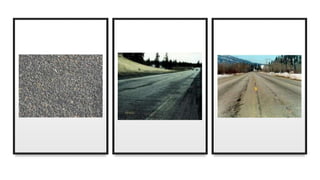
 Description:
The progressive disintegration of an HMA layer from the surface
downward as a result of the dislodgement of aggregate particles.
 Problem:
Loose debris on the pavement, roughness, water collecting in the
ravelled locations resulting in vehicle hydroplaning, loss of skid
resistance.
Raveling and Weathering
 Possible Causes: Several including:
• Loss of bond between aggregate particles and the asphalt binder as a
result of:
 A dust coating on the aggregate particles that forces the asphalt
binder to bond with the dust rather than the aggregate.
 Aggregate Segregation. If fine particles are missing from the
aggregate matrix, then the asphalt binder is only able to bind the
remaining coarse particles at their relatively few contact points.
Raveling and Weathering
• Inadequate compaction during construction.
• High density is required to develop sufficient cohesion
within the HMA.
Raveling and Weathering
Rigid
Pavement
Distress
Joint Seal Damage
 Description:
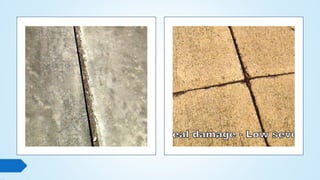
Any condition that enables incompressible foreign material such as soil
or rocks to accumulate in the joints or that allows infiltration of water.
 Problem:
Foreign materials prevents the slabs from expanding and may result in
buckling, shattering, or spalling.
 Possible Causes:
Joint seal damage is caused by improper joint width,
use of the wrong type of sealant, incorrect application,
not properly cleaning the joint before sealing, and/or
climate (aging).
Joint/Corner Spall
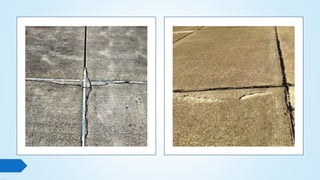
 Description:
Corner spalling is the raveling or breakdown of the slab within approximately 2
feet (0.6 m) of the corner. It differs from a corner break in that the spall usually
angles downward to intersect the joint, while a break extends vertically through
the slab.
 Problem:
Foreign materials prevents the slabs from expanding and may result in buckling,
shattering, or spalling
 Possible Causes:
Load repetitions combined with the loss of support, poor load
transfer across the joint, and thermal curling and moisture
warping stresses
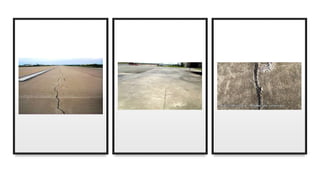
Mid-panel Cracks
 Description and cause:
Cracks in rigid pavements often result from stresses caused by expansion and contraction
or warping of the pavement. Overloading, loss of subgrade support, and insufficient
and/or improperly cut joints acting singly or in combination are also possible causes
 Discussion:
Low severity cracks are usually warping or friction related and are not considered major
structural distresses. Medium or high severity cracks are usually working cracks and are
considered major structural distresses. Hairline cracks that are only a few feet long and
do not extend across the entire slab are rated as shrinkage cracks.
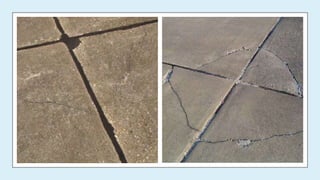
Corner break
 Description:
Corner breaks are characterized by a crack that intersects the joints at a distance less than or
equal to one-half of the slab length on both sides, measured from the corner of the slab. A
corner break differs from a corner spall in that the break extends vertically through the entire
slab thickness; a corner spall intersects the joint at an angle.
 Possible Cause :
Load repetition, combined with loss of support and curling stresses, usually causes cracks at
the slab corner. The lack of support may be caused by pumping or loss of load transfer at the
joint.
Shattered Slab
 Description:
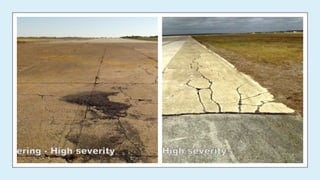
A shattered slab is defined as a slab where intersecting cracks break up
the slab into four or more pieces.
Possible Cause :
This is primarily caused by overloading due to traffic and/or
inadequate foundation support.
Patching
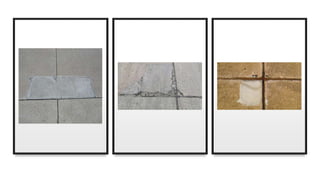
 Description and Possible Cause :
an area where the original pavement has been removed and replaced by a filler
material. Deterioration of a patch typically progresses at a higher rate than the
original pavement. Patching is usually divided into two types: n(a) Small. A small
patch is defined as an area less than 5 ft² (0.5 m²). n(b) Large and utility cuts. A
large patch is defined as an area greater than 5 ft² (0.5 m²). A utility cut is defined
as a patch that has replaced the original pavement due to placement of
underground utilities.
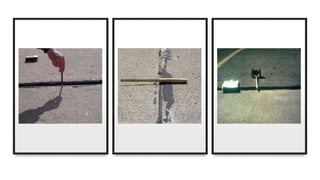
Faulting
 Description:
Settlement or faulting is a difference in elevation at a joint or crack
 Possible Cause :
caused by upheaval or non-uniform consolidation of the underlying
pavement layer(s) material. This condition may result from loss of
fines, frost heave, or swelling soils.
Thank you

Distress in Pavement Full.pptx

  • 1.
    University of Jordan Facultyof Engineering &Technology Department of Engineering Pavement Design Distress in Flexible & Rigid Pavement Instructor: Prof. Adli H. Al-Balbissi Students: Hakam Al-Ramoni & Aws Al-Ott
  • 2.
  • 3.
    Fatigue (Alligator) Cracking Description: Seriesof interconnected cracks caused by fatigue failure of the HMA surface (or stabilized base) under repeated traffic loading. In thin pavements, cracking initiates at the bottom of the HMA layer where the tensile stress is the highest then propagates to the surface as one or more longitudinal cracks
  • 5.
     Problem: Indicator ofstructural failure, cracks allow moisture infiltration  Possible Causes: • Decrease in pavement load supporting characteristics Loss of base, subbase or subgrade support (e.g., poor drainage or spring thaw resulting in a less stiff base). • Increase in loading (e.g., more or heavier loads than anticipated in design) • Inadequate structural design • Poor construction (e.g., inadequate compaction) Fatigue (Alligator) Cracking
  • 6.
     Repair: • Small,localized fatigue cracking indicative of a loss of subgrade support. Remove the cracked pavement area then dig out and replace the area of poor subgrade and improve the drainage of that area if necessary. Patch over the repaired subgrade. • Large fatigue cracked areas indicative of general structural failure. Place an HMA overlay over the entire pavement surface. This overlay must be strong enough structurally to carry the anticipated loading because the underlying fatigue cracked pavement most likely contributes little or no strength Fatigue (Alligator) Cracking
  • 7.
     Description: • Interconnectedcracks that divide the pavement up into rectangular pieces. • Blocks range in size from approximately 0.1 m2 to 9 m2 . • Larger blocks are generally classified as longitudinal and transverse cracking. • Block cracking normally occurs over a large portion of pavement area but sometimes will occur only in non-traffic areas. Block Cracking
  • 9.
     Possible Causes: •HMA shrinkage and daily temperature cycling. • Typically caused by an inability of asphalt binder to expand and contract with temperature cycles because of:  Asphalt binder aging  Poor choice of asphalt binder in the mix design Block Cracking
  • 10.
     Repair: Strategies dependupon the severity and extent of the block cracking: • Low severity cracks (< 1/2 inch wide). Crack seal to prevent: 1. entry of moisture into the subgrade through the cracks and 2. further ravelling of the crack edges. HMA can provide years of satisfactory service after developing small cracks if they are kept sealed. • High severity cracks (> 1/2 inch wide and cracks with ravelled edges). Remove and replace the cracked pavement layer with an overlay. Block Cracking
  • 11.
     Description: Cracks parallelto the pavement's centreline or lay down direction. Usually a type of fatigue cracking.  Possible Causes: • Poor joint construction or location. Joints are generally the least dense areas of a pavement. Therefore, they should be constructed outside of the wheel path so that they are only infrequently loaded. Joints in the wheel path like those shown in third through fifth figures above, will general fail prematurely. • A reflective crack from an underlying layer (not including joint reflection cracking) • HMA fatigue (indicates the onset of future alligator cracking) • top-down cracking. Longitudinal Cracking
  • 13.
     Repair: Strategiesdepend upon the severity and extent of the cracking: • Low severity cracks (< 1/2 inch wide and infrequent cracks). Crack seal to prevent: 1. entry of moisture into the subgrade through the cracks and 2. further ravelling of the crack edges. HMA can provide years of satisfactory service after developing small cracks if they are kept sealed • High severity cracks (> 1/2 inch wide and numerous cracks). Remove and replace the cracked pavement layer with an overlay. Longitudinal Cracking
  • 14.
     Description: An areaof pavement that has been replaced with new material to repair the existing pavement. • A patch is considered a defect no matter how well it performs.  Problem: Roughness Possible Causes: • Previous localized pavement deterioration that has been removed and patched • Utility cuts Patching
  • 16.
     Repair: • Patchesare themselves a repair action. • The only way they can be removed from a pavement's surface is by either a structural or non-structural overlay. Patching
  • 17.
     Description: • Small,bowl-shaped depressions in the pavement surface that penetrate all the way through the HMA layer down to the base course. • They generally have sharp edges and vertical sides near the top of the hole. • Potholes are most likely to occur on roads with thin HMA surfaces (25 to 50 mm (1 to 2 inches)) and seldom occur on roads with 100 mm (4 inch) or deeper HMA surfaces Potholes
  • 19.
     Possible Causes: •Generally, potholes are the end result of alligator cracking. • As alligator cracking becomes severe, the interconnected cracks create small chunks of pavement, which can be dislodged as vehicles drive over them. • The remaining hole after the pavement chunk is dislodged is called a pothole. Potholes
  • 20.
     Description: • Aform of plastic movement typified by ripples (corrugation) or an abrupt wave (shoving) across the pavement surface. • The distortion is perpendicular to the traffic direction. • Usually occurs at points where traffic starts and stops (corrugation) or areas where HMA abuts a rigid object (shoving). Shoving
  • 22.
     Possible Causes: Usuallycaused by traffic action (starting and stopping) combined with: • An unstable (i.e. low stiffness) HMA layer (caused by mix contamination, poor mix design, poor HMA manufacturing, or lack of aeration of liquid asphalt emulsions) • Excessive moisture in the subgrade. Shoving
  • 23.
     Repair: A heavilycorrugated or shoved pavement should be investigated to determine the root cause of failure. Repair strategies generally fall into one of two categories: • Small, localized areas of corrugation or shoving. Remove the distorted pavement and patch. • Large corrugated or shoved areas indicative of general HMA failure. Remove the damaged pavement and overlay. Shoving
  • 24.
     Description: • Surfacedepression in the wheel path. Pavement uplift (shearing) may occur along the sides of the rut. • Ruts are particularly evident after a rain when they are filled with water. • There are two basic types of rutting: mix rutting and subgrade rutting. • Mix rutting occurs when the subgrade does not rut yet the pavement surface exhibits wheel path depressions as a result of compaction/mix design problems. Rutting
  • 25.
     Subgrade ruttingoccurs when the subgrade exhibits wheel path depressions due to loading. In this case, the pavement settles into the subgrade ruts causing surface depressions in the wheel path. Rutting
  • 27.
     Problem: Ruts filledwith water can cause vehicle hydroplaning, can be hazardous because ruts tend to pull a vehicle towards the rut path as it is steered across the rut.  Possible Causes: Permanent deformation in any of a pavement's layers or subgrade usually caused by consolidation or lateral movement of the materials due to traffic loading. Rutting
  • 28.
     Specific causesof rutting can be: • Insufficient compaction of HMA layers during construction. If it is not compacted enough initially, HMA pavement may continue to densify under traffic loads. • Subgrade rutting (e.g., as a result of inadequate pavement structure) Rutting
  • 29.
     Repair: • Aheavily rutted pavement should be investigated to determine the root cause of failure (e.g. insufficient compaction, subgrade rutting, poor mix design or studded tire wear). • Slight ruts (< 1/3 inch deep) can generally be left untreated. Pavement with deeper ruts should be levelled and overlaid. Rutting
  • 30.
     Description: • Waterbleeding occurs when water seeps out of joints or cracks or through an excessively porous HMA layer. • Pumping occurs when water and fine material is ejected from underlying layers through cracks in the HMA layer under moving loads. Pumping
  • 32.
     Possible Causes: Severalincluding: • Porous pavement as a result of inadequate compaction during construction or poor mix design • High water table • Poor drainage Pumping
  • 33.
     Repair: • Waterbleeding or pumping should be investigated to determine the root cause. If the problem is a high water table or poor drainage, subgrade drainage should be improved. • If the problem is a porous mix (in the case of water bleeding) a fog seal or slurry seal may be applied to limit water infiltration. Pumping
  • 34.
     Description: A filmof asphalt binder on the pavement surface. It usually creates a shiny, glass-like reflecting surface (as in the third photo) that can become quite sticky.  Problem: Loss of skid resistance when wet. Bleeding
  • 35.
     Possible Causes: •Bleeding occurs when asphalt binder fills the aggregate voids during hot weather and then expands onto the pavement surface. • Since bleeding is not reversible during cold weather, asphalt binder will accumulate on the pavement surface over time. Bleeding
  • 36.
     This canbe caused by one or a combination of the following: • Excessive asphalt binder in the HMA (either due to mix design or manufacturing) • Excessive application of asphalt binder during BST application (as in the above figures) • Low HMA air void content (e.g., not enough room for the asphalt to expand into during hot weather). Bleeding
  • 37.
     Description: The progressivedisintegration of an HMA layer from the surface downward as a result of the dislodgement of aggregate particles.  Problem: Loose debris on the pavement, roughness, water collecting in the ravelled locations resulting in vehicle hydroplaning, loss of skid resistance. Raveling and Weathering
  • 39.
     Possible Causes:Several including: • Loss of bond between aggregate particles and the asphalt binder as a result of:  A dust coating on the aggregate particles that forces the asphalt binder to bond with the dust rather than the aggregate.  Aggregate Segregation. If fine particles are missing from the aggregate matrix, then the asphalt binder is only able to bind the remaining coarse particles at their relatively few contact points. Raveling and Weathering
  • 40.
    • Inadequate compactionduring construction. • High density is required to develop sufficient cohesion within the HMA. Raveling and Weathering
  • 41.
  • 42.
    Joint Seal Damage Description: Any condition that enables incompressible foreign material such as soil or rocks to accumulate in the joints or that allows infiltration of water.  Problem: Foreign materials prevents the slabs from expanding and may result in buckling, shattering, or spalling.
  • 44.
     Possible Causes: Jointseal damage is caused by improper joint width, use of the wrong type of sealant, incorrect application, not properly cleaning the joint before sealing, and/or climate (aging).
  • 45.
    Joint/Corner Spall  Description: Cornerspalling is the raveling or breakdown of the slab within approximately 2 feet (0.6 m) of the corner. It differs from a corner break in that the spall usually angles downward to intersect the joint, while a break extends vertically through the slab.  Problem: Foreign materials prevents the slabs from expanding and may result in buckling, shattering, or spalling
  • 47.
     Possible Causes: Loadrepetitions combined with the loss of support, poor load transfer across the joint, and thermal curling and moisture warping stresses
  • 48.
    Mid-panel Cracks  Descriptionand cause: Cracks in rigid pavements often result from stresses caused by expansion and contraction or warping of the pavement. Overloading, loss of subgrade support, and insufficient and/or improperly cut joints acting singly or in combination are also possible causes  Discussion: Low severity cracks are usually warping or friction related and are not considered major structural distresses. Medium or high severity cracks are usually working cracks and are considered major structural distresses. Hairline cracks that are only a few feet long and do not extend across the entire slab are rated as shrinkage cracks.
  • 50.
    Corner break  Description: Cornerbreaks are characterized by a crack that intersects the joints at a distance less than or equal to one-half of the slab length on both sides, measured from the corner of the slab. A corner break differs from a corner spall in that the break extends vertically through the entire slab thickness; a corner spall intersects the joint at an angle.  Possible Cause : Load repetition, combined with loss of support and curling stresses, usually causes cracks at the slab corner. The lack of support may be caused by pumping or loss of load transfer at the joint.
  • 52.
    Shattered Slab  Description: Ashattered slab is defined as a slab where intersecting cracks break up the slab into four or more pieces. Possible Cause : This is primarily caused by overloading due to traffic and/or inadequate foundation support.
  • 54.
    Patching  Description andPossible Cause : an area where the original pavement has been removed and replaced by a filler material. Deterioration of a patch typically progresses at a higher rate than the original pavement. Patching is usually divided into two types: n(a) Small. A small patch is defined as an area less than 5 ft² (0.5 m²). n(b) Large and utility cuts. A large patch is defined as an area greater than 5 ft² (0.5 m²). A utility cut is defined as a patch that has replaced the original pavement due to placement of underground utilities.
  • 56.
    Faulting  Description: Settlement orfaulting is a difference in elevation at a joint or crack  Possible Cause : caused by upheaval or non-uniform consolidation of the underlying pavement layer(s) material. This condition may result from loss of fines, frost heave, or swelling soils.
  • 58.