.
A Seminar presentation
on
Methods of Dewatering
On Construction Site
By
Gaikwad A. A.
Guide: Ms. Pujari P.D. .
CONTENTS
 Introduction
 Lesson Objective
 Purpose of Dewatering
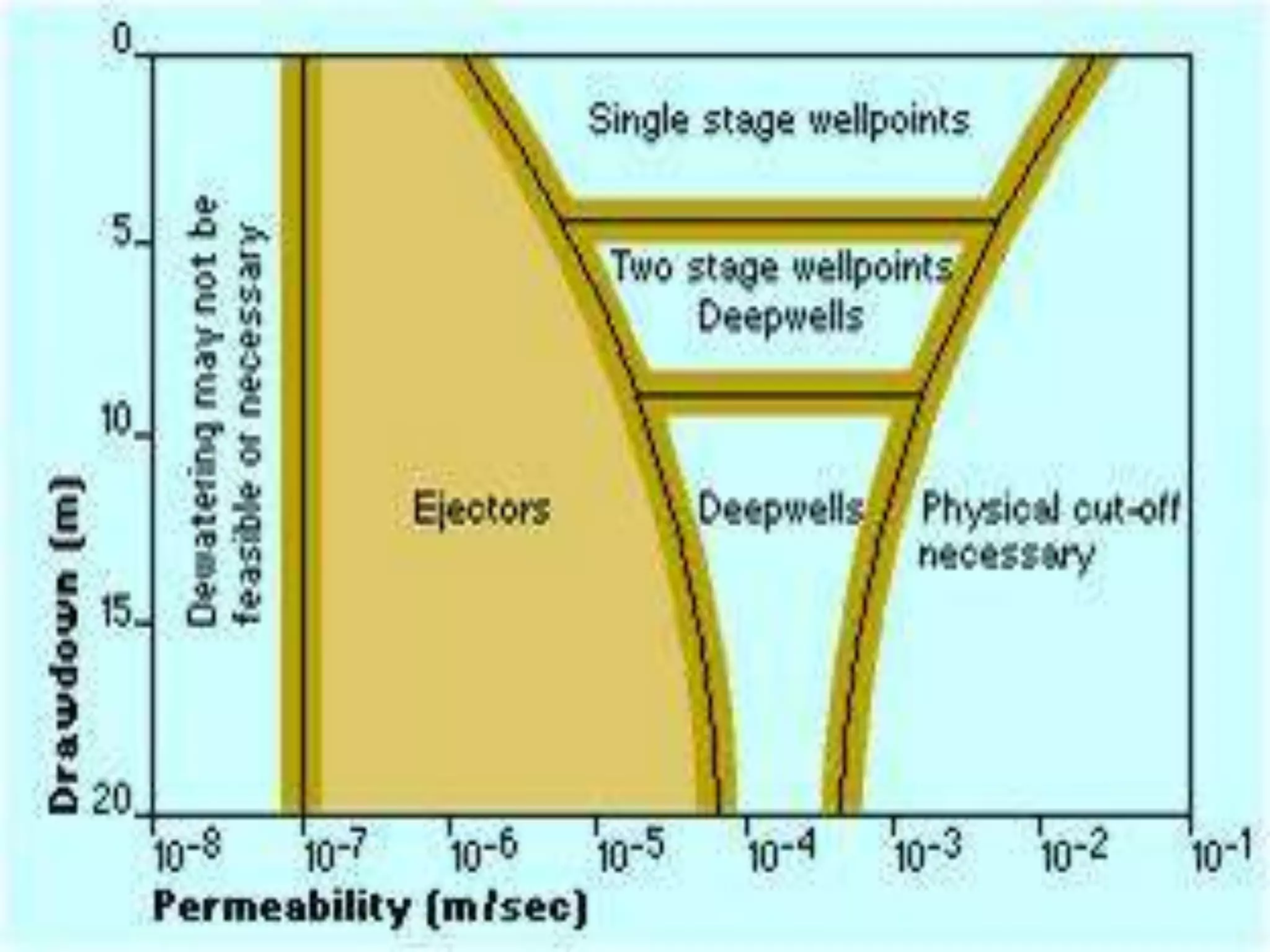
 Factors controlling Selection
 Methods of Dewatering
 Conclusion
.
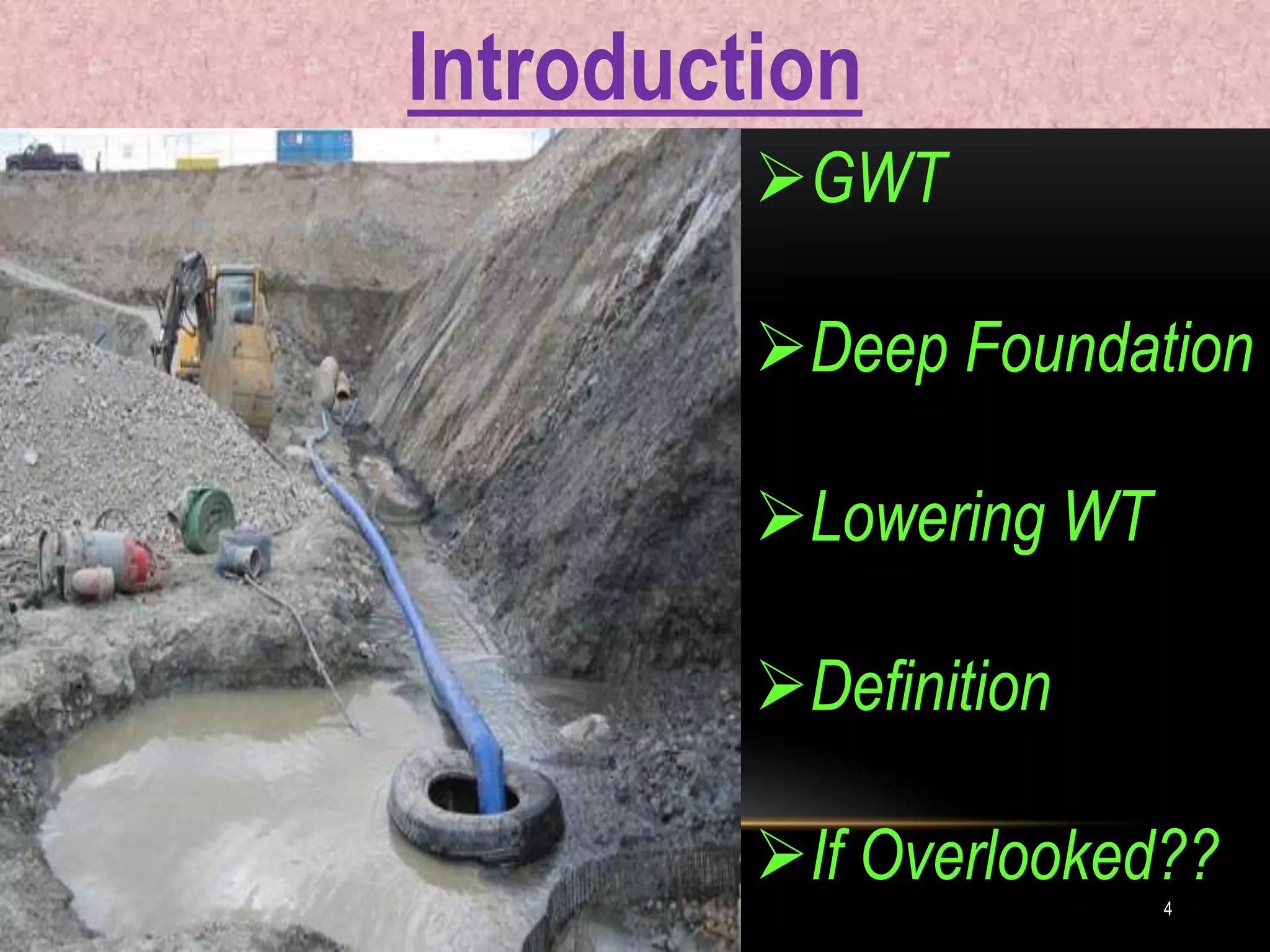
Introduction
4
GWT
Deep Foundation
Lowering WT
Definition
If Overlooked??
Lesson Objective
5
To know the concept of Dewatering
 To know Importance of Dewatering
 To know various Methods of Dewatering
6
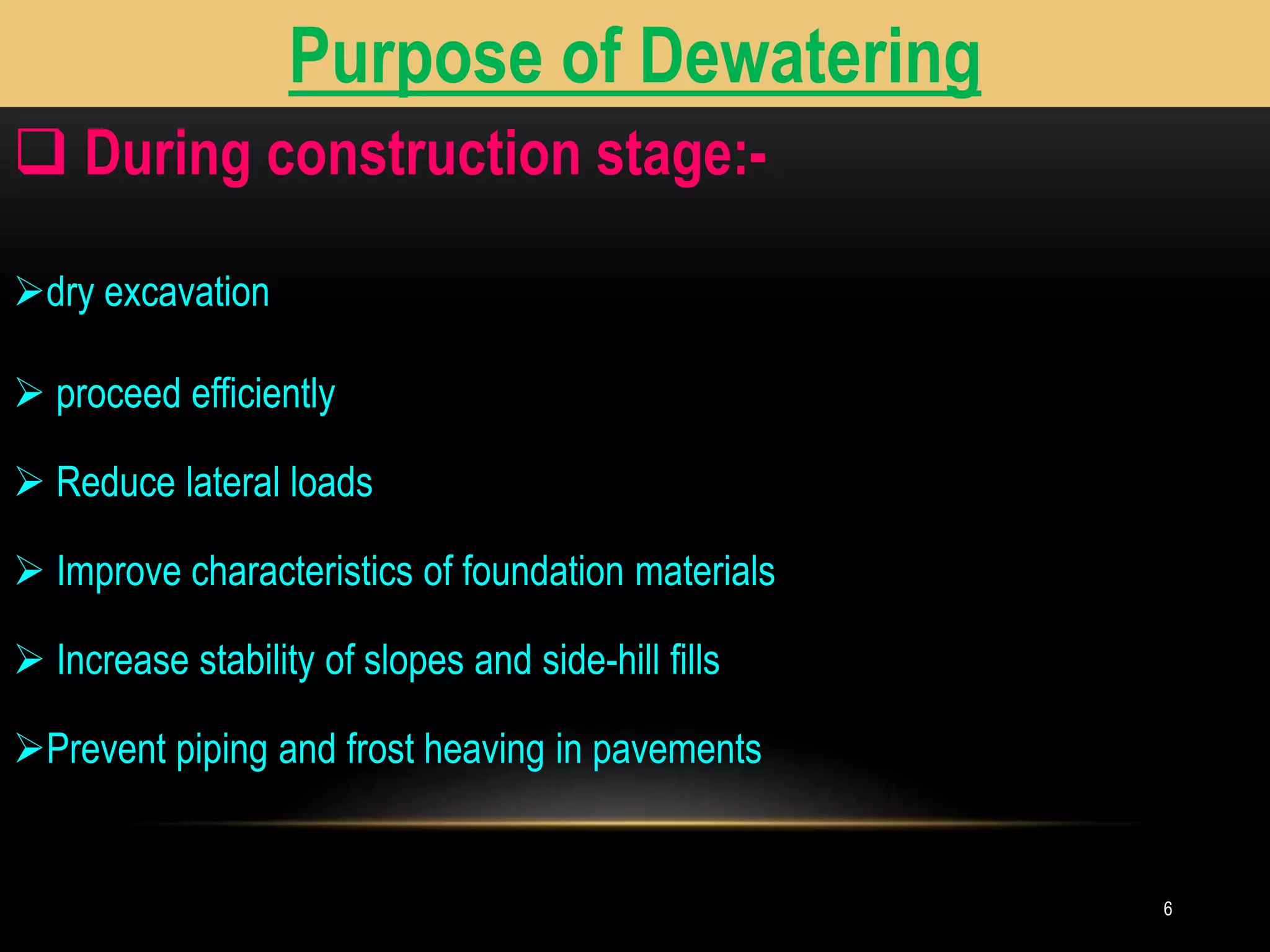
Purpose of Dewatering
 During construction stage:-
dry excavation
 proceed efficiently
 Reduce lateral loads
 Improve characteristics of foundation materials
 Increase stability of slopes and side-hill fills
Prevent piping and frost heaving in pavements
77
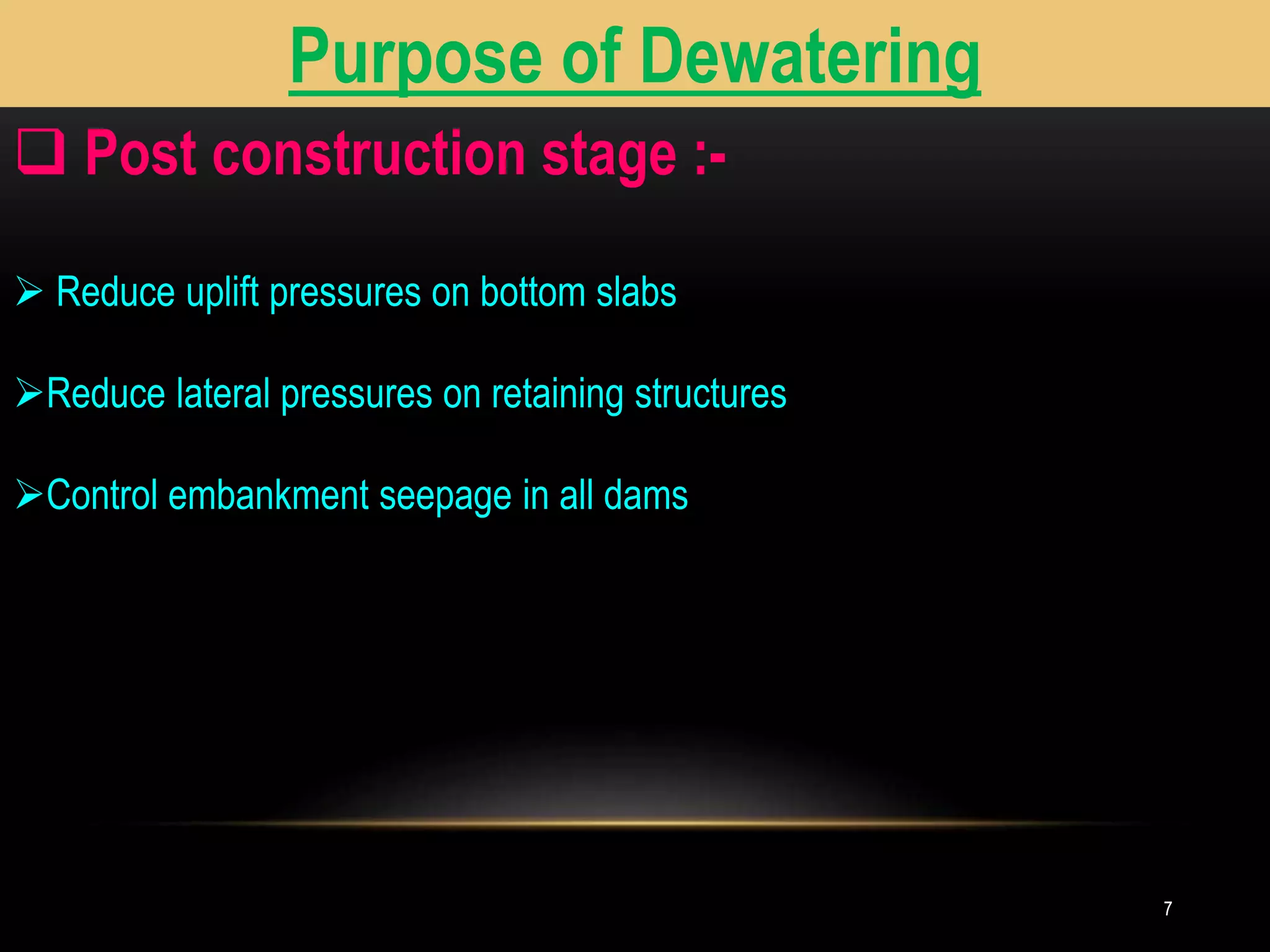
Purpose of Dewatering
 Post construction stage :-
 Reduce uplift pressures on bottom slabs
Reduce lateral pressures on retaining structures
Control embankment seepage in all dams
Purpose of Dewatering
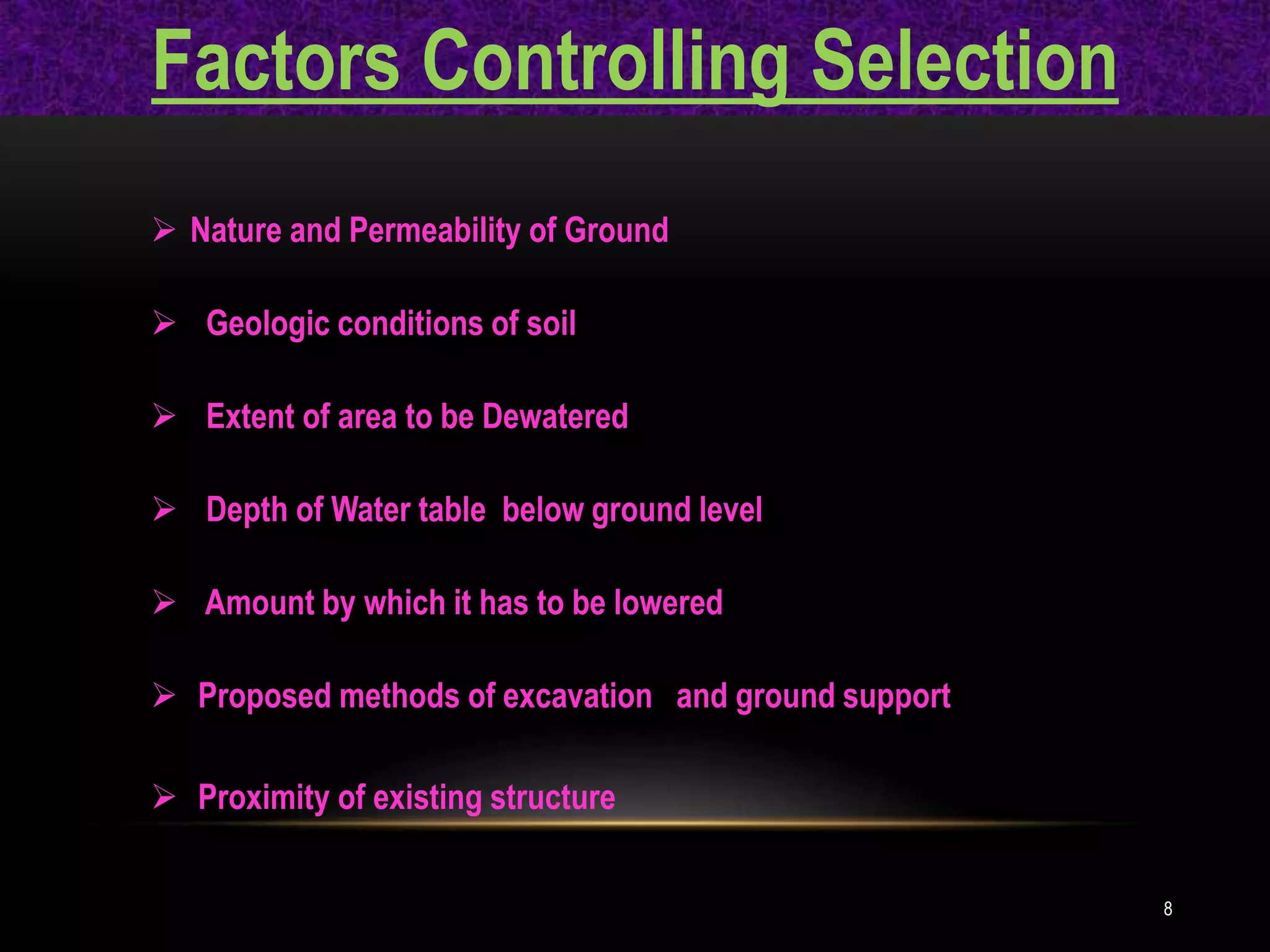
Factors Controlling Selection
 Nature and Permeability of Ground
 Geologic conditions of soil
 Extent of area to be Dewatered
 Depth of Water table below ground level
 Amount by which it has to be lowered
 Proposed methods of excavation and ground support
 Proximity of existing structure
8
9
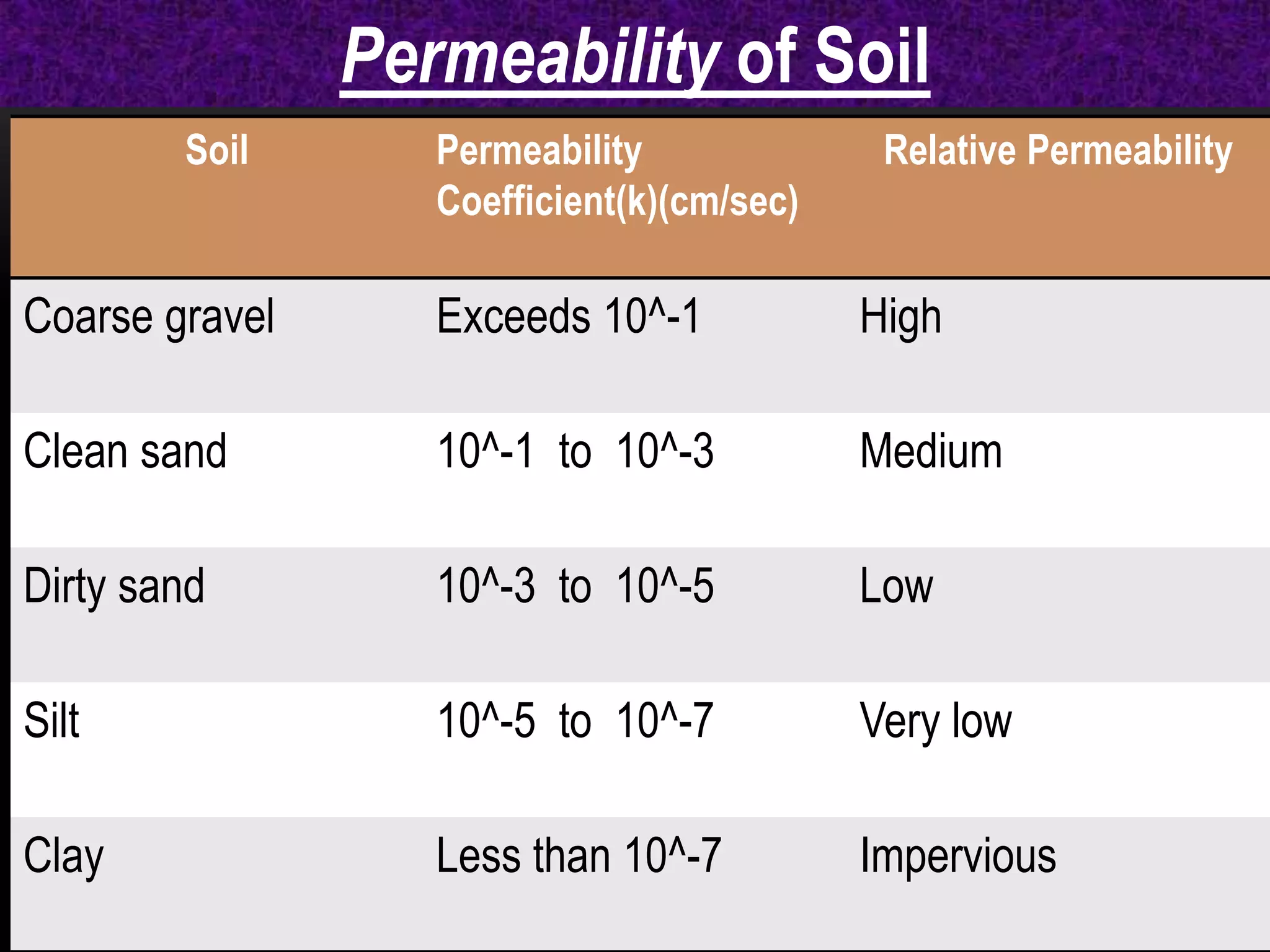
Soil Permeability
Coefficient(k)(cm/sec)
Relative Permeability
Coarse gravel Exceeds 10^-1 High
Clean sand 10^-1 to 10^-3 Medium
Dirty sand 10^-3 to 10^-5 Low
Silt 10^-5 to 10^-7 Very low
Clay Less than 10^-7 Impervious
Permeability of Soil
10
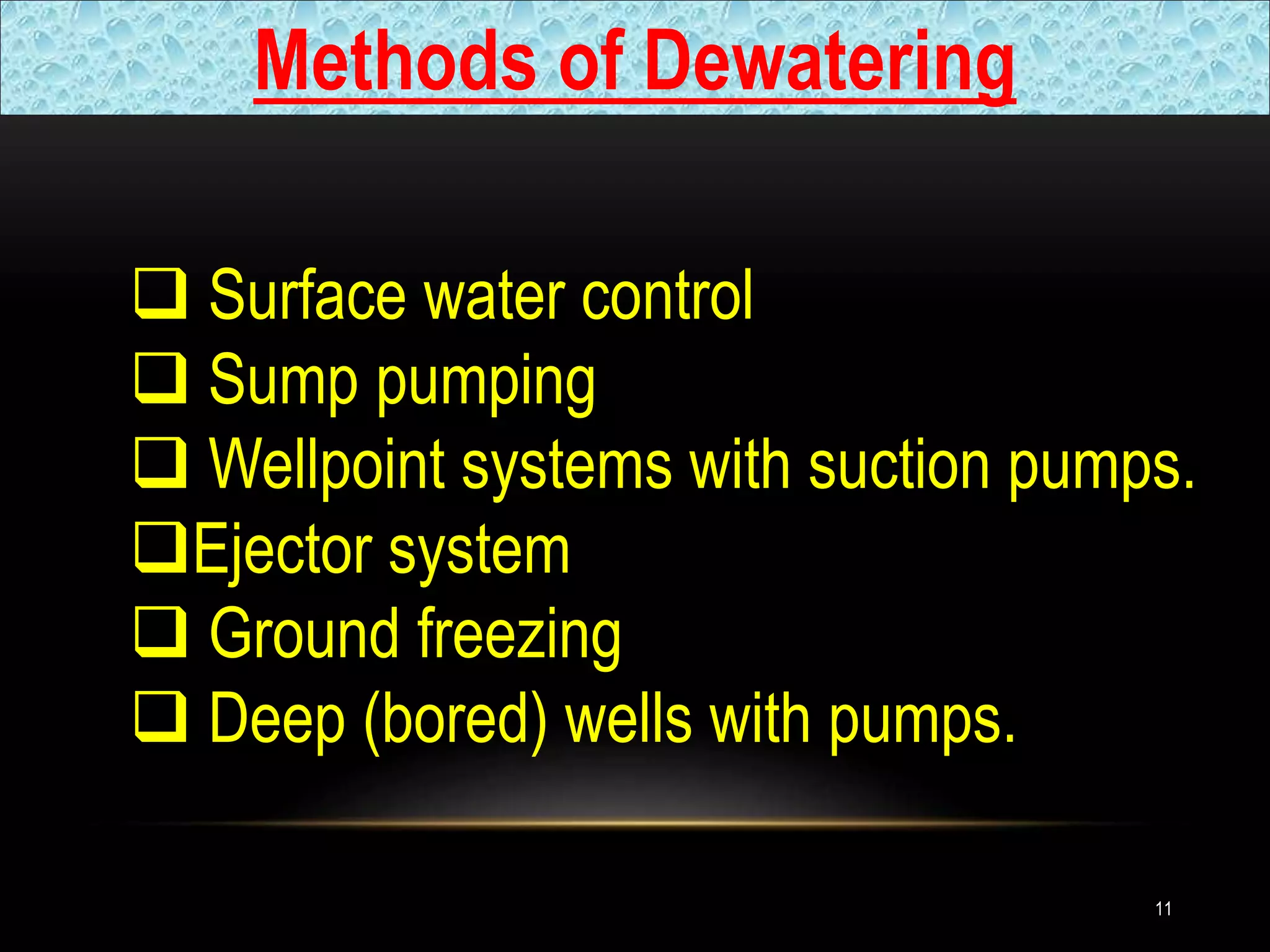
Methods of Dewatering
 Surface water control
 Sump pumping
 Wellpoint systems with suction pumps.
Ejector system
 Ground freezing
 Deep (bored) wells with pumps.
11
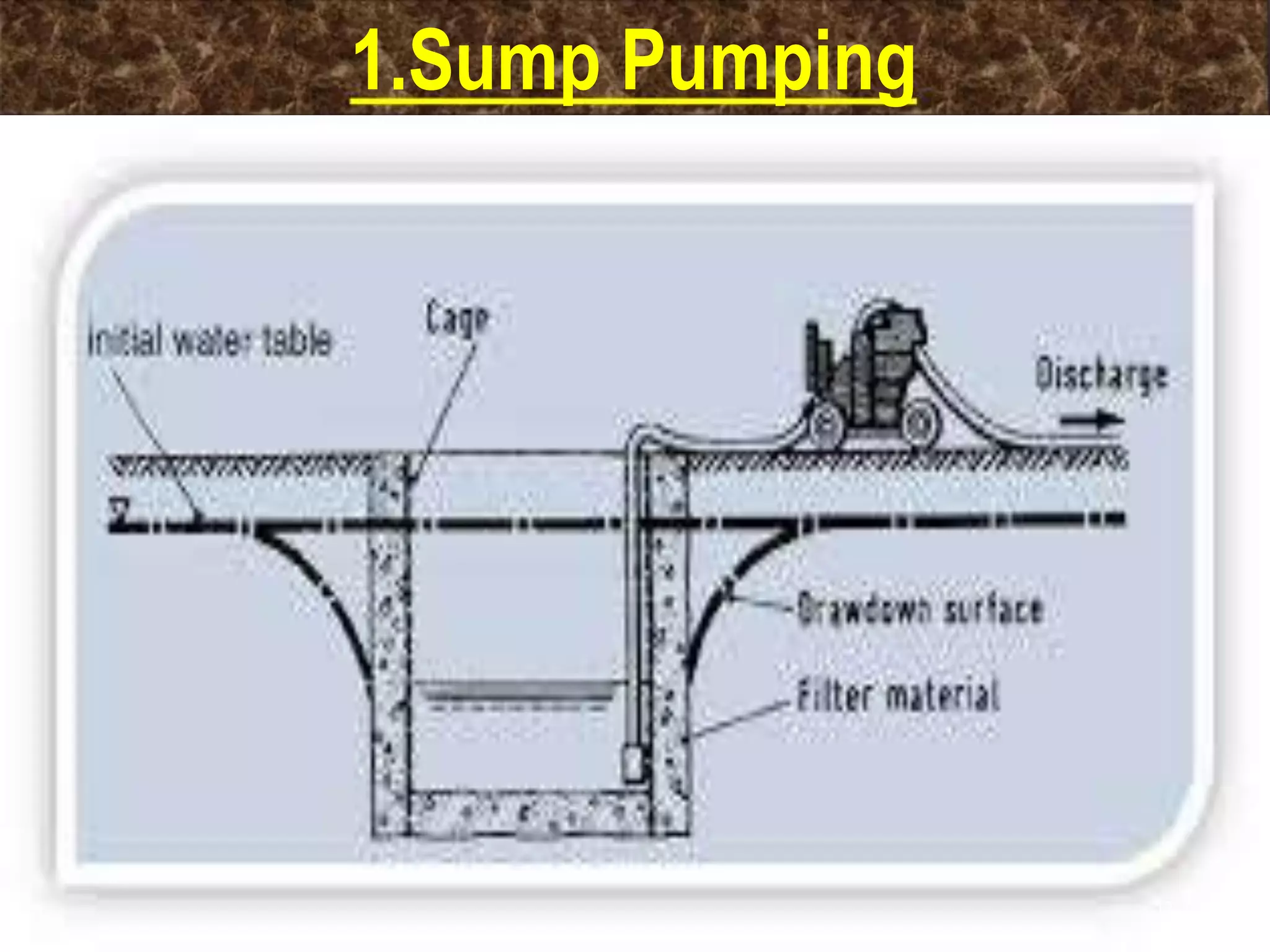
1.Sump Pumping
12
13
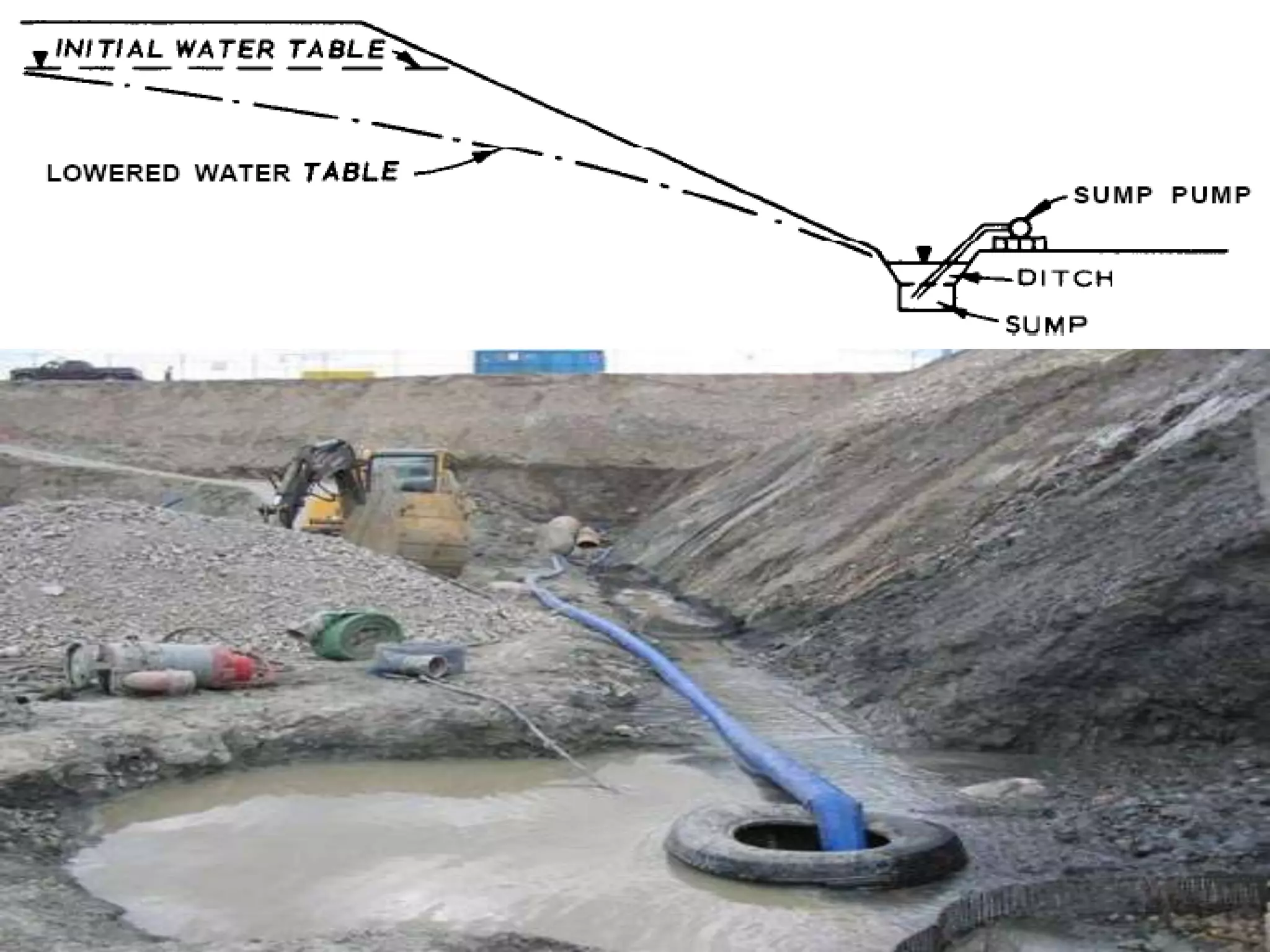
1.Sump Pumping
 What is Sump?
 Slope
 Pump
 Fines
 Lined
14
15
 Widely used method
 Most economical method for installation and maintenance
 Can be applied for most soil and rock conditions
 Most appropriate where boulders or massive obstructions
j are met with in the ground
Advantages of Open Sump and Ditches
1616
 Due to more flow of GW towards excavation risk of
collapse of sides occurs.
In open or timbered excavations there is risk of
instability of the base due to seepage towards pumping
sump.
Note:- Greatest depth to which the water table can be
lowered by this method is about 8 m below the pump.
Disadvantages of Open Sump and Ditches
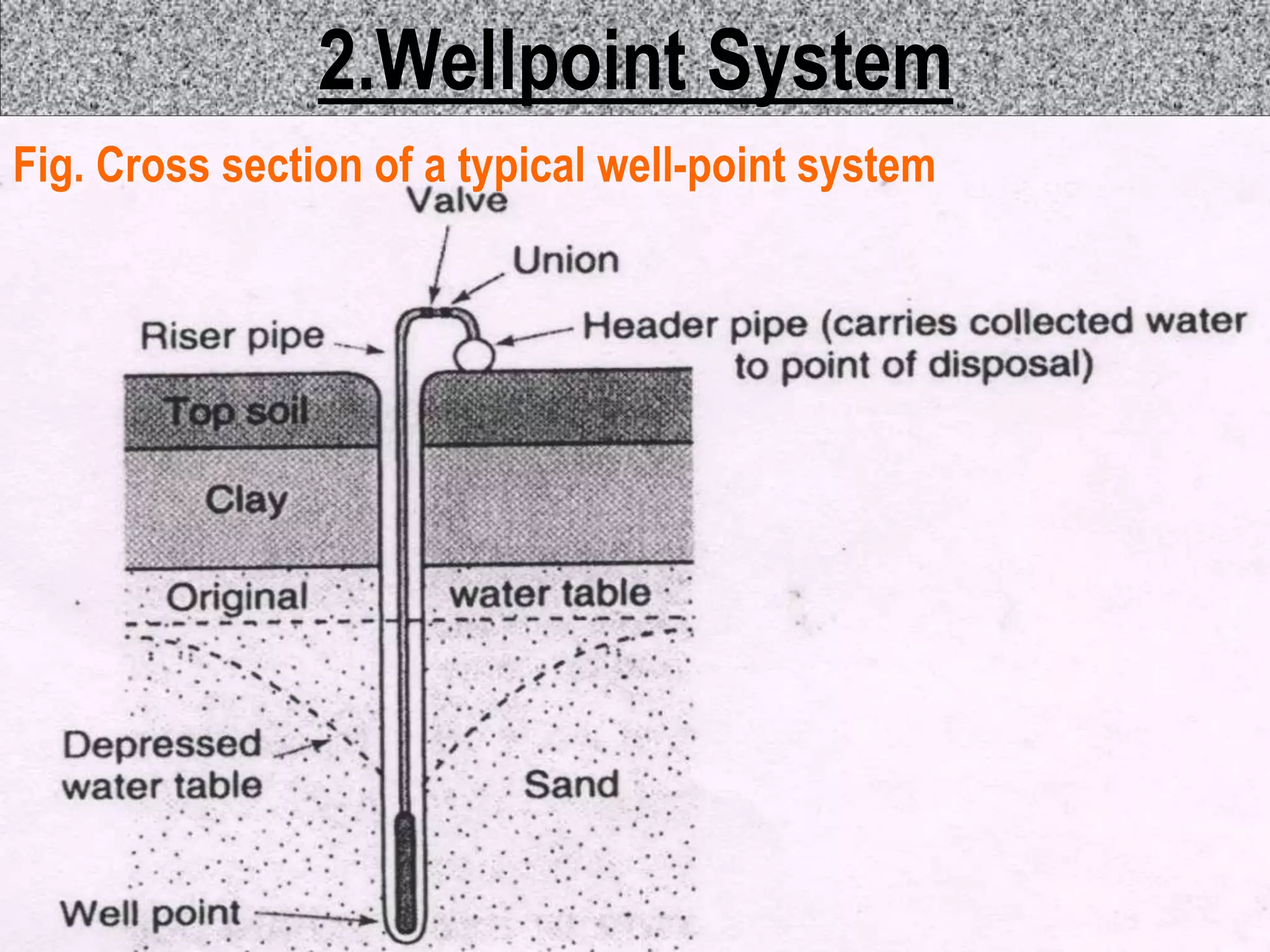
2.Wellpoint System
17
Fig. Cross section of a typical well-point system
18
2.Wellpoint System
 Perforated Well
 Material
 Sandy
 Foot – Orifice
 Series of Closely Placed
 Dimension
 Spacing
 Construction steps
1919
2.Wellpoint System
19
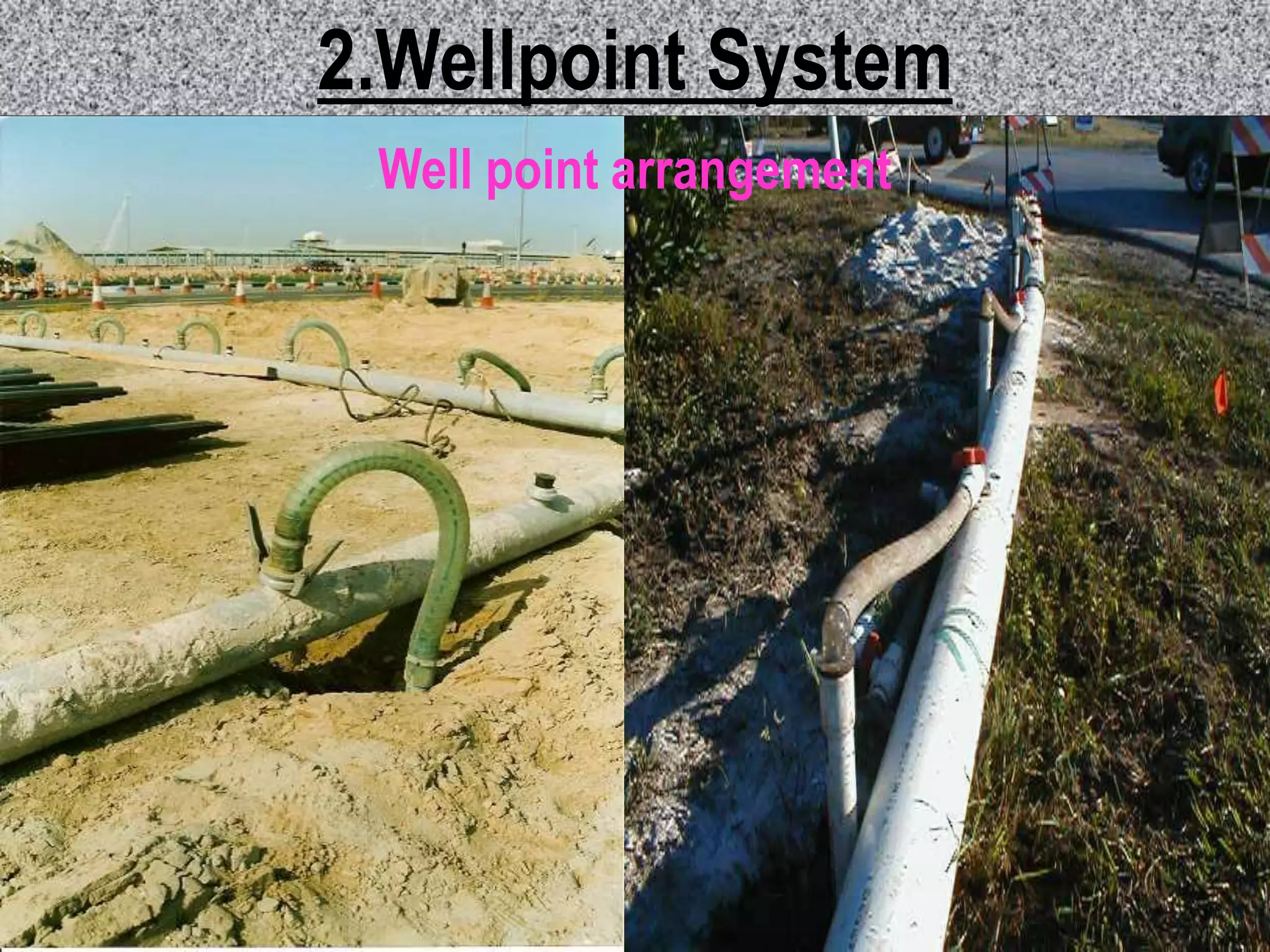
Well point arrangement
20
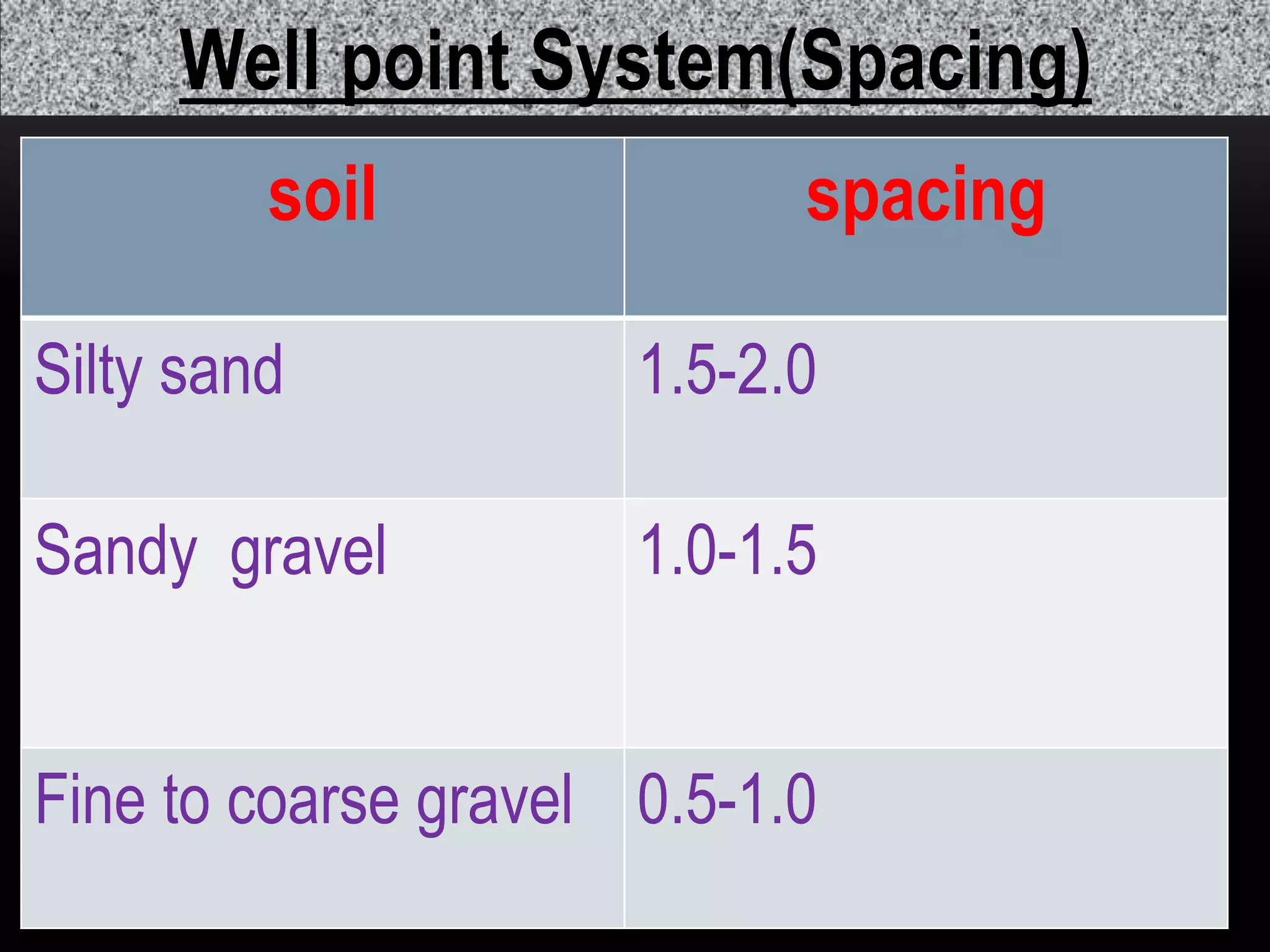
Well point System(Spacing)
soil spacing
Silty sand 1.5-2.0
Sandy gravel 1.0-1.5
Fine to coarse gravel 0.5-1.0
21
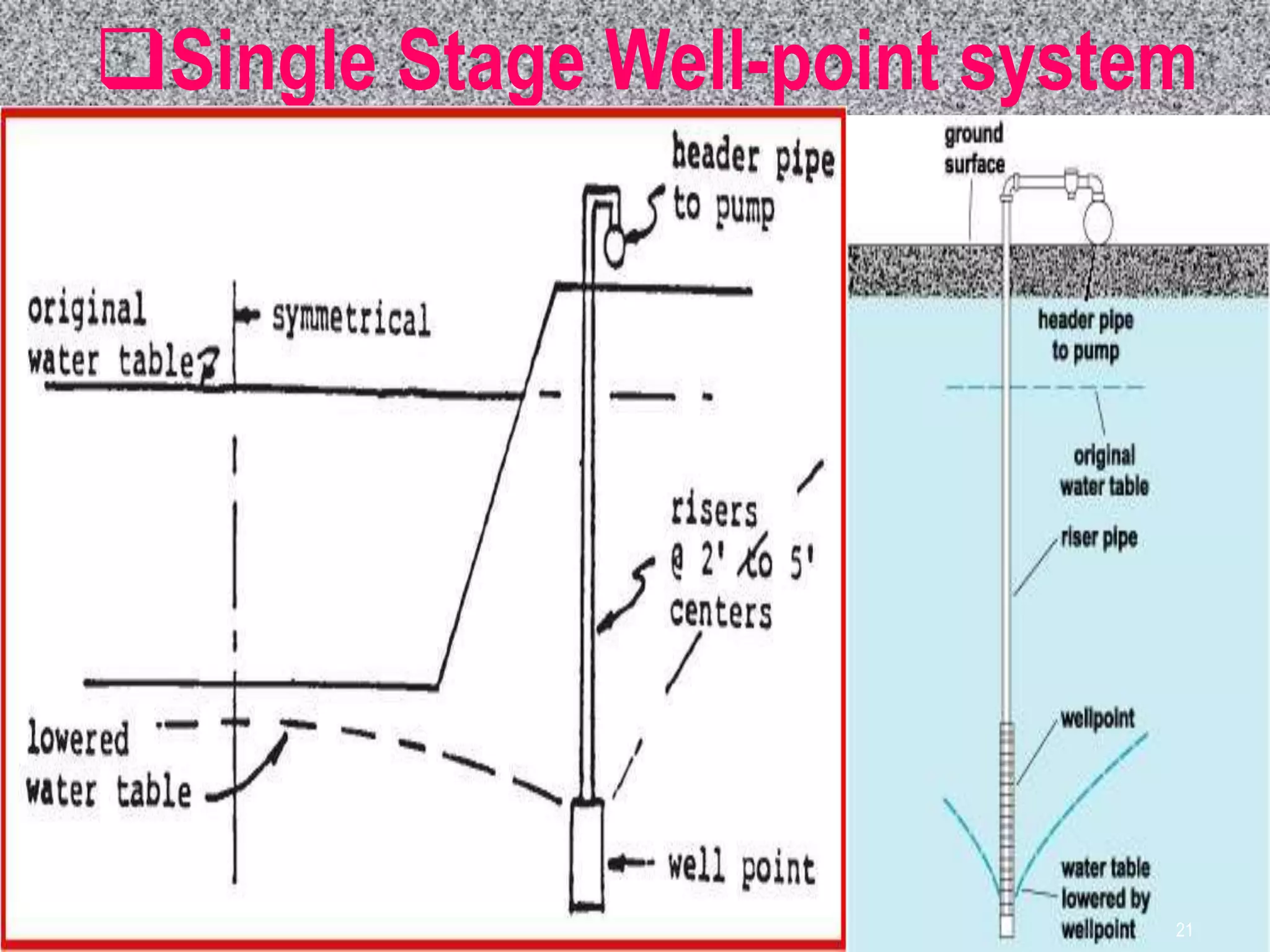
Single Stage Well-point system
21
22
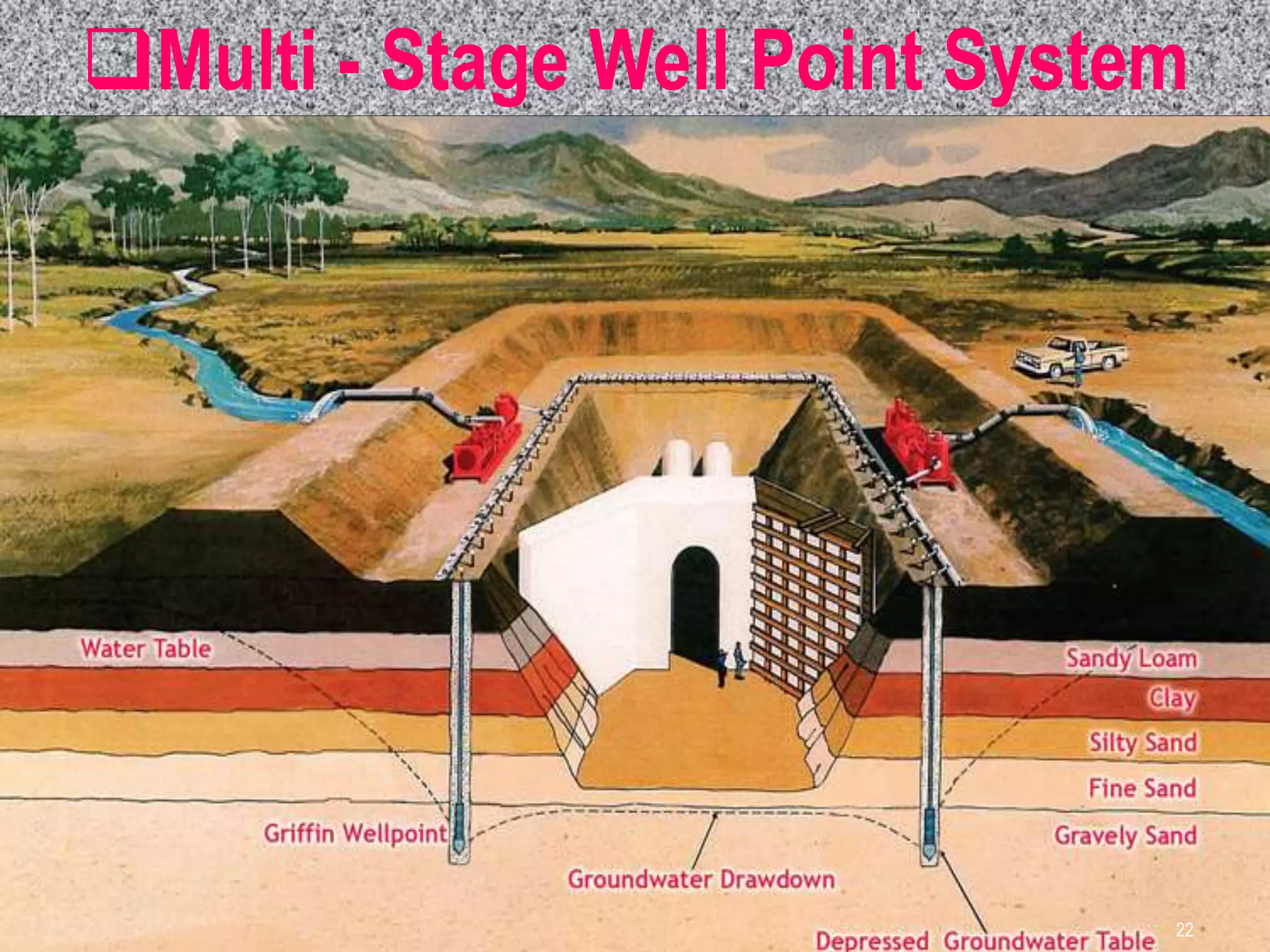
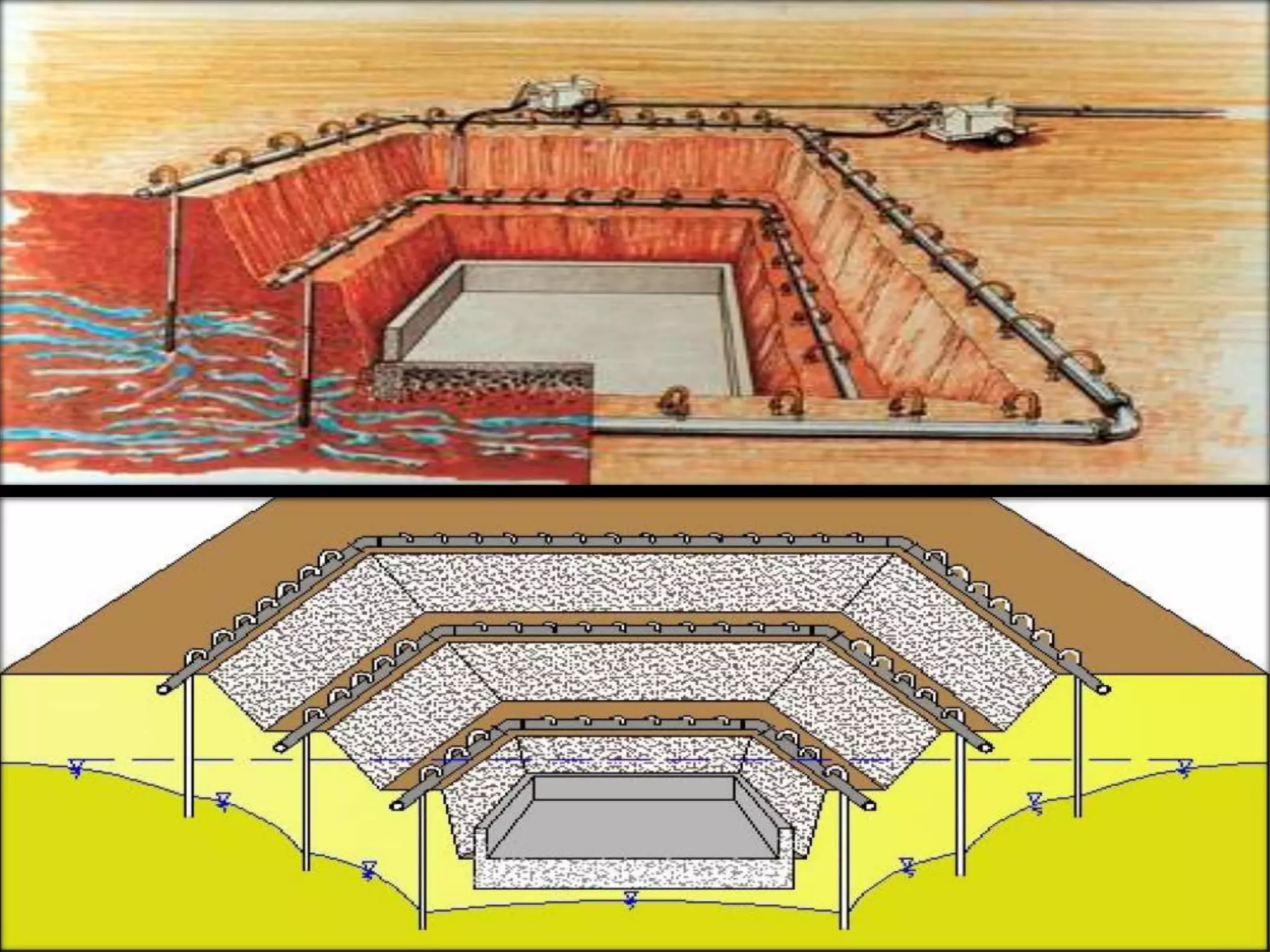
Multi - Stage Well Point System
22
2323
Multi - Stage Well Point System
23
24
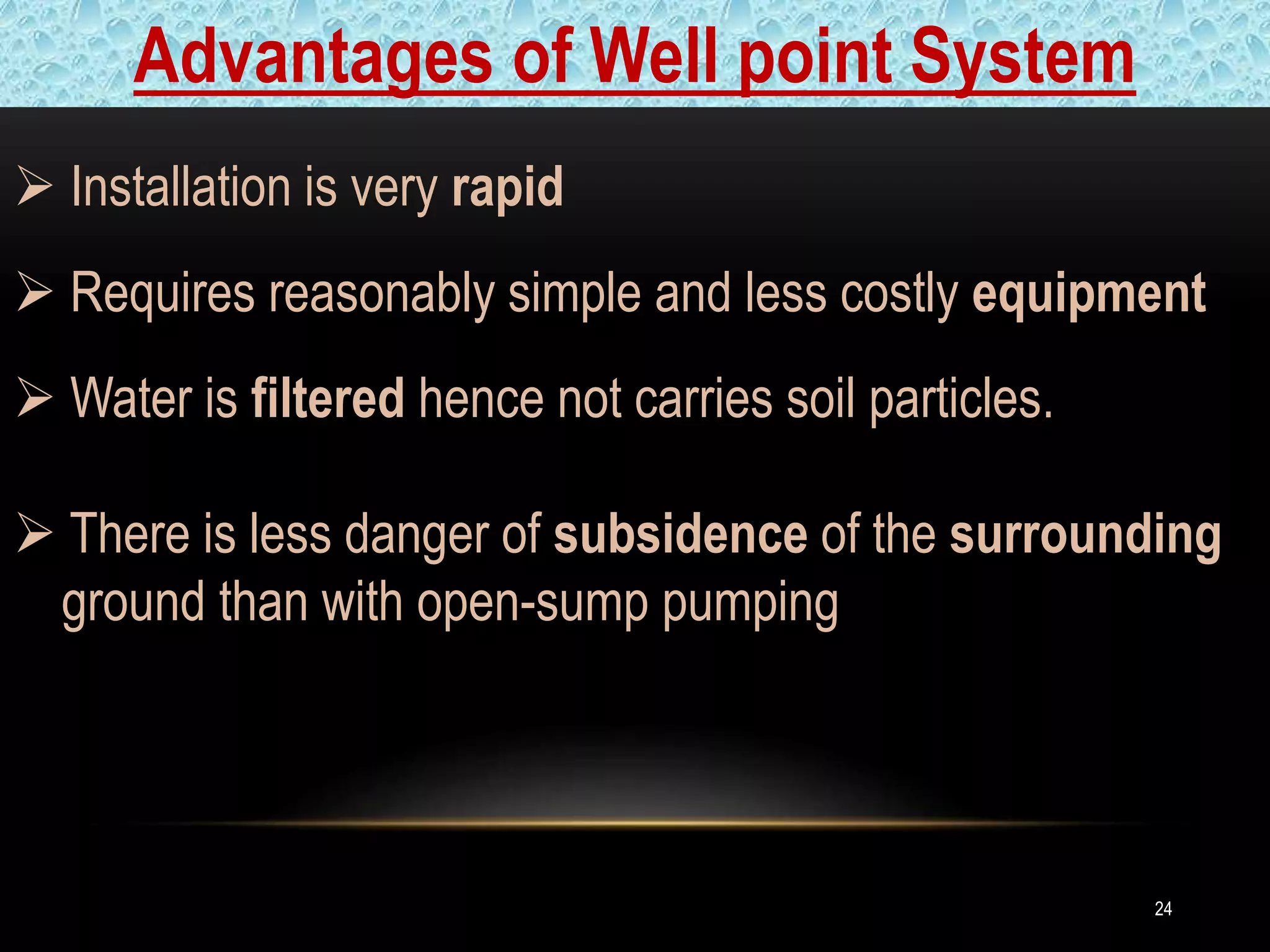
 Installation is very rapid
 Requires reasonably simple and less costly equipment
 Water is filtered hence not carries soil particles.
 There is less danger of subsidence of the surrounding
gj ground than with open-sump pumping
Advantages of Well point System
2525
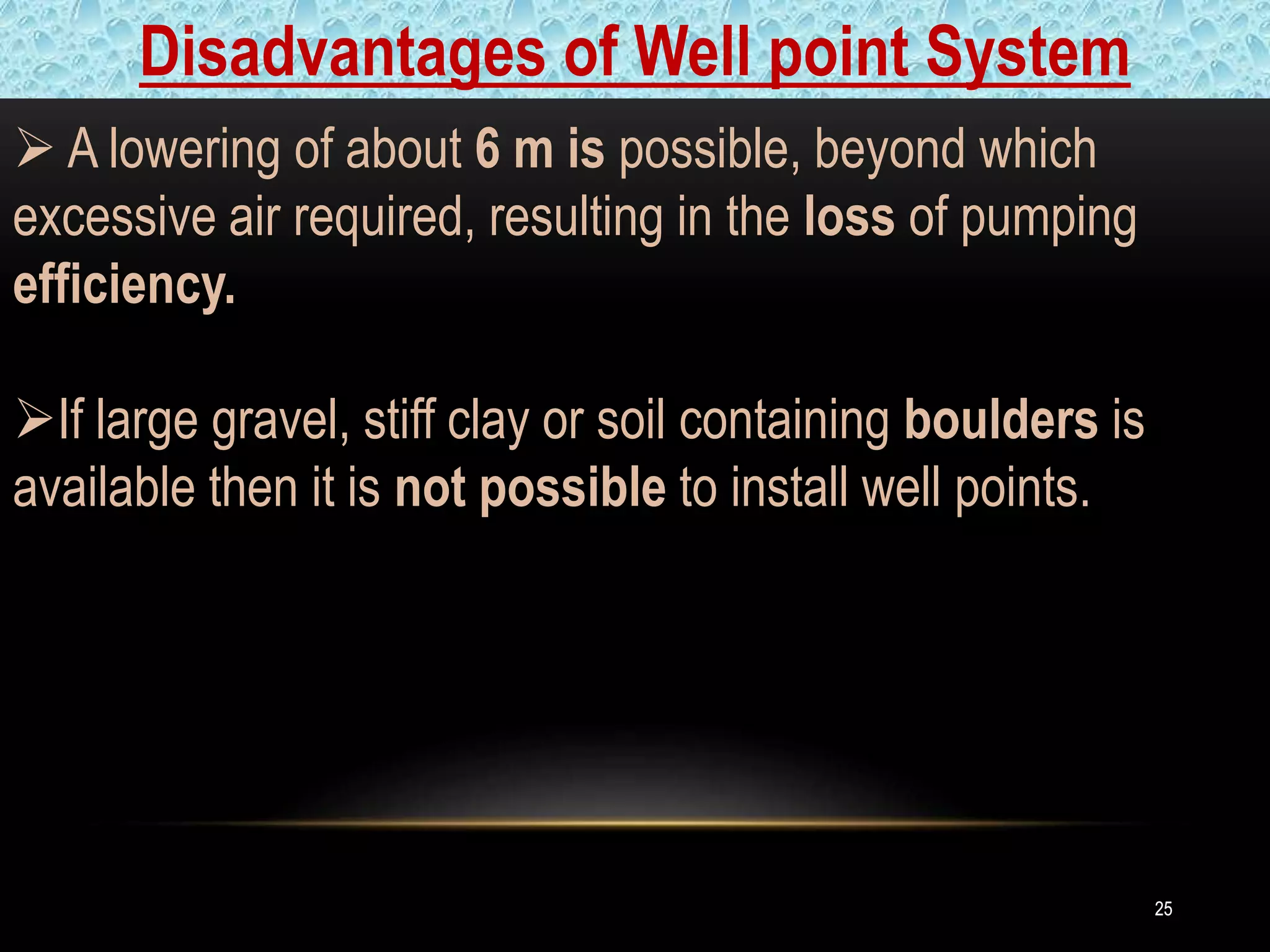
 A lowering of about 6 m is possible, beyond which
excessive air required, resulting in the loss of pumping
efficiency.

If large gravel, stiff clay or soil containing boulders is
available then it is not possible to install well points.
Disadvantages of Well point System
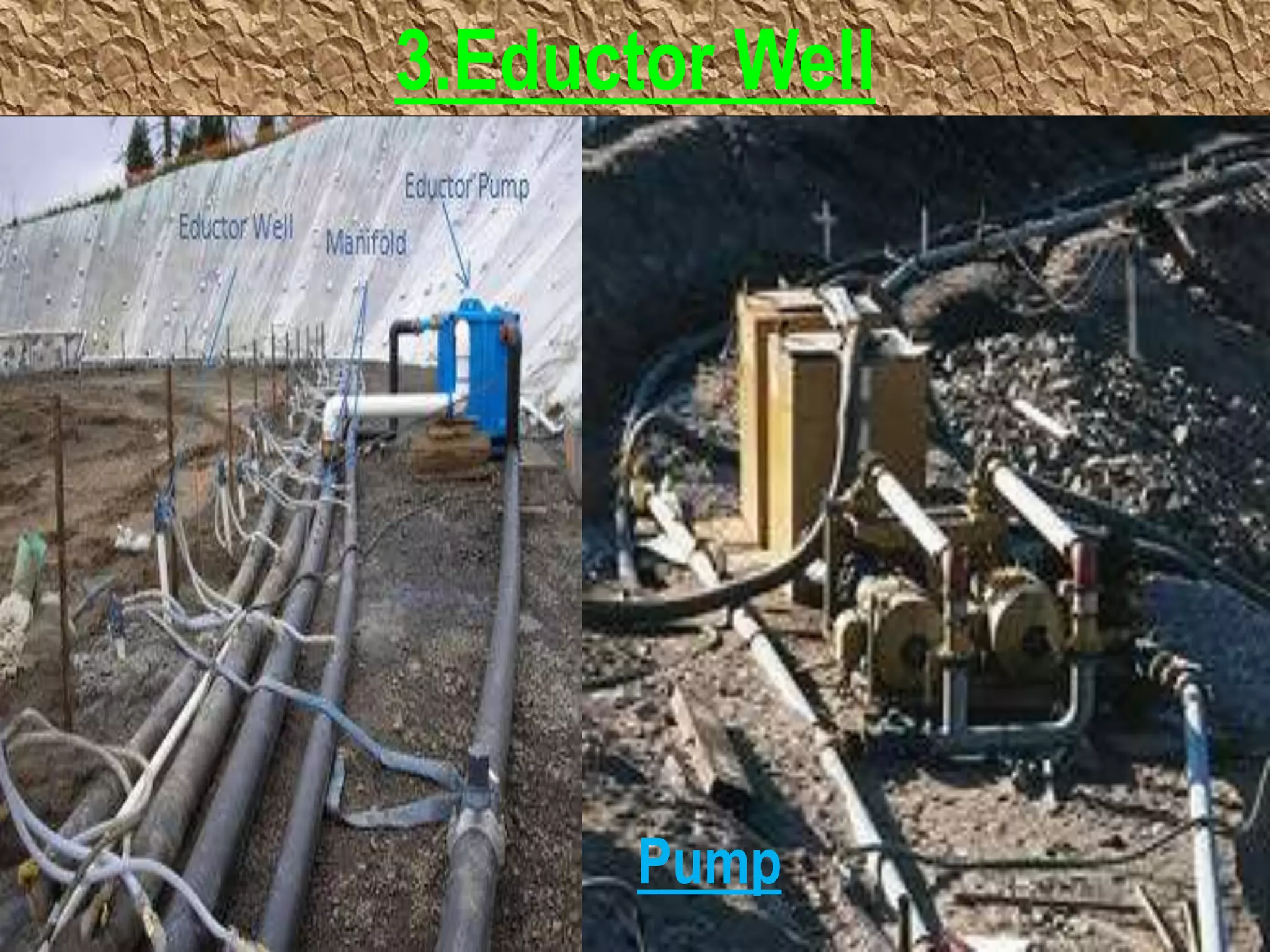
3.Eductor Well
26
Pump
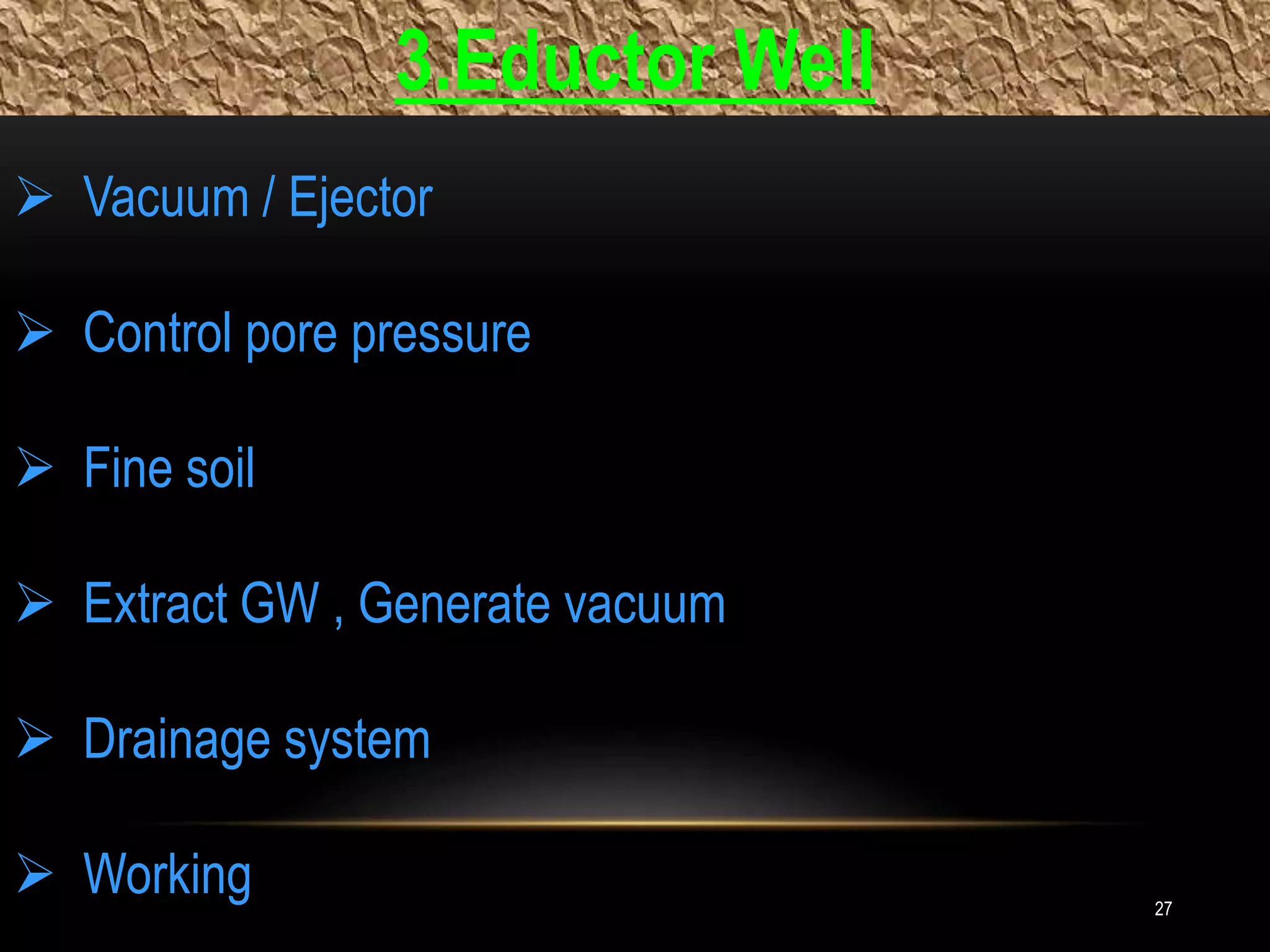
27
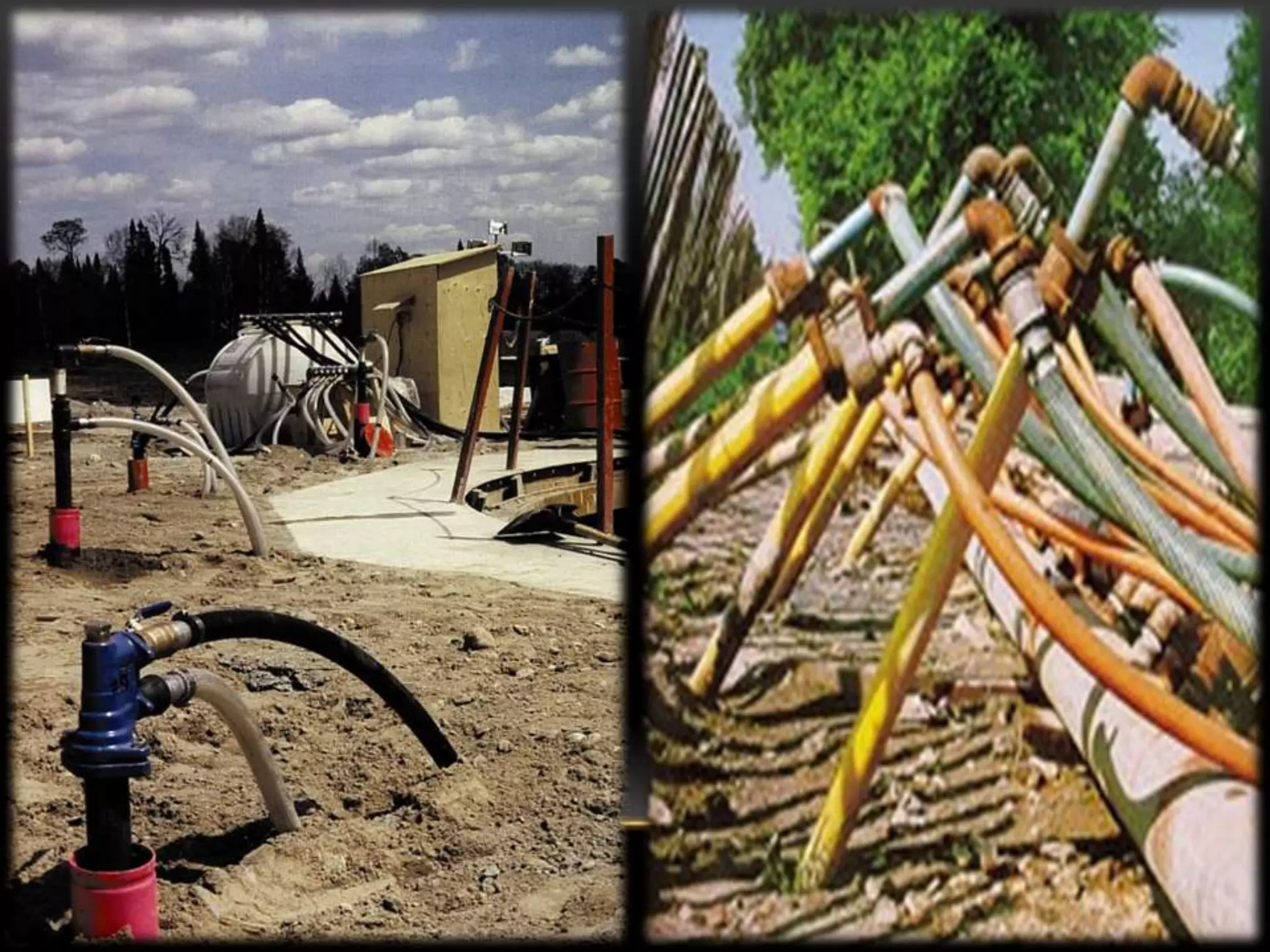
3.Eductor Well
 Vacuum / Ejector
 Control pore pressure
 Fine soil
 Extract GW , Generate vacuum
 Drainage system
 Working
28
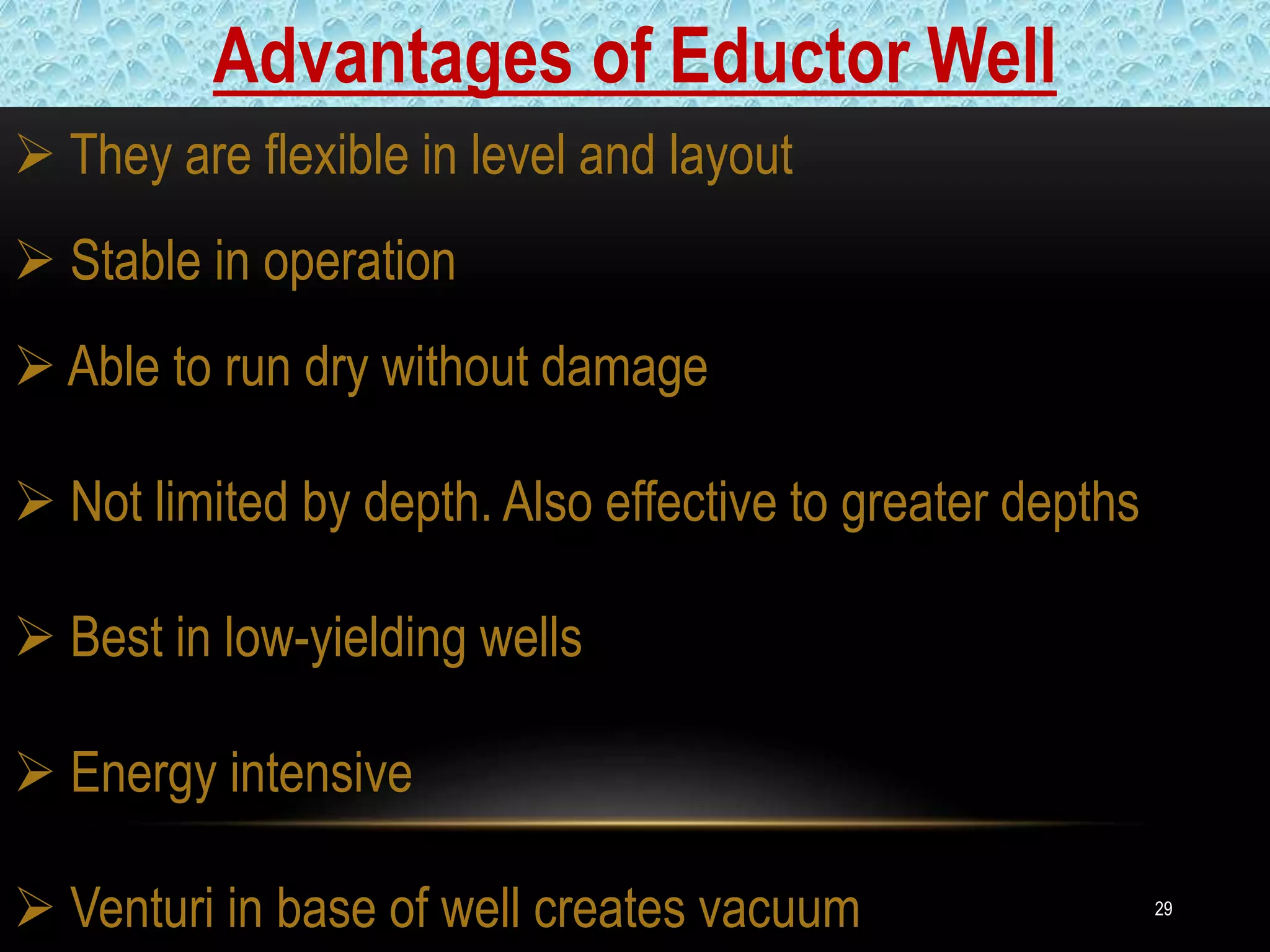
29
 They are flexible in level and layout
 Stable in operation
 Able to run dry without damage
 Not limited by depth. Also effective to greater depths
 Best in low-yielding wells
 Energy intensive
 Venturi in base of well creates vacuum
Advantages of Eductor Well
3030
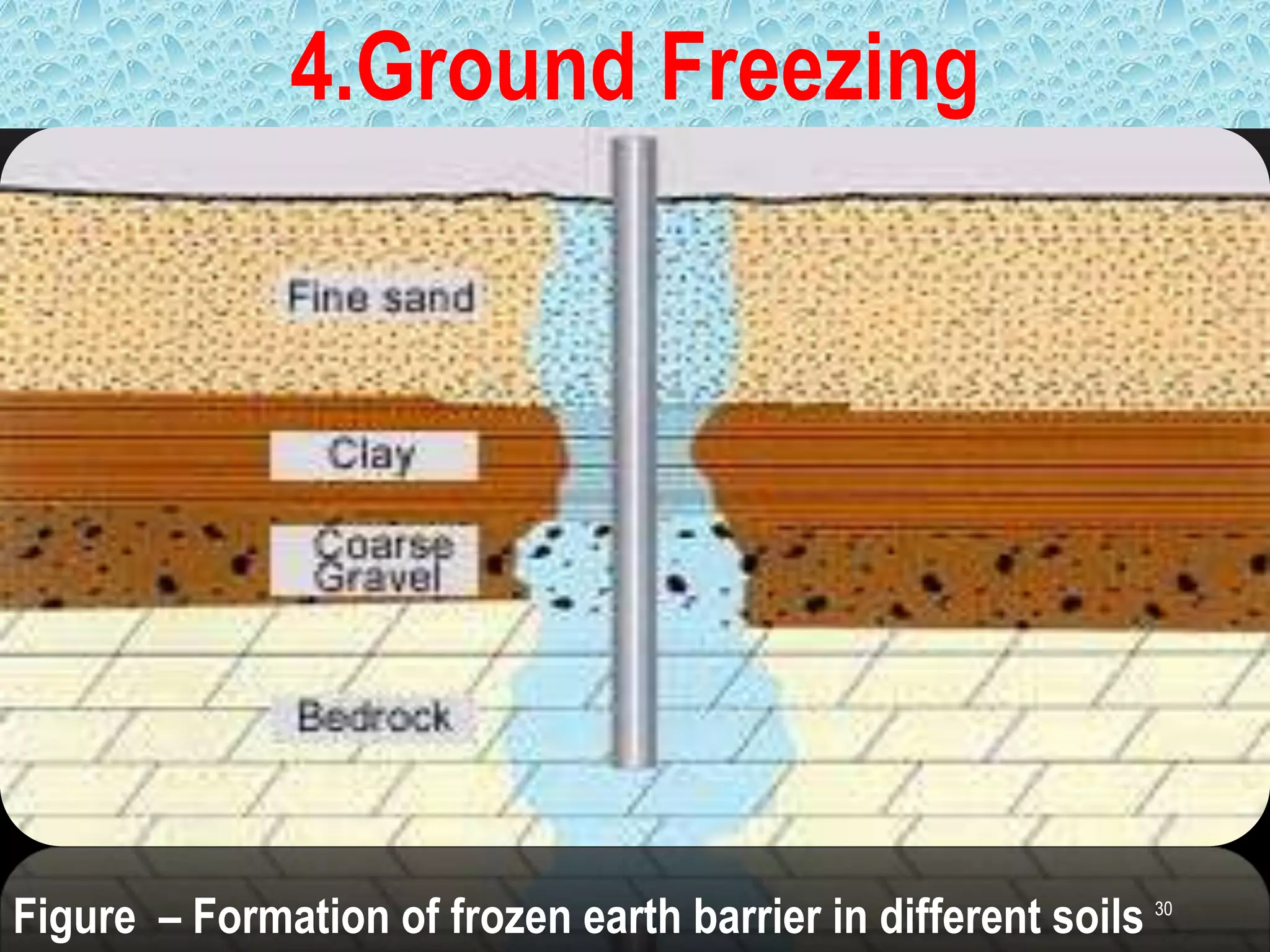
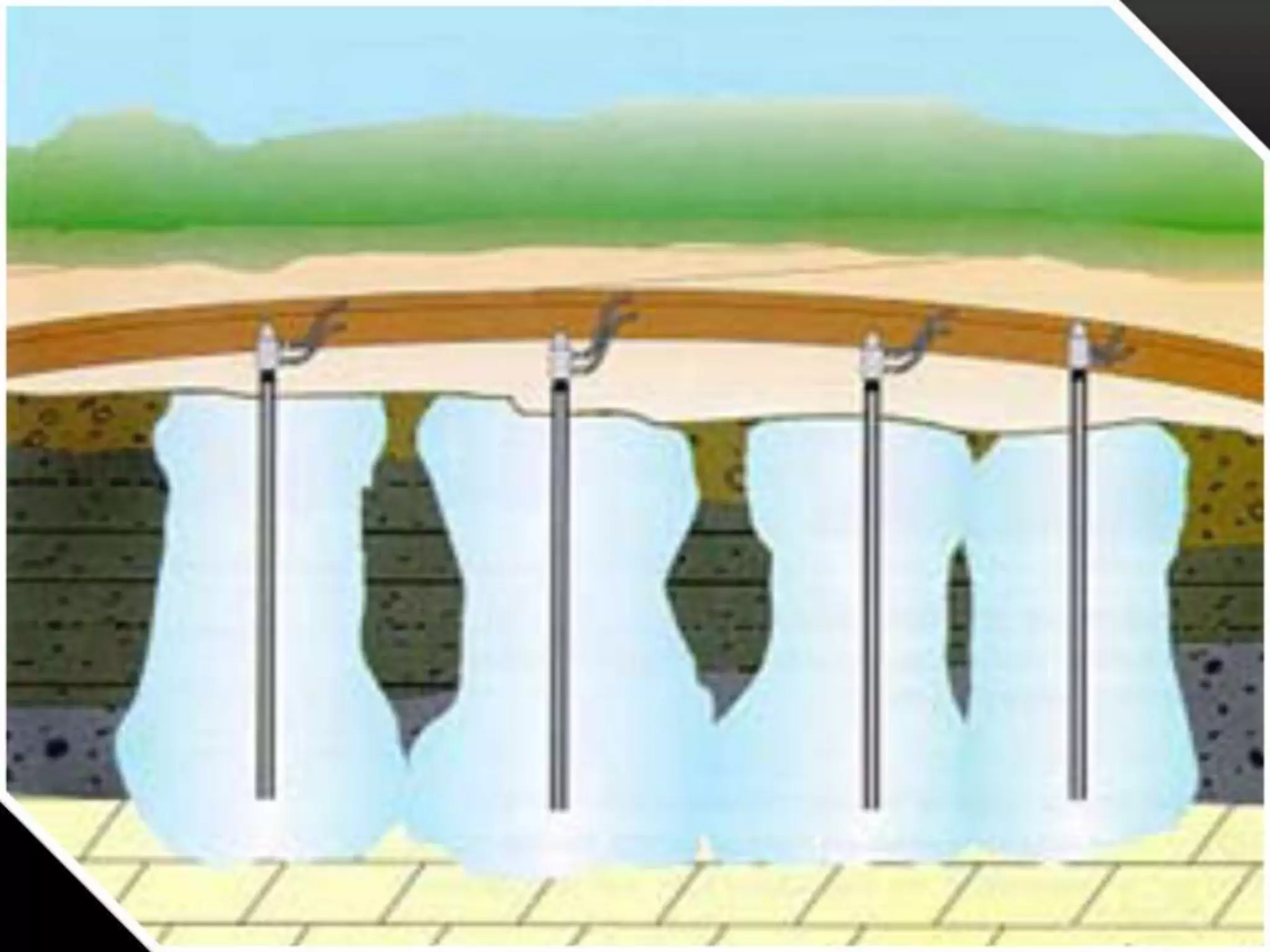
4.Ground Freezing
Figure – Formation of frozen earth barrier in different soils
31
32
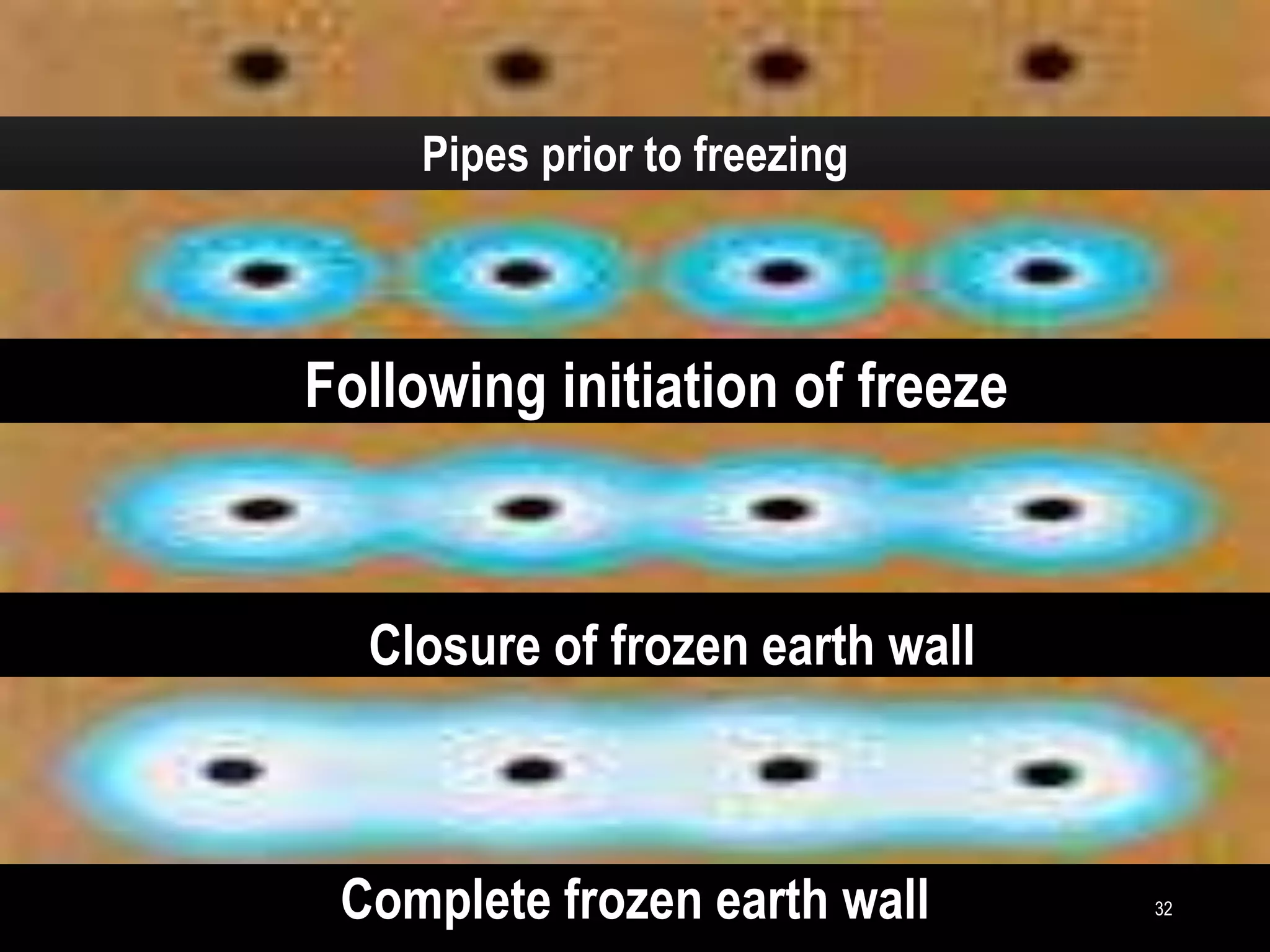
Pipes prior to freezing
Following initiation of freeze
Closure of frozen earth wall
Complete frozen earth wall
33
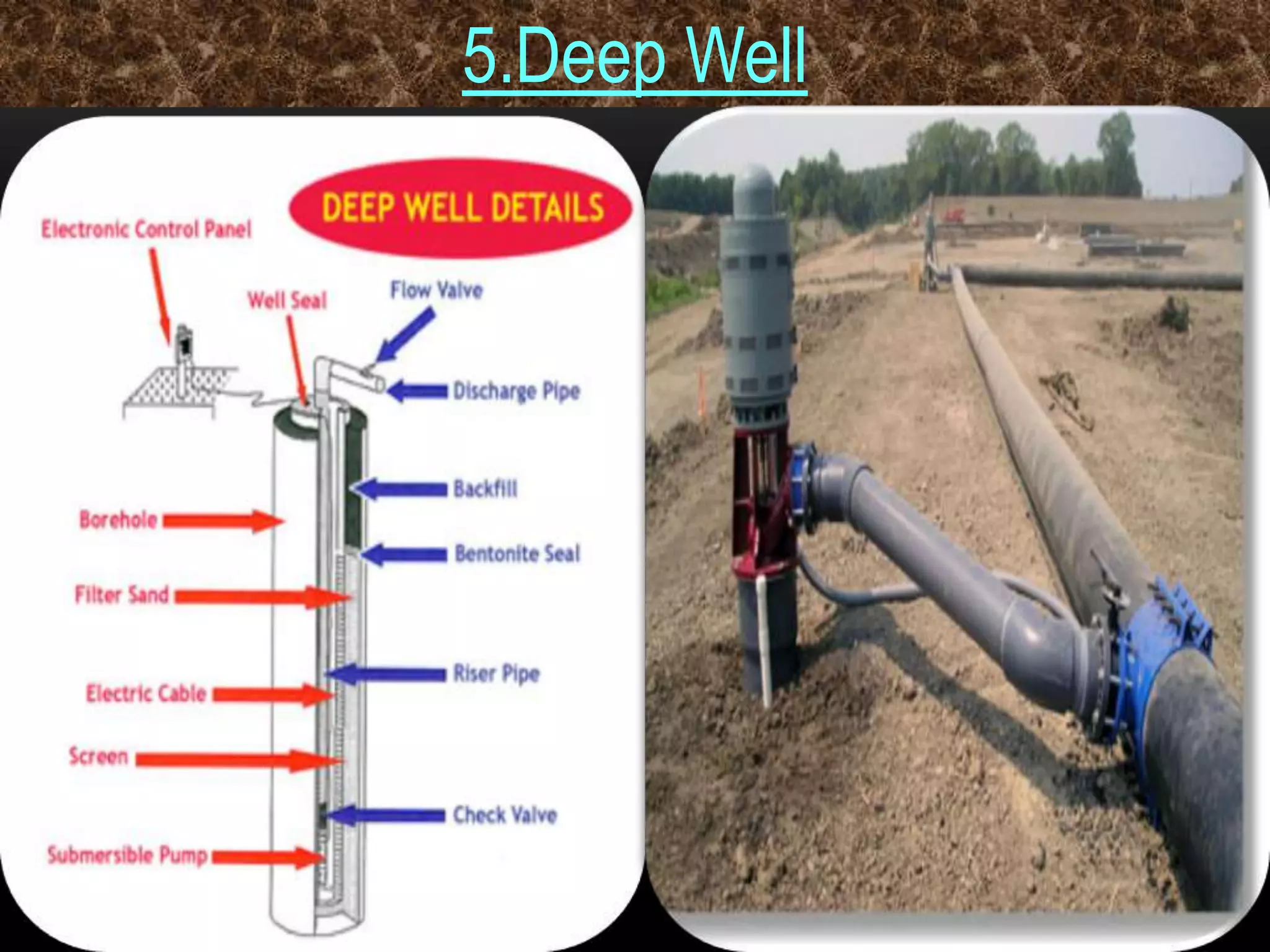
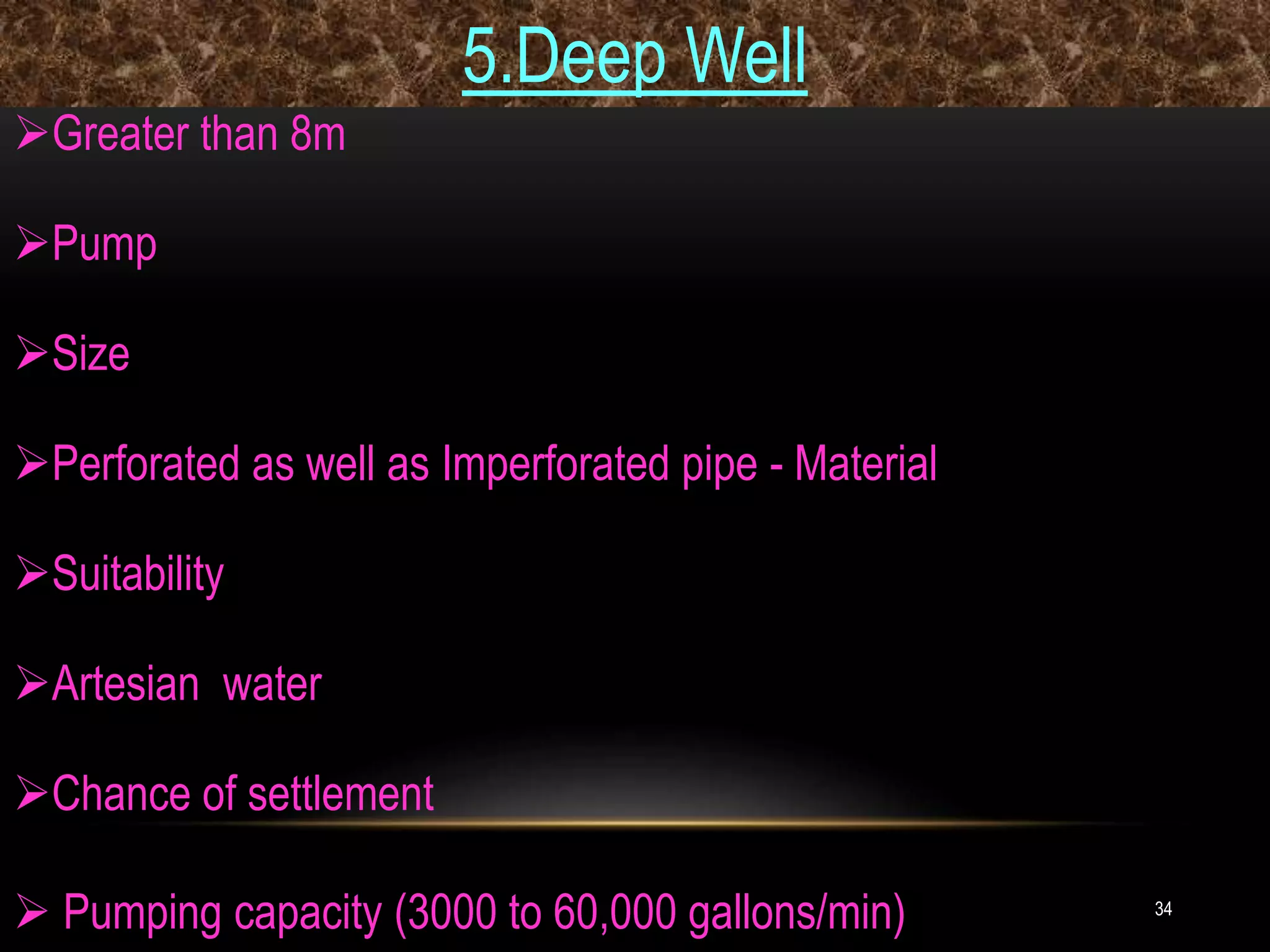
5.Deep Well
34
5.Deep Well
Greater than 8m
Pump
Size
Perforated as well as Imperforated pipe - Material
Suitability
Artesian water
Chance of settlement
 Pumping capacity (3000 to 60,000 gallons/min)
35
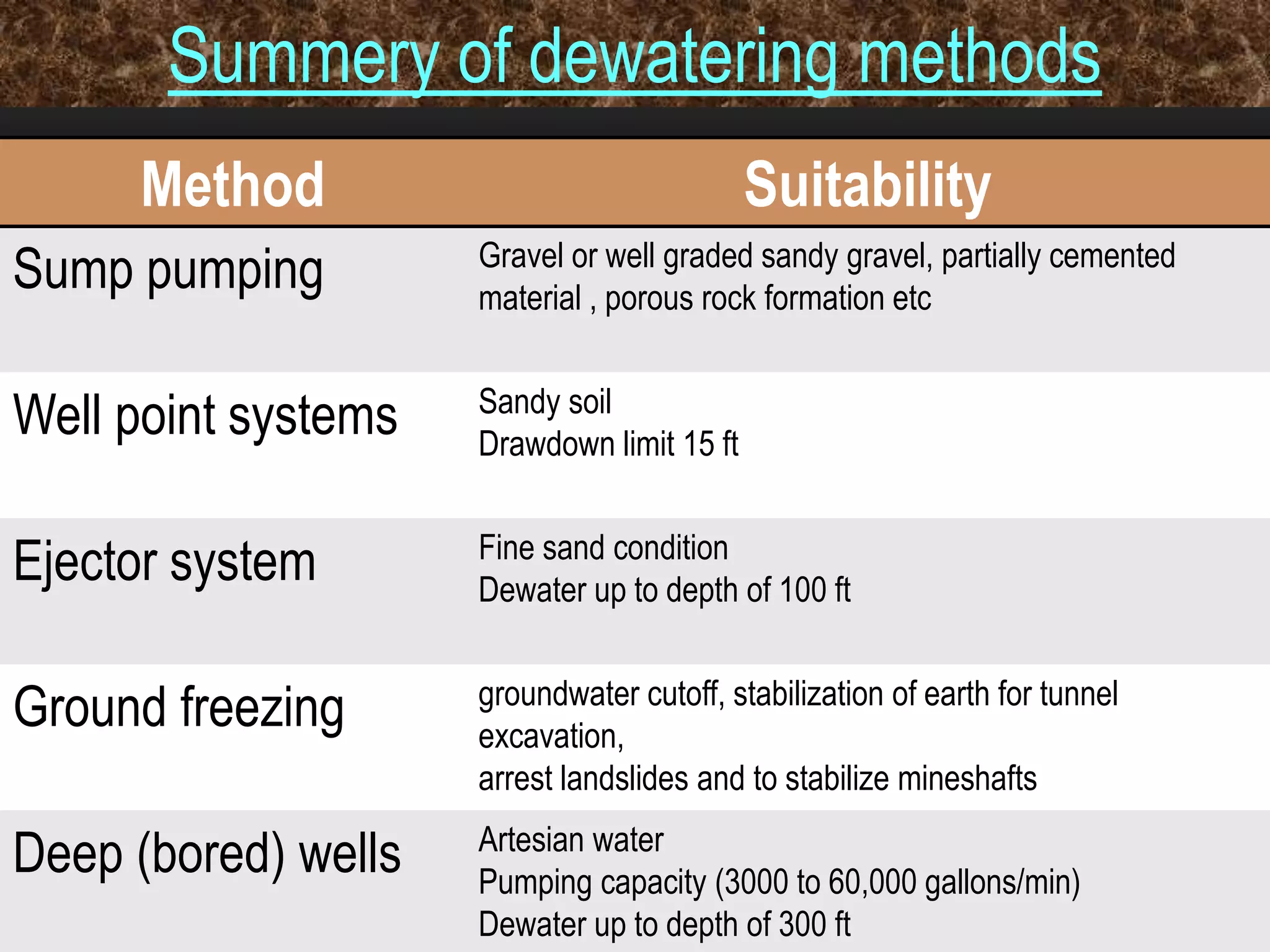
Summery of dewatering methods
Method Suitability
Sump pumping Gravel or well graded sandy gravel, partially cemented
material , porous rock formation etc
Well point systems Sandy soil
Drawdown limit 15 ft
Ejector system Fine sand condition
Dewater up to depth of 100 ft
Ground freezing groundwater cutoff, stabilization of earth for tunnel
excavation,
arrest landslides and to stabilize mineshafts
Deep (bored) wells Artesian water
Pumping capacity (3000 to 60,000 gallons/min)
Dewater up to depth of 300 ft
36
Books:
 DEWATERING AND GROUNDWATER
CONTROL(HQ.DEPARTMENTS OF ARMY, AIR
FORCE, NAVY WASHINGTON)
 Construction Dewatering and Ground
Freezing (University of Washington)
Methods of Dewatering

Methods of Dewatering

  • 1.
  • 2.
    A Seminar presentation on Methodsof Dewatering On Construction Site By Gaikwad A. A. Guide: Ms. Pujari P.D. .
  • 3.
    CONTENTS  Introduction  LessonObjective  Purpose of Dewatering  Factors controlling Selection  Methods of Dewatering  Conclusion .
  • 4.
  • 5.
    Lesson Objective 5 To knowthe concept of Dewatering  To know Importance of Dewatering  To know various Methods of Dewatering
  • 6.
    6 Purpose of Dewatering During construction stage:- dry excavation  proceed efficiently  Reduce lateral loads  Improve characteristics of foundation materials  Increase stability of slopes and side-hill fills Prevent piping and frost heaving in pavements
  • 7.
    77 Purpose of Dewatering Post construction stage :-  Reduce uplift pressures on bottom slabs Reduce lateral pressures on retaining structures Control embankment seepage in all dams Purpose of Dewatering
  • 8.
    Factors Controlling Selection Nature and Permeability of Ground  Geologic conditions of soil  Extent of area to be Dewatered  Depth of Water table below ground level  Amount by which it has to be lowered  Proposed methods of excavation and ground support  Proximity of existing structure 8
  • 9.
    9 Soil Permeability Coefficient(k)(cm/sec) Relative Permeability Coarsegravel Exceeds 10^-1 High Clean sand 10^-1 to 10^-3 Medium Dirty sand 10^-3 to 10^-5 Low Silt 10^-5 to 10^-7 Very low Clay Less than 10^-7 Impervious Permeability of Soil
  • 10.
  • 11.
    Methods of Dewatering Surface water control  Sump pumping  Wellpoint systems with suction pumps. Ejector system  Ground freezing  Deep (bored) wells with pumps. 11
  • 12.
  • 13.
    13 1.Sump Pumping  Whatis Sump?  Slope  Pump  Fines  Lined
  • 14.
  • 15.
    15  Widely usedmethod  Most economical method for installation and maintenance  Can be applied for most soil and rock conditions  Most appropriate where boulders or massive obstructions j are met with in the ground Advantages of Open Sump and Ditches
  • 16.
    1616  Due tomore flow of GW towards excavation risk of collapse of sides occurs. In open or timbered excavations there is risk of instability of the base due to seepage towards pumping sump. Note:- Greatest depth to which the water table can be lowered by this method is about 8 m below the pump. Disadvantages of Open Sump and Ditches
  • 17.
    2.Wellpoint System 17 Fig. Crosssection of a typical well-point system
  • 18.
    18 2.Wellpoint System  PerforatedWell  Material  Sandy  Foot – Orifice  Series of Closely Placed  Dimension  Spacing  Construction steps
  • 19.
  • 20.
    20 Well point System(Spacing) soilspacing Silty sand 1.5-2.0 Sandy gravel 1.0-1.5 Fine to coarse gravel 0.5-1.0
  • 21.
  • 22.
    22 Multi - StageWell Point System 22
  • 23.
    2323 Multi - StageWell Point System 23
  • 24.
    24  Installation isvery rapid  Requires reasonably simple and less costly equipment  Water is filtered hence not carries soil particles.  There is less danger of subsidence of the surrounding gj ground than with open-sump pumping Advantages of Well point System
  • 25.
    2525  A loweringof about 6 m is possible, beyond which excessive air required, resulting in the loss of pumping efficiency. If large gravel, stiff clay or soil containing boulders is available then it is not possible to install well points. Disadvantages of Well point System
  • 26.
  • 27.
    27 3.Eductor Well  Vacuum/ Ejector  Control pore pressure  Fine soil  Extract GW , Generate vacuum  Drainage system  Working
  • 28.
  • 29.
    29  They areflexible in level and layout  Stable in operation  Able to run dry without damage  Not limited by depth. Also effective to greater depths  Best in low-yielding wells  Energy intensive  Venturi in base of well creates vacuum Advantages of Eductor Well
  • 30.
    3030 4.Ground Freezing Figure –Formation of frozen earth barrier in different soils
  • 31.
  • 32.
    32 Pipes prior tofreezing Following initiation of freeze Closure of frozen earth wall Complete frozen earth wall
  • 33.
  • 34.
    34 5.Deep Well Greater than8m Pump Size Perforated as well as Imperforated pipe - Material Suitability Artesian water Chance of settlement  Pumping capacity (3000 to 60,000 gallons/min)
  • 35.
    35 Summery of dewateringmethods Method Suitability Sump pumping Gravel or well graded sandy gravel, partially cemented material , porous rock formation etc Well point systems Sandy soil Drawdown limit 15 ft Ejector system Fine sand condition Dewater up to depth of 100 ft Ground freezing groundwater cutoff, stabilization of earth for tunnel excavation, arrest landslides and to stabilize mineshafts Deep (bored) wells Artesian water Pumping capacity (3000 to 60,000 gallons/min) Dewater up to depth of 300 ft
  • 36.
  • 37.
    Books:  DEWATERING ANDGROUNDWATER CONTROL(HQ.DEPARTMENTS OF ARMY, AIR FORCE, NAVY WASHINGTON)  Construction Dewatering and Ground Freezing (University of Washington)