Seminar on –
“Pavement Failures and their
Maintenance”
Bangalore Institute of Technology
K R road, V V Pura, Bangalore – 560 004
Department of Civil Engineering
Presented By – C T Akshay Kuma
1BI15CV041
Under the Guidance of
M B Girish
Asst. Prof, Department of Civil Engineering
Bangalore Institute of Technology
1
Contents
1. Introduction
2. Cracking
3. Potholes
4. Rutting
5. Shoving
6. Raveling
7. Bleeding
2
Introduction
A pavement is the durable surface material laid down on an
area intended to sustain vehicular traffic, such as
a road or walkway. A pavement is designed to support the
wheel loads imposed on it from traffic moving over it.
Pavement structure generally consists of few layers of
selected superior pavement materials laid over a
prepared subgrade. It consists of prepared soil subgrade,
granular sub-base course, base course and surface
course.
Based on structural behaviour, pavements are classified
into two categories –
1. Flexible pavement
2. Rigid pavement 3
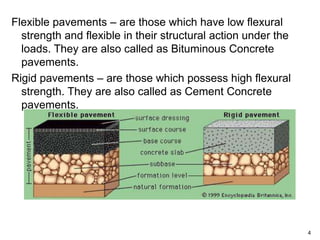
Flexible pavements – are those which have low flexural
strength and flexible in their structural action under the
loads. They are also called as Bituminous Concrete
pavements.
Rigid pavements – are those which possess high flexural
strength. They are also called as Cement Concrete
pavements.
4
Types of pavement failures
1. Cracking
2. Potholes
3. Rutting
4. Shoving
5. Raveling
6. Bleeding
5
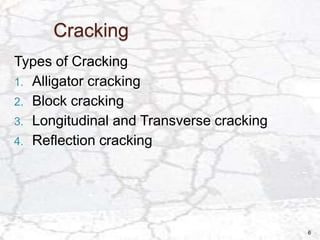
Cracking
Types of Cracking
1. Alligator cracking
2. Block cracking
3. Longitudinal and Transverse cracking
4. Reflection cracking
6
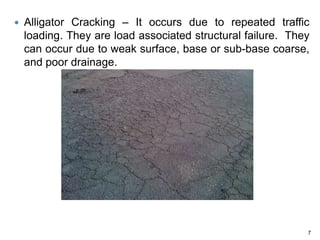
 Alligator Cracking – It occurs due to repeated traffic
loading. They are load associated structural failure. They
can occur due to weak surface, base or sub-base coarse,
and poor drainage.
7
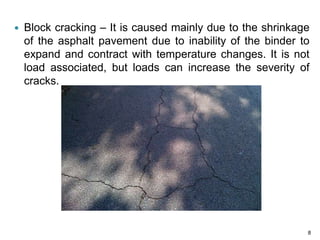
 Block cracking – It is caused mainly due to the shrinkage
of the asphalt pavement due to inability of the binder to
expand and contract with temperature changes. It is not
load associated, but loads can increase the severity of
cracks.
8
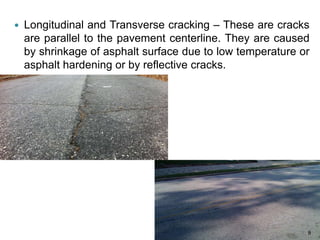
 Longitudinal and Transverse cracking – These are cracks
are parallel to the pavement centerline. They are caused
by shrinkage of asphalt surface due to low temperature or
asphalt hardening or by reflective cracks.
9
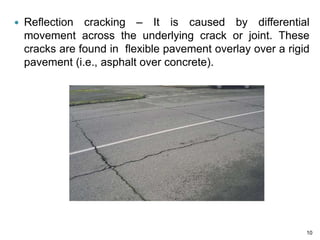
 Reflection cracking – It is caused by differential
movement across the underlying crack or joint. These
cracks are found in flexible pavement overlay over a rigid
pavement (i.e., asphalt over concrete).
10
Remedial measures for Cracking
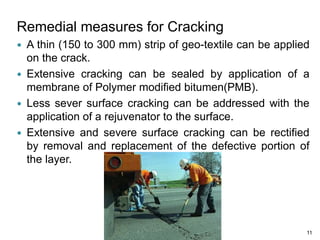
 A thin (150 to 300 mm) strip of geo-textile can be applied
on the crack.
 Extensive cracking can be sealed by application of a
membrane of Polymer modified bitumen(PMB).
 Less sever surface cracking can be addressed with the
application of a rejuvenator to the surface.
 Extensive and severe surface cracking can be rectified
by removal and replacement of the defective portion of
the layer.
11
Potholes
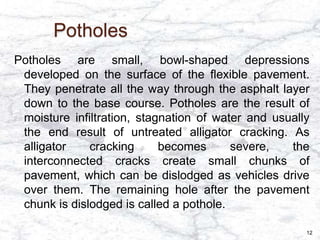
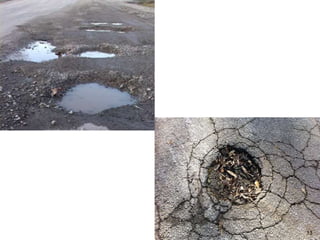
Potholes are small, bowl-shaped depressions
developed on the surface of the flexible pavement.
They penetrate all the way through the asphalt layer
down to the base course. Potholes are the result of
moisture infiltration, stagnation of water and usually
the end result of untreated alligator cracking. As
alligator cracking becomes severe, the
interconnected cracks create small chunks of
pavement, which can be dislodged as vehicles drive
over them. The remaining hole after the pavement
chunk is dislodged is called a pothole.
12
13
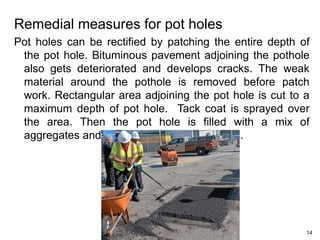
Remedial measures for pot holes
Pot holes can be rectified by patching the entire depth of
the pot hole. Bituminous pavement adjoining the pothole
also gets deteriorated and develops cracks. The weak
material around the pothole is removed before patch
work. Rectangular area adjoining the pot hole is cut to a
maximum depth of pot hole. Tack coat is sprayed over
the area. Then the pot hole is filled with a mix of
aggregates and binder. It is then compacted.
14
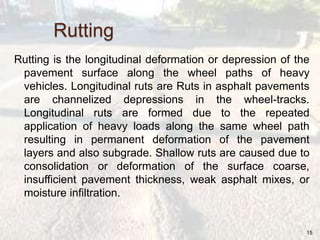
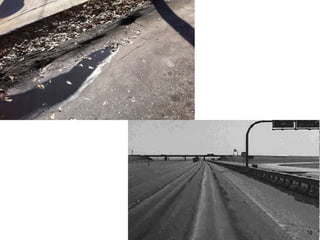
Rutting
Rutting is the longitudinal deformation or depression of the
pavement surface along the wheel paths of heavy
vehicles. Longitudinal ruts are Ruts in asphalt pavements
are channelized depressions in the wheel-tracks.
Longitudinal ruts are formed due to the repeated
application of heavy loads along the same wheel path
resulting in permanent deformation of the pavement
layers and also subgrade. Shallow ruts are caused due to
consolidation or deformation of the surface coarse,
insufficient pavement thickness, weak asphalt mixes, or
moisture infiltration.
15
16
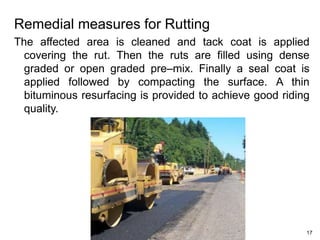
Remedial measures for Rutting
The affected area is cleaned and tack coat is applied
covering the rut. Then the ruts are filled using dense
graded or open graded pre–mix. Finally a seal coat is
applied followed by compacting the surface. A thin
bituminous resurfacing is provided to achieve good riding
quality.
17
Shoving
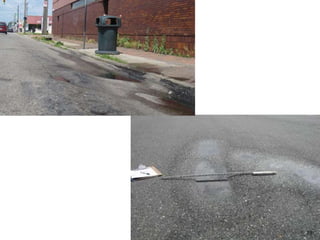
Shoving is the formation of ripples or the longitudinal
displacement of localized areas across a pavement
caused by shear forces induced by traffic loading.
Shoving occurs at locations having severe horizontal
stresses, such as at intersections. It is caused by excess
asphalt content, high quantity of fine aggregate, presence
of rounded aggregate, or a weak granular base.
18
19
Remedial measures for Shoving
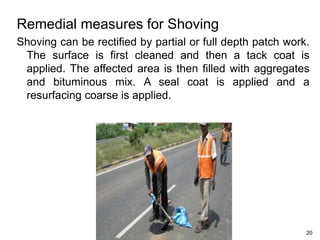
Shoving can be rectified by partial or full depth patch work.
The surface is first cleaned and then a tack coat is
applied. The affected area is then filled with aggregates
and bituminous mix. A seal coat is applied and a
resurfacing coarse is applied.
20
Raveling
Raveling (or aggregate loss) is the process where the
aggregate particles are dislodged from the pavement
surface where the asphalt binder is removed. Raveling is
caused by the abrasive action of traffic, low binder
content, construction during wet weather, delayed rolling
or over heating of the bituminous mix.
21
22
Remedial measures for Raveling
If the raveling is in its initial stage, the surface is cleaned
and a seal coat(or slurry seal) is applied.
For severe raveling conditions, the surface is cleaned and a
tack coat is applied. This is followed by applying a
resurfacing coarse.
23
Bleeding
Bleeding is the condition where a film of bituminous
binder is present on the surface which creates a
shiny, reflective surface which may be tacky in hot
weather. It is caused by high asphalt content or low
air void content. Bleeding reduces the skid resistance
of the pavement with affects the safety of the road
users. Since the bleeding process is not reversible
during cold months, asphalt will accumulate on the
surface and lower the skid resistance.
24
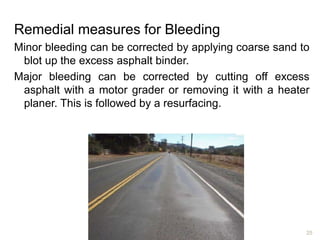
Remedial measures for Bleeding
Minor bleeding can be corrected by applying coarse sand to
blot up the excess asphalt binder.
Major bleeding can be corrected by cutting off excess
asphalt with a motor grader or removing it with a heater
planer. This is followed by a resurfacing.
25
References
1. S K Khanna, C E G Justo, A Veeraragavan “Highway
Engineering” revised 10th edition
2. Al-Mustansiryah University, Faculty of Engineering, Department
of Highways and Transportation Engineering, “Highway
Maintenance Course” (2015-2016).
3. Zulufqar Bin Rashid, Dr. Rakesh Gupta “Study of defects in
Flexible Pavement and its Maintenance” Volume 15, Issue 2
(Ver. II) Mar. - Apr. 2018
4. Sharad.S.Adlinge, Prof.A.K.Gupta “Pavement Deterioration
and its Causes”
5. Surajo Abubakar Wada “Bituminous Pavement Failures”
Volume 6, Issue 2, (Part - 4) February 2016
26
Thank You
27

Seminar Presentation "Pavements failures and their maintenance"

  • 1.
    Seminar on – “PavementFailures and their Maintenance” Bangalore Institute of Technology K R road, V V Pura, Bangalore – 560 004 Department of Civil Engineering Presented By – C T Akshay Kuma 1BI15CV041 Under the Guidance of M B Girish Asst. Prof, Department of Civil Engineering Bangalore Institute of Technology 1
  • 2.
    Contents 1. Introduction 2. Cracking 3.Potholes 4. Rutting 5. Shoving 6. Raveling 7. Bleeding 2
  • 3.
    Introduction A pavement isthe durable surface material laid down on an area intended to sustain vehicular traffic, such as a road or walkway. A pavement is designed to support the wheel loads imposed on it from traffic moving over it. Pavement structure generally consists of few layers of selected superior pavement materials laid over a prepared subgrade. It consists of prepared soil subgrade, granular sub-base course, base course and surface course. Based on structural behaviour, pavements are classified into two categories – 1. Flexible pavement 2. Rigid pavement 3
  • 4.
    Flexible pavements –are those which have low flexural strength and flexible in their structural action under the loads. They are also called as Bituminous Concrete pavements. Rigid pavements – are those which possess high flexural strength. They are also called as Cement Concrete pavements. 4
  • 5.
    Types of pavementfailures 1. Cracking 2. Potholes 3. Rutting 4. Shoving 5. Raveling 6. Bleeding 5
  • 6.
    Cracking Types of Cracking 1.Alligator cracking 2. Block cracking 3. Longitudinal and Transverse cracking 4. Reflection cracking 6
  • 7.
     Alligator Cracking– It occurs due to repeated traffic loading. They are load associated structural failure. They can occur due to weak surface, base or sub-base coarse, and poor drainage. 7
  • 8.
     Block cracking– It is caused mainly due to the shrinkage of the asphalt pavement due to inability of the binder to expand and contract with temperature changes. It is not load associated, but loads can increase the severity of cracks. 8
  • 9.
     Longitudinal andTransverse cracking – These are cracks are parallel to the pavement centerline. They are caused by shrinkage of asphalt surface due to low temperature or asphalt hardening or by reflective cracks. 9
  • 10.
     Reflection cracking– It is caused by differential movement across the underlying crack or joint. These cracks are found in flexible pavement overlay over a rigid pavement (i.e., asphalt over concrete). 10
  • 11.
    Remedial measures forCracking  A thin (150 to 300 mm) strip of geo-textile can be applied on the crack.  Extensive cracking can be sealed by application of a membrane of Polymer modified bitumen(PMB).  Less sever surface cracking can be addressed with the application of a rejuvenator to the surface.  Extensive and severe surface cracking can be rectified by removal and replacement of the defective portion of the layer. 11
  • 12.
    Potholes Potholes are small,bowl-shaped depressions developed on the surface of the flexible pavement. They penetrate all the way through the asphalt layer down to the base course. Potholes are the result of moisture infiltration, stagnation of water and usually the end result of untreated alligator cracking. As alligator cracking becomes severe, the interconnected cracks create small chunks of pavement, which can be dislodged as vehicles drive over them. The remaining hole after the pavement chunk is dislodged is called a pothole. 12
  • 13.
  • 14.
    Remedial measures forpot holes Pot holes can be rectified by patching the entire depth of the pot hole. Bituminous pavement adjoining the pothole also gets deteriorated and develops cracks. The weak material around the pothole is removed before patch work. Rectangular area adjoining the pot hole is cut to a maximum depth of pot hole. Tack coat is sprayed over the area. Then the pot hole is filled with a mix of aggregates and binder. It is then compacted. 14
  • 15.
    Rutting Rutting is thelongitudinal deformation or depression of the pavement surface along the wheel paths of heavy vehicles. Longitudinal ruts are Ruts in asphalt pavements are channelized depressions in the wheel-tracks. Longitudinal ruts are formed due to the repeated application of heavy loads along the same wheel path resulting in permanent deformation of the pavement layers and also subgrade. Shallow ruts are caused due to consolidation or deformation of the surface coarse, insufficient pavement thickness, weak asphalt mixes, or moisture infiltration. 15
  • 16.
  • 17.
    Remedial measures forRutting The affected area is cleaned and tack coat is applied covering the rut. Then the ruts are filled using dense graded or open graded pre–mix. Finally a seal coat is applied followed by compacting the surface. A thin bituminous resurfacing is provided to achieve good riding quality. 17
  • 18.
    Shoving Shoving is theformation of ripples or the longitudinal displacement of localized areas across a pavement caused by shear forces induced by traffic loading. Shoving occurs at locations having severe horizontal stresses, such as at intersections. It is caused by excess asphalt content, high quantity of fine aggregate, presence of rounded aggregate, or a weak granular base. 18
  • 19.
  • 20.
    Remedial measures forShoving Shoving can be rectified by partial or full depth patch work. The surface is first cleaned and then a tack coat is applied. The affected area is then filled with aggregates and bituminous mix. A seal coat is applied and a resurfacing coarse is applied. 20
  • 21.
    Raveling Raveling (or aggregateloss) is the process where the aggregate particles are dislodged from the pavement surface where the asphalt binder is removed. Raveling is caused by the abrasive action of traffic, low binder content, construction during wet weather, delayed rolling or over heating of the bituminous mix. 21
  • 22.
  • 23.
    Remedial measures forRaveling If the raveling is in its initial stage, the surface is cleaned and a seal coat(or slurry seal) is applied. For severe raveling conditions, the surface is cleaned and a tack coat is applied. This is followed by applying a resurfacing coarse. 23
  • 24.
    Bleeding Bleeding is thecondition where a film of bituminous binder is present on the surface which creates a shiny, reflective surface which may be tacky in hot weather. It is caused by high asphalt content or low air void content. Bleeding reduces the skid resistance of the pavement with affects the safety of the road users. Since the bleeding process is not reversible during cold months, asphalt will accumulate on the surface and lower the skid resistance. 24
  • 25.
    Remedial measures forBleeding Minor bleeding can be corrected by applying coarse sand to blot up the excess asphalt binder. Major bleeding can be corrected by cutting off excess asphalt with a motor grader or removing it with a heater planer. This is followed by a resurfacing. 25
  • 26.
    References 1. S KKhanna, C E G Justo, A Veeraragavan “Highway Engineering” revised 10th edition 2. Al-Mustansiryah University, Faculty of Engineering, Department of Highways and Transportation Engineering, “Highway Maintenance Course” (2015-2016). 3. Zulufqar Bin Rashid, Dr. Rakesh Gupta “Study of defects in Flexible Pavement and its Maintenance” Volume 15, Issue 2 (Ver. II) Mar. - Apr. 2018 4. Sharad.S.Adlinge, Prof.A.K.Gupta “Pavement Deterioration and its Causes” 5. Surajo Abubakar Wada “Bituminous Pavement Failures” Volume 6, Issue 2, (Part - 4) February 2016 26
  • 27.