M.HAMZA KIYANI 17-ECT-56
NAJUM UL SAQIB 17-ECT-55
USMAN ZAKI 17-ECT-61
M.ARSLAN 17-ECT-52
JUNCTION FIELD EFFECT TRANSISTOR
(JFET)
Introduction
Junction gate field-effect transistor (JFET) is the simplest type of field-effect
transistor. This is three-terminal semiconductor device that can be electronically used as
controlled switches, amplifiers, or voltage-controlled resistors. PN junction diode has
properties that it injects minority carriers with forward bias and variation of depletion width
with reverse bias. These properties play important role in working of the device. JFET is a
majority carrier device and called unipolar transistor. It is voltage controlled current device
having extremely high input impedence
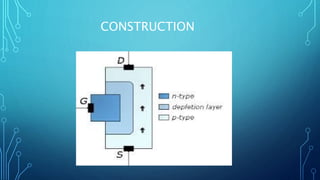
CONSTRUCTION
CONSTRUCTION
JFET Diffusion construction: It is the simplest form of
construction for a Junction FET (JFET) using diffusion techniques.
It uses a small slab of N type semiconductor into which are
infused two P type areas to form the Gate. Current (electrons)
flows through the device from source to drain along the N type
silicon channel. As only one type of charge carrier (electrons)
carry current in N channel JFETs, these transistors are also called
"Unipolar" devices
CONSTRUCTION
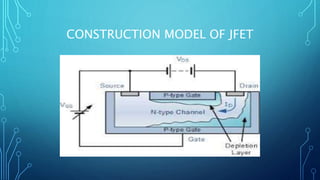
JFET planar construction: in this technology the load current
flows through the device from source to drain along a channel
made of N type silicon. In the planar device the second part of
the gate is formed by the P type substrate. P channel JFETs are
also available and the principle of operation is the same as the N
channel type described here, but polarities of the voltages are of
course reversed, and the charge carriers are holes
CONSTRUCTION MODEL OF JFET
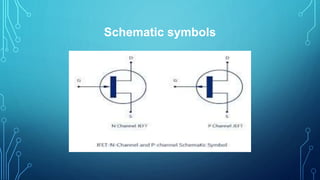
Schematic symbols
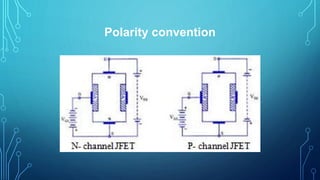
Polarity convention
JFET working
JFET operation is just like that of a garden
hose. The flow of water through a hose can
be controlled by squeezing it to reduce the
cross section, similarly the flow of electric
charge through a JFET is controlled by
constricting the current carrying channel.
The current also depends on the electric
field between source and drain
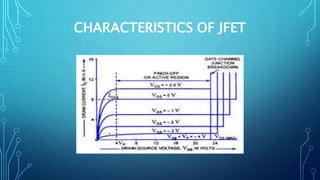
CHARACTERISTICS OF JFET
CONCLUSION
JFET is a field effect transistor which is a voltage controlled
current source having extremely high input impedance unlike BJT
it is a unipolar junction transistor which is used in many
electronic devices as an amplifier
FUTURE SCOPE
JFET is most popular device in today’s electronic world and it will
be used for amplifing device and voltage variable registor in
future and in many applications in future
REFERENCES
• D. Chattopadhyay (2006). "§13.2 Junction fieldeffect transistor
(JFET)". Electronics (fundamentals and applications).
• Balbir Kumar and Shail B. Jain (2013). Electronic Devices and
Circuits. PHI Learning Pvt. Ltd.
• J.b. gupta analog electronics
JFET TRANSISTER with reference,working and conclusion

JFET TRANSISTER with reference,working and conclusion

  • 2.
    M.HAMZA KIYANI 17-ECT-56 NAJUMUL SAQIB 17-ECT-55 USMAN ZAKI 17-ECT-61 M.ARSLAN 17-ECT-52
  • 3.
    JUNCTION FIELD EFFECTTRANSISTOR (JFET) Introduction Junction gate field-effect transistor (JFET) is the simplest type of field-effect transistor. This is three-terminal semiconductor device that can be electronically used as controlled switches, amplifiers, or voltage-controlled resistors. PN junction diode has properties that it injects minority carriers with forward bias and variation of depletion width with reverse bias. These properties play important role in working of the device. JFET is a majority carrier device and called unipolar transistor. It is voltage controlled current device having extremely high input impedence
  • 4.
  • 5.
    CONSTRUCTION JFET Diffusion construction:It is the simplest form of construction for a Junction FET (JFET) using diffusion techniques. It uses a small slab of N type semiconductor into which are infused two P type areas to form the Gate. Current (electrons) flows through the device from source to drain along the N type silicon channel. As only one type of charge carrier (electrons) carry current in N channel JFETs, these transistors are also called "Unipolar" devices
  • 6.
    CONSTRUCTION JFET planar construction:in this technology the load current flows through the device from source to drain along a channel made of N type silicon. In the planar device the second part of the gate is formed by the P type substrate. P channel JFETs are also available and the principle of operation is the same as the N channel type described here, but polarities of the voltages are of course reversed, and the charge carriers are holes
  • 7.
  • 8.
  • 9.
  • 10.
    JFET working JFET operationis just like that of a garden hose. The flow of water through a hose can be controlled by squeezing it to reduce the cross section, similarly the flow of electric charge through a JFET is controlled by constricting the current carrying channel. The current also depends on the electric field between source and drain
  • 11.
  • 12.
    CONCLUSION JFET is afield effect transistor which is a voltage controlled current source having extremely high input impedance unlike BJT it is a unipolar junction transistor which is used in many electronic devices as an amplifier
  • 13.
    FUTURE SCOPE JFET ismost popular device in today’s electronic world and it will be used for amplifing device and voltage variable registor in future and in many applications in future
  • 14.
    REFERENCES • D. Chattopadhyay(2006). "§13.2 Junction fieldeffect transistor (JFET)". Electronics (fundamentals and applications). • Balbir Kumar and Shail B. Jain (2013). Electronic Devices and Circuits. PHI Learning Pvt. Ltd. • J.b. gupta analog electronics