1
Syllabus
Unit 6. Field Effect Transistor: (8 hours); [Ref. 2: Chapters. 15 & 16, Ref. 3,
Ref. 4: Chapter. 4]
JFET- Basic construction - Theory of operation - Static characteristics - Drain
characteristics- Advantages - MOSFET – Depletion enhancement MOSFET –
Construction – Static characteristics.Uni-junction Transistor - Construction-
operation Silicon Controlled rectifier - Construction biasing - operation-
applications.
Books forstudy:
1. Basic electronics- Santiram Kal
2. Basic electronics- B. L. Theraja
3. Principles of electronics- V. K. Mehta
4. A first coursein Electronics- Anwar A. Khan, Kanchan K. Dey
1.FET-FieldEffect Transistor
FET is an acronym for Field Effect Transistor.
It is a three- terminal unipolar solid state device like bipolar junction transistor
(BJT).
In FET current is controlled by an electric field setup in the device,
hence the name FET.
Here the current conduction is only by majority carriers. Due to electrons or holes
So FET is called a unipolar device.
The three terminal are :- (i).SOURCE (ii).DRAIN (iii).GATE
FET is a voltage controlled device.
Classificationof FET
Based on construction, there are two basic types of FET.
(a). JFET-Junction Field Effect Transistor
(b). MOSFET-Metal Oxide SemiconductorField Effect Transistor .
It is also called insulated gate FET- (IGFET)
2
a.JFET-JunctionField Effect Transistor(JFET)
A junction field effect transistor is a three terminal semiconductor device in which
current conduction is by one type of carrier i.e., electrons or holes. It is a unipolar
device. Current flow is due to majority carriers only.
Depending on the type of carriers, JFET are of two types.
(i).N-channel JFET
(ii).P-Channel JFET
(i).N-ChannelJFET
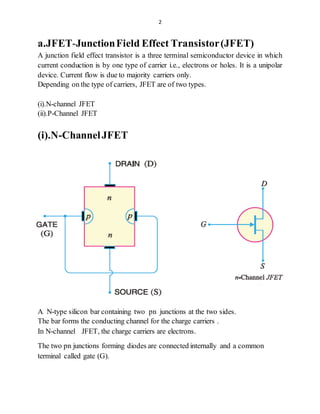
A N-type silicon bar containing two pn junctions at the two sides.
The bar forms the conducting channel for the charge carriers .
In N-channel JFET, the charge carriers are electrons.
The two pn junctions forming diodes are connected internally and a common
terminal called gate (G).
3
The terminals at the either ends of the bar are called Source(S) and Drain (D), and
can be interchanged. Either end can be used as sourceand the other end as drain.
The electrons enter the channel through the terminal called source and leave
through the terminal called Drain.
Schematic symbol of n-channel FET is shown in figure.
(ii).P-Channel JFET
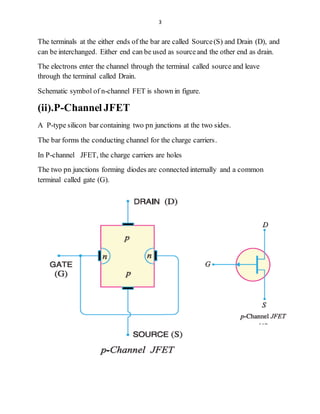
A P-type silicon bar containing two pn junctions at the two sides.
The bar forms the conducting channel for the charge carriers.
In P-channel JFET, the charge carriers are holes
The two pn junctions forming diodes are connected internally and a common
terminal called gate (G).
4
The terminals at the either ends of the bar are called Source (S) and Drain (D),and
can be interchanged.
Either end can be used as sourceand the other end as drain.
The electrons enter the channel through the terminal called source and leave
through the terminal called Drain.
2.Comparisonon BJT and FET
BJT FET
1 Bipolar device
(Current flow is due to both
electrons & holes)
Unipolar device
(Current flow is due to majority
carriers)
2 Current controlled device Voltage controlled device
3 Noisy Less noisy
4 Low input impedance High input impedance
5 Fabrication is not easy Easy to fabricate
6 Operation is temperature dependent Almost temperature independent
7 High gain bandwidth product Low gain bandwidth product
3. Applicationsof JFET
(i).Used as amplifiers in electronic voltmeters, oscilloscopes
(ii). It is used to construct oscillators.
(iii). Used as an analog switch.
(iv). Used as a chopper
(v). Used in logic circuits.
5
4. Advantages of JFET
High input impedance, Less noise , High power gain, Voltage controlled device ,
Small size, long life, high efficiency.
Disadvantages
Small gain bandwidth product
Large switching time
Performance deteriorates as frequency increases.
3.Static characteristicsof JFET
To understand the electrical behavior of a JFET, to study the interrelation of the
current and voltage in JFET.
These relationships can be plotted graphically, commonly known as characteristics
of JFET.
The important characteristics of JFET are
1. Drain characteristics
2. Transfer characteristics
Draincharacteristics(output characteristics)
It gives the relation between drain current (ID) and drain-source voltage (VDS ) for
different values of gate source voltage (VGS).
The circuit arrangement for obtaining the characteristics of an n-channel FET is
shown in figure.
6
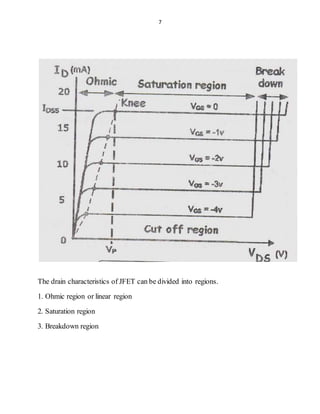
A typical output or drain characteristics of a n-channel FET is shown in figure.
7
The drain characteristics of JFET can be divided into regions.
1. Ohmic region or linear region
2. Saturation region
3. Breakdown region
8
1. Ohmic region or linearregion
In ohmic region the drain current ID varies with VDS and the JFET is said to be
voltage variable resistor.(VVR)
When VDS is small drain current is nearly proportional to drain source voltage.
Drain current increases almost linearly with VDS.
At first, the drain current ID rises rapidly with drain-source voltage VDS but then
becomes constant.
2. Saturationregion
Pinch off voltage
The drain-source voltage above which drain current becomes constant is known as
pinch off voltage. (Vp).Above pinch off voltage. Consequently, drain current
remains constant (saturation).
3. Breakdownvoltage
Here the drain current increases rapidly with a small increase of the drain to source
voltage.
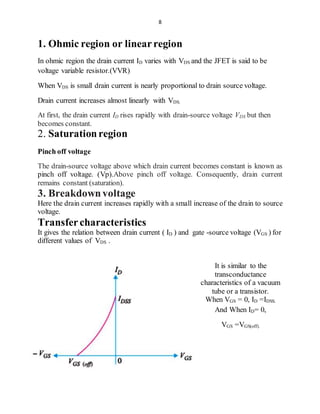
Transfercharacteristics
It gives the relation between drain current ( ID ) and gate -source voltage (VGS ) for
different values of VDS .
It is similar to the
transconductance
characteristics of a vacuum
tube or a transistor.
When VGS = 0, ID =IDSS.
And When ID= 0,
VGS =VGS(off).
9

JFET

  • 1.
    1 Syllabus Unit 6. FieldEffect Transistor: (8 hours); [Ref. 2: Chapters. 15 & 16, Ref. 3, Ref. 4: Chapter. 4] JFET- Basic construction - Theory of operation - Static characteristics - Drain characteristics- Advantages - MOSFET – Depletion enhancement MOSFET – Construction – Static characteristics.Uni-junction Transistor - Construction- operation Silicon Controlled rectifier - Construction biasing - operation- applications. Books forstudy: 1. Basic electronics- Santiram Kal 2. Basic electronics- B. L. Theraja 3. Principles of electronics- V. K. Mehta 4. A first coursein Electronics- Anwar A. Khan, Kanchan K. Dey 1.FET-FieldEffect Transistor FET is an acronym for Field Effect Transistor. It is a three- terminal unipolar solid state device like bipolar junction transistor (BJT). In FET current is controlled by an electric field setup in the device, hence the name FET. Here the current conduction is only by majority carriers. Due to electrons or holes So FET is called a unipolar device. The three terminal are :- (i).SOURCE (ii).DRAIN (iii).GATE FET is a voltage controlled device. Classificationof FET Based on construction, there are two basic types of FET. (a). JFET-Junction Field Effect Transistor (b). MOSFET-Metal Oxide SemiconductorField Effect Transistor . It is also called insulated gate FET- (IGFET)
  • 2.
    2 a.JFET-JunctionField Effect Transistor(JFET) Ajunction field effect transistor is a three terminal semiconductor device in which current conduction is by one type of carrier i.e., electrons or holes. It is a unipolar device. Current flow is due to majority carriers only. Depending on the type of carriers, JFET are of two types. (i).N-channel JFET (ii).P-Channel JFET (i).N-ChannelJFET A N-type silicon bar containing two pn junctions at the two sides. The bar forms the conducting channel for the charge carriers . In N-channel JFET, the charge carriers are electrons. The two pn junctions forming diodes are connected internally and a common terminal called gate (G).
  • 3.
    3 The terminals atthe either ends of the bar are called Source(S) and Drain (D), and can be interchanged. Either end can be used as sourceand the other end as drain. The electrons enter the channel through the terminal called source and leave through the terminal called Drain. Schematic symbol of n-channel FET is shown in figure. (ii).P-Channel JFET A P-type silicon bar containing two pn junctions at the two sides. The bar forms the conducting channel for the charge carriers. In P-channel JFET, the charge carriers are holes The two pn junctions forming diodes are connected internally and a common terminal called gate (G).
  • 4.
    4 The terminals atthe either ends of the bar are called Source (S) and Drain (D),and can be interchanged. Either end can be used as sourceand the other end as drain. The electrons enter the channel through the terminal called source and leave through the terminal called Drain. 2.Comparisonon BJT and FET BJT FET 1 Bipolar device (Current flow is due to both electrons & holes) Unipolar device (Current flow is due to majority carriers) 2 Current controlled device Voltage controlled device 3 Noisy Less noisy 4 Low input impedance High input impedance 5 Fabrication is not easy Easy to fabricate 6 Operation is temperature dependent Almost temperature independent 7 High gain bandwidth product Low gain bandwidth product 3. Applicationsof JFET (i).Used as amplifiers in electronic voltmeters, oscilloscopes (ii). It is used to construct oscillators. (iii). Used as an analog switch. (iv). Used as a chopper (v). Used in logic circuits.
  • 5.
    5 4. Advantages ofJFET High input impedance, Less noise , High power gain, Voltage controlled device , Small size, long life, high efficiency. Disadvantages Small gain bandwidth product Large switching time Performance deteriorates as frequency increases. 3.Static characteristicsof JFET To understand the electrical behavior of a JFET, to study the interrelation of the current and voltage in JFET. These relationships can be plotted graphically, commonly known as characteristics of JFET. The important characteristics of JFET are 1. Drain characteristics 2. Transfer characteristics Draincharacteristics(output characteristics) It gives the relation between drain current (ID) and drain-source voltage (VDS ) for different values of gate source voltage (VGS). The circuit arrangement for obtaining the characteristics of an n-channel FET is shown in figure.
  • 6.
    6 A typical outputor drain characteristics of a n-channel FET is shown in figure.
  • 7.
    7 The drain characteristicsof JFET can be divided into regions. 1. Ohmic region or linear region 2. Saturation region 3. Breakdown region
  • 8.
    8 1. Ohmic regionor linearregion In ohmic region the drain current ID varies with VDS and the JFET is said to be voltage variable resistor.(VVR) When VDS is small drain current is nearly proportional to drain source voltage. Drain current increases almost linearly with VDS. At first, the drain current ID rises rapidly with drain-source voltage VDS but then becomes constant. 2. Saturationregion Pinch off voltage The drain-source voltage above which drain current becomes constant is known as pinch off voltage. (Vp).Above pinch off voltage. Consequently, drain current remains constant (saturation). 3. Breakdownvoltage Here the drain current increases rapidly with a small increase of the drain to source voltage. Transfercharacteristics It gives the relation between drain current ( ID ) and gate -source voltage (VGS ) for different values of VDS . It is similar to the transconductance characteristics of a vacuum tube or a transistor. When VGS = 0, ID =IDSS. And When ID= 0, VGS =VGS(off).
  • 9.