Name Roll
 Waqas 10-MCT-19
 Shaheryar 10-MCT-57
 Usama 10-MCT-63
 Ishtiaq 10-MCT-64
 M.Ehsan 10-MCT-66
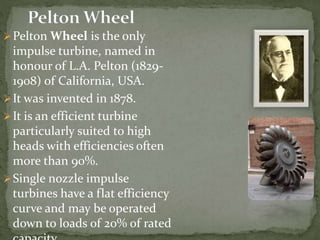
Pelton Wheel is the only
impulse turbine, named in
honour of L.A. Pelton (1829-
1908) of California, USA.
It was invented in 1878.
It is an efficient turbine
particularly suited to high
heads with efficiencies often
more than 90%.
Single nozzle impulse
turbines have a flat efficiency
curve and may be operated
down to loads of 20% of rated
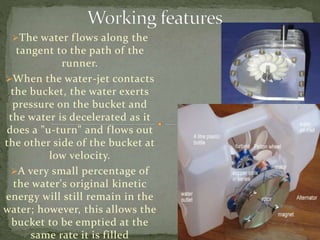
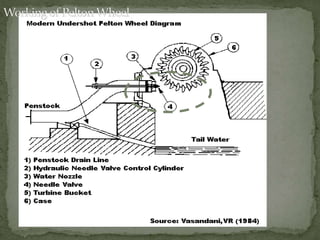
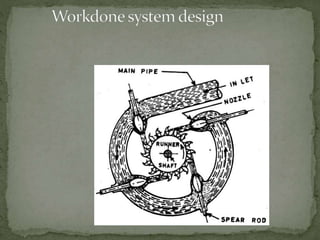
The water flows along the
tangent to the path of the
runner.
When the water-jet contacts
the bucket, the water exerts
pressure on the bucket and
the water is decelerated as it
does a "u-turn" and flows out
the other side of the bucket at
low velocity.
A very small percentage of
the water's original kinetic
energy will still remain in the
water; however, this allows the
bucket to be emptied at the
same rate it is filled
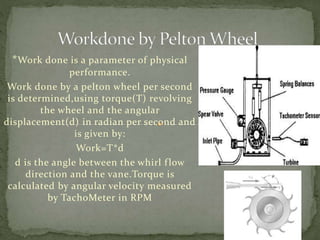
*Work done is a parameter of physical
performance.
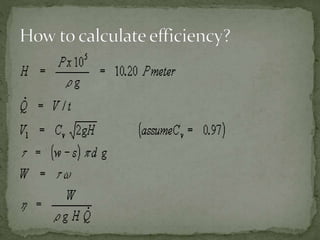
Work done by a pelton wheel per second
is determined,using torque(T) revolving
the wheel and the angular
displacement(d) in radian per second and
is given by:
Work=T*d
d is the angle between the whirl flow
direction and the vane.Torque is
calculated by angular velocity measured
by TachoMeter in RPM
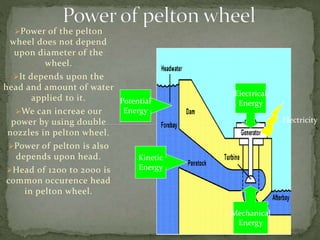
Power of the pelton
wheel does not depend
upon diameter of the
wheel.
It depends upon the
head and amount of water
applied to it.
We can increae our
power by using double
nozzles in pelton wheel.
Power of pelton is also
depends upon head.
Head of 1200 to 2000 is
common occurence head
in pelton wheel.
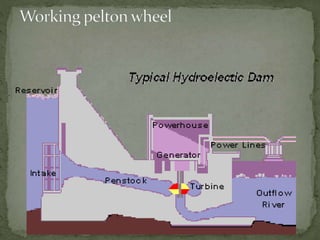
Potential
Energy
Kinetic
Energy
Electrical
Energy
Mechanical
Energy
Electricity
The power P = Fu = Tω, where ω is
the angular velocity of the wheel.
 Substituting for F, we have P = 2ρQ(Vi − u)u.
 To find the runner speed at maximum
power, take the derivative of P with respect
to u and set it equal to zero, [dP/du = 2ρQ(Vi −
2u)].
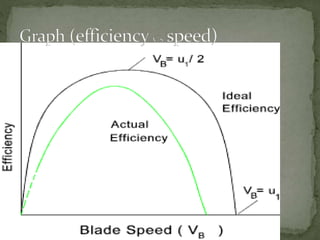
 Maximum power occurs
whenu = Vi /2. Pmax = ρQVi
2/2.
Substituting the initial jet power Vi = √(2gh),
this simplifies to Pmax = ρghQ.
This quantity exactly equals the kinetic
power of the jet, so in this ideal case, the
efficiency is 100%, since all the energy in the
jet is converted to shaft output.
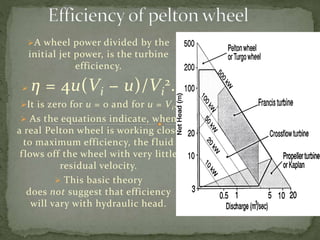
A wheel power divided by the
initial jet power, is the turbine
efficiency.
 η = 4u(Vi − u)/Vi
2.
It is zero for u = 0 and for u = Vi.
 As the equations indicate, when
a real Pelton wheel is working close
to maximum efficiency, the fluid
flows off the wheel with very little
residual velocity.
 This basic theory
does not suggest that efficiency
will vary with hydraulic head.
The work done /s by unit weight of water striking/s is given
by:
Work=1/g[(Vw1+Vw2)u]
Where
g is gravitational acceleration;
Vw1 is velocity of whirl at inlet;
Vw2 is velocity of whirl at outlet and
u is tangential velocity of vane or bucket.

PELTON WHEEL

  • 2.
    Name Roll  Waqas10-MCT-19  Shaheryar 10-MCT-57  Usama 10-MCT-63  Ishtiaq 10-MCT-64  M.Ehsan 10-MCT-66
  • 3.
    Pelton Wheel isthe only impulse turbine, named in honour of L.A. Pelton (1829- 1908) of California, USA. It was invented in 1878. It is an efficient turbine particularly suited to high heads with efficiencies often more than 90%. Single nozzle impulse turbines have a flat efficiency curve and may be operated down to loads of 20% of rated
  • 4.
    The water flowsalong the tangent to the path of the runner. When the water-jet contacts the bucket, the water exerts pressure on the bucket and the water is decelerated as it does a "u-turn" and flows out the other side of the bucket at low velocity. A very small percentage of the water's original kinetic energy will still remain in the water; however, this allows the bucket to be emptied at the same rate it is filled
  • 7.
    *Work done isa parameter of physical performance. Work done by a pelton wheel per second is determined,using torque(T) revolving the wheel and the angular displacement(d) in radian per second and is given by: Work=T*d d is the angle between the whirl flow direction and the vane.Torque is calculated by angular velocity measured by TachoMeter in RPM
  • 9.
    Power of thepelton wheel does not depend upon diameter of the wheel. It depends upon the head and amount of water applied to it. We can increae our power by using double nozzles in pelton wheel. Power of pelton is also depends upon head. Head of 1200 to 2000 is common occurence head in pelton wheel. Potential Energy Kinetic Energy Electrical Energy Mechanical Energy Electricity
  • 10.
    The power P= Fu = Tω, where ω is the angular velocity of the wheel.  Substituting for F, we have P = 2ρQ(Vi − u)u.  To find the runner speed at maximum power, take the derivative of P with respect to u and set it equal to zero, [dP/du = 2ρQ(Vi − 2u)].  Maximum power occurs whenu = Vi /2. Pmax = ρQVi 2/2. Substituting the initial jet power Vi = √(2gh), this simplifies to Pmax = ρghQ. This quantity exactly equals the kinetic power of the jet, so in this ideal case, the efficiency is 100%, since all the energy in the jet is converted to shaft output.
  • 11.
    A wheel powerdivided by the initial jet power, is the turbine efficiency.  η = 4u(Vi − u)/Vi 2. It is zero for u = 0 and for u = Vi.  As the equations indicate, when a real Pelton wheel is working close to maximum efficiency, the fluid flows off the wheel with very little residual velocity.  This basic theory does not suggest that efficiency will vary with hydraulic head.
  • 15.
    The work done/s by unit weight of water striking/s is given by: Work=1/g[(Vw1+Vw2)u] Where g is gravitational acceleration; Vw1 is velocity of whirl at inlet; Vw2 is velocity of whirl at outlet and u is tangential velocity of vane or bucket.