ESP 179- Winter 2012

            EIRs
       January 17, 2012

   Instructor: Trevor Macenski
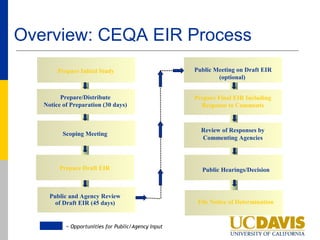
Overview: CEQA EIR Process
        Prepare Initial Study                        Public Meeting on Draft EIR
                                                             (optional)


         Prepare/Distribute                          Prepare Final EIR Including
   Notice of Preparation (30 days)                     Response to Comments


                                                       Review of Responses by
          Scoping Meeting
                                                       Commenting Agencies


        Prepare Draft EIR                              Public Hearings/Decision


     Public and Agency Review
       of Draft EIR (45 days)                         File Notice of Determination


           = Opportunities for Public/Agency Input
EIR Process Highlights
 Notice of Preparation (NOP) review for 30 days
 Scoping meeting is required for qualifying projects
 Public scoping meeting is not required, but is
  commonplace
 Notice of Completion (NOC) and Notice of
  Availability (NOA) to start minimum 45-day Draft
  EIR public review
 Public hearing on Draft EIR is discretionary
EIR Process Highlights
 Proposed responses to comments sent to
  responding public agencies at least 10 days before
  certification
 Public hearing is not required by CEQA, but often
  held for other project review reasons
 EIR certification, project approval, CEQA findings,
  MMRP, statement of overriding considerations (if
  needed)
 File Notice of Determination (NOD)
Environmental Impact Reports
 Project EIR
 Subsequent EIR
 Supplement to an EIR
 Master EIR and Focused EIR
 Program EIR
 Others (Staged, Redevelopment, Base
  Reuse, General Plan)
 Addendum to an EIR
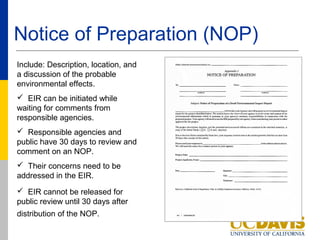
Notice of Preparation (NOP)
Include: Description, location, and
a discussion of the probable
environmental effects.
 EIR can be initiated while
waiting for comments from
responsible agencies.
 Responsible agencies and
public have 30 days to review and
comment on an NOP.
 Their concerns need to be
addressed in the EIR.
 EIR cannot be released for
public review until 30 days after
distribution of the NOP.
NOP Procedures
 Send to State Clearinghouse, Responsible
  Agencies, Trustee Agencies and involved
  Federal Agencies
 Send to jurisdictions, individuals and
  groups with an interest in the project
 Use certified mail or other method to
  confirm delivery
 30 days run from date of receipt
  (not postage date)
Scoping Meeting
 Required for statewide, regional and area
  wide projects as defined in CCR §15206
 Not a public scoping meeting (no public
  notice requirements unless person
  requests notice, but good to invite
  interested public)
 Notice to Responsible, Trustee Agencies
  and persons requesting notice (PRC
  §21083.9; CCR §15082 )
Contents of an EIR
   Table of contents
                                            Format may vary
   Summary
   Project description                     Each element must be
   Environmental setting                    covered
   Consideration and discussion of
    impacts
                                            State where each is
   Significance Thresholds
   Significant effects
                                             discussed
   Mitigation measures
   Alternatives
   Cumulative impacts
   Significant irreversible changes
   Growth inducing impacts
    Effects found not to be significant
   Organizations and persons
    consulted
Contents of an EIR (cont.)
 Table of contents
 Summary
   brief summary of proposed action
   each significant effect and mitigation
   alternatives comparison
   areas of controversy
   issues to be resolved
Contents of an EIR (cont.)
 Project Description
   regional map with location
   precise location/boundaries on a map
   statement of objectives
   project characteristics
   intended uses of the EIR
     agencies using EIR
     list of permits and approvals
     list of environmental review/consultation needs
Contents of an EIR (cont.)
 Environmental Setting
   Description of physical environmental conditions
    at the time of the NOP, or when environmental
    analysis is commenced, if no NOP
   Baseline for environmental analysis, which is
    normally the setting at time of NOP
   Regional setting and rare or unique resources
Contents of an EIR (cont.)
 Significant environmental effects
   thresholds of significance
   direct and indirect, short- and long-term, all phases
   effect of bringing people/development to an area
 Significant effects that cannot be avoided
 Irreversible environmental changes
 Growth-inducing impacts
   foster economic or population growth
   remove obstacles to population growth
Contents of an EIR (cont.)
 Alternatives offer environmental advantage
    Avoid or lessen at least one significant impact
 Feasible alternatives
    “capable of being accomplished in a successful
     manner within a reasonable period of time,
     taking into account economic, environmental,
     social, and technological factors.”
 A range of reasonable alternatives
 Environmentally superior alternative
 Can identify alternatives found to be infeasible
Contents of an EIR (cont.)
 Effects found not to be significant
 Organizations and persons consulted
 List of preparers
 In Final EIR:
   comments on draft EIR,
   list of commenters,
   responses to environmental points raised
   revisions to EIR text (embedded in responses, in
    an errata chapter, or track changes in full text
    discretionary)
Typical EIR Impact Analysis
Issues
 Air quality                Cultural Resources
 Biology                    Traffic
 Hydrology/Water quality    Recreation
 Climate Change/GHG         Agriculture
                             Seismic safety
 Energy
                             Noise
 Geology/Soils              Aesthetics
 Community Character        Hazardous materials
 Land Use & Planning
 Public Services
Project Alternatives

 Shall focus on alternatives to the project
  or its locations which are capable of
  avoiding or substantially lessening any
  significant effects of the proposed project,
  even if these alternatives would impede to
  some degree the attainment of the project
  objectives
How Many Alternatives?
 Rule of Reason
 Mandatory - No Project Alternative
 Typical Alternatives:
   Reduced size/intensity
   Revised design to mitigate impacts
   Alternative locations
Notice of Availability
 Public Notice of Availability (NOA)
   Mailed to those previously requesting notice
    and,
   General circulation newspaper or,
   Posting in the project area or,
   Direct mailing to owners/occupants of
    contiguous parcels
Final EIR
 Text revisions to Draft EIR
 Responses to comments
    Must be good-faith, reasoned analysis
    Must respond to significant environmental points
    Discuss any alternatives suggested during public review
 No separate review period for Final EIR
 Written response to commenting public agencies
    At least 10 days prior to certification
 Explain rationale behind responses (use
  substantial evidence, refer to Draft EIR coverage)
Court Case:
The People vs. County of Kern
…where comments from responsible experts
 or sister agencies disclose new or
 conflicting data or opinions that cause
 concern that the agency may not have
 fully evaluated the project and its
 alternatives, these comments may not
 simply be ignored. There must be good
 faith, reasoned analysis in response.
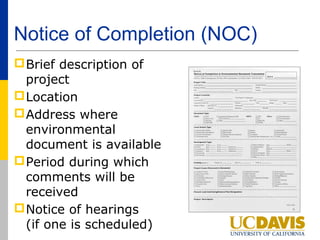
Notice of Completion (NOC)
 Brief description of
  project
 Location
 Address where
  environmental
  document is available
 Period during which
  comments will be
  received
 Notice of hearings
  (if one is scheduled)
Decision Process
 Consider and Certify EIR
 Approve Project
   Make Findings
   Adopt Mitigation, Monitoring Program
   Adopt Statement of Overriding Considerations
    (if necessary)
Findings for a Decision
 Findings needed for approval of Project
 Only 3 possible findings:
    (a)(1) Changes or alterations have been required that
     avoid or substantially lessen significant effects

    (a)(2) Such changes or alterations are within the
     responsibility and jurisdiction of another public agency,
     and such changes have been adopted or can and should
     be adopted by that agency

    (a)(3) Specific economic, legal, social, technological, or
     other considerations make mitigation/alternatives
     infeasible

                      (CCR § 15091)
Hints for Findings
 Finding must be made for each significant effect
 Suggested format
   Impact:
   Finding:
   Facts:
 Facts explain rationale behind the finding
 MMRP need not be in EIR, but adopted with project
  approval
 Mitigation measures become conditions of approval
Statement of Overriding
Considerations
 Statement needed for approval of project with
  remaining significant effects
   Reasons to approve a project where significant impacts
    are not avoided or substantially lessened
   Supported by substantial evidence in the record
   Reasons can be economic, legal, social, technological or
    other, including region-wide or statewide environmental
    benefits (2010 revisions)
                        (CCR § 15093)
Notice of Determination (NOD)
 Within 5 working days after project approval
 Posted with the county clerk for at least 30
  days
 Filed with State Clearinghouse for at least
  30 days
 DFG Fee required at time of filing
 Starts 30 day Statute of Limitations (180
  days if not filed and posted)
 Required for ND/MND and EIR
                (CCR §15094)
Notice of Determination (NOD)
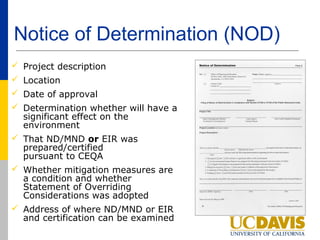
 Project description
 Location
 Date of approval
 Determination whether will have a
  significant effect on the
  environment
 That ND/MND or EIR was
  prepared/certified
  pursuant to CEQA
 Whether mitigation measures are
  a condition and whether
  Statement of Overriding
  Considerations was adopted
 Address of where ND/MND or EIR
  and certification can be examined
Fish and Game Filing Fees
FGC § 711.4
 To file a NOD w/ County Clerk or State
  Clearinghouse
 EIR and ND/MND: (adjusted annually) County
  clerk fee $50 (no fee for Clearinghouse)
 “No effect on fish and wildlife” avoids the fee,
  but narrowly defined
   Contact regional DFG office
 New regulations clarifying the process are
  expected
 Project is not vested or final until fee is paid
Questions?
  Thank You

January 17th- EIRs

  • 1.
    ESP 179- Winter2012 EIRs January 17, 2012 Instructor: Trevor Macenski
  • 2.
    Overview: CEQA EIRProcess Prepare Initial Study Public Meeting on Draft EIR (optional) Prepare/Distribute Prepare Final EIR Including Notice of Preparation (30 days) Response to Comments Review of Responses by Scoping Meeting Commenting Agencies Prepare Draft EIR Public Hearings/Decision Public and Agency Review of Draft EIR (45 days) File Notice of Determination = Opportunities for Public/Agency Input
  • 3.
    EIR Process Highlights Notice of Preparation (NOP) review for 30 days  Scoping meeting is required for qualifying projects  Public scoping meeting is not required, but is commonplace  Notice of Completion (NOC) and Notice of Availability (NOA) to start minimum 45-day Draft EIR public review  Public hearing on Draft EIR is discretionary
  • 4.
    EIR Process Highlights Proposed responses to comments sent to responding public agencies at least 10 days before certification  Public hearing is not required by CEQA, but often held for other project review reasons  EIR certification, project approval, CEQA findings, MMRP, statement of overriding considerations (if needed)  File Notice of Determination (NOD)
  • 5.
    Environmental Impact Reports Project EIR  Subsequent EIR  Supplement to an EIR  Master EIR and Focused EIR  Program EIR  Others (Staged, Redevelopment, Base Reuse, General Plan)  Addendum to an EIR
  • 6.
    Notice of Preparation(NOP) Include: Description, location, and a discussion of the probable environmental effects.  EIR can be initiated while waiting for comments from responsible agencies.  Responsible agencies and public have 30 days to review and comment on an NOP.  Their concerns need to be addressed in the EIR.  EIR cannot be released for public review until 30 days after distribution of the NOP.
  • 7.
    NOP Procedures  Sendto State Clearinghouse, Responsible Agencies, Trustee Agencies and involved Federal Agencies  Send to jurisdictions, individuals and groups with an interest in the project  Use certified mail or other method to confirm delivery  30 days run from date of receipt (not postage date)
  • 8.
    Scoping Meeting  Requiredfor statewide, regional and area wide projects as defined in CCR §15206  Not a public scoping meeting (no public notice requirements unless person requests notice, but good to invite interested public)  Notice to Responsible, Trustee Agencies and persons requesting notice (PRC §21083.9; CCR §15082 )
  • 9.
    Contents of anEIR  Table of contents  Format may vary  Summary  Project description  Each element must be  Environmental setting covered  Consideration and discussion of impacts  State where each is  Significance Thresholds  Significant effects discussed  Mitigation measures  Alternatives  Cumulative impacts  Significant irreversible changes  Growth inducing impacts  Effects found not to be significant  Organizations and persons consulted
  • 10.
    Contents of anEIR (cont.)  Table of contents  Summary  brief summary of proposed action  each significant effect and mitigation  alternatives comparison  areas of controversy  issues to be resolved
  • 11.
    Contents of anEIR (cont.)  Project Description  regional map with location  precise location/boundaries on a map  statement of objectives  project characteristics  intended uses of the EIR agencies using EIR list of permits and approvals list of environmental review/consultation needs
  • 12.
    Contents of anEIR (cont.)  Environmental Setting  Description of physical environmental conditions at the time of the NOP, or when environmental analysis is commenced, if no NOP  Baseline for environmental analysis, which is normally the setting at time of NOP  Regional setting and rare or unique resources
  • 13.
    Contents of anEIR (cont.)  Significant environmental effects  thresholds of significance  direct and indirect, short- and long-term, all phases  effect of bringing people/development to an area  Significant effects that cannot be avoided  Irreversible environmental changes  Growth-inducing impacts  foster economic or population growth  remove obstacles to population growth
  • 14.
    Contents of anEIR (cont.)  Alternatives offer environmental advantage  Avoid or lessen at least one significant impact  Feasible alternatives  “capable of being accomplished in a successful manner within a reasonable period of time, taking into account economic, environmental, social, and technological factors.”  A range of reasonable alternatives  Environmentally superior alternative  Can identify alternatives found to be infeasible
  • 15.
    Contents of anEIR (cont.)  Effects found not to be significant  Organizations and persons consulted  List of preparers  In Final EIR:  comments on draft EIR,  list of commenters,  responses to environmental points raised  revisions to EIR text (embedded in responses, in an errata chapter, or track changes in full text discretionary)
  • 16.
    Typical EIR ImpactAnalysis Issues  Air quality  Cultural Resources  Biology  Traffic  Hydrology/Water quality  Recreation  Climate Change/GHG  Agriculture  Seismic safety  Energy  Noise  Geology/Soils  Aesthetics  Community Character  Hazardous materials  Land Use & Planning  Public Services
  • 17.
    Project Alternatives  Shallfocus on alternatives to the project or its locations which are capable of avoiding or substantially lessening any significant effects of the proposed project, even if these alternatives would impede to some degree the attainment of the project objectives
  • 18.
    How Many Alternatives? Rule of Reason  Mandatory - No Project Alternative  Typical Alternatives:  Reduced size/intensity  Revised design to mitigate impacts  Alternative locations
  • 19.
    Notice of Availability Public Notice of Availability (NOA)  Mailed to those previously requesting notice and,  General circulation newspaper or,  Posting in the project area or,  Direct mailing to owners/occupants of contiguous parcels
  • 20.
    Final EIR  Textrevisions to Draft EIR  Responses to comments  Must be good-faith, reasoned analysis  Must respond to significant environmental points  Discuss any alternatives suggested during public review  No separate review period for Final EIR  Written response to commenting public agencies  At least 10 days prior to certification  Explain rationale behind responses (use substantial evidence, refer to Draft EIR coverage)
  • 21.
    Court Case: The Peoplevs. County of Kern …where comments from responsible experts or sister agencies disclose new or conflicting data or opinions that cause concern that the agency may not have fully evaluated the project and its alternatives, these comments may not simply be ignored. There must be good faith, reasoned analysis in response.
  • 22.
    Notice of Completion(NOC)  Brief description of project  Location  Address where environmental document is available  Period during which comments will be received  Notice of hearings (if one is scheduled)
  • 23.
    Decision Process  Considerand Certify EIR  Approve Project  Make Findings  Adopt Mitigation, Monitoring Program  Adopt Statement of Overriding Considerations (if necessary)
  • 24.
    Findings for aDecision  Findings needed for approval of Project  Only 3 possible findings:  (a)(1) Changes or alterations have been required that avoid or substantially lessen significant effects  (a)(2) Such changes or alterations are within the responsibility and jurisdiction of another public agency, and such changes have been adopted or can and should be adopted by that agency  (a)(3) Specific economic, legal, social, technological, or other considerations make mitigation/alternatives infeasible (CCR § 15091)
  • 25.
    Hints for Findings Finding must be made for each significant effect  Suggested format  Impact:  Finding:  Facts:  Facts explain rationale behind the finding  MMRP need not be in EIR, but adopted with project approval  Mitigation measures become conditions of approval
  • 26.
    Statement of Overriding Considerations Statement needed for approval of project with remaining significant effects  Reasons to approve a project where significant impacts are not avoided or substantially lessened  Supported by substantial evidence in the record  Reasons can be economic, legal, social, technological or other, including region-wide or statewide environmental benefits (2010 revisions) (CCR § 15093)
  • 27.
    Notice of Determination(NOD)  Within 5 working days after project approval  Posted with the county clerk for at least 30 days  Filed with State Clearinghouse for at least 30 days  DFG Fee required at time of filing  Starts 30 day Statute of Limitations (180 days if not filed and posted)  Required for ND/MND and EIR (CCR §15094)
  • 28.
    Notice of Determination(NOD)  Project description  Location  Date of approval  Determination whether will have a significant effect on the environment  That ND/MND or EIR was prepared/certified pursuant to CEQA  Whether mitigation measures are a condition and whether Statement of Overriding Considerations was adopted  Address of where ND/MND or EIR and certification can be examined
  • 29.
    Fish and GameFiling Fees FGC § 711.4  To file a NOD w/ County Clerk or State Clearinghouse  EIR and ND/MND: (adjusted annually) County clerk fee $50 (no fee for Clearinghouse)  “No effect on fish and wildlife” avoids the fee, but narrowly defined  Contact regional DFG office  New regulations clarifying the process are expected  Project is not vested or final until fee is paid
  • 30.

Editor's Notes

  • #3 Candi – enter process chart (slide 30) from JoAnn 2-26-08 powerpoint (in CEQA powerpoint folder)
  • #18 [NOTES – key is Significant Impacts and Project Objectives ]