ESP 179- Winter 2013

 Environmental Impact Assessment

    Instructor: Trevor Macenski
  Teaching Assistant: Kevin Fang
Waitlisted Students
Capacity for 85 students in class.

Come see me after class to add.

CONTACT: Melissa Whaley for PTA Numbers
Student Affairs Officer
Environmental Science & Policy
2134 Wickson Hall - 530-752-7183
Introductions

 Trevor Macenski
  B.S. Environmental Policy Analysis and Planning- UC Davis
  M.Sc. Environmental Science- Johns Hopkins University
  Board of Directors- Association of Environmental Professionals
     Education Group: Teach CEQA Basics, Advanced CEQA, Etc
     Immerging Issues Committee
     Ag and Land Use Committee
  Certified Wetland Delineator
  Director of Environmental Services, FirstCarbon Solutions
Introductions
Kevin Fang
 B.A. Integrative Biology- UC Berkeley
 M.S. City and Regional Planning- CalPoly
 M.S. Transportation Engineering- CalPoly
 Phd Candidate-Transportation Technology
  and Policy- UC Davis
Course Objectives
 Develop an understanding of Environmental
  Impact Assessment (EIA)
 Provide practical skill set for preparing CEQA
  documents
 Introduce EIA Methodologies related to
  CEQA/NEPA
 Teach you skills that will help you get a job.

“The objective of the course is for students to
  acquire a understanding of the California
  Environmental Quality Act and the Environmental
  Impact Assessment methodologies that are used
  with respect to law, policy, and practice.”
How it will work ?
The quarter divided into two parts:

1) Introduction to theories, concepts, and
   methods

2) Development of practical skills and
   impact assessment methodologies with
   CEQA.
Rules of the game…
 Facebook Page:
    http://www.facebook.com/pages/UC-Davis-ESP-179-Winter-2013/30
    Questions will be posted for discussion
    Articles and websites
 Assumptions:
    Land Use and Planning Concepts
    General Environmental Understanding
    Strong writing skills
 Syllabus:
    Read the websites and articles
    Yes you have to read the course reader
 Class and Discussion:
    Take notes or not your call
    I will provide the lectures usually 2-3 days after the class
    Ask questions and get involved
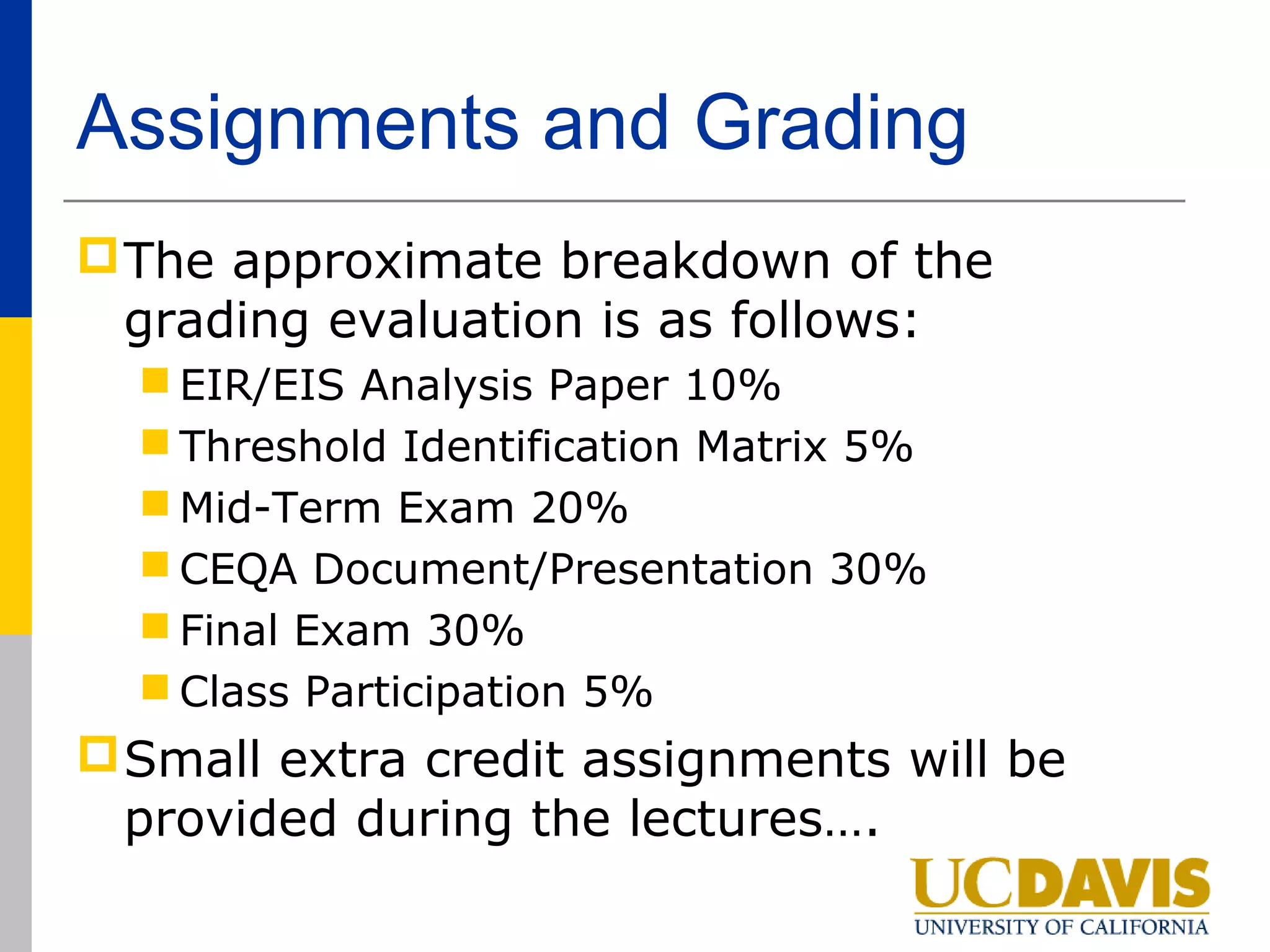
Assignments and Grading
 The approximate breakdown of the
  grading evaluation is as follows:
   EIR/EIS Analysis Paper 10%
   Threshold Identification Matrix 5%
   Mid-Term Exam 20%
   CEQA Document/Presentation 30%
   Final Exam 30%
   Class Participation 5%
 Small extra credit assignments will be
  provided during the lectures….
Questions
Introduction to
Environmental Impact
     Assessment
Environmental Impact Assessment
 EIA- An environmental impact
  assessment is an assessment of the
  possible positive or negative impacts that
  a proposed project may have on the
  environment, together consisting of
  the natural, social and economic aspects.
EIA Purpose
 Ensure that decision makers consider the
  potential environmental impacts when
  deciding whether to proceed with a
  project.

 Requires decision makers to account for
  environmental values.
Origins of EIA
 Public Health
   Policy had long been concerned with cause-
    effect relationships, but, other than sanitary
    protection from infectious disease, medical
    diagnosis tended to regard the environment
    as largely neutral.
 Going to War
   After World War II, direct and indirect
    consequences of new and unfamiliar industrial
    and biomedical technologies stimulated
    research into their impacts upon individuals,
    societies, and nature.
Origins of EIA
 Cost-benefit Analysis
   Cost-benefit analysis had been used to
    establish an appropriate balance between the
    monetary costs of a project and its alleged
    benefits.
   Technique has frequently fallen short of real
    impact analysis. Costs and benefits have often
    been narrowly construed and monetized—
    whatever couldn’t be measured and priced
    being omitted from the calculations.
     It has been relatively easy to skew the inputs and
      outputs to obtain a “politically preferred” ratio.
Origins of EIA
 Blame it all on NEPA
   The development of environmental impact analysis and
    assessment pursuant to NEPA greatly expanded the
    scope and content of cause-effect analysis.
      Other analytic techniques such as technology assessment
       and risk assessment were developed to inform—but not
       necessarily to determine—policy.
   Environmental impact assessment mandated by NEPA
    was specifically intended to influence policy and to force
    action on the principles enumerated under Title I of the
    Act. It was intended to bring ecological rationality to the
    policy process
EIA in the US at the Federal Level
 1960- Environmental Enlightenment
   Resulted in the National Environmental Policy Act
    (NEPA) of 1969.
   NEPA’s purpose: "To declare a national policy which will
    encourage productive and enjoyable harmony between
    man and his environment; to promote efforts which will
    prevent or eliminate damage to the environment and
    biosphere and stimulate the health and welfare of man;
    to enrich the understanding of the ecological systems
    and natural resources important to the Nation; and to
    establish a Council on Environmental Quality."
NEPA
 First national statute to mandate an assessment of the
  environmental impact of proposals for legislation and other
  major governmental action significantly affecting the
  quality of the human environment.
 Provisions:
    The environmental impact of the proposed action
    Any adverse effects which could not be avoided should the
     project be implemented.
    Alternatives to the proposed action
    The relationship between local short-term uses of man’s
     environment and the maintenance and enhancement of long-
     term productivity, and
    Any irreversible and irretrievable commitments of resources
     which would be involved in the proposed action should it be
     implemented.
NEPA
 In addition to the impact statement, NEPA
  (PL 91-190 §102 2[a]), required the
  federal agencies to:
   “utilize a systematic, interdisciplinary approach
    which will insure the integrated use of the
    natural and social sciences, and the
    environmental design arts in planning and in
    decision making which may have an impact on
    man’s environment.”
 The agencies were also required to give
  appropriate consideration to unquantified
  environmental amenities and values.
CEQA
 NEPA passed shortly after the California Environmental
  Quality Act (CEQA) passed in 1970

 CEQA’s Purpose: “To institute a statewide policy of
  environmental protection. CEQA does not directly regulate
  land uses, but instead requires state and local agencies
  within California to follow a protocol of analysis and public
  disclosure of environmental impacts of proposed projects
  and adopt all feasible measures to mitigate those
  impacts. Because CEQA makes environmental protection a
  mandatory part of every California state and local agency's
  decision making process, it has become a model for
  environmental protection laws in other states. It has also
  become the basis for numerous lawsuits concerning public
  and private projects”
CEQA
 Inform government decision makers and
  the public about the potential significant
  environmental impacts of proposed
  activities

 Identify ways that environmental
  impact(s) can be avoided or significantly
  reduced
CEQA
 Prevent significant avoidable damage to
  the environment by requiring changes in
  the project through the use of feasible
  alternatives and mitigation

 Disclose to the public the reason that an
  agency approved a project
  notwithstanding its unavoidable,
  significant environmental impacts
  [Decisions made in the light of day]
Overview: CEQA & Entitlement
 CEQA- 1970
    Checks and balances for land-use development and
     management.
    Revolves around a EIA document called and Environmental
     Impact Report or EIR.
    Other laws matter
       Clean Water Act, Endangered Species Act, Permit Streamlining Act,
        ETC.
 Cities and Counties
    Regulate by planning, zoning, and subdivision controls.
 State Agencies
    Regulate the private use of state land, resources, and certain
     activities
 Federal Agencies
    Have authority over activities on federal lands and over certain
     resources
A Global Perspective
 Australia
   Environment Protection Act 1974 which was superceded
    by the Environment Protection and Biodiversity
    Conservation Act of 1999
 Canada
   Canadian Environmental Assessment Act 1995
 China
   Environmental Impact Assessment Law since 1972 but
    adopted in 2006
 Egypt
   Law 4/1994 for the Protection of Environment, the
    Egyptian Environmental Affairs Agency 1982
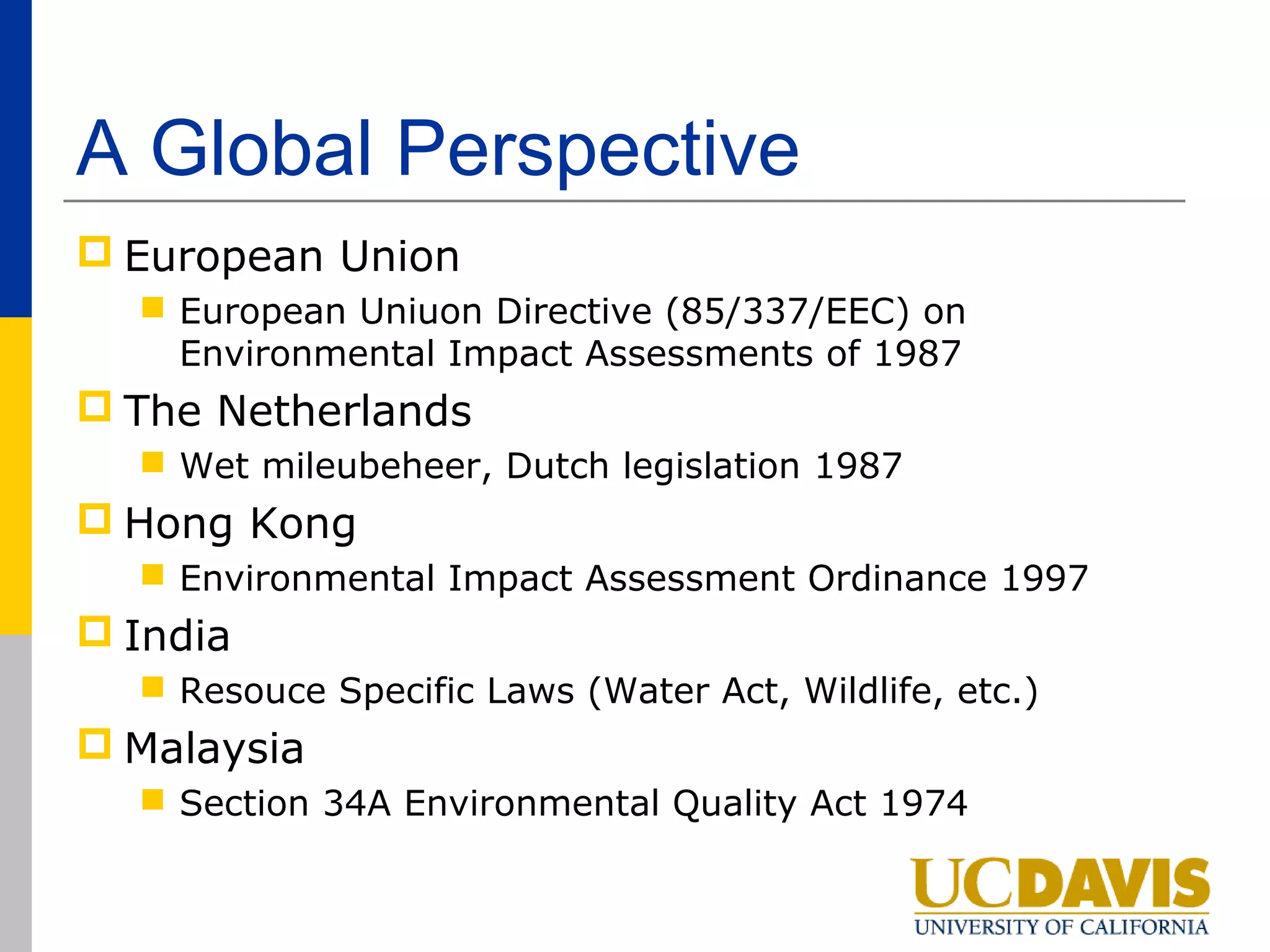
A Global Perspective
 European Union
   European Uniuon Directive (85/337/EEC) on
    Environmental Impact Assessments of 1987
 The Netherlands
   Wet mileubeheer, Dutch legislation 1987
 Hong Kong
   Environmental Impact Assessment Ordinance 1997
 India
   Resouce Specific Laws (Water Act, Wildlife, etc.)
 Malaysia
   Section 34A Environmental Quality Act 1974
Sample Flowcharts
 City of Woodland Example:

 http://www.ci.woodland.ca.us/civica/filebank/b
  =2540
Reading Assignments
 http://ceres.ca.gov/ceqa/guidelines/intro.html

 http://
  en.wikipedia.org/wiki/Environmental_impact_a
Questions?
 Thank You

January 8th esp 179 lecture- class intro and eia basics

  • 1.
    ESP 179- Winter2013 Environmental Impact Assessment Instructor: Trevor Macenski Teaching Assistant: Kevin Fang
  • 2.
    Waitlisted Students Capacity for85 students in class. Come see me after class to add. CONTACT: Melissa Whaley for PTA Numbers Student Affairs Officer Environmental Science & Policy 2134 Wickson Hall - 530-752-7183
  • 3.
    Introductions Trevor Macenski  B.S. Environmental Policy Analysis and Planning- UC Davis  M.Sc. Environmental Science- Johns Hopkins University  Board of Directors- Association of Environmental Professionals  Education Group: Teach CEQA Basics, Advanced CEQA, Etc  Immerging Issues Committee  Ag and Land Use Committee  Certified Wetland Delineator  Director of Environmental Services, FirstCarbon Solutions
  • 4.
    Introductions Kevin Fang  B.A.Integrative Biology- UC Berkeley  M.S. City and Regional Planning- CalPoly  M.S. Transportation Engineering- CalPoly  Phd Candidate-Transportation Technology and Policy- UC Davis
  • 5.
    Course Objectives  Developan understanding of Environmental Impact Assessment (EIA)  Provide practical skill set for preparing CEQA documents  Introduce EIA Methodologies related to CEQA/NEPA  Teach you skills that will help you get a job. “The objective of the course is for students to acquire a understanding of the California Environmental Quality Act and the Environmental Impact Assessment methodologies that are used with respect to law, policy, and practice.”
  • 6.
    How it willwork ? The quarter divided into two parts: 1) Introduction to theories, concepts, and methods 2) Development of practical skills and impact assessment methodologies with CEQA.
  • 7.
    Rules of thegame…  Facebook Page:  http://www.facebook.com/pages/UC-Davis-ESP-179-Winter-2013/30  Questions will be posted for discussion  Articles and websites  Assumptions:  Land Use and Planning Concepts  General Environmental Understanding  Strong writing skills  Syllabus:  Read the websites and articles  Yes you have to read the course reader  Class and Discussion:  Take notes or not your call  I will provide the lectures usually 2-3 days after the class  Ask questions and get involved
  • 8.
    Assignments and Grading The approximate breakdown of the grading evaluation is as follows:  EIR/EIS Analysis Paper 10%  Threshold Identification Matrix 5%  Mid-Term Exam 20%  CEQA Document/Presentation 30%  Final Exam 30%  Class Participation 5%  Small extra credit assignments will be provided during the lectures….
  • 9.
  • 10.
  • 11.
    Environmental Impact Assessment EIA- An environmental impact assessment is an assessment of the possible positive or negative impacts that a proposed project may have on the environment, together consisting of the natural, social and economic aspects.
  • 12.
    EIA Purpose  Ensurethat decision makers consider the potential environmental impacts when deciding whether to proceed with a project.  Requires decision makers to account for environmental values.
  • 13.
    Origins of EIA Public Health  Policy had long been concerned with cause- effect relationships, but, other than sanitary protection from infectious disease, medical diagnosis tended to regard the environment as largely neutral.  Going to War  After World War II, direct and indirect consequences of new and unfamiliar industrial and biomedical technologies stimulated research into their impacts upon individuals, societies, and nature.
  • 14.
    Origins of EIA Cost-benefit Analysis  Cost-benefit analysis had been used to establish an appropriate balance between the monetary costs of a project and its alleged benefits.  Technique has frequently fallen short of real impact analysis. Costs and benefits have often been narrowly construed and monetized— whatever couldn’t be measured and priced being omitted from the calculations. It has been relatively easy to skew the inputs and outputs to obtain a “politically preferred” ratio.
  • 15.
    Origins of EIA Blame it all on NEPA  The development of environmental impact analysis and assessment pursuant to NEPA greatly expanded the scope and content of cause-effect analysis.  Other analytic techniques such as technology assessment and risk assessment were developed to inform—but not necessarily to determine—policy.  Environmental impact assessment mandated by NEPA was specifically intended to influence policy and to force action on the principles enumerated under Title I of the Act. It was intended to bring ecological rationality to the policy process
  • 16.
    EIA in theUS at the Federal Level  1960- Environmental Enlightenment  Resulted in the National Environmental Policy Act (NEPA) of 1969.  NEPA’s purpose: "To declare a national policy which will encourage productive and enjoyable harmony between man and his environment; to promote efforts which will prevent or eliminate damage to the environment and biosphere and stimulate the health and welfare of man; to enrich the understanding of the ecological systems and natural resources important to the Nation; and to establish a Council on Environmental Quality."
  • 17.
    NEPA  First nationalstatute to mandate an assessment of the environmental impact of proposals for legislation and other major governmental action significantly affecting the quality of the human environment.  Provisions:  The environmental impact of the proposed action  Any adverse effects which could not be avoided should the project be implemented.  Alternatives to the proposed action  The relationship between local short-term uses of man’s environment and the maintenance and enhancement of long- term productivity, and  Any irreversible and irretrievable commitments of resources which would be involved in the proposed action should it be implemented.
  • 18.
    NEPA  In additionto the impact statement, NEPA (PL 91-190 §102 2[a]), required the federal agencies to:  “utilize a systematic, interdisciplinary approach which will insure the integrated use of the natural and social sciences, and the environmental design arts in planning and in decision making which may have an impact on man’s environment.”  The agencies were also required to give appropriate consideration to unquantified environmental amenities and values.
  • 19.
    CEQA  NEPA passedshortly after the California Environmental Quality Act (CEQA) passed in 1970  CEQA’s Purpose: “To institute a statewide policy of environmental protection. CEQA does not directly regulate land uses, but instead requires state and local agencies within California to follow a protocol of analysis and public disclosure of environmental impacts of proposed projects and adopt all feasible measures to mitigate those impacts. Because CEQA makes environmental protection a mandatory part of every California state and local agency's decision making process, it has become a model for environmental protection laws in other states. It has also become the basis for numerous lawsuits concerning public and private projects”
  • 20.
    CEQA  Inform governmentdecision makers and the public about the potential significant environmental impacts of proposed activities  Identify ways that environmental impact(s) can be avoided or significantly reduced
  • 21.
    CEQA  Prevent significantavoidable damage to the environment by requiring changes in the project through the use of feasible alternatives and mitigation  Disclose to the public the reason that an agency approved a project notwithstanding its unavoidable, significant environmental impacts [Decisions made in the light of day]
  • 22.
    Overview: CEQA &Entitlement  CEQA- 1970  Checks and balances for land-use development and management.  Revolves around a EIA document called and Environmental Impact Report or EIR.  Other laws matter  Clean Water Act, Endangered Species Act, Permit Streamlining Act, ETC.  Cities and Counties  Regulate by planning, zoning, and subdivision controls.  State Agencies  Regulate the private use of state land, resources, and certain activities  Federal Agencies  Have authority over activities on federal lands and over certain resources
  • 23.
    A Global Perspective Australia  Environment Protection Act 1974 which was superceded by the Environment Protection and Biodiversity Conservation Act of 1999  Canada  Canadian Environmental Assessment Act 1995  China  Environmental Impact Assessment Law since 1972 but adopted in 2006  Egypt  Law 4/1994 for the Protection of Environment, the Egyptian Environmental Affairs Agency 1982
  • 24.
    A Global Perspective European Union  European Uniuon Directive (85/337/EEC) on Environmental Impact Assessments of 1987  The Netherlands  Wet mileubeheer, Dutch legislation 1987  Hong Kong  Environmental Impact Assessment Ordinance 1997  India  Resouce Specific Laws (Water Act, Wildlife, etc.)  Malaysia  Section 34A Environmental Quality Act 1974
  • 25.
    Sample Flowcharts  Cityof Woodland Example:  http://www.ci.woodland.ca.us/civica/filebank/b =2540
  • 26.
    Reading Assignments  http://ceres.ca.gov/ceqa/guidelines/intro.html http:// en.wikipedia.org/wiki/Environmental_impact_a
  • 27.