
BY Sir Hamisi Kisesa (Gumzo)
Email: kisesahamis@gmail.com Or
kisesahamis@arpf.or.tz
Website:www.arpf.or.tz
Mobile:+255717797536 Or
+255762655283
 Introduction
 Registration criteria
 Screening criteria
 Scoping criteria
 Compiling Term of References
 Organizing EIA study
 Undertaking full EIA study
 Environment Impact Statement (EIS)
 EAI review
 Environment Management and Monitoring
 Environment Auditing
 Decision making
 This presentation basing on assessing of any
proposed development activity/project under
EIA.
 The presentation also based much on
Tanzania country.
 Any proposed project development has great
influence on either positive or negative
impacts on the environment.
 Therefore, there is a need to evaluate such
project basis on the environmental effects.
 On assessing such proposed project the
assessor needs to evaluate by using
Environment impact assessment processes.
 The environment impact assessment work
under series of steps.
 Such steps are ;
 The project proponent should first officially
register in purpose to undertake development
activity.
 Remember, registration process differs from
country to country.
 In Tanzania, ENVIROMENT REGULATORY
BODY (ERBS) Responsible for registration of
proposed project.
 Screening determining what level of
environmental assessment exhibit.
 Determine the proposed project if require EIA
or not since not all project needs EIA.
 ON THIS PROCESS ;
 Identify project activities that may cause
potential significant impacts.
 Identify project capacity, project size, project
location ,etc
 Observe if it is community based or not.
 Observe the environmental characteristics on
that project.
 Then predict the impact.
 Also you need to identify if the project requre
full scale EIA or further environmental
analysis or not .
 Example of projects that require full Scale EIA
, infrastructure project, fishing practices,
waste management and disposal, large scale
industries activities etc.
 On screening proposed project develop a
check list type approach.
 Example ,
 USA check list criteria
 European union check list criteria
 World bank check list criteria
 African bank check list criteria
 European bank check list criteria
 If proposed project falling outside of the
developed checklist criteria would not
normally require further assessment.
 Consider,
LEVEL OF ENVIROMENT ASSESMENT OF KISESA
PROJECT COMPOSED WITH LEVEL OF EXPECTED
USING WORLD BANK CRITERIA.
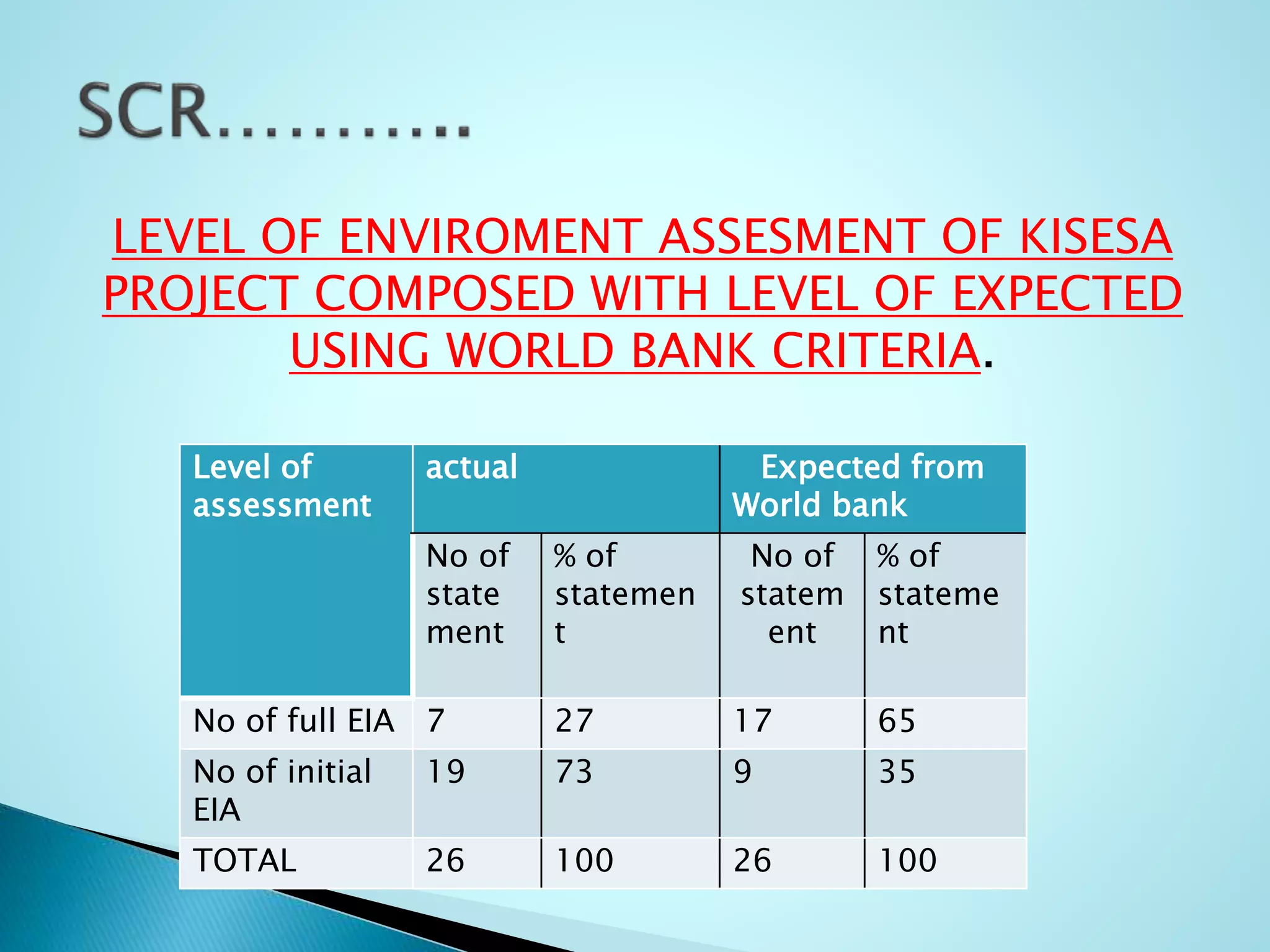
LEVEL OF ENVIROMENT ASSESMENT OF KISESA
PROJECT COMPOSED WITH LEVEL OF EXPECTED
USING WORLD BANK CRITERIA.
Level of
assessment
actual Expected from
World bank
No of
state
ment
% of
statemen
t
No of
statem
ent
% of
stateme
nt
No of full EIA 7 27 17 65
No of initial
EIA
19 73 9 35
TOTAL 26 100 26 100
 Scoping focus EIA key issues for decision
making.
 Identify information needed like, study
boundaries( spatial, temporal or institutional
boundaries).
 State main problem and issues surround the
project.
 State positive and negative impacts of the
project.
 Example GUMZO FARMING IN ARUSHA ALONG
USA RIVER.
 Report how scoping was undertaking on this
project.
 Report how authorities and interested
affected parties involved on this project.
 Report how local or central government was
involved.
 Stakeholders concerns
 Examine the impacts and prepare the impact
assessment or alternatives
 TOR format depend on the local condition
and circumstances of the project.
 TOR may be prepared by developer, agency
or consultant requested by the developer or
donor like world bank.
 TOR should be systematic, tailored to the
specific context of the project.
 TOR should introduce the proponent, project
proposal and objective of the study
 TOR should introduce relevant studies
(background).
 TOR should introduce specific EIA
requirement like how to address, avoiding,
mitigate and managing impacts.
 TOR should shows range of stakeholders who
should involved in EIA process.
 TOR should indicate time for undertaking on
EIA process( timelines).
 It involves acquisition of relevant
environmental standards and guidelines,
laws, policies and institutional arrangement.
 Organizing EIA ensuring the team , time,
stakeholders , financial resources etc are
available and adequate.
 Attempts to predict which impacts will occurs
as a results of the project and their likely
significances
 It identify measures to mitigate or avoid the
impacts.
 It identify all impacts that should be
investigated in details.
 It considers alternative site for the project
and identify environmental implication on
each.
 It evaluate and asses impacts by determine
significance impacts at local, national and
international levels.
 It seeks to develop mitigation measures to
prevent or reduce impacts of the project and
these should be drawn together into
environmental management plan.
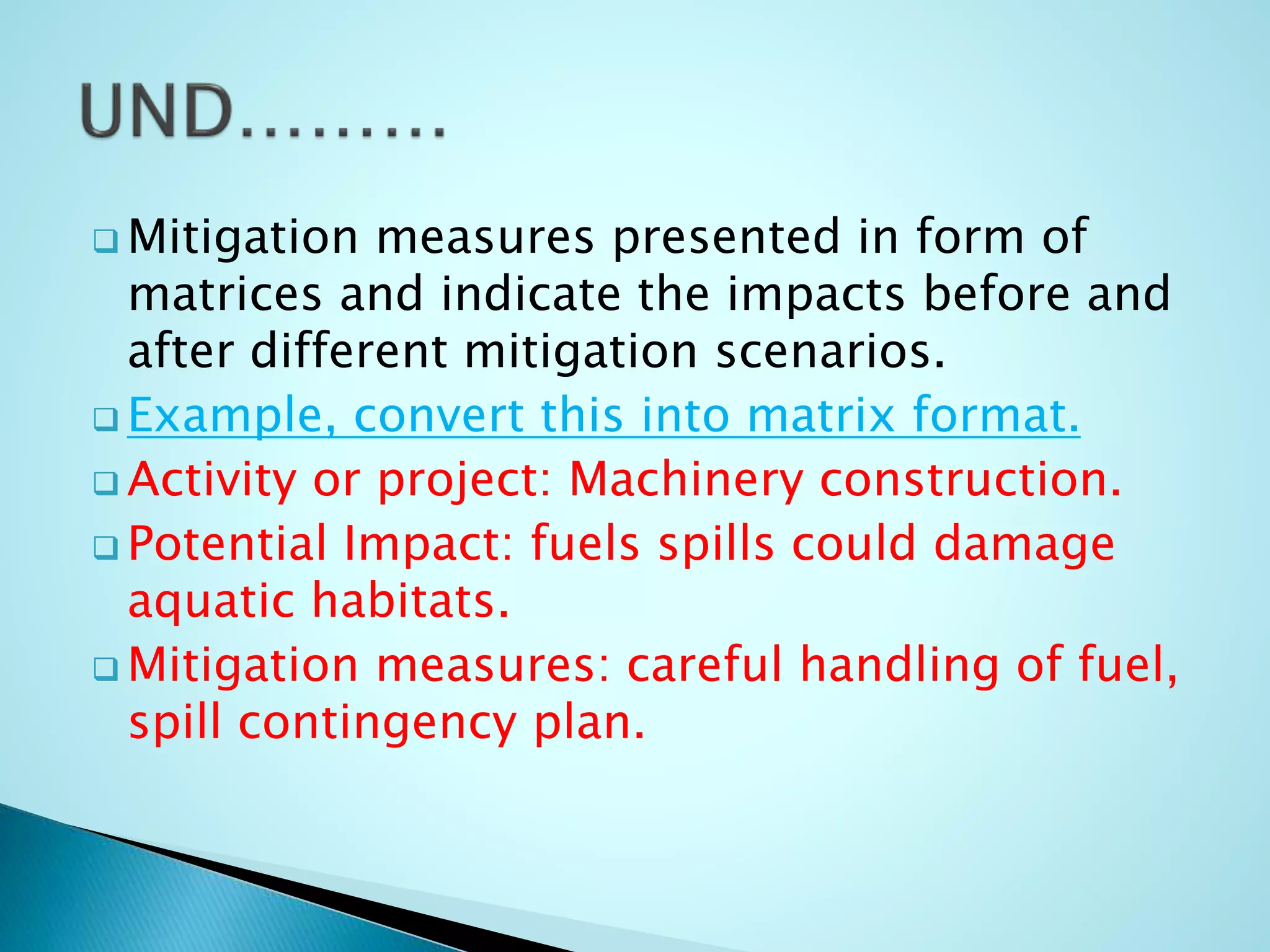
 Mitigation measures presented in form of
matrices and indicate the impacts before and
after different mitigation scenarios.
 Example, convert this into matrix format.
 Activity or project: Machinery construction.
 Potential Impact: fuels spills could damage
aquatic habitats.
 Mitigation measures: careful handling of fuel,
spill contingency plan.
 This involves the following:
 Executive summary
 Two or three pages written.
 Should be written in kiswahili and English for
Tanzania.
 Not use jargon and technical languages.
 Title of the project, location of the project, name of
the proponent, name of the organization preparing
the EIA project, brief environment description, names
of stakeholders plus their public involvement,
description of major significant impacts,
recommendation and compensation/ mitigation
measures and conclusion.
 Introduction Should identify type of project
proposed like, road, forest etc. and State its
location, size of coverage, outline proponents
and its background.
 Project description
 Project stakeholders and public involvement.
 Description of institutional and policy
 Assessment of environmental impact
 Environmental planning and design
 Impact mitigation planning and management
 Economic evaluation (environmental cost and
benefit of the project)
 Summary and recommendation
 appendices
 It asses quality of the EIA and its adequacy for
decision making.
 In Tanzania review agencies establish special
review panel drawn from different
organization and agencies like universities,
NGOs, consultation organizations, expertise
from government departments etc.
 It reviews sufficiency information if provided.
 It reviews sufficient attention to EIA process
like project design team.
 It reviews reliability of analysis and
interpretation like use of accepted
methodologies .
 It reviews utility of decision making like clear
description of the environmental
consequences, clear statement etc.
 It asses the effects of the project on the
natural and cultural environment.
 Environmental management plans that
prepared by developer used to bring together
mitigation and monitoring measures.
 It assure approval conditions and mitigation
measures have been carried out and testing
whether predictions were accurates.
 It review practices related to meeting
environmental requirements.
 It provide opportunity to re-thinks
environmental management practices as the
project progress through the project cycle by:
 Audit what environmental impacts were
predicted.
 Audit actual impacts that have been
monitored.
 Also audit where the results recorded?
 This takes throughout the EIA process and
many decision are made by proponent.
 During decision making it involves three main
points (decision maker, actions and
outcomes)
 Example
 Decision maker: EIA agency or regulator.
 Action: screening of the project.
 Outcomes: full EIA required, no EIA required
or preliminary EIA
FOR MORE COMPREHENSIVE SUMMARY
MATERIALS
FOLLOW AND SHARE
kisesahamis/slideshares

Assessing proposed project development under EIA

  • 1.
    BY Sir HamisiKisesa (Gumzo) Email: kisesahamis@gmail.com Or kisesahamis@arpf.or.tz Website:www.arpf.or.tz Mobile:+255717797536 Or +255762655283
  • 2.
     Introduction  Registrationcriteria  Screening criteria  Scoping criteria  Compiling Term of References  Organizing EIA study
  • 3.
     Undertaking fullEIA study  Environment Impact Statement (EIS)  EAI review  Environment Management and Monitoring  Environment Auditing  Decision making
  • 4.
     This presentationbasing on assessing of any proposed development activity/project under EIA.  The presentation also based much on Tanzania country.  Any proposed project development has great influence on either positive or negative impacts on the environment.  Therefore, there is a need to evaluate such project basis on the environmental effects.
  • 5.
     On assessingsuch proposed project the assessor needs to evaluate by using Environment impact assessment processes.  The environment impact assessment work under series of steps.  Such steps are ;
  • 6.
     The projectproponent should first officially register in purpose to undertake development activity.  Remember, registration process differs from country to country.  In Tanzania, ENVIROMENT REGULATORY BODY (ERBS) Responsible for registration of proposed project.
  • 7.
     Screening determiningwhat level of environmental assessment exhibit.  Determine the proposed project if require EIA or not since not all project needs EIA.  ON THIS PROCESS ;  Identify project activities that may cause potential significant impacts.  Identify project capacity, project size, project location ,etc  Observe if it is community based or not.
  • 8.
     Observe theenvironmental characteristics on that project.  Then predict the impact.  Also you need to identify if the project requre full scale EIA or further environmental analysis or not .  Example of projects that require full Scale EIA , infrastructure project, fishing practices, waste management and disposal, large scale industries activities etc.
  • 9.
     On screeningproposed project develop a check list type approach.  Example ,  USA check list criteria  European union check list criteria  World bank check list criteria  African bank check list criteria  European bank check list criteria
  • 10.
     If proposedproject falling outside of the developed checklist criteria would not normally require further assessment.  Consider, LEVEL OF ENVIROMENT ASSESMENT OF KISESA PROJECT COMPOSED WITH LEVEL OF EXPECTED USING WORLD BANK CRITERIA.
  • 11.
    LEVEL OF ENVIROMENTASSESMENT OF KISESA PROJECT COMPOSED WITH LEVEL OF EXPECTED USING WORLD BANK CRITERIA. Level of assessment actual Expected from World bank No of state ment % of statemen t No of statem ent % of stateme nt No of full EIA 7 27 17 65 No of initial EIA 19 73 9 35 TOTAL 26 100 26 100
  • 12.
     Scoping focusEIA key issues for decision making.  Identify information needed like, study boundaries( spatial, temporal or institutional boundaries).  State main problem and issues surround the project.  State positive and negative impacts of the project.
  • 13.
     Example GUMZOFARMING IN ARUSHA ALONG USA RIVER.  Report how scoping was undertaking on this project.  Report how authorities and interested affected parties involved on this project.  Report how local or central government was involved.  Stakeholders concerns  Examine the impacts and prepare the impact assessment or alternatives
  • 14.
     TOR formatdepend on the local condition and circumstances of the project.  TOR may be prepared by developer, agency or consultant requested by the developer or donor like world bank.  TOR should be systematic, tailored to the specific context of the project.
  • 15.
     TOR shouldintroduce the proponent, project proposal and objective of the study  TOR should introduce relevant studies (background).  TOR should introduce specific EIA requirement like how to address, avoiding, mitigate and managing impacts.  TOR should shows range of stakeholders who should involved in EIA process.  TOR should indicate time for undertaking on EIA process( timelines).
  • 16.
     It involvesacquisition of relevant environmental standards and guidelines, laws, policies and institutional arrangement.  Organizing EIA ensuring the team , time, stakeholders , financial resources etc are available and adequate.
  • 17.
     Attempts topredict which impacts will occurs as a results of the project and their likely significances  It identify measures to mitigate or avoid the impacts.  It identify all impacts that should be investigated in details.  It considers alternative site for the project and identify environmental implication on each.
  • 18.
     It evaluateand asses impacts by determine significance impacts at local, national and international levels.  It seeks to develop mitigation measures to prevent or reduce impacts of the project and these should be drawn together into environmental management plan.
  • 19.
     Mitigation measurespresented in form of matrices and indicate the impacts before and after different mitigation scenarios.  Example, convert this into matrix format.  Activity or project: Machinery construction.  Potential Impact: fuels spills could damage aquatic habitats.  Mitigation measures: careful handling of fuel, spill contingency plan.
  • 20.
     This involvesthe following:  Executive summary  Two or three pages written.  Should be written in kiswahili and English for Tanzania.  Not use jargon and technical languages.  Title of the project, location of the project, name of the proponent, name of the organization preparing the EIA project, brief environment description, names of stakeholders plus their public involvement, description of major significant impacts, recommendation and compensation/ mitigation measures and conclusion.
  • 21.
     Introduction Shouldidentify type of project proposed like, road, forest etc. and State its location, size of coverage, outline proponents and its background.  Project description  Project stakeholders and public involvement.  Description of institutional and policy
  • 22.
     Assessment ofenvironmental impact  Environmental planning and design  Impact mitigation planning and management  Economic evaluation (environmental cost and benefit of the project)  Summary and recommendation  appendices
  • 23.
     It assesquality of the EIA and its adequacy for decision making.  In Tanzania review agencies establish special review panel drawn from different organization and agencies like universities, NGOs, consultation organizations, expertise from government departments etc.
  • 24.
     It reviewssufficiency information if provided.  It reviews sufficient attention to EIA process like project design team.  It reviews reliability of analysis and interpretation like use of accepted methodologies .  It reviews utility of decision making like clear description of the environmental consequences, clear statement etc.
  • 25.
     It assesthe effects of the project on the natural and cultural environment.  Environmental management plans that prepared by developer used to bring together mitigation and monitoring measures.  It assure approval conditions and mitigation measures have been carried out and testing whether predictions were accurates.
  • 26.
     It reviewpractices related to meeting environmental requirements.  It provide opportunity to re-thinks environmental management practices as the project progress through the project cycle by:  Audit what environmental impacts were predicted.  Audit actual impacts that have been monitored.  Also audit where the results recorded?
  • 27.
     This takesthroughout the EIA process and many decision are made by proponent.  During decision making it involves three main points (decision maker, actions and outcomes)  Example  Decision maker: EIA agency or regulator.  Action: screening of the project.  Outcomes: full EIA required, no EIA required or preliminary EIA
  • 28.
    FOR MORE COMPREHENSIVESUMMARY MATERIALS FOLLOW AND SHARE kisesahamis/slideshares