Basic Concepts for
Assessing Environmental
Impacts
[DATE][SPEAKERS NAMES]
ENCAP EA-ESD Course: Basic Concepts for EIA. Visit
www.encapafrica.org 2
In EIA, the term
“impacts” is used
instead of “effects
of activities.”
What is an
impact?
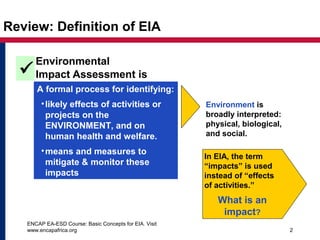
Review: Definition of EIA
Environmental
Impact Assessment is
A formal process for identifying:
•likely effects of activities or
projects on the
ENVIRONMENT, and on
human health and welfare.
•means and measures to
mitigate & monitor these
impacts

Environment is
broadly interpreted:
physical, biological,
and social.
ENCAP EA-ESD Course: Basic Concepts for EIA. Visit
www.encapafrica.org 3
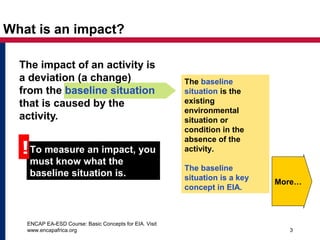
What is an impact?
The impact of an activity is
a deviation (a change)
from the baseline situation
that is caused by the
activity.
To measure an impact, you
must know what the
baseline situation is.
!
The baseline
situation is the
existing
environmental
situation or
condition in the
absence of the
activity.
The baseline
situation is a key
concept in EIA.
More…
ENCAP EA-ESD Course: Basic Concepts for EIA. Visit
www.encapafrica.org 4
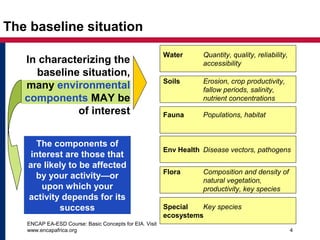
The baseline situation
In characterizing the
baseline situation,
many environmental
components MAY be
of interest
Water Quantity, quality, reliability,
accessibility
Soils Erosion, crop productivity,
fallow periods, salinity,
nutrient concentrations
Flora Composition and density of
natural vegetation,
productivity, key species
Fauna Populations, habitat
Special Key species
ecosystems
Env Health Disease vectors, pathogens
The components of
interest are those that
are likely to be affected
by your activity—or
upon which your
activity depends for its
success
ENCAP EA-ESD Course: Basic Concepts for EIA. Visit
www.encapafrica.org 5
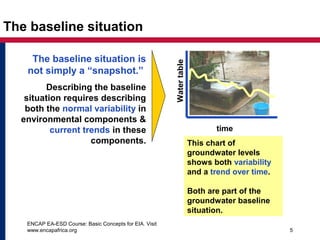
The baseline situation
The baseline situation is
not simply a “snapshot.”
Describing the baseline
situation requires describing
both the normal variability in
environmental components &
current trends in these
components.
time
Watertable
This chart of
groundwater levels
shows both variability
and a trend over time.
Both are part of the
groundwater baseline
situation.
ENCAP EA-ESD Course: Basic Concepts for EIA. Visit
www.encapafrica.org 6
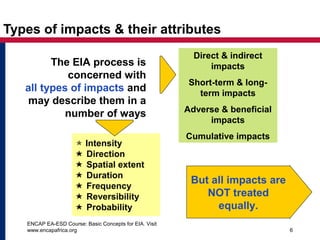
Types of impacts & their attributes
Direct & indirect
impacts
Short-term & long-
term impacts
Adverse & beneficial
impacts
Cumulative impacts
The EIA process is
concerned with
all types of impacts and
may describe them in a
number of ways
 Intensity
 Direction
 Spatial extent
 Duration
 Frequency
 Reversibility
 Probability
But all impacts are
NOT treated
equally.
ENCAP EA-ESD Course: Basic Concepts for EIA. Visit
www.encapafrica.org 7
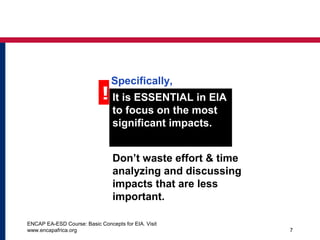
! It is ESSENTIAL in EIA
to focus on the most
significant impacts.
Don’t waste effort & time
analyzing and discussing
impacts that are less
important.
Specifically,
ENCAP EA-ESD Course: Basic Concepts for EIA. Visit
www.encapafrica.org 8
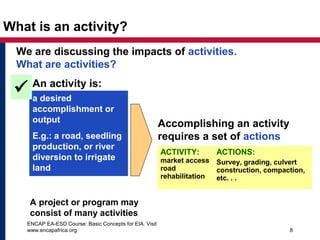
What is an activity?
ACTIVITY:
market access
road
rehabilitation
ACTIONS:
Survey, grading, culvert
construction, compaction,
etc. . .
a desired
accomplishment or
output
E.g.: a road, seedling
production, or river
diversion to irrigate
land
An activity is:

Accomplishing an activity
requires a set of actions
We are discussing the impacts of activities.
What are activities?
A project or program may
consist of many activities
ENCAP EA-ESD Course: Basic Concepts for EIA. Visit
www.encapafrica.org 9
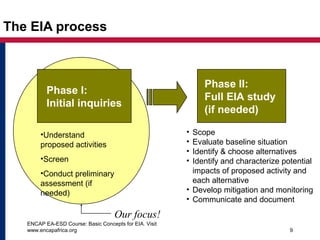
The EIA process
• Scope
• Evaluate baseline situation
• Identify & choose alternatives
• Identify and characterize potential
impacts of proposed activity and
each alternative
• Develop mitigation and monitoring
• Communicate and document
Phase I:
Initial inquiries
Phase II:
Full EIA study
(if needed)
Our focus!
•Understand
proposed activities
•Screen
•Conduct preliminary
assessment (if
needed)
ENCAP EA-ESD Course: Basic Concepts for EIA. Visit
www.encapafrica.org 10
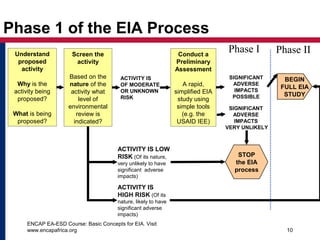
Phase 1 of the EIA Process
Screen the
activity
Based on the
nature of the
activity what
level of
environmental
review is
indicated?
Conduct a
Preliminary
Assessment
A rapid,
simplified EIA
study using
simple tools
(e.g. the
USAID IEE)
ACTIVITY IS
OF MODERATE
OR UNKNOWN
RISK
SIGNIFICANT
ADVERSE
IMPACTS
POSSIBLE
SIGNIFICANT
ADVERSE
IMPACTS
VERY UNLIKELY
ACTIVITY IS LOW
RISK (Of its nature,
very unlikely to have
significant adverse
impacts)
ACTIVITY IS
HIGH RISK (Of its
nature, likely to have
significant adverse
impacts)
Phase IIPhase IUnderstand
proposed
activity
Why is the
activity being
proposed?
What is being
proposed?
BEGIN
FULL EIA
STUDY
STOP
the EIA
process
ENCAP EA-ESD Course: Basic Concepts for EIA. Visit
www.encapafrica.org 11
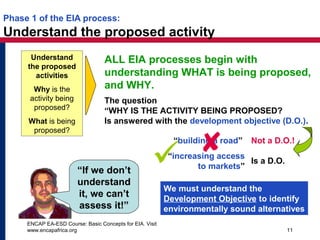
Phase 1 of the EIA process:
Understand the proposed activity
Understand
the proposed
activities
Why is the
activity being
proposed?
What is being
proposed?
ALL EIA processes begin with
understanding WHAT is being proposed,
and WHY.
The question
“WHY IS THE ACTIVITY BEING PROPOSED?
Is answered with the development objective (D.O.).
“If we don’t
understand
it, we can’t
assess it!”
“building a road”
“increasing access
to markets”
We must understand the
Development Objective to identify
environmentally sound alternatives

Not a D.O.!
Is a D.O.
ENCAP EA-ESD Course: Basic Concepts for EIA. Visit
www.encapafrica.org 12
Phase 1 of the EIA process:
Understand the proposed activity
Understand
the proposed
activities
Why is the
activity being
proposed?
What is being
proposed?
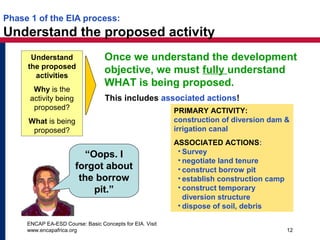
Once we understand the development
objective, we must fully understand
WHAT is being proposed.
“Oops. I
forgot about
the borrow
pit.”
This includes associated actions!
PRIMARY ACTIVITY:
construction of diversion dam &
irrigation canal
ASSOCIATED ACTIONS:
• Survey
• negotiate land tenure
• construct borrow pit
• establish construction camp
• construct temporary
diversion structure
• dispose of soil, debris
ENCAP EA-ESD Course: Basic Concepts for EIA. Visit
www.encapafrica.org 13
Phase 1 of the EIA process:
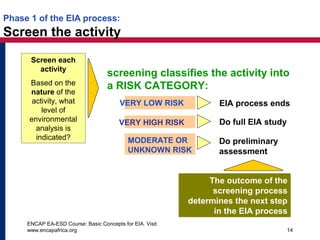
Screen the activity
Screen each
activity
Based on the
nature of the
activity, what
level of
environmental
analysis is
indicated?
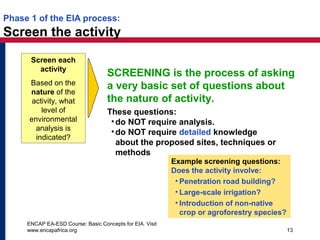
SCREENING is the process of asking
a very basic set of questions about
the nature of activity.
These questions:
•do NOT require analysis.
•do NOT require detailed knowledge
about the proposed sites, techniques or
methods
Example screening questions:
Does the activity involve:
• Penetration road building?
• Large-scale irrigation?
• Introduction of non-native
crop or agroforestry species?
ENCAP EA-ESD Course: Basic Concepts for EIA. Visit
www.encapafrica.org 14
Phase 1 of the EIA process:
Screen the activity
Screen each
activity
Based on the
nature of the
activity, what
level of
environmental
analysis is
indicated?
screening classifies the activity into
a RISK CATEGORY:
VERY LOW RISK
VERY HIGH RISK
MODERATE OR
UNKNOWN RISK
EIA process ends
Do full EIA study
Do preliminary
assessment
The outcome of the
screening process
determines the next step
in the EIA process
ENCAP EA-ESD Course: Basic Concepts for EIA. Visit
www.encapafrica.org 15
Phase 1 of the EIA process:
Screen the activity
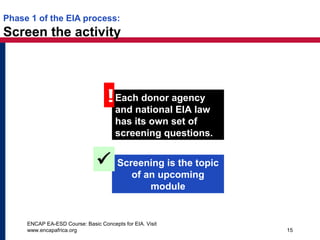
Each donor agency
and national EIA law
has its own set of
screening questions.
!
Screening is the topic
of an upcoming
module

ENCAP EA-ESD Course: Basic Concepts for EIA. Visit
www.encapafrica.org 16
Phase 1 of the EIA process:
The Preliminary Assessment
Conduct a
Preliminary
Assessment
A rapid,
simplified EIA
study using
simple tools
(e.g. the
USAID IEE)
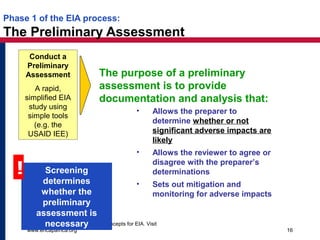
The purpose of a preliminary
assessment is to provide
documentation and analysis that:
Screening
determines
whether the
preliminary
assessment is
necessary
!
• Allows the preparer to
determine whether or not
significant adverse impacts are
likely
• Allows the reviewer to agree or
disagree with the preparer’s
determinations
• Sets out mitigation and
monitoring for adverse impacts
ENCAP EA-ESD Course: Basic Concepts for EIA. Visit
www.encapafrica.org 17
Phase 1 of the EIA process:
The Preliminary Assessment
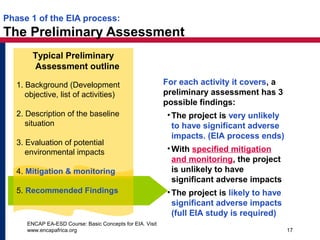
Typical Preliminary
Assessment outline
1. Background (Development
objective, list of activities)
2. Description of the baseline
situation
3. Evaluation of potential
environmental impacts
4. Mitigation & monitoring
5. Recommended Findings
For each activity it covers, a
preliminary assessment has 3
possible findings:
•The project is very unlikely
to have significant adverse
impacts. (EIA process ends)
•With specified mitigation
and monitoring, the project
is unlikely to have
significant adverse impacts
•The project is likely to have
significant adverse impacts
(full EIA study is required)
ENCAP EA-ESD Course: Basic Concepts for EIA. Visit
www.encapafrica.org 18
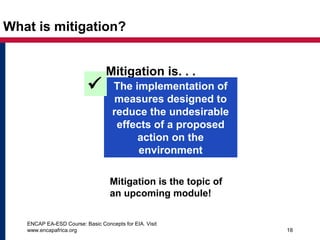
What is mitigation?
Mitigation is. . .
The implementation of
measures designed to
reduce the undesirable
effects of a proposed
action on the
environment

Mitigation is the topic of
an upcoming module!
ENCAP EA-ESD Course: Basic Concepts for EIA. Visit
www.encapafrica.org 19
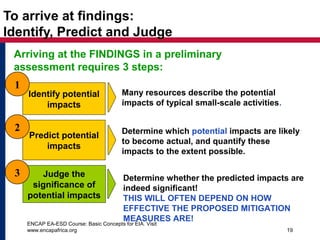
To arrive at findings:
Identify, Predict and Judge
Identify potential
impacts
Judge the
significance of
potential impacts
Predict potential
impacts
Arriving at the FINDINGS in a preliminary
assessment requires 3 steps:
Many resources describe the potential
impacts of typical small-scale activities.
Determine which potential impacts are likely
to become actual, and quantify these
impacts to the extent possible.
1
2
3 Determine whether the predicted impacts are
indeed significant!
THIS WILL OFTEN DEPEND ON HOW
EFFECTIVE THE PROPOSED MITIGATION
MEASURES ARE!
ENCAP EA-ESD Course: Basic Concepts for EIA. Visit
www.encapafrica.org 20
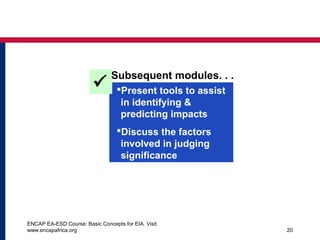
Present tools to assist
in identifying &
predicting impacts
Discuss the factors
involved in judging
significance

Subsequent modules. . .
ENCAP EA-ESD Course: Basic Concepts for EIA. Visit
www.encapafrica.org 21
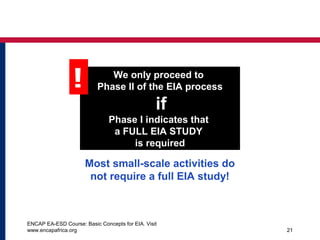
We only proceed to
Phase II of the EIA process
if
Phase I indicates that
a FULL EIA STUDY
is required
!
Most small-scale activities do
not require a full EIA study!
ENCAP EA-ESD Course: Basic Concepts for EIA. Visit
www.encapafrica.org 22
Phase 2 of the EIA process:
The Full EIA study
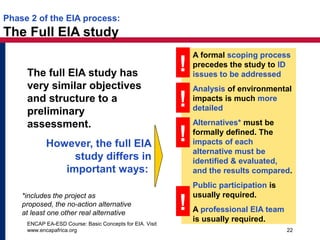
The full EIA study has
very similar objectives
and structure to a
preliminary
assessment.
However, the full EIA
study differs in
important ways:
A formal scoping process
precedes the study to ID
issues to be addressed
Analysis of environmental
impacts is much more
detailed
Alternatives* must be
formally defined. The
impacts of each
alternative must be
identified & evaluated,
and the results compared.
Public participation is
usually required.
A professional EIA team
is usually required.
!
!
!
*includes the project as
proposed, the no-action alternative
at least one other real alternative
!
ENCAP EA-ESD Course: Basic Concepts for EIA. Visit
www.encapafrica.org 23
Phase 2 of the EIA process:
The Full EIA study
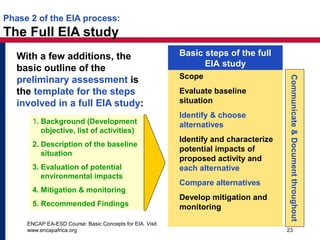
With a few additions, the
basic outline of the
preliminary assessment is
the template for the steps
involved in a full EIA study:
Scope
Evaluate baseline
situation
Identify & choose
alternatives
Identify and characterize
potential impacts of
proposed activity and
each alternative
Compare alternatives
Develop mitigation and
monitoring
1. Background (Development
objective, list of activities)
2. Description of the baseline
situation
3. Evaluation of potential
environmental impacts
4. Mitigation & monitoring
5. Recommended Findings
Basic steps of the full
EIA study
Communicate&Documentthroughout
ENCAP EA-ESD Course: Basic Concepts for EIA. Visit
www.encapafrica.org 24
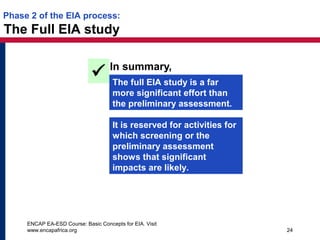
In summary,
The full EIA study is a far
more significant effort than
the preliminary assessment.

It is reserved for activities for
which screening or the
preliminary assessment
shows that significant
impacts are likely.
Phase 2 of the EIA process:
The Full EIA study
ENCAP EA-ESD Course: Basic Concepts for EIA. Visit
www.encapafrica.org 25
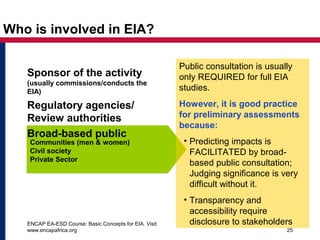
Who is involved in EIA?
Sponsor of the activity
(usually commissions/conducts the
EIA)
Regulatory agencies/
Review authorities
Broad-based public
Public consultation is usually
only REQUIRED for full EIA
studies.
However, it is good practice
for preliminary assessments
because:
• Predicting impacts is
FACILITATED by broad-
based public consultation;
Judging significance is very
difficult without it.
• Transparency and
accessibility require
disclosure to stakeholders
Communities (men & women)
Civil society
Private Sector
ENCAP EA-ESD Course: Basic Concepts for EIA. Visit
www.encapafrica.org 26
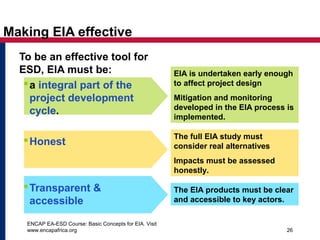
EIA is undertaken early enough
to affect project design
Mitigation and monitoring
developed in the EIA process is
implemented.
Making EIA effective
To be an effective tool for
ESD, EIA must be:
a integral part of the
project development
cycle.
Honest
Transparent &
accessible
The full EIA study must
consider real alternatives
Impacts must be assessed
honestly.
The EIA products must be clear
and accessible to key actors.

Eia basic concepts_15_dec05

  • 1.
    Basic Concepts for AssessingEnvironmental Impacts [DATE][SPEAKERS NAMES]
  • 2.
    ENCAP EA-ESD Course:Basic Concepts for EIA. Visit www.encapafrica.org 2 In EIA, the term “impacts” is used instead of “effects of activities.” What is an impact? Review: Definition of EIA Environmental Impact Assessment is A formal process for identifying: •likely effects of activities or projects on the ENVIRONMENT, and on human health and welfare. •means and measures to mitigate & monitor these impacts  Environment is broadly interpreted: physical, biological, and social.
  • 3.
    ENCAP EA-ESD Course:Basic Concepts for EIA. Visit www.encapafrica.org 3 What is an impact? The impact of an activity is a deviation (a change) from the baseline situation that is caused by the activity. To measure an impact, you must know what the baseline situation is. ! The baseline situation is the existing environmental situation or condition in the absence of the activity. The baseline situation is a key concept in EIA. More…
  • 4.
    ENCAP EA-ESD Course:Basic Concepts for EIA. Visit www.encapafrica.org 4 The baseline situation In characterizing the baseline situation, many environmental components MAY be of interest Water Quantity, quality, reliability, accessibility Soils Erosion, crop productivity, fallow periods, salinity, nutrient concentrations Flora Composition and density of natural vegetation, productivity, key species Fauna Populations, habitat Special Key species ecosystems Env Health Disease vectors, pathogens The components of interest are those that are likely to be affected by your activity—or upon which your activity depends for its success
  • 5.
    ENCAP EA-ESD Course:Basic Concepts for EIA. Visit www.encapafrica.org 5 The baseline situation The baseline situation is not simply a “snapshot.” Describing the baseline situation requires describing both the normal variability in environmental components & current trends in these components. time Watertable This chart of groundwater levels shows both variability and a trend over time. Both are part of the groundwater baseline situation.
  • 6.
    ENCAP EA-ESD Course:Basic Concepts for EIA. Visit www.encapafrica.org 6 Types of impacts & their attributes Direct & indirect impacts Short-term & long- term impacts Adverse & beneficial impacts Cumulative impacts The EIA process is concerned with all types of impacts and may describe them in a number of ways  Intensity  Direction  Spatial extent  Duration  Frequency  Reversibility  Probability But all impacts are NOT treated equally.
  • 7.
    ENCAP EA-ESD Course:Basic Concepts for EIA. Visit www.encapafrica.org 7 ! It is ESSENTIAL in EIA to focus on the most significant impacts. Don’t waste effort & time analyzing and discussing impacts that are less important. Specifically,
  • 8.
    ENCAP EA-ESD Course:Basic Concepts for EIA. Visit www.encapafrica.org 8 What is an activity? ACTIVITY: market access road rehabilitation ACTIONS: Survey, grading, culvert construction, compaction, etc. . . a desired accomplishment or output E.g.: a road, seedling production, or river diversion to irrigate land An activity is:  Accomplishing an activity requires a set of actions We are discussing the impacts of activities. What are activities? A project or program may consist of many activities
  • 9.
    ENCAP EA-ESD Course:Basic Concepts for EIA. Visit www.encapafrica.org 9 The EIA process • Scope • Evaluate baseline situation • Identify & choose alternatives • Identify and characterize potential impacts of proposed activity and each alternative • Develop mitigation and monitoring • Communicate and document Phase I: Initial inquiries Phase II: Full EIA study (if needed) Our focus! •Understand proposed activities •Screen •Conduct preliminary assessment (if needed)
  • 10.
    ENCAP EA-ESD Course:Basic Concepts for EIA. Visit www.encapafrica.org 10 Phase 1 of the EIA Process Screen the activity Based on the nature of the activity what level of environmental review is indicated? Conduct a Preliminary Assessment A rapid, simplified EIA study using simple tools (e.g. the USAID IEE) ACTIVITY IS OF MODERATE OR UNKNOWN RISK SIGNIFICANT ADVERSE IMPACTS POSSIBLE SIGNIFICANT ADVERSE IMPACTS VERY UNLIKELY ACTIVITY IS LOW RISK (Of its nature, very unlikely to have significant adverse impacts) ACTIVITY IS HIGH RISK (Of its nature, likely to have significant adverse impacts) Phase IIPhase IUnderstand proposed activity Why is the activity being proposed? What is being proposed? BEGIN FULL EIA STUDY STOP the EIA process
  • 11.
    ENCAP EA-ESD Course:Basic Concepts for EIA. Visit www.encapafrica.org 11 Phase 1 of the EIA process: Understand the proposed activity Understand the proposed activities Why is the activity being proposed? What is being proposed? ALL EIA processes begin with understanding WHAT is being proposed, and WHY. The question “WHY IS THE ACTIVITY BEING PROPOSED? Is answered with the development objective (D.O.). “If we don’t understand it, we can’t assess it!” “building a road” “increasing access to markets” We must understand the Development Objective to identify environmentally sound alternatives  Not a D.O.! Is a D.O.
  • 12.
    ENCAP EA-ESD Course:Basic Concepts for EIA. Visit www.encapafrica.org 12 Phase 1 of the EIA process: Understand the proposed activity Understand the proposed activities Why is the activity being proposed? What is being proposed? Once we understand the development objective, we must fully understand WHAT is being proposed. “Oops. I forgot about the borrow pit.” This includes associated actions! PRIMARY ACTIVITY: construction of diversion dam & irrigation canal ASSOCIATED ACTIONS: • Survey • negotiate land tenure • construct borrow pit • establish construction camp • construct temporary diversion structure • dispose of soil, debris
  • 13.
    ENCAP EA-ESD Course:Basic Concepts for EIA. Visit www.encapafrica.org 13 Phase 1 of the EIA process: Screen the activity Screen each activity Based on the nature of the activity, what level of environmental analysis is indicated? SCREENING is the process of asking a very basic set of questions about the nature of activity. These questions: •do NOT require analysis. •do NOT require detailed knowledge about the proposed sites, techniques or methods Example screening questions: Does the activity involve: • Penetration road building? • Large-scale irrigation? • Introduction of non-native crop or agroforestry species?
  • 14.
    ENCAP EA-ESD Course:Basic Concepts for EIA. Visit www.encapafrica.org 14 Phase 1 of the EIA process: Screen the activity Screen each activity Based on the nature of the activity, what level of environmental analysis is indicated? screening classifies the activity into a RISK CATEGORY: VERY LOW RISK VERY HIGH RISK MODERATE OR UNKNOWN RISK EIA process ends Do full EIA study Do preliminary assessment The outcome of the screening process determines the next step in the EIA process
  • 15.
    ENCAP EA-ESD Course:Basic Concepts for EIA. Visit www.encapafrica.org 15 Phase 1 of the EIA process: Screen the activity Each donor agency and national EIA law has its own set of screening questions. ! Screening is the topic of an upcoming module 
  • 16.
    ENCAP EA-ESD Course:Basic Concepts for EIA. Visit www.encapafrica.org 16 Phase 1 of the EIA process: The Preliminary Assessment Conduct a Preliminary Assessment A rapid, simplified EIA study using simple tools (e.g. the USAID IEE) The purpose of a preliminary assessment is to provide documentation and analysis that: Screening determines whether the preliminary assessment is necessary ! • Allows the preparer to determine whether or not significant adverse impacts are likely • Allows the reviewer to agree or disagree with the preparer’s determinations • Sets out mitigation and monitoring for adverse impacts
  • 17.
    ENCAP EA-ESD Course:Basic Concepts for EIA. Visit www.encapafrica.org 17 Phase 1 of the EIA process: The Preliminary Assessment Typical Preliminary Assessment outline 1. Background (Development objective, list of activities) 2. Description of the baseline situation 3. Evaluation of potential environmental impacts 4. Mitigation & monitoring 5. Recommended Findings For each activity it covers, a preliminary assessment has 3 possible findings: •The project is very unlikely to have significant adverse impacts. (EIA process ends) •With specified mitigation and monitoring, the project is unlikely to have significant adverse impacts •The project is likely to have significant adverse impacts (full EIA study is required)
  • 18.
    ENCAP EA-ESD Course:Basic Concepts for EIA. Visit www.encapafrica.org 18 What is mitigation? Mitigation is. . . The implementation of measures designed to reduce the undesirable effects of a proposed action on the environment  Mitigation is the topic of an upcoming module!
  • 19.
    ENCAP EA-ESD Course:Basic Concepts for EIA. Visit www.encapafrica.org 19 To arrive at findings: Identify, Predict and Judge Identify potential impacts Judge the significance of potential impacts Predict potential impacts Arriving at the FINDINGS in a preliminary assessment requires 3 steps: Many resources describe the potential impacts of typical small-scale activities. Determine which potential impacts are likely to become actual, and quantify these impacts to the extent possible. 1 2 3 Determine whether the predicted impacts are indeed significant! THIS WILL OFTEN DEPEND ON HOW EFFECTIVE THE PROPOSED MITIGATION MEASURES ARE!
  • 20.
    ENCAP EA-ESD Course:Basic Concepts for EIA. Visit www.encapafrica.org 20 Present tools to assist in identifying & predicting impacts Discuss the factors involved in judging significance  Subsequent modules. . .
  • 21.
    ENCAP EA-ESD Course:Basic Concepts for EIA. Visit www.encapafrica.org 21 We only proceed to Phase II of the EIA process if Phase I indicates that a FULL EIA STUDY is required ! Most small-scale activities do not require a full EIA study!
  • 22.
    ENCAP EA-ESD Course:Basic Concepts for EIA. Visit www.encapafrica.org 22 Phase 2 of the EIA process: The Full EIA study The full EIA study has very similar objectives and structure to a preliminary assessment. However, the full EIA study differs in important ways: A formal scoping process precedes the study to ID issues to be addressed Analysis of environmental impacts is much more detailed Alternatives* must be formally defined. The impacts of each alternative must be identified & evaluated, and the results compared. Public participation is usually required. A professional EIA team is usually required. ! ! ! *includes the project as proposed, the no-action alternative at least one other real alternative !
  • 23.
    ENCAP EA-ESD Course:Basic Concepts for EIA. Visit www.encapafrica.org 23 Phase 2 of the EIA process: The Full EIA study With a few additions, the basic outline of the preliminary assessment is the template for the steps involved in a full EIA study: Scope Evaluate baseline situation Identify & choose alternatives Identify and characterize potential impacts of proposed activity and each alternative Compare alternatives Develop mitigation and monitoring 1. Background (Development objective, list of activities) 2. Description of the baseline situation 3. Evaluation of potential environmental impacts 4. Mitigation & monitoring 5. Recommended Findings Basic steps of the full EIA study Communicate&Documentthroughout
  • 24.
    ENCAP EA-ESD Course:Basic Concepts for EIA. Visit www.encapafrica.org 24 In summary, The full EIA study is a far more significant effort than the preliminary assessment.  It is reserved for activities for which screening or the preliminary assessment shows that significant impacts are likely. Phase 2 of the EIA process: The Full EIA study
  • 25.
    ENCAP EA-ESD Course:Basic Concepts for EIA. Visit www.encapafrica.org 25 Who is involved in EIA? Sponsor of the activity (usually commissions/conducts the EIA) Regulatory agencies/ Review authorities Broad-based public Public consultation is usually only REQUIRED for full EIA studies. However, it is good practice for preliminary assessments because: • Predicting impacts is FACILITATED by broad- based public consultation; Judging significance is very difficult without it. • Transparency and accessibility require disclosure to stakeholders Communities (men & women) Civil society Private Sector
  • 26.
    ENCAP EA-ESD Course:Basic Concepts for EIA. Visit www.encapafrica.org 26 EIA is undertaken early enough to affect project design Mitigation and monitoring developed in the EIA process is implemented. Making EIA effective To be an effective tool for ESD, EIA must be: a integral part of the project development cycle. Honest Transparent & accessible The full EIA study must consider real alternatives Impacts must be assessed honestly. The EIA products must be clear and accessible to key actors.

Editor's Notes

  • #3 Aspects of the environment: Physical: soil & water resources, air quality Biological: fauna, flora, ecosystem Social: human health and welfare, culture, religion, and local values Or: Economical, social and eco-systemic
  • #5 For example, an ecotourism activity might depend on water level in watering holes---but this environmental component is not in fact affected by your activity.
  • #13 Note that the difference between ACTIVITIES and ACTIONS is discussed in
  • #14 Are these questions indicative of low-risk or high-risk activities
  • #20 Predicting impacts can involve Quantitative analysis (simulation models, statistical analysis, etc) It almost always involves qualitative analysis (professional judgment, intuitive reasoning, etc)
  • #25 The purpose of a Full EIA study is not to find that impacts will not be significant. Its purpose is to allow an informed decision to be made about which significant environmental impacts may be acceptable to obtain a particular development objective. The preliminary assessment cannot serve this function.