PRESENTED BY NAVEED
ABBASI
GLASS TEMPERING
What is tempering
Tempered glass is a glass that has been heat-
treated to make it stronger, more resistant to heat
and break in a way to prevent injury.
Tempered glass is used in front doors, shower
stalls, fireplace doors and gates, and anywhere
strong .
Tempering puts the outer surfaces into
compression and the inner surfaces into tension
Overview of Tempered Glass:
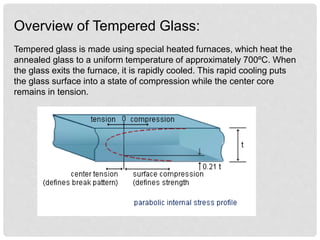
Tempered glass is made using special heated furnaces, which heat the
annealed glass to a uniform temperature of approximately 700ºC. When
the glass exits the furnace, it is rapidly cooled. This rapid cooling puts
the glass surface into a state of compression while the center core
remains in tension.
Steps Involved In
Manufacturing Of Tempered
Glass
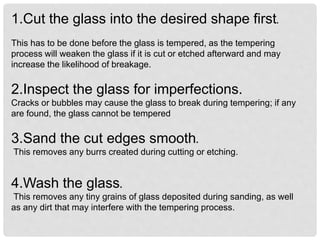
1.Cut the glass into the desired shape first
2.Inspect the glass for imperfection
3.Sand the cut edges smooth
4.Wash the glass
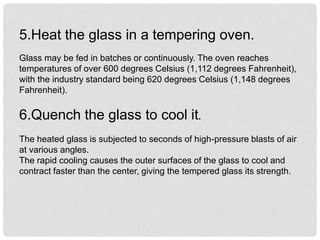
5.Heat the glass in tempering oven
6.Quench the glass to cool it
1.Cut the glass into the desired shape first.
This has to be done before the glass is tempered, as the tempering
process will weaken the glass if it is cut or etched afterward and may
increase the likelihood of breakage.
2.Inspect the glass for imperfections.
Cracks or bubbles may cause the glass to break during tempering; if any
are found, the glass cannot be tempered
3.Sand the cut edges smooth.
This removes any burrs created during cutting or etching.
4.Wash the glass.
This removes any tiny grains of glass deposited during sanding, as well
as any dirt that may interfere with the tempering process.
5.Heat the glass in a tempering oven.
Glass may be fed in batches or continuously. The oven reaches
temperatures of over 600 degrees Celsius (1,112 degrees Fahrenheit),
with the industry standard being 620 degrees Celsius (1,148 degrees
Fahrenheit).
6.Quench the glass to cool it.
The heated glass is subjected to seconds of high-pressure blasts of air
at various angles.
The rapid cooling causes the outer surfaces of the glass to cool and
contract faster than the center, giving the tempered glass its strength.
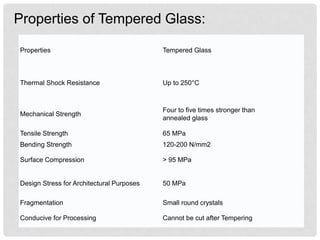
Properties Tempered Glass
Thermal Shock Resistance Up to 250°C
Mechanical Strength
Four to five times stronger than
annealed glass
Tensile Strength 65 MPa
Bending Strength 120-200 N/mm2
Surface Compression > 95 MPa
Design Stress for Architectural Purposes 50 MPa
Fragmentation Small round crystals
Conducive for Processing Cannot be cut after Tempering
Properties of Tempered Glass:
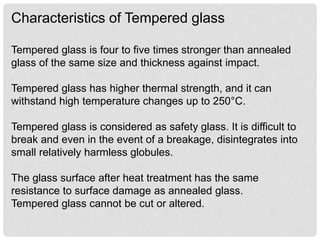
Characteristics of Tempered glass
Tempered glass is four to five times stronger than annealed
glass of the same size and thickness against impact.
Tempered glass has higher thermal strength, and it can
withstand high temperature changes up to 250°C.
Tempered glass is considered as safety glass. It is difficult to
break and even in the event of a breakage, disintegrates into
small relatively harmless globules.
The glass surface after heat treatment has the same
resistance to surface damage as annealed glass.
Tempered glass cannot be cut or altered.
Application of Tempered Glass:
Tempered glass is specifically designed for use in areas
where there is a high risk of contact and breakage.
Tempering does not make glass more porous nor is
tempered glass more prone to scratches than normal
glass.
There is a wide scope for the use of tempered glass in the
building industry. It can be used to raise the elemental
beauty of exteriors and interiors by using it on facades,
showroom shelves, dividers, shower cabins, doors and the
like.
High resistance to thermal stress and small missile impact
makes tempered glass an ideal choice for sloped glazing.
In the motor vehicle industry, tempered glass is commonly
used inside and rear windows.
TTHANK YOU !

Glass tempering

  • 1.
  • 2.
    What is tempering Temperedglass is a glass that has been heat- treated to make it stronger, more resistant to heat and break in a way to prevent injury. Tempered glass is used in front doors, shower stalls, fireplace doors and gates, and anywhere strong . Tempering puts the outer surfaces into compression and the inner surfaces into tension
  • 3.
    Overview of TemperedGlass: Tempered glass is made using special heated furnaces, which heat the annealed glass to a uniform temperature of approximately 700ºC. When the glass exits the furnace, it is rapidly cooled. This rapid cooling puts the glass surface into a state of compression while the center core remains in tension.
  • 4.
    Steps Involved In ManufacturingOf Tempered Glass 1.Cut the glass into the desired shape first 2.Inspect the glass for imperfection 3.Sand the cut edges smooth 4.Wash the glass 5.Heat the glass in tempering oven 6.Quench the glass to cool it
  • 5.
    1.Cut the glassinto the desired shape first. This has to be done before the glass is tempered, as the tempering process will weaken the glass if it is cut or etched afterward and may increase the likelihood of breakage. 2.Inspect the glass for imperfections. Cracks or bubbles may cause the glass to break during tempering; if any are found, the glass cannot be tempered 3.Sand the cut edges smooth. This removes any burrs created during cutting or etching. 4.Wash the glass. This removes any tiny grains of glass deposited during sanding, as well as any dirt that may interfere with the tempering process.
  • 6.
    5.Heat the glassin a tempering oven. Glass may be fed in batches or continuously. The oven reaches temperatures of over 600 degrees Celsius (1,112 degrees Fahrenheit), with the industry standard being 620 degrees Celsius (1,148 degrees Fahrenheit). 6.Quench the glass to cool it. The heated glass is subjected to seconds of high-pressure blasts of air at various angles. The rapid cooling causes the outer surfaces of the glass to cool and contract faster than the center, giving the tempered glass its strength.
  • 7.
    Properties Tempered Glass ThermalShock Resistance Up to 250°C Mechanical Strength Four to five times stronger than annealed glass Tensile Strength 65 MPa Bending Strength 120-200 N/mm2 Surface Compression > 95 MPa Design Stress for Architectural Purposes 50 MPa Fragmentation Small round crystals Conducive for Processing Cannot be cut after Tempering Properties of Tempered Glass:
  • 8.
    Characteristics of Temperedglass Tempered glass is four to five times stronger than annealed glass of the same size and thickness against impact. Tempered glass has higher thermal strength, and it can withstand high temperature changes up to 250°C. Tempered glass is considered as safety glass. It is difficult to break and even in the event of a breakage, disintegrates into small relatively harmless globules. The glass surface after heat treatment has the same resistance to surface damage as annealed glass. Tempered glass cannot be cut or altered.
  • 9.
    Application of TemperedGlass: Tempered glass is specifically designed for use in areas where there is a high risk of contact and breakage. Tempering does not make glass more porous nor is tempered glass more prone to scratches than normal glass. There is a wide scope for the use of tempered glass in the building industry. It can be used to raise the elemental beauty of exteriors and interiors by using it on facades, showroom shelves, dividers, shower cabins, doors and the like. High resistance to thermal stress and small missile impact makes tempered glass an ideal choice for sloped glazing. In the motor vehicle industry, tempered glass is commonly used inside and rear windows.
  • 10.